The Cost of the Seating Chart
Chapter 1: The Paper Crown and the Empty Plates
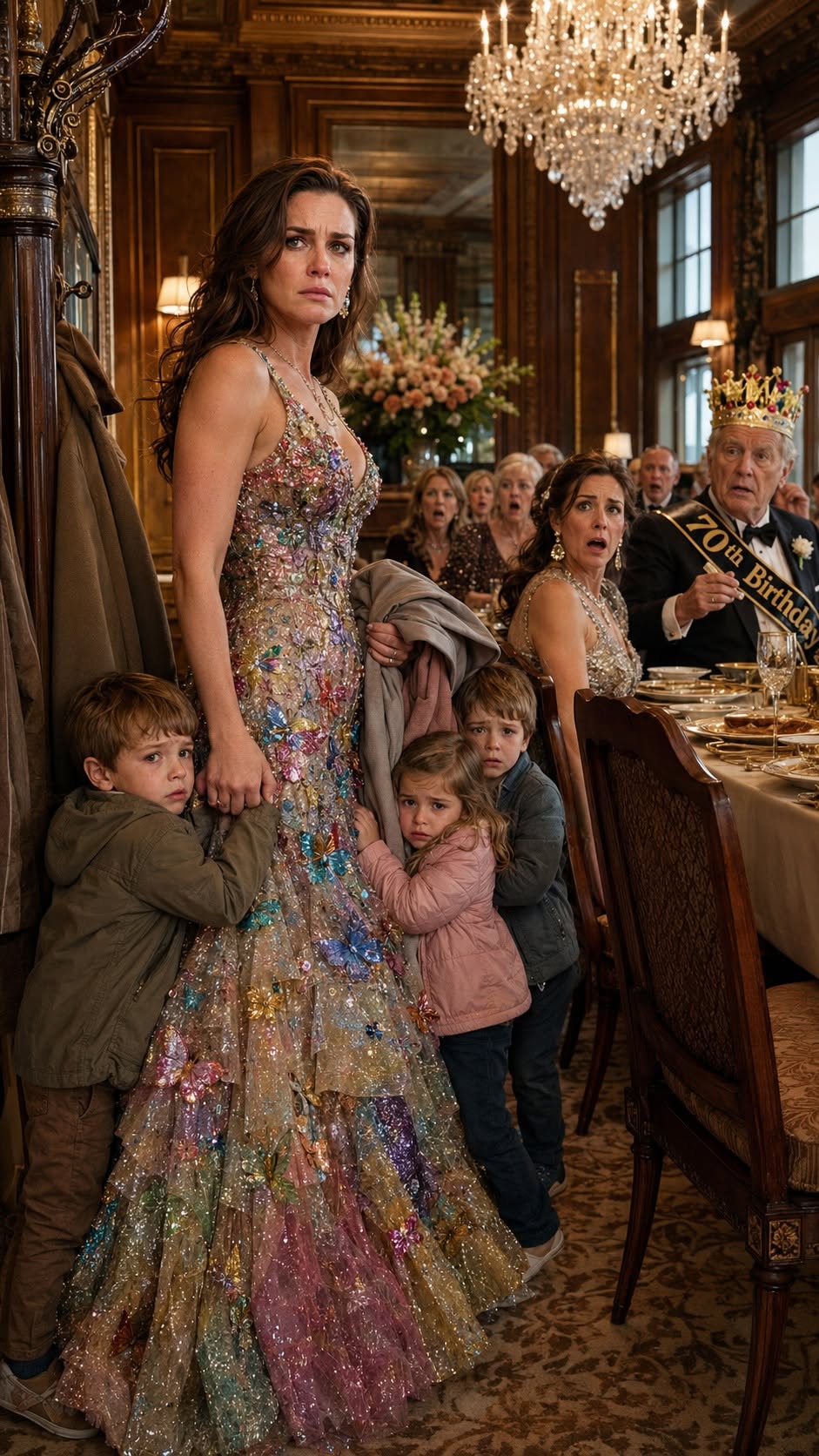
My three children stood huddled by the polished mahogany coat rack, their small plates still entirely empty. Through the warm, amber glow of the private dining room, we watched their cousins—only forty feet away—gleefully requesting second helpings of herb-crusted prime rib.
My sister, Marguerite, sat near the center of the room. She smoothed the pristine white tablecloth in front of her with deliberate, manicured fingers, executing the gesture as if she were straightening an invisible crown upon her head.
“They can eat when the guests are done,” she declared. Her voice carried the light, musical cadence of a woman entirely accustomed to being obeyed. Then, she offered me a smile. It was the exact, condescending upward tilt of the lips she had deployed against me since we were little girls sharing a bedroom—a smile that communicated infinite patience with my supposed inadequacies.
At the head of the sprawling banquet table sat our father, Desmond. Resting precariously on his thinning gray hair was a birthday crown my seven-year-old daughter, Della, had spent three days meticulously crafting out of construction paper and silver glitter glue.
I looked at him. I needed him to say something. Just a single sentence correcting his eldest daughter in front of this room full of his country club friends.
My father simply nodded. He didn’t look at me. He didn’t let his gaze drop to his grandchildren, who were shifting uncomfortably on their feet. Instead, he picked up his heavy silver fork and calmly went back to slicing his medium-rare steak.
It wasn’t a sudden, blinding rage that propelled me out of the shadows of that corner. It was a terrifying, crystal-clear lucidity. Thirty-one years of quiet exclusions, of subtle comparisons, of being the family afterthought, suddenly coalesced into a physical shape. And that shape was my father’s silent nod.
I turned on my heel and walked directly to that coat rack. I bypassed the maître d’ who had been eyeing my children like stray dogs who had wandered into his establishment. I pulled down three small coats. One featured a broken zipper I had been meaning to fix for a month. Another swallowed my eldest daughter, Faye, because it was a frayed hand-me-down two sizes too large. The last was a faded blue jacket with a hole in the pocket that my five-year-old son, Beckett, nervously kept pushing his thumb through.
I knelt on the plush carpet, wrestling Beckett’s arms into his sleeves. Then, I stood up and pitched my voice so that it cut cleanly through the clinking of crystal and the low murmur of wealthy conversation.
“We’ll eat at home,” I announced to the room at large. “Where nobody has to earn their dinner.”
The silence that followed was suffocating—the specific, heavy quiet of people who know a boundary has been irrevocably shattered but lack the courage to acknowledge it. Nobody tried to stop us. Nobody followed us out the heavy oak doors and into the biting chill of the January parking lot.
As I wrestled the stubborn clasp of Beckett’s car seat, my hands were trembling so violently I scraped my knuckles against the hard plastic. I didn’t know it yet, but the promise I whispered to myself in the freezing cab of my aging sedan would eventually cost my sister the empire she had spent a decade ruthlessly building. It would all begin with a mundane manila folder she had no idea I would ever touch.
But as I pulled out of the restaurant lot, the only thing I knew for certain was the terrifying arithmetic of my life. I had three hungry children, a tank running on fumes, and a checking account with exactly one hundred and eighty dollars to my name.
Chapter 2: The Architecture of Scarcity
To understand the explosive contents of that folder, you must first understand the invisible architecture of the life I was living. My name is Linnea Thorn, and I had spent three decades mastering the art of being the daughter nobody bothered to factor into their plans.
I was twenty-six when my marriage evaporated. Trent Doyle wasn’t a man who left with a theatrical slamming of doors or screaming matches on the front lawn. He left the way a slow leak drains a reservoir—quietly, incrementally, over the course of fourteen months. First, it was working late. Then, weekend conferences. Until one rainy Tuesday, I found his side of the closet gutted and a vaguely worded note on the kitchen island claiming he needed “space to discover his authentic self.”
He discovered his authentic self in a condo two states away, alongside a junior marketing executive from his old firm. Four days after he changed his phone number, I sat on the edge of the bathtub staring at two pink lines on a plastic stick. I was pregnant with Beckett. I already had a two-year-old and a four-year-old.
I didn’t immediately call my family for support. I already knew the choreography of that conversation.
You see, my sister Marguerite had married exceptionally well. Her husband, Preston, operated a highly lucrative chain of automotive dealerships across three affluent counties. From the exact moment Marguerite floated down the aisle in a custom silk gown that cost more than my entire college education, an imperceptible shift occurred in our parents’ eyes.
It wasn’t overt cruelty. It was a tragedy of micro-aggressions. Before she passed away, our mother, Eleanor, would routinely cancel Sunday dinners at my cramped apartment. “Well, Linnea, Marguerite’s family has a lot of moving parts right now,” she would sigh, using it as a shield to justify driving an extra hour to babysit Marguerite’s children instead of my own. My father would interrogate Marguerite’s sons about their elite soccer leagues and piano recitals with journalistic intensity. When he turned to my kids, he’d offer a distracted pat on the head and mutter, “You kids staying out of trouble?”
By the time my divorce decree was stamped by the county clerk, I was leasing a drafty, two-bedroom apartment situated directly above a neighborhood hardware store. Faye and Della shared a tiny bedroom that smelled perennially of old plaster, while Beckett’s crib was violently wedged between my dresser and the radiator in my room.
Childcare for three children on a single, fractured income wasn’t a logistical challenge; it was a mathematical impossibility. Consequently, I worked mornings answering phones at a bleak medical billing office, and three nights a week, I counted boxes in a freezing logistics warehouse while an elderly neighbor watched the kids.
Meanwhile, Marguerite was chronically documenting her second custom kitchen renovation in four years on social media, posting photos of “casual family game nights” in a living room that boasted more square footage than my entire apartment.
The disparity peaked one Christmas when Beckett was still crawling. Marguerite’s children systematically tore into a mountain of presents that obscured the base of their towering, professionally decorated spruce. There were virtual reality consoles, matching motorized scooters, and a custom-built dollhouse that required two men to carry.
When the frenzy died down, my father approached my daughters. With a benevolent, warm smile that somehow made the insult sting worse, he handed them a single, hastily wrapped set of generic coloring books to share.
“You girls don’t need all that plastic junk,” he chuckled, sipping his scotch. “You’re not spoiled like your cousins. You know the value of things.”
I swallowed the bile rising in my throat. I said absolutely nothing. I had convinced myself that maintaining a dignified silence was the superior moral high ground. I feared that raising my voice over a pack of crayons would only validate their unspoken consensus: that Linnea was bitter, volatile, and jealous. I smiled until my jaw ached, thanked him profusely, and drove my children back to our freezing apartment, wondering precisely when I had signed the contract agreeing to be the designated recipient of their scraps.
I never begged them for a dime. When the transmission on my sedan shattered into metal confetti, I rode two different city buses to the warehouse for five grueling months. When Beckett developed chronic ear infections and the medical co-pays threatened to drown me, I sold my plasma.
I was determined to prove I could survive. But survival is a hungry beast, and it was about to start feeding on my children.
A week after the disastrous birthday dinner at the steakhouse, my reality began to cave in. My landlord hiked the rent by forty dollars a month. It sounds trivial, but when you are already playing a desperate game of roulette between keeping the electricity on and buying winter boots for a growing ten-year-old, forty dollars is a death sentence.
I took on a fourth night shift at the warehouse. I began skipping lunch, then breakfast. It wasn’t a dramatic martyrdom; it was the quiet, invisible math of a mother ensuring her children had protein on their plates while she survived on black coffee and sheer willpower.
But kids are terrifyingly perceptive. One evening, I was sitting at the scarred kitchen table, rubbing my temples as I stared at a pile of past-due notices. Faye, my eldest, quietly pulled out a chair and sat beside me. She didn’t ask what was wrong. She just rested her small head against my arm, already carrying the heavy, unspoken comprehension of our poverty.
The true breaking point arrived on a Tuesday in late January. I was precisely two hundred and thirty dollars short on rent.
I had already pawned the only item of monetary value I possessed—my maternal grandmother’s sapphire ring. I drove to a pawn shop three towns over just to ensure nobody I knew would spot me walking under the neon signs. Sitting in my car afterward, clutching a thin stack of twenty-dollar bills, I wept until I couldn’t breathe. It wasn’t the loss of the heirloom that broke me; it was the terrifying realization of my proximity to the edge. I was one bad flu, one flat tire away from having a conversation with my babies about sleeping in a homeless shelter.
That same week, I received a voicemail from Della’s second-grade teacher requesting an emergency conference.
I sat in a miniature plastic chair in a classroom smelling of floor wax and chalk dust. The teacher, looking deeply uncomfortable, explained that she had noticed Della smuggling extra sandwich bags into the cafeteria. She was hoarding dry crackers and packets of peanut butter in her cubby. When the teacher gently asked why she wasn’t eating them, my sweet, innocent seven-year-old had whispered that she needed to build a stockpile at home, just in case Mommy’s dinner ran out again.
My dinner.
It felt as though a fault line had violently cracked open directly through my chest. My children were absorbing the trauma of scarcity. They were learning to expect the world to withhold from them.
I walked out of that elementary school, the winter wind biting at my wet cheeks. I didn’t call my father. It didn’t even cross my mind. That void of instinct told me everything I needed to know about the terminal state of our relationship. As I gripped the steering wheel, I made a vow to whatever forces were listening. I was going to claw my way out of this survival mode, even if I had to tear my own hands to the bone to do it.
Chapter 3: The Ledger of Salvation
The universe rarely sends angels with wings; sometimes, they come smelling of sawdust and industrial solvent.
The person who physically kept me from collapsing that brutal winter was my landlord, Presley Judd. Presley owned the hardware store beneath my apartment. She was a woman in her late sixties, boasting sharp, assessing eyes and hands calloused from decades of cutting keys and mixing paint. She had watched my children grow up navigating the creaky wooden stairs beside her front counter.
Presley possessed a quiet, observant grace. She noticed when my apartment lights were burning at 2:00 AM three nights in a row. She never pitied me aloud. Instead, anonymous miracles began appearing on my welcome mat: a garbage bag filled with pristine, name-brand winter clothes allegedly “outgrown by a distant niece,” or a massive, steaming casserole dish left with a sticky note claiming she had “accidentally cooked for a marching band.”
One evening in February, I was dragging a basket of cheap groceries up the stairs, my hip jutting out to support a exhausted Beckett. Presley intercepted me on the landing.
“You know, Linnea,” she murmured, leaning against the banister and crossing her arms. “You don’t have to carry on like you’re the only soul on this earth who’s ever been broken in half.”
I let out a dry, humorless laugh. “Most days, Presley, it feels exactly like I am.”
She offered a gentle, knowing smile. “Family isn’t just the people who share your bloodline and last name, honey. Family is the people who show up in the dark when there’s absolutely nothing in it for them.”
Presley became my confessional. Sitting on overturned paint buckets in the backroom of her shop after the kids were asleep, I poured out the realities of my financial terror. She listened, handed me a mug of spiked tea, and then she offered me a lifeline.
She knew a local commercial bookkeeper who was drowning in Q4 paperwork and desperately needed part-time data entry help. It was tedious work, but it paid significantly better than hauling boxes at the warehouse, and I could do it from my kitchen table.
I remember the profound exhaustion and quiet thrill of that first week. It was past midnight. The apartment was silent save for the hiss of the radiator. I was hunched over a second-hand laptop with a fractured screen hinge, squinting at complex Excel spreadsheets. For the first time in nearly a decade, I felt a forgotten sensation sparking in my brain: Competence.
I wasn’t begging for scraps. I wasn’t just surviving. I was utilizing a sharp, analytical part of my mind that had been buried under years of diapers and despair. I was good at this.
Within four months, my meticulous attention to detail paid off. The bookkeeper recommended me to two independent small businesses. By month eight, I had quietly, stubbornly built a modest but rapidly growing freelance bookkeeping practice entirely by word of mouth. I dropped the warehouse shifts. Two months later, I submitted my resignation at the medical billing office.
The Friday I realized my independent client income had officially eclipsed my previous dual wages, I didn’t buy a bottle of champagne. I loaded Faye, Della, and Beckett into the car and drove to a retro diner two towns away.
I slapped the menus down on the sticky vinyl table and looked at my children. “Order anything you want. Don’t look at the prices.”
Beckett’s eyes widened to the size of saucers. “Even a milkshake? The chocolate one with the cherry?”
“Even a milkshake, buddy,” I smiled, fighting back a tear. Watching the waitress set down four massive burgers and three towering milkshakes, I felt the tight, suffocating band around my chest finally begin to loosen.
Rebuilding wasn’t a cinematic montage. It was a gritty, terrifying grind. There were weeks when invoices were paid late and the old panic flared in my gut. I still felt a pang of intense guilt when I had to tell Della that gymnastics lessons would have to wait another year.
But incrementally, the earth beneath our feet solidified. I established a sacred emergency fund in a separate bank account. My children stopped waking up in the middle of the night to check if the hallway lights were still on. They were beginning to trust the stability of our lives.
And it was directly through this newfound stability, through this precise, numbers-driven work, that the foundational lie of my family was finally dragged into the light.
One of my newest clients was a high-end used furniture consignment boutique. Purely by geographical coincidence, this boutique was frequently contracted by Marguerite’s husband’s dealership group to stage their luxury model showroom waiting areas.
My responsibility was standard reconciliation: matching every vendor invoice against its supporting banking documentation. Late one Tuesday afternoon, while auditing a massive, disorganized reimbursement file sent over by the dealership’s chaotic accounting department, I noticed something anomalous.
Stapled beneath a legitimate invoice for leather sofas was a cluster of backup documentation that had absolutely nothing to do with furniture. They were old wire transfer confirmations, erroneously filed in the general ledger folder.
I was about to toss them into the shred pile when a specific name printed in the ‘Originating Account’ field stopped my heart dead in my chest.
Eleanor Thorn Trust.
Our mother’s name.
When Mom died six years prior, she had left behind a modest but significant educational trust. It wasn’t staggering wealth, but it was a substantial sum legally structured to be divided equally between Marguerite’s children and mine upon their eighteenth birthdays. Years ago, I had signed a mountain of legalese at my father’s request and promptly put it out of my mind, trusting—like an absolute fool—that family blood meant the money was sitting in a secure escrow account.
It was not sitting securely anywhere.
My fingers flew across the cracked keyboard. I pulled up the digitized banking archives. Over a period of three years, in highly specific increments carefully calculated to avoid triggering automatic IRS flags, massive sums had been quietly bled out of my mother’s trust.
I traced the routing numbers. The destination account didn’t belong to any educational fund. It belonged to the holding company overseeing the massive architectural expansion of Preston’s flagship auto dealership.
The very same dealership expansion that had financed Marguerite’s imported Italian marble kitchen island. The same money that paid for the private country club steakhouse room. The same money that bought the towering seafood platter my children were forced to watch their cousins devour while their own stomachs growled.
At first, a wave of profound denial washed over me. There must be a mistake. That’s the default setting of the scapegoat—to assume you have misinterpreted the data, to give your abusers the benefit of the doubt even as they are robbing you blind.
I spent the next fourteen hours locked in a fugue state of forensic accounting. I cross-referenced the consignment shop’s ledgers against public municipal permits for the dealership expansion. I matched the dates. The pattern was bulletproof. It wasn’t a one-time clerical error. It was a deliberate, malicious, and highly coordinated financial draining executed three times a year, for thirty-six months.
When the sun finally crept through the blinds of my kitchen, casting long shadows across my apartment, I sat perfectly still. I stared at the glowing monitor.
I thought about Beckett, tugging on my sleeve, asking when it was our turn to eat.
I thought about Della, hoarding stale crackers in her cubby because she was terrified of starving.
I thought about my father’s silent, complicit nod.
I didn’t cry. The time for weeping in pawn shop parking lots was over. A cold, absolute fury settled into my bones.
Over the next three days, I systematically printed every damning page. The wire confirmations. The forged authorization forms. The dealership’s capitalization records. I placed the thick stack of paper into a generic manila folder and shoved it into the bottom drawer of my desk, buried beneath old tax returns.
I told no one. I didn’t even breathe a word to Presley. I needed professional artillery.
Three weeks later, I walked into the mahogany-paneled office of Dorian Voss, a ruthless, high-end estate attorney Presley had once mentioned in passing. I sat down in a leather wingback chair, dropped the manila folder onto his pristine glass desk, and looked him dead in the eye.
“I need you to look at these documents,” I said, my voice shockingly steady. “And I need you to tell me if I am looking at a decade of quiet, systematic theft.”
Chapter 4: The Reckoning in the Boardroom
Dorian Voss did not mince words. Within forty-eight hours, he called me back into his office.
“Linnea,” he said, tapping a silver pen against the manila folder. “A first-year law student suffering from a hangover could follow this paper trail. The trust documents explicitly mandate equal, unalterable disbursement. Your signature is completely absent from any of the redirection authorizations. What we are looking at here is a textbook, egregious breach of fiduciary duty.”
He smiled, and it was the smile of a shark smelling blood in the water. “We are going to request a full, legally binding accounting through their attorney of record. We are going to drag this entire mess out into the blinding light of day.”
The legal machinery engaged with terrifying speed. Once the formal notices were served, the facade of my family’s polite, wealthy superiority violently fractured.
Initially, Marguerite attempted to play the victim. Through her frantic lawyers, she tried to frame the embezzlement as a “temporary, undocumented familial bridge loan”—funds she fully intended to repay once the dealership hit its quarterly targets.
But Dorian Voss was merciless. The paperwork screamed the truth. There were no loan agreements drafted. There were no interest terms negotiated. There was zero repayment schedule. It was simply a unilateral siphoning of cash that miraculously ceased the exact month the dealership’s grand opening was celebrated.
The most devastating blow came during the deposition phase. When pinned down by Dorian’s relentless questioning under oath, my father, Desmond, finally cracked. He admitted, his voice barely a whisper, that he had co-signed the transfer authorizations without “fully reading” the fine print. He claimed he implicitly trusted Marguerite’s business acumen.
He trusted her. Just as he had never required me to earn his trust, because he simply never deemed me important enough to warrant it. He had sacrificed my children’s future to maintain the illusion of Marguerite’s flawless success, keeping the peace at the direct expense of my family’s survival.
The climax of the legal war occurred five months later, during a mandatory mediation session in a sterile, glass-walled conference room in downtown.
It was the first time I had seen my sister since the steakhouse. Marguerite looked remarkably diminished. Stripped of her social armor, sitting across a vast mahogany table rather than holding court at the head of one, she looked tired. Her eyes were shadowed with the stress of impending financial ruin.
“Are you genuinely going to do this, Linnea?” she hissed across the table, her voice vibrating with a mixture of disbelief and venom. “Are you going to destroy this family over a perceived slight about a seating chart?”
I leaned forward, folding my hands carefully on the tabletop.
“This was never about a seating chart, Marguerite,” I replied, my voice dangerously calm. “This is about three years of you consciously deciding that my children’s educational future mattered less than the imported marble on your kitchen island. You assigned my children a lesser value. I just didn’t have the receipts to prove it until I went looking for them.”
She recoiled as if physically struck. Desperate, she tried to pivot, appealing to nostalgia. She brought up our shared childhood, the bedroom with the floral wallpaper, the secrets we whispered in the dark before our parents’ favoritism drove a wedge between us. She weaponized our history, demanding a free pass based on DNA.
“I remember that bedroom, too,” I said softly, halting her mid-sentence. “I remember it being the last physical space in our lives where we were actual equals. Before Mom and Dad decided there were two tiers of daughters in this family. I am not punishing you for the dynamics we inherited as kids, Marguerite. I am holding you accountable for the crimes you committed as an adult. With a pen in your hand, three times a year, while my kids sat at folding tables with empty plates.”
She had no response. The silence in the room was absolute.
The resolution was a bloodbath for her ego and her bank accounts. The judge ordered the trust to be restored in full, with heavy punitive interest. Because the stolen funds had been sunk into brick-and-mortar assets, the restitution had to be forcefully liquidated from Marguerite and Preston’s personal wealth.
A massive, humiliating legal lien was placed against the flagship dealership. My children’s rightful share—the inheritance quietly stolen while they were treated like second-class citizens—was recalculated, restored, and locked behind an impenetrable fortress of independent legal oversight. No one sharing my maiden name would ever be able to touch a single cent of it until my kids turned eighteen.
Marguerite lost significantly more than capital. She lost the intoxicating, arrogant assumption that she could pillage shared resources without consequence. She lost her throne. And that specific breed of aristocratic confidence, once shattered, can never be glued back together.
Chapter 5: A Table Big Enough
The week the final accounting was legally certified and the liens were filed, my phone buzzed on the kitchen counter. The caller ID flashed my father’s name.
I let it ring three times before I answered.
He didn’t offer a dramatic, weeping apology. Men of his generation, men built on stubborn pride and emotional cowardice, rarely possess the vocabulary for true repentance. But his voice was ragged, stripped of its usual booming authority.
He told me he hadn’t fully grasped the sheer scale of what Marguerite had been doing. He confessed that for decades, he had been desperately trying to keep the peace between his wildly different daughters, and in doing so, he had become willfully blind to whose peace was constantly being sacrificed to maintain the facade.
I listened to his monologue. When he finally wound down, I asked him the question that had been burning a hole in my psyche for months.
“Dad. Why did you just nod that night at the restaurant? When Marguerite called my kids ‘guests’ and refused to feed them. Why didn’t you say a single word to defend your own grandchildren?”
The silence on the line stretched so long I thought the connection had dropped. Finally, he exhaled a shaky breath.
“Linnea… I just didn’t want to orchestrate a spectacle. It was my seventieth birthday. I didn’t want a scene.”
I closed my eyes, leaning my forehead against the cool glass of my kitchen window. “That is exactly the tragedy, Dad. By avoiding a temporary scene, you cost my children their dignity. Worse than that, you communicated to them—without uttering a single syllable—exactly where they ranked in your heart. You showed them they were expendable.”
I took a deep breath. “I appreciate the call, Dad. I truly do. But hear me clearly: I will never, ever bring my children back into a dynamic where they are forced to sit separately and eat last. Not at a dinner table, and certainly not in a legal trust. If you want a relationship with Faye, Della, and Beckett moving forward, it happens on absolute, equal footing. Or it doesn’t happen at all. The era of separate tables is over.”
He has been trying. Slowly, clumsily, in ways that felt agonizingly small at first but have begun to accumulate weight.
Last spring, he drove an hour and a half to attend Beckett’s opening little league game. He sat alone on the sun-baked aluminum bleachers for three hours. Afterward, he didn’t offer a generic “Good job, team.” He walked directly up to the chain-link fence, looked Beckett in the eye, and told him his swing mechanics were sharp and his hustle was impressive. A compliment surgically aimed only at my son.
In June, he took Faye and Della to a local café on a Tuesday afternoon while I was wrapping up quarterly taxes. Faye came home looking mildly bewildered, reporting that Grandpa had actually asked her detailed questions about her middle school science fair project—and then put his phone face-down on the table to listen to her entire ten-minute explanation.
The most profound shift occurred on a rainy Sunday in October. He came over to my house, asked for a pot of coffee, and sat all three of my children down in the living room, one by one. Without me prompting him, he looked at them and explicitly apologized for the birthday dinner. He told them he was deeply ashamed that he hadn’t used his voice to protect them the moment it happened.
Beckett, who was now six and fiercely empathetic, shrugged and said, “It’s okay, Grandpa.”
I didn’t interject in front of the kids. But as I walked my father to his car later, I stopped him on the porch.
“It’s not okay, Dad,” I said quietly but firmly. “It is forgiven. But those are two very different concepts. I need you to comprehend the difference if you want to keep coming around here.”
He nodded. This time, it wasn’t a nod of dismissal. It was a nod of submission.
That year, for the first time in his life, Beckett received a birthday card in the mail on his actual birthday. Inside, written in my father’s shaky scrawl, were the words: I am so incredibly proud of the young man you are becoming.
It isn’t a fairy tale ending. It doesn’t magically erase the childhood I desperately wish my kids had experienced from the beginning. But it is authentic. It is hard-won. And it is infinitely more than we ever possessed before.
Marguerite and I do not speak. I don’t harbor malicious joy in our estrangement. She is still my sister, and there will always be a phantom ache in my chest mourning the relationship we might have cultivated if she hadn’t treated my flesh and blood like peasants begging at the gates of her castle. But I have officially stopped waiting for a version of her that doesn’t exist to miraculously appear.
I have constructed something far more resilient in her absence.
My bookkeeping firm now operates as an LLC. It fully supports my family, providing a comfortable, robust income. By last spring, my client roster was so saturated I had to start referring overflow work to other accountants.
With that stability, we finally packed up our lives and moved out of the cramped apartment above the hardware store. We bought a modest but beautiful house in a quiet suburban neighborhood. It has a sprawling green yard, three legitimate bedrooms, and a kitchen bathed in natural light.
Presley still visits nearly every weekend. She usually bursts through the front door carrying an absurd amount of baked ziti or blueberry muffins, claiming she “lost track of the recipe.” She has evolved into more of a grandmother to my children than anyone who actually shares our DNA.
I will never forget the day we moved in. Presley stood in the center of the echoing, empty dining room, a heavy toolbox slung over her shoulder. She looked around at the towering stacks of cardboard boxes, smiled her crooked smile, and said, “Well, Linnea. It looks like somebody finally built a table big enough.”
She was right.
Last month, we celebrated Faye’s eleventh birthday. We didn’t rent a private room at a country club. We gathered in our own brightly lit kitchen. All four of us sat around a massive, solid oak table I had bought with my own hard-earned money. We ate off real ceramic plates, and absolutely no one was forced to wait for someone else to finish before they could begin.
Beckett, who is older now, his mind sharp and observant, remembers fragmented flashes of that humiliating night at the steakhouse, even if he doesn’t fully grasp the venomous politics behind it. As I sliced the chocolate cake, he looked around at the four generously heaped plates in front of us.
He looked up at me, his eyes bright. “Everybody gets to eat at the exact same time here, right, Mom?”
I reached out and brushed a stray curl from his forehead. “Yes, baby. That is the only rule that has ever mattered to me. And as long as you live under my roof, it will always be the rule.”
I still think about that steakhouse dinner occasionally. The scent of roasted garlic, the suffocating silence, the humiliating weight of the broken zippers on the coats in my arms. I used to believe that the most agonizing part of that night was the public degradation—the acute embarrassment of standing in front of wealthy strangers while my children were explicitly told they held zero value.
I don’t believe that anymore.
I now realize the true tragedy was that for thirty-one years, I had been conditioned to believe that it was perfectly natural for love to be distributed via a seating chart. I had accepted the horrific premise that some children simply cost less to love out loud than others, and that my own flesh and blood had been assigned the cheap seats before they even drew their first breath.
It took losing the illusion of a family, and nearly losing my mind to poverty that brutal January, to finally understand that the seating chart itself was never the actual disease. It was merely the loudest, most undeniable symptom of an infection that had been festering for decades.
So, I will leave you with the exact same question I had to ask my trembling reflection in the rearview mirror of that freezing parking lot, with three hungry children in the backseat:
When the people who are biologically mandated to protect you continually prove exactly where you rank in their hierarchy… how many more dinners are you willing to quietly sit through before you finally push back your chair, stand up, and walk out the door?