- Giselle, my sister-in-law, spoke those cold words right beneath her late mother’s portrait. My husband, Kenneth, didn’t offer a single word of contradiction. Neither did Uncle Raymond, the relative who never missed an opportunity to preach about protecting the family’s reputation. I stared down at the open letter on the table, feeling my fourteen years with this family tear cleanly down the middle.
- My name is Melanie Crawford. I was a thirty-nine-year-old accountant living near Biloxi, Mississippi. Kenneth and I lived with our two children, Laura and Lucas, in the spacious home that legally belonged to my father-in-law, Gerald. For the past five years, Gerald had been locked away, convicted of embezzling nearly two million dollars meant for twenty-seven local corn farmers.
- From the moment the judge handed down his sentence, the town treated him like a pariah. My mother-in-law passed away before ever getting the chance to hold him again. Aaron, the youngest son, vanished without a trace the moment the trial ended.
- But I never forgot the man Gerald truly was. On my wedding day, when relatives sneered at the cheap, secondhand earrings my mother had given me, he was the only one to defend me. Years later, when I nearly died from a hemorrhage giving birth to Lucas, Gerald quietly sold off his precious livestock to cover my medical bills. He never treated me like the poor daughter-in-law; he treated me like his own blood.
- That was why it felt like a betrayal to discover a letter hidden in a drawer at Kenneth’s office—a letter in which Gerald announced he would be released on November 27th. The notice had arrived three weeks earlier, and my husband had deliberately concealed it.
- “Were you seriously planning to let a sixty-eight-year-old man travel over five hundred miles all by himself?” I asked Kenneth, forcing him to look at me.
- “Don’t make such a big deal out of this,” he muttered, averting his eyes. “Justin is getting married next month. If his bride’s wealthy family finds out about my dad, they could cancel the entire ceremony.”
- That evening, we gathered Giselle, Justin, and Uncle Raymond around the dining table. Not one of them offered to pick Gerald up. They rationalized that the bus was perfectly safe and argued that his early return would only ignite local gossip. It was Giselle who suggested cleaning out the damp storage cellar near the chicken coop, ensuring her father wouldn’t set foot in the main house until the wedding was over.
- “This entire house is registered in his name,” I reminded them, utterly disgusted. “Are you really planning to hide the rightful owner in the dirt yard?”
- Kenneth slammed his fist onto the table. “My father has already ruined our lives enough with his mistakes!”
- Even young Justin lowered his head, unwilling to speak up for his grandfather.
- The next morning, I took time off work, checked my car’s fluids, and packed fresh clothes, medicine, and new shoes. When I tried to leave, Kenneth stood firmly blocking the driveway gate.
- “If you drive through that gate right now, do not say I failed to warn you about the trouble you will cause,” he said coldly.
- “I am leaving because someone in this family needs to remember everything he did for us,” I replied, shifting the car into gear and driving away.
- I drove over five hundred miles to the correctional facility in central Alabama. At noon, I watched Gerald step through the heavy metal gates carrying nothing but a small cloth bag. His hair was entirely white, his shoes worn to the soles. He scanned the empty road, realized nobody from his own bloodline had come, and quietly turned toward the local bus terminal.
- I ran over and threw my arms around him. When he immediately asked about his children, I swallowed the bitter truth and lied, telling him they were tied up with work.
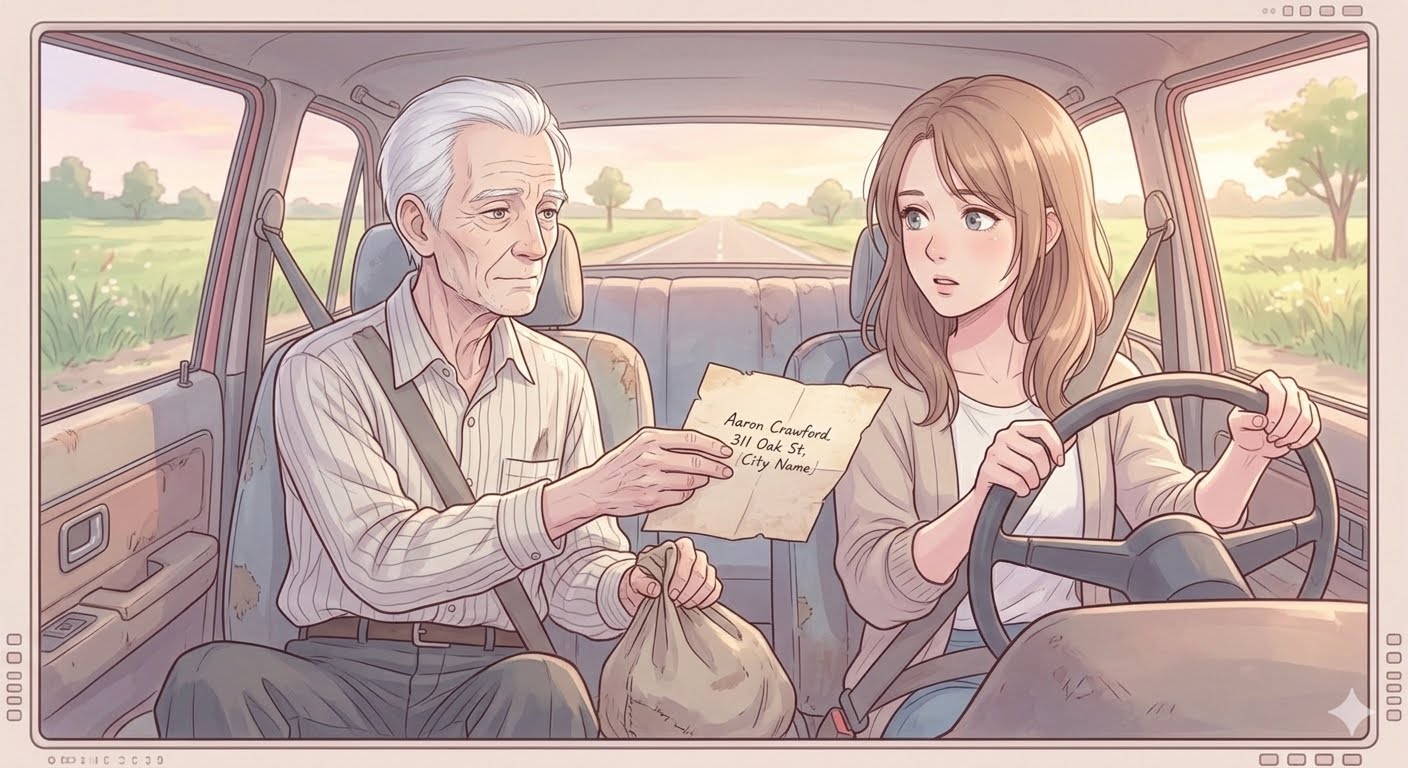
- Once we were on the highway, he reached into his pocket, pulled out a folded slip of paper, and spoke softly. “Do not drive us back home just yet. Take me to this address before three o’clock, and please, do not tell Kenneth anything about it.”
- I unfolded the paper. Written across it was the name of the man who had been missing for five years: Aaron.
- Part 2
- The address led us to a dilapidated boarding house behind the Montgomery bus station. Daniel, Gerald’s fiercely loyal lawyer, escorted us to room 307 and knocked using a coded rhythm.
- When the door creaked open, I barely recognized Aaron. The arrogant young man I once knew had deteriorated into a thin, heavily bearded shadow with trembling hands. The second he saw his father, he collapsed to his knees, sobbing into his hands.
- “Please forgive me, Dad,” Aaron wept.
- Gerald lifted his son by the shoulders. “First, tell me if Marisol and the baby are safe and healthy.”
- Inside the cramped room sat a laptop, a hard drive, and towering stacks of bank records. Aaron finally confessed the truth: back in 2019, persuaded by a corrupt businessman named Victor, Aaron had taken the two million dollars meant for the farm association to make a highly risky investment. He used forged stamps, copied signatures, and manipulated blank authorization forms that Kenneth had pre-signed at the office.
- Victor emptied the accounts and threatened to frame the entire family if anyone spoke up. By the time Gerald uncovered the massive fraud, Aaron’s wife was pregnant and suffering from a severe heart condition. Terrified that the shock would kill her and the baby, Gerald took the total blame. He sold his own land to pay off the most desperate families and falsely confessed to authorizing every transaction.
- “So you knew all along that Aaron was the guilty one?” I asked, stunned.
- My father-in-law remained silent, offering no defense for himself.
- Aaron pushed the hard drive across the table, explaining it held the emails, audio, and banking trails linking Victor to the theft. He planned to hand over the evidence and flee the state again, terrified because someone had recently photographed his young child outside of school.
- “You are not going to run away ever again,” Gerald commanded. “You are going to walk into the station and tell the absolute truth.”
- “You don’t understand how dangerous these people are to my family!” Aaron panicked.
- “I gave away five years of my life to shield you,” Gerald said, his voice breaking with profound sorrow. “And all I managed to teach you was that someone else will always step up to pay for your mistakes.”
- The sheer weight of the argument pushed my father-in-law to his physical limit. He clutched his chest and collapsed over the table. We rushed him to a local clinic, where doctors ruled out a heart attack but warned his blood pressure was critically high.
- While Gerald lay under observation, Aaron vanished from the waiting room. I assumed he had bolted, but Daniel soon received a call: Aaron had walked straight into the prosecutor’s office and surrendered with all the evidence.
- The next morning, Daniel explained that while the new files would trigger a formal case review, they wouldn’t magically erase Gerald’s false confession. But as I looked over the case files, my eyes caught something on nine specific receipts. Kenneth’s authentic signature was written clearly—before any dates or amounts had been filled in.
- “Kenneth knew those blank formats were being used around the office,” I realized aloud.
- Gerald lowered his gaze to the floor, unable to deny it. He hadn’t gone to prison to save one child; he had sacrificed himself to save both of his sons.
- I couldn’t hold it back anymore. I told Gerald everything—how Kenneth had hidden his letter, how Giselle wanted to lock him in the dirt cellar, how none of them wanted him home. The remaining color drained from his face.
- “Perhaps I am nothing more than an embarrassment to my own children,” he murmured.
- “You are looking for excuses for them again,” I told him fiercely. “Who is ever going to look for an excuse for you?”
- Gerald sat quietly for a long time. Then, he reached for his cloth bag and stood up, a new fire in his eyes.
- “Take me back home,” he said firmly. “This time, I am not protecting anyone from the absolute truth.”
- Part 3
- On the drive back to Mississippi, Daniel received an urgent call. It was Brenda, a corporate assistant from the firm, who agreed to meet us near a local market—provided Gerald stayed out of sight.
- I found her hiding near a fruit stall, anxiously scanning the street.
- “I knew those receipts were being altered behind closed doors,” Brenda confessed in a hushed whisper. “Several were falsified while Gerald was hospitalized with pneumonia. When I tried to report it, Victor sent me a photograph of my child as a warning.”
- She handed Daniel a hidden notebook and a flash drive with complete system backups. The files proved unequivocally that the fraudulent transfers occurred before Gerald ever signed anything. Kenneth had uploaded his signed blank forms after the money was already gone. My husband hadn’t masterminded the theft, but he had turned a blind eye to his brother’s crime to save his own skin, letting his father take the fall.
- We finally reached the family home at dusk. The house was fully lit. Laura and Lucas ran outside with pure joy, my daughter placing a new hat on her grandfather’s head while my son hugged him tight.
- Kenneth stood paralyzed in the front hallway, holding a bag of the medication he had failed to give me when I left.
- “You came back home, Dad,” Kenneth said hesitantly.
- Gerald looked directly at him, his face unreadable. “Yes. I returned to my own home.”
- Giselle burst into tears and tried to embrace him, but Gerald walked right past her. He lit a small candle near his late wife’s portrait, then opened the door to his old master bedroom. It was packed to the ceiling with storage boxes, sewing machines, and wedding decorations.
- “The room was getting damp,” Giselle stammered quickly. “We thought about putting you up in the cellar for a few days while we fixed the roof.”
- Gerald dropped his bag onto the table with a heavy thud. “Clear every single box out of my bedroom immediately. I will be sleeping in my own bed tonight.”
- Kenneth stepped forward. “Dad, you are exhausted. It’s really not a good idea to start an argument right now.”
- “I am not arguing with anyone,” Gerald stated, his voice like iron. “I am simply deciding where I sleep inside my own house.”
- Uncle Raymond cleared his throat, stepping in to manage the PR. “Gerald, everyone here just wants to help you. You must understand that Justin is getting married soon, and his bride comes from a very respected family—”
- “Respected by whom?” Gerald cut him off. “By people who require a total lie just to accept a young man into their family?”
- Suddenly, Justin stood up. He was pale, but his chin was raised. “Grandpa is completely right. I lied to my fiancée by saying he was away working. But I am going to tell her the entire truth tomorrow morning, even if she decides to walk away.”
- “You are going to ruin your whole wedding over a situation that ended years ago!” Giselle shrieked.
- “It never ended,” Justin replied firmly. “We just tried to hide it from the world.”
- Gerald instructed everyone to sit as Daniel laid the official legal documents on the table. He revealed that Aaron was in police custody and a full sentence review was underway. Then, Gerald turned his piercing gaze to his eldest son.
- “Now it is your turn to speak up,” Gerald told Kenneth.
- Kenneth shook his head defensively. “I never stole a single penny of that money.”
- “Nobody claimed you stole it,” I interjected. “You signed blank forms, knew they were being misused, and kept silent while your father took the blame.”
- Kenneth slammed his hand down. “We had two tiny children and massive debts! Who was going to support you if I went to jail?”
- “I would have,” I answered without hesitation. “I was working back then and I am working now. You never even gave me the choice to face the truth together.”
- Kenneth stared at me, genuinely shocked, as if the concept of shared burden had never crossed his mind.
- Gerald leaned heavily on his walking cane, looking at the children he had sacrificed everything for. “I did not ask you either, Melanie,” he acknowledged with deep regret. “I made decisions for everyone because I thought protecting my sons meant taking their guilt. But I only taught them how to hide behind me.”
- Giselle sobbed loudly, “I had absolutely nothing to do with those financial papers!”
- “No, you did not,” her father agreed. “However, you wanted to lock me in a storage cellar, and you have been collecting rental income from my properties for three years without ever showing me a single accounting statement.”
- Giselle’s face hardened. “Mom left me in charge of the house! I took care of her while you were sitting in a cell!”
- “Taking care of your mother did not make you the owner of my real estate.”
- Defeated, Giselle tossed a set of keys onto the table, admitting she had siphoned the rental funds for her workshop and Justin’s wedding, promising she meant to pay it back.
- Gerald closed his eyes, an overwhelming fatigue washing over him, before looking up with absolute resolve. “A formal notary will arrive tomorrow morning. Nobody will manage my properties without signed contracts and proper accounting. As long as I am healthy, I will make my own decisions.”
- “Actions like this will completely divide this family,” Uncle Raymond warned.
- “This family was already divided,” Gerald replied coldly. “The only difference now is that we will stop calling cowardice a form of prudence.”
- Without being asked, Laura and Lucas began dragging the heavy storage boxes out of the bedroom. Beneath the clutter, they uncovered Gerald’s old winter coat, a faded bus ticket still resting in the pocket. He held the fabric gently, asking where his late wife’s personal belongings were stored. Giselle pointed silently to a trunk in the back.
- “While I was sitting in prison, you were stripping my life away piece by piece,” Gerald said to the room. “First you took my bedroom, then my reputation, and finally my dignity.”
- Kenneth took a step forward to apologize, but Gerald raised a single hand to stop him. “I do not want any explanations tonight. I just need to sleep in my own room without feeling like I am in everyone’s way.”
- The four of us cleared the room, laid down a fresh mattress, and opened the window to the cool night air. Before lying down, Gerald made one final request: to leave the bedroom door completely open.
- “Five years was more than enough time to spend sleeping behind locked doors,” he whispered.
- Nobody had a word to say to that.
- Kenneth spent the entire night sitting awake in the hallway. At dawn, he walked into the kitchen and handed me a heavy ledger.
- “These are all the business records since Dad was taken away,” Kenneth said quietly. “It includes my personal payments and the blank receipts I signed.”
- “Handing me a book doesn’t fix what you did.”
- “I know,” he replied softly. “But hiding things any longer will only make everything worse.”
- I made it clear that if he attempted to stop me from giving a full statement to the investigators, I would pack up the children and leave him. He didn’t fight me. That afternoon, Kenneth met with the authorities to formally confess his negligence and silence, triggering an independent investigation into his actions.
- Giselle surrendered control of the financial accounts and sold her workshop equipment to repay the stolen rental funds. Justin’s wedding was temporarily postponed, but his fiancée chose to stay by his side, telling him that the true shame lay in pretending his grandfather didn’t exist, not in having a family member in prison.
- The legal review took over a year to reach a conclusion. Forensic analysis confirmed the digital alterations, clearing Gerald of all financial embezzlement charges. While no court could give him back his five lost years, his criminal record was completely expunged.
- Victor was apprehended trying to flee the country, and Aaron faced his trial courageously, never once asking his father to intervene. He sold a hidden property to fund a restitution program, ensuring the twenty-seven affected farm families were finally made whole.
- Gerald personally visited several of those farmers to deliver formal apologies for concealing the truth. Kenneth accompanied him to every meeting, swallowing his pride, accepting full responsibility, and enduring the heavy loss of his own clients and assets. I didn’t offer my husband immediate forgiveness; I made it explicitly clear that our marriage surviving depended entirely on his future choices and a strict commitment to counseling.
- Giselle secured a grueling factory job to rebuild her life. She came home one afternoon, her feet swollen, and collapsed on the porch. Gerald quietly walked out, carrying a bucket of warm salt water, and set it down for her feet.
- “Do you still love me after everything I did, Dad?” she asked, tears spilling over.
- Gerald continued trimming a nearby bush before he finally answered. “I am deeply angry with your actions,” he said gently. “But that doesn’t mean I ever stopped loving you. I simply will no longer carry the weight of your mistakes for you.”
- A year later, Justin and his fiancée were married in a beautiful, simple ceremony. Just before the bride walked down the aisle, Justin took his grandfather by the arm and guided him to a reserved seat in the very front row.
- “I tried to hide you away in the past, Grandpa,” Justin said proudly, his voice carrying over the quiet crowd. “Today, I want every single person here to see you stand with us.”
- Gerald smiled softly. “Let them focus on the bride and groom. I have had more than enough attention for one lifetime.”
- Fundamental changes took root back at the house. Gerald secured his property deeds in a safe and established uncompromising boundaries. He chose not to transfer the house title to my name, despite relatives suggesting I was the only one who had earned it.
- “True affection cannot be bought with real estate parcels,” Gerald explained to me one evening. “If I gave you this house as a reward, I would be turning your genuine kindness into a simple business transaction.”
- He was entirely right. I didn’t drive five hundred miles to secure an inheritance. I drove because a human being does not lose their inherent dignity simply because they spent time in a cell.
- Months later, Laura asked her grandfather if it still hurt when neighbors occasionally referred to him as a former convict. Gerald carefully peeled an orange for her before answering.
- “What causes me the most pain is realizing that I loved my children in the wrong way for so long,” he reflected quietly.
- “Is it actually possible to love someone the wrong way?” Laura asked.
- “Yes, it is,” Gerald answered softly. “When you step in to absorb the legitimate consequences of someone else’s actions, you are not saving them at all. You are stealing their chance to grow into a responsible person.”
- Lucas looked up from his homework, brow furrowed, and raised his hand. “Does that mean if I fail to complete my school assignments, Mom shouldn’t do them for me?”
- Laughter filled the bright kitchen. I looked over at Gerald, surrounded by his grandchildren inside the very house where his own children had once tried to hide him away. The journey hadn’t just brought home a man who served his time; it had restored his right to self-determination, teaching our family that true love requires accountability rather than hidden truths.
“If your father comes back before the wedding, he should sleep in the cellar. Nobody needs to know he was in prison.”