- It didn’t buzz softly. It rang—a sharp, piercing noise that vibrated across the quiet kitchen and rattled the pie knife beside the sink.
- The house smelled of pumpkin pie, cinnamon, black coffee, and the butter that had spilled onto the oven floor around four. Outside, sleet tapped against the windowpanes, and the small American flag my late husband had hung years ago snapped violently in the November wind.
- I remember those small, mundane details because terror has a way of preserving the background.
- I had been awake since before sunrise, baking pies no one might ever eat and trying to pretend a quiet holiday was the same thing as a peaceful one.
- My twenty-eight-year-old daughter, Chloe, was expected around noon. She had promised to bring sweet potatoes because she insisted I always made them too soft. That was Chloe—a brilliant structural engineer who could tease me about my cooking while carrying three heavy grocery bags in one hand and a toolbox in the other.
- People often mistook her composure for fragility, but she felt things deeply. When her father passed, she was only nineteen, yet she organized the entire memorial service herself so I wouldn’t have to answer another call. Years later, when her first apartment flooded, she systematically labeled every damaged item by room and insurance category before allowing herself a single tear.
- Chloe never made a scene. She never invented drama. She never asked for help unless everything was already reduced to ashes.
- So when my son-in-law’s name flashed across my phone screen at 5:02 AM, my blood ran cold.
- Marcus never called early. And he certainly never called out of kindness.
- Marcus was thirty-two, sharply tailored, newly promoted, and consumed by the arrogant belief that a large salary was a substitute for character. His mother, Sylvia, had spent his entire life teaching him that respect was something owed to him by people with less money. Sylvia wore pearls at breakfast and wore cruelty like a designer scarf.
- For three years, I had watched them systematically pick Chloe apart. They mocked her clothes, criticized her cooking, and constantly reminded her that Marcus’s rising corporate career demanded “the right kind of wife.” If Chloe laughed, Sylvia corrected her tone. If she grew quiet, Marcus called her cold. If she worked late, they accused her of selfishness; if she took time off, they questioned her drive.
- They did all of this while barely acknowledging my existence. To them, I was just Eleanor. Widowed. Retired. Quiet. An old woman who drove a ten-year-old SUV, clipped grocery coupons, and had flour on her apron every holiday. They looked at my modest home and simple life and assumed they knew everything about me.
- They never bothered to ask what career I had retired from.
- I answered the call.
- No greeting. No apology. Just Marcus’s flat, condescending voice.
- “Come pick up your garbage.”
- The kitchen seemed to recede. I pressed one hand against the counter, grounding myself until my voice was steady. “Marcus. Where is Chloe?”
- “Downtown bus terminal,” he said. He sounded entirely bored—a casual, offhand tone that chilled me to the bone. “Your daughter decided last night was the perfect time to have a hysterical breakdown. I’m hosting my CEO for Thanksgiving dinner today, and I don’t have time for trash in my house.”
- In the background, a woman’s sharp laugh echoed over the line. Sylvia.
- “Tell her to take that pathetic girl back where she came from!” Sylvia called out loudly. “And tell her I expect payment for my five-thousand-dollar Persian rug! That brat ruined it!”
- “Go get her, Eleanor,” Marcus added coldly. “The caterers arrive in four hours. Do not bring her back here.”
- The line went dead.
- For one terrible second, I wanted to call him back and scream until my lungs burned. I wanted to tell him who he was actually dealing with. But anger is just a match; evidence is a furnace. I had spent my life learning the difference.
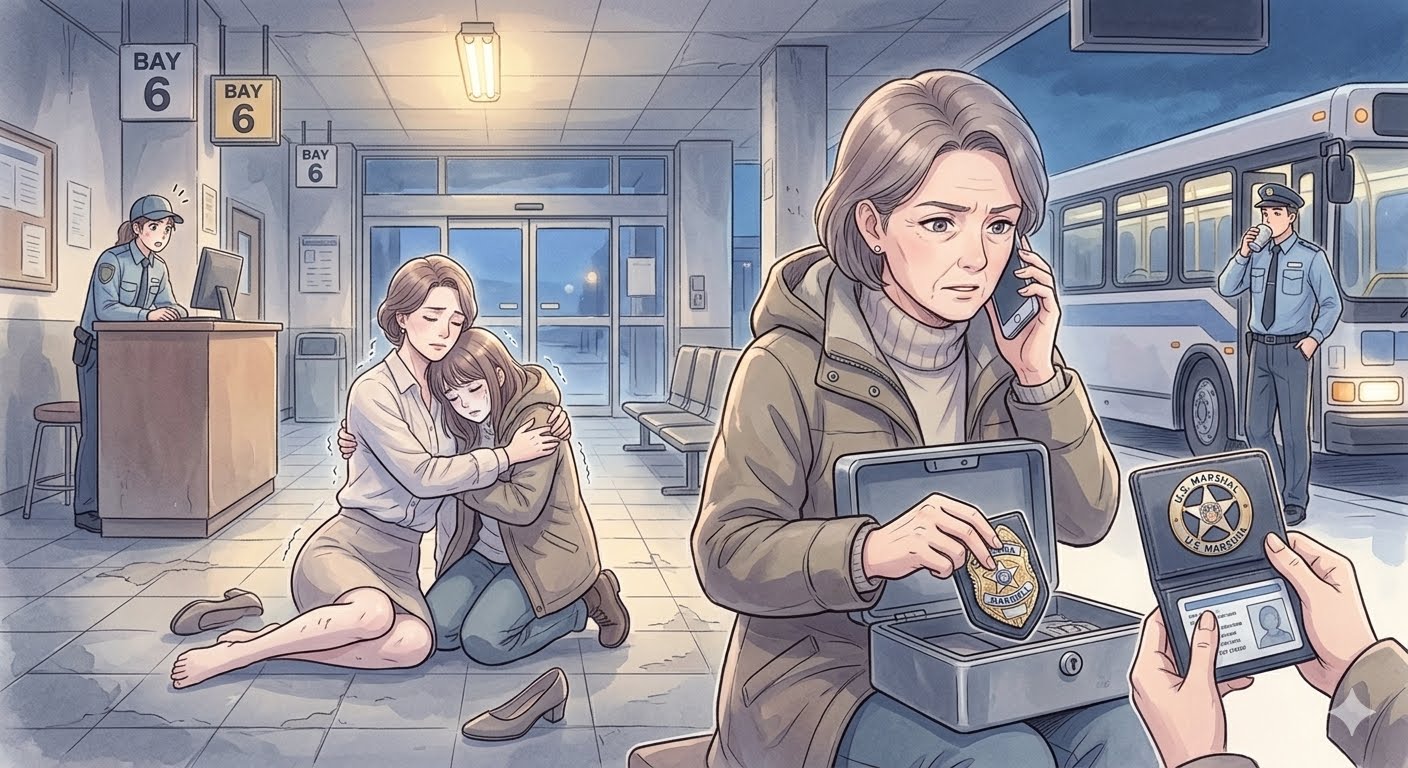
- I grabbed my coat and keys. Then, I walked to the hallway closet and pulled down a small steel lockbox from the top shelf. The metal was icy in my hands. Inside lay a federal badge, an old credential holder, and an entire former life Marcus knew nothing about.
- Before I was the soft-spoken widow baking pies, I was a federal prosecutor. I had spent decades staring down dangerous men who thought power made them untouchable. I knew how abusers sounded when they assumed no one was listening, and I knew that the first hour was everything—the first call, the first timestamp, the first witness before they could be coerced.
- At 5:19 AM, I pulled out of my driveway. By 5:43, I arrived at the nearly deserted downtown bus terminal. The flickering fluorescent lights buzzed over cracked tile, and the heavy air smelled of old cigarettes, stale coffee, and cold metal.
- I headed straight for Bay 6.
- The automatic doors slid open, releasing a draft of warm air that immediately died against the freezing morning. Outside, curled on a metal bench beneath a flickering streetlamp, was Chloe.
- She had no coat.
- My mind struggled to process what I was seeing. One missing shoe. Blue fingers. Hair matted with dark blood at her temple. A split lip. A swollen eye. A torn sweater. She had curled herself into a tight ball, as if trying to become small enough to disappear entirely.
- “Mom,” she rasped.
- I fell to my knees beside her, the concrete biting into my legs. “Baby. Look at me. Stay with me.”
- Her swollen eye shifted toward me, unfocused. Her hand reached out weakly, clutching my coat and leaving a streak of red on the wool.
- “They beat me,” she whispered.
- “Who?” I asked, keeping my voice utterly level while a cold fury settled in my chest.
- “Marcus,” she breathed. “And Sylvia.”
- “With what?”
- “A golf club.”
- I unclasped my scarf and gently pressed it against the cut on her head. She flinched away instinctively—and that flinch nearly broke me. My daughter, who used to run barefoot through the grass to bring me flowers, now expected pain whenever a hand came near her.
- I didn’t break down. A mother could fall apart later; a prosecutor had to secure the scene.
- “Listen to me, Chloe. Did Marcus drive you here?”
- “Yes,” she whispered, coughing weakly. Red stained her teeth. “Sylvia wiped the floor before we left. She said no one would believe me… He has someone else, Mom. Sylvia said I had to be gone so she could sit at the table. His mistress. She said I was embarrassing him.”
- They had beaten my daughter and dumped her on the street so another woman could take her seat at a holiday dinner.
- “Chloe, stay with me,” I urged softly.
- Her grip on my sleeve loosened, her eyes rolled back, and her body went completely limp in my arms.
- I swallowed the scream rising in my throat. I had sat beside victims in court while defense attorneys tried to paint them as bitter or unstable. I had seen guilty men adjust their ties and smile for cameras. But I had never held my own dying child as physical evidence.
- At 5:47 AM, I dialed 911. My voice was chillingly calm.
- “I need Advanced Life Support at the downtown bus terminal, Bay 6,” I said. “Adult female, severe blunt-force trauma, possible internal bleeding, unconscious, exposed to sub-zero temperatures.”
- “Ma’am, are you in a safe location?” the dispatcher asked.
- “Not relevant yet,” I replied. “Dispatch police immediately. I am reporting an attempted murder.”
- There was a sudden pause on the line as the dispatcher realized who she was speaking to.
- Nearby, the terminal security guard finally stepped out from behind his glass partition, horror dawning on his face. “Ma’am! Do you need—”
- “Cameras,” I interrupted firmly. “Bay 6. East entrance. Parking curb. Pull the footage now and preserve it. Do not overwrite a single frame.”
- He blinked, startled. “What?”
- I held up my credentials. The badge caught the fluorescent light, and the guard’s posture instantly changed. A badge isn’t just about authority; it’s a warning that legal consequences are incoming.
- I gave the dispatcher my name, my former title, and my federal identification number.
- “Mrs. Eleanor,” the dispatcher said, her tone instantly growing formal and urgent. “Units are en route. Do you believe the suspects are still at the residence?”
- Before I could answer, my phone buzzed with an incoming text from Marcus. It was a photo of his lavishly set Thanksgiving table. Twelve place settings. Crystal stemware. Burning candles. Sylvia sat at the head of the table, smiling with a glass of wine. And in the bottom corner of the frame, barely hidden under the sideboard, was Chloe’s missing shoe.
- I showed the screen to the security guard. He covered his mouth in shock. “I’ll get the footage right now,” he said, turning and running back toward his office.
- Within minutes, paramedics arrived, cutting away Chloe’s clothing to start IV lines and wrapping her in thermal blankets. As they lifted her onto the gurney, she looked five years old again—feverish, pale, and trusting me to make the pain stop.
- “I’m right here, baby,” I whispered, climbing into the ambulance beside her.
- At the hospital, the medical team moved with alarming speed. I provided a precise, chronological statement to the intake nurse: blunt-force assault with a weapon, suspected internal injuries, exposure, two named suspects, time of abandonment, and police notification timestamps.
- A detective arrived shortly after. He was young, but he was sharp and focused. I handed him Marcus’s text, the photograph, the precise timeline, and informed him that an officer needed to secure the terminal’s security footage before anyone attempted to tamper with it.
- “Patrol went by the house,” the detective told me quietly. “There are cars all down the driveway. They’re hosting a party.”
- Of course they were. Men like Marcus don’t cancel dinner when they hurt someone; they just rearrange the room around the damage.
- At 7:26 AM, the detective received the first still frames from the bus terminal’s security cameras. The images were clear: Marcus’s car pulling up to the curb, Marcus opening the passenger door, Sylvia standing beside him in a pristine wool coat, Chloe collapsing onto the bench, and Sylvia bending down before leaving.
- “She took something off your daughter’s hand,” the detective noted, zooming in on the image.
- “Her wedding ring,” I said coldly. “She wanted to erase her completely.”
- Moments later, my phone rang again. Marcus. I put it on speaker so the detective could listen.
- “Eleanor,” Marcus snapped. “Where are you? Don’t make a scene today. Chloe embarrassed herself last night. She was drunk and fell down. She needs help, but not the dramatic stunt you’re trying to pull.”
- I said nothing. Silence always makes arrogant men talk too much.
- “I have very important people in my home today,” Marcus continued, his voice rising. “If you show up here with some sob story, I’ll make sure Chloe loses everything. She’s unstable! I have witnesses!”
- In the background, Sylvia chimed in: “Tell that old woman she should be grateful we didn’t call the police on her pathetic daughter!”
- The detective raised a finger, signaling me to keep him talking.
- “What happened to the rug, Marcus?” I asked softly.
- He scoffed. “She bled on it!” He paused, realizing his slip a second too late. “After she fell, I mean.”
- The detective scribbled two words in his notepad: Spontaneous admission.
- I didn’t say another word. I simply ended the call.
- By 8:41 AM, tactical units surrounded Marcus’s home. The body-camera footage from that morning was later entered into evidence.
- The dining room had been filled with guests. The turkey was carved, candles were lit, and a new woman sat in the seat that belonged to my daughter. Chloe’s chair hadn’t just been left empty; it had been removed entirely so no one would ask questions.
- Sylvia was passing a serving dish when the police knocked. When officers forced entry, Marcus stood up so fast his chair slammed into the wall. He tried charm first, then corporate threats, then legal posturing. Sylvia screamed about her lawyers while officers photographed the bloodstained rug, the golf club hidden in the mudroom, and the spots of blood near the baseboards.
- Then, an officer held up the camera still showing Sylvia pulling the ring from Chloe’s finger. Sylvia’s face didn’t just fall—it completely emptied. The wedding ring was found tucked inside her designer handbag.
- At 9:18 AM, the doctor updated me: Chloe had suffered three broken ribs, a severe concussion, and internal bleeding, but she was going to survive.
- When she woke up late that afternoon, her first whispered words broke my heart: “Mom… did I ruin Thanksgiving?”
- That is the tragedy of abuse: it teaches the victim to apologize for their own bleeding.
- I squeezed her hand tightly. “No, sweetheart. They turned their dining room into a crime scene. There’s a big difference.”
- The legal fallout was swift and absolute. Faced with authenticated camera footage, recorded phone calls, blood evidence, and my detailed legal documentation, Marcus accepted a plea deal to avoid a trial that would have sent him away for decades. He was sentenced to significant prison time for aggravated assault and felony abandonment.
- Sylvia was convicted as an accessory, her stolen wedding ring proving her direct involvement in the cover-up. The mistress, who claimed ignorance, was shunned by the very social circle she had tried so hard to enter.
- Chloe’s recovery was long and difficult. For months, sudden noises made her flinch, and the healing of her ribs was painfully slow. But her engineering mind returned long before her body fully healed. Together, we built a life grounded in absolute safety.
- The following Thanksgiving, Chloe brought sweet potatoes to my house. She deliberately cooked them a little too firm, smirking as she challenged me to complain.
- As we sat at my table, listening to the rain tap against the window, I looked across at my daughter. Her hands were steady, her laughter was real, and her seat was right where it belonged.
The clock on my nightstand read 5:02 AM when the phone rang on Thanksgiving morning.