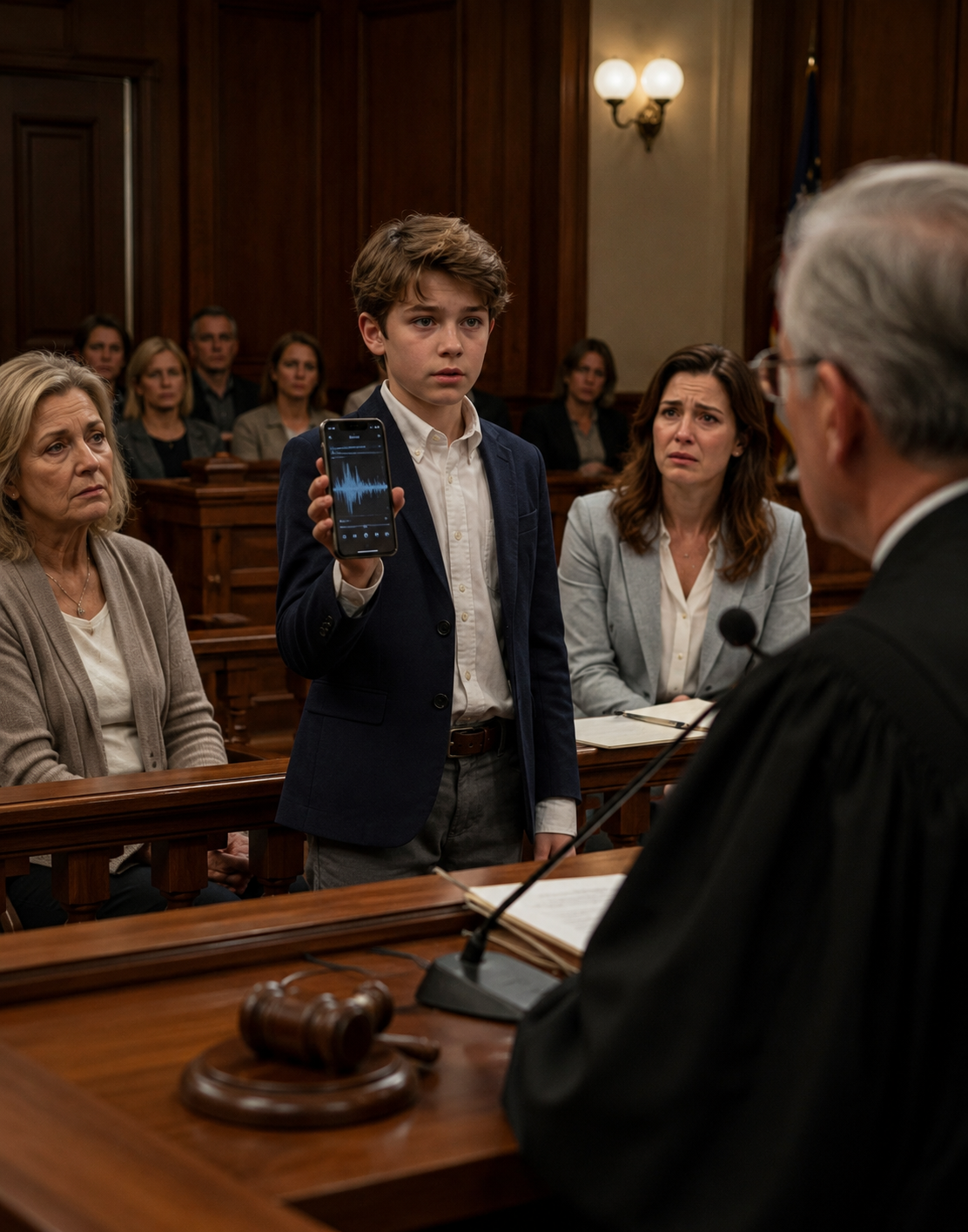
PART 3 “You’re still thinking about going to your grandmother’s?” Melissa’s voice. Cold. Not the soft, grieving mother she had presented in court. The real one. Ethan’s voice came next. Quiet. “Grandma said I could stay with her if I wanted.” A pause. Then Melissa laughed. Not a happy laugh. A frustrated one. “Your grandmother doesn’t understand what you’re doing.” “What am I doing?” “Making things harder.” The courtroom stayed silent. Ethan stood completely still. His eyes remained fixed on the floor. Like he had heard these words so many times that they no longer surprised him. But they hurt me. Because I hadn’t. I hadn’t heard them. I hadn’t known. The recording continued. “You have a mother,” Melissa said. “And your place is with me.” Ethan’s voice shook. “But Mom… you said last week that you don’t have time to take me to soccer anymore.” “Because I’m busy.” “You’re always busy.” The words were small. But they carried eight months of loneliness. Then Melissa said something that made my entire body go cold. “Your father is gone, Ethan. Things are different now.” “I know.” “Then stop acting like everything should stay the same.” A pause.
Then Ethan asked: “Did you ever want me?” The courtroom changed. Not physically. Nobody moved. Nobody spoke. But something shifted. Because every adult in that room suddenly realized this wasn’t about custody. It was about a child who had been asking a question nobody should ever have to ask. “Did you ever want me?” The recording continued. Melissa didn’t answer immediately. And that silence was louder than anything. Finally, she said: “Don’t be dramatic.” Ethan’s breathing became heavier. “I’m not.” “You don’t understand what I’m dealing with.” “I lost Dad too.” “And I lost my husband.” The words came sharper. “Do you think this is easy for me?” “No.” “Then stop making me feel guilty.” “I just want to live somewhere I feel like someone wants me.” Another silence. Then Melissa said: “Your grandmother is filling your head with ideas.” My heart broke. Because I had never once told Ethan to leave his mother. Never. Not even when I saw him come over with dirty clothes. Not even when I noticed how quiet he became. Not even when he started apologizing for needing things. I always told him: “Your mother loves you.” Even when I wasn’t sure she knew how to show it.
The recording ended with Melissa saying: “You’re staying with me. This isn’t a discussion.” Then the sound stopped. Nobody moved. The judge looked down at the phone. Then at Ethan. Then at Melissa. The expression on his face had changed. Not anger. Something worse. Disappointment. “Mrs. Carter,” Judge Carlton said. Melissa swallowed. “Yes, Your Honor?” “Is this recording authentic?” Her attorney immediately stood. “Your Honor, we object to the admission of a private recording—” The judge raised his hand. “I asked the mother.” Melissa looked trapped. For the first time since we entered the courtroom, she wasn’t controlling the room. “I…” She looked at Ethan. Then away. “Yes.” A whisper. “Yes, it is.” The room erupted with quiet murmurs. Her attorney turned toward her. “You didn’t tell me there was a recording.” Melissa ignored him. Her eyes stayed on Ethan. “Ethan, why would you do this?” That question broke something inside me. Because even now… Even after everything… She wasn’t asking: “Are you okay?” She wasn’t asking: “How long have you felt this way?” She was asking why he exposed her. Ethan looked at her. And his voice was barely above a whisper. “Because nobody believed me.” The judge leaned back. “Ethan.” The boy looked up. “I want you to understand something.” His voice softened. “You are not responsible for protecting the feelings of adults.” Ethan blinked. “You don’t have to choose sides.”
A tear slipped down his cheek. “I just want a home.” The judge looked at the paperwork in front of him. Then at my attorney. Then at Melissa. “I believe we have enough information to move forward.” Melissa’s face changed. “What does that mean?” Judge Carlton folded his hands. “It means the court will consider the child’s stated preference, the evidence presented, and the circumstances surrounding his care.” My heart started pounding. Because I knew what was happening. The truth was finally being heard. During a short recess, Ethan came and sat beside me. For the first time that day, he looked twelve again. Not brave. Not controlled. Just a scared child. “I’m sorry,” he whispered. I turned toward him. “For what?” “For causing problems.” My eyes filled immediately. “Oh, Ethan.” I took his hand. “You didn’t cause problems.” “But Mom is mad.” “That’s not your fault.” He looked down. “I thought if I told the truth, everyone would hate me.” I squeezed his hand. “Sometimes telling the truth is scary.” I looked at him. “But living a lie hurts more.” When we returned to the courtroom, Melissa looked different. The confidence was gone. The perfect grieving widow image had cracked. Her attorney whispered something to her.
She shook her head. Then she stood. “Your Honor…” The judge looked up. “I want to say something.” Everyone waited. Melissa looked at Ethan. And for the first time, she didn’t look angry. She looked lost. “I didn’t know I was doing that.” Nobody spoke. “I thought I was just trying to survive.” Her voice broke. “I lost David.” She wiped her eyes. “And I was angry. I was overwhelmed.” She looked at Ethan. “But I didn’t realize…” She stopped. “I didn’t realize he lost him too.” Ethan stared at her. The room was silent. Then Melissa said the words nobody expected. “I made him feel alone.” But an admission wasn’t the same as change. The judge knew that. I knew that. And Ethan knew that. Because children can forgive many things. But they remember how they felt. At the end of the hearing, Judge Carlton made his decision. He didn’t make it dramatic. He didn’t raise his voice. He simply said: “The court finds that Ethan’s best interest requires a temporary placement with his grandmother while a structured parenting evaluation is completed.” My breath caught. Ethan looked at me. Not smiling. Not celebrating. Just relieved. Safe. For the first time in months. Melissa sat frozen. Then the judge added: “Mrs. Carter, this is not a punishment.” She looked up. “This is an opportunity.” “An opportunity to prove that being a parent is not about having custody.”
“It is about creating safety.”
Outside the courtroom, the sky was gray.
Ethan stood beside me holding his backpack.
A twelve-year-old boy carrying far too much.
I looked at him.
“Are you ready?”
He nodded.
Then after a moment, he asked:
“Grandma?”
“Yes?”
“Can I stay with you?”
My heart broke and healed at the same time.
I hugged him.
“Forever, if you need me.”
And as we walked toward the parking lot, I thought everything was finally over.
I was wrong.
Because three days later…
Melissa showed up at my door.
And she wasn’t alone.
She had something with her that would reveal the truth about David’s final months…
A truth even I didn’t know.
Three days after the court hearing, I was standing in my kitchen making pancakes for Ethan.
It was a normal morning.
And after everything that had happened, normal felt like a miracle.
For eight months, my house had felt like a museum.
Everything was exactly where David had left it.
His coffee mug still sat in the cabinet above the coffee maker.
His old fishing jacket still hung in the hall closet.
His favorite chair still faced the television, untouched.
I couldn’t bring myself to move anything.
Because moving things felt like admitting he was never coming back.
But now there was noise in the house again.
A backpack dropped by the door.
A teenager complaining about homework.
The sound of someone opening the refrigerator every ten minutes even though they weren’t hungry.
Ethan was slowly bringing life back into the rooms.
“Grandma?”
I turned around.
He stood in the doorway wearing one of David’s old baseball shirts.
My breath caught.
For a second, I didn’t see Ethan.
I saw my son.
The same brown eyes.
The same little smile.
The same habit of standing with one shoulder lower than the other.
“What is it, sweetheart?”
“Can I ask you something?”
“Of course.”
He looked uncomfortable.
“Do you think my dad would be disappointed in me?”
The spatula in my hand froze.
“What?”
“If he knew I didn’t stay with Mom.”
I walked over and turned off the stove.
Then I knelt in front of him.
“Ethan, listen to me.”
He looked at me.
“Your father loved you more than anything in this world.”
“But I picked Grandma over Mom.”
“No.”
I held his shoulders gently.
“You picked a place where you felt safe.”
A tear formed in his eye.
“Would Dad understand?”
I smiled sadly.
“Your father spent his whole life making sure people he loved felt protected.”
I paused.
“He would understand.”
But what I didn’t know then…
Was that David had already tried to protect Ethan.
Even after he was gone.
That afternoon, someone knocked on my door.
I expected a neighbor.
Maybe a package.
Maybe Ethan’s school paperwork.
I wasn’t expecting Melissa.
She stood on my porch alone.
No lawyer.
No angry expression.
No courtroom performance.
Just Melissa.
The woman who had spent months fighting me.
The woman who had looked at me like I was trying to steal her son.
Now she looked exhausted.
“Can we talk?”
Every instinct told me to say no.
But then I remembered something.
Ethan wasn’t just my grandson.
He was her son.
And if there was any chance of repairing what was broken…
Someone had to try.
I stepped aside.
“Come in.”
She entered slowly.
Her eyes moved around the house.
The same house where David had grown up.
The same house where Ethan now slept.
She looked at a photo on the wall.
David holding a baby Ethan.
Her expression changed.
“I forgot how young he was.”
I didn’t answer.
Because I knew she wasn’t talking about the baby.
She was talking about David.
We sat at the kitchen table.
The same table where I had packed school lunches.
The same table where David used to do homework.
Melissa placed a small envelope in front of me.
“I found this.”
I looked at it.
“Where?”
“In David’s things.”
My heart stopped.
“What is it?”
She looked down.
“Something he wrote.”
My hands suddenly felt cold.
“Why are you giving this to me?”
Melissa took a deep breath.
“Because I think you need to read it.”
“And because…”
She swallowed.
“I think Ethan needs to know.”
Inside the envelope was a letter.
David’s handwriting.
The handwriting I had seen thousands of times.
The handwriting on birthday cards.
Shopping lists.
Notes left on the refrigerator.
But this letter felt different.
Because it was written near the end.
Before he died.
I unfolded it.
And I read.
Mom,
If you’re reading this, then something happened that I hoped would never happen.
I know you will want to protect Ethan. I know you always have.
But there is something you need to know.
I am worried about him.
My heart started beating faster.
I looked at Melissa.
She looked away.
I continued.
Ethan is trying to be strong because he thinks that’s what everyone needs from him.
He tells people he’s okay even when he’s not.
He thinks being quiet means he won’t cause problems.
My eyes blurred.
Because those were the exact things Ethan had done.
I have tried talking to Melissa. I know she loves him. I believe she does. But she is struggling, and sometimes when people are hurting, they don’t realize who else they are hurting.
I stopped.
Melissa wiped her eyes.
The letter continued.
If something happens to me, please don’t let Ethan feel like he has to choose between his mother and anyone else.
He needs love from everyone.
Not a battle.
Not adults making him pick sides.
Just love.
I lowered the letter.
My hands were shaking.
“David knew?”
Melissa nodded.
“He tried to tell me.”
Her voice cracked.
“I didn’t listen.”
The room went quiet.
“He told me Ethan was getting quiet.”
She stared at the table.
“He told me he was worried.”
A tear rolled down her cheek.
“I told him he was overreacting.”
For the first time, I saw something different in Melissa.
Not the woman from court.
Not the woman defending herself.
A grieving mother.
A woman who had lost her husband and almost lost her son because she couldn’t see past her own pain.
“I was angry after David died,” she whispered.
“I blamed everyone.”
She looked at me.
“I blamed you.”
I said nothing.
“I thought you were trying to replace me.”
Her voice broke.
“But you weren’t.”
She looked toward the hallway where Ethan’s shoes sat.
“You were trying to help my son.”
That evening, I showed Ethan the letter.
Not all of it.
Only the part David wrote about loving him.
We sat together on the couch.
He held the paper carefully.
Like it was something fragile.
“He wrote this before he died?”
I nodded.
Ethan traced his father’s handwriting with his finger.
“He knew?”
“Yes.”
“He knew I was sad?”
I swallowed.
“Yes.”
A tear fell down his face.
“I wish I told him.”
I pulled him close.
“What?”
“I wish I told him I was scared.”
“Oh, Ethan…”
“But I thought he had enough to worry about.”
That sentence broke me.
Because a child should never think their pain is a burden.
The next morning, Melissa came back.
But this time, she didn’t come to argue.
She came to apologize.
Not to me.
To Ethan.
She sat across from him.
No excuses.
No explanations.
Just honesty.
“I hurt you.”
Ethan looked at her.
She continued.
“I was so focused on my own pain that I didn’t see yours.”
Her voice shook.
“I can’t change what happened.”
“But I want to learn how to be your mom again.”
Ethan didn’t answer immediately.
And that was okay.
Healing wasn’t instant.
Trust wasn’t rebuilt in one conversation.
But after a long silence…
He asked:
“Are you going to be different?”
Melissa nodded.
“I hope so.”
Then she said something important.
“But I know I have to prove it.”
Over the next few months, things slowly changed.
Melissa started therapy.
She attended Ethan’s school meetings.
She showed up.
Not perfectly.
But consistently.
And Ethan noticed.
Children notice everything.
They notice when someone says they will come and actually comes.
They notice when someone listens.
They notice when someone finally sees them.
A year after the court hearing, Judge Carlton reviewed the case again.
This time, the room felt different.
Ethan was no longer a scared child holding a phone.
He was a confident thirteen-year-old standing beside the adults who loved him.
The judge looked at him.
“Where do you want to live?”
Everyone waited.
Ethan looked at me.
Then at Melissa.
Then he smiled slightly.
“I want to have a home with both of them.”
The judge smiled.
“That is a very mature answer.”
Ethan nodded.
“I don’t want to lose my mom.”
He looked at me.
“And I don’t want to lose my grandma.”
Then he said:
“I just don’t want anyone to forget me again.”
That sentence stayed with everyone.
Because that had been the real story all along.
Not a custody battle.
Not a grandmother versus a mother.
Not one person winning and another losing.
It was about a boy who had lost his father…
And almost lost his sense of being loved.
Years later, Ethan would tell people about that day in court.
People always asked him:
“Weren’t you scared?”
And he would smile.
“Yes.”
“Then why did you do it?”
He would answer:
“Because I realized adults were fighting about where I should live.”
“And nobody was asking where I felt loved.”
But there was still one final thing Ethan wanted to do.
Something he had been waiting years for.
Something connected to his father.
A promise David had made before he died.
And when Ethan finally revealed it…
It would bring our entire family together one last time.
PART 4
The years after the court hearing were not perfect.
I want people to understand that.
Real healing rarely happens in one dramatic moment.
There was no magical day when all the pain disappeared.
There were still difficult conversations.
There were still uncomfortable memories.
There were still moments when Ethan got quiet and missed his father so much that no words could make it better.
But something important had changed.
Nobody was pretending anymore.
And that was the beginning of everything.
Ethan was fourteen when he first told me about the promise.
We were sitting in my backyard on a warm summer evening.
The same backyard where David used to play catch as a child.
The same place where he taught Ethan how to ride a bike.
Ethan was older now.
Taller.
His voice had changed.
The little boy who once stood in court holding a phone was becoming a young man.
But sometimes, when he smiled, I still saw my son.
“Grandma?”
I looked up from my gardening.
“Yes?”
“Do you remember when Dad used to take me fishing?”
I smiled.
“Every Saturday morning.”
“He always said he had a surprise for me.”
I stopped.
“A surprise?”
Ethan nodded.
“He told me when I was old enough, he would show me something.”
“What something?”
He looked toward the old shed at the back of the yard.
“The boat.”
My heart skipped.
David’s boat.
I had almost forgotten about it.
After his funeral, I couldn’t look at it.
It sat covered in the garage for years.
A reminder of mornings that would never happen again.
A reminder of a father who should have been there to teach his son everything.
“I thought your father sold it,” I said.
Ethan shook his head.
“No.”
Then he reached into his backpack.
He pulled out an old key.
My hands froze.
“Where did you get that?”
“He gave it to me.”
“When?”
Ethan looked down.
“Two weeks before he died.”
I sat beside him.
“Ethan…”
He swallowed.
“Dad knew he was sick.”
The words hit me.
“Why didn’t he tell me?”
“He didn’t want everyone to worry.”
That sounded exactly like David.
Always protecting everyone.
Always carrying more than he should.
“What did he say?”
Ethan looked at the key.
“He told me that when I felt ready, I should open the boat storage box.”
My heart started racing.
“What was inside?”
“I don’t know.”
He looked at me.
“I was scared.”
I took his hand.
“Why didn’t you tell anyone?”
“Because it was the last thing Dad gave me.”
His eyes filled.
“I thought if I opened it, it meant he was really gone.”
That weekend, Ethan asked if I would go with him.
Of course I said yes.
Melissa came too.
At first, it was awkward.
The three of us standing beside something that belonged to David.
But then something unexpected happened.
Melissa reached out and touched the boat.
“I haven’t seen this in years.”
Her voice was quiet.
“David loved this thing.”
I smiled.
“He loved you too.”
She looked at me.
“I know.”
And for once…
There was no anger.
No competition.
Just two people missing the same person.
Ethan unlocked the storage box.
Inside was a small waterproof container.
His hands shook.
He opened it.
Inside were photographs.
A watch.
A handwritten journal.
And one final letter.
The envelope had Ethan’s name written on it.
For my son, when you’re ready.
Nobody spoke.
Ethan sat down.
He opened it slowly.
Dear Ethan,
If you are reading this, it means you are older than you were when I wrote it.
First, I want you to know something.
Nothing that happened was ever your fault.
Not my illness.
Not the changes in our family.
Not the hard days after I left.
Children have a way of blaming themselves for things they cannot control. Don’t do that.
Ethan covered his mouth.
A tear fell onto the paper.
I know sometimes you feel like you have to be strong.
But being strong doesn’t mean pretending you don’t hurt.
It means having the courage to tell the truth.
I looked at Ethan.
Because that was exactly what he had done.
I hope you and your mother are okay.
I hope she learns what I already know.
You don’t need a perfect parent.
You need a parent who shows up.
Melissa closed her eyes.
The words hurt because they were true.
And Grandma…
I froze.
David had written my name.
Please take care of her too. She will act strong because that’s what she does. But she will miss me every day.
My eyes filled.
Because even at the end…
My son was still thinking about me.
Ethan, when you grow up, I hope you don’t remember the things we lost.
I hope you remember the mornings we had.
The fishing trips.
The jokes.
The times you fell asleep on my shoulder.
That’s what matters.
Love is not measured by how long someone stays.
It’s measured by how deeply they leave their mark.
I love you forever.
Dad.
Nobody spoke for a long time.
Then Ethan did something I had never seen before.
He cried.
Not the quiet tears he had hidden for years.
Not the controlled tears from the courtroom.
Real tears.
The kind that come when someone finally lets go of something heavy.
Melissa wrapped her arms around him.
And this time…
He let her.
That evening, we did something David would have loved.
We went fishing.
The three of us.
At first, it felt strange.
Like we were trying to recreate something impossible.
But then Ethan caught a fish.
A big one.
He laughed so loudly that everyone on the dock looked over.
And for a second…
I could almost hear David laughing beside us.
A few years later, Ethan graduated high school.
Melissa and I sat together in the front row.
Not separately.
Not competing.
Together.
When Ethan walked across the stage, he looked toward us.
Then he looked at the sky.
I knew exactly who he was thinking about.
After graduation, he gave a speech.
Most people expected him to talk about school.
His future.
His achievements.
But he talked about something else.
“People think family is something you’re born into.”
He looked at us.
“But I learned family is something people choose every day.”
The room became quiet.
“I lost my dad when I was young.”
His voice shook.
“But I gained people who refused to let me feel alone.”
He looked at me.
Then at Melissa.
“Sometimes the people who love you make mistakes.”
“But the ones who truly love you are the ones who try to fix them.”
Years later, when I look back at everything…
I don’t think about the courtroom first.
I don’t think about the recording.
I don’t think about the arguments.
I think about a twelve-year-old boy who stood up because he was tired of feeling invisible.
A boy who found the courage to say:
“I just want a home.”
And because he spoke…
Everyone finally listened.
I lost my son.
That pain never disappeared.
A mother never stops missing her child.
But David left behind something stronger than grief.
He left behind love.
He left behind a son who learned his own worth.
He left behind a family that learned to communicate.
He left behind a reminder that sometimes the greatest tragedy is not losing someone.
It’s failing to appreciate them while they’re still there.
Today, Ethan is an adult.
He has a family of his own.
And every year, on the anniversary of David’s passing, we gather together.
We don’t cry only because we lost him.
We smile because we had him.
And every year, Ethan brings the same old letter.
The paper is worn.
The edges are soft from being opened hundreds of times.
He reads the same words.
“Love is not measured by how long someone stays.”
“It’s measured by how deeply they leave their mark.”
And that is what David did.
He left his mark.
Not just on Ethan.
Not just on me.
On all of us.
Because sometimes…
A child doesn’t need someone to fight for them.
They need someone to finally hear them.
And sometimes…
The strongest thing a child can do is stand up and tell the truth.
Because the truth may break a family apart for a moment…
But it can also be the thing that finally puts it back together.
PART 5
Years passed quietly after Ethan’s graduation.
The kind of years that don’t make headlines.
The kind where life simply happens one ordinary day at a time.
And maybe that was the greatest gift of all.
Because for so long, our family had been living through storms.
Loss.
Anger.
Regret.
Misunderstandings.
But eventually…
The storms stopped.
And we learned how to enjoy the sunshine again.
Ethan became the kind of man his father would have been proud of.
Not because he became successful.
Not because he earned awards or built a career.
Those things were nice.
But they weren’t what mattered.
What mattered was the person he became.
He was patient.
Kind.
Thoughtful.
The kind of person who noticed when someone sitting alone needed company.
The kind of person who remembered birthdays.
The kind of person who kept promises.
Because he knew what it felt like when someone didn’t.
One afternoon, Ethan visited me.
He was older now.
A grown man with his own home, his own responsibilities, and his own family.
But when he walked through my front door, he still called:
“Grandma, I’m here.”
The same way he had when he was twelve.
I smiled.
“You know you don’t have to announce yourself anymore.”
He laughed.
“I know.”
Then he hugged me.
“But I like doing it.”
Some things never change.
We sat on the porch drinking coffee.
The same porch where I had once sat alone after David died.
The same porch where I had cried because I was afraid I would lose Ethan too.
Now it was filled with laughter.
Children’s voices.
Life.
Ethan looked across the yard.
“You know something?”
“What?”
“When I was younger, I thought losing Dad was the worst thing that could happen.”
I nodded.
“It was a terrible thing.”
He looked at me.
“But I learned something.”
“What?”
He smiled sadly.
“I didn’t lose everything.”
I looked at him.
“I still had you.”
My eyes filled.
“And Mom.”
He paused.
“And eventually, I had her too.”
Melissa changed more than anyone expected.
Not overnight.
Not because someone forced her.
Because she finally understood something.
Being a parent wasn’t about proving you deserved your child.
It was about proving your child could depend on you.
She never forgot what happened.
She never pretended the court hearing didn’t happen.
Years later, she told Ethan:
“That day was painful.”
He asked:
“Because you almost lost me?”
She shook her head.
“No.”
She looked at him.
“Because I realized I had been losing you long before that.”
One evening, Melissa came to my house.
She brought old photographs.
She sat beside me at the kitchen table.
“I found these while cleaning.”
I looked through them.
Pictures of David.
Pictures of Ethan.
Pictures from years ago.
Then I found one that surprised me.
It was a picture of me holding baby Ethan.
I laughed.
“I forgot about this one.”
Melissa smiled.
“I didn’t.”
I looked at her.
She touched the photo.
“I used to think you were trying to take my place.”
She took a breath.
“But you were never trying to replace me.”
“No.”
“You were trying to make sure he was loved.”
I reached across the table.
And for the first time, I held her hand.
Not because we had forgotten the past.
Because we had survived it.
A few months later, Ethan gave me a small gift.
A wooden box.
Inside was something familiar.
The old phone.
The one he had used in court.
I looked at him.
“Why do you still have this?”
He smiled.
“Because that phone changed my life.”
I shook my head.
“No, sweetheart.”
I touched his hand.
“Your courage changed your life.”
He smiled.
“Maybe.”
Then he added:
“But that phone reminded everyone to listen.”
On my eightieth birthday, the whole family gathered at my house.
My grandchildren ran through the yard.
My son was still missing.
That never changed.
There was always a chair at the table that belonged to him.
Always a moment where we wished he could walk through the door.
But grief had changed.
At first, grief was a heavy stone.
Something that made it hard to breathe.
Over time, it became something else.
A reminder.
A reminder that we had loved someone deeply enough to miss them.
Before dinner, Ethan stood up.
Everyone became quiet.
“I want to say something.”
He looked around the table.
“Years ago, I stood in a courtroom because I didn’t know where I belonged.”
He smiled.
“Today, I know.”
He looked at Melissa.
“I belong with my mom.”
He looked at me.
“I belong with my grandma.”
Then he looked at the empty chair.
“And I belong with my dad’s memory.”
Nobody spoke.
Because everyone understood.
Ethan continued.
“I used to think my family was broken.”
He shook his head.
“But I was wrong.”
“Broken things can be thrown away.”
He smiled.
“But families can be repaired.”
His voice became softer.
“Sometimes it takes a child being brave enough to tell the truth.”
That night, after everyone left, I sat alone on the porch.
I looked at the stars.
And I thought about David.
About the little boy he had been.
The man he became.
The father he was.
The father he never got the chance to become for longer.
But I also thought about what he left behind.
A son who knew he was loved.
A family that learned to forgive.
A story that began with heartbreak…
And ended with healing.
People often ask me if I would change the past.
If I would erase the courtroom.
Erase the pain.
Erase the years we lost.
My answer is always the same.
Yes.
I would.
I would give anything to have David back.
I would give anything for Ethan to never experience that loneliness.
I would give anything for my family to have learned those lessons without so much hurt.
But life doesn’t give us the chance to rewrite yesterday.
It only gives us the chance to do better tomorrow.
The truth is…
Ethan never needed a courtroom to prove where he belonged.
He never needed a recording.
He never needed to fight for love.
He deserved it from the beginning.
And maybe that was the greatest lesson David left us:
A child should never have to ask if they are wanted.
A parent should never wait until they almost lose their child to show them they matter.
And love is not proven by words spoken when someone is leaving.
Love is proven by the small choices we make every single day.
Showing up.
Listening.
Being there.
The last time Ethan visited me before I moved into a smaller home, he helped me pack.
He found the old letter from David.
He picked it up carefully.
“Grandma?”
“Yes?”
“Do you still miss him?”
I smiled.
“Every day.”
He nodded.
“Me too.”
Then he placed the letter back inside the box.
“But I think Dad would be happy.”
I looked at him.
“Why?”
He smiled.
“Because we finally became the family he always knew we could be.”
And he was right.
Because families are not made perfect by never breaking.
They are made stronger by choosing to rebuild.
And sometimes…
The smallest voice in the room…
The child everyone thinks should stay quiet…
Is the one brave enough to bring everyone back home.
PART 6: THE MAN WHO HEARD THE RECORDING The summer Ethan turned twenty-six, I believed our family’s hardest chapters had finally been written. Life had become wonderfully ordinary. The kind of ordinary I used to pray for. The kind where the phone only rang because someone wanted to say hello…………..
The kind where laughter echoed through the house more often than tears. On Sunday afternoons, the entire family gathered at my smaller home overlooking the lake. Melissa always arrived first now. Not because she had to. Because she wanted to help. She carried casseroles through the front door without asking where they belonged. She laughed with my neighbors. She teased Ethan about arriving late even though he almost never did. Sometimes I caught myself watching her. Not the woman from the courtroom. Not the grieving widow who had nearly lost everything. But the mother she had fought so hard to become. People can change. Not everyone does. But some people decide one day that they cannot bear becoming the reason someone else hurts. Melissa became one of those people. Ethan had married a wonderful young woman named Claire two years earlier. She was an elementary school teacher with endless patience and the kind of smile that made children trust her immediately. When they announced they were expecting their first baby, I cried before either of them finished the sentence. Melissa cried too. Then we laughed because neither of us could stop crying. David was going to become a grandfather in every way except the one that mattered most. That absence still hurt. Some pains never disappear. You simply learn to carry them without letting them carry you.
One evening, Ethan knocked on my front door. He wasn’t smiling. He held a folded envelope in his hand. “Grandma?” Something in his voice made my stomach tighten. “What happened?” He stepped inside. “I received a letter.” “From who?” “I don’t know.” There was no return address. Only his name. Written in careful blue ink. Not handwritten. Typed. He placed it on my kitchen table. Neither of us moved for several seconds. Finally, I opened it. Inside was one sheet of paper. It read: Dear Ethan, You don’t know me. But I know your father. My heart stopped. I looked at Ethan. He had already read it. “I searched online,” he said quietly. “I couldn’t find anything.” I continued reading. Years ago, your father helped save my life. He never told anyone. He would have been embarrassed if I thanked him publicly. But now that enough time has passed, I think you deserve to know who your father really was. There was no signature. Only one sentence at the bottom. Meet me Saturday. Afton Marina. Dock 12. Silence filled the kitchen. Finally I asked, “Are you going?” “I don’t know.” Claire thought it was a scam. Melissa thought it might be dangerous. I agreed with both of them. But Ethan couldn’t stop thinking about it.
“What if it’s real?” “What if Dad did something none of us knew about?” I looked at David’s framed photograph on my bookshelf. My son had always helped people quietly. He hated attention. He once repaired a widow’s roof over an entire weekend and told everyone he’d gone fishing. When the widow thanked him publicly at church, he nearly disappeared under the pew. So… Could this letter be true? Absolutely. Saturday morning arrived gray and humid. The four of us drove together. Me. Melissa. Claire. Ethan. Dock 12 was almost empty. One older man stood beside a weathered fishing boat. Late sixties. White beard. Blue baseball cap. When he saw Ethan, his shoulders relaxed. “You came.” Ethan nodded cautiously. “You sent the letter?” “I did.” The man extended his hand. “My name is Thomas Avery.” Nobody shook it immediately. He smiled sadly. “I understand.” Then he reached into his jacket. Melissa instinctively stepped closer to Ethan.
But Thomas only removed a faded photograph. “I thought this might help.” He handed it to Ethan. It showed two younger men standing beside a disabled pickup truck. One of them… Was David. Much younger. Smiling. The other was Thomas. “I took that in 2009.” Ethan stared at it. “I’ve never seen this.” “Your father wouldn’t have kept it.” “Why?” Thomas laughed softly. “Because he never believed helping someone deserved remembering.” We listened. And Thomas began telling us a story none of us had ever heard. Fifteen years earlier… He had been driving home after losing everything. His business had failed. His wife had left. He had spent the afternoon deciding whether life was still worth living. His truck broke down on an isolated highway. David stopped. Spent three hours repairing the engine. Bought Thomas dinner afterward. Then sat with him until nearly midnight. “I don’t even remember what we talked about,” Thomas admitted. “But your father somehow knew I wasn’t just stranded.” “He knew I was broken.” Thomas looked directly at Ethan. “He never asked embarrassing questions.” “He never judged me.” “He simply kept saying…” “‘Tomorrow deserves a chance before you decide today was the end.’”
Melissa covered her mouth.
That sounded exactly like David.
Thomas continued.
“I never told him what I’d been planning.”
“I couldn’t.”
“But he knew.”
“Before he left, he handed me twenty dollars.”
“I tried giving it back.”
“He refused.”
“He smiled and said…”
“‘Buy breakfast tomorrow.’”
Thomas laughed through tears.
“I did.”
“Then lunch.”
“Then another tomorrow.”
“I’m alive because your father gave me one more tomorrow.”
Nobody spoke.
The wind moved gently across the water.
Thomas looked at Ethan.
“I became a counselor five years later.”
“I’ve spent the last decade helping veterans, widowers, and men who think nobody sees them.”
He smiled.
“Every person I’ve helped…”
“I quietly thank your father.”
Ethan’s eyes filled with tears.
“I thought I knew everything about Dad.”
Thomas shook his head.
“No.”
“You knew the father.”
“I knew the stranger.”
“And he treated strangers exactly the way he treated family.”
He reached into his backpack.
“There is one more thing.”
Inside was a worn leather notebook.
“David left this in my truck.”
“I found it after he drove away.”
“I tried returning it.”
“He laughed.”
“‘Keep it,’ he said.”
“‘Maybe you’ll write something worth remembering.’”
Thomas opened the notebook.
Hundreds of pages.
Names.
Dates.
Short entries.
Every page described someone David had helped.
Never himself.
Only other people.
“Mrs. Keller finally smiled today.”
“Young mechanic got accepted into trade school.”
“Single father fixed his furnace before winter.”
“Teenager said he passed math.”
Dozens.
Then hundreds.
Little moments.
Small victories.
Anonymous kindness.
Thomas closed the notebook.
“I’ve spent fifteen years filling the rest.”
He handed it to Ethan.
“It’s yours now.”
Ethan stared at the worn cover.
“I can’t take this.”
“You have to.”
Thomas smiled.
“Because your father started something.”
He looked toward the lake.
“And I think it’s your turn to continue it.”
Ethan didn’t answer.
He simply held the notebook against his chest.
As we drove home that afternoon, nobody turned on the radio.
There was too much to think about.
Finally, Ethan broke the silence.
“I always thought Dad’s greatest gift was loving us.”
He looked out the window.
“Now I realize…”
“He spent his whole life making complete strangers feel like they mattered too.”
He smiled through tears.
“I think that’s the inheritance he wanted to leave behind.”
I looked at David’s grandson kicking gently inside Claire’s growing belly.
And for the first time in many years…
I stopped asking what my son had lost.
Instead…
I began discovering everything he had quietly left behind.
END OF PART 6
PART 7: THE NOTEBOOK OF TOMORROWS
For weeks after meeting Thomas Avery, Ethan carried the notebook everywhere.
Not because he planned to read it.
Because he wasn’t ready.
Some books ask to be opened.
Others wait until your heart is prepared.
This one belonged to the second kind.
One rainy Tuesday evening, Claire found him sitting alone in the nursery.
Their daughter was due in less than two months.
Tiny clothes hung neatly inside the closet.
A wooden rocking chair stood beneath the window.
The notebook rested unopened on Ethan’s lap.
Claire sat beside him.
“You’ve been staring at that thing for an hour.”
He smiled weakly.
“I’m afraid.”
“Of what?”
He looked down at the worn leather cover.
“What if I find out Dad was even more amazing than I already think he was?”
Claire laughed softly.
“Would that really be so terrible?”
“No.”
He sighed.
“But it makes me wonder if I’ll ever measure up.”
She took his hand.
“Ethan…”
“You’ve spent your whole life trying to become your father.”
He nodded.
She smiled.
“Maybe it’s time to become yourself.”
Those words stayed with him.
Finally…
He opened the notebook.
The first pages were filled with Thomas’s handwriting.
Each entry described a stranger.
Not famous people.
Not wealthy people.
Ordinary people.
A cashier whose husband had died unexpectedly.
A teenager who almost quit high school.
A lonely widower who simply needed someone to drink coffee with every Thursday morning.
Each story ended the same way.
Tomorrow came.
That was all.
No dramatic endings.
No applause.
Just another tomorrow.
Halfway through the notebook, Ethan noticed something folded between two pages.
A photograph.
His father.
Standing outside a hardware store.
Talking to an elderly man.
Neither looked at the camera.
Someone had taken the picture from across the parking lot.
On the back, Thomas had written:
“He never knew I took this.”
“He spent forty-five minutes loading supplies into a stranger’s truck.”
“Then he paid the man’s bill when he thought nobody was watching.”
Ethan smiled.
“That sounds like him.”
Claire leaned against his shoulder.
“It really does.”
As he turned another page, something slipped onto the floor.
A receipt.
Faded.
Almost unreadable.
Date:
October 14.
Fifteen years earlier.
One shovel.
Two blankets.
Groceries.
Dog food.
Ethan frowned.
“Dog food?”
Thomas had written underneath.
“Family lost home in electrical fire.”
“David said nobody remembers the pets.”
Claire wiped away tears.
“Who thinks of that?”
Ethan answered without hesitation.
“My dad.”
He kept reading.
Every page revealed another life quietly touched by his father.
A waitress whose son needed school shoes.
A retired teacher whose furnace had broken.
A young couple who couldn’t afford diapers.
David never solved everyone’s problems.
He simply refused to let people feel alone while facing them.
Near the back of the notebook…
Ethan found several blank pages.
Only one sentence appeared across the top.
Someone has to continue writing.
Nothing else.
He stared at those empty pages for a long time.
That weekend…
Claire went into labor.
After fourteen exhausting hours…
Their daughter arrived.
Tiny.
Healthy.
Perfect.
The nurse placed her carefully into Ethan’s arms.
He looked down.
Immediately, she wrapped her tiny fingers around one of his.
The room disappeared.
The machines.
The voices.
The hospital lights.
Everything faded.
Only one thought remained.
“Dad…”
He whispered toward the ceiling.
“I wish you could meet her.”
Melissa cried openly beside the hospital bed.
I cried too.
Claire smiled through exhaustion.
“What should we call her?”
Ethan looked at me.
Then at Melissa.
Finally, he looked at his daughter.
“We’ve decided.”
He smiled.
“Her name is Hope.”
Nobody questioned it.
Because every person in that room understood exactly why.
Hope had carried our family farther than anger ever could.
Three weeks later…
Ethan opened the notebook again.
This time…
He wrote his first entry.
“Today my daughter smiled for the first time.”
“She doesn’t know it yet…”
“But she comes from a man who taught strangers they mattered.”
“I hope one day she learns to do the same.”
He closed the notebook.
A month passed.
Then something unexpected happened.
A package arrived at his house.
No return address.
Inside was another notebook.
Brand new.
Completely empty.
Attached was a handwritten note.
Thomas Avery passed away peacefully last week.
Among his belongings was your address.
He instructed us to mail this to you.
He said you would understand.
There was no signature.
Only the name of the law office handling Thomas’s estate.
Ethan drove to my house immediately.
He placed both notebooks on my kitchen table.
“The first one is almost full.”
He looked at the second.
“I think this is the next volume.”
I smiled.
“Then you’d better start filling it.”
He laughed.
“I don’t know where to begin.”
I poured two cups of coffee.
“Begin the same way your father did.”
“How?”
I looked out the window.
“Notice people.”
That afternoon…
We went grocery shopping together.
Nothing unusual.
Milk.
Bread.
Coffee.
Fruit.
As we waited in line…
A young cashier apologized repeatedly to an elderly customer whose food assistance card wasn’t working.
The woman looked embarrassed.
People behind her sighed impatiently.
Without saying anything…
Ethan quietly stepped forward.
He paid the remaining balance.
The elderly woman burst into tears.
“You don’t have to do that.”
He smiled.
“I know.”
She asked his name.
He simply shook his head.
“Someone once did the same kind of thing for me.”
Then he walked outside.
When we reached the car…
He opened the new notebook.
His handwriting looked almost identical to David’s.
He wrote:
“Elderly woman.”
“Needed groceries.”
“Hopefully tomorrow feels a little lighter.”
He closed the notebook.
I realized something then.
Legacies don’t survive because people remember names.
They survive because someone chooses to repeat kindness.
Months turned into years.
Hope learned to walk.
Then to run.
Then to ask endless questions.
One afternoon, when she was five, she found both notebooks on Ethan’s bookshelf.
“Daddy?”
“Yes?”
“Who’s David?”
The room became quiet.
Ethan lifted her into his lap.
“He was your grandpa.”
“Where is he?”
Ethan smiled gently.
“He isn’t here anymore.”
Hope thought carefully.
Then she pointed to the notebooks.
“But he wrote these?”
Ethan shook his head.
“No.”
“He lived them.”
Hope frowned, trying to understand.
Finally she asked,
“Can I help write the next one?”
Ethan’s eyes filled with tears.
He kissed the top of her head.
“Yes.”
“You already are.”
Because in that moment…
A new generation quietly inherited something worth far more than money.
The habit…
Of noticing people.
And somewhere beyond everything we could see…
I liked to believe David was smiling.
Not because his family remembered him.
But because they had finally begun living the way he always had.
END OF PART 7
PART 8: THE LAST PROMISE Hope was seven years old the first time she asked to visit her grandfather’s grave by herself. Not completely alone. She wanted Ethan to wait nearby. “But I want to talk to Grandpa.” Ethan smiled. “You know he can’t answer.” She shrugged with the absolute confidence only children possess…………
“Maybe not.” “But people still like being talked to.” That sounded so much like David that it nearly stopped my heart. We drove to the cemetery on a crisp October morning. The maple trees had turned brilliant shades of gold and crimson. Leaves drifted gently across the stone pathways. David’s headstone looked exactly as it always had. Simple. No elaborate monument. Just his name. The dates of his life. And one sentence Ethan had insisted on engraving years earlier. He Made Tomorrow Feel Possible. Hope carried a small bouquet of wildflowers she had picked herself. Not expensive roses. Not florist arrangements. Tiny daisies. Goldenrod. Purple asters. Flowers David would have loved because they grew freely. She knelt beside the stone. “Hi, Grandpa.” The rest of us stood several yards away. Far enough to give her privacy. Close enough if she needed us. She brushed a leaf from the top of the headstone. “I brought flowers.” A pause. “Daddy says you liked fishing.” Another pause. “I don’t really like worms.” Claire laughed quietly beside me. Hope continued talking. “I started second grade.” “I’m learning multiplication.” “I got an A on my spelling test.” She smiled proudly. “I think you’d be proud of me.” Then her voice became softer. “Daddy misses you.” My eyes immediately filled. “So does Grandma Melissa.” “And Great-Grandma.” She looked toward me and waved.
I waved back through tears. Then Hope leaned closer to the headstone. “You don’t have to worry.” “We’re taking good care of them.” Silence settled across the cemetery. Even the wind seemed to pause. After several minutes, Hope stood. She walked back toward us carrying something. A tiny folded piece of paper. “It was under Grandpa’s flowers.” Ethan frowned. “What do you mean?” “It was tucked under the vase.” He unfolded it. None of us recognized the handwriting. The note simply read: Thank you for saving my father. No name. No explanation. No signature. Only those six words. Melissa looked around the cemetery. There was nobody nearby. Just distant visitors tending other graves. “Who left this?” Ethan carefully folded the paper again. “I don’t know.” “But I think Dad would smile.” Over the following months… More notes appeared. Not every week. Sometimes months apart. Always different handwriting. Always anonymous. One read: He paid my college application fee. Another: He sat with my husband in the hospital when none of us could get there in time. Another: He fixed our furnace during the coldest winter we’d ever had. Another: He convinced me not to quit when everyone else had.
None included names. None asked for recognition. It became a quiet tradition. People David had helped… Or their families… Would leave a simple thank-you beneath the flowers. One snowy December afternoon, Ethan counted them. Thirty-eight notes. Thirty-eight lives we had never known about. Claire looked at the small stack. “I wonder how many there really were.” Ethan smiled. “Probably hundreds.” I nodded. “And we only know the ones who decided to say thank you.” That Christmas, Hope had an unusual idea. She stood in front of the fireplace holding one of the empty notebooks. “Daddy?” “Yes?” “Can we help people without them knowing who we are?” Ethan exchanged a glance with Claire. “What do you have in mind?” Hope reached into her backpack. She had emptied her piggy bank. Coins. Dollar bills. Birthday money. Christmas money. “I want to buy presents.” “For who?” She shrugged. “Whoever needs them.” Claire smiled. “I think Grandpa David would approve.”
The next Saturday, the entire family went shopping. Not for ourselves. For strangers. Winter coats. Children’s books. Warm blankets. Gift cards. Groceries. Hope insisted every package include the same handwritten note. Someone believes tomorrow can be better. No names. No return address. Just hope. The local newspaper eventually noticed. Anonymous gifts kept appearing throughout the county every December. Nobody knew who delivered them. People began calling the mystery donor… The Tomorrow Family. When a reporter approached Ethan for an interview, he politely declined. “We’re not the story.” “But people want to thank you.” He smiled. “Then help someone else.” “That’s thanks enough.” The reporter never published his name. Instead… The article ended with one sentence. “Kindness doesn’t need a signature.” Years continued passing. Hope became a teenager. Then a young woman. The notebooks multiplied. One became two. Two became six. Six became fourteen. Each one filled with quiet acts of compassion. Not dramatic rescues. Not impossible miracles. Just ordinary people choosing not to walk past someone else’s pain.
On Ethan’s fiftieth birthday…
Hope surprised him.
She carried out a large wooden chest.
“What is this?”
She smiled.
“Open it.”
Inside…
Were every notebook.
Perfectly preserved.
Along with hundreds of letters.
Cards.
Photographs.
Thank-you notes.
Drawings from children.
Christmas ornaments.
Wedding invitations.
Graduation announcements.
Each came from someone whose life had been touched by the kindness David unknowingly set into motion.
Hope lifted the top letter.
“It isn’t just Grandpa’s legacy anymore.”
She looked around the room.
“It’s ours.”
Ethan couldn’t speak.
Melissa cried openly.
Claire squeezed his hand.
I looked at the faces surrounding the table.
Four generations.
Connected by one ordinary man who never believed he’d done anything extraordinary.
Late that evening, after everyone had gone home, Ethan sat alone on the porch.
The same porch where he’d once told me he still had me.
I joined him.
Neither of us spoke for a long time.
Finally he asked,
“Grandma…”
“Yes?”
“Do you think Dad knew?”
“Knew what?”
“That all of this would happen.”
I looked toward the stars.
Then slowly shook my head.
“No.”
“I don’t think he had any idea.”
Ethan smiled.
“I think that’s what makes it beautiful.”
“So do I.”
Because David never planted seeds hoping to sit beneath their shade.
He planted them simply because the ground in front of him looked empty.
And decades later…
An entire forest had grown.
END OF PART 8
PART 9: WHEN THE STORY CAME HOME
I was ninety-two years old when someone knocked on my front door carrying a camera.
At my age, surprises were rare.
Most people called first.
The young woman standing on my porch looked nervous.
She couldn’t have been older than thirty.
She held a leather folder against her chest.
“Mrs. Whitaker?”
“Yes?”
“My name is Julia Bennett.”
“I hope I’m not disturbing you.”
I smiled.
“At ninety-two, dear, almost every visitor is a pleasant surprise.”
She laughed.
“I’ve been trying to find you for almost a year.”
That caught my attention.
“For me?”
She nodded.
“And for your family.”
I invited her inside.
Hope happened to be visiting that afternoon with her two little boys.
The house was full of the familiar sounds of another generation growing up.
Julia looked around the living room.
Family photographs covered nearly every wall.
David as a little boy.
David in his Navy-blue graduation gown.
David holding baby Ethan.
Ethan and Claire on their wedding day.
Hope holding her first child.
Our family tree stretched across decades.
Julia stopped in front of David’s photograph.
“That’s him.”
I looked at her carefully.
“You knew my son?”
She shook her head.
“No.”
“But I’ve known his story my entire life.”
She opened the folder.
Inside was a yellowed newspaper clipping.
The date surprised me.
It was printed three years before David died.
The headline read:
LOCAL MAN HELPS STRANDED FAMILY DURING WINTER STORM
There was no photograph.
Only a brief article.
A father.
A mother.
Two young daughters.
Their car had slid into a ditch during a blizzard.
A passing driver stopped.
He spent four hours helping them.
He refused money.
Then disappeared before the police arrived.
The article never mentioned his name.
Only one witness had identified him later.
David Whitaker.
Julia smiled.
“One of those little girls…”
She touched the article.
“…was me.”
Silence filled the room.
Hope slowly sat beside me.
Julia continued.
“My parents talked about him every Christmas.”
“They called him ‘the man who refused to leave.’”
I frowned.
“What do you mean?”
“Our heater had stopped working after the accident.”
“The roads were closed.”
“There was nowhere to go.”
Julia’s voice softened.
“He stayed.”
“He built a fire.”
“He wrapped us in blankets.”
“He made hot chocolate over a camping stove.”
She laughed through tears.
“And he spent hours telling terrible jokes because he didn’t want us to be scared.”
Hope smiled.
“That sounds exactly like Grandpa.”
Julia nodded.
“My father always said…”
“‘That man didn’t save our car.’”
“‘He saved our fear.’”
The room became very quiet.
Then Julia reached deeper into her folder.
“There is something else.”
She carefully removed a hardcover book.
Its title made every one of us stop breathing.
Tomorrow Deserves a Chance
Author:
Julia Bennett
Hope whispered,
“You wrote a book?”
Julia smiled.
“I did.”
“It comes out next month.”
I looked at the cover.
There wasn’t a single photograph.
Only the silhouette of two people standing beside a broken-down truck beneath falling snow.
“It’s about your father?”
She nodded.
“Partly.”
“It’s about people whose quiet kindness changed lives.”
“I interviewed more than one hundred families.”
Hope blinked.
“One hundred?”
Julia smiled.
“I expected to find maybe ten.”
“I kept finding more.”
She opened the book.
Every chapter told the story of someone ordinary.
A teacher.
A mechanic.
A nurse.
A firefighter.
A grocery clerk.
A bus driver.
People whose small acts of compassion had quietly changed another person’s future.
The final chapter…
Was about David.
She handed me the manuscript.
“I hoped you would read this before anyone else.”
My hands trembled as I turned the pages.
She hadn’t turned David into a superhero.
She hadn’t exaggerated.
She simply told the truth.
He noticed people.
That was all.
And somehow…
That had been enough.
A month later…
The book was published.
Nobody expected what happened next.
It became a bestseller.
Not because of David.
Not because of Julia.
Because readers recognized themselves.
Thousands of letters poured into the publisher.
Each one shared another story.
“My third-grade teacher did this for me.”
“My neighbor paid my rent when my husband died.”
“A stranger bought my son’s asthma medicine.”
“The internet began calling them…”
Tomorrow Stories.
Schools started using the book.
Counselors recommended it.
Churches built volunteer programs around it.
Businesses created employee kindness projects.
None of it belonged to us.
It belonged to everyone.
One afternoon, Ethan called me.
“Grandma…”
“You’d better turn on the television.”
I rarely watched daytime television.
But I did that day.
The national morning show featured Julia.
The host asked,
“What inspired your book?”
Julia smiled.
“One ordinary man.”
The host laughed.
“Was he famous?”
“No.”
“Rich?”
“No.”
“A celebrity?”
Julia shook her head.
“He simply stopped his truck.”
The audience became silent.
Then Julia looked directly into the camera.
“If every person watching helps one stranger this week…”
She smiled.
“…that man will still be changing the world.”
Hope called twenty minutes later.
“Grandma…”
“Yes?”
“Our website crashed.”
“What website?”
“The Tomorrow Project.”
I laughed.
“I forgot Ethan started that.”
Three years earlier, Hope had convinced Ethan to digitize the notebooks.
Not the private names.
Only the lessons.
People could anonymously share stories of kindness.
At first…
A few dozen people joined.
Then hundreds.
Now…
Millions.
Stories arrived from every continent.
Different languages.
Different cultures.
The same humanity.
Someone in Japan helping an elderly neighbor after an earthquake.
A teenager in Kenya tutoring younger children beneath a tree.
A baker in France quietly paying school lunch debts.
A fisherman in the Philippines repairing another family’s boat after a storm.
The map on the website slowly filled with tiny golden lights.
Each light represented one story.
One tomorrow.
One person refusing to walk past another’s pain.
Hope stared at the screen.
“There are too many to count.”
Ethan smiled quietly.
“There always were.”
That autumn…
The city council announced something none of us expected.
They wanted to rename the small lakeside park where David had often taken Ethan fishing.
There would be a ceremony.
A bronze bench.
A plaque.
Ethan almost refused.
“Dad wouldn’t want attention.”
The mayor smiled.
“We’re not honoring attention.”
“We’re honoring example.”
The dedication drew far more people than anyone imagined.
Not politicians.
Not reporters.
Families.
Teachers.
Retired couples.
Construction workers.
Students.
Nurses.
Hundreds of ordinary people.
Each carried a handwritten note.
When the ceremony ended…
They placed the notes beneath the bench.
By sunset…
There were more than a thousand.
Hope read one aloud.
“Someone helped my mother twenty years ago.”
“Today I helped someone else.”
Another.
“I don’t know your family.”
“But thank you for reminding me to notice people.”
Another.
“Tomorrow deserves a chance.”
I looked at Ethan.
He looked exactly like David had at that age.
Not because of his face.
Because of his expression.
Quiet.
Humbled.
Almost embarrassed.
Just like his father.
As everyone began leaving…
A little boy, no older than eight, walked over to Ethan.
He held one dollar in his hand.
“Mister?”
“Yes?”
“I want to help somebody.”
He held out the dollar.
“But I don’t know who.”
Ethan knelt until they were eye to eye.
He gently folded the little boy’s fingers back around the bill.
“Keep it.”
The boy looked confused.
“What should I do?”
Ethan smiled.
“The first person you notice…”
He tapped the boy gently on the shoulder.
“…start there.”
The boy nodded seriously.
Then ran back toward his parents.
I watched him disappear into the crowd.
And suddenly…
I understood something that had taken me almost an entire lifetime to learn.
Legacies aren’t built by the people who are remembered.
They’re built by the people who remember to keep going.
David’s story had stopped belonging to our family years ago.
Now…
It belonged to anyone willing to make tomorrow a little brighter than today.
END OF PART 9
PART 10: THE BENCH BESIDE THE LAKE When I turned ninety-five, Ethan asked me a question that caught me completely off guard. “What do you want for your birthday, Grandma?” At my age, people assume you stop wanting things. You don’t. You simply begin wanting different things…………
“I’d like one more family picnic.” He smiled. “That’s all?” “That’s everything.” So on the first Saturday of May, our family gathered at David Whitaker Memorial Park. The little fishing lake looked almost exactly the way it had when David was a boy. The water still shimmered beneath the afternoon sun. Children still raced along the shoreline. Older couples still walked hand in hand beneath the maple trees. Only one thing had changed. The bronze bench. The one the city had dedicated years earlier. It had become something none of us ever expected. People traveled from all over the country just to sit there. Not because of David’s name. Because of what the plaque beneath it said. “Notice People.” Three simple words. Nothing more. Nothing less. Every morning, someone left flowers. Every afternoon, strangers sat together talking. Every evening, handwritten notes appeared beneath the bench. Some thanked people they had never met. Some apologized to loved ones. Some simply promised to become kinder tomorrow than they had been today. Hope collected the older notes every month. She stored them carefully inside acid-free boxes. “There are over thirty thousand now,” she told me. I smiled.
“I don’t think David would know what to do with that.” “No.” She laughed. “He’d probably sneak away before anyone thanked him.” Exactly. That was my son. While everyone prepared lunch, I quietly walked toward the lake. Age had slowed me. My steps were careful now. My hands shook slightly. But I still loved the feeling of fresh grass beneath my shoes. When I reached the bench… Someone was already sitting there. A teenage boy. Maybe sixteen. Head lowered. Shoulders heavy. The kind of posture I had seen before. The posture of someone carrying something too large for one heart. He noticed me immediately. “I’m sorry.” “I didn’t know someone was using it.” I smiled. “It’s a public bench.” He stood. I gently touched his arm. “You don’t have to leave.” So we sat together. For several minutes… Neither of us spoke. Sometimes silence is the kindest conversation. Finally he asked, “Did you know him?” I looked toward David’s name. “Yes.” “He was my son.” The boy stared. “The David?” I laughed. “Just David.” He looked embarrassed. “I’m sorry.” “No need.” He hesitated. Then quietly admitted, “My dad died last year.” My heart immediately understood. Some grief recognizes itself. “He used to bring me fishing.” He looked out across the water.
“I haven’t been back since.” I nodded. “I understand.” He swallowed. “People keep telling me it gets easier.” “What do you think?” He shrugged. “I don’t think they remember.” His answer stayed with me. Because he was right. People don’t forget. They simply learn how to carry love differently. I reached into my purse. Inside… I still carried one folded photograph. David. Ethan. Fishing together. I handed it to him. “My son loved this lake.” The teenager studied the picture. “They look happy.” “They were.” He handed it back. “I wish I had more pictures.” I smiled. “You probably have something better.” He frowned. “What?” “Memories nobody else can see.” His eyes filled. “I still hear Dad laughing.” “Good.” “I still remember how he whistled while fixing things.” “Hold onto that.” “I still remember…” His voice cracked. “…how safe I felt when he hugged me.” I reached over and squeezed his hand. “Then he isn’t as far away as you think.” We sat quietly again. Finally he stood. “Thank you.” I smiled. “I didn’t really do anything.” He shook his head. “I think you did.” As he walked away… He stopped. Turned back. “My name’s Noah.” “I’m Eleanor.” He smiled. “I think I’ll come fishing next weekend.”
“I think your father would like that.”
He waved once.
Then disappeared among the trees.
When I returned to our picnic…
Hope noticed something.
“You look happy.”
“I met someone.”
She smiled knowingly.
“Another Tomorrow Story?”
I nodded.
“Maybe.”
That evening…
The grandchildren played tag.
The adults laughed over old family stories.
Melissa sat beside me.
She reached for my hand.
“I’ve been thinking.”
“About what?”
“About that courtroom.”
I looked at her.
“So have I.”
She sighed.
“I still wish I could apologize to David.”
I squeezed her fingers.
“I think you already have.”
She shook her head.
“Not enough.”
I smiled gently.
“You became the mother he hoped you would become.”
“He would have seen that.”
Tears filled her eyes.
“I hope so.”
“I know so.”
The sun slowly began setting across the lake.
Golden light danced across the water.
Hope’s children chased butterflies near the shoreline.
Ethan stood quietly watching them.
For a moment…
He looked exactly like his father.
Hands in his pockets.
Watching everyone else enjoy themselves.
Never needing to be the center of attention.
Claire slipped her hand into his.
“What are you thinking?”
He smiled.
“I’m thinking Dad would probably tell those kids they’re holding the fishing poles wrong.”
We all laughed.
Because he absolutely would have.
Later that night…
After everyone had gone home…
Hope asked if she could help me organize the old notebooks.
There were twenty-seven now.
Thousands upon thousands of stories.
Each one a reminder that kindness spreads farther than we ever see.
As we worked…
Hope found one final envelope hidden inside the very first notebook.
Neither of us had ever noticed it before.
The paper had slipped beneath the binding years earlier.
Carefully…
She opened it.
Inside was a single sheet of paper.
Not written by David.
Not written by Thomas.
It was Ethan’s handwriting.
Dated the day his daughter Hope was born.
The note read:
“If someone opens this years from now…”
“Please understand something.”
“This was never about my father being extraordinary.”
“He wasn’t perfect.”
“He got tired.”
“He made mistakes.”
“He forgot birthdays sometimes.”
“He burned pancakes.”
“He worried too much.”
“He was simply an ordinary man who decided other people mattered.”
“If this story inspires you…”
“Don’t try to become David.”
“Become the best version of yourself.”
“Notice your neighbor.”
“Call your mother.”
“Forgive someone.”
“Help someone who can’t repay you.”
“Listen when a child says they’re hurting.”
“You don’t have to change the whole world.”
“You only have to change one person’s tomorrow.”
Hope couldn’t finish reading.
She was crying too hard.
“So that’s it,” she whispered.
I nodded.
“Yes.”
“That’s the whole story.”
She looked around the room.
At the photographs.
The notebooks.
The letters.
The fishing rods leaning in the corner.
The generations of love that had grown from one man’s quiet choices.
“What happens now, Great-Grandma?”
I smiled.
“The same thing that’s always happened.”
“What?”
I closed the final notebook.
“Tomorrow arrives.”
EPILOGUE
If you’re reading these pages years from now, you may never remember our family’s names.
That’s all right.
Names fade.
Buildings crumble.
Photographs yellow with time.
But kindness has a remarkable memory.
It survives in people.
It travels through generations.
It appears in places where no one expects it.
Perhaps tomorrow you’ll hold a door for someone.
Perhaps you’ll make a phone call you’ve been postponing.
Perhaps you’ll sit beside someone who looks lonely.
You may never know what burden they’re carrying.
You may never discover how much that small moment mattered.
Neither did David.
That was the beautiful part.
He never helped because he wanted a story.
He helped because someone was standing in front of him.
And in the end…
That was enough.
Because a child who found the courage to press play in a courtroom…
A grandmother who refused to stop believing…
A mother who chose to change instead of defend herself…
And one ordinary man who quietly noticed people…
Proved something our family would never forget.
Love is rarely remembered for being loud.
It is remembered for showing up.
And tomorrow…
Tomorrow always deserves another chance.
EPILOGUE: TEN YEARS LATER
Ten years passed faster than any of us expected.
The notebooks had grown from twenty-seven to forty-three.
Not because our family had become extraordinary.
Because people all over the world had decided that kindness deserved to be recorded.
Hope was thirty-two now.
She had become exactly the kind of teacher Claire once was.
Every September, she welcomed a new classroom full of children who arrived carrying invisible burdens.
Some came from happy homes.
Some didn’t.
She had learned long ago that children rarely said, “I’m hurting.”
Instead, they forgot homework.
They became unusually quiet.
They acted angry over little things.
Or they smiled too much.
Hope noticed.
Just like her grandfather had.
One Monday morning, a little boy named Liam stayed behind after class.
“Miss Whitaker?”
“Yes, Liam?”
He looked at the floor.
“My mom says we’re moving.”
“When?”
“This weekend.”
“You’ll make new friends.”
He shook his head.
“I’m not scared about that.”
“What are you scared of?”
He whispered,
“I’m scared nobody will remember me.”
Hope’s heart stopped.
Those words.
Almost identical.
“I just don’t want anyone to forget me again.”
She had heard them before.
Years earlier.
From her own father.
She knelt beside Liam.
“Can I tell you a secret?”
He nodded.
“When I was little, my dad told me something.”
“What?”
“He said people aren’t remembered because they stay in one place.”
“They’re remembered because of how they make people feel.”
Liam thought about that.
“So… if I’m kind…”
“You’ll be remembered.”
He smiled.
A real smile.
The kind children wear when hope finally sounds believable.
That evening, Hope opened Notebook Forty-Four.
She wrote:
“Liam.”
“Needed someone to remind him that leaving doesn’t erase love.”
“Tomorrow looked less frightening when he left my classroom.”
She closed the notebook.
Another story.
Another tomorrow.
Across town, Ethan had officially retired.
Not because he wanted to stop working.
Because he wanted to spend more time at the lake.
Almost every morning, he walked to the bronze bench carrying two cups of coffee.
One for himself.
The second…
He always placed beside him.
People often asked why.
He always smiled.
“My dad liked coffee.”
One chilly October morning, a young construction worker asked if he could sit down.
“Go ahead.”
The man stared at the lake.
“My wife says I work too much.”
Ethan laughed.
“So did mine.”
The stranger smiled.
“I’m trying to save money.”
“For what?”
“A better future.”
Ethan nodded.
Then quietly asked,
“What are you sacrificing to build it?”
The man didn’t answer.
Not immediately.
Finally…
“My little girl asked why I missed her school play.”
Silence.
“I told her I had to work.”
He rubbed his eyes.
“I think she believed me.”
Ethan looked toward the empty coffee cup.
“My father once told me something.”
“What?”
“‘Children remember who showed up.’”
The man swallowed.
“I’ve missed three birthdays.”
“You still have tomorrow.”
The stranger stood.
“I think I’m taking Friday off.”
He smiled.
“Thank you.”
Ethan watched him leave.
Then quietly whispered toward the second coffee cup,
“That one’s yours, Dad.”
Every year…
On the anniversary of David’s passing…
The park filled before sunrise.
Nobody organized it anymore.
Nobody advertised it.
People simply came.
Some carried flowers.
Some carried fishing poles.
Some carried stories.
This year…
More than five thousand people gathered.
A choir from the local high school sang softly beneath the maple trees.
Veterans stood beside teachers.
Doctors beside mechanics.
Children beside grandparents.
Nobody was separated by titles.
Only united by gratitude.
The mayor stepped to the microphone.
“I’ve prepared a speech.”
He looked at the crowd.
Then smiled.
“But I don’t think today’s about speeches.”
He folded the paper.
Instead, he asked,
“Would anyone like to share a story?”
An elderly woman slowly approached.
“I never met David.”
She looked toward the bench.
“But someone helped me because someone helped them.”
A firefighter spoke next.
“So did I.”
Then a nurse.
Then a teenager.
Then a mail carrier.
Story after story.
Like ripples spreading across water.
None of them ended with applause.
Each ended with the same sentence.
“Someone noticed me.”
Hope counted.
Sixty-three stories.
One after another.
No cameras.
No television crews.
Just people.
Real people.
Living proof that kindness travels farther than we ever witness.
Late that afternoon…
After everyone had gone home…
Hope’s youngest son tugged on Ethan’s sleeve.
“Grandpa?”
“Yes?”
“Was Great-Grandpa famous?”
Ethan smiled.
“No.”
“Then why do all these people come?”
Ethan looked across the quiet lake.
At the bronze bench.
At the notebooks resting in his backpack.
At generations of lives quietly connected by one ordinary man.
Then he answered.
“Because your great-grandpa proved something.”
“What?”
“You don’t have to be famous to change the world.”
The little boy frowned thoughtfully.
“How do you change it?”
Ethan took his hand.
The same way David had once taken his.
“By changing one person’s day.”
The boy smiled.
“I think I can do that.”
“I know you can.”
They began walking home together.
Behind them…
The bench remained beside the lake.
Waiting.
For the next tired soul.
The next lonely stranger.
The next person who needed someone to notice them.
Because some stories never truly end.
They simply wait…
For someone else…
To write the next page.
PART 11: THE BOY WHO SAT ON THE BENCH Twenty-five years after the courtroom… Long after the notebooks had spread across the country… Long after David Whitaker’s name had quietly become connected with thousands of unseen acts of kindness……..
A seventeen-year-old boy sat alone on the bronze bench. His name was Mason Brooks. Nobody knew him. Not yet. His backpack rested beside him. Inside was everything he owned. Two shirts. One hoodie. A notebook from school. And a bus ticket. He had left home that morning. Not because he wanted adventure. Because he no longer believed anyone would notice if he disappeared. The lake was quiet. Families laughed in the distance. Children chased ducks along the shoreline. Mason stared at the water. He wondered what it would feel like to simply keep walking. Not toward the lake. Just away. Away from everyone. Away from disappointment. Away from feeling invisible. Then an elderly man slowly lowered himself onto the opposite end of the bench. Neither of them spoke. The old man carried two paper cups of coffee. One he kept. The other he placed between them. After several minutes, he smiled. “I always buy two.” Mason looked confused. “Is someone coming?” The old man chuckled. “Sometimes.” “And when nobody comes?” “I usually meet someone anyway.” Mason couldn’t help smiling. It was the first time he had smiled all week. “My name’s Ethan.”
“Mason.” “Nice to meet you.” Silence returned. Comfortable silence. The kind that doesn’t demand conversation. Finally Ethan asked, “Skipping school?” Mason laughed quietly. “How’d you know?” “I’ve got grandchildren.” “They think old people don’t notice things.” Mason looked down. “I quit.” “School?” “No.” He swallowed. “Life.” Ethan turned toward him. “What happened?” Mason shrugged. “My dad left years ago.” “My mom works all the time.” “I failed two classes.” “My girlfriend broke up with me.” “My coach cut me.” He laughed bitterly. “I think the universe is trying to tell me something.” “What?” “That I don’t matter.” Ethan stared across the lake. “No.” “The universe is terrible at communication.” Mason looked at him. “What do you mean?” “It usually whispers.” “But pain…” He smiled sadly. “Pain shouts.” For the first time… Mason felt like someone understood. “I don’t know what to do anymore.” Ethan pointed toward the bronze plaque. “Read it.” Mason stood. He read the three simple words. NOTICE PEOPLE He frowned. “What does that mean?” Ethan took a slow breath. “It means someone once believed every person deserved to be seen.” “Who?” “My father.” “He wasn’t famous.” “He wasn’t rich.”
“But he noticed people.” Mason looked around. “This park’s named after him?” Ethan nodded. “Why?” “Because one day…” He smiled softly. “…someone noticed me.” For nearly an hour… Ethan told him the story. Not every detail. Not the courtroom. Not the letters. Not the books. Just enough. A father. A son. A family. A lesson. When he finished… Mason wiped his eyes. “I wish someone had noticed me sooner.” Ethan reached into his backpack. He pulled out Notebook Forty-Nine. Almost full. He opened to the final blank page. Then handed Mason the pen. “What?” “Write your name.” “Why?” “Because today’s story isn’t mine.” “It’s yours.” Mason hesitated. Then slowly wrote: Mason Brooks. Below it he added: “An old man bought me coffee.” “He listened.” “I decided to stay.” Ethan closed the notebook. “That’s enough.”
Mason looked confused. “That’s all?” “Sometimes…” Ethan smiled. “…the smallest chapter changes the entire book.” Six months later… Hope received an email. Subject: You Don’t Know Me She opened it. It read: Dear Tomorrow Project, Half a year ago I sat on a bench planning to disappear from everyone’s life. An older man sat beside me. He never judged me. He never lectured me. He simply listened. Today I’m back in school. I’m working weekends. I’m tutoring younger students who are struggling like I did. He told me to notice people. I’m trying. Please thank him if he’s still around. My name is Mason Brooks. Hope smiled through tears. She forwarded the email to Ethan. A minute later her phone rang. Neither of them spoke for several seconds. Finally Ethan whispered, “It keeps happening.” Hope smiled. “What does?” He looked toward the window where his grandchildren were playing. “Dad.” “He keeps happening.” One year later… Mason returned to the park.
This time…
He wasn’t alone.
Five teenagers walked beside him.
Each carried a backpack.
Each volunteered at local schools.
Each had once believed nobody cared.
Mason pointed toward the bronze bench.
“Sit down.”
They looked confused.
“Why?”
He smiled.
“Because this is where tomorrow started for me.”
One of the younger boys asked,
“Who’s David Whitaker?”
Mason looked toward the lake.
Then quietly answered,
“Someone I never met.”
“But somehow…”
“He still saved my life.”
Far away…
The wind moved gently across the water.
Leaves drifted beneath the old maple trees.
The bronze bench remained exactly where it had always been.
Waiting.
Not for crowds.
Not for ceremonies.
Just for one more person…
Who needed someone…
To notice them.
TO BE CONTINUED…
PART 12: THE LETTER NOBODY EXPECTED
Three years after Mason first sat on the bronze bench…
The Tomorrow Project reached ten million stories.
Hope still refused to call it a success.
“It isn’t ours,” she always said.
“It belongs to everyone who decided to notice someone.”
The website had become something remarkable.
There were no advertisements.
No memberships.
No rankings.
No “most inspiring story.”
Every story mattered equally.
Because every person mattered equally.
One quiet Tuesday morning, Hope arrived at the project’s small office before sunrise.
She loved the silence.
Coffee in one hand.
The first notebook in the other.
She often reread her grandfather’s earliest entries before beginning work.
Not because she needed motivation.
Because she never wanted to forget where everything started.
When she unlocked the front door…
She stopped.
A plain cardboard box sat on the welcome mat.
No shipping label.
No return address.
Only four handwritten words.
For David’s family.
Hope carried it inside.
She called Ethan immediately.
Thirty minutes later…
He arrived.
“So…”
He smiled nervously.
“We’re still getting mystery packages.”
“It appears so.”
Neither of them opened it right away.
Old memories had taught them something.
Some boxes changed lives.
Finally…
Hope carefully lifted the lid.
Inside…
There was another notebook.
Older than any they had ever seen.
Its leather cover was cracked with age.
The pages had yellowed.
Tucked inside was a single envelope.
Addressed simply:
If the Whitaker family is ever found…
Ethan slowly unfolded the letter.
The handwriting belonged to neither David…
Nor Thomas Avery.
It belonged to a woman named Margaret Ellis.
The letter began.
If this notebook ever reaches David’s family, then I have lived long enough for miracles.
My name is Margaret.
I met your father forty-one years ago.
He probably forgot me.
I never forgot him.
Ethan frowned.
“I’ve never heard that name.”
Hope quietly kept reading.
I was nineteen.
Homeless.
Pregnant.
Terrified.
I sat outside a grocery store wondering how long I could hide my situation.
People walked past all afternoon.
Some stared.
Most didn’t.
Then your father came outside carrying groceries.
He didn’t ask what was wrong.
He simply asked if I had eaten.
Hope looked up.
Neither of them spoke.
She continued.
He bought me dinner.
Then he called a women’s shelter.
He waited with me until someone arrived.
Before leaving, he handed me a notebook.
He said something I’ll never forget.
“One day your child will want to know who their mother was.”
“Start writing today.”
Inside the box…
Beneath the letter…
Lay that notebook.
Margaret had filled every page.
Not with tragedy.
With survival.
The first page read:
“Today a stranger reminded me I still mattered.”
The second:
“Today I decided my baby deserved tomorrow.”
Hundreds of entries followed.
The notebook chronicled twenty years.
Finding work.
Raising her daughter.
Buying her first home.
Watching her child graduate.
Celebrating becoming a grandmother.
Every major milestone ended with one sentence.
Thank you, David.
Hope gently closed the notebook.
“She kept writing…”
Ethan nodded slowly.
“For decades.”
At the bottom of Margaret’s letter…
One final paragraph appeared.
My daughter asked me once who saved my life.
I told her nobody.
One man simply reminded me it was worth saving myself.
There is a difference.
Ethan whispered,
“Dad would have liked that.”
Several weeks later…
Hope tracked down Margaret’s daughter.
Her name was Rebecca.
She agreed to meet.
Not for publicity.
For gratitude.
Rebecca was in her fifties now.
She brought her own daughter…
And granddaughter.
Four generations sat around one table.
Our family.
Her family.
Connected by a meal purchased decades earlier.
Rebecca smiled.
“My mother never called David a hero.”
“What did she call him?”
She laughed softly.
“A witness.”
Hope frowned.
“A witness?”
Rebecca nodded.
“She always said…”
“‘People survive terrible things every day.’”
“‘What they cannot survive…’”
She paused.
“…’is believing nobody sees them.’”
The room became quiet.
Ethan looked at the notebooks spread across the table.
Dozens of them now.
Different handwriting.
Different lives.
The same beginning.
Someone had noticed.
Months later…
The Tomorrow Project announced something new.
Not an award.
Not a scholarship.
Not a memorial.
Instead…
Every participating school received thousands of blank notebooks.
Nothing printed inside except one sentence on the first page.
Someone’s tomorrow may begin with what you notice today.
Children began writing.
Teachers began writing.
Parents.
Grandparents.
Bus drivers.
Doctors.
Mechanics.
Cashiers.
Entire communities quietly documented ordinary kindness.
Within a year…
Millions of notebooks existed.
None identical.
All connected.
On David’s birthday…
Ethan walked alone to the bronze bench.
He carried the very first notebook.
The one Thomas Avery had given him decades earlier.
Its pages were worn thin.
The leather had nearly fallen apart.
He sat quietly.
Then noticed something.
A little girl…
Maybe eight years old…
Was watching him.
She held a notebook too.
Pink cover.
Covered with stickers.
She finally walked over.
“Mister?”
“Yes?”
“My teacher says this bench is important.”
“It is.”
She held up her notebook.
“I started mine today.”
“What did you write?”
She proudly opened the first page.
In careful handwriting it read:
“Today I shared my lunch with a new girl.”
“She smiled.”
“I think tomorrow will be easier for her.”
Ethan smiled so widely that his eyes filled with tears.
“That’s a beautiful first page.”
She looked at his old notebook.
“Is yours finished?”
He gently ran his fingers across the worn cover.
Then looked toward the lake.
Toward the trees.
Toward the generations of lives quietly changed by one ordinary man.
Finally he answered.
“No.”
He smiled.
“I don’t think it ever will be.”
The little girl nodded as if she completely understood.
Then she skipped away.
Leaving Ethan alone beside the bench.
But not lonely.
Never lonely.
Because somewhere…
Another notebook had just begun.
And somewhere else…
Another tomorrow was already waiting to be written.
PART 13: THE DAY THE NOTEBOOK CAME BACK Twenty years after the Tomorrow Project began… Hope was sixty. Ethan had become the age David never had the chance to reach. The bronze bench still overlooked the lake. The notebooks now existed in more than sixty countries…………..
Schools translated them into dozens of languages. Hospitals kept blank copies in waiting rooms. Military counselors gave them to veterans. Prisons used them during rehabilitation programs. Children carried them in backpacks. Grandparents kept them beside family Bibles. Nobody owned the idea anymore. It belonged to humanity. One crisp autumn morning, Hope received an email unlike any she had ever seen. The subject line read: I FOUND NOTEBOOK #1 She frowned. Notebook #1 had never been lost. It sat inside a climate-controlled display case at the Tomorrow Project headquarters. Curious, she opened the message. Inside was only one sentence. Not your Notebook #1. His. Attached was a photograph. Hope stared. Her coffee slipped from her hand onto the floor. The notebook in the picture… Was older than David’s. Far older. Its leather binding looked handmade. The pages were almost brown with age. Embossed into the front cover were three faded initials.
E.W. She immediately called Ethan. “I think…” Her voice trembled. “…I think Grandpa David wasn’t the first.” Two weeks later… The email’s sender arrived. His name was Professor Benjamin Hale. A retired historian. Seventy-eight years old. He specialized in local American history. He carefully placed the ancient notebook onto the conference table. “I found this while cataloging donations from an abandoned church.” Everyone leaned closer. Hope wore white archival gloves before touching it. Inside… The first page carried a date. March 17, 1934. David hadn’t even been born. The handwriting belonged to someone named… Edward Whitaker. Ethan frowned. “My grandfather?” Benjamin nodded. “I believe so.” Silence filled the room. Nobody had ever heard of Edward keeping journals. Hope slowly turned the page.
The first entry read: “Today I repaired Mrs. Collins’ porch.” “She offered to pay me.” “I told her to bake cookies for the next hungry child instead.” Hope looked up. “That sounds familiar.” Benjamin smiled. “It gets better.” Page after page… The entries continued. A widow needing firewood. A farmer whose horse had died. A young family whose roof leaked during spring rains. Edward never wrote about himself. Only about people. Then… Near the middle… One sentence stopped everyone cold. “David watched today.” “He’s only six.” “I hope he understands that strong men notice quiet suffering.” Hope covered her mouth. David. As a little boy. Watching his own father. Learning. Without realizing it. Benjamin gently spoke.
“I don’t think your family started this.” “I think your family continued it.” The notebook continued for nearly forty years. Toward the end… Edward’s handwriting became shakier. One entry read: “My hands aren’t as strong.” “David lifted the lumber today.” “He thinks I didn’t notice him slipping groceries onto Mrs. Parker’s porch.” “I noticed.” Another. “He believes he’s hiding his kindness.” “He’s getting better at it.” Another. “One day he’ll understand…” “Children learn more from watching than listening.” Ethan quietly wiped away tears. “My dad never talked about Grandpa much.” Benjamin nodded. “Maybe he didn’t need to.” “He simply became him.” Three months later… Hope organized a small family gathering.
No reporters.
No cameras.
Only descendants.
Old photographs covered the tables.
Someone had located a faded black-and-white picture of Edward Whitaker standing beside a wagon.
Little David stood next to him.
Holding a toolbox almost too heavy for his tiny hands.
Hope laughed.
“So that’s where it started.”
Ethan smiled.
“Maybe.”
Then Claire pointed toward something in the background.
“What is that?”
Hope enlarged the photograph.
Everyone leaned closer.
There…
Almost hidden behind Edward…
Sat a wooden bench beneath an old oak tree.
Not our bronze bench.
A different one.
On the back…
Barely visible…
Three carved words.
Notice People Always
Nobody spoke.
Benjamin quietly whispered,
“I don’t think your father invented the phrase.”
“I think he inherited it.”
That discovery changed the Tomorrow Project forever.
Not because it made David less important.
Because it proved something even more beautiful.
Goodness rarely begins with us.
Someone teaches us.
Someone shows us.
Someone lives in such a way…
That we quietly become more like them.
Hope added one new page to every future notebook.
The first page no longer began with an empty line.
Instead…
It carried these words.
Every act of kindness has an ancestor.
Someone taught someone…
Who taught someone else…
Until it reached you.
Now it’s your turn.
That Christmas…
Hope visited the cemetery.
She placed fresh flowers beside David’s grave.
Then she drove another fifteen minutes.
To a much older cemetery.
One almost forgotten.
She found Edward Whitaker’s weathered headstone beneath a giant oak.
Its lettering had faded.
Moss covered much of the stone.
Very few visitors had come for years.
Hope gently cleaned away the leaves.
Then she smiled.
“I finally found you.”
She placed a notebook beside the grave.
The newest edition.
Translated into thirty-four languages.
Millions printed.
Millions more written.
She looked toward the sky.
“You probably never imagined this.”
The wind gently moved through the old oak branches.
Almost like quiet applause.
Hope stood.
Walked a few steps.
Then turned back.
“Thank you…”
“…for teaching a little boy to notice people.”
She left without another word.
Behind her…
Two generations rested beneath different skies.
Edward.
David.
One who planted.
One who watered.
Neither lived long enough to see the forest.
But together…
They had grown one anyway.
END OF PART 13
PART 14: THE LITTLE GIRL WITH THE RED NOTEBOOK
Thirty years after Ethan first sat beside his grandmother in a courtroom…
The world had changed.
Technology changed.
Cities grew taller.
Cars became quieter.
People talked through screens more than across fences.
But one thing refused to disappear.
The notebooks.
By then, more than fifty million had been written around the world.
Some contained only ten pages.
Others filled dozens of volumes.
None were graded.
None were judged.
Every single one began with the same reminder.
Someone’s tomorrow may begin with what you notice today.
Hope was seventy-three when she finally decided to retire from teaching.
Her students refused to let her leave quietly.
On her last day…
Every child entered the classroom carrying a notebook.
Not the official Tomorrow notebooks.
Their own.
Blue ones.
Purple ones.
Cheap spiral notebooks.
Fancy leather journals.
One little girl carried hers upside down.
Hope smiled.
“What are all these?”
A boy in the front row stood.
“We wanted to show you.”
One by one…
The children began reading.
“Today I helped my little brother with homework.”
“Today I sat with the new student.”
“Today I told Grandpa I loved him.”
“Today I picked up trash at the park.”
No dramatic stories.
No impossible miracles.
Just children.
Learning that changing the world often begins with changing one afternoon.
By the time the last student finished…
Hope couldn’t stop crying.
She hugged every one of them before leaving the classroom.
As she reached the hallway…
The school principal stopped her.
“There’s one more visitor.”
Standing near the front entrance…
Was a young woman in her late twenties.
She carried a faded red notebook.
Its corners were worn.
Its elastic band had nearly broken.
“Mrs. Whitaker?”
“Yes?”
“My name is Lily.”
Hope smiled politely.
“I’m sorry…”
“We’ve never met.”
“No.”
Lily nodded.
“But you met my father.”
Hope looked confused.
“My father was Mason Brooks.”
Hope’s eyes widened.
“The boy from the bench.”
Lily smiled.
“He talked about your family every birthday.”
Hope embraced her before another word was spoken.
Later that afternoon…
They sat together beside the lake.
On the same bronze bench.
Lily gently placed the red notebook between them.
“Dad wanted you to have this.”
Hope carefully opened it.
The first page had been written thirty years earlier.
In shaky teenage handwriting.
Mason Brooks
“An old man bought me coffee.”
“He listened.”
“I decided to stay.”
Hope remembered every word.
Then she turned another page.
Years of entries followed.
College graduation.
Marriage.
The birth of Lily.
The death of Mason’s mother.
His first promotion.
Volunteer work.
Every chapter of his life.
Always ending the same way.
Tomorrow came.
Hope smiled through tears.
“He kept writing.”
Lily nodded.
“Until the very end.”
Hope froze.
“The end?”
Lily looked toward the lake.
“Dad passed away six months ago.”
Silence settled between them.
“He had cancer.”
Hope reached across the bench and squeezed Lily’s hand.
“I’m so sorry.”
Lily smiled gently.
“He wasn’t afraid.”
“He kept saying something.”
“What?”
“‘Someone noticed me.’”
Hope closed her eyes.
She could hear Ethan’s voice.
She could hear David’s.
She could almost hear Thomas Avery.
The chain had continued.
Lily reached into her bag again.
“There was one more thing.”
She handed Hope a sealed envelope.
Across the front…
Mason had written:
Open with the Whitakers.
That evening…
The entire family gathered.
Ethan.
Claire.
Hope.
Their children.
Their grandchildren.
Even the youngest members sat quietly.
Hope opened the letter.
If you’re reading this…
Then tomorrow came for me, too.
I used to believe one conversation couldn’t change a life.
I was wrong.
An old man gave me one hour.
That hour gave my daughter a father.
My grandchildren a grandfather.
Thousands of teenagers a mentor.
One hour became an entire lifetime.
Please don’t ever underestimate one conversation.
Someone is always closer to hope than they appear.
Sometimes they’re also closer to giving up than they let anyone see.
Notice them.
Even if all you can offer is coffee.
Especially then.
Nobody spoke.
The youngest great-grandson finally asked,
“Who was Mason?”
Ethan smiled.
“A friend.”
Hope shook her head.
“No.”
She looked around the room.
“He became family.”
A month later…
The Tomorrow Project dedicated a second bench.
Not across the country.
Not in another city.
Right beside David’s.
The first plaque still read:
NOTICE PEOPLE
The second carried Mason’s words.
ONE CONVERSATION CAN SAVE A TOMORROW
Visitors rarely understood at first why there were now two benches.
Then they read both.
One reminded people to see others.
The other reminded them to stop long enough to listen.
Late one evening…
After everyone had left…
A little girl with a bright red notebook climbed onto the second bench.
She couldn’t have been older than nine.
She opened her notebook.
Carefully wrote one sentence.
“Today I asked the lonely boy at recess if he wanted to play with us.”
She smiled.
Closed the notebook.
Ran back toward her parents.
She would probably never know David.
Or Ethan.
Or Hope.
Or Mason.
She would never know the courtroom.
The recording.
The first notebook.
Or the coffee shared on an autumn afternoon.
She didn’t need to.
Because stories like these are never really about remembering names.
They’re about carrying forward what those names stood for.
And somewhere…
Beyond every page that had already been written…
Another blank notebook waited.
Not for a hero.
Not for someone extraordinary.
Just for the next ordinary person…
Who would choose…
To notice someone.
END OF PART 14
PART 15: THE FINAL ENTRY Forty years after Ethan first pressed play in that courtroom… The world had forgotten many things. Old headlines disappeared. Television stories faded. The courthouse where everything began had been renovated twice…………
The judge who listened to one frightened twelve-year-old boy had long since passed away. But the notebooks… They remained. Not because paper lasts forever. Because people kept choosing to write the next page. Ethan was ninety-three. His hair had turned completely white years ago. Walking required a cane now. His hands shook whenever he poured coffee. But every Saturday morning… Without fail… He still visited the bronze benches beside the lake. There were three now. The first: NOTICE PEOPLE The second: ONE CONVERSATION CAN SAVE A TOMORROW The third had been added only a year earlier. Hope had insisted on it. Its plaque read: KEEP WRITING THE STORY That Saturday… The park was unusually quiet. Early autumn leaves drifted lazily across the water. Ethan carried the oldest notebook in existence. Thomas Avery’s notebook. Its leather cover had finally split. The pages were so delicate they could barely be turned. He smiled.
“So…” He whispered toward the lake. “We’re both getting old.” Someone laughed behind him. “So are you talking to the notebook…” “…or your father?” Hope. She was eighty-three now. Older. Slower. Still carrying a notebook everywhere she went. Ethan smiled. “Both.” She sat beside him. Neither spoke for several minutes. The silence between them had become familiar over the decades. It no longer needed words. Finally Hope asked, “Have you ever counted?” “Counted what?” “The stories.” Ethan shook his head. “No.” She smiled. “I did.” He looked surprised. “How many?” She handed him a folded piece of paper. Across the top… One number. 102,483,911 He blinked. “What is this?” Hope laughed. “Our best estimate.” “Stories submitted.” “Acts recorded.”
“Lives touched.” Ethan stared at the number. “I don’t believe it.” “I didn’t either.” She smiled. “But the volunteers counted three times.” He folded the paper carefully. Then looked across the lake. “Dad would think somebody misplaced a decimal.” They both laughed. Later that afternoon… A small ceremony began. No television cameras. No politicians. Just families. Teachers. Students. Doctors. Mechanics. Children. Thousands of ordinary people. Exactly the kind David would have wanted. Hope stepped to the microphone. “I’ve been asked many times…” “…who started all of this.” She looked toward Ethan. Then toward the crowd. “The answer is…” “…I don’t know.” People looked confused. She smiled. “Maybe it was Edward Whitaker.” “Maybe someone taught Edward.”
“Maybe kindness has no beginning.” She paused. “But I do know this.” “It only survives…” “…because someone decides not to let it end.” The crowd applauded quietly. Then Hope surprised everyone. She called Ethan forward. He walked slowly. Carefully. The audience stood. Not because he asked them to. Because gratitude has a way of standing on its own. Hope handed him the microphone. He looked out at the crowd. Then smiled. “I’ve spent my whole life trying to think of the perfect speech.”
He chuckled.
“I never found one.”
The audience laughed softly.
“So I’ll tell you the truth.”
“My father wasn’t extraordinary.”
“He wasn’t famous.”
“He wasn’t trying to build a movement.”
“He simply refused to walk past hurting people.”
He looked at the children sitting in the front row.
“If you remember anything after today…”
“…remember this.”
“The world doesn’t need more heroes.”
“It needs more neighbors.”
Silence settled over the park.
The kind of silence that means people are listening with their hearts.
That evening…
After everyone left…
Ethan remained beside the lake.
Alone.
Almost.
A little boy approached.
No older than ten.
He carried a blank notebook.
“Mister?”
“Yes?”
“My teacher said I should give this to you.”
Ethan looked at the notebook.
“Why me?”
The boy shrugged.
“She said you’re supposed to write the last page.”
Ethan smiled.
“There isn’t a last page.”
The boy frowned.
“There has to be.”
Ethan gently opened the notebook.
Turned to the very first page.
Then wrote slowly.
His handwriting was shakier than it once had been.
But every letter remained clear.
He wrote:
If this notebook ever feels full…
Give it to someone younger.
Stories don’t end because writers grow old.
They continue because readers decide to become writers.
He signed only one word.
Ethan
Nothing more.
He closed the notebook.
Handed it back.
The little boy smiled.
“Now what?”
Ethan looked toward the lake one final time.
Then answered with the sentence his father had unknowingly been teaching for generations.
“Now…”
“…go notice somebody.”
The boy ran toward the playground.
Notebook tucked beneath his arm.
Already searching.
Already looking.
Already becoming part of a story he didn’t even realize had begun decades before he was born.
Ethan watched until the boy disappeared from sight.
Then he leaned back against the bronze bench.
Closed his eyes.
And smiled.
Not because the story was ending.
Because he knew…
Without the slightest doubt…
That somewhere…
At that exact moment…
Someone was opening a blank notebook.
Someone was sitting beside a stranger.
Someone was making tomorrow just a little brighter.
And that meant the story would never truly belong to one family.
It belonged to everyone willing to keep writing it.
THE END
“The smallest act of kindness may never appear in history books… but it may become the reason someone else believes tomorrow is worth seeing.”
PART 16: THE FIRST PAGE
The little boy’s name was Caleb.
He was ten years old.
He held the notebook against his chest all the way home.
Not because he understood its history.
Because the old man who gave it to him smiled as though he had trusted Caleb with something important.
Children recognize trust.
Even when they cannot explain it.
That evening, Caleb placed the notebook on his bedroom desk.
He stared at the first page.
There was Ethan’s message.
If this notebook ever feels full…
Give it to someone younger.
He read it three times.
His mother knocked gently on the door.
“Dinner’s ready.”
He nodded.
Then asked,
“Mom?”
“Yes?”
“Have you ever changed someone’s life?”
She laughed.
“I don’t think so.”
Caleb thought for a moment.
“Maybe you just didn’t notice.”
The next morning…
School felt different.
Not because anything had changed.
Because Caleb had.
He found himself looking at people instead of walking past them.
His teacher looked tired.
The cafeteria worker rubbed her sore wrist.
The crossing guard limped slightly.
Things he had never noticed before.
At recess…
He saw a boy sitting alone beneath the basketball hoop.
Everyone else was playing.
Nobody spoke to him.
Caleb walked over.
“Hi.”
The boy looked surprised.
“Hi.”
“I’m Caleb.”
“I’m Noah.”
“Wanna play?”
Noah looked toward the basketball court.
“They don’t usually pick me.”
Caleb shrugged.
“I wasn’t asking them.”
He tossed Noah the ball.
“We only need two people.”
They spent the entire recess laughing.
When the bell rang…
Noah quietly said,
“Thanks.”
“For what?”
“For noticing me.”
Caleb froze.
Those words.
He had heard them before.
From Ethan.
That afternoon…
He opened the notebook.
He wrote.
Noah.
Sat alone.
Turns out he laughs really loud when he makes a basket.
Tomorrow won’t be as lonely.
He smiled.
Closed the notebook.
One page.
Just one.
Weeks became months.
The notebook slowly filled.
Not with dramatic stories.
With ordinary ones.
Helping a new student carry books.
Writing a thank-you card to the school janitor.
Visiting an elderly neighbor after shoveling snow.
Calling his grandfather just because.
Each entry was only a few sentences long.
Each one reminded Caleb of something.
Changing a life didn’t always look important.
Sometimes…
It looked like showing up.
One rainy afternoon…
Caleb rushed into the Tomorrow Center carrying the notebook.
Hope’s granddaughter Emma worked there now.
She smiled.
“What brings you here?”
“I think I found something.”
“What?”
He opened the notebook.
Near the middle…
A folded piece of paper had worked loose from the binding.
Neither of them had seen it before.
Emma carefully unfolded it.
It wasn’t Ethan’s handwriting.
It wasn’t David’s.
It wasn’t Edward’s.
At the top…
Only one line appeared.
To whoever writes after us…
Emma’s heart began racing.
She kept reading.
If you’re reading this…
Then our family has become only a small part of this story.
Good.
That was always the hope.
Never build monuments to people.
Build habits.
People eventually disappear.
Habits become culture.
Culture changes generations.
If you’ve reached this page…
Please stop asking whether one person can make a difference.
You’re holding proof.
Now close the notebook.
Go outside.
And notice someone.
There was no signature.
Emma smiled.
“I wonder who wrote this.”
Caleb looked at the faded ink.
“Does it matter?”
She thought for a moment.
Then slowly shook her head.
“No.”
“It really doesn’t.”
That evening…
Caleb walked home beneath a sky full of stars.
He passed the bronze benches by the lake.
They were empty.
For the first time in decades.
No Ethan.
No Hope.
No speeches.
No ceremonies.
Just quiet.
He sat for a while.
Listening to the water.
Then he noticed something.
A brand-new bench had been installed a few yards away.
It didn’t carry a family name.
It didn’t honor one person.
Its plaque read simply:
YOUR STORY STARTS HERE
Caleb smiled.
He understood.
The Whitaker family’s story had finally become everyone else’s story.
He opened the notebook.
Turned to a fresh page.
And wrote the shortest entry yet.
Today…
I realized this notebook was never meant to be finished.
He closed it.
Stood.
And walked toward a man struggling to carry groceries across the parking lot.
Without saying a word…
He reached for one of the bags.
The man smiled.
“Thank you.”
Caleb smiled back.
“It’s no problem.”
But he knew.
Sometimes…
The smallest beginning…
Becomes the story someone else tells for the rest of their life.
TO BE CONTINUED…
PART 17: THE MAN WHO RETURNED THE NOTEBOOK
Twenty-two years after Caleb received the notebook…
He came back to the lake.
Not as a boy.
As a father.
His daughter, Sophie, skipped ahead of him carrying a blue notebook decorated with hand-drawn stars.
She was nine.
Exactly one year younger than Caleb had been when Ethan handed him the old journal.
Some moments in life have a way of returning.
Not exactly the same.
But close enough to make your heart pause.
The bronze benches had become part of the landscape.
People no longer asked why they were there.
They simply accepted them.
Tourists sat on them.
Teenagers ate lunch there.
Couples watched sunsets.
Children climbed over them while playing tag.
Very few knew the entire story anymore.
That made Caleb smile.
It meant the lesson had survived without depending on the names.
“Dad?”
Sophie pointed toward the oldest bench.
“Is this where it happened?”
Caleb nodded.
“Right there.”
“The old man met you?”
“Yes.”
“What was he like?”
Caleb laughed softly.
“He asked better questions than anyone I’d ever met.”
She frowned.
“What questions?”
“He asked how I was.”
“Lots of people ask that.”
“Yes.”
He looked at her.
“But he waited for the answer.”
Sophie sat quietly beside him.
She opened her notebook.
“So…”
“What should I write today?”
Caleb smiled.
“You tell me.”
She looked around.
People were everywhere.
An elderly couple feeding ducks.
A teenager reading beneath a tree.
A mother comforting a crying toddler.
A groundskeeper sweeping fallen leaves.
“So many people.”
“Exactly.”
“Which one needs help?”
Caleb shrugged.
“You’ll know when you notice.”
She thought about that.
Then pointed.
“The man over there.”
A park employee struggled to lift a heavy trash container.
Without another word…
Sophie walked over.
“Can I help?”
The man smiled.
“It might be a little heavy.”
“I’m stronger than I look.”
He laughed.
Together…
They rolled the container toward the maintenance shed.
When Sophie returned…
She looked proud.
“Did that count?”
Caleb smiled.
“It counts.”
She immediately wrote in her notebook.
Later that afternoon…
A black sedan quietly pulled into the parking lot.
An elderly woman stepped out.
She carried a small wooden box.
Caleb noticed her immediately.
Not because she looked familiar.
Because she kept staring at the benches as though she had been searching for them for years.
She slowly approached.
“Excuse me.”
“Are you Caleb Brooks?”
He blinked.
“Yes.”
“My name is Sarah Carlton.”
The name meant nothing.
“I’m sorry…”
“I don’t think we’ve met.”
She smiled gently.
“No.”
“But my grandfather met your family.”
Something clicked.
“Carlton?”
She nodded.
“My grandfather was Judge Carlton.”
Silence.
Caleb stood.
The same judge.
The man who had listened to twelve-year-old Ethan decades earlier.
Sarah carefully opened the wooden box.
“My grandfather passed away last winter.”
“I’m sorry.”
“He left instructions.”
She removed a sealed envelope.
Across the front…
One sentence.
For Ethan… or whoever carries the notebook after him.
Caleb’s hands trembled.
“He knew?”
Sarah nodded.
“He never forgot that day.”
“He often said…”
“‘The bravest witness I ever heard wasn’t an adult.’”
That evening…
Hope’s grandchildren gathered everyone at the Tomorrow Center.
The envelope sat unopened on the table.
Nobody wanted to rush.
Finally…
Emma carefully unfolded the letter.
It read:
If this letter reaches you…
Then I was right.
That frightened little boy changed more than one courtroom.
Judges are taught to apply the law.
But sometimes…
Children teach judges how justice feels.
The day Ethan played that recording…
I thought I was helping one family.
I was wrong.
Years later, I noticed something.
Family court in my county changed.
More judges began speaking directly to children.
Waiting rooms became friendlier.
Counselors were added.
Children received their own advocates more often.
One truthful voice reminded us that children are not evidence.
They are people.
Please tell Ethan…
He taught an old judge something no law school ever could.
Respectfully,
Judge Harold Carlton
Nobody spoke.
Emma looked around the room.
“We always thought the courtroom changed Ethan.”
She looked down at the letter.
“It changed the judge too.”
Weeks later…
The Tomorrow Center added a new exhibit.
Not about David.
Not about Ethan.
Not even about the notebooks.
Instead…
Visitors entered a quiet room with only one chair.
On the wall…
Judge Carlton’s words appeared in large letters.
Children are not evidence.
They are people.
Below them sat a simple invitation.
Before you leave…
Remember someone whose voice deserves to be heard.
Visitors often remained there for several minutes.
Some cried.
Some smiled.
Many left quietly calling their children.
Or their parents.
Or someone they had not spoken to in years.
One evening…
As the center prepared to close…
Sophie tugged on Caleb’s sleeve.
“Dad?”
“Yes?”
“I think I understand now.”
“What?”
She looked around the room.
At David’s photograph.
At Ethan’s notebook.
At Judge Carlton’s letter.
At the millions of stories now preserved on shelves and screens around the world.
“This was never really about notebooks.”
Caleb smiled.
“No.”
“It wasn’t.”
She closed her blue journal.
“It was about making sure nobody feels invisible.”
Caleb felt tears filling his eyes.
Because after all those years…
After all those pages…
After all those people…
A nine-year-old girl had managed to summarize an entire lifetime in one sentence.
He hugged her tightly.
Then whispered,
“I think Grandpa Ethan would have been very proud of you.”
Outside…
The bronze benches overlooked the lake as they always had.
Waiting.
Not for history.
Not for heroes.
Just for the next ordinary person…
Who chose to stop…
And truly see someone else.
TO BE CONTINUED…
PART 18: THE EMPTY CHAIR Forty-eight years had passed since a frightened twelve-year-old boy stood in a courtroom and pressed play. The recording had ended long ago. The judge had passed away. The lawyers were gone. The courthouse had been renovated twice. Yet the consequences of one child’s courage continued to spread farther than anyone could measure…………
Caleb understood that now. More than anyone expected. Because he had become one of the caretakers of the Tomorrow Center. Not its director. Not its owner. No one owned it. He simply considered himself its caretaker. Just as Ethan once cared for the notebooks. Just as Hope cared for the stories. Just as David had cared for strangers. One spring morning, Caleb unlocked the front doors before sunrise. He loved arriving before everyone else. The building always felt different in silence. The exhibits seemed less like museum displays… And more like conversations waiting to begin. He walked slowly through the Hall of Stories. Thousands of notebooks rested behind glass. Each one represented a life quietly changed. He stopped before the oldest display. Thomas Avery’s notebook. Beside it… David’s photograph. Nothing fancy. Just an ordinary smiling man. Caleb often wondered what David would think if he could see all this.
He imagined the answer. He’d probably blush. Then ask if anyone needed help carrying chairs after the ceremony. A volunteer approached. “Caleb?” “Yes?” “We have a school visiting today.” “How many students?” “About one hundred.” He smiled. “My favorite kind of day.” The buses arrived just after nine. Children poured into the center. Some excited. Some bored. Some already checking their phones. Teachers tried to keep everyone together. Caleb welcomed them. “I have one request.” The students looked at him. “For the next hour…” “Don’t worry about remembering names.” “Worry about remembering ideas.” A few nodded. Most simply followed him inside. Halfway through the tour… One student stayed behind. A quiet girl. Thirteen years old. She stared at Ethan’s old notebook for a very long time. Caleb gently walked over. “Something catch your attention?” She nodded. “My grandpa kept journals.” “He passed away last year.” “I’m sorry.” She smiled sadly.
“I never read them.” “Why not?” “I thought they were probably boring.” Caleb looked toward the notebook. “Maybe.” He smiled. “But boring things often become priceless later.” She looked thoughtful. “I never thought of that.” “What was your grandfather’s name?” “Arthur.” “What did he do?” “He drove a city bus.” Caleb smiled. “Then I guarantee he noticed more people than most of us ever will.” The girl’s eyes widened. “You think so?” “I know so.” That evening… The girl went home. She climbed into her grandmother’s attic.
After an hour of searching… She found six dusty boxes. Inside… Twenty-three journals. All written by Arthur. The first page of the first journal read: “Passenger cried today.” “Didn’t ask why.” “Just waited until she stopped.” The second entry. “Little boy forgot his lunch.” “Shared mine.” The third. “Elderly man rode three extra stops because he wanted someone to talk to.” The journals continued for thirty-one years. Ordinary days. Ordinary routes. Extraordinary attention. Three weeks later… Caleb received a package. Inside… Twenty-three journals. Along with a note. “My grandfather wasn’t famous either.” “Maybe someone else needs his story.” The Tomorrow Center created a new exhibit.
Not for Arthur alone.
For everyone whose quiet work had gone unnoticed.
Teachers.
Bus drivers.
Crossing guards.
Janitors.
Lunch ladies.
Mail carriers.
Receptionists.
Neighbors.
Parents.
The exhibit contained only one title.
THE PEOPLE WHO KEPT SHOWING UP
Visitors loved it more than any other room.
Because almost everyone recognized someone they had forgotten to thank.
Months later…
Sophie asked Caleb a question.
“Dad…”
“If all these ordinary people mattered…”
“Why don’t history books talk about them?”
Caleb smiled.
“Because history usually records power.”
He looked around the exhibit.
“But life remembers kindness.”
She wrote that sentence in her notebook.
That Christmas…
The Tomorrow Center hosted its annual community dinner.
Hundreds attended.
There was one tradition everyone loved.
One chair remained empty.
Always.
No one sat there.
Children often asked why.
This year…
A little boy finally spoke up.
“Is someone coming?”
Caleb smiled.
“No.”
“Then why is the chair empty?”
He walked beside it.
Placed one hand gently on the back.
“It’s for the person who first noticed you.”
The boy looked confused.
“My mom?”
“Maybe.”
“Your dad.”
“Your teacher.”
“A coach.”
“A stranger.”
“Whoever reminded you that you mattered.”
The little boy smiled.
“My grandmother.”
“Then tonight…”
Caleb nodded toward the empty chair.
“…we’re thankful for her too.”
One by one…
People began quietly naming someone.
“My third-grade teacher.”
“My older brother.”
“The nurse who stayed after her shift.”
“My neighbor.”
“My grandfather.”
“My friend.”
“My wife.”
“My son.”
Soon…
The room wasn’t silent anymore.
It was filled with gratitude.
Not for famous people.
For faithful people.
Those who kept showing up.
Late that night…
After everyone had gone home…
Caleb noticed something on the empty chair.
A folded note.
No one had seen who left it.
He opened it.
Inside were only twelve words.
The greatest kindness is making someone believe they were never alone.
No signature.
No explanation.
Caleb smiled.
He folded the note carefully.
Placed it inside the oldest notebook.
Then quietly whispered toward the empty room,
“I think the story found another page.”
Outside…
Snow began falling over the lake.
The benches stood quietly beneath white blankets.
Waiting.
As they always had.
For tomorrow.
END OF PART 18
PART 19: THE LETTER IN THE WALL
Five years after the empty chair became part of the Tomorrow Center…
Renovations began.
The old building had served millions of visitors.
Time had left its mark.
The roof leaked during heavy rain.
The heating system struggled every winter.
The floors creaked beneath thousands of footsteps.
No one minded.
But eventually…
Even places built on memories need repairs.
Caleb arrived early on demolition day.
Construction crews carefully removed old drywall from the original hallway.
A loud voice echoed through the building.
“Mr. Brooks!”
Caleb looked up.
One of the workers stood frozen.
“You need to see this.”
Inside the wall…
Behind insulation that hadn’t been touched for nearly sixty years…
Sat a small metal lunchbox.
Rust covered its edges.
The latch barely opened.
Someone had wrapped it carefully in wax paper before hiding it.
Caleb felt something strange.
As if the building itself had been waiting.
The workers gathered around.
Slowly…
He lifted the lid.
Inside…
There were only three things.
An old black-and-white photograph.
A folded letter.
A pocket watch.
The photograph showed a young carpenter standing beside the unfinished building.
Nobody recognized him.
The pocket watch no longer worked.
But the letter…
Changed everything.
Across the front someone had written:
For whoever opens this building after I’m gone.
The paper had yellowed with age.
Caleb unfolded it carefully.
My name is Samuel Turner.
I helped build this place in 1967.
If you’re reading this…
Then time has finally reached these walls.
Good.
Buildings should grow old.
That means people used them.
The workers became completely silent.
You don’t know me.
And that’s exactly how I wanted it.
While building this place…
A little girl came every afternoon.
She brought sandwiches for the workers because her mother couldn’t pay us.
One day she apologized.
“I’m sorry they’re only peanut butter.”
None of us cared.
One man knelt beside her.
He smiled.
He told her…
“Kindness never arrives too small.”
Caleb stopped reading.
His heart skipped.
That sentence.
Nobody in his family had ever written it.
Yet…
It sounded exactly like David.
Exactly like Ethan.
Exactly like every notebook.
He continued.
That little girl grew up.
She became a nurse.
Years later she cared for my wife during her final illness.
She never recognized me.
But I recognized her.
That day I understood something.
Kindness always comes home.
The construction crew wiped away tears.
Even the foreman quietly removed his hardhat.
Samuel’s letter continued.
If this building is still standing…
Then people must still believe ordinary lives matter.
Please never lose that.
Because statues honor yesterday.
But ordinary kindness builds tomorrow.
There was no signature beyond his name.
No request for recognition.
Only gratitude.
Hope’s granddaughter Emma stared at the photograph.
“I know that face.”
Everyone looked at her.
“You do?”
She nodded.
She hurried toward the archive room.
Minutes later she returned carrying an old newspaper clipping.
There…
Standing behind David at a community fundraiser…
Was the same carpenter.
Samuel Turner.
He had quietly volunteered at Tomorrow events for almost twenty years.
Nobody had interviewed him.
Nobody had written about him.
Nobody realized…
He had been watching the story continue.
That evening…
Caleb placed Samuel’s letter inside a new display.
The title read:
THE PEOPLE HISTORY ALMOST FORGOT
The exhibit wasn’t about famous names.
It honored people whose fingerprints remained…
Even after their names disappeared.
Carpenters.
Bricklayers.
Gardeners.
Electricians.
Volunteers.
Secretaries.
Custodians.
People who quietly built places where others could heal.
Visitors loved it.
Because nearly everyone remembered someone like Samuel.
A month later…
An elderly woman arrived carrying a faded lunchbox.
She smiled through tears.
“My mother…”
She whispered.
“…was the little girl with the peanut butter sandwiches.”
Caleb stood speechless.
She placed a photograph beside Samuel’s display.
It showed her mother wearing a nurse’s uniform.
On the back…
One handwritten sentence.
“A stranger once made me believe I had something worth giving.”
Caleb looked around the Tomorrow Center.
At every notebook.
Every photograph.
Every ordinary face.
Then he understood something new.
The story had never belonged to one family.
Not even close.
The Whitakers had simply become one branch…
On a tree with roots too deep to measure.
And every year…
Those roots grew a little farther.
One quiet act.
One quiet person.
One quiet tomorrow…
At a time.
TO BE CONTINUED…
PART 20: THE LAST KEEPER Seventy-three years had passed since Ethan stood in a courtroom holding a phone with trembling hands. Very few people still remembered the details. Almost no one remembered the headlines. The recording itself had long ago been placed in a secure archive. Technology had changed so much that the phone Ethan used looked like something from another century…………..
Yet every morning… Someone still walked through the doors of the Tomorrow Center. Not because of history. Because of hope. Caleb was seventy-eight. His daughter Sophie had become the Center’s director years earlier. He no longer worked every day. He simply visited. Just as Ethan once had. He made coffee. Watered the flowers. Straightened chairs that didn’t need straightening. He smiled at visitors. Sometimes… That was enough. One autumn afternoon, Sophie found him sitting quietly in the archive room. He held the very first notebook. Its pages had become too fragile to turn. “We should preserve it,” she said. Caleb smiled. “We already have.” She looked confused. “I don’t mean the paper.” “I mean the people.” That week… The Tomorrow Foundation announced something unexpected. Not another building. Not another exhibit. Not another memorial. They were creating something called… The Living Library.
Instead of displaying notebooks behind glass… People would borrow them. Read them. Write one page. Then pass them to someone they trusted. No ownership. No collecting. Only sharing. Some board members worried. “What if they’re lost?” An elderly volunteer smiled. “What if they’re found?” The motion passed unanimously. The first notebook left the Center on a rainy Tuesday. A college student carried it home. Three months later… It returned. Filled with stories from twelve different people. A teacher. A firefighter. A refugee. A widower. A teenager. A doctor. A child. None had met. Yet each had added another tomorrow. Soon… Hundreds of notebooks traveled from family to family. City to city. Country to country. Sometimes they disappeared for years.
Then unexpectedly returned. Always fuller. Always carrying more hope than before. One winter morning… A package arrived from Iceland. Inside was Notebook Twenty-Two. Missing for eleven years. Its final pages had been written in six different languages. One entry had been translated into English. “I could not understand their words.” “But I understood their kindness.” “Sometimes compassion needs no translation.” Sophie smiled. The story had crossed oceans. Exactly as David never imagined. Late one evening… As the Center prepared to close… A boy about fifteen stood outside the front doors. He looked nervous. He carried no notebook. Only an old photograph. Sophie welcomed him inside. “My name’s Adrian.” “What can I help you with?” He handed her the photograph. It showed a young woman standing beside David’s bronze bench. She held a notebook against her chest. “That’s my grandmother.” Sophie smiled. “She visited?” He nodded. “Every year.” “I didn’t know why.” “She passed away last month.” “I’m sorry.” He looked around the quiet building.
“When we cleaned her house…”
“…we found something.”
He opened his backpack.
Inside…
Was the smallest notebook Sophie had ever seen.
Only pocket-sized.
Its pages were worn almost transparent.
The first page read:
“Nobody noticed me today.”
The second:
“One woman smiled at me in the grocery store.”
The third:
“Today I smiled first.”
Page after page…
The handwriting slowly changed.
The sadness became lighter.
The entries became brighter.
The final page simply read:
“I spent forty years making sure nobody else felt invisible.”
Sophie closed the notebook carefully.
“What was your grandmother’s name?”
“Anna.”
“She never told anyone about this.”
She smiled softly.
“Maybe…”
“…she didn’t need to.”
Months later…
A new display appeared.
No photographs.
No famous names.
Only a mirror.
Above it…
A single question.
Who first made YOU feel seen?
Visitors stopped.
Looked at themselves.
Then quietly wrote names.
Mothers.
Brothers.
Teachers.
Neighbors.
Complete strangers.
By the end of the first year…
More than two million names covered the digital wall.
Not celebrities.
Not presidents.
Not athletes.
Ordinary people.
Who had quietly changed ordinary lives.
On Caleb’s eighty-fifth birthday…
His family gathered once again beside the lake.
The benches had weathered beautifully.
Children still climbed over them.
Teenagers still sat talking for hours.
Older couples still watched sunsets there.
Nothing about the benches demanded attention.
That had always been their greatest strength.
Sophie’s youngest granddaughter climbed onto Caleb’s lap.
She couldn’t have been older than six.
“Great-Grandpa?”
“Yes?”
“Who owns all the notebooks now?”
Caleb looked across the lake.
Then smiled.
“No one.”
She frowned.
“Then whose are they?”
He gently tapped her little notebook.
“They belong…”
“…to the next person who decides to notice someone.”
She thought very seriously.
Then nodded.
“I think that’s me.”
Caleb laughed.
“I was hoping you’d say that.”
That night…
Long after everyone had gone home…
The wind moved gently across the quiet lake.
Three bronze benches stood beneath the old maple trees.
The lights inside the Tomorrow Center slowly turned off.
The notebooks rested peacefully on their shelves.
Waiting.
Not for another chapter.
Not for another hero.
Simply…
For another ordinary person.
Someone who would hold a door.
Share a meal.
Listen without interrupting.
Notice a lonely child.
Call an aging parent.
Forgive an old friend.
Or sit beside a stranger who looked like they needed company.
Because stories like this never truly end.
They only pause…
Until kindness finds its next author.
And somewhere…
Perhaps even today…
Someone is opening a blank notebook for the very first time.
Without realizing…
They are continuing a story that began long before any of us…
And will continue…
Long after we’re gone.
THE TRUE END.
BOOK 2 – SHADOWS OF TOMORROW
CHAPTER 1: THE REPORTER WHO WANTED TO DESTROY A LEGACY
Fifty years after Ethan pressed play in a courtroom…
Nobody questioned whether the Tomorrow Project had changed lives.
The numbers spoke for themselves.
Millions of notebooks.
Millions of volunteers.
Thousands of schools.
Hundreds of countries.
People often called it the greatest kindness movement in modern history.
Which was exactly why someone wanted to prove it was built on a lie.
Her name was Victoria Hale.
Forty-two years old.
Investigative journalist.
Winner of three national awards.
Known for exposing charities that misused donations.
Politicians who lied.
Corporations that hid corruption.
She had built her career on one simple belief.
Every legend has a secret.
Every hero has a flaw.
Every organization eventually forgets why it began.
When an anonymous envelope arrived at her office…
She almost threw it away.
Inside was one newspaper clipping.
A photograph of David Whitaker.
Beneath it…
One handwritten sentence.
He wasn’t who everyone thinks he was.
No signature.
No explanation.
Just those words.
Victoria smiled.
“I’ve seen this before.”
Anonymous tips usually led nowhere.
Still…
Something about it bothered her.
She opened her laptop.
Typed three words.
Tomorrow Project scandal
Nothing.
No financial fraud.
No abuse.
No lawsuits.
No missing money.
Almost suspiciously clean.
“No organization stays perfect this long.”
She leaned back.
“Let’s find the crack.”
Three days later…
Victoria arrived at Tomorrow Center pretending to write a feature celebrating its anniversary.
Sophie’s grandson welcomed her warmly.
He gave her a visitor’s badge.
Offered coffee.
Invited her to tour the archives.
Everyone was astonishingly open.
No locked rooms.
No secret files.
No rehearsed answers.
That made Victoria even more suspicious.
People hiding something usually controlled the conversation.
These people…
Simply answered questions.
While touring the archives…
She noticed something strange.
Millions of notebooks.
Yet almost none mentioned David himself.
Instead…
They focused on ordinary strangers.
Teachers.
Cashiers.
Firefighters.
Children.
Bus drivers.
Neighbors.
She frowned.
“Why isn’t every notebook about your founder?”
The archivist smiled.
“Because he never wanted that.”
Victoria wrote the answer down.
Then quietly underlined it twice.
Late that evening…
She visited the bronze bench alone.
Rain had begun falling.
The park was empty.
She sat down.
Opened her recorder.
“This is Victoria Hale.”
“I’m beginning an investigation into what may be the most carefully protected public image in America.”
She looked toward the lake.
“If David Whitaker wasn’t perfect…”
“I’ll find out.”
Behind her…
An elderly groundskeeper quietly continued sweeping wet leaves.
He had heard every word.
He didn’t interrupt.
He simply smiled to himself.
Then whispered softly…
“So it begins again.”
Because every generation has someone who believes hope must be questioned.
And every generation has to decide…
Whether the truth is strong enough to survive the questions.
END OF BOOK 2 – CHAPTER 1
[ENDING STORY] BOOK 2 – SHADOWS OF TOMORROW CHAPTER 2: THE MAN IN THE PHOTOGRAPH Victoria Hale never believed anonymous letters. She believed evidence. Evidence had fingerprints. Dates. Witnesses. Paper trails. People lied. Documents usually didn’t. The next morning she arrived at the county records office before it opened…………….
If David Whitaker had hidden something… It would begin with paperwork. An elderly clerk greeted her. “Can I help you?” “I’m researching David Whitaker.” The clerk smiled. “Oh.” “Another Tomorrow Project article?” “Something like that.” The clerk spent twenty minutes pulling property records. Business licenses. Tax filings. Court documents. Victoria examined every page. Nothing. No bankruptcies. No lawsuits. No criminal record. No hidden companies. No unexplained wealth. She frowned. “That’s impossible.” The clerk laughed. “What is?” “Nobody reaches this level of public admiration without someone eventually finding dirt.” The old man shrugged. “Maybe.” “Or maybe some people really are boring.” Victoria didn’t smile. She hated boring. Boring stories never won journalism awards. That afternoon… She visited David’s old neighborhood. Most of the original houses were still standing. Children rode bicycles where Ethan once learned to ride.
The old grocery store had become a coffee shop. The mechanic’s garage was now a bakery. Only the lake looked exactly the same. An elderly woman watered flowers on her front porch. Victoria approached. “Excuse me.” The woman looked up. “Yes?” “I’m writing about David Whitaker.” The woman’s face softened immediately. “Oh…” “I still miss that young man.” Victoria pulled out her notebook. “What can you tell me about him?” The woman laughed. “Nothing exciting.” “He mowed lawns.” “He fixed fences.” “He shoveled snow.” Victoria waited. “There has to be something else.” The woman thought. “Well…” “He was terrible at singing.” Victoria blinked. “I’m serious.” “So am I.” The woman smiled. “He sang while working.”
“Completely off-key.” “My husband used to tease him.” Victoria stared. “That’s it?” “What else were you expecting?” “A secret.” The woman looked confused. “Honey…” “His biggest secret was that he couldn’t carry a tune.” By the end of the week… Victoria had interviewed twenty-three people. Every interview frustrated her. None matched perfectly. One remembered David fixing bicycles. Another remembered him coaching baseball. Someone else remembered him repairing church steps. Different stories. Same conclusion. “He noticed people.” The repetition bothered her. People usually remembered different things. Not identical ideas. It felt rehearsed. Almost too perfect. She wrote in her notebook. Someone taught them what to say. That evening… She replayed every interview.
Something finally caught her attention. Not what people said. What they didn’t say. Nobody claimed David was perfect. One woman remembered him forgetting to return borrowed tools. Another laughed about his terrible cooking. Someone else recalled him getting lost during camping trips. They freely admitted his flaws. Yet somehow… Their admiration never changed. Victoria leaned back. “Interesting.” Perfect people usually turned out to be fake. Imperfect people… Were much harder to expose. The following morning… Another anonymous envelope appeared on her desk. Inside… Only one photograph. David. Standing beside another man. Both smiling. The second man’s face had been circled in red ink.
Across the back…
One sentence.
Find him.
No name.
No address.
Nothing else.
Victoria scanned the photograph.
Enlarged it.
There…
Barely visible on the man’s work shirt…
A stitched name.
HARRIS
Only Harris.
No first name.
Three days later…
She finally found him.
Martin Harris.
Eighty-six years old.
Retired electrician.
Living in a small farmhouse outside town.
He answered the door slowly.
Using a walker.
“Can I help you?”
“I’m looking for Martin Harris.”
“Found him.”
She showed him the photograph.
His eyes immediately filled with tears.
“I haven’t seen that picture in forty years.”
“Were you friends with David Whitaker?”
Martin smiled.
“We argued every Tuesday.”
Victoria frowned.
“Argued?”
“Oh yes.”
“About what?”
“Everything.”
“Baseball.”
“Politics.”
“Which fishing bait worked best.”
Victoria quickly opened her notebook.
Finally.
Conflict.
Real conflict.
“So you two didn’t always agree?”
Martin laughed loudly.
“Heavens, no.”
“Half the town thought we’d eventually stop speaking.”
“What happened?”
Martin looked toward the old photograph.
“We kept helping each other anyway.”
Victoria stopped writing.
“What?”
He smiled.
“You young folks think agreement creates friendship.”
He slowly shook his head.
“It doesn’t.”
“Character does.”
He invited her inside.
Old photographs covered every wall.
There was David again.
Painting a church fence.
Replacing roof shingles.
Laughing beside a fishing boat.
None looked staged.
None looked official.
Just ordinary life.
Martin carefully opened an old wooden cabinet.
“I’ve got something.”
He removed a rusted toolbox.
Inside…
Lay two hammers.
Nearly identical.
One looked brand new.
The other had been worn smooth by decades of work.
Martin handed Victoria the older one.
“That’s David’s.”
She looked surprised.
“He left it here?”
“He forgot it.”
“Why didn’t you return it?”
Martin smiled.
“I tried.”
“What happened?”
“He laughed.”
“‘Keep it.’”
“‘You’ll probably need it before I do.’”
Victoria turned the hammer over.
David’s initials had been carved into the wooden handle.
Small.
Crooked.
Done by hand.
“He never came back for it?”
Martin looked out the window.
“No.”
“He died six months later.”
Silence filled the room.
Finally Victoria asked,
“Were you close?”
Martin nodded.
“But that’s not why you’re here.”
She looked up.
“No?”
He smiled gently.
“You’re here because you’re trying to decide whether David Whitaker deserves the reputation people gave him.”
Victoria froze.
“How did you know?”
Martin chuckled.
“Because reporters have been asking that question for fifty years.”
“What do you tell them?”
He carefully took the hammer back.
Held it in both hands.
Then quietly answered,
“I tell them they’re asking the wrong question.”
She frowned.
“What question should I ask?”
Martin looked directly into her eyes.
“Ask whether the people he helped deserved his kindness.”
She didn’t answer.
Because for the first time…
She wasn’t sure what story she was investigating anymore.
As Victoria drove away from the farmhouse…
She glanced at the anonymous photograph again.
Someone had wanted her to find Martin Harris.
But why?
Who kept sending the envelopes?
And why did every answer only create a deeper mystery?
She looked in the rearview mirror.
Martin still stood on his porch.
Watching her leave.
Then he quietly whispered to himself,
“You’re almost ready.”
Ready for what…
She had no idea.
END OF BOOK 2 – CHAPTER 2
BOOK 2 – SHADOWS OF TOMORROW
CHAPTER 3: THE WOMAN WHO NEVER FORGAVE
Victoria Hale couldn’t stop thinking about Martin Harris.
She had arrived expecting bitterness.
Instead, she found peace.
That bothered her.
In her experience, people carried old grudges like treasured heirlooms.
Especially after fifty years.
Martin had every reason to resent David.
They had disagreed constantly.
Competed on jobs.
Argued at town meetings.
Yet somehow…
He still loved the man.
That didn’t fit Victoria’s understanding of people.
So she searched for someone who hadn’t forgiven him.
Surely, after all these decades…
Someone existed.
Three days later…
An old newspaper clipping led her to a name.
Margaret Sloan.
Age eighty-four.
Former president of the neighborhood association.
Interviewed years earlier after a zoning dispute involving David.
The article described the disagreement as “heated.”
Victoria smiled.
Finally.
Conflict.
Real conflict.
Margaret lived alone in a white farmhouse overlooking acres of sunflowers.
Despite her age, she answered the door with surprising energy.
“You must be the reporter.”
Victoria blinked.
“You were expecting me?”
Margaret laughed.
“I’ve lived in this town eighty years.”
“News travels faster than the internet.”
She invited Victoria inside.
The living room overflowed with books.
Family photographs.
Quilts.
Plants covering nearly every windowsill.
“I understand you knew David Whitaker.”
Margaret snorted.
“Knew him?”
“I spent five years trying to beat him.”
Victoria opened her notebook.
“Tell me about that.”
“It started over a playground.”
“A playground?”
Margaret nodded.
“Our town received a grant.”
“Not enough money.”
“Everyone fought over where to build it.”
“I wanted the north side.”
“He wanted the south.”
“Why?”
“He said the poorer neighborhood had fewer parks.”
Margaret smiled.
“I called him naïve.”
“What did he call you?”
She laughed loudly.
“Stubborn.”
Victoria waited.
“So who won?”
Margaret leaned back.
“He did.”
“You were angry?”
“Oh, absolutely.”
“For months.”
Victoria felt the story finally taking shape.
“And then?”
Margaret walked slowly toward the window.
Children played in a park across the road.
“The following spring…”
“My grandson broke his leg.”
Victoria looked up.
“What happened?”
“I couldn’t leave him alone.”
“My daughter worked nights.”
“I had doctor’s appointments.”
“I didn’t know what to do.”
She smiled softly.
“Then every Tuesday…”
“Someone mowed my lawn.”
Victoria frowned.
“Who?”
“I didn’t know.”
“No note.”
“No knock.”
“No bill.”
“Just freshly cut grass.”
“This continued for three months.”
“Until one morning…”
“I woke up early.”
She laughed quietly.
“And caught David.”
Silence.
“He never said a word.”
“He just smiled.”
“Finished mowing.”
“Waved.”
“And drove away.”
Victoria stared.
“You argued with him for years.”
Margaret nodded.
“He still helped.”
“Did you thank him?”
“I tried.”
“What happened?”
“He told me…”
She smiled through tears.
“‘Good neighbors don’t keep score.’”
Victoria stopped writing.
She suddenly realized something.
Every interview ended the same way.
Not with admiration.
With transformation.
People weren’t remembering David because he had been extraordinary.
They remembered him because…
He had changed how they treated other people.
Margaret opened an old cabinet.
“I’ve got something else.”
She removed a faded cardboard box.
Inside were dozens of handwritten letters.
“What are these?”
“My apology letters.”
Victoria looked confused.
“To who?”
Margaret smiled.
“Everyone I judged too quickly.”
She handed Victoria the top one.
It wasn’t addressed to David.
He had already passed away.
Instead…
It was addressed to a young mother Margaret once criticized.
Another.
To an elderly neighbor.
Another.
To her own sister.
“You wrote all these?”
Margaret nodded.
“David taught me something.”
“What?”
“I wasn’t nearly as kind as I believed.”
As Victoria prepared to leave…
Margaret stopped her.
“Can I ask you something?”
“Of course.”
“What are you hoping to find?”
Victoria hesitated.
“The truth.”
Margaret nodded slowly.
“No.”
She smiled gently.
“You’re hoping to find disappointment.”
Victoria felt the words land harder than she expected.
“You don’t know me.”
“I know reporters.”
Margaret walked her to the front porch.
“You’ve spent your career exposing people.”
“That’s honorable.”
“The world needs truth.”
She paused.
“But don’t become so good at finding darkness…”
“…that you stop recognizing light.”
Victoria stood silently beside her car.
Margaret added one final sentence.
“The most dangerous lie…”
“…is believing goodness must always be fake.”
That evening…
Victoria returned to her hotel room.
She spread every interview across the bed.
Thirty-seven witnesses.
Thousands of pages.
Countless stories.
Different years.
Different places.
Different circumstances.
Yet every person described the same pattern.
David never tried to impress anyone.
He simply showed up.
Victoria opened her laptop.
Instead of writing an exposé…
She created a new document.
Its title surprised even her.
WHAT IF THEY’RE TELLING THE TRUTH?
She stared at the blinking cursor.
For the first time in twenty years of journalism…
She realized she had spent weeks searching for evidence that a good man was secretly bad.
She had never considered the opposite possibility.
That ordinary goodness…
Could simply be real.
Outside…
Rain began falling softly against the hotel window.
Victoria closed the laptop.
She looked at the anonymous envelope that had started everything.
Only one mystery remained.
Who had mailed it?
And why did they want her to investigate a man who seemed impossible to hate?
Somewhere…
Someone still hadn’t stepped into the story.
And Victoria had the growing feeling…
They were about to.
END OF BOOK 2 – CHAPTER 3
BOOK 2 – SHADOWS OF TOMORROW
CHAPTER 4: THE ANONYMOUS LETTERS
Victoria Hale had filled an entire notebook with interviews.
Forty-one witnesses.
Forty-one different lives.
Not one person had described David Whitaker as extraordinary.
They described him as available.
Present.
Reliable.
It frustrated her.
Heroes usually left dramatic stories.
David left grocery receipts.
Broken fences.
Fishing trips.
Coffee conversations.
He seemed almost… ordinary.
And yet…
Millions of people had built an entire movement around his example.
That didn’t make sense.
Unless she was still missing someone.
Someone who knew why the anonymous letters had begun.
Back in her hotel room, Victoria spread every envelope across the desk.
There had been four.
Each one typed.
Each mailed from a different city.
No fingerprints.
No return address.
No DNA.
Professional.
But something caught her eye.
The stamps.
All purchased from different post offices.
Yet every envelope had been folded the exact same way.
Three equal folds.
Always the same.
She smiled.
“Whoever sent these is meticulous.”
She photographed every envelope.
Then enlarged the images.
One tiny detail appeared.
A faint blue mark on the inside flap.
Ink.
Almost invisible.
She enhanced it further.
It wasn’t random.
It was part of a logo.
Only three letters remained visible.
H C A
The next morning, she called a friend at the National Postal Archive.
“You owe me a favor.”
“I know.”
“What do you need?”
“I’m looking for organizations with the initials HCA that ordered custom envelopes around twenty years ago.”
Her friend laughed.
“That’s oddly specific.”
“It always is.”
“I’ll call you back.”
Four hours later…
Her phone rang.
“I found twelve.”
Victoria grabbed her notebook.
“Anything interesting?”
“One stands out.”
“Hope Counseling Association.”
“What do they do?”
“Family counseling.”
“Mostly children.”
Her heartbeat quickened.
“Where?”
“Just outside Norfolk.”
Norfolk.
The same city where Ethan had grown up.
Two days later…
Victoria walked into a modest brick building tucked between a public library and an elementary school.
No fancy offices.
No expensive furniture.
Just children’s drawings covering the hallway walls.
The receptionist smiled warmly.
“Can I help you?”
“I’m looking for someone who might know about David Whitaker.”
The receptionist froze.
Then quietly stood.
“Please wait.”
She disappeared into the back.
Moments later…
An elderly woman emerged.
Silver hair.
Gentle eyes.
Walking with a cane.
“My name is Dr. Helen Cross.”
“You wanted to ask about David?”
Victoria blinked.
“You know him?”
Helen smiled sadly.
“I wish I’d met him.”
Victoria frowned.
“Then how do you know his name?”
Helen gestured toward her office.
The walls were covered with photographs.
Not of famous people.
Children.
Families.
Graduation pictures.
Holiday cards.
Hope.
Helen sat slowly.
“I’ve been a child psychologist for forty-six years.”
Victoria opened her recorder.
“I think you may have answers.”
Helen looked toward an old filing cabinet.
“No.”
“I have questions.”
She opened the drawer.
Removed one thick folder.
Across the front…
One handwritten label.
ETHAN CARTER
Victoria stared.
“The boy from the courtroom?”
Helen nodded.
“I became his counselor.”
Silence.
“You knew Ethan?”
“For six years.”
Victoria leaned forward.
“Did he tell you about David?”
Helen smiled.
“No.”
“He talked about his grandmother.”
“And his mother.”
“And how afraid he had been.”
She paused.
“But mostly…”
“He talked about the man he wished he had more time with.”
Victoria carefully asked,
“Why were the anonymous letters sent to me?”
Helen didn’t answer immediately.
Instead…
She opened another drawer.
Inside…
Lay dozens of newspaper clippings.
Every few years…
Another journalist.
Another article.
Another investigation.
Helen looked up.
“You’re the twelfth.”
Victoria blinked.
“The twelfth what?”
“The twelfth reporter who came looking for a scandal.”
“What happened to the others?”
“They all left.”
“Without publishing?”
Helen nodded.
“They found something else.”
Victoria felt uneasy.
“Did you send the letters?”
Helen smiled.
“No.”
“I promised someone I never would.”
“Someone?”
Helen stood.
Walked to the window.
Forty children played outside in the counseling center’s garden.
She watched them for a long moment.
Then quietly said,
“The letters are sent by people whose lives were changed.”
Victoria frowned.
“I don’t understand.”
“They’re invitations.”
“To what?”
“To listen.”
Helen turned back.
“When Ethan became an adult…”
“He asked me one question.”
Victoria waited.
“He asked…”
“‘How do I stop people from turning my dad into a saint?’”
Victoria looked surprised.
“What did you tell him?”
Helen smiled.
“I told him…”
“‘Keep telling the truth.’”
“The truth?”
“That David lost his temper.”
“That he forgot anniversaries.”
“That he sometimes doubted himself.”
“That he wasn’t fearless.”
She paused.
“But never stop telling people…”
“…he showed up anyway.”
Victoria looked around the office.
Every photograph.
Every smiling child.
Every family.
“What does any of this have to do with the letters?”
Helen opened one final drawer.
Inside…
Lay a small wooden box.
She placed it gently on the desk.
“I’ve been waiting thirty years to give this to the right journalist.”
Victoria carefully opened it.
Inside…
Was a cassette tape.
Not a phone.
Not a recording from court.
A cassette.
Beside it…
A note.
Recorded by David Whitaker
Date:
Six months before his death.
Victoria’s breath caught.
“Nobody knew this existed.”
Helen nodded.
“Very few people do.”
“What is it?”
Helen smiled softly.
“I’ve never listened to it.”
Victoria looked stunned.
“You never…”
Helen shook her head.
“It wasn’t meant for me.”
“It was meant…”
She looked directly into Victoria’s eyes.
“…for the person who needed to hear it.”
Victoria suddenly understood.
The anonymous letters…
The interviews…
Martin Harris.
Margaret Sloan.
Every conversation had led here.
Not to expose David.
But to understand him.
She carefully lifted the cassette.
Hands trembling.
“What if it changes everything?”
Helen smiled.
“I think it will.”
Outside…
The children continued laughing in the garden.
Completely unaware…
That a forgotten recording…
Was about to reveal the one thing David Whitaker had never told anyone.
END OF BOOK 2 – CHAPTER 4
BOOK 2 – SHADOWS OF TOMORROW
FINAL CHAPTER: THE RECORDING
The cassette tape was older than many of the people who had visited the Tomorrow Center.
Its clear plastic case had yellowed with age.
One corner was cracked.
A faded label, written in blue ink, read only:
David
Nothing else.
No explanation.
No instructions.
Just a name.
Victoria turned it over carefully.
“You’ve really never listened to it?”
Dr. Helen Cross smiled.
“No.”
“Why?”
“Because it wasn’t mine.”
She walked toward an old bookshelf and removed a small cassette player.
“I kept this working for thirty years.”
Victoria looked surprised.
“You expected someone to come.”
Helen nodded.
“I just didn’t know who.”
The room became silent.
The tape clicked into place.
Victoria pressed PLAY.
Static filled the office.
Several long seconds passed.
Then…
A man’s voice.
Warm.
Calm.
A little uncertain.
David.
“Well…”
He laughed awkwardly.
“I’ve never been good at talking to machines.”
“If you’re hearing this…”
“I’m probably gone.”
Another pause.
“I hope not.”
“But if I am…”
“I guess this is the closest thing I’ll ever get to saying goodbye.”
Victoria closed her notebook.
She no longer wanted to write.
She simply wanted to listen.
“I don’t know who’s listening.”
“Maybe Ethan.”
“Maybe Mom.”
“Maybe nobody.”
“I almost threw this tape away.”
He laughed again.
“I figured nobody needed another speech.”
“But Helen convinced me to record something.”
His voice became quieter.
“So…”
“Here it is.”
“I’ve been thinking a lot lately about mistakes.”
“I’ve made plenty.”
“I worked too much.”
“I missed birthdays.”
“I forgot anniversaries.”
“I said things I wish I could take back.”
“I got angry.”
“I got impatient.”
“I worried constantly.”
“If people remember me…”
“I hope they remember all of it.”
“Not just the good parts.”
Victoria felt tears forming.
This wasn’t a man protecting his image.
It was a man telling the truth.
“I’ve heard people say they want to change the world.”
He chuckled.
“I don’t.”
“I’d settle for changing today.”
“Tomorrow can take care of itself.”
Another pause.
“You know what I’ve learned?”
“Most people don’t need someone to rescue them.”
“They need someone to notice they’re carrying something heavy.”
“They’ll usually carry it themselves.”
“They just shouldn’t have to carry it alone.”
The tape hissed softly.
David continued.
“I’ve also learned something from Ethan.”
“He thinks I don’t notice.”
“But I do.”
“I notice when he pretends to be brave.”
“I notice when he’s scared.”
“I notice when he smiles just to make someone else feel better.”
“I hope he never loses that.”
Victoria looked toward Dr. Cross.
Neither of them moved.
“One day…”
“Ethan will probably think I taught him everything important.”
David laughed softly.
“The truth is…”
“He taught me.”
“He reminded me that children watch everything.”
“They don’t become what we tell them.”
“They become what they see.”
“So…”
“If anyone ever listens to this…”
“And you have children…”
“Let them catch you being kind.”
“They’re always watching.”
Several moments of silence passed.
Only the sound of David breathing remained.
Then…
His voice broke for the first time.
“I’m afraid.”
The room froze.
“I know fathers aren’t supposed to admit that.”
“But I am.”
“I’m afraid Ethan will think I left him.”
“I didn’t.”
“I’m afraid Mom will blame herself.”
“She shouldn’t.”
“I’m afraid Melissa will think I stopped loving her.”
“I won’t.”
“I’m afraid people will remember me better than I deserved.”
His breathing steadied.
“So if that ever happens…”
“Please…”
“Tell the truth.”
“Tell them I was ordinary.”
“Tell them I tried.”
“Tell them I failed sometimes.”
“But tell them…”
“I never wanted anyone to feel invisible.”
Victoria wiped away tears she hadn’t realized were falling.
The recording continued.
“I don’t need a statue.”
“I don’t need my name on a building.”
“I don’t need people quoting me.”
“If someone wants to honor me…”
“Visit your parents.”
“Call your child.”
“Forgive your brother.”
“Help your neighbor.”
“Sit beside someone who’s eating lunch alone.”
“That’s enough.”
His voice became almost a whisper.
“Actually…”
“That’s everything.”
The tape clicked.
Silence.
Then one final sentence.
Almost too quiet to hear.
“If tomorrow comes for you…”
“Please help someone believe it’ll come for them too.”
The cassette stopped.
The machine clicked.
No one spoke.
Victoria sat motionless.
The recorder she’d brought to capture evidence had never been turned on.
She didn’t need it.
The truth wasn’t hiding.
It had been waiting.
Finally she looked at Dr. Helen Cross.
“I understand now.”
Helen smiled gently.
“What do you understand?”
Victoria looked toward the silent cassette player.
“I spent twenty years believing every inspiring story had a hidden lie.”
She laughed through tears.
“This one had a hidden truth.”
Six months later…
Victoria Hale published the most important article of her career.
It wasn’t an exposé.
It wasn’t an investigation.
It carried a simple title.
The Ordinary Man We Almost Didn’t Believe
She wrote about David’s mistakes.
His fears.
His forgotten anniversaries.
His terrible singing.
His off-key jokes.
His ordinary life.
And then she wrote something that readers would quote for decades.
“I searched for the scandal behind a good man’s reputation. Instead, I discovered something far rarer: an ordinary person who never expected to be remembered. His legacy was never perfection. It was presence.”
The article became the most-read piece in the newspaper’s history.
Not because it revealed a secret.
Because it reminded millions that goodness doesn’t have to be dramatic to matter.
One year later…
Victoria visited the bronze bench alone.
No cameras.
No interviews.
No notebook.
She simply sat.
After a few minutes…
She noticed an elderly woman struggling with two grocery bags.
Without thinking…
Victoria stood.
“May I help you?”
The woman smiled.
“I’d appreciate that.”
As they walked together toward the parking lot…
The woman asked,
“Do you come here often?”
Victoria smiled.
“I used to come looking for a story.”
“And now?”
Victoria looked back at the three bronze benches beside the lake.
“Now…”
“I come to remember that the best stories are the ones we continue.”
Years later…
People would still visit the benches.
Children would still begin their first notebooks.
Families would still gather around dinner tables and tell stories of ordinary kindness.
Most of them would never know every detail about David Whitaker.
They didn’t need to.
Because the story had never really been about David.
It was about a frightened twelve-year-old boy who found the courage to tell the truth.
A grandmother who refused to stop loving.
A mother who chose to change instead of defend herself.
A judge who listened.
A reporter willing to admit she was wrong.
And millions of ordinary people who discovered that changing the world rarely begins with grand gestures.
It begins…
With noticing the person standing right in front of you.
And choosing…
Not to walk past.
THE END