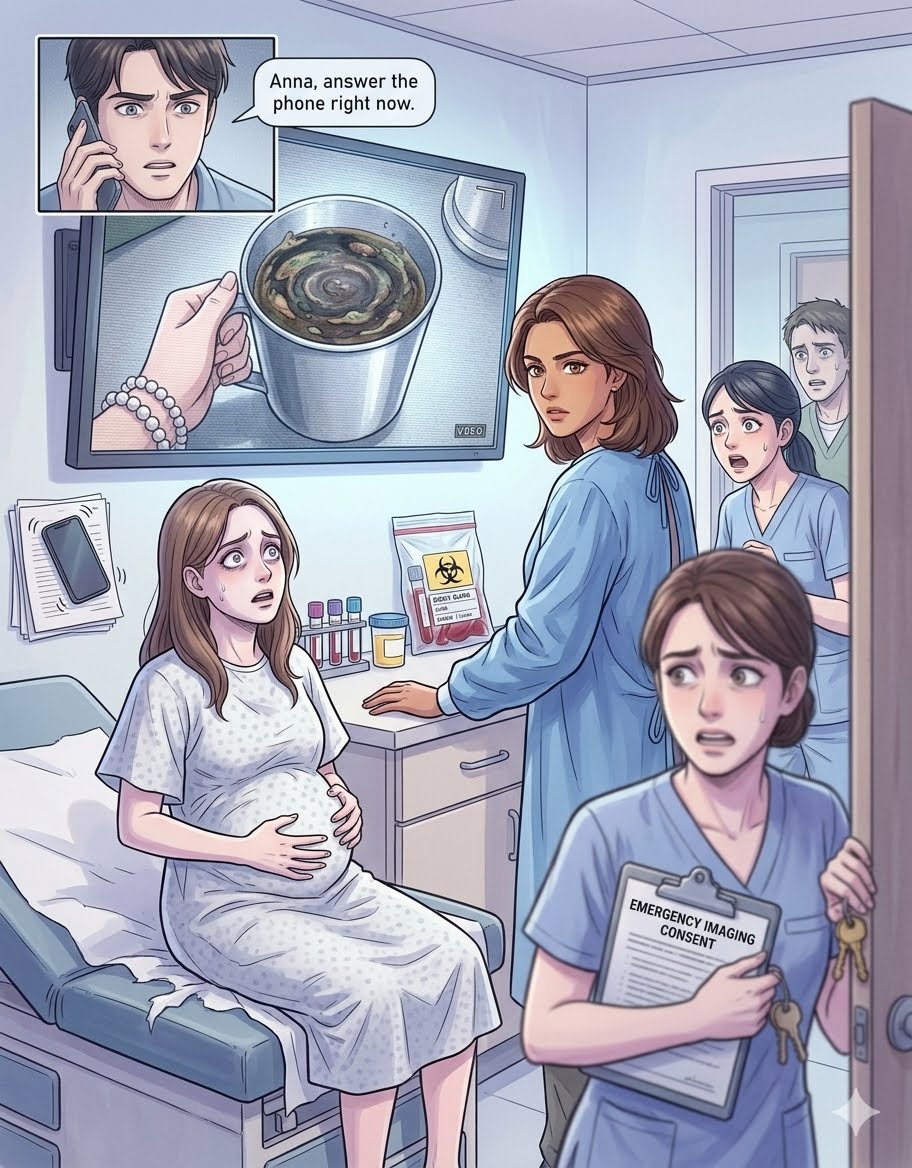
- Dr. Reed leaned closer to the security monitor before instructing the nurse to preserve the video recording and dial 911 immediately.
- Outside, Aaron struck the heavy glass door once more.
- “Anna, open this door!” he shouted, his voice echoing through the intercom. “You are confused, and these people do not know your medical history!”
- His tone had shifted from raw frustration to a measured, rehearsed professionalism—the exact same calm voice he always used whenever he wanted outsiders to believe I was the irrational, unstable one.
- Dr. Reed pressed the intercom button on her desk.
- “Mrs. Mitchell has explicitly revoked permission for you to take part in her care,” she stated clearly. “Please step away from the entrance.”
- Aaron’s expression turned ice-cold. “I am her husband, and I am her attending physician.”
- “You cannot serve as both in this clinic,” Dr. Reed answered firmly.
- Sylvia remained beside him holding the silver cup, though her hand had started to tremble violently.
- Aaron turned toward her and murmured something too quiet for the microphone to capture. Sylvia lowered her eyes to the cup. Then she glanced up, looking through the glass directly toward the security camera lens.
- For the very first time since I had met her, Sylvia looked completely uncertain about which expression she was expected to display.
- A sharp knot of tension tightened deep beneath my hands. Dr. Reed noticed instantly.
- “Is that pain, Anna?” she asked softly.
- “It feels like pressure,” I managed to whisper.
- The nurse quickly helped me recline on the table while Dr. Reed attached two monitoring straps across my swollen abdomen—one tracking my son’s heartbeat, the other monitoring uterine contractions.
- The rapid, rhythmic thudding of my baby’s heart filled the quiet room. It was reassuring enough to steady my erratic breathing, yet urgent enough that no one in the room relaxed.
- The nurse lowered the overhead lights and prepared the emergency ultrasound device Dr. Reed had ordered. She carefully explained every step before touching me—a simple act of basic respect that nearly brought me to tears.
- For months, Aaron had insisted that knowing too much information would only make me anxious, that complex medical decisions belonged solely to him, and that a good mother simply trusted the man keeping her safe.
- Dr. Reed displayed the clear image on the monitor only after asking if I wished to see it.
- Positioned close to my cervix rested a curved object resembling a slender plastic ring. It was situated far too high for me to have ever inserted or removed myself, and it appeared nowhere in the official medical records I had brought from Aaron’s practice.
- “What is that?” I whispered, cold dread settling into my chest.
- “It resembles a medication-delivery device,” Dr. Reed explained carefully. “However, it has been manually modified, and there is no legitimate medical reason for it to be placed inside you without your full knowledge and consent.”
- My mouth suddenly felt completely dry.
- Six weeks earlier, Aaron had carried out what he described as a routine cervical examination at home after I mentioned experiencing mild pelvic pressure. He had locked the bedroom door, instructed Sylvia to keep everyone else downstairs, and claimed he was sparing me an exhausting, unnecessary trip to his clinic.
- I vividly remembered the icy touch of a metal instrument, the sharp sting as something was placed much deeper than I expected, and Aaron telling me to stop tensing because I was making the examination harder for him.
- When I asked what he had done, he had simply kissed my forehead and said, “I’m protecting the pregnancy.”
- I had trusted him because he was my husband. I had trusted him because he was a doctor. More than anything, I had trusted him because he had gradually isolated and reshaped my entire life until believing his lies felt far safer than questioning his motives.
- The nurse walked to the window and pulled the blinds completely shut, blocking the lobby from view.
- Outside the room, the clinic doorbell chime rang over and over in frantic succession. Then, Aaron’s incoming phone calls suddenly stopped.
- A new text message flashed across my screen.
-
Tell them you have pan!c att@cks.
- Another message appeared immediately afterward.
-
They will transfer you if you act unstable.
- Dr. Reed looked at the display only after I handed her the device. She did not voice what she thought the messages meant; instead, she asked what I wanted her to do with them.
- “Save everything,” I said. My voice sounded foreign to my own ears, yet it remained completely steady.
- The nurse photographed the display, noted the exact timestamp, and sealed my phone inside a heavy plastic evidence bag alongside the medical samples.
- From beyond the examination room wall came the muffled sound of a man aggressively arguing in the front lobby. Aaron had apparently abandoned his demands for entry and shifted to flaunting his professional credentials. He was informing the receptionist that I had a documented history of severe anxiety, that I had fled home without my prescribed medication, and that the clinic would face massive liability if they allowed me to refuse care from the physician who knew my case best.
- Dr. Reed listened for less than a minute before stepping toward the door.
- “You are not leaving this building through the front lobby,” she told me plainly. “We are arranging a direct medical transfer to the hospital for continuous monitoring and the safe removal of that device.”
- “Will he try to follow us?” I asked, my heart racing.
- “He may try,” Dr. Reed said gently, lowering herself until we were at eye level. “But he no longer decides who has access to you.”
- Those words struck me harder than any speech ever could.
- My eyes drifted to my purse resting on the chair, the phone Aaron had been secretly tracking, and the empty hook where my car keys should have hung. He had confiscated them three months earlier after I became lightheaded in a grocery store parking lot.
- I understood now that my dizziness had never proven I was too weak to care for myself. It had simply been engineered to make me easier to control.
- Part 4
- Wailing sirens grew louder from somewhere beyond the parking lot.
- On the security monitor, Aaron reached aggressively toward the silver cup. Sylvia flinched and pulled back. He reached again, far more forcefully this time, but she clutched the silver handles tightly against her cardigan.
- “Give it to me!” he demanded, his voice easily picked up by the entrance microphone.
- Sylvia stood her ground, staring at her son as if seeing him clearly for the very first time. “What was inside those packets, Aaron?” she asked, her voice trembling.
- Aaron darted a furious glance toward the security camera. “Her prenatal supplement mixture!”
- “That isn’t what you called it when we were at home.”
- He stepped toward her, towering over her small frame.
- In response, Sylvia slowly lowered the silver cup onto the concrete ledge beside the entrance and lifted both of her hands high away from it.
- “I am not touching it again,” she said firmly.
- That was the exact moment Aaron stopped pretending his concern was about my well-being. He slammed his palm against the ledge with a loud bang and ordered his mother to pick up the cup before the police stepped outside.
- She flatly refused.
- When two armed police officers and the clinic’s security guard approached the entrance, Aaron immediately pointed a finger at Sylvia.
- “My mother has been secretly administering unapproved herbal remedies to my pregnant wife,” he lied without blinking. “I came here to stop her!”
- Sylvia’s expression changed instantly. Not because he had blamed her, but because he had thrown her to the authorities without the slightest hesitation.
- Slowly, she reached into her leather handbag and withdrew several folded paper packets held tightly together with a thick rubber band.
- “Aaron gave me these,” she told the officers, her voice clear. “He handwrote the schedule on them and ordered me to dissolve one into her tea every single morning.”
- Aaron loudly insisted she was confused and senile. Sylvia ignored him, looking through the glass doors directly into the clinic toward me.
- “I thought they were just herbs,” she said softly through the speaker. “At first.”
- Those final two words meant more than everything else she had said. At first meant there had been a moment when she realized something was wrong. At first meant she had chosen to participate anyway.
- I rested my hand over my baby’s sharp kick beneath my ribs and told Dr. Reed that I did not want Sylvia allowed anywhere near me either. Dr. Reed nodded, honoring my boundary without asking me to soften my stance.
- An ambulance crew arrived through a secured side corridor while the police officers kept Aaron occupied at the front doors. Before they wheeled me out, Dr. Reed asked if there was anyone in my life I trusted enough to call.
- My parents’ faces came to mind, accompanied by a wave of guilt so overwhelming it nearly choked me.
- For two years, Aaron had systematically convinced me that my parents were intrusive, judgment-filled, and bitter about our marriage. He had once blocked my mother’s number on my phone after she persistently asked why I had missed three family gatherings in a row. Later, he unblocked it and claimed it had all been a simple misunderstanding, but by then, I was already too exhausted to reach out.
- “Call my father,” I whispered. I still knew his phone number by heart.
- During the transport, the paramedics asked for my explicit permission before tightening a strap, checking my vitals, or adjusting the warm blanket over my legs. Every gentle question served as a painful reminder of how many basic choices Aaron had stolen from me under the guise of medical necessity.
- At the hospital, a team of specialists safely removed the modified ring without causing any harm to my unborn son. They secured the device inside a sterile evidence container, meticulous in documenting its placement, the chemical residue on its surface, and the complete absence of any corresponding entry in my official prenatal files.
- Initial blood tests delivered immediate answers. A powerful prescription sedative was detected in my bloodstream at toxic levels that matched no legitimate prescription I had ever been given. Traces of the exact same chemical compound were later identified on the removed ring and within the liquid residue left inside Sylvia’s silver cup.
- The attending physician who explained the forensic findings avoided dramatic language. He simply stated that the drug fully explained the severe dizziness, chronic exhaustion, memory lapses, and sudden weakness Aaron had continually cited as proof that I was unfit to drive, travel, shop alone, or visit my family.
- Aaron had not merely been reacting to my physical decline. He had spent months deliberately inducing it.
- Part 5
- My father arrived before sunset wearing the heavy canvas work jacket he kept in his truck, despite the warm weather outside. He paused at the doorway of my hospital room, taking in the monitors, and quietly asked if he was allowed to come closer.
- That simple, respectful question broke down the last of my emotional walls.
- I nodded through my tears. He walked across the tiled floor, took my hand in his rough palm, and never once asked why I had stayed away for so long. He did not remind me that he had warned me about Aaron. He simply pulled a chair beside my bed and said, “Your mother is packing a bag at home. We are staying right here for as long as you need us.”
- Aaron called the hospital desk continuously. He identified himself first as my treating physician, then as my legal husband, and finally as the father of my child. Each of those titles had once opened every door for him. This time, none of them worked.
- I signed a formal directive completely stripping him of his status as my medical contact, revoking his access to my room, and barring him from viewing my records or influencing my care. My father watched me sign the papers, standing by as a silent pillar of support without ever attempting to grab the pen.
- The hospital preserved every logged phone call, my prior treatment history, and all the evidence transferred from Dr. Reed’s clinic for law enforcement and medical board review. They made no empty promises of a quick or simple legal victory, but they provided something far more vital: they restored my right to make my own decisions.
- The following morning, Sylvia requested permission to speak with me in person. I flatly refused.
- Instead, she left a detailed statement with the hospital’s patient advocate, insisting she would provide evidence regardless of whether I ever chose to forgive her. She surrendered the remaining chemical packets, printouts of text messages Aaron had sent her, and a handwritten schedule he had hidden inside her kitchen cabinet.
- The schedule outlined the exact days I was to receive his injections, the mornings Sylvia was required to spike my tea, and the specific hours Aaron wanted me unconscious or heavily sedated. Beside one entry, he had written: “She is becoming too restless and might attempt to visit her parents.”
- Sylvia’s message logs revealed she had questioned him twice. The first time, Aaron assured her the medication was a routine, safe treatment for pregnancy-induced anxiety. The second time, he claimed my pregnancy had rendered me mentally unstable, warning her that questioning his care would put her future grandson in direct danger. She had accepted his explanations because believing them allowed her to pretend her compliance was an act of maternal protection.
- Then came the single text message that utterly destroyed Aaron’s defense:
-
Keep her foggy until delivery. Once the baby is here, she will stop talking about leaving.
- It was not a medical treatment plan. It was a calculated domestic imprisonment strategy written by a man who viewed an innocent child as nothing more than a permanent lock.
- When confronted by police with the evidence, Aaron attempted to claim he had merely exaggerated his language to calm his overly anxious mother. He insisted the cervical ring had been meant to treat potential complications and that I had verbally consented during an episode of confusion I could no longer recall.
- However, the timeline completely unraveled his story. The ring had been inserted late at night. I vividly remembered pleading with him to stop the painful examination at home, and our smart-home security records confirmed that no other medical personnel had been present.
- My text history from that exact night contained desperate messages asking why I was bleeding and why he refused to explain what he had done to me.
- His recorded reply consisted of that same single, haunting word: Protection.
- Sylvia eventually confessed to the one truth she had fought hardest to hide. Two weeks before my appointment with Dr. Reed, she had watched me pour my bitter morning tea down the kitchen sink. When she reported it to Aaron, he had ordered her to brew a fresh cup and stand over my bed until I drank every last drop. She had complied.
- “I was terrified he would cut me off from my grandson,” she admitted in her written affidavit. “I told myself Anna was just being difficult because that was easier than accepting that my son had become a monster.”
- I read her confession once before handing it back to the advocate. Her honesty was legally useful, but it could never erase the memory of her standing beside my bed morning after morning holding that silver cup. I owed her no quick forgiveness simply because her guilt had finally caught up with her.
- Part 6
- The hospital kept me under close observation for several days as the sedatives fully cleared my system.
- Gradually, my persistent dizziness vanished. The heavy mental fog I had accepted as a normal part of pregnancy lifted entirely, leaving my mind sharp and clear. My son’s heartbeat remained remarkably strong, and the early contractions settled without leading to premature labor.
- Dr. Reed visited me every day after her clinic hours, carrying none of the arrogant, controlling certainty Aaron had worn like a uniform. She brought copies of my updated care plan and sat quietly beside my bed while I reviewed every single line. Whenever I encountered medical jargon I didn’t recognize, she explained it clearly. Whenever I asked the same question twice, she answered it with unwavering patience.
- Before leaving on my final evening, she placed the folder in my lap and said, “Anna, you never have to earn the right to know what is happening to your own body.”
- Upon my discharge, my parents brought me directly to their home.
- Because Aaron had controlled our finances, house, transportation, and healthcare, escaping his grip did not feel like a single cinematic act of bravery. It felt like enduring a hundred tedious, exhausting steps. I had to replace my stolen identification, reset every digital password, establish my own bank account, and repeatedly explain to legal representatives why my husband was barred from contacting me.
- On certain dark mornings, I would wake up feeling a cold rush of panic, wondering if I had somehow overreacted. But then I would force myself to remember the modified ring inside the evidence container, the bitter powder clinging to the silver cup, and Aaron’s written directive to keep me drugged until delivery. Those undeniable facts became the sturdy railing I held onto whenever shame tried to make the room spin.
- Aaron’s medical license was immediately suspended pending criminal prosecution and formal board review. I learned not to measure my safety by the slow machinery of the court system; my true protection came from the absolute boundaries I built around my life.
- All communications were routed strictly through legal council. He was legally barred from my medical appointments, had no access to my location, and could no longer hide behind professional authority to override my choices.
- Months later, after my son was born, Sylvia formally petitioned for supervised visitation. I did not consent immediately. Only after she continued fully cooperating with law enforcement and ceased sending messages pleading for her son’s reputation did I allow a single, brief visit with my father present in the room.
- She held her grandson tightly and wept in silence. She never referred to herself as his protector, nor did she ask me to absolve her of her guilt. When the visit concluded, she handed him back the exact second I reached out my arms. That unspoken respect meant far more than any tearful apology ever could.
- My son arrived precisely on his due date following an uncomplicated labor. I followed a birth plan that I had personally written, reviewed, and approved. My mother held my hand on one side of the bed, my father waited outside with two hot cups of coffee, and Dr. Reed guided my delivery. No decisions were made without my explicit consent, and no one ever suggested that my fear meant I should surrender control.
- Several weeks later, I drove my son to his first wellness checkup in my father’s old SUV.
- My hands trembled slightly as I gripped the steering wheel, but the anxiety faded as I pulled down the driveway. Aaron had once taken my keys and claimed it was an act of protection. Now, the keys rested safely in the center console beside me while my baby slept peacefully in his car seat.
- When we returned home, I carried my son onto the front porch, unlocked the front door myself, and hung the keys on a small hook right beside the entrance where I could always see them.
- Then, I poured my own fresh tea into a simple blue mug, left the silver cup sealed away with the rest of the criminal evidence, and sat comfortably by the sunlit window while my son woke up safely in my arms.
Part 3 A faint dusting of bitter white powder still coated the inner edge of the silver cup.