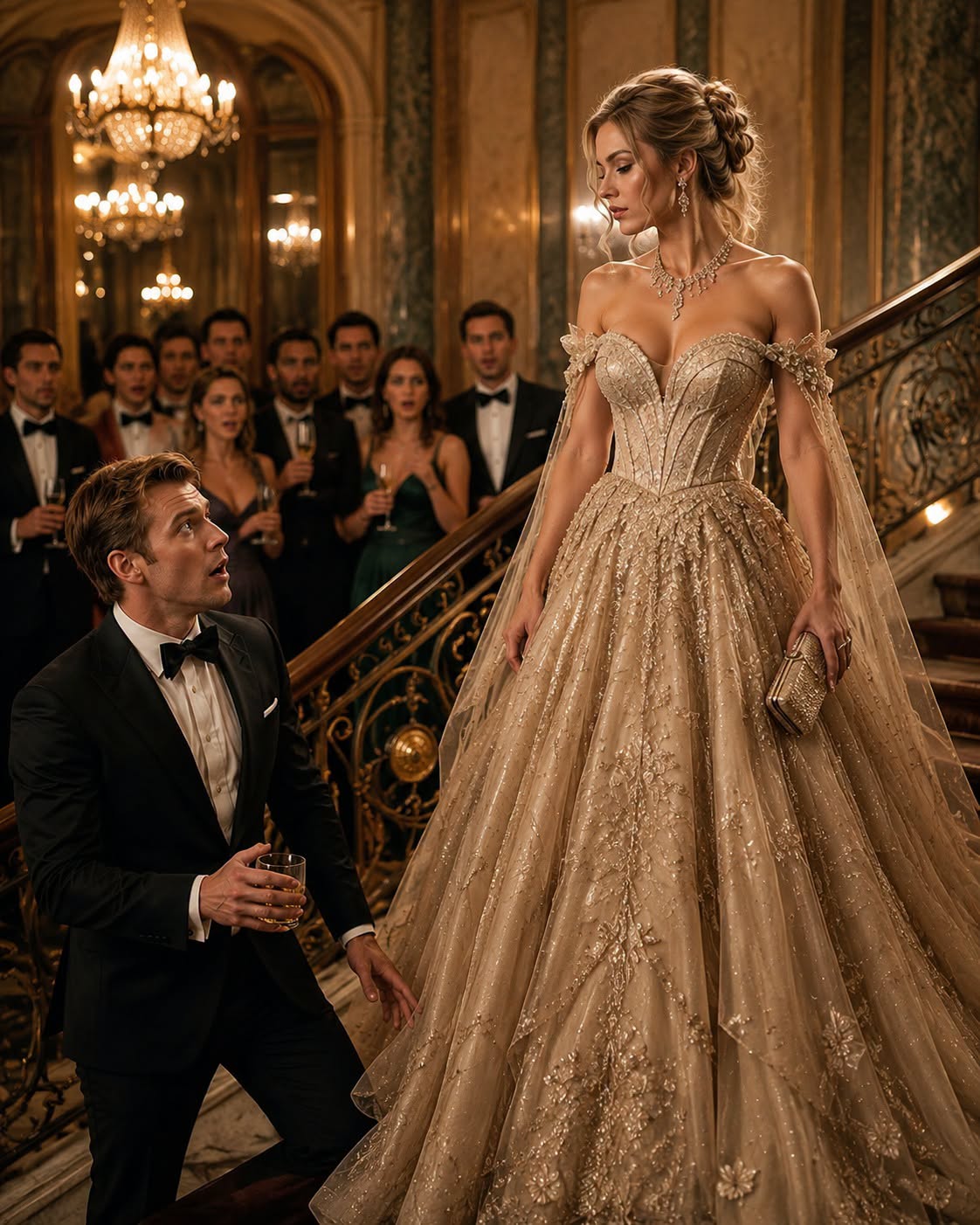
PART 2: He Burned My Dress to Keep Me Away—But at the Gala, I Learned His Betrayal Was Only the Beginning1 026
His gaze moved from my tear-streaked face to the blackened remains of the blue dress.
A corner of fabric still smoldered beneath the twisted metal grate.
“My lady,” he said quietly.
I had not heard him call me Clara since I was nineteen.
Tonight, the title did not make me feel powerful.
It made me feel exposed.
“He burned it,” I said.
Mr. Blackwood’s eyes hardened, but his voice remained controlled.
“I gathered as much.”
“He said I would embarrass him.”
A muscle moved in his jaw.
I expected him to offer anger on my behalf.
Instead, he removed his coat and draped it gently around my shoulders.
“You do not need to prove anything tonight,” he said.
“Not to him.
Not to the board.
Not to your family.”
“I know.”
“Do you?”
The question landed more deeply than I wanted it to.
For seven years, I had told myself that leaving the Vaughn estate had been an act of courage.
I had wanted a life untouched by wealth, influence, and carefully arranged introductions.
I had wanted to be chosen simply because someone saw me.
But standing in the backyard, watching the last thread of my dress curl into ash, I wondered whether I had truly left my family behind—or whether I had spent seven years building another test no human being could possibly know he was taking.
“I’m going to the gala,” I said.
Mr. Blackwood studied my face.
“As Clara?”
“Yes.”
“Which Clara?”
I looked toward the house.
Through the kitchen window, I could see the chipped mug Adrian used every morning, the grocery list I had written, and the stack of unopened mail he always left for me to sort.
Ordinary pieces of an ordinary life.
I had once found comfort in them.
Now they looked like evidence from a life I had misunderstood.
“Both,” I said.
Mr. Blackwood nodded.
Only then did he gesture toward the car.
Inside, a garment bag rested across the rear seat beside a velvet jewelry case.
I recognized the gold crest embossed on the case before he opened it.
The diamond set had belonged to my grandmother.
It was not worth fifty million pesos because of its history.
It was worth that amount because each stone had been selected over thirty years, then recut into a necklace designed to resemble a line of falling stars.
My grandmother had worn it only twice.
The second time had been at my father’s inauguration as chairman.
“I asked for the diamonds because I was angry,” I admitted.
Mr. Blackwood raised an eyebrow.
“That has never stopped anyone in your family from making expensive decisions.”
Despite everything, a laugh escaped me.
It was small and unsteady, but it was mine.
He closed the jewelry case.
“Would you prefer something simpler?”
I touched the edge of the velvet.
“Yes.”
He looked almost pleased.
From another compartment, he removed a single sapphire pendant surrounded by tiny diamonds.
My mother’s pendant.
She had worn it in nearly every photograph taken before she disappeared from public life.
My fingers went still.
“I thought this was in the family vault.”
“It was.”
“Who authorized its release?”
Mr. Blackwood’s pause was brief, but I noticed it.
“Your father.”
The warmth drained from my face.
“My father is in Switzerland.”
“That is what the public believes.”
I turned sharply toward him.
“What does that mean?”
“It means,” he said carefully, “that tonight may be more complicated than your husband’s behavior.”
Before I could press him, the rear door opened and a woman in a cream suit leaned inside.
Her name was Amara, and she had been my mother’s personal stylist before establishing her own fashion house in Paris.
She looked at me once, then at the soot on my hands.
“No questions,” she said.
“Not yet.”
The gown she had brought was not the dramatic garment I had imagined when I made the call.
It was elegant rather than extravagant, made from deep midnight-blue silk that moved like water.
The sleeves fell softly at my wrisTS. The neckline was modest, and the fabric gathered at my waist before descending in a clean, graceful line.
It did not feel like a costume.
It felt like the dress I might have chosen if I had never needed to hide.
Amara helped me change in the guest room while Mr. Blackwood waited outside.
She pinned my hair loosely and covered the redness around my eyes without erasing the fact that I had been crying.
When she fastened my mother’s sapphire around my neck, I stared at myself in the mirror.
I did not see a queen.
I saw a woman who had spent years making herself smaller so that love would feel safer.
And for the first time, I understood that Adrian’s cruelty was not the only truth I had to face.
I had hidden from him.
Not because he had earned my trust and lost it, but because I had never truly offered it.
That did not excuse what he had done.
But it complicated the story.
Real life often did.
“You are thinking too loudly,” Amara said.
I met her eyes in the mirror.
“Can you tell what I’m thinking?”
“No.
But women only stare at themselves like that when they are about to forgive too much or destroy too much.”
“I’m planning to do neither.”
“Good.”
She adjusted one loose strand of hair near my cheek.
“Then go learn the truth.”
The gala was being held at the Grand Meridian Hotel, in a ballroom that overlooked the city.
By the time we arrived, the entrance was crowded with executives, investors, government advisers, and reporters invited to cover Vanguard Dominion’s expansion announcement.
Camera flashes burst against the glass canopy.
For years, I had attended meetings through secure video calls, signed directives through the family trust, and communicated with the board through Mr. Blackwood and two attorneys.
Only a handful of senior officers knew the chairwoman’s identity.
To most employees, Clara Vaughn was a signature at the bottom of confidential documenTS.
Some believed I was elderly.
Others believed I was a committee rather than a person.
Adrian had once joked over dinner that the hidden chairwoman was probably “some ancient widow afraid of daylight.”
I had laughed with him.
The memory made my chest ache.
The car stopped beside the carpeted entrance.
Mr. Blackwood glanced at me.
“You may still leave.”
“I’ve spent seven years leaving.”
He said nothing more.
The moment I stepped from the car, the conversations nearest the entrance softened.
Not stopped.
Shifted.
It was the subtle change that occurred when people sensed importance but had not yet identified its source.
Mr. Blackwood offered his arm, and we entered together.
Inside, crystal lights glittered above long tables dressed in white linen.
A string quartet played near the terrace doors.
Servers moved between guests carrying silver trays, while the company’s black-and-gold emblem appeared on screens throughout the room.
On the main stage, a banner displayed the evening’s theme:
BUILDING THE FUTURE TOGETHER.
I almost smiled at the irony.
“Mrs. Vaughn?”
A young woman approached us, holding a tablet.
Her event badge identified her as Lila Santos, junior coordinator.
Her eyes widened when she recognized Mr. Blackwood.
“Sir, I wasn’t informed—”
“That is because the guest list was updated privately,” he said.
Lila looked at me.
“May I have your name?”
“Clara.”
She waited.
“Clara Vaughn.”
The tablet nearly slipped from her hand.
Her gaze darted between us.
“The Clara Vaughn?”
“There should only be one on the list,” I said gently.
Her nervousness eased by a fraction.
She searched the tablet, then straightened.
“You’re seated at the chairman’s table.”
“Thank you, Lila.”
As she led us across the ballroom, I felt eyes follow us.
Whispers moved faster than we did.
At the center of the room, Adrian stood beside Vanessa Hale.
Vanessa wore a silver dress and carried herself with the relaxed confidence of someone accustomed to being noticed.
Her father, Director Marcus Hale, was speaking to a group of senior managers nearby.
Adrian looked polished and triumphant.
The same hands that had poured lighter fluid over my dress now rested calmly around a glass of champagne.
For one painful second, I remembered tying his necktie before his first interview at Vanguard.
He had been so nervous he could barely keep still.
“You always make me feel like I can do this,” he had told me.
I had believed that was what love meant.
Helping someone become brave.
But courage built on another person’s sacrifices could easily turn into entitlement if gratitude disappeared.
Vanessa saw me first.
Her smile faded.
She leaned toward Adrian and said something I could not hear.
He turned.
The color left his face so quickly that even from a distance, I saw it.
His eyes moved from my gown to the sapphire at my throat, then to Mr. Blackwood beside me.
For several seconds, he simply stared.
I stopped a few feet away.
“Good evening, Adrian.”
His mouth opened, but no words came.
Vanessa recovered before he did.
“Clara?”
There was genuine confusion in her voice.
“You know her?” Adrian asked.
Vanessa looked at him strangely.
“Everyone in my family knows the Vaughn name.”
“That isn’t what I asked.”
“No,” she said.
“I don’t know her personally.”
Director Hale approached, his attention fixed on Mr. Blackwood.
“Edmund,” he said.
Mr. Blackwood’s expression cooled.
“Marcus.”
The two men shook hands without warmth.
Then Director Hale looked at me.
Unlike his daughter, he did not appear confused.
He appeared alarmed.
“Miss Vaughn,” he said.
Adrian stared at him.
“You know my wife?”
Director Hale’s eyes sharpened.
“Your wife?”
The question struck the surrounding conversation silent.
Vanessa turned fully toward Adrian.
“You told me you and Clara were separated.”
I looked at him.
Adrian’s grip tightened around his glass.
“We’ve been having problems.”
“You told me she refused to attend,” Vanessa continued.
“You said bringing me would avoid uncomfortable questions.”
“I can explain.”
“Can you?” I asked.
His gaze snapped back to mine.
For the first time since I had known him, Adrian seemed uncertain which version of himself to present.
The confident vice president?
The embarrassed husband?
The frightened employee standing before the family that controlled his future?
“Clara,” he said quietly, “let’s speak privately.”
“I agree.”
Relief flashed across his face.
Then Mr. Blackwood added, “After the opening remarks.”
Adrian’s relief vanished.
Director Hale looked at me with a careful expression.
“Does the board know you are here?”
“They will.”
“I see.”
He did not.
None of us did.
A soft chime sounded from the stage, calling guests to their seaTS.
Vanessa moved away from Adrian.
He reached for her arm, but she stepped beyond his hand.
“Don’t,” she said.
There was no scene, no raised voice.
Her disappointment was quieter and more devastating than anger.
“I came because I thought you needed a professional companion for the evening,” she continued.
“Not because I intended to help you humiliate your wife.”
Then she took her seat beside her father.
Adrian remained standing until a senior manager touched his shoulder and murmured that the program was beginning.
I sat at the chairman’s table with Mr. Blackwood.
There were three empty seaTS.
One had been reserved for the chairwoman.
The second bore my father’s name.
The third had no card at all.
“Why is my father’s seat here?” I whispered.
Mr. Blackwood looked toward the stage.
“I did not arrange it.”
Before I could ask more, the master of ceremonies welcomed the guests and introduced a short film celebrating Vanguard Dominion’s history.
Images moved across the screens: factories, research centers, hospitals funded through the Vaughn Foundation, shipping terminals, and thousands of employees standing beneath company banners.
Then came an old photograph of my grandfather breaking ground at the first manufacturing plant.
Beside him stood my father, barely twenty-five.
And beside my father was my mother.
The sapphire pendant rested at her throat.
My breath caught.
I had not seen that photograph in years.
My mother had vanished when I was twelve.
The official explanation had been exhaustion followed by long-term medical treatment abroad.
No funeral had been held.
No death announcement had ever been made.
As a child, I had asked when she was coming home until the adults around me began answering with silence.
Eventually, I learned to stop.
The film ended, and Director Hale took the stage.
He delivered a polished speech about loyalty, leadership, and the company’s future.
Then he introduced Adrian as the newly appointed Vice President of Operations.
Applause filled the room.
Adrian walked to the podium.
From a distance, no one would have known that his life had changed in the past fifteen minutes.
He thanked the board.
He thanked Director Hale.
He thanked his mentors, his colleagues, and “everyone who believed in the vision.”
He did not mention me.
Perhaps he had removed my name from the speech before leaving the house.
Or perhaps it had never been there.
As the applause began again, Adrian looked toward my table.
Our eyes met.
He hesitated.
Then, unexpectedly, he returned to the microphone.
“There is one person I failed to acknowledge,” he said.
The room quieted.
“My wife, Clara, supported me before any of this was possible.”
A murmur traveled through the ballroom.
Adrian’s voice remained steady, but I knew him well enough to hear the strain beneath it.
“I would not be standing here without the years she gave to our marriage and to my ambitions.”
For a brief, dangerous moment, the words touched the part of me that still loved him.
Then I remembered the flames.
Public gratitude cost him nothing now.
Private contempt had revealed far more.
Adrian continued.
“I hope tonight can mark a new beginning.”
His eyes did not leave mine.
The audience applauded, interpreting the moment as romantic.
I did not.
When he stepped away from the podium, the master of ceremonies announced the chairwoman’s address.
A screen displayed the Vanguard crest.
The room waited.
No speaker appeared.
Confusion spread near the stage.
Director Hale checked his phone.
Two board members whispered urgently.
Mr. Blackwood turned to me.
“This was not on the final program.”
“Was I expected to speak?”
“No.”
The lights changed.
Then a familiar voice came through the ballroom speakers.
“My apologies for not appearing in person.”
My father.
I went completely still.
The guests straightened in their chairs.
Most of them had never heard Alexander Vaughn speak outside archived interviews.
“The past several years have required the Vaughn family to place Vanguard Dominion under unusually private leadership,” he continued.
“That decision protected the company during a period of internal uncertainty.
It also placed a great burden on the person who accepted that role.”
The screen remained black.
Adrian was staring at me now.
My father’s voice filled the room.
“Tonight, it is time for secrecy to end.”
My pulse thundered.
Mr. Blackwood leaned closer.
“Clara, I was not informed of this.”
 Mom Gives Cousin Thousands In Baby Gear, Then Watches Her Sell Almost Everything Within Hours
“Neither was I.”
The screen illuminated.
A photograph of me appeared behind the stage.
Not from childhood.
Not from any formal family portrait.
It was an image taken only three weeks earlier, showing me leaving a neighborhood market in my work uniform, carrying groceries beneath one arm.
The room erupted in whispers.
“Clara Vaughn has served as Chairwoman of Vanguard Dominion for the past five years,” my father announced.
“Under her oversight, the corporation survived two attempted acquisitions, expanded employee health protections, and completed the largest operational restructuring in its history.”
I could feel Adrian staring.
The applause began hesitantly, then grew.
I remained seated.
This was not how I had planned to reveal myself.
In truth, I had not planned a reveal at all.
My identity was supposed to remain confidential until I chose otherwise.
The photograph on the screen changed.
It showed me entering the small clinic where I worked three evenings each week as an administrative assistant.
Then another image appeared of me boarding a public bus.
Someone had been documenting my life.
My father’s voice continued.
“My daughter believed that understanding ordinary hardship would make her a more responsible leader.
Whether one agrees with her methods or not, her commitment cannot be questioned.”
The applause faded.
I heard something in his tone.
A warning.
“However,” he said, “leadership is not inherited by blood alone.
It is proven through judgment.”
The screen went dark again.
“There are decisions still to be made about Vanguard’s future.
Clara will make them with the board in the coming weeks.”
The message ended.
No farewell.
No explanation.
The ballroom remained silent for a heartbeat.
Then every person seemed to begin speaking at once.
Reporters moved toward the chairman’s table, only to be blocked by security.
Board members rose.
Phones appeared in hands all over the room.
Director Hale walked swiftly toward me.
“This announcement was unauthorized,” he said under his breath.
“By whom?” I asked.
“By the communications office, the board, and apparently everyone except your father.”
“Where is he?”
“I assumed you knew.”
Adrian approached from the other side.
“Clara.”
I looked at him.
He appeared stunned, but not angry.
Not yet.
“Five years?” he said.
“You’ve been chairwoman for five years?”
“Yes.”
“And you never told me?”
“No.”
His face changed as the reality settled over him.
“You listened to me talk about Vanguard every night.”
“Yes.”
“You let me complain about decisions you made.”
“Sometimes.”
“You knew about my promotion.”
“I approved the operating budget that created the position.
I did not select the candidate.”
His eyes narrowed.
“But you could have stopped it.”
“I could have interfered.”
“That’s not an answer.”
“It is the only one I have.”
The space between us filled with everything we had concealed from each other.
I thought he would accuse me of deceiving him.
He had every right to.
Instead, he said, “So this was all a test.”
“No.”
“You lived in that house.
You watched me struggle.
You sold your jewelry to pay my tuition while your family owned half the skyline.”
“I sold what belonged to me.”
“You could have changed everything.”
“I was trying to build something real.”
“With a lie?”
His words were not cruel.
That made them harder to dismiss.
Before I could answer, Vanessa stepped beside us.
“Not here,” she said.
Adrian looked toward the gathering reporters.
His shoulders lowered slightly.
For once, he listened.
Mr. Blackwood led us into a private lounge behind the ballroom.
Director Hale followed, along with Vanessa.
The door closed, muting the noise outside.
No one spoke at first.
The room smelled faintly of coffee and polished wood.
Adrian stood near the window.
I remained by the door.
We looked like strangers forced into a family photograph.
Finally, Vanessa turned to him.
“Did you destroy her dress?”
Adrian’s face tightened.
I had not told her.
She must have noticed the soot beneath my nails or heard something from the staff who had arrived at the house.
“Vanessa,” he said.
“That is a yes.”
“It was an argument.”
“No,” I said.
“It was a decision.”
Adrian looked at me.
Shame flickered across his face, but he did not apologize.
Not yet.
Perhaps an apology offered too quickly would have been another performance.
Director Hale exhaled.
“Whatever occurred in your marriage must remain separate from company proceedings.”
“That depends,” Mr. Blackwood said, “on whether company proceedings influenced what occurred in the marriage.”
Director Hale’s expression sharpened.
“What are you suggesting?”
Mr. Blackwood removed a thin envelope from inside his jacket and placed it on the table.
“I am suggesting that Mr. Adrian Vale’s promotion was finalized four days before the committee vote.”
Adrian turned from the window.
“That’s impossible.”
“Is it?”
“I was interviewed by six people.”
“Five of whom had already been instructed to approve you.”
“By whom?”
Mr. Blackwood looked at Director Hale.
Vanessa’s father went pale.
“I did not order that,” he said.
Vanessa stared at him.
“Dad?”
“I recommended Adrian,” Hale said.
“His performance justified consideration.
But I did not control the vote.”
Mr. Blackwood opened the envelope.
Inside were printed emails, approval memos, and a copy of a confidential personnel directive.
I moved closer.
The directive carried the authorization code used by the chairwoman’s office.
My code.
My signature appeared at the bottom.
I had never seen the document.
“This is forged,” I said.
Mr. Blackwood nodded.
“I believe so.”
Adrian read the page.
“It says Clara requested my promotion.”
“I did not.”
“Then who did?”
“That,” Mr. Blackwood said, “is the more important question.”
Director Hale took the document and examined it.
“The access code is genuine.”
“It was retired eighteen months ago,” I replied.
His eyes lifted.
“Retired—but not deleted.”
A chill passed through me.
Only three people had access to archived chairwoman credentials.
My father.
Mr. Blackwood.
And me.
I looked at Mr. Blackwood.
He did not flinch.
“If you suspect me,” he said, “you should say it.”
“I don’t know what I suspect.”
“Good.
Certainty would be dangerous tonight.”
Adrian gave a disbelieving laugh.
“You’re discussing access codes while my entire life is being turned inside out.”
I faced him.
“Your promotion may have been manipulated.”
“I earned it.”
“Those things can both be true.”
He looked away.
The sentence seemed to wound him more than a direct accusation would have.
For years, Adrian had needed to believe every achievement proved he had escaped the humiliations of his childhood.
He had grown up moving between relatives, borrowing school uniforms, and pretending not to be hungry when there was little food at home.
I had once admired the fierce determination that came from those years.
But perhaps somewhere along the way, determination had become fear.
And fear had taught him to discard anything that reminded him of where he began.
Including me.
Vanessa studied the forged directive.
“Why promote Adrian?” she asked.
“What would anyone gain?”
Mr. Blackwood answered, “Access.”
Adrian frowned.
“As vice president of operations,” Mr. Blackwood continued, “you are scheduled to receive clearance for the Caligo Project on Monday.”
I had heard the name only once.
It was attached to a sealed acquisition my father had suspended before leaving the country.
“What is Caligo?” I asked.
Director Hale looked surprised.
“You don’t know?”
“My father removed it from my review portfolio.”
Hale glanced at Mr. Blackwood, then lowered his voice.
“Caligo is not an acquisition.”
“What is it?”
“A records recovery program.”
“For what records?”
He hesitated.
Vanessa said, “Tell her.”
Director Hale looked directly at me.
“Files connected to your mother’s disappearance.”
The room seemed to tilt.
I gripped the back of a chair.
“My mother’s medical records?”
“No.”
“Then what?”
“Internal investigations.
Travel logs.
Security reporTS. Payments made through shell companies nearly twenty years ago.”
I could barely hear him over the rush of blood in my ears.
“My father told me she was ill.”
“He told everyone that.”
“Are you saying she wasn’t?”
“I’m saying the company spent years trying to discover where she went.”
The sapphire pendant suddenly felt heavy against my skin.
I looked at Mr. Blackwood.
“You knew?”
“I knew an investigation existed,” he said.
“I did not know Caligo had been reactivated.”
“Who reactivated it?”
Director Hale handed me another page.
The authorization had been issued six weeks earlier.
Again, it carried my code.
Again, it carried my name.
Adrian stared at the document.
“So someone promoted me to give me access to files about Clara’s mother?”
“Possibly,” Vanessa said.
“Why me?”
No one answered.
I thought of the photograph displayed during my father’s message.
Someone had followed me to the market.
Someone had watched me board the bus.
Someone knew exactly where I lived.
My phone vibrated inside my bag.
Every person in the room went silent.
The screen showed an unknown number.
A message had arrived.
Ask your husband what he found in the house last Tuesday.
I looked up.
Adrian’s face had changed.
Not with confusion.
With recognition.
“What happened last Tuesday?” I asked.
“Nothing.”
The answer came too quickly.
I walked toward him.
“What did you find?”
He shook his head.
“This is not the place.”
“We are past that.”
His eyes moved toward the others.
“Clara.”
“What did you find?”
For several seconds, he resisted.
Then his shoulders sagged.
“I came home early,” he said.
“You were at the clinic.”
“I remember.”
“The back door was unlocked.”
“I never leave it unlocked.”
“I know.”
He reached inside his jacket and removed a small brass key.
It was old, its surface worn smooth with age.
My breath caught when I saw the tiny symbol engraved near the bow.
A falling star.
The same design as my grandmother’s diamond necklace.
“Where was that?” Mr. Blackwood asked.
“Under a loose floorboard in the guest room.”
I stared at Adrian.
“Why didn’t you tell me?”
“Because there was a note with it.”
He pulled a folded piece of paper from his wallet.
The paper was yellowed at the edges.
My name was written on the front.
Not printed.
Written.
I knew the handwriting before he opened it.
I had spent years tracing those graceful letters in old birthday cards.
My mother’s handwriting.
My knees weakened.
Adrian unfolded the note and handed it to me.
There were only two lines.
Clara, when the company begins watching you, do not trust the person who brings you home.
Below the message was a date.
The day after my mother disappeared.
No one spoke.
I read the sentence again.
Then again.
Mr. Blackwood stood perfectly still beside me.
He had brought me home tonight.
He had also brought me home from school on the last afternoon I ever saw my mother.
Slowly, I raised my eyes to him.
His face held no anger.
Only sorrow.
“Clara,” he said, “there is something I should have told you a long time ago.”
END OF PART 2 – LIKE, SHARE AND COMMENT “THE ENTIRE STORY” IF YOU WANT TO READ THE FULL STORY.