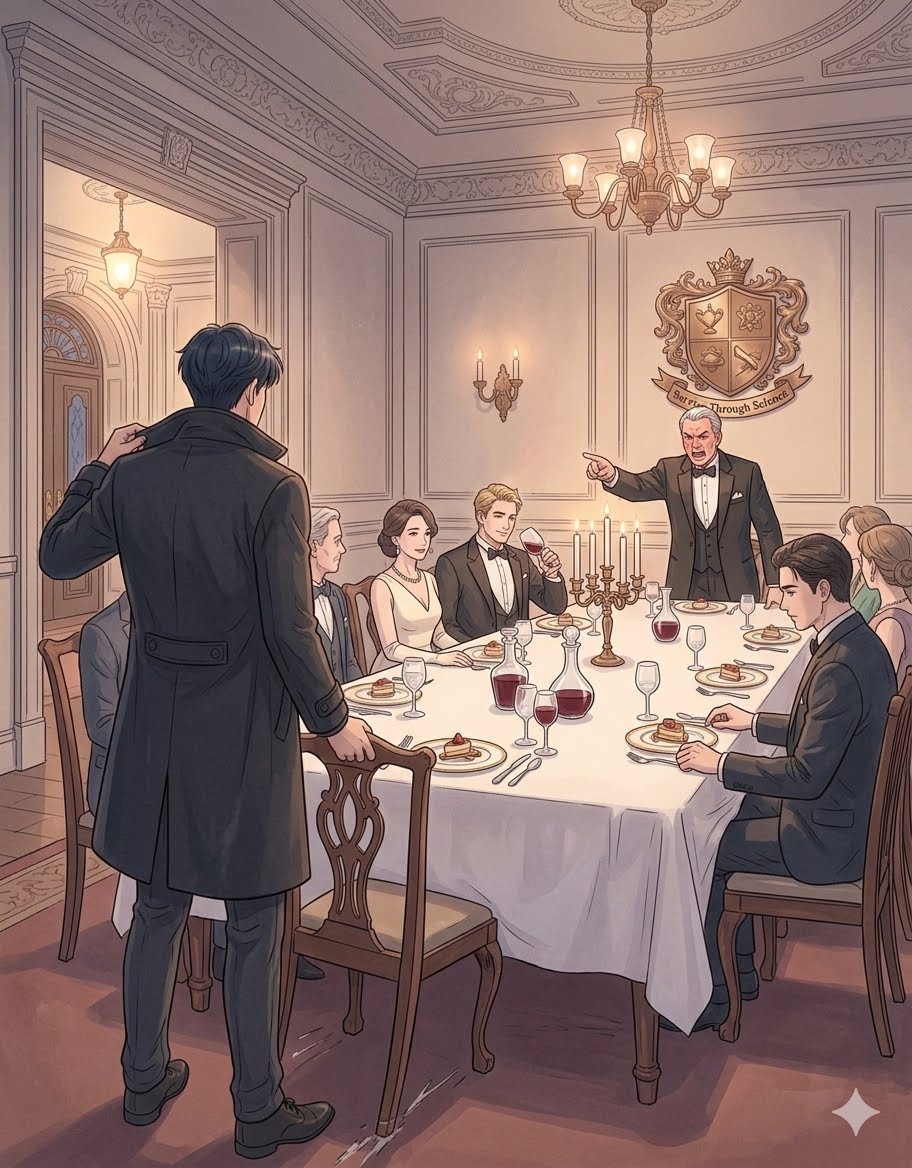
- “Get out,” he roared. “And don’t ever come back.”
- His voice slammed against the high decorative ceiling and rolled across the formal dining room, sending a subtle shudder through the crystal glasses set beside eighteen untouched dessert plates. The room smelled of roasted rosemary, decanted red wine, and warm candle wax, but all I could taste was the dry, metallic copper gathering at the back of my throat.
- My name is Ethan Vale. I was twenty-six years old that night, and until that precise second, I had still been pretending that I belonged to the family that raised me.
- My father, Dr. Conrad Vale, stood at the head of the long mahogany table, one heavy hand pressed against the white linen cloth. His face had flushed a dark, mottled red above the crisp collar of his tuxedo. Hanging directly behind him was the polished bronze family crest my grandfather had commissioned decades ago, engraved with three words: Service Through Science.
- My mother, Dr. Marianne Vale, sat to his left in a tailored ivory evening gown, her diamonds catching the chandelier light. She didn’t look startled by his violent outburst.
- She looked relieved.
- My older brother, Graham, leaned back in his chair, swirling his wine glass while watching me with a faint, amused smile. He was thirty-two, a celebrated chief neurosurgery resident, and the person my parents held up as the golden standard of the Vale name.
- My younger brother, Owen, stared intently at his gilded salad plate. He had always been the type who could memorize a thousand pages of medical texts overnight but couldn’t summon the spine to speak a single honest sentence when it counted.
- Seated around them were grandparents, aunts, uncles, and cousins who had known me since the day I was born.
- Not one of them moved.
- Not one of them told my father he had crossed a line.
- For years, I had rehearsed what I would say if this exact moment ever arrived. I thought I might unleash every insult they had hurled at me since I walked away from medical school. I thought I might lay bare every lie they had spun about my “failure,” or force someone in that room to finally ask why I abandoned the stethoscope.
- Instead, a quiet, surreal calm settled over me.
- I pushed my chair back from the table. Its heavy wooden legs scraped sharply against the polished hardwood—a sound far colder and final than my father’s roar.
- I picked up my dark wool coat from the back of the seat and slid my arms through the sleeves.
- My father’s eyes narrowed, almost disappointed that I wasn’t falling to my knees to plead.
- “That’s it?” he demanded, his chest heaving. “You have nothing to say for yourself?”
- I looked him dead in the eye. “You’ve already said enough for both of us.”
- My mother’s lips pulled into a thin, tight line. As I turned toward the grand foyer, I caught her leaning toward my aunt, whispering softly, “Let him go. He’ll come crawling back the moment he realizes what life actually costs.”
- The brass doorknob was ice-cold beneath my palm.
- I stepped out into the night without looking back.
- The sharp March air bit across my face as the heavy oak door clicked shut behind me. The brownstone steps were still slick from an earlier rain, reflecting the ambient orange glow of the streetlights. Down the block, a delivery truck hissed to a stop; a yellow taxi chimed its horn near Park Avenue.
- I stood on the landing for a few heartbeats, listening to the muffled noise of the anniversary dinner continuing blissfully behind those thick limestone walls.
- Then, I reached into my coat pocket and pulled out my car keys.
- My family believed I was walking out into the cold with nowhere to go. They thought I was an unemployed, disgraced dropout who still relied on their wealth, their spare bedroom, and their grudging approval.
- They had never seen the custom, midnight-black sports car parked two blocks away.
- They had never seen the deed to my Manhattan penthouse.
- And they had never seen the private account holding the first eight figures I had built entirely on my own before my twenty-fifth birthday.
- Twenty-three minutes later, I pulled into the private underground garage of a sleek glass tower in Lower Manhattan. The heavy security gate lifted automatically as the scanner read my license plate, and the valet on duty gave me a polite nod as I glided past.
- “Good evening, Mr. Vale.”
- I entered the private elevator bay and pressed the button for the sixty-second floor. The doors slid shut, and the elevator surged smoothly upward into the sky.
- When the doors parted, I stepped into a pristine foyer crafted from pale stone, rich dark walnut, and expansive floor-to-ceiling glass. Below me, the entirety of Manhattan stretched out in a glittering grid of amber and white lights. Far to the east, the river cut through the city like a wide black ribbon shimmering with reflected neon.
- My penthouse spanned nearly three thousand square feet of elevated, quiet luxury.
- I had acquired it eleven months ago.
- No trust fund distributions.
- No parental co-signers.
- No hidden hand-outs from the Vale family legacy.
- I dropped my key fob onto the marble console table and walked out into the vast living room. My footsteps sounded hollow against the hard floor. It was only then, standing in the middle of that quiet space, that my hands finally began to tremble.
- It wasn’t because I had just lost my family.
- It was because the stark realization had finally set in: I had never truly had them in the first place.
- I sat on the edge of the deep leather sofa and opened my laptop. The screen flickered to life, displaying a single unread message sitting at the top of my inbox.
- The subject line read:
- “30 Under 30 Publication Date Confirmed.”
- I clicked it open.
- The national feature detailing my tech firm, my background, and an independently audited net worth of $42.5 million was scheduled to go live at precisely 6:00 a.m. on the morning of March 26.
- I leaned closer, reading the final paragraph twice through the dim glow of the monitor.
- Once that profile was broadcast to the world, there would be no disguising the man I had built myself into.
- My family had slammed the door on me that night believing they were writing the final, tragic chapter of my life.
- In eleven days, the entire country would find out they hadn’t even read the cover.
- Part 2: Blood Law and Architecture
- In the Vale family, medicine was never viewed as a career choice.
- It was treated as blood law.
- My grandfather had been a legendary cardiac surgeon during an era when open-heart procedures were reported in newspapers like miraculous events. An entire wing of the municipal hospital bore his name, and his framed oil portrait hung prominently in the administrative hallway, depicting him in a pristine white coat with a steady hand resting over a patient’s chart.
- My father followed in those exact footsteps, entering cardiovascular surgery and building a high-profile career around ruthless ambition, surgical precision, and absolute authority. By fifty-five, Dr. Conrad Vale reigned as the director of cardiac surgery at one of Manhattan’s most exclusive private institutions.
- People instinctively lowered their voices whenever he walked into a room.
- My mother was a high-society internist whose private client roster read like a directory of fortune 500 executives, federal judges, hedge fund founders, and families whose names were etched into museum wings. She maintained an infallible memory for every patient’s allergies and every useful social connection.
- At home, she managed her household with that exact same calculated structure.
- Graham was the golden, brilliant firstborn.
- Owen was the quiet, obedient youngest child.
- I was the glitch in the middle.
- The strange thing was that I had initially been good at playing the role assigned to me. I pulled straight A’s, aced my pre-med requirements ahead of schedule, and entered medical school with glowing recommendation letters that had my father’s colleagues shaking his hand as if he had earned them himself.
- For the first two years, I forced myself through the motions.
- I sat through endless lectures under humming fluorescent lights, drank lukewarm vending-machine coffee, and memorized thousands of pages of anatomical data until my eyes burned. During my clinical rotations, I watched exhausted residents destroy their mental health just to win scraps of praise from attending physicians who didn’t even know their first names.
- I didn’t hate medicine itself.
- I hated what it was turning me into.
- Every morning, I woke up with the sickening realization that I was walking through a life tailored for someone else. The white lab coat fit my shoulders, but it never felt like it belonged to me.
- At night, when I was supposed to be reviewing pathology, I sat up teaching myself software engineering and computer science.
- It began out of pure curiosity. I had always understood abstract systems far better than social hierarchy. Give me a complex digital framework with hidden vulnerabilities, and I could sit for hours tracing how every variable impacted the whole.
- I became obsessed with decentralized blockchain infrastructure—not for the flashy promises of instant crypto-wealth, but for the mathematics and architecture beneath it. I studied how decentralized protocols settled value, where smart contracts broke down, and how flawed security layers could leave millions of dollars exposed to exploit in seconds.
- That work made me feel alive.
- On May 12, 2022, halfway through my third year of medical school, I walked into the dean’s office and withdrew.
- My father found out from the university registrar before I even had the chance to sit him down.
- He summoned me to his private study that evening. Rain clicked against the tall paned windows, and the air smelled heavily of leather-bound books and the expensive cigars he claimed to have quit years ago.
- “Tell me this is a clerical error,” he said, his voice dangerously low.
- “It isn’t.”
- “You withdrew?”
- “Yes.”
- His expression changed slowly, as if the son standing across from his desk had suddenly morphed into a complete stranger.
- “What happened? Did you fail an exam?”
- “No.”
- “Were you facing disciplinary action?”
- “No.”
- “Then why in god’s name would you commit such a humiliating act?”
- I tried to explain. I told him I had found a discipline I was truly passionate about. I told him I wanted to design security protocols for modern financial technology, and that I had already written code capable of detecting critical vulnerabilities in decentralized networks.
- He listened for less than sixty seconds.
- Then, he burst into a harsh, cruel laugh.
- “You left medical school to play with fake digital coins?”
- “That isn’t what I said.”
- “That is exactly what you said.”
- My mother wept that night, but her tears weren’t for my well-being. She cried because she had already boasted to her inner circle that her second son was on track to become a chief surgeon.
- For the next three years, my family treated me like a dirty secret.
- At dinner parties, Marianne would offer a tight smile and lie, “Ethan is taking a brief sabbatical to figure things out.”
- Graham would ask condescendingly if I had “finally found a real job yet.”
- My father routinely referred to my career as “high-tech gambling.”
- They saw me sleeping past nine in the morning and assumed I was a lazy failure. They never asked why my desk lamps were still burning at four a.m. They saw empty coffee mugs, tangled ethernet cables, and three massive monitors.
- They didn’t see Tokyo markets opening.
- They didn’t see London markets closing.
- They didn’t see the rigorous security audits, the enterprise licensing agreements, or the venture capitalists calling me from international time zones.
- Three weeks after walking away from medicine, I invested $50,000. Most of it came from savings I had accumulated working remote software engineering internships during undergrad; the rest came from a modest inheritance left directly to me by my grandmother.
- I didn’t gamble it on hype.
- I built quantitative algorithms.
- I tracked cross-exchange liquidity, identified subtle arbitrage pricing gaps, and deployed automated execution systems that operated completely free of emotion. When the markets plummeted, I didn’t panic. When they surged, I didn’t get reckless.
- By the end of 2023, my personal trading portfolio sat at $8.3 million.
- But trading was just capital generation. I wanted to build infrastructure.
- That was when I connected with Noah Pierce, a brilliant, soft-spoken systems architect from Seattle whose GitHub profile had virtually no personal details. We began exchanging technical papers on security vulnerabilities in open-source financial protocols. Six months later, we co-founded Aegis Ledger—a high-level security protocol designed to monitor decentralized transactions in real time and automatically halt malicious code executions.
- Our first corporate office was my spare bedroom.
- Our first conference table was a cheap folding desk from Amazon.
- Our first enterprise client signed a $380,000 annual licensing deal.
- I didn’t mention a word of it to my family.
- Only my uncle Ellis suspected there was more to my life than they assumed. Ellis was my father’s younger brother—a retired physician who had walked away from hospital administration before the greed and politics could strip away his humanity.
- Whenever we were at family gatherings, Ellis would quietly sit next to me and ask, “How’s the company coming along?”
- Not, “When are you going back to med school?”
- Not, “When are you going to get a respectable job?”
- Just, “How’s the company?”
- The morning of my parents’ anniversary dinner, Ellis texted me:
- “You going tonight?”
- “They insisted,” I replied.
- “Keep your head up. You’re building something far bigger than they have the capacity to understand.”
- I stared at his text for a long time.
- At the time, I thought Ellis was just being a supportive uncle.
- I had no idea that someone inside our circle had already started digging into where my financial independence was coming from—or that my mother was planning to use the anniversary dinner to publicly strip away my privacy.
- Part 3: The Annihilation Dinner
- Two weeks before the anniversary, my mother did something unusual: she called my phone instead of sending a text.
- That subtle change instantly put me on edge.
- Marianne preferred text messages because they functioned like written court orders—leaving zero space for debate. Her texts typically consisted of a location, an exact arrival time, and a strict dress code.
- When I answered, her voice carried a artificial warmth that made my skin crawl.
- “Ethan, darling, your father and I are hosting an intimate dinner for our thirty-fifth wedding anniversary. We would love to have the entire family under one roof.”
- “How many people?” I asked, leaning back against my office desk.
- “Just eighteen.”
- I glanced over at my secondary monitor, where our real-time revenue dashboard was updating with fresh subscription metrics.
- “And why is it so important that I attend?”
- A brief beat of silence.
- “Because you’re our son.”
- The line came out far too rehearsed.
- Every instinct told me to decline, but a deeper part of me wanted to see what kind of trap she was setting.
- “I’ll be there.”
- “Seven o’clock sharp,” she said, her sweet tone vanishing in an instant. “Do not keep the caterers waiting.”
- When I pulled up to the Upper East Side townhouse that evening, two commercial catering vans were double-parked out front. The multi-story brownstone glowed warmly behind massive windows, every room staged like a catalog spread.
- My mother greeted me at the door in an ivory designer gown, diamonds gleaming at her neck. She offered two delicate air-kisses near my cheeks.
- “You actually showed up.”
- “You sent an invitation.”
- “Yes, well… come in.”
- In the grand foyer, a hand-lettered calligraphy seating chart was displayed on a marble console table.
- The main table in the formal dining room was reserved for my parents, Graham, Owen, my grandparents, three aunts, two uncles, and several prominent hospital donors.
- My name wasn’t listed on it.
- I finally spotted my place card over on a secondary, wooden folding table set up right beside the swinging kitchen doors. It was crammed with the family’s children, ranging from eight to sixteen years old.
- My mother glided up behind me. “We thought it would be much more comfortable for you over there, dear.”
- I turned to look at her. “Comfortable?”
- “Well, the main table will be engaged in high-level discussions regarding medicine and professional developments.”
- “I’m twenty-six years old.”
- Her tight smile never faltered. “Yes, Ethan. We are well aware.”
- I took my seat between a ten-year-old cousin who kicked the table leg continuously and an eight-year-old who managed to knock a glass of grape juice across my sleeve within five minutes of sitting down.
- Across from me, a twelve-year-old stared at me curiously. “Why are you at our table? Aren’t you old?”
- “Ancient,” I muttered.
- He gave a solemn nod and went back to buttery dinner rolls.
- The dinner stretched on for nearly an hour. Waiters pushed through the swinging doors right behind my chair, filling the air with the rich scents of seared tenderloin, butter, and cracked pepper.
- The laughter erupting from the main table felt performative and loud.
- At 7:38 p.m., my father gently tapped a silver spoon against his crystal glass.
- The room instantly grew quiet.
- “Tonight,” he began, standing at the head of the mahogany table, “we celebrate thirty-five wonderful years with my extraordinary wife.”
- A wave of polite applause followed.
- “But more importantly, we celebrate the continuation of the Vale family legacy.”
- Graham adjusted his tie and sat up straighter.
- My father proudly announced that Graham had just been selected to deliver the prestigious keynote address at an upcoming international neurosurgical symposium in Vienna. The main table erupted into cheers. My mother dabbed a tear from the corner of her eye with a linen napkin, and Graham embraced my parents with the practiced modesty of someone who had known about the honor for weeks.
- I joined in the applause from the kids’ table.
- The clapping died down after twenty seconds.
- Once everyone settled back into their seats, my father turned his gaze across the room, locking eyes directly with me.
- The shift in energy was so sharp and deliberate that the air in the room felt suddenly cold.
- “Ethan,” my father called out loudly. “We’re taking time to highlight family achievements tonight. Perhaps you’d like to share what notable things you’ve been working on lately?”
- My mother set her wine glass down with practiced precision.
- Graham leaned back, a smirk pulling at his mouth.
- Every face in the room turned toward the kitchen doors.
- I finally understood the full setup. Graham’s Vienna announcement was only half the show.
- I was the entertainment—the public reminder of what happens when a Vale strays from the path.
- “I work full-time,” I said calmly, keeping my voice steady across the room.
- My father raised a skeptical eyebrow. “Doing what, exactly?”
- “Financial technology.”
- “You mean cryptocurrency?”
- “I build enterprise security infrastructure for decentralized networks.”
- A few uncles exchanged amused, knowing glances.
- My father chuckled softly, shaking his head. “’Security infrastructure.’ That’s a remarkably grand phrase for online gambling, Ethan.”
- “It’s not gambling.”
- “Isn’t it?”
- “No.”
- He pushed his chair back and stood up straight, the soft candlelight casting long shadows across his face.
- “You threw away an ivy-league medical education that cost this family hundreds of thousands of dollars. You walked away from a noble, respected profession just to sit in a dark room staring at imaginary internet money.”
- “I repaid the full unused portion of that education fund last year,” I stated clearly.
- My mother’s head snapped in my direction. “What did you say?”
- “I wired the entire remaining balance back into the family account last year.”
- That was the first detail that threw off their script.
- My father recovered his composure quickly. “With what money?”
- “Money I earned myself.”
- “By playing around with these digital games?”
- “Yes.”
- He glared at me, a flicker of genuine confusion breaking through his anger for a fraction of a second.
- Then my mother chimed in, her tone dripping with suspicion. “If you’ve actually been earning money, Ethan, why on earth have you been hiding it from your family?”
- “I haven’t hidden anything from anyone. None of you ever bothered to ask.”
- “We asked you all the time!” Graham cut in.
- “No, Graham. You mocked me all the time. That isn’t asking.”
- Graham’s smirk vanished.
- My father slammed his open palm down onto the mahogany table. The silverware rattled violently against the china plates.
- “You have no right to sit there and lecture this family about respect!”
- “I didn’t initiate this conversation,” I replied.
- “You’ve embarrassed this family for three solid years!”
- “No,” I said, standing up from the small folding table. “You embarrassed yourselves by lying to everyone about why I left.”
- The entire dining room went deathly silent.
- My mother rose slowly from her seat. “What lies?”
- “You told your country club friends I flunked out,” I said, looking her dead in the eye. “You told Dad’s surgical colleagues I was unemployed and living off your charity. None of it was ever true.”
- My father’s voice dropped into a dangerous register. “Then enlighten us right now. Tell us the truth.”
- The demand hung heavily in the air.
- I could have laid it all out right then. I could have named Aegis Ledger, given them my corporate address, and pulled up my personal banking balances right there on my phone.
- But something deep inside me refused to give them the satisfaction.
- They didn’t want the truth out of love or pride.
- They wanted it because they could feel their control slipping away, and they wanted to quantify it.
- “My professional business is private,” I said simply.
- My father’s face hardened into stone. “Then as far as I am concerned, you are nothing more than an ungrateful failure.”
- He raised his arm and pointed directly at the heavy front doors.
- “Get out of my house, and don’t ever come back.”
- And that was how I found myself standing on the damp pavement, buttoning my wool coat against the biting March wind.
- My father thought he was punishing me. He thought he was stripping away my safety net.
- In reality, he had just handed me the one thing I had never been able to grant myself:
- Complete permission to stop caring about his approval.
- Part 4: The Vindication
- The first three days following the dinner passed in total silence.
- My parents didn’t attempt to call, operating under the assumption that being cast out of the Upper East Side brownstone would force me into total submission. They believed that without their social standing and financial safety net, I would quickly come undone.
- On the second night, my younger brother Owen sent me a short text message:
- “I’m really sorry about how Dad reacted. He was wrong, but I can’t get involved right now. My residency placement depends heavily on his connections.”
- I read it while standing by my living room window, looking out over the illuminated arches of the Brooklyn Bridge.
- I typed out three different responses.
- Then I deleted every single one of them.
- Owen’s text wasn’t an apology; it was a formal declaration of where his loyalty lay.
- On the third day, Graham uploaded a curated photo carousel to social media from the anniversary party. Every slide featured the family looking pristine, wealthy, and united.
- In the one group photo where I had been standing near the edge of the room, my image had been deliberately cropped out.
- His caption read: “A night celebrating thirty-five years of love, excellence, and unbroken family tradition.”
- I locked my phone and set it aside.
- While Graham was busy editing family photos, Aegis Ledger officially crossed three million active user wallets.
- While my parents waited by the phone for me to come begging, Noah and I finalized a $6 million Series A funding round.
- The lead partner on the venture deal was Celeste Arden—a notoriously sharp investor who had spent the previous three weeks dissecting our source code, backend architecture, and financial projections line by line.
- After signing the closing documents in her office, she stacked the papers neatly and looked across the boardroom table at me.
- “You realize what you’ve built here, don’t you, Ethan?”
- “A solid company with a massive amount of scaling work ahead of us.”
- “No,” she corrected with a slight smile. “You’ve built the core security protocol that half of this entire market is going to rely on over the next decade.”
- Outside her corner office, rain streaked down the glass as yellow taxis crawled through the Financial District sixty floors below.
- “Our quantitative analysts project that Aegis Ledger will easily cross a $180 million valuation before our next funding milestone,” she added. “And frankly, that might be a conservative estimate.”
- I thought back to my father standing at the head of the dinner table, calling my life’s work “imaginary.”
- “We keep building,” I said quietly.
- Celeste smiled. “That is precisely why I wrote the check.”
- Eight days before the tech magazine was scheduled to release its annual feature, an industry reporter leaked a partial list of the upcoming 30 Under 30 honorees online.
- My name was listed right near the top.
- The initial leak didn’t disclose my personal net worth, but it formally linked my name to Aegis Ledger in the public sphere for the first time.
- My inbox exploded within hours.
- Enterprise tech executives requested urgent strategy calls. Senior software engineers submitted unsolicited résumés. Venture partners who had ignored our seed cold-emails suddenly sent long messages claiming they had been “following my journey from day one.”
- My family, predictably, missed the entire thing.
- They spent their time reading medical journals, hospital newsletters, and high-society event prints. The digital tech world could have burned to the ground right outside their front door, and they wouldn’t have smelled the smoke.
- On the nineteenth day after the anniversary dinner, my mother finally called my cell phone.
- I watched the screen light up and let it ring four full times before picking up.
- “Hello?”
- “Ethan.”
- Her voice lacked its usual smooth, commanding posture.
- “I’m here, Marianne.”
- “Are you doing alright?”
- “I’m doing fine.”
- “A few of your father’s colleagues at the hospital have been asking about you today,” she said, her tone cautious.
- I walked over to my floor-to-ceiling windows. “What are they asking?”
- “They mentioned seeing your name pop up in financial news outlets. Your father was caught completely off guard in the lounge.”
- “That sounds like an uncomfortable position for him.”
- She brushed past the comment instantly. “Ethan, are you involved in some kind of legal trouble or financial scheme?”
- I almost laughed out loud.
- Even when confronted with undeniable evidence of my success, her mind automatically defaulted to assuming I must be failing or committing a crime.
- “No.”
- “Then why are senior medical directors calling your father to talk about you?”
- “You could always ask them.”
- “Ethan, please stop being so childish!”
- “I’m not the one reaching out because complete strangers know more about my career than my own parents do.”
- I heard her take a sharp, irritated breath.
- “Easter is next month,” she said, attempting to pivot back to her usual authoritative script. “We expect you to come home for dinner so we can finally put this unpleasant situation behind us.”
- “No.”
- A long silence stretched over the line.
- “What did you just say?”
- “I won’t be coming.”
- “We are still your family, Ethan.”
- “My father permanently ended that relationship on March fifteenth.”
- “Your father spoke out of momentary anger!”
- “No, he spoke with absolute clarity.”
- “Ethan, listen to me—”
- I pressed the red button and ended the call.
- She tried calling back three times in a row. I flipped my phone face down on the desk and went back to work.
- At four o’clock on the morning of March 26, I woke up well before my alarm.
- The penthouse was silent and cold. I brewed a cup of black coffee and carried it into my office, watching the gray light of dawn slowly wash over the city skyline.
- At 6:00 a.m. sharp, I refreshed the publication’s homepage.
- My profile picture filled the center of the screen, right beneath a bold headline:
- FROM MEDICAL SCHOOL DROPOUT TO $42.5 MILLION TECH FOUNDER
- The article chronicled my decision to walk away from medical school, the disciplined algorithmic trading that generated my initial seed capital, and the creation of Aegis Ledger. It highlighted our exponential enterprise growth and broke down the revolutionary security architecture Noah and I had developed.
- I had spent years wondering how it would feel when the truth finally came out. I thought vindication would feel like a loud, explosive victory.
- Instead, it felt like an overwhelming sense of peace.
- It felt like walking out of a noisy, suffocating room and gently closing the heavy door behind me.
- At 6:12 a.m., my phone began to buzz incessantly.
- At 7:41 a.m., my father called.
- At 7:44 a.m., he called again.
- At 7:49 a.m., Graham sent a text: “How long have you been keeping this from us?”
- At 8:03 a.m., Owen texted: “Is that net worth number actually real??”
- I didn’t open or answer a single one of them.
- At 8:17 a.m., Uncle Ellis’s name lit up the screen.
- I picked up immediately. “Morning, Uncle Ellis.”
- For a few seconds, he didn’t say a word. Then, a low, genuine chuckle came through the speaker.
- “I knew you were doing well for yourself, kid,” he said warmly. “I didn’t realize you were forty-two-million-dollars well.”
- “It was a gradual process.”
- “That’s usually how lasting structures are built.” He paused for a moment before continuing. “Your father found out in the doctors’ lounge about an hour ago.”
- I sat up a little straighter. “What happened?”
- “The chief of surgery walked right up to him holding an iPad, showed him the front page of the feature, and congratulated him in front of the entire department for raising a tech genius.”
- I closed my eyes, taking a slow breath.
- “Conrad was completely speechless,” Ellis added softly. “Looked like he was about to drop his coffee right onto the floor.”
- A strange, quiet ache passed through my chest. It wasn’t satisfaction, and it certainly wasn’t pity.
- It was simply the final, quiet death of a long-held childhood hope.
- My father had once possessed a son who wanted nothing more than a single moment of genuine understanding and interest in his life.
- Now, all he had was a headline, a net worth figure, and a public audience.
- And tragically, those were the only things that had ever been capable of making him pick up the phone.
- Here is a completely rewritten, polished version of the final parts of your story. It heightens the emotional depth, sharpens the dramatic tension, and maintains every plot beat, character interaction, and underlying theme to deliver a powerful conclusion.
- Part 5: The Rewritten History
- My mother responded to the article exactly as I should have anticipated.
- She rewrote history.
- At two o’clock that afternoon, Marianne published a lengthy, polished statement on her public social media profile. She attached a link to the magazine feature and painted a picture of two devoted parents who had always encouraged their son to pursue his unique passion.
- She wrote that she and Conrad had stood by my difficult decision to walk away from medical school.
- She wrote that they had believed unconditionally in my technical vision through the long, quiet years of development.
- She wrote that they were overwhelmed with pride for their boy.
- Within hours, the post accumulated hundreds of reactions from hospital trustees, society friends, former medical school classmates, and distant relatives. The comment section overflowed with praise for my parents’ progressive, open-minded parenting.
- One comment read: “Behind every exceptional young man are parents who believed in him first.”
- I read the post from my office desk, initially feeling a hollow, empty numbness.
- Then my eyes hit the sentence where she claimed she had sat beside me through late nights of coding, offering coffee and support.
- I vividly remembered hearing her through the bedroom wall, whispering furiously to my father: “He sleeps until noon. He has zero discipline. He’s becoming a useless parasite.”
- I remembered the folding table by the swinging kitchen doors.
- I remembered the sharp sound of the oak front door shutting me out into the rain.
- Before I could even decide whether to write a public response, someone else took care of it.
- My aunt Denise was my mother’s younger sister. She worked in commercial real estate and had spent decades smiling politely while Marianne transformed every single family milestone into a bloodsport.
- Denise had been sitting right there in the dining room during the anniversary dinner.
- Forty-five minutes after my mother published her tribute, Denise dropped five unedited screenshots directly into the comment section.
- They were pulled straight from our private family group chat.
- In the first screenshot, my mother explicitly called me a lazy parasite.
- In the second, she complained bitterly that my grandmother had left her modest inheritance directly to me instead of placing it under parental control.
- In the third, she boasted that my father had finally thrown me out on the street, predicting I would come crawling back on my knees within a week once I realized what rent cost.
- Denise attached a single, razor-sharp sentence:
- “You do not get to publicly disown your son and then claim credit when strangers discover he succeeded entirely without you.”
- The internet took care of the rest.
- The screenshots spread like wildfire. Within minutes, the sentiment beneath my mother’s post shifted from admiration to pure disgust. Society acquaintances quietly deleted their supportive comments. Others openly demanded to know if the text messages were authentic.
- Denise replied to every single one: “Every word is authentic.”
- Within two hours, my mother deleted the post.
- By nightfall, she had deactivated her entire account.
- The collateral damage, however, had already escaped her control.
- At my father’s hospital, the fallout was quieter but far more devastating.
- For three years, Conrad had assured his colleagues that his middle son was an unemployed, directionless disappointment. Now, those exact same department heads were reading about a security firm with millions of active users and a founder worth more than most chief surgeons would earn across several lifetimes.
- According to Uncle Ellis, a senior board member confronted my father in the executive dining room.
- “I was under the impression you told us your son had no viable career,” the man remarked dryly.
- My father stammered, claiming he had simply been protecting my privacy.
- The board member didn’t buy it for a second.
- Neither did anyone else.
- The next morning, Celeste called my line. “Your media feature completely shifted our user projections,” she said. “Platform registrations spiked by twenty-eight percent overnight.”
- “That spike won’t hold long-term.”
- “No, but the elevated visibility is huge. Three major institutional funds are requesting immediate pitch meetings.”
- “What valuation are they coming in with?”
- “One hundred eighty million. Possibly higher.”
- I leaned back, watching the traffic flow down West Street below my window.
- For most of my life, I had assumed power meant having a voice loud enough to make people listen. I was finally beginning to realize that true power was no longer needing their validation at all.
- Three weeks after the feature went live, I established a philanthropic division within Aegis Ledger.
- Our inaugural gesture was a five-million-dollar endowment to the university I had left behind. The funds were strictly earmarked for computer science, cybersecurity, and financial technology scholarships.
- Not a single penny went to the medical school.
- I didn’t implement that restriction out of spite for medicine. I did it because students choosing unconventional, difficult paths deserved support that wasn’t contingent on wearing a white coat.
- My second donation was far more calculated.
- My father’s hospital was in the middle of a massive fundraising drive for a new cardiovascular wing. Conrad had spent months assuring the board that his personal network would secure the primary naming rights.
- I quietly directed two million dollars in advanced diagnostic equipment and research grants to an underfunded public hospital across the East River.
- The official press release highlighted healthcare equity for working-class families.
- It made zero mention of my father.
- It didn’t have to.
- The medical community understood the message perfectly.
- A week later, my building intercom chimed on a stormy Tuesday evening.
- “Mr. Vale,” the front desk doorman reported, “there is a couple in the lobby claiming to be your parents. They are demanding to be sent up to the sixty-second floor.”
- I looked out at the storm hovering over the Hudson River, lightning flashing inside dense clouds.
- “Send them up,” I instructed. “And keep building security standing by in the hallway.”
- Five minutes later, the private elevator chimed and opened.
- My parents stepped into my foyer and froze.
- My mother was holding a box from an high-end French bakery. My father stared around at the gallery artwork, the pale stone floors, and the Manhattan skyline filling the massive glass windows.
- For the first time in my life, I watched Dr. Conrad Vale step into a space that belonged entirely to me.
- And he possessed zero authority inside it.
- Part 6: The Unreachable Son
- My mother recovered her composure first.
- “Ethan,” she said, offering a forced, fragile smile. “Your home is absolutely breathtaking.”
- I remained standing behind the marble kitchen island, arms folded. “Why are you here?”
- She lifted the pastry box slightly. “We brought your favorite pastries.”
- “I didn’t ask what you brought. I asked why you are here.”
- My father’s jaw set into a hard line. “We need to speak with you privately.”
- “Security is waiting right outside the door.”
- “That is completely unnecessary, Ethan.”
- “That isn’t your decision to make.”
- Rain rattled hard against the glass. My parents remained hovering near the elevator bay, looking like unwanted guests waiting for permission to step further inside.
- I offered no invitation.
- My father cleared his throat, adjusting his coat. “This entire situation has become completely unacceptable.”
- “Which situation?”
- “The public circus. The news articles. The targeted donations. Your mother’s social media incident.”
- “Her public lie was the incident,” I corrected. “The screenshots were simply the evidence.”
- Marianne looked genuinely wounded. “I was only trying to show the world how proud I am of you.”
- “You were trying to attach your name to something you spent three years scorning.”
- “We simply didn’t understand your work back then,” she said softly.
- “You never attempted to understand it.”
- “We were worried sick about your future!”
- “You were worried about what the country club thought.”
- My father took a rigid step forward. “Enough. We did not come here to squabble over past misunderstandings.”
- “Then tell me why you came.”
- “We want to find a way to move forward.”
- I waited, saying nothing.
- He glanced toward my mother, then leveled his gaze at me. “Your sudden publicity has attracted relentless media scrutiny to this family. Reporters are calling my department. Colleagues are asking incredibly invasive questions. It would be in everyone’s best interest if we presented a united front.”
- There it was.
- No expression of remorse.
- No admission of cruelty.
- Just a strategic public relations proposal.
- “You want photo opportunities,” I said, the realization settling in.
- My mother’s face flushed. “That is an unfair assessment.”
- “You want me at Easter dinner so your friends can see us standing together,” I continued. “You want me to attend one of Dad’s hospital galas. Maybe I can stand shoulder-to-shoulder with Graham while you tell everyone how close we’ve always been.”
- “We are your family, Ethan,” she whispered.
- “You were my family when you seated me at the children’s table by the kitchen doors.”
- “That was just a seating arrangement!”
- “You were my family when Dad called me a failure in front of eighteen people.”
- “He was speaking out of frustration!”
- “You were my family when I walked out into the rain, and not a single person in that room followed me.”
- My father’s familiar impatience flared. “I am still your father, Ethan! Whatever has transpired between us, you owe me a fundamental level of respect!”
- I set my glass down onto the marble counter. The sound clicked sharply through the open space.
- “No, Conrad. Respect is earned, not inherited.”
- His eyes widened in shock at the sound of his first name coming from my mouth.
- My mother gasped softly. “Ethan…”
- “You ordered me to leave your house and never return,” I said, keeping my voice utterly level. “I respected that decision. Now you will respect mine.”
- My father’s face went dark red. “Your donation to that public hospital across the river was a deliberate attempt to embarrass me professionally!”
- “I donated equipment to a facility that desperately needed it.”
- “You intentionally bypassed my institution!”
- “Your institution already has an abundance of wealthy donors.”
- “You cost my department millions in potential funding!”
- “No, Conrad. Your behavior cost you the opportunity to ask me for it.”
- He glared at me with the exact stern glare he used to silence medical residents and junior attending surgeons.
- It was completely useless.
- My future didn’t hinge on his signature.
- My home didn’t rely on his financial backing.
- My career didn’t require his validation.
- He had no leverage left.
- “You have become dangerously arrogant, Ethan,” he said, his voice trembling with contained rage.
- “No,” I replied. “I’ve simply become unreachable.”
- My mother’s eyes brimmed with tears. For one brief, fragile second, the desperate child inside me wanted to believe her grief was real.
- Then she opened her mouth.
- “Think about what this public stance is doing to Graham and Owen’s reputations,” she pleaded.
- Not what they had done to me.
- Not the damage they had inflicted.
- Only how my refusal to play along was impacting the sons who had stayed obedient.
- The very last thread snapped inside me.
- “I am thinking clearly for the first time in my life,” I said.
- I walked past them to the elevator and pressed the call button.
- My father stood his ground. “You will regret cutting yourself off from your own blood.”
- “I didn’t cut myself off. You threw me out.”
- “We can fix this, Ethan.”
- “You can fix your reputation without using me to do it.”
- The elevator arrived with a quiet, polite chime, its doors sliding open.
- I looked at both of them. “Leave.”
- My father’s hands clenched into tight fists at his sides. “You cannot speak to us this way!”
- I held his gaze without flinching.
- “Get out of my home. And don’t ever come back.”
- The words echoed through the quiet penthouse, sounding vastly different than they had in that crowded dining room weeks ago.
- My mother lowered her head.
- My father stepped into the elevator cabin without another word. She followed him, still clutching the unopened bakery box.
- As the doors began to close, Marianne looked up at me, her voice breaking. “Someday, Ethan, you’ll realize we only ever wanted what was best for you.”
- “No,” I said as the doors narrowed. “You wanted what looked best on you.”
- The doors met and sealed shut.
- For a long moment, I stood completely alone in the silent foyer.
- Then, a quiet sound broke the stillness.
- My own laughter.
- It wasn’t bitter, triumphant, or cruel. It was the deep, exhausted laughter of a man who had finally put down a heavy burden he was never meant to carry.
- For the first time, I truly understood that freedom wasn’t the penthouse, the company valuation, or the eight-figure bank account.
- Freedom was knowing they would never have the power to force me back to that table again.
- Part 7: The True Inner Circle
- After my parents left, the rest of the extended family began quietly reaching out.
- They didn’t do it all at once. They approached cautiously, each pretending that my net worth had nothing to do with their sudden change of heart.
- A cousin who had stared silently at his plate during my eviction sent me a long pitch deck for a restaurant venture he had zero experience managing.
- An aunt called asking if I could personally secure an internship for her daughter at Aegis Ledger.
- A former medical school classmate wrote to tell me he had “always admired my radical courage” and wanted to discuss taking on an executive role at my firm. I distinctly remembered him laughing when I handed in my withdrawal paperwork.
- Our HR department sent him a automated rejection letter.
- Graham waited almost two full months before reaching out directly.
- His message was far longer than I anticipated:
- “You’ve made your point, Ethan. Mom barely leaves the brownstone, Dad’s standing at the hospital has become deeply uncomfortable, and everyone in our circle is treating me like my medical achievements don’t matter anymore. You really need to consider what your obsession with revenge is doing to this family.”
- I read his message twice through.
- Not a single line acknowledged his own behavior.
- Not a single word referenced his smug smile while I was being thrown out.
- I typed back a six-word reply:
- “My life is not about you.”
- Then I blocked his number.
- His keynote address in Vienna took place that September. According to Ellis, Graham rushed through his technical presentation and reacted poorly to minor pushback during the Q&A session. For the first time in his life, he was operating in a room where the Vale name didn’t automatically guarantee a standing ovation.
- Owen reached out to me one final time.
- “I should have stood up for you that night,” he wrote. “I was terrified of Dad.”
- His honesty was more than any of the others had offered, but it arrived long after the danger had passed.
- I didn’t harbor hatred for him, but I also didn’t grant him access. I simply stopped allowing his fear to become my problem.
- Aegis Ledger continued its explosive trajectory. We expanded our engineering teams across New York, Seattle, Toronto, and London. Noah finally agreed to appear on stage beside me at an international cybersecurity conference.
- Backstage before the keynote, he adjusted the collar of a dark suit, staring out at the blinding stage lights.
- “I liked it a lot better when we were invisible,” he muttered.
- “So did I.”
- “Then why are we standing out here?”
- “Because the company has grown bigger than our personal comfort zones.”
- He nodded slowly. “You’re starting to sound like Celeste.”
- “That is hands-down the most offensive thing you’ve ever said to me.”
- He burst out laughing, and the stage manager signaled for us to walk out.
- That genuine friendship meant more to me than every formal family dinner I had ever endured. Noah had known me long before the magazine covers, the multi-million-dollar valuations, and the industry praise. He knew how many times our early code crashed. He knew the nights I slept on a foam pad on the office floor during security breaches. He knew the vast difference between the public narrative and the real work.
- Uncle Ellis remained the single relative I kept in my life.
- He never asked for money.
- He called every Sunday afternoon to talk about baseball, food, and whether I was taking time to rest.
- One evening, we sat at a small corner table in a quiet Italian restaurant downtown. Rain streaked the glass windows, and the room smelled of garlic, red wine, and espresso.
- “I should have spoken up at the anniversary dinner,” Ellis said quietly, looking down at his glass.
- “You were the only person in that family who treated me like a human being before I had a headline,” I told him.
- “That doesn’t excuse sitting there silently while my brother disowned you.”
- I looked at him across the table.
- He didn’t offer excuses. He didn’t claim Conrad was intimidating or that the situation had escalated too fast.
- He simply owned it.
- “I was ashamed of myself,” Ellis said softly. “I still am.”
- That was the only real apology anyone in my family ever offered me.
- “I’m not ready to pretend it didn’t happen,” I told him honestly.
- “You shouldn’t be.”
- “But I’m willing to keep building this relationship.”
- He gave a slow, meaningful nod. That was enough.
- Six months after the profile was published, I returned to the university auditorium I had walked out of years prior.
- The air smelled of floor wax, stage drapes, and old wood. Rows of bright, ambitious students filled the seats beneath the overhead lighting.
- I stood at the podium to formally announce the Ethan Vale Innovation Scholarship—a five-million-dollar endowment designed for students pursuing degrees in cybersecurity and decentralized systems.
- I didn’t tell them to prove their doubters wrong. Living your life to spite your enemies is just another form of captivity.
- Instead, I looked out at the audience and said: “Build something you deeply respect, even when nobody in authority understands it yet.”
- After the presentation concluded, a young student named Maya approached the stage. She was clutching her scholarship acceptance letter so tightly the paper was creased.
- “My parents are furious that I’m turning down law school,” she admitted, her voice trembling slightly. “They told me technology is unstable and that I’m throwing my entire future away.”
- “What do you actually want to build?” I asked.
- “Security infrastructure for small, local businesses.”
- “Then build it.”
- “They threatened to stop paying my tuition.”
- “This scholarship covers your full tuition and living expenses.”
- Tears welled in her eyes. “You have no idea what this means to me.”
- I looked at her and smiled softly. “I think I have a pretty good idea.”
- As she walked toward the exit, my phone vibrated in my pocket.
- It was an email notification from my mother.
- The subject line read: “Your father is ill. Please come home.”
- For a long moment, the bustling auditorium vanished around me.
- I tapped the screen and opened the message.
- Part 8: The Final Choice
- My mother’s email contained four long paragraphs.
- Only one sentence actually addressed my father’s health: he had experienced mild chest tightness during a hospital board meeting and had been admitted overnight for observation.
- The remaining three paragraphs detailed the immense emotional toll our public estrangement was taking on him.
- She wrote that his professional reputation was suffering.
- She wrote that he was losing sleep.
- She wrote that the family desperately needed healing.
- She concluded with: “Whatever has happened between us, Ethan, he is still your father.”
- I dialed Ellis immediately. “Is Conrad in danger?”
- “No.”
- “Did he suffer a heart attack?”
- “No. All cardiac markers came back completely normal. It was a panic attack brought on by stress and exhaustion, from what I’ve gathered.”
- I looked out toward the empty stage. “Did Marianne ask you to call me?”
- “She’s called everyone in the extended family.”
- “Why?”
- “Because Conrad refuses to admit he was wrong, and she believes your presence at his bedside would fix the public optics without requiring him to apologize.”
- It was the exact same playbook.
- I closed my eyes, taking a slow breath.
- A year ago, news of my father in a hospital bed would have sent me rushing uptown in a panic, mistaking guilt for love and anxiety for duty.
- Now, I saw the situation clearly.
- “Has he personally asked to see me, Ellis?”
- Ellis paused on the line. “No, Ethan. He hasn’t.”
- That was all I needed to hear.
- I didn’t go.
- I sent no angry reply. I issued no press statement. I simply declined to participate in another manufactured crisis designed to force my compliance.
- Two weeks later, a thick, handwritten letter arrived at my corporate office, bearing my father’s precise handwriting on the envelope.
- I opened it alone after the engineering team had gone home for the night.
- The first page outlined the endless sacrifices he had made to provide us with an elite upbringing. The second page argued that his harsh words at the anniversary dinner had stemmed from “deep paternal concern” for my trajectory. Near the end, he conceded that calling me a failure had been “excessive.”
- Not cruel.
- Not wrong.
- Just excessive.
- He offered no apology for lying about my departure from school.
- He offered no apology for isolating me at the children’s table.
- He offered no apology for demanding I stay away until my wealth made me useful to his social standing.
- His closing line read: “I trust that time will grant you the maturity to understand my true intentions.”
- I folded the letter neatly and slid it back into its envelope.
- For years, I had believed that true closure would arrive when my father finally understood who I was.
- Now, I knew better.
- Closure arrived the moment I stopped needing him to understand.
- My net worth crossed sixty-eight million dollars that winter, but I rarely checked the portfolio balances anymore. Money had provided me with safety, resources, and distance, but it couldn’t heal an old wound by itself.
- Healing came from quieter, real moments.
- It came from Sunday afternoon calls with Uncle Ellis.
- It came from debating system architecture with Noah over terrible midnight takeout.
- It came from watching our scholarship recipients present their first working applications.
- It came from waking up in my home without wondering which version of myself I needed to perform to be accepted.
- One cold evening, almost a year after my eviction, I stood by the windows as snow drifted softly between the glass towers of Manhattan.
- On my desk sat a draft of a letter addressed to Conrad and Marianne.
- I had written:
-
“You believed that saving lives required a white coat and an Ivy League title. You never understood that there are many ways to build, protect, and serve. Medicine was your path—it was never mine. I forgive you for failing to see me, but forgiveness does not grant you access to my life. I will never return to a relationship built on control.”
- I read the text through twice.
- Then, I highlighted the entire document and hit delete.
- They didn’t need the letter.
- More importantly, I didn’t need them to read it.
- My father had once pointed toward a door, believing he was casting me out into failure. In reality, he had pushed me out of the only environment where I had been trained to doubt my own worth.
- I never returned to the Upper East Side brownstone.
- I never attended another Vale family gathering.
- I didn’t reconcile with Graham, and I didn’t allow my parents to stand beside me for photo opportunities once my name became valuable.
- Owen eventually sent a sincere, quiet apology without asking for anything in return. I accepted his words, but I kept my distance.
- Forgiveness, when it finally arrived, didn’t mean restoring the toxic dynamics of the past. It simply meant stripping them of their ability to poison the present.
- People often assume my ultimate victory was achieving a $42.5 million valuation after being disowned.
- It wasn’t.
- My ultimate victory was discovering that my self-worth did not depend on their regret.
- I no longer cared whether my father felt embarrassed when his colleagues mentioned my firm.
- I no longer wondered whether my mother quietly followed my press releases.
- I no longer measured my journey against Graham’s status or Owen’s compliance.
- Their opinions had become nothing more than faint background noise from a house I no longer lived in.
- The city lights glimmered below as snow dusted the glass balcony.
- Behind me, my phone chimed on the desk. Noah’s name lit up the screen.
- I picked up. “Hey, Noah.”
- “Where are you at?” he asked.
- “Still at the office.”
- “Celeste ordered dinner for the entire team down at the shop. We’re celebrating the new protocol launch.”
- “I thought we explicitly agreed there would be no party,” I said with a faint smile.
- “You agreed. Nobody else did.”
- I smiled, looking out over the city. “I’ll be there in twenty minutes.”
- I grabbed my wool coat from the rack and paused by the front door.
- For most of my life, walking through a door felt like being rejected.
- That night, it felt like freedom.
- I stepped into the elevator and watched the penthouse doors slide shut.
- The family I was born into had spent years telling me who I was allowed to be. The life waiting downstairs was built alongside people who never asked me to shrink.
- My father had once shouted, “Don’t ever come back!”
- In the end, I gave him exactly what he asked for.
- And it was the best decision I ever made.