
Part 1: The Empty Chairs Told Me the Truth
When Mallory Hayes finally regained consciousness after nearly losing her life, the first thing she noticed was the steady rhythm of the heart monitor beside her bed. The fluorescent lights overhead, the smell of disinfectant lingering in the room, and the burning pain in her throat reminded her that she was still alive, even though every movement felt painfully difficult.
A quiet voice came from beside her bed, urging her to take it easy. She slowly turned her head and found her husband, Ethan, slumped in a narrow hospital chair, looking as though the past several days had stolen years from his life with his wrinkled clothes, uneven beard, and exhausted eyes.
The moment Ethan realized she was awake, relief washed over his face.
“Oh, thank God.”
He stood so quickly that the chair scraped loudly across the floor.
Before everything happened, Mallory was thirty-three years old and worked as a senior payroll manager in downtown Omaha. Whenever payroll problems, tax issues, or workplace crises appeared, everyone depended on her, and that same sense of responsibility followed her home every single day.
For years, she had quietly paid her parents’ overdue bills, rescued her younger sister from one financial disaster after another, and solved every family emergency without complaint. Somewhere along the way, she convinced herself that carrying everyone else’s burdens was simply what loving your family meant.
Her parents encouraged that belief without ever saying it directly.
Her mother praised her for being practical.
Her father admired how dependable she was.
Her younger sister, meanwhile, laughed whenever Mallory asked to be repaid, accusing her of making too much fuss over money.
Only Ethan ever challenged the pattern.
“They use you.”
Every time he said those words, Mallory defended her family without hesitation.
“They’re family.”
That single sentence became an excuse for everything she endured. It justified driving across town to fix her mother’s internet, paying forgotten property taxes after her father missed another deadline, and transferring money to her sister whenever another financial mistake ended in tears.
Looking back, Mallory realized trust wasn’t always something beautiful. Sometimes it simply meant leaving the door unlocked for people who already knew exactly where everything valuable was kept.
The last thing she remembered before waking in the hospital was standing beside the office copier with a stack of reports in her arms. A coworker named Jenna called her name, the floor suddenly seemed to tilt beneath her feet, and the next thing she knew, everything had disappeared into darkness.
“How long?” she asked weakly after finally finding her voice.
Ethan squeezed her hand gently.
“Nine days since you collapsed. You were unconscious for most of it.”
The number didn’t feel real. Nine days sounded like something that belonged to another person’s tragedy instead of her own, and she struggled to understand how so much time had disappeared without her even realizing it.
A nurse named Carla entered the room a few moments later, calmly checking her monitor before adjusting the blanket over her legs. After finishing the examination, she smiled gently.
“You gave everybody quite a scare.”
The word everybody immediately caught Mallory’s attention. She slowly turned toward the window and noticed two visitor chairs sitting silently in the corner of the room, both completely empty.
There were no flowers from her mother, no balloon from her father, and no handwritten note from her younger sister. The only personal belongings in the room belonged to people who had actually been there: Ethan’s jacket hanging over the chair, a paperback novel Jenna had brought, and a small grocery-store bouquet already beginning to wilt.
“Where are they?” Mallory asked quietly.
Ethan exchanged a brief glance with Carla before she continued.
“My parents. Did anyone call them?”
Carla lowered her clipboard and answered as gently as she could.
“We contacted every emergency number listed in your file.”
“And?”
“Your mother answered twice. Your father returned one call. They told us they had several things happening and would come when their schedule allowed.”
The answer left the room feeling strangely heavy. Mallory stared at the empty chairs, unable to believe that her parents lived only forty minutes away while her sister was even closer, yet none of them had visited during the nine days she had spent unconscious and fighting for her life.
For the next several days, Mallory searched desperately for another explanation because accepting the truth felt impossible. She wondered whether the hospital had made a mistake or whether someone had given her family the wrong room number, but Ethan never argued with her or tried to change her mind.
Instead, he quietly handed her the folder he had assembled throughout her hospitalization. Inside were admission records, emergency contact logs, ambulance reports, Jenna’s workplace incident report, and hospital notes confirming that every member of her family had been notified that her condition was critical.
Each document carried dates, names, signatures, and precise timestamps. Together, they proved one undeniable fact: her family had known exactly what was happening, and despite that knowledge, none of them had chosen to come.
The silence continued even after she regained consciousness. On the eleventh day, her sister texted asking whether Mallory still knew the password to their streaming service, and three days later, her mother simply wrote, Hope you’re better, without apologizing or asking a single question about her recovery.
Her father wasn’t any different. On the sixteenth day, he forwarded a joke about hospital food, and Mallory quietly ignored the message because she no longer had the energy to pretend any of it was normal.
Recovery moved painfully slowly after she returned home. Ethan stayed beside her through every difficult step while Jenna regularly stopped by with books, clean clothes, and small comforts, and Carla continued checking on her whenever their schedules crossed.
Little by little, Mallory began understanding what genuine care actually looked like. It wasn’t empty promises or convenient excuses, but a husband sleeping night after night in a hospital chair, a coworker showing up with clean socks and shampoo, and a nurse who never forgot to pull a blanket over a frightened patient before quietly leaving the room.
About a month after coming home, Mallory was sitting at the kitchen table while Ethan prepared breakfast when her phone suddenly vibrated. The message came from her father, and instead of asking how she was feeling after nearly dying, he wrote only one sentence.
We need $12,000 for your mother’s surgery.
Mallory read the message twice before silently handing the phone to Ethan. He looked at the screen, met her eyes, and quietly said the only words she needed to hear.
“Don’t.”
Mallory understood exactly what he meant. She opened her banking app, transferred exactly one dollar to her father, and replied with two simple words.
Good luck.
Part 2: One Dollar Changed Everything
A month after leaving the hospital, Mallory had only just begun rebuilding her strength. Every day still revolved around medication, short walks around the house, and learning to trust that her body would eventually recover, while Ethan quietly stayed by her side without ever making her feel guilty for needing help.
That morning, she sat at the kitchen table watching Ethan prepare breakfast when her phone vibrated again. Expecting a simple check-in, she instead found a message from her father containing only a single demand.
We need $12,000 for your mother’s surgery.
There wasn’t a greeting.
There wasn’t a single question about her recovery.
After weeks of silence while she fought for her life, the first thing her father wanted from her was money.
Mallory silently handed the phone to Ethan. He read the message once before looking back at her with an expression that mixed disappointment and certainty.
“Don’t.”
She understood exactly what he meant. There would be no explaining herself, no pleading for understanding, and no trying to repair another relationship built entirely on sacrifice.
Instead, Mallory opened her banking app, transferred exactly one dollar, and typed only two words.
Good luck.
Her father’s response arrived almost immediately.
You selfish little witch.
Mom is sick.
You owe this family.
Those words erased whatever lingering guilt Mallory had been carrying. She thought about every utility bill, every emergency transfer, every forgotten tax payment, and every lonely night she had spent solving problems that were never hers to begin with.
Then she remembered the two empty chairs beside her hospital bed and Carla’s quiet reminder that the hospital had made it absolutely clear her condition was critical. In that moment, Mallory realized she owed these people nothing.
Instead of arguing, she documented everything. She saved screenshots of the request for twelve thousand dollars, the one-dollar transfer receipt, and every insulting reply before forwarding copies to Ethan and Jenna.
Years of working in payroll had taught her one lesson above all others.
If something wasn’t documented, someone else could always rewrite the story.
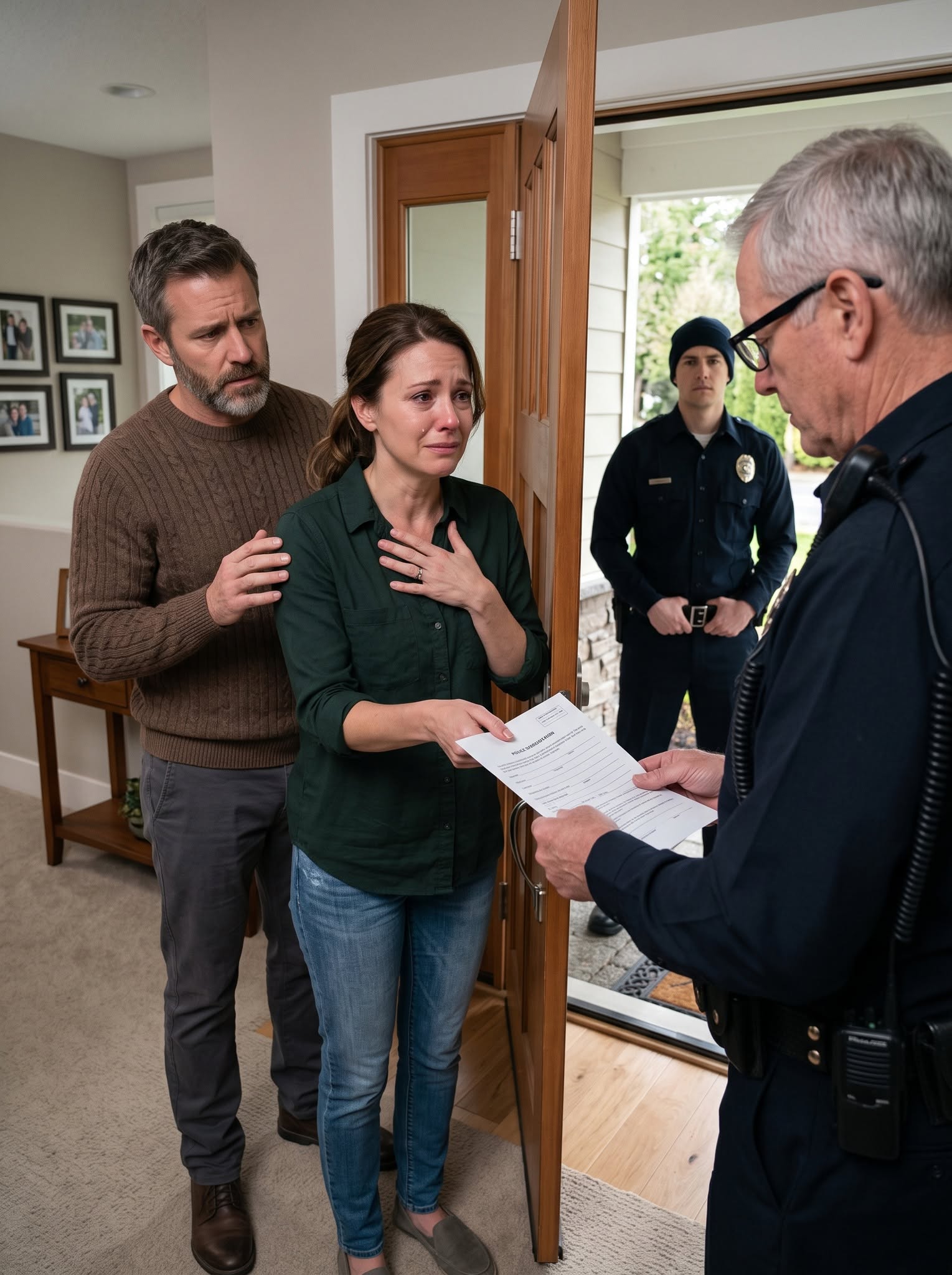
Several hours later, three loud knocks echoed through the house.
Ethan looked through the peephole, and the color immediately drained from his face. Red and blue lights reflected through the front window as he slowly turned back toward Mallory.
“Mallory,” he said quietly. “It’s the police.”
She pushed herself to her feet carefully, waiting for the dizziness to settle before walking to the door. Her body still felt fragile after weeks in the hospital, but her mind had never been clearer.
When Ethan opened the door, two police officers introduced themselves before addressing her directly.
“Mallory Hayes?”
“Yes.”
The older officer unfolded a printed report.
“Your father filed a complaint claiming money intended for your mother’s surgery was transferred to you and that you’re refusing to return it. He also alleges you’ve been financially exploiting your parents.”
Ethan instinctively stepped forward, but Mallory gently raised her hand to stop him. She wanted every fact to speak for itself.
“Officer,” she said calmly, “may I show you something?”
The officer nodded.
Mallory unlocked her phone and opened the conversation with her father, showing the original request for twelve thousand dollars, the receipt proving she had transferred only one dollar, and every threatening message that followed.
While the officers read through the texts, Ethan walked to the side table and picked up the folder that had remained there since Mallory returned home. He carefully handed over the hospital records, including the emergency contact log, admission paperwork, and Carla’s patient advocate note documenting that Mallory’s parents had been informed her condition was critical but chose to come only when their schedule allowed.
The older officer studied each page carefully, lingering on the hospital notes much longer than the others. When he finally looked up again, the expression on his face had changed from routine professionalism to quiet concern.
“Ma’am,” he said, “your father also requested a welfare check for your mother. He claimed you’re withholding money while she’s facing an emergency surgery.”
Before Mallory could answer, her phone vibrated with a new voicemail notification from her father. She pressed play without hesitation, allowing his voice to fill the silent living room.
“You think you’re clever? You send one dollar and embarrass me? I’ll make sure everyone knows what kind of daughter you are. You either send the money tonight, or I’ll tell them you’ve been stealing from us for years.”
The recording ended, leaving an uncomfortable silence behind it. Neither officer spoke immediately, and Ethan quietly rested a reassuring hand against the small of Mallory’s back.
The older officer slowly folded the complaint and handed it back to his partner.
“Mrs. Hayes,” he said, “preserve that voicemail. Don’t delete anything.”
“I won’t.”
“Do you have any reason to believe your mother is actually scheduled for emergency surgery tonight?”
Mallory met his eyes without hesitation.
“No. I believe my father needed money and used my mother’s name because he knew it was the fastest way to manipulate me.”
The officer gave a small nod. Before leaving, he provided a case number, explained how to obtain a copy of the report, and advised her to keep documenting every unwanted message or call.
After the door closed, Mallory remained standing in the quiet living room, staring at the folder still resting on the table. For years, she had believed keeping records was simply part of her job, but she now understood those same records had become the only reason the truth couldn’t be rewritten.
Part 3: I Finally Stopped Calling Their Betrayal Love
The police officers left, but the visit changed something inside Mallory that could never be undone. For the first time, she realized she no longer needed to protect her family’s reputation, because they had already proven they would sacrifice hers without hesitation.
The following morning, she contacted Nebraska Medical Center and requested certified copies of every document connected to her hospitalization. She also emailed Jenna for the original workplace incident report and downloaded years of bank statements showing every transfer she had made to her parents and sister.
She wasn’t gathering evidence to punish anyone. She was protecting herself from people who had already begun rewriting history, determined to portray themselves as victims while painting her as the villain.
By lunchtime, her father had called seven times. Mallory ignored every call, and a short time later her mother finally sent a message.
Your father is upset.
Mallory stared at the screen for several long moments before quietly setting the phone aside. It struck her that no one seemed concerned about the daughter who had nearly died, the husband who had spent weeks sleeping beside a hospital bed, or the coworker who had watched her collapse at work.
Everything still revolved around her father’s feelings.
She finally typed a single reply.
Do not contact me for money again.
Her mother’s response came only minutes later.
After all we’ve done for you?
Mallory didn’t answer.
She had finally learned that some questions were never meant to be answered. They were simply another attempt to pull her back into a cycle of guilt that had controlled her for years.
Over the following week, her sister sent message after message, swinging between desperate apologies and angry accusations. One moment she insisted their father hadn’t meant what he said, and the next she accused Mallory of destroying the family over money.
Mallory read every message without responding. Instead, she saved each one alongside the police case number, hospital records, screenshots, voicemail, and years of financial documents inside a folder she titled FAMILY FINANCIAL CONTACT, then backed up every file twice.
One evening Ethan found her sitting at the kitchen table wrapped in a blanket, carefully organizing bank statements and hospital paperwork. He looked at the growing stack of evidence before quietly reminding her that she didn’t have to prove anything to him.
“You don’t have to prove anything to me.”
“I know,” Mallory replied.
“I’m proving it to myself.”
That quiet conversation became the true turning point. It wasn’t the police arriving at her front door, her father’s threats, or the demand for twelve thousand dollars that finally changed her life.
The real change came when she understood that protecting herself wasn’t cruelty. It was simply refusing to be used any longer.
Her father tried one final time.
In another voicemail, his anger slowly gave way to excuses as he claimed hospitals made him uncomfortable, insisted he had been frightened, said her mother cried every night, and finished by reminding her that family wasn’t supposed to keep score.
Mallory listened to the recording once.
Then she opened a group conversation with her parents and sister and sent the final message they would ever receive from her.
I was in the hospital for weeks and almost died. Not one of you came to visit me, not even once. A month later, Dad demanded $12,000 and filed a false police report when I refused. I have the hospital records, the bank receipt, the text messages, and the voicemail. Do not ask me for money again. Do not come to my home uninvited.
Her sister replied first.
Wow.
A few moments later, her mother sent a much shorter response.
You have changed.
Mallory looked at those three words for a long time before quietly locking her phone. Maybe she had changed, but nearly dying had stripped away the habit of apologizing for wounds other people had caused.
When Ethan found her sitting silently in the kitchen, tears were already running down her face. He wrapped an arm around her shoulders without asking questions, giving her all the time she needed.
After several minutes, she finally whispered the truth she had carried for weeks.
“I kept waiting for them.”
“I know.”
“Even after I knew… I still kept waiting.”
She cried harder then, not because she missed the family she thought she had, but because she was finally grieving the family that had never truly existed.
Over the following months, Mallory slowly reclaimed her life. She returned to work, where Jenna greeted her with a ridiculous WELCOME BACK, PAYROLL QUEEN banner that made her laugh until tears filled her eyes, and Carla even sent a handwritten card thanking her for the gratitude she had shown the hospital staff.
Her parents never offered a genuine apology. Every message from her father eventually circled back to money, her mother never admitted abandoning her daughter when she needed her most, and her sister quietly disappeared once the financial support stopped.
At first, the silence felt unfamiliar.
Then it became peaceful.
The first holiday without them arrived, and instead of chaos, accusations, and emergency phone calls, Mallory spent the morning making pancakes with Ethan while winter sunlight filled the kitchen. For years she had mistaken constant crisis for love, but peace finally taught her what real family looked like.
She kept the police report, the hospital records, and every piece of evidence carefully stored away. She rarely opened the folder anymore because she no longer needed the documents to remind herself of the truth.
Her family had left two hospital chairs empty.
Ethan had filled one.
Jenna had shown up carrying books and clean socks.
Carla had written down the facts when others hoped they would be forgotten.
Looking back, Mallory no longer remembered the police accusation before anything else. She remembered standing in her living room with the hospital folder open, Ethan beside her, and her father’s own recorded voice exposing the truth that years of excuses had tried to hide.
For the first time in her life, she let that truth remain exactly as it was, without disguising it as forgiveness.