- The Dress She Had Practiced In for Months
- On the morning of my younger brother’s rehearsal dinner, my seven-year-old daughter, Lila, stood in front of the bathroom mirror with two tiny hair clips resting in her palms.
- One was shaped like a pearl butterfly. The other had three small ivory flowers arranged along a silver pin. She studied them with the seriousness of someone making the most important decision of her life.
- “The flowers,” she finally announced. “They match the basket.”
- I smiled and carefully pinned them into her soft brown hair. “You made the perfect choice.”
- For nearly four months, Lila had talked about being the flower girl at my brother’s wedding. She had practiced walking slowly through our hallway while holding an empty wicker basket in front of her. She had counted her steps, corrected her posture, and reminded herself not to rush.
- Whenever she reached the living room rug, she would turn around and ask, “Was that graceful enough?”
- Her father, Reid, always answered as if he were judging a royal ceremony: “Very graceful. But perhaps one more practice round.”
- She would laugh and begin again. By the week of the wedding, there was a faint gray mark along the hallway baseboard where her shoes repeatedly brushed the same corner.
- That morning, she wore a pale lavender dress with a soft tulle skirt. Reid had polished her shoes the night before and placed them beside the front door. He had also packed snacks, a sweater, and a congratulatory card for my brother, Holden, and his fiancée, Blair.
- Reid was the kind of husband who noticed what needed to be done before I asked. As I stood in the kitchen checking my purse for the third time, he gently touched my shoulder.
- “You have helped enough with this wedding,” he said. “Everything important is already in the car. Let’s go enjoy the evening.”
- I wanted to believe it would be that simple.
- The Message Before We Went Inside
- The rehearsal dinner was being held at a lakeside estate outside Asheville, North Carolina. Blair’s family had rented the entire property for the weekend. The house had tall white columns, wide porches, and gardens that seemed to stretch toward the mountains—the kind of place where every chair looked expensive and every flower appeared to have been positioned by hand.
- During the drive, Lila pressed her face against the car window. “Do you think Uncle Holden will watch me walk tomorrow?”
- “Of course he will,” I told her.
- “Will he notice my flower clips?”
- “He will probably notice them before he notices anything else.”
- She leaned back in her seat, completely satisfied.
- As Reid turned into the gravel parking area, my phone vibrated. The message was from my mother, Marjorie:
-
Please come around to the garden entrance before you go inside. I need to speak to you alone. Let Reid stay with Lila.
- I read it twice. A strange heaviness settled in my stomach.
- Reid glanced at me. “What happened?”
- “My mother wants to speak to me privately.”
- He studied my face but did not pressure me.
- I turned toward Lila and forced a cheerful smile. “Stay here with Dad for a minute. I’m going to find Grandma.”
- “Okay,” she said. “I’ll show Dad how the flower clips sparkle outside.”
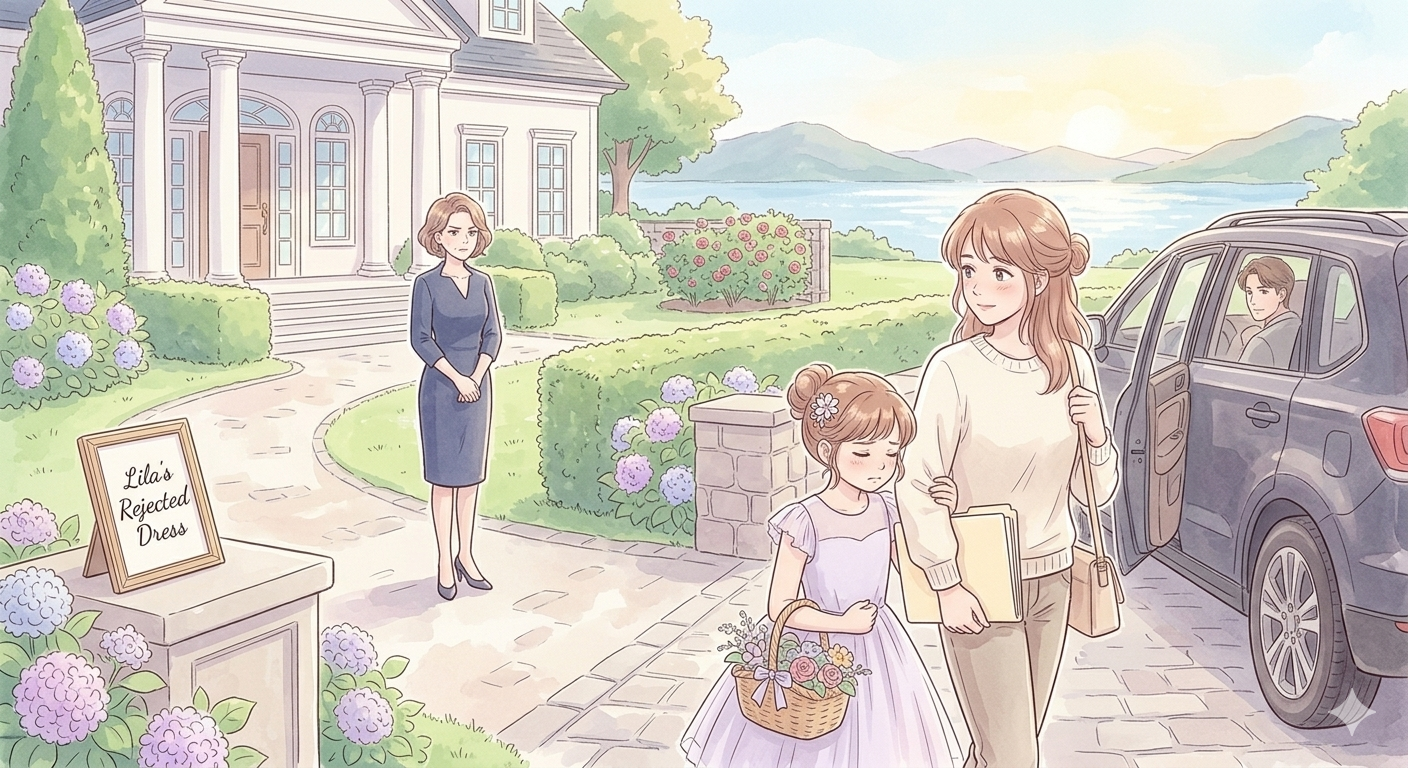
- I closed the car door and followed the stone path around the side of the estate. My mother was standing beside a rose garden in a navy dress, her hands folded neatly at her waist. She looked like someone waiting to deliver news she had already decided I would accept.
- The Decision They Hid From Us
- “What is going on?” I asked.
- My mother took a slow breath. “I wanted to tell you before you walked into the dinner room.”
- I waited.
- She glanced toward the house before continuing. “Blair’s younger sister has a daughter named Tatum. She is five. Blair decided it would look more connected if Tatum were the flower girl instead of Lila.”
- For several seconds, I could not understand what she was saying. “Instead of Lila?”
- “Yes.”
- “Since when?”
- My mother looked away. “A few weeks ago.”
- The words landed harder than I expected. “A few weeks ago?” I repeated. “Lila has been practicing every day. She is sitting in the car wearing the dress we drove to three stores to find.”
- “I know.”
- “She picked her hair clips this morning because they matched the basket.”
- “I know, Laurel.” My name sounded almost impatient in her mouth.
- “Then why did no one tell me?”
- She lowered her voice. “Holden was supposed to call you, but Blair was already overwhelmed, and he did not want to create another difficult conversation before the wedding.”
- I stared at her. “So the solution was to let a seven-year-old arrive believing she still had a role that had been taken away weeks ago?”
- My mother’s expression tightened. “It is Blair’s wedding. She wants the people in the ceremony to feel connected to her side of the family.”
- “Lila is Holden’s niece.”
- “No one is saying she is not family.”
- “That is exactly what this decision says.”
- My mother sighed. “Please do not turn this into something larger than it needs to be. Holden is under enormous pressure. Blair is emotional. Tonight needs to go smoothly.”
- I looked at her carefully. “And what do you need from me?”
- “I need you to be understanding.”
- What she truly meant was familiar: Be quiet. Make yourself smaller. Protect Holden from the consequences of his own choices. I had been doing that since childhood.
- “I need a minute,” I said.
- My mother reached toward my arm, but I stepped back. “I said I need a minute.”
- She nodded, turned, and walked toward the house. I remained beside the roses, wondering how I was supposed to return to the car and explain to my daughter that the adults she trusted had simply forgotten to protect her heart.
- The Question That Nearly Broke Me
- Reid was kneeling beside the car when I returned. Lila was collecting smooth white stones from the gravel and arranging them in a row.
- The moment Reid saw my face, he stood. “Lila,” he said gently, “can you find five stones that are perfectly round?”
- She immediately began searching. Reid moved closer to me. “Tell me.”
- “They replaced her.”
- His jaw tightened. “When?”
- “Weeks ago. Holden knew. Everyone expected Mom to tell me tonight.”
- Reid was silent for a moment. “Do you want to leave?”
- I looked at Lila. She held up a stone triumphantly. “This one is almost a circle!”
- My heart ached. “I have to tell her first.”
- Reid nodded. “Whatever you decide after that, I am with you.”
- I knelt on the gravel in front of my daughter. “Sweetheart, I need to tell you something about tomorrow.”
- She immediately stopped smiling. Children always notice when adults are trying too hard to sound calm.
- “The wedding plans changed,” I said. “Another little girl is going to carry the flower basket.”
- Lila blinked. “Did I walk too fast?”
- The question nearly broke me. I took both of her hands. “No. You did everything perfectly. This was not because of your walking, your dress, or anything you did.”
- She looked down at her shoes. “Did Uncle Holden not like my practice?”
- “He never saw you practice, honey. This was an adult decision, and the adults should have told us sooner.”
- She was quiet. “Can I still wear my dress?”
- “Absolutely.”
- “Can I still eat dessert?”
- Reid crouched beside us. “I have heard there may be two kinds of cake.”
- She considered this information. “Then I still want to go inside.”
- Her strength made me proud, but it also made me sad. She was trying to make the evening easier for us when the adults should have made it easier for her.
- The Basket in Another Child’s Hands
- The dining room was filled with candlelight, soft music, and carefully arranged tables. Nearly forty guests stood talking beneath a large crystal chandelier.
- Holden was near the bar with his arm around Blair, laughing. He did not notice us enter, but Blair did. Her eyes moved from my face to Lila’s dress. For a brief moment, she looked annoyed rather than apologetic.
- Before we reached our table, a little girl in a pale pink dress hurried past us carrying a decorated wicker basket. Lila stopped walking and stared at the basket, then reached for my hand. She did not cry or complain; she simply held my fingers a little tighter.
- Throughout dinner, she behaved with more grace than anyone had the right to expect. She ate her chicken, shared bread with Reid, and told the older couple beside us a long story about a turtle she had seen near our mailbox. I smiled when necessary, but inside, I was unraveling.
- After the main course, I went to the restroom and stood at the sink with cold water running over my wrists. My brother had known for weeks. He had watched me send photographs of Lila’s dress in the family group chat. He had reacted with a heart symbol when I told everyone she was practicing. He had allowed her excitement to continue because honesty would have made his week inconvenient.
- When I returned to the hallway, my phone vibrated. The message was from my father, Eugene:
-
Please meet me on the east porch. Now.
- My father rarely sent messages. When he did, they were usually no more than two words. Something had changed.
- What My Father Had Finally Understood
- My father stood alone near the porch railing, looking toward the darkening lake. When he heard me, he turned.
- “Your mother told me what happened.”
- I folded my arms around myself. “She told me in the garden five minutes before we walked in.”
- His expression hardened. “Holden knew for twenty-three days.”
- I looked away. “I assumed as much.”
- “He sent your mother a message asking her to handle it because he believed you would become emotional.”
- A painful laugh escaped me. “He meant I would react like a mother whose daughter had been hurt.”
- My father nodded, staying silent for a long moment before placing both hands on the railing. “I have spent thirty-two years making life easier for your brother,” he said. “Every time he avoided responsibility, someone stepped in. Sometimes it was your mother. Often it was me. And more times than I want to admit, it was you.”
- I felt tears press behind my eyes.
- “This is not only about a wedding role,” he continued. “It is about the way this family has trained you to absorb every disappointment quietly so Holden never has to feel uncomfortable.”
- He reached into the inside pocket of his jacket. “Your grandmother’s estate was fully settled last month. The final property was the cabin and surrounding land in Boone.”
- The memory came instantly: summer mornings beside the creek, wildflowers near the porch, Holden and I catching fireflies in glass jars when we were children.
- “I had planned to divide it between you,” my father said. “I changed the documents last week. The property belongs entirely to you.”
- I stared at him. “Dad, I cannot accept land because of what happened tonight.”
- “This was decided before tonight,” he replied. “Tonight simply confirmed that I made the right decision. Holden has received help, opportunity, and protection his entire life. You have received expectations.”
- I could not speak.
- Then he removed a small green velvet pouch from his other pocket. Inside was my grandmother’s antique gold locket. She had worn it every day.
- “Where did you get this?”
- My father’s face tightened. “Your mother gave it to Blair as a welcome-to-the-family gift three months ago.”
- I felt the air leave my lungs. “She gave Grandma’s locket away?”
- “Without asking you or me. Holden mentioned it by accident last week. I spoke to Blair tonight and explained that the necklace had been passed down for you. She returned it.”
- I closed my fingers around the locket. For the first time that evening, I cried.
- My father placed one hand on my shoulder. “I should have stopped this pattern years ago.”
- “You are stopping it now.”
- He looked toward the dining room doors. “I am going back inside, and I am going to say something.”
- I panicked. “Dad, you do not need to ruin the dinner.”
- “I am not going to ruin anything,” he replied. “I am going to tell the truth. Those are not the same thing.”
- The Truth Spoken at the Table
- When we entered the dining room, my father walked directly toward the head table. He did not tap a glass or raise his voice; he simply stood beside Holden until the conversations gradually faded.
- Holden looked up. “Dad, is everything okay?”
- “No,” my father said calmly. “Everything is not okay.”
- The room became completely still.
- My father looked around at the guests. “My daughter and granddaughter arrived tonight believing Lila would participate in tomorrow’s ceremony. They were informed in the parking area that the plan had changed weeks ago.”
- Several guests shifted uncomfortably.
- “No one gave Laurel the courtesy of a phone call. No one gave her the opportunity to prepare her daughter. My son asked his mother to deliver the news because he did not want to have an uncomfortable conversation.”
- Holden’s face turned red. Blair stared at the table.
- My father continued. “I love my son. I want his marriage to begin with happiness. But love does not require silence when someone behaves carelessly. Lila is his niece. She practiced for months because she wanted to make him proud. She deserved honesty.”
- My mother stood near the wall, pale with anger. “Eugene, this is not the appropriate place.”
- My father turned toward her. “That is what we always say when the truth makes us uncomfortable.”
- No one moved.
- “I am not asking anyone to change the ceremony tonight,” he said. “I am asking this family to stop pretending that avoiding responsibility is the same as protecting peace.”
- Then he looked directly at Holden. “I love you. That is why I expect better from you.”
- He stepped away from the table.
- The silence remained for several seconds before quiet conversations slowly resumed.
- Lila was sitting in Reid’s lap when my father returned to us. She looked up at him. “Grandpa, did you give a speech?”
- He smiled faintly. “I suppose I did.”
- She touched one of her flower clips. “I still like my dress.”
- My father lifted her into his arms. “You look beautiful, and those flowers are exactly right.”
- The Apology That Came Too Late
- Near the end of dinner, Holden approached our table alone. For once, he did not look confident.
- “I should have called you,” he said.
- I waited.
- “The day Blair changed the plan, I should have called. I kept telling myself I would do it later, and then I asked Mom to handle it because I was afraid you would be upset.”
- “I was always going to be upset,” I said. “The difference is that Lila did not have to be surprised in the parking lot.”
- He nodded. “You are right.” He glanced toward her. “Is she okay?”
- “She is seven. She is trying to protect everyone else from seeing how disappointed she is.”
- He closed his eyes briefly. “I want to make it right.”
- “Then begin by being honest. Do not promise her anything unless you know you can keep that promise.”
- The next afternoon, Lila did not carry the flower basket. Instead, the wedding coordinator gave her one large white peony tied with a lavender ribbon. She was invited to walk at the front of the procession before the rest of the wedding party.
- It did not erase what had happened, but when she walked down the aisle, she held that flower as if she were carrying something priceless. Her steps were slow and careful.
- When she saw Reid and me, her face brightened. My father stood and applauded, and soon several guests joined him. Lila smiled so widely that I knew she would remember that moment longer than she remembered the basket.
- The Family We Became Afterward
- Healing did not happen quickly.
- My mother continued to insist that she had only been trying to keep the weekend peaceful. I eventually stopped asking her to understand why her actions had been hurtful. We now have polite conversations and carefully managed family dinners; there are boundaries where there were once expectations.
- Holden called me three weeks after his honeymoon, and we spoke for nearly two hours. For the first time, he admitted how often he had allowed others to solve his problems and said he wanted to become someone who faced difficult conversations instead of avoiding them. We are not as close as we were when we were children, but we are more honest.
- My father calls every Thursday evening, always asking to speak to Lila first. They discuss birds, school projects, and whether chocolate ice cream is better than strawberry. He sends her magazine pages about cardinals and handwritten notes about the cabin in Boone.
- The property is still mine. We visited it in early autumn. Lila ran through the yard gathering leaves while Reid repaired a loose porch step, and my father sat near the creek, watching her laugh.
- I wore my grandmother’s locket that day. Inside was a tiny folded piece of paper with a verse written in her handwriting.
- Lila asked me to read it. When I finished, she rested her head against my shoulder. “Great-Grandma wanted you to have it, right?”
- “Yes,” I said.
- “Then it came home.”
- I looked across the yard at my father, who had finally chosen honesty over comfort.
- “Yes,” I whispered. “It came home.”
- What Life Teaches Us About Boundaries and Family
-
Silence is not peace: Protecting harmony should never require a child to quietly carry the disappointment created by adults who were unwilling to speak honestly.
-
Accountability shows true love: Love is not demonstrated by endlessly shielding someone from consequences; genuine love means holding them accountable so they can grow.
-
Courage over comfort: Speaking up might make a room uncomfortable for a moment, but silence allows unfair dynamics to persist for a lifetime.
-
Boundaries are self-respect: Setting boundaries does not mean you have stopped loving your family; it means you have decided your own dignity deserves protection too.
-
True legacy: The most meaningful inheritance is not always land or jewelry, but the courage to break an unhealthy cycle so the next generation doesn’t have to carry it.