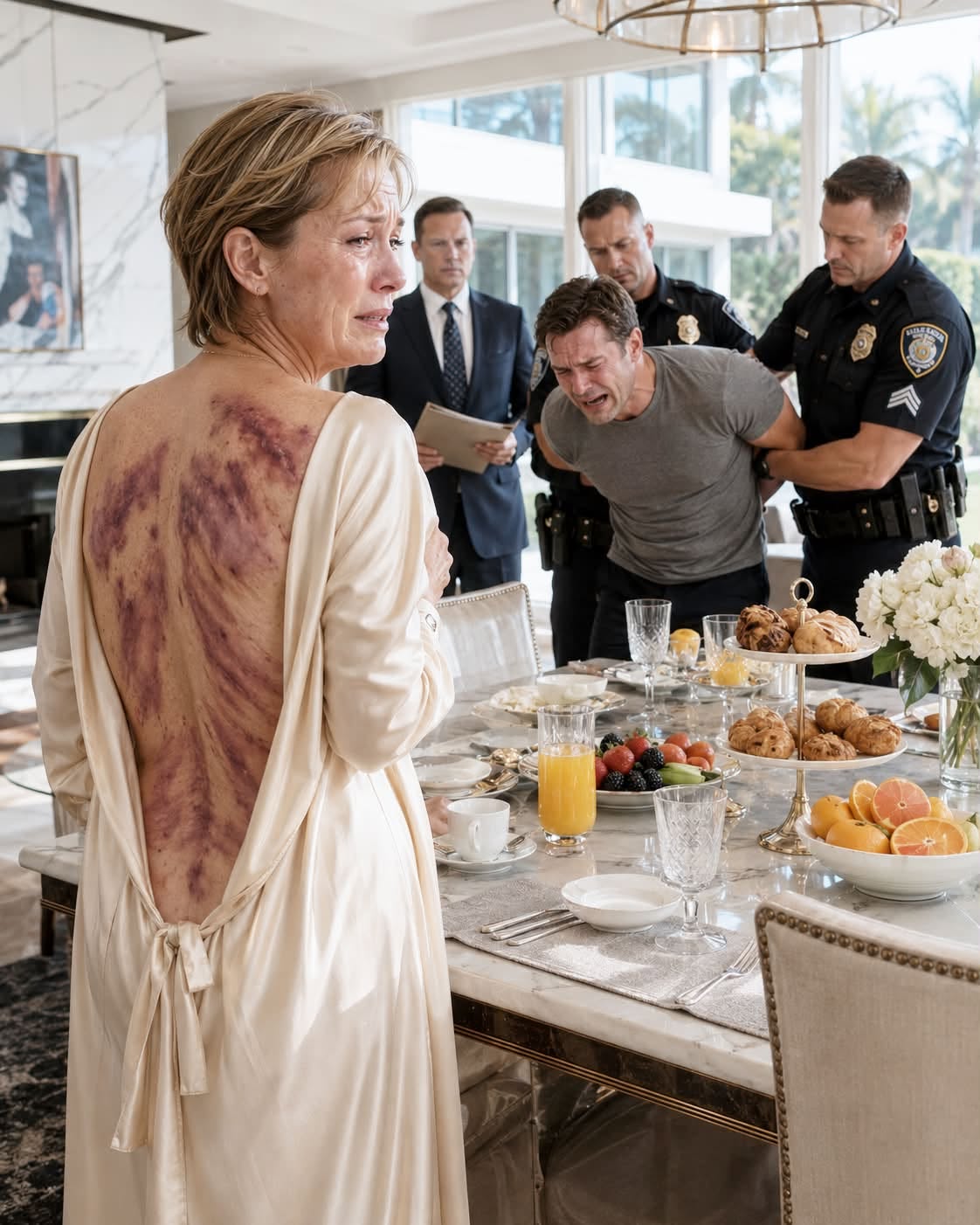
I did not hear the bones in my body crack. What I heard was the sound of an entire family legacy collapsing.
It was 6:14 on a Tuesday evening when my son, Nathan Whitmore, decided that my life was worth less than the money he owed. The marble staircase inside Whitmore Estate gleamed beneath the chandeliers, polished so perfectly that it reflected every crystal above it. As I fell down all twelve steps, each impact felt like a punishment for every warning I had ignored during the past thirty-six years.
When I finally stopped at the bottom, everything around me blurred into red and white. Blood warmed the side of my face while the floor beneath me remained painfully cold. I looked upward, expecting to see my son horrified by what he had done.
Instead, I saw a stranger who happened to share my late husband’s features.
Nathan stood on the landing, calmly adjusting the gold cuff links I had given him for his birthday. He did not rush down. He did not call for help. He simply watched me fight for breath.
“You should have listened when I asked the first time, Mom,” he said.
His voice carried none of the charm he used on wealthy investors and society women. It was cold, controlled, and frightening.
Nathan had once been the little boy who climbed into my room during thunderstorms, clutching a worn green blanket. Now, at thirty-six, he was an empty imitation of the man his father, Charles Whitmore, had wanted him to become.
Charles had transformed Whitmore Freight from one delivery truck into an international logistics empire. But for all his business talent, he had failed to give his only son a conscience.
Nathan slowly walked down the stairs, his leather shoes clicking against the stone.
“You’re being dramatic,” he said, stepping around the tea I had spilled as though it were a minor mess.
“My hip,” I gasped. Pain shot through my body like burning wire. “I think it’s broken.”
“Then call an ambulance.”
He crouched beside me, but not to help. Instead, he pulled a tablet from inside his jacket.
“First, authorize the transfer of two hundred thousand dollars into the offshore account I showed you this morning. The people I owe do not care about your injuries. Honestly, neither do I.”
I stared at him through the blood clouding my vision.
My son was no longer asking for money.
He was hunting me for it.
“No,” I whispered.
His smile disappeared.
He grabbed my arm so hard that I knew his fingers would leave dark marks.
“You will sign,” he said. “Maybe tonight. Maybe tomorrow. You are seventy-one years old, Mother. Elderly women fall. They become confused. Sometimes they go to sleep and never wake up.”
Then he stood, straightened his shirt, and walked out.
The front door slammed, sending an echo through the entrance hall and pain through my ribs. I remained on the floor beneath the large portrait of Charles hanging above the fireplace.
I’m sorry, Charles, I thought. I allowed the wolf into our home.
I dragged myself toward the phone on a nearby table. Every inch felt endless. But just before I reached it, the tablet Nathan had left behind lit up.
The screen displayed a live video feed of a nursery I did not recognize.
The room had pale yellow walls and a white crib. A man stood beside it, holding a bottle.
A man I had buried five years earlier.
The hospital smelled of disinfectant and broken promises.
Dr. Malcolm, an old family acquaintance, examined my X-rays and tried to hide his concern.
“You have a hairline fracture in your hip, two cracked ribs, and a serious concussion, Vivian,” he said. “You told the nurse you tripped. We both know you do not simply fall on level marble while wearing practical shoes.”
“I’m getting clumsy,” I lied.
I was not yet ready to use the truth.
After he left, I took out the prepaid phone I had begun carrying after Nathan moved back into the guest wing three months earlier. I did not call the police.
I called Katherine Brooks, the attorney who had protected Whitmore family interests for more than twenty years.
“Katherine,” I said, struggling to keep my voice steady. “I need the emergency amendment. The one Charles prepared privately.”
The silence on the line lasted several seconds.
“Are you certain?” she asked. “Once we activate it, Nathan will be legally removed from every trust, asset, company interest, and family account.”
“He pushed me down the stairs. Then he watched me bleed while demanding a transfer.”
“I’ll be there within the hour.”
While I waited, I thought about the man in the nursery.
His name was Andrew Cole.
Andrew had been Charles’s most trusted executive and the vice president of operations at Whitmore Freight. Five years earlier, he had supposedly died in a boating accident off the coast of Massachusetts. I had seen the wreckage. I had attended his closed-casket funeral. I had even paid the tuition for his children afterward.
If Andrew was alive, then the accident had been staged.
And if Nathan was monitoring him, my son was involved in something far more dangerous than gambling debts.
When Katherine arrived with two younger partners, Miles Grant and Owen Pierce, I had stopped thinking like a victim.
I was thinking like the woman who had once managed every financial book in the Whitmore empire.
“He believes I’m fragile,” I told them as they arranged documents across my hospital table. “He thinks kindness means weakness.”
“We found more than we expected,” Owen said, opening his laptop. “Nathan has been forging your signature to guarantee personal loans. He used commercial properties in Boston and several warehouses near Newark as collateral.”
“He isn’t only stealing money,” I said. “He is dismantling the company piece by piece.”
Katherine nodded. “His technology business in California never existed. It was a cover for an illegal high-stakes betting operation. It failed, and now he owes millions to people who do not rely on courts to collect.”
I signed the amendment.
My hand trembled, but the signature remained clear.
“What do you know about Andrew Cole?” I asked.
Katherine’s expression changed.
“How do you know that name?”
“I saw him on Nathan’s tablet. He was alive, standing inside a nursery with a baby.”
Katherine exchanged a worried look with Miles.
“If Andrew is alive,” she said, “then the forty-million-dollar insurance payment the company collected after his death was fraudulent. Federal investigators could freeze every Whitmore account.”
The truth settled heavily over me.
Nathan was not simply stealing from the estate. He was standing in the center of a criminal conspiracy with enough power to destroy everything Charles and I had built.
My phone vibrated.
An unknown number had sent me a photograph of the hospital parking lot.
The message beneath it read:
The doctor says you are stable. Good. I’m coming to get you. We need to discuss Andrew.
Nathan drove me home in my vintage Mercedes, taking every turn too fast because he knew the movement caused pain.
He remained silent until the car entered the tree-lined driveway leading to Whitmore Estate.
“You’re going to become a grandmother again,” he said with false sweetness.
“The baby in the nursery?”
“Andrew’s son. His name is Charlie, after Dad. Sentimental, isn’t it?”
Nathan smiled.
“Andrew has been managing offshore accounts since his supposed death. But now he wants more money to keep quiet about the insurance fraud.”
“You helped fake his death.”
“Dad did,” Nathan corrected.
The words stopped my breath.
“Charles discovered Andrew had been stealing from the company,” Nathan continued. “Instead of turning him in, Dad used him. Charles wanted to move money before a federal audit. He helped Andrew disappear, collected the insurance payment, and placed the money in a private Caribbean trust. I found the records after Dad died.”
My son’s betrayal had broken my heart.
My husband’s betrayal changed the foundation beneath my entire life.
Charles, the man I had loved for forty years, had built this secret.
Nathan helped me from the car roughly and guided me into the house.
“Here is what happens now,” he said. “You give me full power of attorney. I pay Andrew, keep federal investigators away, and arrange for a nurse to care for you here.”
He leaned close.
“If you refuse, the newspapers will report that a grieving widow accidentally overdosed on pain medication.”
He pushed me into a chair inside Charles’s study.
“I invited someone for dinner. Vanessa will be joining us.”
“The woman you used to pay to stay near you?”
His face hardened.
“She is my business partner. Be ready by six. And don’t bother calling Katherine. Her office line has already been redirected.”
He left the study whistling.
I sat alone in the darkness.
My husband had been a criminal.
My son had become a monster.
My doctor might be helping him.
Then I looked toward the metal cabinet hidden behind Charles’s portrait.
Nathan knew about the main safe, but he did not know about the second key.
Near the end of his life, Charles had either developed a conscience or become afraid of judgment. I moved the portrait and opened the concealed compartment.
Inside was a folder marked:
FOR VIVIAN—WHEN THE INEVITABLE HAPPENS.
The folder contained account records, legal papers, and a small recording device. Charles had secretly installed microphones inside the study after Nathan first stole from the company ten years earlier.
The system had been saving conversations to a secure server.
I played the newest file.
“She’s seventy-one,” Nathan’s voice said. “Older people fall. Once she signs, we move the money. If she resists, increase the dosage. The doctor is already being paid.”
Dr. Malcolm was not protecting me.
He was helping Nathan.
The clock read 5:15.
I had forty-five minutes to take control.
I used the only telephone line Nathan had forgotten to monitor and called a number I had memorized years ago. It did not belong to the police or an attorney.
It belonged to Samuel Ross, a private investigator and crisis specialist who had solved problems for Charles that polite society was never supposed to know about.
The phone began ringing.
A floorboard creaked behind me.
Vanessa stood in the doorway holding a syringe.
“Nathan said you might become difficult,” she told me.
“Put it down,” I said. “Unless you want to explain why a twenty-six-year-old woman with a narcotics record is standing over a billionaire’s widow with a syringe full of fentanyl.”
Her smile weakened.
“Nathan said you were confused and needed help sleeping.”
“I have never been more awake.”
I leaned forward.
“Did he tell you about the second trust? The one that automatically alerts federal investigators if I die unexpectedly?”
It was a lie.
But it was exactly the lie I needed.
“He never mentioned that,” she said.
“Of course not. Nathan does not intend to share anything with you. If I die tonight, who will the police blame? The grieving son, or the girlfriend with a criminal history who purchased medical supplies yesterday?”
Doubt moved across her face.
“I can offer you something better,” I continued. “Nathan is broke. Everything he promised you has been lost or pledged to criminals. But I still control accounts he cannot reach. Leave this room, tell him I am ready for dinner, and cooperate when the time comes. I will make sure you leave this house alive and protected.”
Vanessa looked at the syringe.
Then she placed it in her pocket and disappeared.
One threat removed.
Samuel finally answered.
“It’s Vivian Whitmore,” I said. “I need a team at the estate. I also need you to find Andrew Cole. He is somewhere near a nursery outside Greenwich. Bring him here safely.”
“That will cost you.”
“Charge it to the Whitmore estate. It is about to have new leadership.”
At 5:50, I sat at the dining table wearing a dark sapphire silk dress and the emerald necklace Charles had given me when Nathan was born.
My hip throbbed. My ribs burned.
But I looked like a queen waiting to pass judgment.
Nathan entered wearing a tuxedo and took Charles’s chair at the head of the table.
“You look beautiful, Mother,” he said. “I assume Vanessa explained the situation.”
“The situation has changed,” I replied, pouring wine. “To the future.”
“To the future.”
We ate while he described plans for international expansion that were clearly methods of laundering money. He spoke about combining company assets with Andrew’s offshore holdings. He talked as though I were already dead.
Finally, I set down my glass.
“There is one thing I want, Nathan. I want to meet Andrew’s child. In fact, I think the entire family should be here.”
Nathan laughed.
“Andrew is legally dead. Dead men cannot attend dinner.”
“Are you certain?”
The front doors opened.
Two men entered with Andrew between them. His hands were secured in front of him. He looked pale and terrified.
Katherine followed.
“The attempt to redirect my telephone line was clever,” she told Nathan. “But you forgot I still have the master access code to the Whitmore security system.”
Nathan stood.
His face turned gray.
“You think this changes anything?” he demanded. “Andrew is a criminal. If I fall, the entire Whitmore name falls with me.”
I picked up a remote control.
The dining-room speakers came alive.
“She’s seventy-one. Older people fall. If she resists, increase the dosage.”
Nathan’s recorded voice filled the room.
Andrew sank into a chair.
“I warned you,” he said. “I told you she would uncover everything.”
“Be quiet!” Nathan shouted.
Katherine placed a thick folder on the table.
“We have records from the offshore trust, evidence of forged signatures, and testimony from the nurse you tried to bribe. We also have a signed statement from Vanessa.”
Vanessa stood near the kitchen entrance with a suitcase at her feet.
Nathan glared at her.
“You betrayed me.”
“She understood that you intended to use her,” I said. “That makes her more practical than you ever were.”
Miles and Owen entered with officers from the Financial Crimes Division.
The lead agent stepped forward.
“Nathan Whitmore, you are under arrest for attempted murder, elder abuse, financial fraud, and conspiracy.”
Nathan did not run.
He sat down and laughed.
“You think you have won? Once the government uncovers the insurance fraud, everything is seized. The company, the estate, the foundation—all of it. You will have nothing left except a broken hip and a disgraced name.”
I looked at Katherine.
She gave me a sorrowful nod.
“He may be right,” she said. “The fraud began with Charles. Protecting yourself may require sacrificing the entire company.”
I looked around the dining room at the polished table, the family portraits, and the symbols of wealth accumulated over generations.
Then I remembered the final document in Charles’s hidden file.
“Not exactly,” I said.
I stood with the help of my cane and removed a stamped letter from my pocket.
“Charles confessed before he died.”
The room became silent.
“He sent a sealed statement to the Department of Justice five years ago. He admitted arranging Andrew’s disappearance and the insurance fraud. He named himself as the sole architect and prepaid financial penalties from a private account.”
Nathan stared at me.
“He surrendered his reputation?”
“He protected the company and its employees from his own crimes. He did what you never could. He accepted responsibility.”
I turned toward the officers.
“Take him.”
As they escorted Nathan away, he stopped near the door.
“You think Dad did that for you?” he called back. “Read the rest of his letter. Read about the woman who has the real claim to the Whitmore name.”
After everyone left, the estate became painfully quiet.
I returned to Charles’s study and opened the final pages of his letter.
Vivian, the handwriting began, if you are reading this, Nathan has failed us. There is another heir. Her name is Claire. She is Andrew Cole’s half sister, but she is also my daughter. She was born thirty years ago. I have supported her privately. She holds controlling rights in the Newark properties. If Nathan tries to seize the company, find her. She has legal authority to challenge him.
I could barely breathe.
Charles had a daughter.
For thirty years, he had hidden a second life beneath business trips, donations, and unexplained visits.
Nathan had discovered Andrew’s secret.
He had also discovered Claire.
And if she stood between him and the company, she was in danger.
I called Samuel.
“Was there a woman at Andrew’s home?”
“There was,” he said. “She disappeared before we arrived. Neighbors saw her forced into a dark SUV.”
“Find her before Nathan’s creditors do.”
The next two days disappeared beneath investigations, emergency board meetings, and legal filings. Nathan’s access was removed. Dr. Malcolm was arrested after evidence connected him to the medication plan.
On the third afternoon, a car entered the driveway.
A woman in her late twenties stepped out. She had dark hair and Charles’s unmistakable eyes.
She entered the hall and looked at the staircase where Nathan had pushed me.
“I heard what happened,” she said. “My name is Claire.”
“I’m Vivian.”
We sat inside the sunroom while winter light reflected across the snow.
Claire explained that Charles had presented himself as a distant family friend. He paid for her law degree and her mother’s medical care but never admitted he was her father.
“I don’t want the Whitmore name,” she said. “I don’t want the money. I only wanted to know whether I was a mistake.”
“You were hidden,” I told her. “That was his failure, not yours.”
I placed a set of board documents before her.
“I am resigning as chairwoman. I want you to take my seat.”
She looked stunned.
“Why would you trust me? I am proof that your husband betrayed you.”
“No,” I said, taking her hand. “You are proof that something valuable survived his dishonesty. Nathan inherited his greed. You inherited his ability.”
Before she could answer, the security alarm sounded.
A guard’s voice came through the intercom.
“Mrs. Whitmore, three men are at the gate. They say Nathan left an unpaid debt. They are demanding the Newark properties.”
The men were not attorneys.
They were the criminals Nathan had been borrowing from.
“Lock yourself in the study,” I told Claire.
“You cannot confront them alone.”
“I am a seventy-one-year-old widow with a broken hip and an excellent security team. I am not alone.”
I opened the front door.
Three men stood on the porch in expensive coats. Their leader was Viktor, a name I recognized from Nathan’s private messages.
“Mrs. Whitmore,” he said. “Your son promised us the Newark properties.”
“My son never owned them.”
Viktor smiled coldly.
“We know about Claire. Her life may be worth the same amount as those warehouses.”
Anger burned through me.
“You have five minutes to leave.”
“You are bluffing.”
I raised my phone. A live video of the men, their faces, and their vehicle was already being transmitted to federal investigators.
“Every person on this porch is being identified. Your license plate has been recorded. If anyone threatens this house or Claire, you will spend the rest of your life in prison.”
Viktor studied me.
“Nathan said you were dangerous.”
“I am a mother,” I replied. “And I have finished tolerating men who mistake restraint for weakness.”
The men returned to their vehicle and drove away.
Only after the gates closed did my strength fail.
Claire caught me before I fell.
“Are they gone?”
“For now,” I said. “But we have a company to repair and a name to rebuild.”
Six months later, the staircase inside Whitmore Estate no longer frightened me. I replaced the marble with reclaimed oak. It was warmer, safer, and more honest.
Nathan pleaded guilty and received fifteen years in federal prison. I had not visited him.
Andrew entered witness protection and agreed to testify against the betting network. His little boy was being raised in a bright, peaceful home by his mother with help from Claire.
I stood inside the boardroom of Whitmore Freight overlooking the city.
Claire sat at the head of the table, discussing ethical labor practices and sustainable transportation. She was intelligent, calm, and capable.
She was the best thing Charles had left behind.
Katherine stood beside me with a glass of wine.
“To boundaries,” she said.
“To truth,” I corrected.
The company survived. The family foundation was renamed the Whitmore Renewal Fund and began supporting victims of domestic abuse, elder exploitation, and financial crime.
We had turned our humiliation into protection for other people.
My ribs healed. I stopped using the cane. The marks Nathan left on my arm eventually disappeared, but the lesson remained.
I no longer wondered whether I had been too severe with my son.
I no longer asked whether I could have saved Charles from his own corruption.
I only wondered why it had taken me so many years to understand that the strongest woman is not the one who never suffers.
She is the one who finally refuses to remain broken.
As I prepared to leave the boardroom one evening, my assistant handed me an envelope with no return address.
Inside was a photograph of a worn green blanket.
Beneath it was a note:
I’m sorry, Mom. I’m finally learning how to sleep without the light.
I placed the note on the table.
I did not cry.
I did not smile.
I simply walked into the hallway, my footsteps steady against the oak floor.
I was Vivian Whitmore.
And for the first time in seventy-one years, my life belonged entirely to me.