Part 1

“If you don’t have enough to pay, then just leave the bottles and head home.”
The nurse spoke in a low voice, almost as though she was shielding herself from yet another hopeless situation after an exhausting day filled with endless rain.
Yet the small boy standing uncertainly in the entrance wasn’t begging for kindness.
He was pleading for compassion.
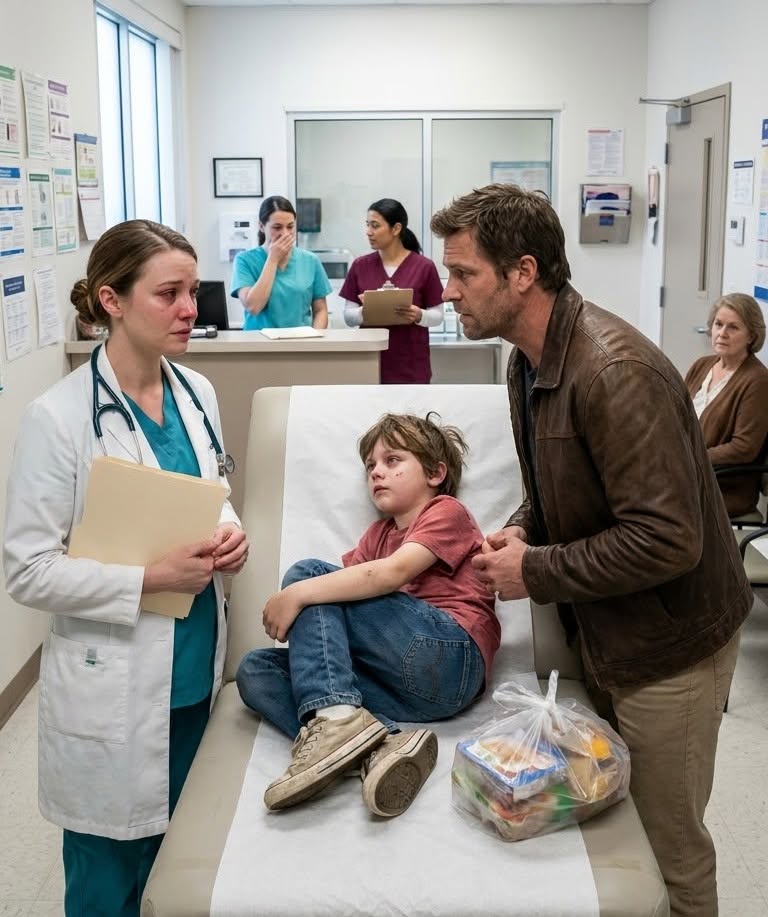
I had just finished locking the doors of my little neighborhood clinic when I noticed him standing outside beneath the rain. Water drummed against the aging windows while the fluorescent lights above the reception desk buzzed softly overhead. His oversized shirt clung to his narrow ribs, soaked from the storm, and his worn-out sneakers left tiny wet footprints across the tile with every careful step.
The thin plastic grocery sack in his fingers rustled constantly because he refused to loosen his grip.
“Doctor,” he murmured, trembling so badly his teeth chattered together. “Can you help fix me? I brought money.”
Then he carefully unfolded the bag.
Inside sat sticky handfuls of coins, a pair of crushed aluminum cans, and three empty soda bottles with faded peeling labels.
“The recycling man told me they’re worth twelve dollars,” he explained quietly. “I can collect more tomorrow.”
He said his name was Lucas.
At least, that was the name everyone seemed to call him.
His right leg was badly swollen and positioned at an angle that immediately concerned me. My hands reacted before my thoughts could, but as I gently rolled up his pant leg, something stopped me completely.
Old bruises fading into yellow and purple.
Tiny circular marks.
Long marks across his skin that looked as though they had come from experiences no child should ever be forced to fear.
But none of that was the hardest thing to see.
It was his face.
The same straight eyebrows.
The same determined little chin.
The same large brown eyes I had spent five long years desperately trying to erase from my memory.
“What’s your father’s name?” I asked, although my heart had already answered.
The little boy lowered his gaze toward the floor.
“Julian Sterling.”
Five years before, Julian Sterling had been my husband.
His relatives possessed wealth, influence, and the kind of respected reputation the entire town rushed to defend. They controlled private clinics, sat on hospital boards, attended charity galas, and smiled from framed newspaper photographs showing everyone how generous they appeared.
I was Clara Vance, the woman running a tiny rented storefront with secondhand scrubs and an unwavering belief that caring for people mattered far more than appearing successful.
After my son entered the world, Julian’s family decided I was the obstacle they needed removed.
His mother slid legal papers across the table. She insisted my baby deserved a better future. Then she placed a check beside them as though a signature could erase the sound of a mother losing her own child.
I signed them.
Or perhaps I simply fell apart.
Now that very same child stood before me carrying twelve dollars, a handful of empty bottles, and an injured leg he believed he had to purchase treatment for.
“Who did this to you?” I asked gently.
Lucas instantly folded into himself.
“I was bad,” he whispered. “I spilled some water. I didn’t wipe it up fast enough. I fell asleep before finishing the dishes.”
People invent different names for harmful behavior whenever facing the truth becomes too painful. They call fear discipline. They call silence respect.
A child always understands the difference.
When I reached carefully toward his injured ankle, he immediately threw both hands over his head.
“Please don’t hurt me,” he sobbed. “Please. I’ll behave now.”
I turned away briefly because the emotion filling my chest would have frightened him even more than the pain already had.
Then I washed my hands, opened a fresh package of bandages, and steadied my voice.
“Lucas, nobody is going to hurt you here.”
At exactly 6:18 p.m., I carefully documented every bruise across the intake paperwork. I photographed the swelling. I entered every injury into his medical record. I placed the X-ray film beside him because I understood powerful families could dismiss almost anything as an accident whenever no evidence existed.
When I offered him warm soup and half of a boiled egg from my own lunch bag, he ate with such careful restraint that my heart shattered.
Not like a hungry child.
Like someone who had learned that food could vanish without warning.
Then he quietly asked whether he should wash the bowl afterward.
When he attempted to stand, the pain doubled him over instantly. I caught him before he reached the floor, and he buried his face against my shirt.
“I’m sorry,” he whispered. “I’m sorry. I’m sorry.”
The waiting room carried the scent of rain-soaked pavement, rubbing alcohol, and stale coffee left warming far too long. A small American flag rested beside the sign-in clipboard on the reception counter, nearly invisible within the silent room.
I held my son tightly against my chest, yet still couldn’t speak the words he deserved to hear.
That I was his mother.
That I had searched for him every single day in the only ways I could.
“Lucas,” I asked quietly, “if I bring you back there tonight, will you feel safe?”
He slowly closed his eyes.
“I’m going to try not to cry.”
That was the exact moment I realized I could never send him back.
At 6:47 p.m., I completed a medical incident report. I photographed the empty bottles, the scattered coins, the worn-out sneakers, and every visible injury. Then I stared at a phone number I had once sworn I would never dial again.
Julian picked up on the second ring.
“Clara?”
I didn’t bother with greetings.
“I found Lucas.”
Silence.
Then his voice became quiet.
“Is he… with you?”
“Yes. And I need you to answer one question. Did you know your son’s leg was healing incorrectly because someone had repeatedly mistreated him?”
Twenty minutes later, bright headlights sliced through the rain outside my clinic.
A black SUV rolled to a stop beside the mailbox near the sidewalk.
Julian climbed out without opening an umbrella. His expensive coat was soaked within seconds. His face looked nothing like the confident man I used to know.
For one brief moment, I wanted him to remain outside.
I wanted him to stand there in the cold.
I wanted him to experience even the smallest piece of what our son had endured for the past five years.
But Lucas was waiting inside.
So I unlocked the door.
“Come with me,” I said quietly.
Without speaking, he followed me into the treatment room.
Lucas lay asleep on the narrow cot, one hand tucked beneath his cheek while the other rested protectively beside his head.
Julian’s eyes moved across the bruises, the marks, the swollen leg, and the little boy who apologized before asking anyone for help.
Slowly, he reached down and brushed Lucas’s forehead.
Lucas flinched even while sleeping.
His tiny hand flew over his head.
“Don’t hurt me. Don’t lock me away. I won’t do it again.”
Julian stumbled backward as though those frightened words had struck him across the chest.
The man who had once allowed his own family to take my baby away now stood beneath the harsh clinic lights, drenched by the storm, staring silently at the son he had promised would always be protected.
For the very first time in five years, I saw genuine fear written across Julian Sterling’s face.
Then Lucas slowly opened his eyes, looked straight at him, and whispered a single word that nearly caused Julian’s knees to buckle…
Part 2
“Dad.”
The word barely left Lucas’s mouth, but Julian reacted like the entire room had shifted beneath him.
He grabbed the edge of the chair beside the cot to steady himself while I watched the man who once stood between me and my baby finally understand what he had lost.
Lucas didn’t reach for him.
He didn’t run into his arms.
He only stared at him with the same scared eyes that had looked at me hours earlier and asked if paying twelve dollars was enough to deserve help.
Julian kept whispering that he didn’t know.
That he thought Lucas was safe.
That he believed his family when they said everything was under control.
But there is a difference between not knowing and refusing to look.
And children often carry the consequences when adults choose not to see.
Then Julian noticed the folder sitting beside the medical chart.
It wasn’t just the intake paperwork.
Inside was the copy of the custody documents his mother had made me sign five years earlier, along with a new incident report showing the concerning signs that proved Lucas had never been protected the way they promised.
At 7:12 p.m., I had also saved the voicemail that came from an unknown number earlier that evening.
A voice warning Lucas not to tell anyone what happened.
Julian’s face changed when he heard the first few seconds.
The anger disappeared.
Then the guilt arrived.
His mother, the woman who had once told me she was saving my son, covered her mouth when Julian called her from the clinic and played the recording.
For the first time, she had no polished explanation.
No perfect excuse.
No family reputation to hide behind.
She just sat there silently.
Then Julian looked back at me, looked at Lucas, and asked the question I had been waiting five years to hear.
“Clara… what did they tell you about the day they took him from you?”
Part 3
Julian stood motionless in the harsh glare of the clinic lights, the cell phone trembling in his grasp as the silence on the other end of the line stretched into an admission of guilt.
“They told me you abandoned him,” Julian whispered, his voice cracking as he looked from the phone to me. “My mother… she said you took the money and walked away. She said you didn’t want the burden.”
“She handed me a pen while I was still hemorrhaging in a hospital bed, Julian,” I said, my tone flat, stripped of all tears. “She told me that if I didn’t sign, your family’s attorneys would ensure I never saw my baby again, and that I’d spend the rest of my life buried in legal debt. I didn’t take a dime. I signed because I was twenty-two, terrified, and bleeding out alone while you were away at a conference in Chicago.”
Julian’s eyes closed, a gut-wrenching breath shuddering through his chest. He looked back at Lucas, who was watching us with wide, watchful eyes—the hyper-vigilant gaze of a child who had learned to assess every adult’s movement for danger.
“I didn’t know,” Julian choked out, taking a small, tentative step toward the cot. “I swear to God, Clara, I thought he was with top-tier nannies. I thought my mother was raising him in the estate…”
“You didn’t want to look,” I corrected coldly. “It was easier to believe a lie that kept your family’s reputation clean than to check on the boy you left behind.”
Julian didn’t argue. The evidence was laid out on the stainless-steel tray beside him: the X-ray showing a malaligned fracture, the photographic log of fading circular burns and belt marks, and the plastic bag filled with twelve dollars in wet change and crushed soda bottles.
Slowly, Julian pulled out his phone again. His hands were shaking so violently he nearly dropped it. He dialed a direct line to his firm’s chief legal officer.
“Arthur,” Julian said, his voice dropping into a register of cold, absolute steel. “Cancel the family trust meeting tomorrow morning. Contact Child Protective Services and the District Attorney’s office. I need an emergency protective custody order issued immediately against my mother and my sister.”
There was a frantic voice on the receiver, but Julian cut it off.
“I don’t care about the board! I don’t care about the headlines! They abused my son!” he roared into the phone, the sound echoing off the clinic walls. “If anyone in this firm attempts to cover this up, I will burn the entire enterprise to the ground myself. Have the investigators at the clinic in twenty minutes.”
He ended the call and let the phone slide onto the floor.
Lucas flinched at the sharp clatter, pulling his knees toward his chest. Julian immediately dropped to his knees on the cold tile floor, keeping his hands open and visible, lowering his head until he was eye-level with our son.
“Lucas,” Julian said, tears finally breaking past his composure and tracking down his rain-soaked face. “I am so sorry. I failed you. But no one is ever going to hurt you again. I swear it on my life.”
Lucas looked at his father, then turned his head slowly to look at me. “Is he going to take me back there?”
I walked over to the cot, sat on the edge, and gently took Lucas’s small, cold hand in mine.
“No, baby,” I said softly, looking over his head straight into Julian’s eyes. “Nobody is taking you anywhere you don’t want to go. You’re staying with me.”
Julian swallowed hard, nodding slowly. “She’s right, Lucas. You’re staying with your mother.”
Final
By midnight, the quiet clinic had become the command center for the collapse of the Sterling family’s public facade.
Detective Harrison and two caseworkers from Child Protective Services arrived alongside Julian’s personal legal team. I presented the official medical intake report, the forensic photographic records, the X-rays, and the recorded voicemail. The evidence was indisputable, clinical, and devastating.
Before dawn, state troopers executed an arrest warrant at the Sterling estate. Julian’s mother, Evelyn Sterling, and his sister, Beatrice, were taken into custody on charges of severe child endangerment, felony physical abuse, and unlawful restraint. The polished reputation they had spent decades building through charity galas and hospital donations dissolved overnight as news crews covered their arraignment.
The legal battle that followed was swift. With Julian refusing to defend his family and providing full financial and testimonial support to my legal team, the court formally voided the fraudulent custody agreement from five years prior.
I was granted sole legal and physical custody of Lucas.
Julian surrendered his executive position at Sterling Enterprises, handing control over to a court-appointed board while he stepped back entirely to face the consequences of his negligence and undergo court-mandated family rehabilitation. He established a multi-million-dollar medical trust in Lucas’s name, ensuring our son would have access to every resource needed for his physical and emotional recovery.
Three months later, the spring sun washed over the small garden behind my clinic.
Lucas sat on a wooden bench beneath an oak tree, wearing a bright yellow cast on his right leg. He was coloring in a sketchbook, his small face relaxed, the hyper-vigilant tension finally leaving his shoulders. He no longer flinched when a door closed, and he no longer asked if he needed to pay for his meals.
I walked out onto the porch carrying two juice boxes, setting one down beside him.
“Thanks, Mom,” Lucas said smoothly, not even looking up from his drawing.
The word hit my chest with a warmth so deep it made my eyes sting. Five years of nightmare, searching, and heartbreak dissolved into that single, quiet moment in the afternoon sun.
A soft knock at the garden gate drew my attention. Julian stood outside the fence, holding a box of fresh art supplies. He didn’t step through; he always waited for permission now, maintaining the strict boundaries established by the court.
Lucas looked up, saw his father, and offered a small, tentative wave.
“Can I show Dad my drawing?” Lucas asked me quietly.
I looked at Julian—a man stripped of his arrogance, working every day to earn a fraction of the trust he had forfeited—and then down at our son, whose smile was growing genuine and real with every passing week.
“Go ahead, Lucas,” I said softly.
Lucas picked up his sketchbook and hopped carefully toward the gate on his crutches.
I stood back on the porch, holding my cup of tea, watching the afternoon breeze rustle the leaves above us. The rain had long since stopped, the storm had cleared, and for the first time in five years, my family was finally home.