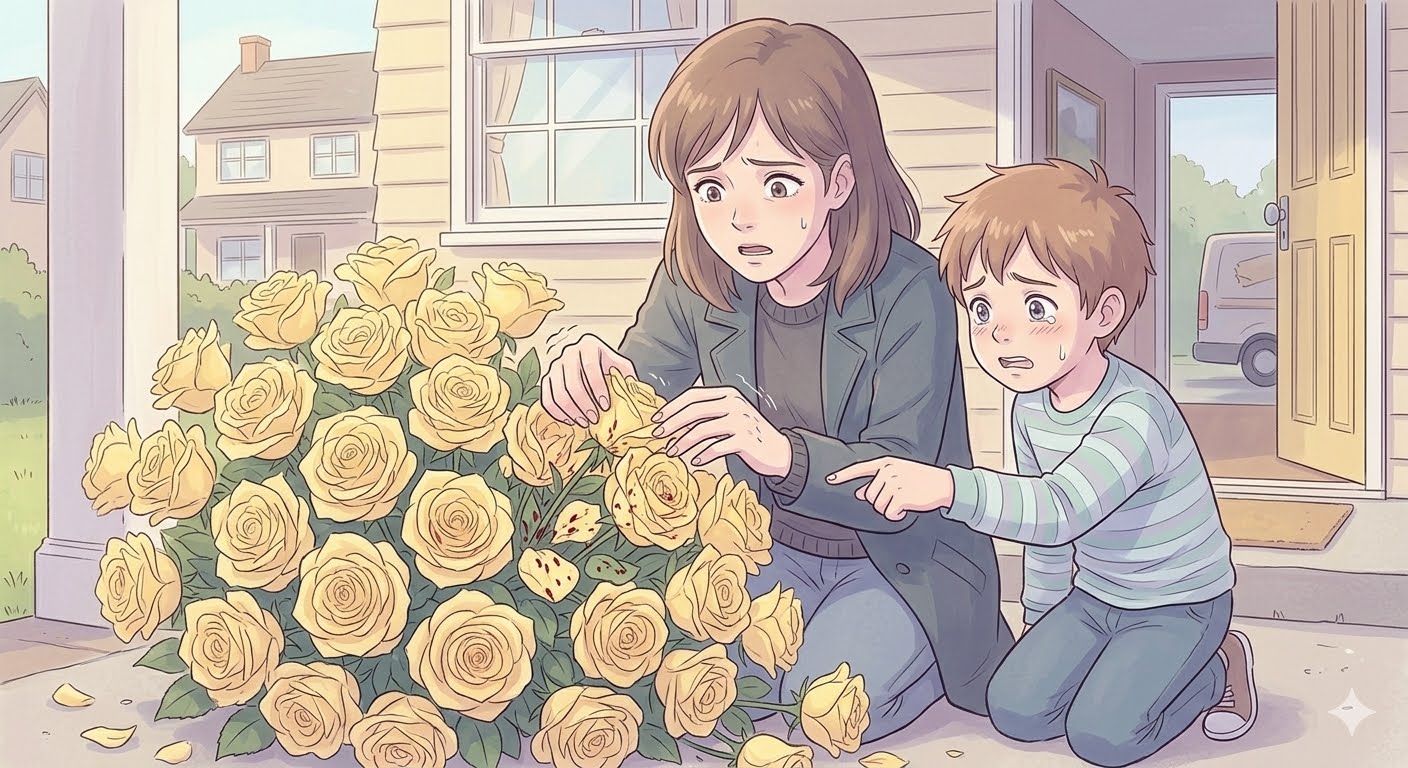
- The bouquet arrived shortly after noon.
- One hundred yellow roses.
- I had just finished rinsing my morning coffee cup when the doorbell echoed through the quiet, empty house. My husband, Daniel, was supposedly away on a week-long business trip to Chicago, so I wasn’t expecting a soul.
- When I swung the front door open, a deliveryman was standing behind an immense, towering wall of golden petals.
- “Amber?”
- “Yes.”
- “These are for you.”
- The bouquet was so massive and heavy that I had to use both arms to hoist it into my chest. The roses were physically flawless, their velvety petals glowing under the bright afternoon sun.
- “Someone must really want to impress you,” the delivery driver remarked with a small smile.
- I searched frantically between the stems for a card. “Is there a message?”
- He glanced down at his handheld scanner and checked the florist label. “Only your name printed on the delivery slip.”
- At first, I smiled.
- Daniel had never been a man of grand written gestures. Once, years ago, he sent me a diamond necklace without a card and later joked that the velvet box spoke for itself. After eighteen years of marriage, I knew his quiet, unspoken ways of showing affection.
- I lugged the massive arrangement into the dining room and set it squarely in the center of the mahogany table. For a few brief moments, the sheer size of the flowers seemed to transform the entire atmosphere of the house.
- Then, the first shadow of unease began to creep in.
- Daniel knew I loved white roses.
- I had carried white roses down the aisle at our wedding. He had brought them home the night my mother passed away. A giant vase of white roses had decorated our table for our fifteenth anniversary. In nearly two decades together, he had never once chosen yellow flowers for me.
- Then my eyes caught the exact number printed on the florist’s order tag.
- Quantity: 100.
- Not a standard dozen. Not ninety-nine. Not one hundred and one. Exactly one hundred.
- Daniel was thoughtful, but he was practical to a fault—never extravagant without cause. There was no birthday today, no anniversary, no milestone to celebrate.
- My pulse began to quicken. I pulled out my phone and dialed his cell.
- It rang four times before dropping straight to voicemail.
- I typed out a quick message: Did you send these flowers to the house?
- No reply.
- Ten minutes passed. Then twenty.
- The bouquet on the dining table no longer looked like a romantic surprise. It looked unnaturally rigid, precise, and deliberate—almost as if it had been placed in my home with surgical intent.
- I slowly walked a circle around the dining table, studying the arrangement. The flowers had been woven into ten perfectly uniform rows of ten.
- Except near the very center, where several blooms sat noticeably lower than the rest.
- I leaned over the table to inspect them.
- Tucked beneath the outer petal of one yellow rose near the core was a tiny, dried red stain.
- I initially assumed it was a natural flaw or a drop of dye—until I parted the surrounding stems and found a second one. Then a third.
- Exactly three yellow roses, deep within the arrangement, had been secretly marked in red.
- My breath hitched, and my hands began to tremble so violently I almost dropped my phone.
- I had seen that exact pattern once before.
- Years ago, my late father—a veteran homicide detective—had spoken about a infamous, cold case that had haunted his career. He had never shared the gruesome details with me, but I vividly remembered sitting on the porch late one night, watching him stare blankly into the dark street.
- “Some monsters don’t leave fingerprints, Amber,” he had whispered, his voice heavy with ghosts. “They leave symbols.”
- My heart hammered against my ribs as I reached for my phone again. This time, I didn’t text my husband.
- I called the police.
- The emergency dispatcher asked if I was in immediate physical danger.
- “I don’t know,” I admitted, my voice shaking. “But someone just delivered one hundred yellow roses to my house, and three of them are marked in red.”
- Two patrol officers arrived within forty-five minutes. They examined the vase politely, clearly suspecting they were dealing with a paranoid woman unnerved by a simple florist error.
- Then a dark, unmarked sedan pulled sharply into my driveway.
- A silver-haired senior detective named Kellan stepped into the foyer. The moment I mentioned my father’s name, the casual indifference dropped from his face.
- “I worked the line with your dad,” Kellan said quietly.
- He walked into the dining room and stepped up to the table. The instant his eyes landed on the three marked yellow roses in the center of the bundle, the color drained completely from his face.
- He turned sharply to the two patrol officers. “Secure this house immediately.”
- One officer blinked, caught off guard. “Sir?”
- “Draw the blinds, clear the perimeter, and call for forensic backup. Do it now.”
- I gripped the wooden back of a dining chair to keep my knees from buckling. “You recognize it, don’t you?”
- Kellan turned to me, his expression gravely serious. “Twenty-two years ago, three women vanished across this state. Before each abduction, the victim received an anonymous delivery of exactly one hundred yellow roses.”
- “And the red marks?” I whispered.
- “Three marked stems in every single bouquet.”
- My stomach churned violently.
- Kellan explained that my father had believed the number one hundred represented finality—a closed cycle, a deliberate goodbye. The flowers were never a gift.
- They were an execution notice.
- PART 2: The Husband Who Never Left Town
- The police spent the next hour trying to track down Daniel. Every call went straight to a dead tone.
- Detective Kellan stepped out onto the porch to call the corporate headquarters of the company Daniel worked for while forensic teams dusted the foyer. When Kellan walked back inside, his face was drawn tight.
- “Daniel was never sent on a business trip, Amber.”
- I stared at him, my mind refusing to accept the words. “That’s impossible. He packed his bag on Monday morning. He had a conference in Chicago—”
- “No flight was ever booked,” Kellan interrupted softly. “The hotel reservation was non-existent. His office hasn’t seen him in four days.”
- Four days ago, Daniel had kissed my forehead at 6:00 AM, picked up his leather roller bag, and promised he would call the moment he landed in Illinois. Now, I was standing in my own living room realizing I had no idea where my husband was.
- Or why he had built a mountain of lies to leave me.
- By nightfall, officers were tearing through every room in the house. I sat huddled on the living room sofa, wrapped in a blanket, listening to drawers being yanked open upstairs and low, serious murmurings from the hallway.
- Around midnight, Kellan came downstairs carrying a small, locked metal fire-box he had forced open in Daniel’s home office.
- Inside were dozens of old, yellowed newspaper clippings.
- Every single article detailed the three cold-case disappearances from twenty-two years ago.
- Photographs of the missing women. Crime scene diagrams. Published theories from the original task force. And scrawled densely across the margins of every single page were notes in dark blue ink.
- Daniel’s handwriting.
- My chest tightened until I couldn’t breathe. This was the man I had loved for nearly two decades—the man who made terrible, burnt pancakes every Sunday morning, who always remembered how I took my coffee, and who had held me while I sobbed at my father’s grave.
- Had he been obsessing over these unsolved murders? Or had I been sleeping next to the killer all along?
- By 2:00 AM, the police officially listed Daniel as the primary suspect in the revived cold-case investigation.
- I didn’t sleep a single second.
- The following morning, Detective Kellan returned to the house with the forensic print report from the glass vase and the florist’s counter tag.
- “The fingerprints on the vase do not match Daniel,” he said.
- A chaotic surge of relief and sheer confusion collided in my chest. “Then whose are they?”
- Kellan hesitated, exchanging a heavy look with his partner before sitting down across from me. “They belong to a man named Amos Vance.”
- The name meant nothing to me. “Who is he?”
- “He’s a retired senior detective,” Kellan said grimly. “He was your father’s primary partner on the original task force twenty-two years ago.”
- My father’s own partner.
- Kellan leaned forward, lowering his voice. “Your father suspected Amos right before he died, Amber. He believed Amos was using his authority as a detective to cover his tracks, but your dad died before he could prove it.”
- “Then why would Amos send those flowers here? To me?”
- “We don’t believe the flowers were a threat against you,” Kellan said softly. “They were bait.”
- Piece by piece, the horrific truth began to come into focus. Daniel hadn’t been obsessing over the murders out of guilt—he had discovered my father’s private, unfiled case journals hidden away in our attic. For months, Daniel had been secretly following up on my father’s old leads, slowly cornering Amos Vance. The fake business trip had been Daniel’s desperate attempt to confront the truth without dragging me into the crosshairs of a serial killer.
- Amos had realized Daniel was closing in.
- The bouquet delivered to my door hadn’t been sent to kill me; it was designed to terrify me, trigger a police response, and frame Daniel as the killer returning to his old ritual. The clippings in the metal box weren’t trophies—they were Daniel’s evidence.
- I buried my face in my hands, weeping uncontrollably. I had spent twenty-four hours agonizing over whether my husband was a monster, when in reality, he had walked into the dark to finish what my father started.
- By mid-afternoon, state police traced an old cellular signal to a remote, abandoned hunting cabin miles outside the city limit. I was taken to the precinct and told to wait in a quiet holding room while tactical teams moved on the property.
- Every tick of the wall clock felt agonizing. I sat under the cold fluorescent lights, tightly clutching Daniel’s silver wedding band—which he had left behind on his nightstand, likely fearing it might identify him if he was ambushed.
- Hours passed. Finally, the door opened. Detective Kellan walked in, his eyes glistening.
- “He’s alive, Amber.”
- I leaped out of my chair, a sound breaking from my throat that was half-sob, half-prayer. “Daniel?”
- “He’s battered, but he’s alive.”
- Two days later, Daniel returned home with deep bruising across his face, fractured ribs, and heavy bandages wrapped around his wrist. The second he crossed the threshold of our foyer, I threw myself into his arms, ignoring his wince of pain as he held me with everything he had.
- “I thought I lost you,” I cried against his neck.
- “I am so sorry, Amber,” he choked out. “I am so, so sorry.”
- He told me everything. He had uncovered my father’s hidden journals while clearing out storage boxes in the attic months ago. The entries clearly showed how Amos Vance had deliberately altered evidence logs to protect himself. Daniel had naively believed he could hunt down the final proof and hand Amos to the authorities before anyone knew what he was doing.
- “You should have told me!” I sobbed, pulling back to look at his bruised face.
- “I couldn’t,” he whispered. “If Amos knew you were involved, he would have targeted you first. I had to keep you completely out of it.”
- The yellow roses proved his terror had been entirely justified.
- PART 3: The Message Meant for Daniel
- The tactical raid on Amos Vance’s remote cabin yielded overwhelming evidence.
- Inside a concealed floor safe, investigators uncovered personal belongings taken from the three missing women, hidden photographic trophies, original florist receipts spanning two decades, and official department records proving how Amos had systematically sabotaged my father’s investigation from the inside.
- After twenty-two agonizing years, three families finally received the definitive answers they had been denied. Amos Vance was formally charged with three counts of capital murder and spent the remainder of his life behind bars.
- The bouquet of yellow roses remained in police evidence. I never asked to look at them again.
- For weeks afterward, I couldn’t bear to look at yellow flowers of any kind. Every time I saw a golden petal, I was dragged back to the feeling of standing in my foyer, holding an unsigned warning, looking at three blood-red marks.
- The recovery at home was slow and painful. Daniel and I were forced to have the hardest conversations of our marriage.
- As much as I understood that his actions were born out of a desperate desire to protect me and honor my father, I couldn’t simply forgive the wall of secrecy he had erected. He had staged a fake life, vanished into thin air, and left me completely vulnerable in the middle of a nightmare.
- “I was reckless, Amber,” Daniel admitted one evening, his head in his hands. “I thought I was being a hero, finishing what your father started. I almost got myself killed, and I almost let him frame me.”
- “And you let me sit in this house for a full night thinking the man I loved was a murderer,” I said softly, the pain still fresh in my voice.
- He looked up, tears brimming in his eyes. “I never imagined he would send those flowers to our front door.”
- Daniel’s plan had been to track Amos to his cabin, photograph the evidence, and call Kellan. He never anticipated that Amos would spot him first, overpower him, and hold him hostage.
- The delivery to our house had been sent immediately after Daniel was captured.
- At first, I had believed the flowers were meant to terrorize me because my name was printed on the label. But as the full picture emerged, the terrifying truth became clear:
- The bouquet was never meant for me. It was a message for Daniel.
- The one hundred yellow roses represented the final act of a killer’s twisted ritual. The three red-marked stems were a direct message to the man chained in his cabin: I know what you found, and you are going to become number four.
- Amos had addressed the delivery to me so that when police inevitably investigated Daniel’s sudden disappearance, they would find the case notes in his desk, the missing husband, and the ominous yellow roses on his wife’s porch—creating the perfect illusion that Daniel was the cold-case killer who had revived his ritual before fleeing the country.
- Amos had tried to turn the man exposing him into his ultimate scapegoat.
- For months, sleep did not come easily to our house. Every creak of the floorboards at night made my chest tighten. Every unknown number on my phone sent a cold shock down my spine.
- Gradually, slowly, a fragile normal returned.
- Daniel began attending therapy to process the trauma of his abduction and the crushing guilt he carried for risking my safety. I had my own deep wounds to heal. Love doesn’t instantly erase terror, and relief doesn’t automatically rebuild shattered trust.
- One warm evening, several weeks after the trial concluded, Daniel and I sat quietly together on the front porch as the sun dipped beneath the horizon.
- The house was still. No police cruisers in the driveway. No ringing landlines. No terror waiting on the porch mat.
- I looked out at the quiet garden and finally voiced the thought that had settled deep in my heart.
- “The flowers were never really meant for me, were they?”
- Daniel slowly laced his fingers through mine, squeezing tightly. “No, Amber. They were meant for me.”
- He nodded slowly into the darkening evening.
- For the first time, the complete truth of what my father had left behind felt fully realized.
- The yellow roses were not a romantic gift. They were not just a sadistic taunt to a dead detective’s daughter. They were a frantic, desperate attack by a cornered killer who realized a brave man was about to pull his dark history into the light.
- My father had spent the final years of his life tormented by the suspicion that his own partner was a monster. He had died without the proof he needed, but the meticulous records he preserved in the dark of our attic eventually found their way into the hands of a man who loved his daughter enough to fight for the truth.
- Those notes had given Daniel the key. Those notes led the police to the cabin. And those notes finally brought peace to three families who had waited more than two decades for justice.
- Daniel squeezed my hand tighter as the stars began to appear above us.
- “I am so sorry I lied to you, Amber,” he whispered, his voice steady.
- “I know.”
- “I thought protecting you meant keeping you in the dark.”
- I turned to look at him, seeing the quiet resolve in his eyes. “And what do you think now?”
- “Now I know that real protection means standing in the light together, no matter how terrifying it gets.”
- I leaned over and rested my head against his shoulder.
- The yellow roses had entered our lives as a sickening symbol of fear, death, and silence. But Amos Vance had made one fatal calculation: he believed that keeping dark secrets made a man invincible.
- He was wrong. The secrets he tried so desperately to bury had created a clear trail straight back to his door. And long after his death, my father had still managed to reach through the dark and guide us all back home.
PART 1: The Roses Without a Name