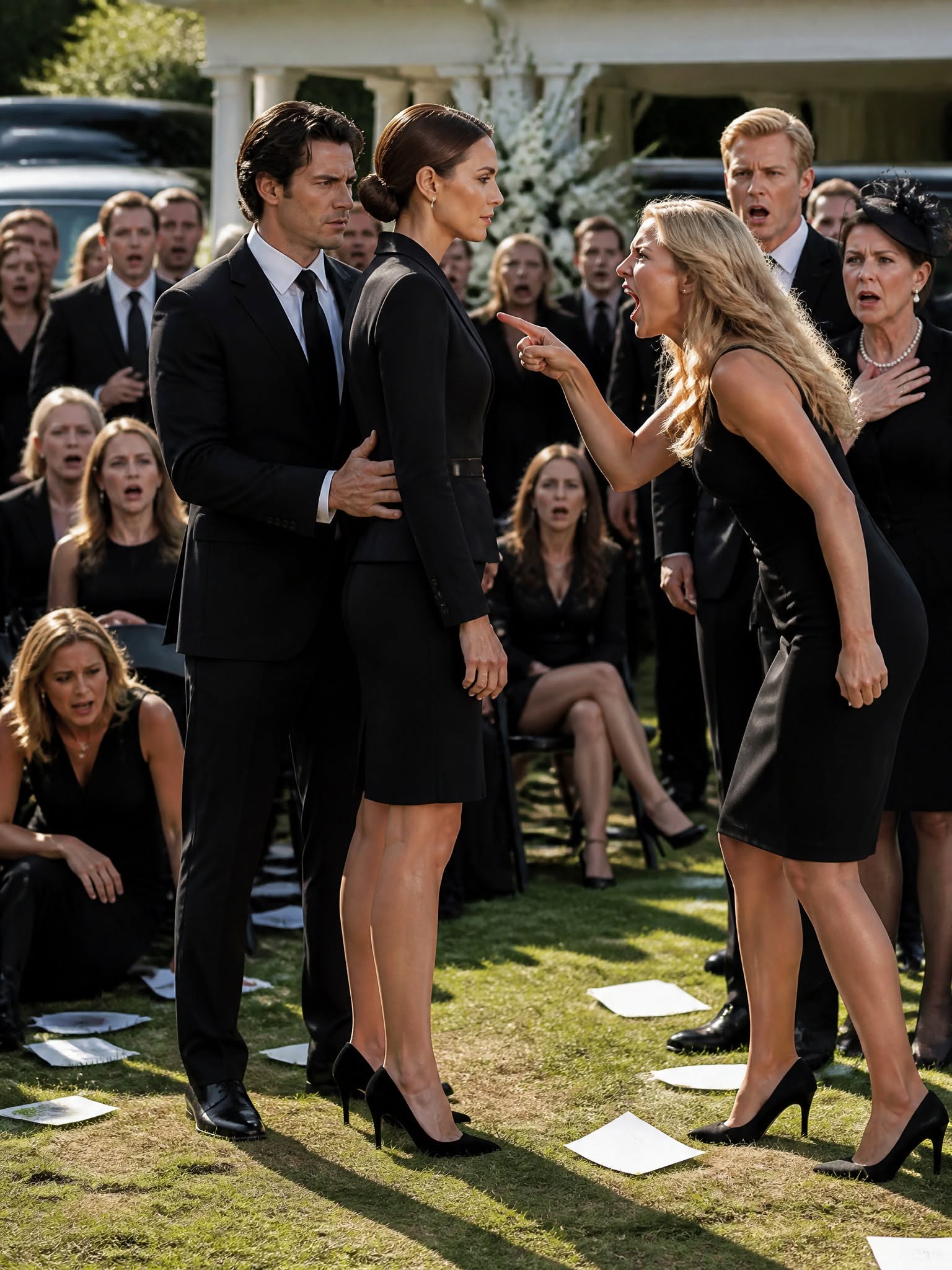
My sister stole my fiancé, then mocked me at our father’s funeral. “You’re just a bitter spinster,” she sneered. I stayed perfectly still, standing at parade rest. Then my billionaire husband walked in. He placed one arm firmly around my waist, turned his cold gaze toward my sister, and said, “You mocked my wife.” The moment she recognized him, every trace of confidence vanished.
Part 1: The Insult Beside the Grave
“Poor Amelia. You look so stiff in that uniform.”
My younger sister, Cassandra, leaned close enough for her gardenia perfume to drown out the scent of white lilies around our father’s grave.
Then she whispered, “No wonder Julian chose me. He said hugging you felt like hugging a fence post.”
The cemetery grass was still wet from morning rain. Cold water had soaked through my polished shoes, but I remained still in my Army dress uniform, shoulders squared and hands controlled at my sides.
Twenty feet away, the funeral director was lowering my father’s casket.
Beside Cassandra stood Julian Mercer, the man who had once placed a diamond ring on my finger and promised me forever. Now he held an umbrella over my sister while rain collected on my service cap.
Cassandra pressed herself against him in a black gown better suited for a cocktail party than a funeral.
She wanted me to flinch.
She wanted tears.
Instead, I slowly removed my white gloves and looked at her.
“You’re smiling,” she said uneasily.
“I was remembering something.”
Four years earlier, I had driven straight from a field-training exercise to Julian’s office with a bag of his favorite Thai food on the passenger seat.
His office smelled of stale air-conditioning and carpet cleaner.
Then I smelled gardenias.
Through the narrow gap in his office door, I heard him laughing.
“Amelia doesn’t understand passion,” he said. “She understands orders and schedules. Being with her feels like being inspected.”
Cassandra laughed.
“She tries so hard to act like a man.”
I kicked the door open.
Julian and Cassandra were tangled together on the leather couch.
But what stopped my breathing was not the affair.
It was my combat jacket draped over Cassandra’s bare shoulders.
My surname was stitched above the pocket. A faded stain remained on the cuff from a training injury.
I had marched in that jacket.
Slept in it.
Bled in it.
She wore it like a costume.
I walked to the coffee table, removed my engagement ring, and dropped it onto the glass.
“You deserve each other,” I said.
Then I left.
Three days later, I transferred to Washington State, believing I had left the betrayal behind.
I did not yet understand they had taken more than my relationship.
One day, they would try to steal credit for the greatest sacrifice of my life.

Part 2: What I Paid in Silence
The drive to Washington took five days. I ate gas-station snacks, drank terrible coffee, and kept the radio off because every love song felt like an accusation. I told myself I was not grieving Julian. I was grieving the sister I thought I had.
When I reached my new assignment near Tacoma, I rented the cheapest studio I could find. The walls were thin, the pipes rattled, and my furniture was almost nonexistent. None of that mattered. What mattered was my father.
Three months before I discovered the affair, Dad had been diagnosed with aggressive stomach cancer. His insurance covered standard treatment, but the specialist recommended expensive care, nursing support, and equipment so he could stay at home. My mother had died when Cassandra and I were children. Dad had raised us on a machinist’s salary, packing lunches before dawn and showing up for every school event with grease still darkening his hands. He never asked me for money. I sent it anyway.
Every month, I transferred three thousand dollars into his care account. Sometimes more. I paid for a private nurse, an adjustable bed, appointments, transportation, special meals, and medication. I kept every receipt in a manila folder. A soldier documents everything.
After the transfers, there was rarely much left. I slept under Army blankets in a cold apartment, ate instant noodles, and patched the same pair of jeans until the knees were mostly thread. Meanwhile, Cassandra and Julian posted pictures from resorts, rooftop restaurants, and luxury hotels. Cassandra always angled her ring toward the camera. Living the life I deserve, she wrote.
Dad never mentioned their trips. When I called, he asked about my soldiers and whether I was eating enough. Cassandra visited occasionally, usually long enough to take photos with fruit baskets and write sentimental posts about family. She never paid a bill.
For more than a year, I told no one how badly I was struggling. At work, my uniform stayed pressed. My reports were early. My voice stayed controlled. At night, I stared at the water stains on my ceiling and wondered whether Julian had been right. Maybe discipline had made me impossible to love.
Then a civilian budget analyst named Denise Carter stopped me outside headquarters. “You look like you’re carrying a building on your back,” she said. “I’m fine.” “No. You’re functional. That isn’t the same thing.”
She took me to a small pub, and I told her everything. The affair. The jacket. The medical bills. The cold apartment. The fear that something in me was missing. Denise listened, then handed me the card of an Army behavioral health specialist.
A week later, Dr. Mara Benton asked me one question: “Who taught you that femininity requires weakness?” I had no answer. “Loyalty is not masculine,” she said. “Courage is not masculine. Discipline is not a defect. You were forged under pressure.”
Something inside me shifted. Not healed. But aligned. Julian and Cassandra had not defined me. They had only revealed themselves.

Part 3: The Man Who Saw Me Clearly
My recovery did not arrive dramatically.
It came at 4:30 every morning.
I ran through cold rain, returned to my apartment, put on my uniform, and arrived at headquarters before anyone else.
I rebuilt a supply system losing millions through waste, duplicate orders, and weak oversight. I traced missing equipment, corrected routes, and challenged contractors who thought government money had no limit.
Six months later, a general called my office personally.
A year later, I was promoted.
At the ceremony, a colonel pinned the gold oak leaf of a major to my uniform and called me one of the sharpest logistics officers he had ever known.
That afternoon, I bought dark burgundy lipstick.
Cassandra once told me red lipstick made women look aggressive.
That was exactly why I chose it.
I looked in the mirror and saw a woman who was no longer waiting to be chosen.
I met Nathan Cross during a defense cost-review conference in Virginia. He was the CEO of Ironclad Strategic Systems, but unlike the other executives, he did not perform power. He sat quietly and listened.
After I dismantled an inflated cost proposal line by line, he approached me.
“Major Hart,” he said, “you just saved the government several million dollars.”
“I pointed out numbers that were already there.”
“No,” he replied. “You had the courage to say what everyone else was pretending not to see.”
He asked how I found the false assumptions.
Not whether I was married.
Not whether I was available.
How I did the work.
Our conversations grew from twenty minutes to coffee, then dinner.
Nathan never tried to impress me with money. He chose quiet restaurants, respected my career, and never asked me to soften my voice.
When he saw me in dress uniform for the first time, he said, “You look like someone I would trust to lead me out of a burning building.”
I laughed for the first time in years.
Months later, he mentioned that Ironclad had defeated a struggling logistics company for a major contract.
“Their statements were fraudulent,” he said. “The owner is Julian Mercer.”
I told him Julian had once been engaged to me.
Nathan closed the file and listened.
When I finished, he asked if I wanted him to withdraw the complaint.
“No,” I said. “If Julian committed fraud, he answers for fraud. Not for betraying me.”
The following Christmas, Nathan proposed in a cabin while snow pressed against the windows.
“I love the officer,” he told me. “I love the woman. I don’t need you to become less of either.”
We married quietly six months later.
Cassandra did not know.
Neither did Julian.
Then one gray morning, my father’s nurse, Gloria, called.
Dad had died before sunrise.
And before I could leave for the airport, she added, “Your sister has been going through his papers. I think she’s planning something.”
Part 4: The Wake Built on Lies
Dad’s house looked smaller than I remembered.
The porch sagged. The curtains remained open, showing the empty space where his hospital bed had stood.
Cassandra met me in the driveway.
“You came in uniform?”
“Dad requested it.”
Her lips tightened.
“That seems dramatic.”
Inside, Gloria pressed a small key into my palm.
“Top drawer of his bedside table,” she whispered. “Your father said you would know when to use it.”
The key opened a metal box containing a leather journal, sealed envelopes, and financial records.
At the cemetery, Cassandra stood beside Julian beneath his umbrella and whispered insults while Dad’s casket was lowered.
After the burial, everyone gathered at Dad’s house.
Cassandra had hired caterers. Champagne bottles chilled in ice. Relatives laughed beneath framed photographs while mud from the cemetery still clung to their shoes.
Julian stood in the center of the room and tapped a spoon against his glass.
“To my father-in-law,” he announced. “Cassandra and I have no regrets. We paid his medical expenses, arranged his nurses, and made sure he had dignity until the end.”
People murmured approval.
An aunt called them angels.
Then everyone looked at me with pity and judgment.
The daughter who had moved away.
The unmarried soldier, as far as they knew.
I thought of every transfer confirmation.
Every nursing invoice.
Every cold night.
Every skipped meal.
Julian had paid nothing.
Cassandra had delivered fruit baskets and taken photos.
Now they were claiming four years of my sacrifice.
My anger became calm.
Cassandra approached.
“You should leave the military,” she said. “Julian could give you a little office job.”
Julian smiled.
“You’d be good at filing. Making coffee.”
Several relatives laughed.
I looked at Julian, knowing his company was under investigation and his financial lies were already unraveling.
“Before I consider your generous offer,” I said, “perhaps you should explain why Dad’s signature appears on a mortgage application dated three weeks after he lost the ability to hold a pen.”
The color vanished from Cassandra’s face.
For the first time that day, she stopped smiling.
Part 5: My Husband Walked In
The room went silent.
Cassandra’s eyes flicked toward Julian.
“I don’t know what you’re talking about,” she said.
I pulled a copied document from inside my jacket.
Dad’s journal said Cassandra had pressured him to release equity from the house so Julian could save his company.
Dad refused.
Weeks later, a high-interest loan appeared against the house using his signature.
“I’m talking about the mortgage recorded six weeks ago,” I said. “The one connected to Julian’s business account.”
Julian stepped forward.
“This is a private financial matter.”
“It stopped being private when you used my dying father’s home as collateral.”
Cassandra reached for the folder.
I moved it out of reach.
“You twist everything,” she snapped. “Dad wanted to help us.”
“Then why did he write that he refused?”
Her expression changed.
She had not known about the journal.
I told the room I had paid more than one hundred forty thousand dollars for Dad’s care.
Cassandra laughed too loudly.
“That’s insane.”
Gloria stepped out of the kitchen.
“No,” she said. “Major Hart paid me. She called every week. Your father waited for those calls.”
Cassandra stared at her.
“You were an employee.”
“I was present.”
The words hit harder than shouting.
Then Cassandra accused me of trying to be a hero.
“You think wearing medals makes you better than me?”
“No.”
“You think standing there like a robot means you can humiliate us?”
“I haven’t begun.”
Julian narrowed his eyes.
“What does that mean?”
“I can’t accept your offer to make coffee because my husband would object to me working for a company preparing for bankruptcy.”
Silence fell.
“Husband?” Cassandra said.
She saw the sapphire ring on my hand and laughed sharply.
“You bought yourself a ring.”
I took out my phone and texted Nathan.
Time on target. Proceed.
Then I put the phone away and stood at parade rest.
Five seconds passed.
Ten.
Then the doorbell rang.
A black SUV had stopped outside. Two security men stepped out beneath dark umbrellas.
Then Nathan emerged into the rain.
Julian recognized him before he reached the porch.
Every executive chasing government contracts knew Nathan Cross.
And Julian understood that the man approaching the house was not an actor.
He was the person whose legal team had uncovered every lie keeping Julian’s company alive.
Part 6: The Collapse
Nathan entered calmly and walked straight to me.
“I’m sorry,” he said softly. “The weather delayed us.”
He touched my cheek and kissed my forehead.
The gesture was simple and private.
That made it more devastating to Cassandra than any public display.
She stared at his hand resting at my waist.
Julian looked like he could not breathe.
“Mr. Cross,” he managed.
“Julian Mercer,” Nathan replied.
Julian tried to explain the contracting decision as a misunderstanding.
“There were false statements,” Nathan said. “You signed them.”
Then Nathan faced the room.
“My legal team completed the property review. The mortgage against Thomas Hart’s home was obtained using a signature that does not match his verified medical and financial records. The loan proceeds were transferred through two accounts and used to cover debts belonging to Mercer Transit Solutions.”
Relatives gasped.
Cassandra insisted Dad agreed.
“Dad wrote the opposite,” I said.
Nathan continued.
“Cassandra also submitted an estate claim requesting reimbursement for medical expenses she did not pay.”
Gloria folded her arms.
“I gave the attorney copies of every invoice.”
“So did Amelia,” Nathan said. “The records identify Major Hart as the source.”
Nathan had already notified the estate representative, the lender, and investigators. The house could not be sold or transferred until the dispute was resolved.
Then Julian’s phone buzzed.
He read the screen and went pale.
Cassandra grabbed it.
“Your accounts are frozen?”
“It’s temporary,” he said.
“You said the company was recovering.”
“It will.”
“You said the federal contract was delayed.”
“It was.”
Nathan spoke evenly.
“Your company has been permanently excluded from the procurement process. Three lenders have demanded immediate repayment. Your principal warehouse is scheduled for seizure.”
The room erupted in whispers.
Cassandra began asking about their cars, apartment, vacation house, and diamond ring.
One by one, the truth came out.
The cars were leased.
The apartment was short-term.
The vacation house was a promotional booking.
The ring was synthetic moissanite in plated metal, worth less than two hundred dollars.
For years, Cassandra had used that ring as proof that stealing Julian had elevated her life.
Now everyone knew it was almost worthless.
She tore it from her finger and threw it at him.
Their accusations exploded across the room.
Each sentence revealed another secret.
Cassandra had pressured Dad.
Julian had prepared the loan documents.
Cassandra had filed fake caregiving expenses.
Julian had promised the house would save his company.
Their perfect marriage was a conspiracy held together by debt, vanity, and fear.
Finally, Julian turned to me.
“Amelia, ask Nathan to give me a subcontract. Something small. I can rebuild.”
“No.”
“For your father’s sake.”
“Do not use my father as cover.”
Cassandra shifted from rage to desperation.
“We’re sisters.”
“No,” I said. “We were raised in the same house. That is no longer the same thing.”
Nathan offered his arm.
I took it.
Behind us, Cassandra called my name.
I walked out without turning around.
The rain had stopped.
For the first time all day, the air smelled clean.
Part 7: What Dad Knew
Nathan and I flew west that night.
The cabin lights were dim, and the engine hum filled the silence.
Dad’s leather journal rested on my lap.
I had expected victory.
Instead, I felt hollow.
Cassandra and Julian had been exposed, but Dad was still gone.
Eventually, I opened the journal.
Dad’s handwriting had weakened in his final months.
March 4. Amelia called from a supply room because she did not want her soldiers to hear her worry.
April 1. Another transfer. Three thousand dollars. She thinks I do not know what it costs her.
May 18. Gloria says Amelia asked whether I need better food. My daughter is probably eating less so I can eat more.
I covered my mouth.
I had thought he did not know.
Another entry read:
Cassandra brought another fruit basket. She took twelve pictures before putting it on the table. Julian stayed in the car.
Then I found the final note.
Amelia carried all of us without asking for recognition. She has always believed her strength makes her difficult to love. I wish she could see what I see. Cassandra chose appearances. Amelia chose honor. I am proud of my officer.
A tear fell onto the page.
Nathan took my hand.
“He knew,” I whispered.
“He knew.”
Two weeks later, the estate attorney called.
The lender suspended the mortgage and opened a fraud investigation. Cassandra’s reimbursement claim was denied. The remaining equity returned to Dad’s estate.
Dad’s will left most of his modest assets to Gloria and a scholarship fund for children of military families.
The house came to me.
His letter explained why.
You paid for these walls while living without comfort. Do not let anyone shame you for accepting what you already saved.
Cassandra left eleven voice messages.
First, she screamed.
Then she threatened.
Then she cried.
By the ninth message, she called me her only family.
I answered none.
Julian eventually fled to another state and was found in a budget motel trying to sell equipment that already belonged to creditors.
Cassandra moved into a rented room above a beauty salon.
The relatives who praised her at the wake stopped returning her calls.
I deleted their excuses too.
Gloria and I returned once to pack Dad’s things. In the garage, his workbench still smelled of machine oil and sawdust.
She found an old photo of Cassandra and me as children.
There had been a time before betrayal.
That time was real.
But it was over.
“I’ll keep the memory,” I said. “Not the relationship.”
We sold the house months later.
I created a nursing scholarship in Dad’s name.
Nothing went to Cassandra.
She had spent years believing blood entitled her to everything I built.
She learned that access to my life was not an inheritance.
Part 8: Leaving the Battlefield
One foggy morning, Vanessa—Cassandra—sent a message from an unknown number.
Amelia, I need ten thousand dollars. Julian left. The bank took everything. You’re rich now. Family is supposed to help family.
Then another message appeared.
Dad would hate what you’re doing to me.
For years, that would have opened a wound.
That morning, it produced only clarity.
Cassandra had insulted me beside Dad’s grave. She had worn my combat jacket while betraying me. She had watched me fund Dad’s care while presenting herself as the devoted daughter.
She had helped mortgage his home with a false signature.
Now she invoked family because cruelty had become inconvenient.
I typed one sentence:
Dad knew exactly who helped him.
Then I deleted it.
Cassandra already knew the truth.
She simply did not value it.
I blocked the number.
That afternoon, I attended a promotion ceremony at headquarters.
When the new insignia was placed on my uniform, I thought of the woman I had been four years earlier—mud on her boots, Thai food in one hand, betrayal waiting behind an office door.
She had thought walking away meant defeat.
She had not known she was beginning the longest advance of her life.
Nathan waited after the ceremony with coffee.
“Congratulations, Colonel Hart,” he said.
“Thank you.”
“Do I have to salute?”
“Only when taking out the trash.”
He laughed.
So did I.
That evening, we planted white tulips in the garden above Puget Sound.
“New beginnings,” Nathan said.
“Some people say they represent forgiveness.”
He looked at me.
“Are you forgiving your sister?”
“No.”
The answer came easily.
I did not forgive Cassandra.
I did not forgive Julian.
Forgiveness was not required for peace.
I could release the weight without restoring access. I could stop carrying hatred without pretending the harm never happened.
What I chose to forgive was myself.
The young woman who thought Julian’s betrayal proved something was wrong with her.
The officer who ate instant noodles on a freezing floor and confused suffering silently with strength.
Every version of me that had mistaken endurance for obligation.
I knelt beside Nathan in the cold earth and planted the final bulb.
My posture was still straight.
My burgundy lipstick was still sharp.
My uniform had not changed to make anyone comfortable.
Cassandra had spent her life trying to convince me that softness was the only form of womanhood.
She was wrong.
There was softness in loyalty.
Tenderness in protection.
Love in standing guard beside a hospital bed, even from three thousand miles away.
And strength in closing a door permanently when someone has proven they will only enter with another weapon.
The war with my sister ended not because she apologized and not because I forgave her.
It ended because I stopped fighting for love from someone who had never learned how to give it.
I stood beside my husband, looked toward the water, and breathed without pain.
I was a soldier.
I had been betrayed by someone who shared my blood.
But I had not broken.
I had only learned that sometimes the bravest command is ordering your own heart to leave the battlefield and never return.