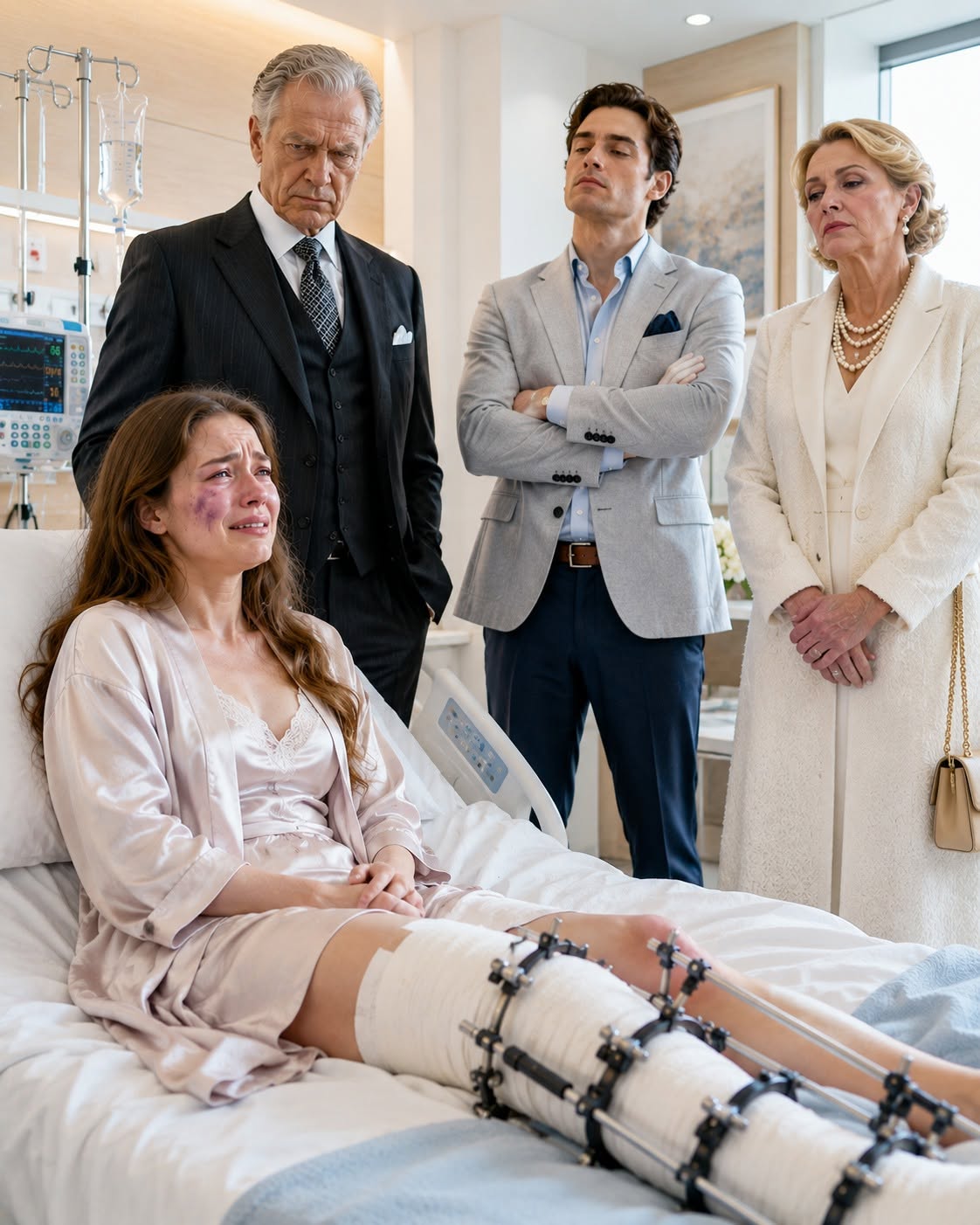
The scream that tore from Emily Carter’s throat never made it beyond the walls of the house.
“Leave her there. A broken leg will teach her what happens when she refuses to listen,” Andrew said while his mother still held the heavy wooden rolling pin.
The third strike had sounded different.
It wasn’t the sharp crack of wood hitting skin.
It was a deep, sickening snap that traveled from my shin all the way into my spine. I collapsed onto the kitchen tiles and stared at my left leg, bent at an angle no leg should ever make.
“Margaret… she broke it,” I managed to say.
My mother-in-law was breathing heavily. Her face was flushed with rage, but there was no regret in her expression.
“I warned you that no one speaks disrespectfully to their elders in this house,” she hissed. “Ever since you married my son, you’ve acted superior because you went to college.”
The argument had started because I told her the stew contained too much salt for my father-in-law, Harold, who had high blood pressure.
That was all.
Margaret took it as an insult in front of her husband.
First, she called me names.
Then she reached for the rolling pin.
Andrew entered after I was already on the floor.
For one brief second, I believed he would call an ambulance.
Three years earlier, when we met at a wedding in Nashville, he had promised he would never allow anyone to hurt me.
Instead, he crouched beside me, seized my chin, and forced me to look at him.
“Emily, you’re always provoking my mother. Why couldn’t you just keep quiet?”
“I need to go to a hospital,” I begged. “I can’t feel my foot.”
Andrew watched the swelling spread beneath my pajama pants.
Then he stood and wiped his hands as though touching me had made him feel dirty.
“We’ll deal with it tomorrow. Tonight, you’re going to learn.”
It was shortly after eight in the evening.
Rain hammered the streets outside our gated neighborhood in Charlotte, North Carolina.
My purse, phone, identification, and credit cards were in the living room, where they kept them “so I wouldn’t do anything foolish.”
For months, they had monitored my calls, controlled my salary, and prevented me from visiting my parents.
I had wanted to leave after losing my pregnancy.
Margaret called me useless.
Andrew said perhaps it was for the best because a baby would have complicated “the family finances.”
When I asked for a divorce, they took my documents and told me no one would ever believe me.
From the kitchen floor, I heard Andrew ordering dinner.
“Mom, calm down. I ordered barbecue and the chocolate cake you like. Dad, turn on the game.”
The three of them went into the living room.
The television came on.
They ate, laughed, and talked about football while I lay trembling on the freezing tile, my leg swelling and my throat dry with thirst.
At one point, Harold asked whether they should take me to the emergency room.
“She isn’t going to die,” Andrew replied. “Tomorrow we’ll say she fell. Then she’ll quit her job and stay here. We’ll finally be able to control her.”
That was when I understood it had not been a sudden outburst.
They weren’t trying to punish me.
They wanted to break me until I stopped being a person.
I waited until the house became silent.
Near midnight, I dragged myself toward the service door using my elbows.
Every inch sent agony through my body, and I had to press my mouth against my sleeve to keep from crying out.
In the bottom drawer, I found an old metal bottle opener.
The vent at the bottom of the door was held in place by four rusted screws.
I gripped the opener with blood-covered fingers and began turning the first screw.
I still didn’t know that before sunrise, the family who believed they had destroyed me would discover that the woman they thought was broken had escaped her cage.
It took me almost an hour to remove the vent.
When I finally forced myself through the opening, I fell into the service yard and felt the broken bone move inside my leg.
I bit my sleeve to keep from screaming.
I had no shoes.
No money.
No phone.
Only thin pajamas and the certainty that if I remained there, Andrew would find me.
Mrs. Jenkins lived less than sixty feet away, but reaching her front door felt like crossing an entire city.
I dragged myself across the gravel, leaving a dark trail of blood and mud behind me.
I managed to knock twice before losing consciousness.
I woke at Charlotte General Hospital.
Dr. Michael Grant explained that I had multiple fractures in my tibia and fibula, severe tissue damage, and a real risk that I might never fully recover the use of my leg.
“We are required to contact the district attorney’s office,” he said.
“Yes,” I answered. “But first, I need to make sure no one knows where I am.”
Nurse Sarah Collins quietly closed the door.
Mrs. Jenkins explained that she had heard screaming from the house for months.
She gave me an old cell phone with a new SIM card.
Using that phone, I dialed the only number I still knew by heart.
My mother answered on the fifth ring.
“Hello?”
“Mom… it’s Emily.”
Her crying broke something inside me more deeply than my leg ever could.
My parents had not heard from me in six months.
Andrew had been sending messages from my account, claiming I never wanted to see them again.
They drove from Nashville, but at my request, they first contacted Olivia Reed, an attorney specializing in domestic abuse.
Olivia arrived that same evening.
She listened to everything, photographed my injuries, requested a forensic medical examination, and filed for emergency protective orders.
She also obtained financial records proving that for three years, my salary had been transferred into an account controlled by Margaret.
“We can file charges immediately,” she said. “But they’ll claim it was an accident. We need them to talk.”
So when Andrew called the hospital, he was told I remained unconscious.
And when he arrived three days later with his parents and a basket of fruit, Sarah quietly moved me into a protected room at the end of the corridor.
Through a narrow opening in the door, I watched them arrive.
Margaret wore her nicest blouse and a satisfied smile.
They were not worried about me.
They had come to see how much damage they had caused.
When they discovered Room 304 was empty, they began shouting.
“She’s his wife! We have the right to see her!” Margaret demanded.
Dr. Grant stepped into the hallway in front of patients, relatives, and hospital staff.
“Mrs. Emily Carter has been transferred to a secure location,” he announced. “The medical assessment confirms that her fractures were caused by repeated strikes with a blunt object. They are not consistent with an accidental fall. The case has been documented, and all future contact must go through her attorney or the district attorney’s office.”
The color drained from Andrew’s face.
“She isn’t mentally well,” Harold interrupted. “She invents things when she gets nervous.”
“That ungrateful woman injured herself!” Margaret screamed.
People in the hallway began whispering.
Sarah recorded every word with a phone hidden in her pocket.
The three of them hurried toward the elevators.
Less than a minute later, my phone rang.
Andrew abandoned his false concern almost immediately.
“Come back to the house,” he threatened. “Or I’ll come and get you. You’re still my wife, and everything you have belongs to me.”
I looked at Olivia.
She activated the recorder and placed several documents in front of me: bank transfers, fraudulent invoices, and messages in which Andrew discussed keeping me “without money and without an escape.”
That was when I understood that my broken leg was only one part of the crime.
Olivia pointed to the final page and whispered,
“Emily, when they open the door to that house tonight, the life they left behind this morning will already be gone.”
The protective order was enforced that same afternoon.
While Andrew, Margaret, and Harold were still arguing at the hospital, two investigators, a social worker, and a court officer entered the house under judicial authorization.
Mrs. Jenkins showed them the service door, the blood trail still visible in the yard, and the kitchen where they had abandoned me.
They recovered the rolling pin.
It had been washed, but traces of blood remained inside a crack in the wood.
Inside Andrew’s closet, they found my passport, driver’s license, three bank cards, and a folder containing my financial statements.
They also seized his computer.
So when the three of them returned and opened the front door, they stopped in disbelief.
Numbered evidence boxes filled the living room.
Forensic photographs covered the dining table.
An investigator was reading through the inventory.
My father stood beside Olivia, gathering my clothes and personal documents.
“What are you doing in my house?” Andrew shouted.
“Protecting your wife,” one investigator answered. “And preserving evidence.”
Margaret tried to snatch the rolling pin from a forensic technician.
Instead, she ended up sitting in a chair, shaking with anger while officers explained that approaching me or my parents would violate a court order.
That night, Andrew called from another number.
First, he cried.
“Em, I made a mistake. My mother lost control, but we can fix this. Come home. I promise no one will ever touch you again.”
Then he offered money.
“You can have the apartment. I’ll give you two hundred thousand dollars. Just tell the district attorney that you fell.”
When I told him the divorce proceedings had already begun, his voice changed.
“You are not taking what belongs to me. Without me, you are nobody.”
“Without you,” I replied, “I get to become myself again.”
Olivia recorded the entire call.
The following day, Margaret returned to the hospital with two of Andrew’s aunts.
She threw herself onto the lobby floor and screamed that the doctors were holding me against my will, that I suffered from mental illness, and that I had attacked her first.
A visitor recorded the scene.
In the video, Margaret could clearly be heard insulting the hospital staff and declaring,
“A wife is disciplined inside her own home.”
Within hours, the recording spread through neighborhood groups and Facebook pages throughout Charlotte.
I posted nothing.
I didn’t need to.
People heard her own words.
The construction company where Andrew worked as a manager quickly recognized him.
Its director, Benjamin Harris, came to see me with a carefully prepared speech.
“We are deeply sorry for what you’ve experienced, Mrs. Carter. Andrew manages several important contracts. Perhaps a private agreement would be in everyone’s best interest.”
“What is in my best interest is having him answer for what he did.”
Benjamin stopped smiling.
“A public scandal could damage careers and reputations.”
“My broken leg is not a public relations issue.”
Olivia placed copies of suspicious invoices on the table.
They showed payments made to a company that did not exist.
The receiving account belonged to one of Andrew’s cousins.
Some of that money had been transferred into Margaret’s account—the same account receiving my salary.
The director left without saying goodbye.
Two days later, Andrew was suspended.
An internal audit revealed improper payments and documents signed electronically using my identity without my knowledge.
The man who claimed everything I owned belonged to him had used my identity to conceal his own fraud.
Harold arrived alone that afternoon.
He carried fruit and wore a defeated expression.
“Emily, what Margaret did was wrong,” he murmured. “But Andrew could lose everything. We’re family.”
“Family?” I repeated. “You saw me lying on the floor, and then you went to eat dinner.”
He lowered his head.
“I didn’t know how to stop her.”
“You didn’t want to stop her.”
I reminded him of the years when I handed over my salary, cooked for all three of them after working all day, endured their insults, and begged for help.
I reminded him about the miscarriage.
The cards they confiscated.
The night he heard his son decide to deny me medical care.
Harold waited several seconds before answering.
“Tell us how much you want.”
“I want my money returned. I want my legal share of the house, my medical expenses covered, and compensation. But none of that will purchase my silence. Abuse does not disappear because someone signs a check.”
His expression hardened.
“You’re becoming cruel.”
“No,” I replied. “I’m becoming free.”
He left without taking the fruit.
The district attorney’s office built its case using the medical report, Mrs. Jenkins’s testimony, the recorded calls, the hospital video, the recovered documents, and Andrew’s messages.
Then investigators found something I had never seen.
Months earlier, in a group chat with two friends, Andrew had written that he needed to “frighten me badly enough” to force me to quit my job.
One friend suggested that hiding my money should be enough.
Andrew replied:
“If she won’t understand the easy way, she’ll understand through pain.”
They could no longer describe that night as an accident.
Even then, they continued trying to intimidate me.
Margaret called from different numbers.
She threatened to go to the school where my mother worked.
Andrew sent an even worse message.
If I did not withdraw the charges within three days, he would buy a propane tank and blow up my parents’ house.
The district attorney assigned police protection and opened a separate investigation into the threats.
My parents temporarily moved in with a relative.
My mother wanted to remain with me, but I asked her to protect herself.
“We already lost you once,” she cried. “We will never leave you alone again.”
“This time, Mom, I’m not alone.”
A week later, I was transferred under a protected identity to a rehabilitation center.
I began learning to walk using parallel bars.
Every step was a battle.
Place the heel down.
Breathe.
Ignore the fire tearing through the leg.
Move another inch.
On the sixth night, the hallway lights went out for several seconds.
Then I heard someone forcing my door open.
Andrew entered wearing a baseball cap, a surgical mask, and a borrowed staff badge.
He held a kitchen knife in one hand and several documents in the other.
“You are going to sign a statement saying you lied,” he said. “This ends tonight.”
For one second, I was back on the kitchen floor.
Fear froze my body.
Then I saw the emergency button beside the bed.
Andrew pushed the door closed with his foot.
“I lost my job because of you. My mother is sick. Everyone looks at us like criminals.”
“Because you are criminals.”
He lunged toward me.
I swung my crutch and knocked his arm aside.
The blade cut across my forearm before falling onto the bed.
I slammed my hand against the emergency button.
Andrew grabbed my hair.
But Sarah, who had temporarily changed shifts so she could remain nearby, entered with a security guard.
Together, they pulled him away until the police arrived.
The security cameras recorded everything.
As officers placed him in handcuffs, Andrew looked at me with hatred and terror.
“Look what you forced me to do.”
“That is what you never understood,” I replied. “No one forced you.”
The attack changed the entire case.
Andrew was charged with domestic abuse, criminal threats, identity theft, financial fraud, and attempted murder.
Margaret was charged with aggravated assault and domestic violence.
Harold accepted responsibility for failing to provide assistance and helping conceal the crime.
He also agreed to testify against his wife and son.
During the hearing, Margaret insisted everything had been exaggerated.
The forensic specialist displayed my X-rays and explained that my leg had suffered at least three separate impacts.
Mrs. Jenkins described finding me barefoot, covered in mud, and barely conscious.
Sarah submitted the recordings.
Then prosecutors played the video of Andrew entering my room with the knife.
For the first time, my mother-in-law had nothing to say.
The family’s attorneys made one last attempt to rewrite events.
They claimed I had manipulated the doctors, created the online scandal, and attacked Andrew first.
They requested a psychological evaluation, hoping to portray me as a vindictive wife.
I agreed without fear.
The psychologist concluded that I suffered from post-traumatic stress disorder but that my account remained consistent and that I was fully capable of testifying.
The defense also presented photographs of a bruise on Margaret’s arm.
A forensic expert determined that the mark was recent and had not existed on the day I was attacked.
One of the aunts who participated in the hospital scene eventually admitted that Margaret had asked her to pretend I was dangerous.
That statement destroyed their final excuse.
When I left the preliminary hearing, dozens of women stood outside holding signs against domestic violence.
I did not know any of them.
One woman approached, took my hand, and said she had reported her husband after watching the hospital video.
That day, I understood that telling the truth had not only opened my cage.
It had opened doors for other women too.
The judge ordered Andrew held without bail.
Months later, he was convicted of attempted murder and several financial crimes.
Margaret was convicted for the assault and permanently prohibited from contacting me.
Harold received a lighter sentence because he cooperated, but he lost the house to cover debts, damages, and the portion that legally belonged to me.
The divorce was finalized.
I recovered my stolen salary, my documents, and compensation that allowed me to continue rehabilitation.
I did not get back the baby I lost.
I did not recover the three years stolen by fear.
And I never regained full mobility.
My doctor was honest.
I would probably need a cane for a long time.
But six months later, I walked out of the rehabilitation center on my own feet.
My parents were waiting outside.
My mother cried.
My father, who had always seemed impossible to break, hugged me carefully and apologized for not searching harder.
“You were not the people who imprisoned me,” I told them. “What matters is that when I finally asked for help, you came.”
Later, I opened a small accounting office in Nashville.
One afternoon each week, I offered free assistance to women who needed help recovering identification, understanding shared finances, or proving financial abuse.
Many arrived repeating the same sentence I had told myself for years:
“He doesn’t hit me every day. Maybe it isn’t that serious.”
I showed them the scar on my leg.
One morning, Harold called.
“You destroyed us,” he said through tears. “Margaret became ill after the trial. Andrew is in prison. We lost the house. No one respects us anymore.”
I looked through the window.
The dogwood trees were beginning to bloom.
“I did not destroy you, Harold,” I answered. “You destroyed yourselves every time you chose silence, violence, and lies.”
“Don’t you have any compassion left?”
I remembered the kitchen.
The sound of the bone breaking.
The laughter coming from the living room.
“I still have compassion,” I said quietly. “For the woman I used to be.”
“And that is why I will never abandon her again.”
I ended the call and continued walking slowly, leaning on my cane.
I learned that a family cannot be saved by hiding abuse.
And forgiveness does not mean returning to the place where someone tried to destroy you.
Sometimes justice cannot restore everything that was taken.
But it can return something fear once stole:
The certainty that your life belongs to you too.