- My daughter’s future in-laws traveled all the way from Europe to meet our family. During dinner, they switched to French, entirely convinced I couldn’t understand a single word.
- Then I heard how they described my daughter.
- My name is Margaret Doyle. I am sixty-three, divorced, recently retired, and living alone outside Rochester, New York.
- For most of my adult life, I had mastered the quiet art of making myself invisible.
- That habit took root slowly over thirty-one years of marriage. My ex-husband rarely yelled or made explicit demands for my silence; he didn’t have to. A raised eyebrow, an impatient sigh, or a soft, sharp question like, “Do you honestly think that’s necessary?” was always enough to make me pull back whatever thought I was about to share.
- By the time our divorce was finalized four years ago, I had practically forgotten how to occupy space without feeling the urge to apologize for it.
- My daughter, Claire, was different. At thirty, she was a thriving graphic designer in Boston—sharp, practical, and refreshingly direct. She had never felt the need to perform cleverness for anyone, though some people mistook her calm, uncluttered nature for a lack of sophistication.
- Two years ago, she met Luca Beaumont, a structural engineer from Brussels. He was thoughtful, soft-spoken, and thoroughly devoted to her. When he proposed, Claire called me before telling anyone else.
- Three months later, Luca’s parents flew in from Belgium.
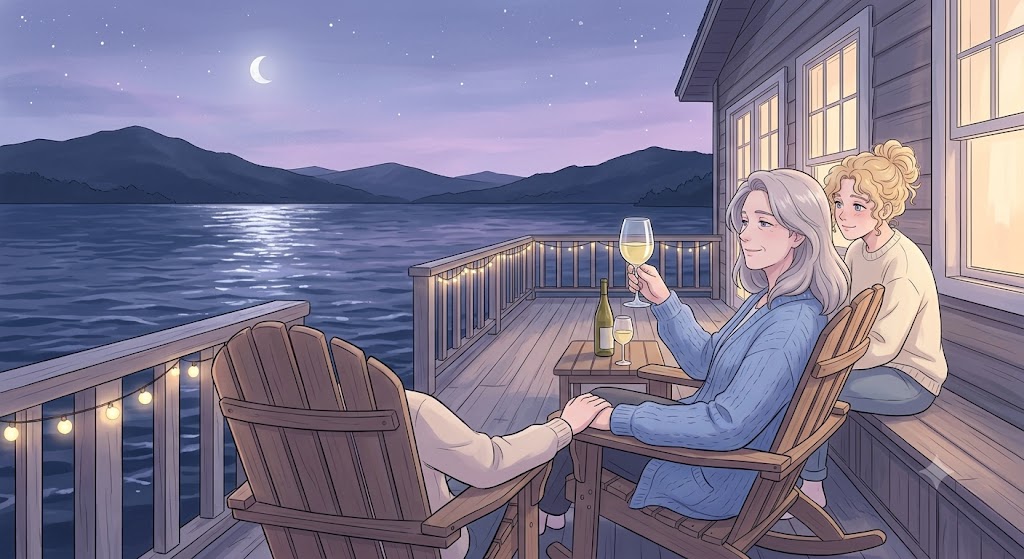
- Claire and Luca rented a beautiful lake house near Lake George in the Adirondacks for Memorial Day weekend. It featured a broad cedar deck, a stone fireplace, and floor-to-ceiling windows overlooking the water.
- On my drive north, I stopped at Wegmans to pick up fresh flowers, a warm loaf of bread, and a bottle of Finger Lakes Riesling. I couldn’t imagine showing up empty-handed—another lingering instinct from my marriage. Never enter a room without a offering. Give people a reason not to question why you’re there.
- Claire met me in the kitchen, flour dusting her apron.
- “Mom, I really need this weekend to go smoothly,” she whispered. “Hélène is lovely, but she can be… particular. Philippe too. They’re immensely proud of their background.”
- “I’ll behave,” I reassured her.
- Claire frowned. “That isn’t what I meant.”
- But it was what I heard: Be pleasant. Stay small. Don’t embarrass anyone.
- Hélène emerged as I was pulling my bag from the trunk. She was tall and effortlessly stylish in crisp linen trousers and a pale silk blouse—looking more prepared for a gallery opening than a weekend at an American lake.
- She kissed both my cheeks. “Margaret, we’ve heard so much about you.” Her English was immaculate, her smile polite but carefully measured.
- Philippe greeted me with a firm handshake. With his silver hair and expensive watch, he carried the unshakeable confidence of a man who had never once doubted his right to be in any room he walked into.
- We shared drinks on the deck before dinner as the late-May sun turned the lake to liquid copper. Claire and Luca chatted happily about wedding logistics while Philippe offered sweeping opinions on architecture, wine, American infrastructure, and everything in between.
- Then Hélène turned to her husband and began speaking French.
- I understood every single word.
- What none of them knew was that before I became a wife, mother, and high school teacher, I had lived in Lyon for eight years. I had moved there alone at twenty-two with a single suitcase and no sensible plan, learning the language by waiting tables, bargaining at neighborhood markets, arguing with landlords, and carving out a life in a city that had zero patience for timid foreigners.
- I almost never spoke about those years. After decades of marriage, the fearless young woman I had been in Lyon felt less like my past self and more like a character from a story I’d once read.
- So I stayed quiet and kept listening.
- At first, Hélène and Philippe’s comments were relatively mild. Hélène deemed the lake house charming, if a bit rustic. Philippe remarked that Americans frequently mistook proximity to nature for actual culture.
- I quietly sipped my wine.
- Then Hélène glanced toward Claire and said in French, “She’s sweet. A bit simple, perhaps, but pleasant.”
- Luca’s posture stiffened immediately. “Please don’t call the woman I’m marrying simple,” he replied in French.
- Hélène waved off his objection with a flick of her wrist. “I mean uncomplicated. Honest. She doesn’t pretend to be more than she is.”
- They kept talking, entirely sure I was oblivious.
- At dinner, Claire served beef bourguignon, a dish she had spent three weeks practicing so she could honor Luca’s roots. Philippe praised the meal warmly in English.
- Then he turned to his wife and murmured in French that he finally understood why Claire lacked refinement—her mother seemed pleasant enough, but was clearly a woman who had never seen much of the world.
- I kept my eyes fixed on my plate.
- Hélène agreed, saying there was no shame in living an ordinary, limited life; after all, not everyone possessed ambition, curiosity, or the courage to reach beyond what was comfortable.
- My fingers tightened around my fork.
- Claire caught my expression. “Is everything okay, Mom?”
- “Everything is fine,” I said.
- Then Philippe added that he feared Luca would spend his whole marriage carrying a wife without a real cultural foundation. He hoped his future grandchildren would remember where they truly came from.
- By that, he meant Brussels. He didn’t mean Claire. And he certainly didn’t mean me.
- In that instant, something inside me—something that had spent decades folding itself smaller and smaller—finally stopped shrinking.
- Very slowly, I set my fork down beside my plate.
- PART 2: The Woman from Lyon Returns
- Philippe was still speaking when I lifted my gaze and addressed him—in flawless, fluid French.
- I didn’t raise my voice. I used the cool, formal politeness I had perfected in Lyon: the precise kind of courtesy that allows you to deliver an absolute dismantling without ever dropping your composure.
- “Forgive me, Philippe,” I began softly. “I was enjoying your conversation so much that I hesitated to interrupt.”
- The entire dining room froze. Hélène’s fork hovered in mid-air. Philippe went utterly pale.
- “I lived in Lyon for eight years,” I continued. “I worked on Rue Mercière and lived near Croix-Rousse. I learned my French from people who didn’t slow down for foreigners, so I have understood every word you’ve spoken since you arrived.”
- Claire stared at me, her mouth slightly open. Luca buried his face in his hands.
- I systematically recounted their remarks—the rustic house, Claire’s supposed simplicity, my limited life, and their grand concerns about our family’s lack of culture.
- Then I sharpened my tone.
- “You sat at my daughter’s table and ate a meal she spent weeks perfecting specifically to welcome you. You used a language you thought protected you to insult her right in front of her.”
- Neither of them moved a muscle.
- “That is not the behavior of cultured people,” I said evenly. “In Lyon, we would call that the behavior of people with money, but no manners—which is the most pathetic form of poverty there is.”
- Hélène parted her lips to interject.
- “I am not finished,” I said pleasantly. “You’ve spent two hours discussing my family. Now it’s my turn, and I am granting you the courtesy of speaking in a language you understand.”
- I spoke of everything Claire had accomplished: how she had built a thriving career in a competitive field without handouts, established herself in a major city, and earned the genuine respect of people who knew far more about the world than expensive watches and grand dining rooms.
- “And she chose your son,” I added. “He is kind, and right now, he is deeply ashamed of you. That tells me you raised him better than you are acting tonight.”
- I made it clear that their future grandchildren would never grow up believing Brussels was superior to Rochester. They would grow up knowing their grandmother once packed a single bag, moved to a foreign country alone, and built a life from scratch.
- “That is the cultural foundation I intend to give them,” I concluded. “And I assure you, it will serve them well.”
- I picked up my fork, turned to my daughter, and switched back to English. “This is wonderful, sweetheart. The sauce is absolute perfection.”
- The silence that followed was heavy and absolute.
- I expected anger, defensive outbursts, or wounded pride. Instead, Philippe slowly set his cutlery down.
- “Madame Doyle,” he said in English, making sure Claire understood every word, “you are right. I am deeply ashamed.”
- He looked squarely at my daughter. “We hid behind our language because cruelty is easy when you assume no one can hold you accountable. Claire, what I said was false and cowardly. You welcomed us with open arms, and I repaid you with disrespect.”
- Tears welled in Hélène’s eyes. “I called you simple,” she admitted, her voice trembling. “But the truth is, you intimidated me. Luca loves you with a depth he has never shown us.”
- When Claire asked why that frightened her, Hélène offered a rare, honest truth: she was terrified of losing her son to a warmer, more welcoming family. Rather than face her insecurity, she had chosen to look down on Claire.
- It didn’t excuse the cruelty, but it changed the room entirely.
- PART 3: The Woman I Had Never Truly Lost
- The remainder of the weekend proved surprisingly transformative.
- Philippe began asking about my time in Lyon with real, unfeigned curiosity. As it turned out, he had completed part of his engineering training there during the exact years I lived in the city. That night, we stayed up until two in the morning, animatedly debating old neighborhood bistros in French and sketching crude maps on paper napkins.
- Claire later confessed she had stood on the stairs listening, weeping softly because she had never seen that side of her mother before.
- Hélène and I didn’t become instant best friends, but on our final morning, she joined me out on the deck while the lake was still calm.
- “I would like to get to know the woman who moved to Lyon alone at twenty-two,” she said quietly. “I don’t think Claire really knows her. I’m not even sure you know her anymore.”
- “I’m rediscovering her,” I replied. “You’re welcome to join us.”
- Claire and Luca were married the following spring in the Finger Lakes. Philippe provided exquisite wine for the occasion, while Hélène helped me select my dress over several long video calls, playfully correcting my French pronunciation along the way like someone who had genuinely grown to care.
- During the reception, Philippe delivered part of his toast in French. He paused, laughed, and looked out at the guests.
- “I will translate for the rest of the Americans here, but not for Margaret,” he announced warmly. “I learned over a very memorable beef bourguignon that she understands every word.”
- The room erupted in laughter, and for the first time in thirty-five years, I didn’t feel the urge to shrink or explain myself. I just laughed along with them.
- Looking back, that weekend was never really about Philippe and Hélène. It was about the moment I put down my fork.
- For over three decades, I had trained myself to keep my eyes on my plate, to let subtle dismissals pass, and to show up everywhere carrying gifts just to justify my presence. My ex-husband had slowly taught me that being quiet was the safest way to exist, until I mistook that defense mechanism for my actual personality.
- But French belonged to a time before I learned to shrink. It belonged to Lyon, to independence, to one bag and no safety net. It belonged to the young woman who wasn’t afraid to speak her mind. When Hélène insulted my daughter, she accidentally reached past the quiet, retired woman at the table and poked the woman underneath—a woman who had never learned to bow her head.
- Claire and Luca now have a daughter named Margaux, who is growing up fluent in two languages across two continents, adored by four grandparents. Whenever I watch her, I speak to her exclusively in French. Her very first complete sentence to me was “Mon amie”—my friend.
- Philippe and I still write to each other in French. He signs every email the same way: To the woman who understood every word.
- He isn’t entirely right, though. I didn’t understand because I was playing a game or waiting to spring a trap. I understood because long before anyone taught me to fade into the background, I was brave enough to stand on my own feet.
- That woman had never left. She had survived the marriage, the quiet divorce, and all the silent years that followed. She was simply waiting for someone to speak to her in a language her fear had never managed to translate.
PART 1: The Language They Thought I Couldn’t Understand