- The fire started from a gas leak in the kitchen in the middle of the night. My father was away on a business trip, leaving just my mother and me at home. She woke up to the smell, then the explosion. She snatched me from my crib and ran through blinding smoke to carry me outside.
- When my father came home and saw her after she was released from the hospital, he didn’t thank her for saving my life. He didn’t even try to hide his disgust. He told her he couldn’t live with the reminder. Later, my mother admitted he had also said he still had time to build a different life with someone he could actually “admire.”
- Then he left. No custody battle, no birthday cards, no phone calls. Nothing.
- My mother never recounted that story with theatrical drama. She would simply say, “Some people leave when life stops flattering them.”
- The fire left severe scars running down one side of her face, her neck, and across her shoulder. She worked double shifts at a diner while undergoing skin treatments she could barely afford, never asking for pity or making me feel like a burden.
- When I turned 16, I secretly took a job stocking shirts at a department store to help with bills. When she found out, she was furious, insisting I focus on my studies.
- “You are not taking a job because of me,” she argued.
- “I’m taking a job because groceries cost money,” I replied.
- That earned a rare laugh from her, and she stopped fighting me on it. I stayed in retail, learned the industry, saved aggressively, and by age 29, opened my own clothing boutique. It did well enough that my mother could finally slow down and retire.
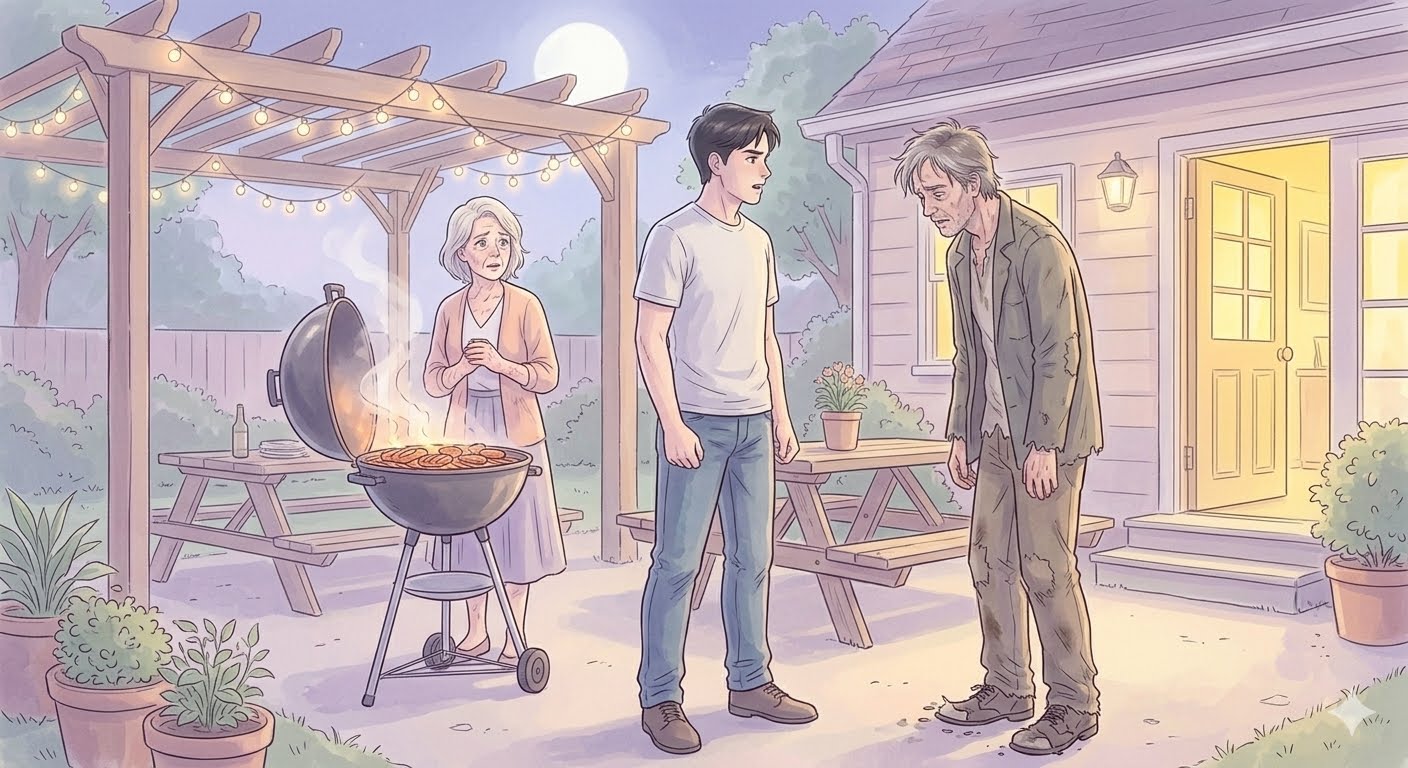
- Last week was my 32nd birthday. I spent it at my mother’s place, grilling burgers and corn in the backyard on a quiet, easy evening.
- A sudden knock at the front door interrupted us. I wiped my hands and opened it to find a man standing on the porch in worn clothes and nearly split shoes. He was thin, tired, and gray around the mouth, but I recognized him instantly. He had my eyes.
- My mother stepped up behind me and froze.
- “Hey,” he rasped, clearing his throat. “Son.”
- “Dad?” I asked.
- He gave a small nod and looked past me at my mother, shrinking under her gaze. He explained that he had gone bankrupt, his second wife had left him, and he had nowhere else to turn. He had tracked me down through my boutique’s public website.
- “I’m not doing this,” my mother said, turning away.
- “Please,” he pleaded. “I just need help getting on my feet.”
- I looked at him—at his shame, his nerve, and the fact that even after 30 years, he still knew where to point his need.
- “I’ll help you,” I said.
- My mother spun around so fast I thought she might throw her glass at me.
- “I’ll help,” I repeated. “Money, a place to stay—all of it. But I have one condition. Tomorrow morning, you’re getting in the car with us, and you’re coming back to the old property.”
- His face fell. “What for?”
- “So you can stand where you left us.”
- The next morning, the three of us drove out to the lot. The original house was long gone, replaced by a modest rental home with a sagging porch and a leaning fence.
- The current property owner, an older man named Walt, came out to greet us. When I explained that my mother had lived on the lot before the fire, Walt’s eyes widened. He recalled that years ago, workers digging near the old kitchen footing had uncovered a faded blue metal recipe box wrapped in oilcloth and buried in the dirt.
- My mother’s hand flew to her mouth. “I buried that,” she whispered.
- Walt retrieved the box from his garage and handed it over. Inside were scorched recipe cards, a baby photo of me, and a letter my mother had written to my father 30 years ago but never sent.
- I handed the letter to my father. “Open it.”
- With trembling hands, he read it. The letter was brief and contained no begging. She wrote that her son was alive because she carried him through fire, and that even if he no longer loved her, he still had a duty to love the child she saved. She closed by stating she would not spend the rest of her life asking a coward to become decent.
- My father sat down on the porch step and buried his face in his hands. “I’m sorry,” he wept.
- I looked at Walt. “You still need work done here?”
- “Porch boards, fence, a couple of posts,” Walt nodded.
- I turned back to my father. “I’ll pay for materials, and I’ll help you get on your feet. But first, you’re going to fix this place. That’s the condition.”
- For a week, my father worked the land. He tore out rotten wood, reset posts, straightened the fence, hauled heavy debris, and built up calluses under the summer sun.
- On the third day, my mother brought him a glass of iced tea, setting it on the porch rail. “Check the support beam before you cover it,” she advised quietly. “Rotten wood doesn’t get stronger just because you hide it.”
- While excavating near the porch, Walt uncovered another remnant buried in the soil: a carved wooden block from the crib my grandfather had built for me by hand before the fire. My mother ran her thumb over the carved star, moved to tears.
- By the end of the week, the porch was sturdy and the fence stood straight. Exhausted, my father looked up at me. “I did what you asked. So now what?”
- “Now you get one month,” I told him. “A room above my store, food, and time to find a job. That’s it.”
- He looked at my mother. “I know I don’t deserve another chance.”
- “No,” she replied plainly. “You don’t.”
- A few days later, I took the carved crib block to a local woodworker and had it mounted on a display board. Underneath the star, I had him engrave one line:
- Made worthy before the world said otherwise.
- I mounted it on the wall near the fitting room in my store, with both my mother and father standing nearby in silence. My mother touched the carved wood with two fingers, a soft smile finally gracing her face.
- I realized then that I hadn’t set that condition to humiliate my father. I set it because too many people confuse regret with repair—and they are not the same thing.
I am 32 now, and the only reason I am alive is that my mother carried me out of a burning house when I was two.