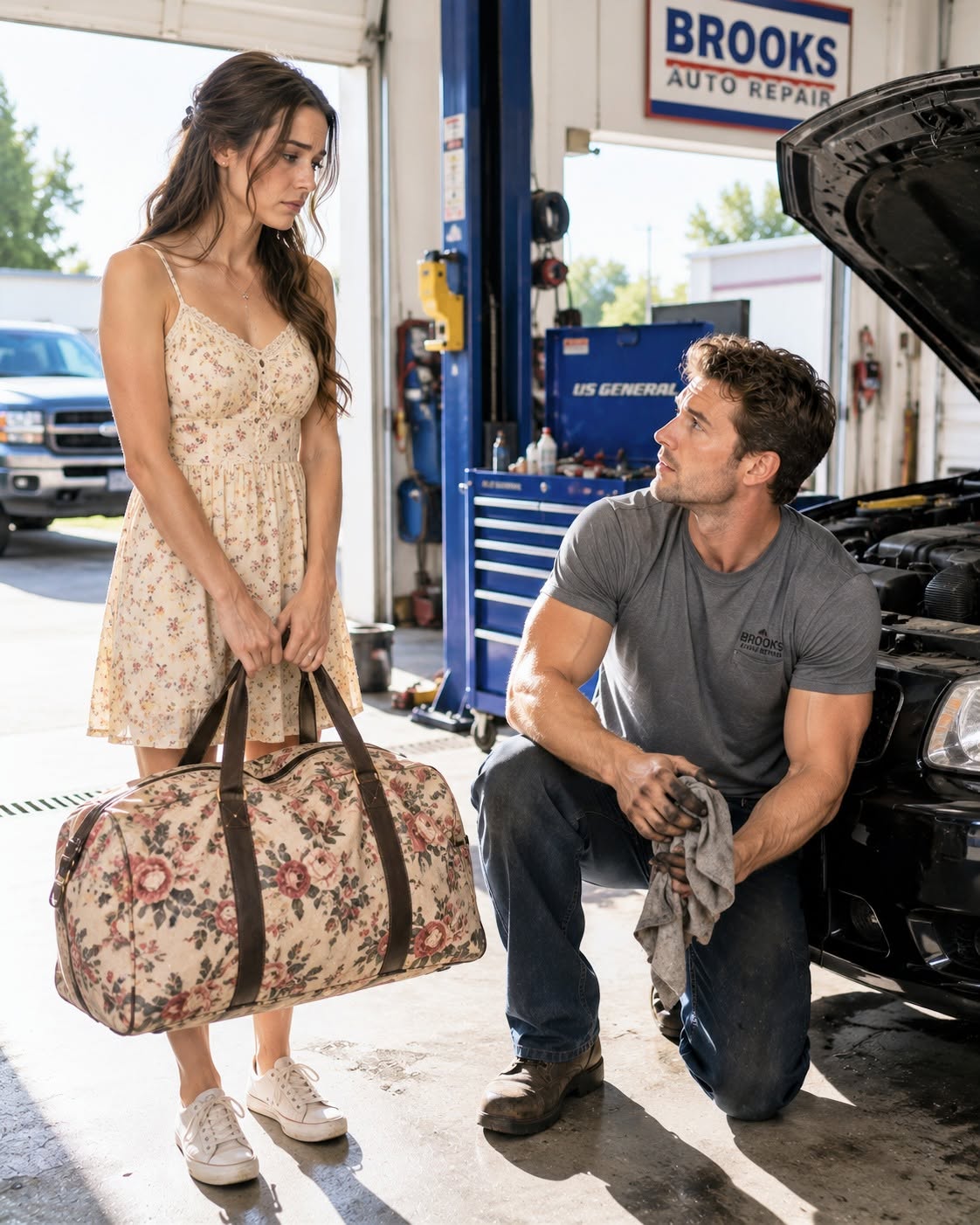
She came to apply for a position at my auto shop. I told her, “What I really need is a wife, not another employee.”
When Rachel Morgan stepped into the repair shop carrying a rose-colored suitcase, the first words she heard were:
“I need a wife, not an employee.”
The man who said it was crouched beside an old pickup truck, a wrench in one hand and a grease-blackened cloth in the other. His hair was disheveled, a dark streak crossed one cheek, and the grin on his face looked like something he regretted the instant the sentence left his mouth.
Rachel tightened both hands around the suitcase handle.
“Then apparently I responded to the wrong advertisement.”
She turned toward the door.
“Wait!” the man called.
He stood up so fast that his head struck the raised hood.
“Damn it!”
Rachel stopped walking, though she did not turn around.
“My name is Daniel Brooks,” he continued, rubbing the top of his head. “I own the shop, and what I just said was absolutely not part of the hiring process.”
“So there actually is an interview?”
“There could be, assuming I haven’t already destroyed my chances.”
Rachel looked at the crooked paper sign taped inside the office window.
RECEPTIONIST NEEDED. $1,200 PER WEEK.
Then she looked through the glass at the disaster inside: piles of unpaid invoices, folders leaning in every direction, a dusty telephone, and a cardboard box with the words “Taxes, possibly” written across the side.
“You need much more than a receptionist.”
“I’m aware. That’s why I’m prepared to apologize a second time.”
She almost smiled.
Daniel moved aside and opened a path through the doorway.
“I make jokes whenever I’m nervous. It isn’t a particularly appealing trait. My mechanic, Mike, reminds me of that every day.”
From somewhere in the garage, a man shouted,
“Because somebody has to do it!”
Rachel gave a brief laugh.
That was enough to make her stay.
She set her résumé on the counter. She had spent six years working in hospital administration, medical billing, insurance processing, and collections. She understood how to organize files, reconcile accounts, and speak calmly to people who believed shouting could alter mathematics.
“What does the position really pay?” she asked.
“Eighteen hundred a week for the first month. If you can untangle my records, twenty-three hundred after that.”
“The sign says twelve hundred.”
“The sign is outdated and, apparently, dishonest.”
Rachel surveyed the office again.
“I can begin tomorrow, but I need to leave for forty-five minutes every day at noon. That part isn’t negotiable. I’ll make up the time after closing.”
“Fine.”
She looked at him, surprised.
“You don’t even know why.”
“You said there are no exceptions. That means it matters.”
For the first time, some of the guarded tension left Rachel’s face.
Daniel handed her an application and the least dirty pen he could locate.
Before leaving, she pointed toward the window.
“You should remove that sign.”
“Why?”
“Because you already hired someone.”
Daniel pulled the cardboard notice down and placed it on the counter.
At the time, he believed the important part was that Rachel had accepted the job. He had no idea she would slip that sign into her suitcase, or that months later the same piece of cardboard would once again decide the future for both of them.
By her third day, the office looked like an entirely different place.
Rachel arrived at 7:30 every morning, pushed the pink suitcase beneath the desk, tied her hair back, and turned on the computer as though she had been appointed to rescue a failing corporation.
Mike watched as she sorted stacks of papers.
“Are you throwing all of that out?”
“I’m determining which documents are still legally alive.”
Mike glanced toward Daniel.
“I like her.”
Before noon, Rachel had uncovered eight unpaid invoices, one purchase that had been paid twice, and an estimate written on the back of a barbecue restaurant menu.
“This is not accounting,” she said. “It’s a distress signal.”
“The customer got his truck back.”
“That doesn’t transform a sauce-stained menu into a valid financial record.”
That same afternoon, she recovered $16,000 the shop had forgotten it still held as supplier credit.
Rachel worked with quiet discipline. She had no mercy for disorder, but she treated people with care. She never moved an appointment without first calling the customer, and she never promised a completion date the mechanics could not realistically meet.
Daniel learned the reason for her daily noon absence at the end of the first week.
Rachel’s mother, Linda Morgan, had been struck by a delivery van in Richmond. She survived surgery, but the damage to one leg required specialized rehabilitation in Charlotte.
Rachel had given up her apartment, left a temporary office contract, and moved Linda into a rehabilitation center near the shop. She was staying in a low-cost motel three miles away and spent every lunch break visiting her mother.
“She put this sticker on my suitcase,” Rachel explained, pointing to a visitor label. “She was worried she might lose track of it while using her walker.”
“Does she normally misplace things?”
“Never.”
Rachel offered no further explanation.
Daniel did not press her.
Beginning the next morning, he stopped booking customer appointments between noon and 12:30. He never called it a favor. He simply changed the schedule so no impatient customer would be standing at the counter when Rachel left.
One afternoon, she returned from the rehabilitation center speaking on the phone.
“Don’t try to stand by yourself, Mom. Push the call button and wait for the nurse.”
Rachel closed her eyes.
“I’m not angry. I’m exhausted. Those are not the same thing.”
There was a pause.
“I love you too. I’ll come back after work.”
She ended the call, drew a slow breath, and greeted a customer as though her voice had never shaken.
Daniel pretended not to have heard.
But from that moment on, he understood those forty-five minutes were the only part of Rachel’s day when she could stop carrying everyone else and simply be someone’s daughter.
Their first real disagreement began with a customer named Harold.
Rachel had installed a large whiteboard in the garage. Every vehicle had a separate row, a promised delivery date, and a list of parts still required.
When Harold saw it, he slapped Daniel on the shoulder.
“So you finally learned how to operate a real business. Took you long enough.”
Daniel laughed automatically.
“I suppose everybody grows up eventually.”
Rachel stood a few feet away with a folder pressed against her chest.
She said nothing.
An hour later, Daniel noticed that the words “System created by R. Morgan” had been erased from the whiteboard.
“Why did you remove your name?”
“The shop belongs to you.”
“The shop does. The system does not.”
“Customers feel safer believing the owner invented everything.”
Daniel understood immediately what he had done.
He could have explained that Harold talked too much, that he wanted to avoid an awkward correction, or that he had simply followed the conversation without thinking. But every excuse would have required Rachel to make herself smaller so he could feel better.
“I accepted the praise because correcting him would have been inconvenient,” Daniel said. “That was wrong.”
Rachel looked up.
“You don’t need to deliver a speech.”
“Good. I’m terrible at speeches.”
When the next customer complimented the whiteboard, Daniel pointed toward the office.
“Thank Rachel. She designed the entire system. I barely understand what the colors mean.”
Then he wrote her name back onto the board.
Rachel examined his handwriting.
“My handwriting is better.”
“Then correct it.”
She did.
It was the first time she openly claimed her place in the business.
As the weeks passed, the shop improved. Rachel introduced reminder systems, negotiated lower supplier prices, and taught Mike to put his notes into a tray rather than scattering them over every surface in the building.
She also began letting her humor show.
She labeled an old metal filing cabinet:
EVIDENCE FOR THE IRS.
“Why would you name it that?” Daniel asked.
“Because when the IRS examines your books, they’ll need proof this catastrophe existed before I arrived.”
Mike laughed so hard he dropped a socket wrench.
After Rachel’s daily visits to the clinic, the three of them began sharing lunch. She brought turkey sandwiches. Daniel brought homemade soup or stew in plastic containers whose lids never matched.
At first, Rachel kept the strap of the pink suitcase wrapped around her ankle.
After two weeks, she began leaving it beneath the chair.
Daniel started noticing details he had no reason to notice: the way she tapped her pen twice whenever a supplier annoyed her, the way she verified every number before entering it, and the light in her expression whenever her mother made progress.
He also noticed how empty the office seemed whenever she arrived late.
“It’s 7:29,” Mike said one morning. “She isn’t late.”
“I was checking the forecast.”
“The weather has looked exactly the same for twenty years.”
At that moment, Rachel entered with rain caught in her hair.
Mike looked at Daniel.
“Amazing. You suddenly don’t care about the weather.”
Daniel threw a rag at him.
One Thursday, Rachel came back from the rehabilitation center holding two coffees.
“My mother walked twenty feet with a cane today.”
“That’s fantastic.”
“She says it was only fifteen.”
“Why?”
“She doesn’t trust the therapist’s measuring system.”
“I think I like your mother.”
“She would make you clean the storage room and tell you those shoes should have been thrown away years ago.”
“My shoes are repaired with windshield adhesive. That demonstrates technical intelligence.”
Rachel laughed.
Daniel nearly made another joke just to hear the sound again, but stopped himself.
He was slowly learning that not every emotion needed to hide behind humor.
The following week, heavy storms flooded several streets in Charlotte. The shop telephone rang constantly, and customers had been waiting since early morning.
Rachel’s cell phone vibrated.
When she answered, all the color disappeared from her face.
“A full evaluation appointment opened for my mother. It’s today at noon. If she passes, they’ll schedule her discharge.”
“Then you should go.”
Rachel looked around the crowded waiting area.
“I can’t. This is our busiest day this month.”
When she reached for the phone to decline the appointment, Daniel covered the receiver with his hand.
“Give me the customer folder.”
“You have six vehicles waiting.”
“Mike has six vehicles waiting. I have a clean shirt and the ability to disappoint people using complete sentences.”
“This isn’t a joke.”
“I know. Go to the evaluation.”
“I’m still in my probation period.”
At that moment, Daniel realized she was not afraid of abandoning the desk.
She was afraid one ordinary human need would erase everything she had fought to prove.
“You are not losing your job. I’m not reducing your pay, and you will not owe me anything because I answered the phone for a few hours. Ask every question you need to ask.”
“I’ll return by two.”
“Return when you’re finished.”
The next three hours were complete chaos.
Daniel mixed up customer keys, wrote two estimates incorrectly, and described a paint shade as “regular white” to a deeply offended woman who insisted it was called “winter pearl.”
“Where is Rachel?” the customer asked.
“Handling something important.”
The woman became quiet and nodded.
Rachel returned at 3:20.
“My mother passed the evaluation. They’ll discharge her in four weeks.”
Daniel sat in her chair surrounded by paperwork.
He smiled.
“That is the best news I’ve heard all day.”
“What was the second-best news?”
“I found the missing Nissan key.”
“Where was it?”
“In my pocket.”
Rachel shut her eyes.
“Of course it was.”
Daniel had kept her pink suitcase away from the grease and placed it on the cleanest chair in the office.
Rachel set a cup of coffee beside his hand.
“It’s cold.”
“I deserve that.”
Their fingers touched briefly around the cup.
The contact lasted less than a second, but Daniel understood that something had shifted.
He did not simply want to help her anymore.
He wanted her to trust him.
He wanted her to remain at the shop.
He also understood he had to want those things without making her feel she owed them to him.
Two evenings later, while they were closing, the zipper on Rachel’s suitcase caught.
A piece of cardboard fell to the floor.
It was the original job advertisement.
On the back, Rachel had written a checklist from her first day.
Below it was a sentence:
“This was the first place that asked what I could do before asking what had gone wrong in my life.”
Daniel read it.
“Please give that back,” she said, embarrassed.
He handed it over immediately.
“You kept it.”
“It’s a useful piece of cardboard.”
“It was a terrible advertisement.”
“It led me to a job.”
Before Daniel could answer, Rachel continued.
“The hospital offered me an interview.”
The expression disappeared from his face.
The position included medical coverage, retirement benefits, and permanent employment. With Linda preparing to leave rehabilitation, it was the most practical opportunity.
Daniel’s first instinct was to ask her to stay.
His second was to understand that he did not have the right.
“It sounds like a strong opportunity.”
Rachel studied his face.
“You don’t care whether I leave?”
“I care enough to hate the possibility. But I’m not going to make the hospital harder for you to choose. I will write the strongest reference letter I can.”
“What if I don’t know what I want?”
“Go to the interview and find out.”
During the following days, Daniel became distant. He stopped bringing coffee and avoided spending time inside the office.
Eventually, Rachel dropped a folder onto his desk.
“Did I do something wrong?”
“No.”
“Then why have you barely spoken to me?”
“I’m trying to give you room.”
“I never asked for room.”
Daniel looked at her.
He had confused respecting her decision with disappearing from it.
“I’m trying not to pressure you.”
“You are allowed to have an opinion without turning it into an obligation.”
He inhaled slowly.
“I want you to stay. I also believe you should attend the interview. Both things are true.”
Rachel’s shoulders relaxed.
“That is all I needed you to say.”
The most difficult test came the following Monday.
Mark Reynolds, regional manager for a delivery company, arrived to discuss maintenance for twenty-five commercial vans. The contract was valuable enough to support the shop through several slow months.
Rachel had prepared the rates, timelines, and service terms.
Mark glanced through the documents without looking at her.
“The plan looks good,” he said, “but I prefer speaking directly to the owner, not the receptionist.”
“Rachel is our Operations Manager,” Daniel replied. “She will be managing your account.”
Mark gestured dismissively toward the office.
“I’m not discussing mechanical service with the girl who answers the phone.”
Rachel’s hands stopped over the keyboard.
Several months earlier, Daniel might have laughed to reduce the tension.
This time, he pushed the contract back across the counter.
“The woman in that office built the system you just praised. She created the pricing and identified three errors in the service list your company provided. If you want to work with us, you will speak to her with the same respect you show me.”
“I’m offering you more than $300,000 a year.”
“That amount does not purchase permission to humiliate my staff.”
Mark stood.
“I’ll take the fleet somewhere else.”
“That is your decision.”
After he left, Rachel confronted Daniel.
“You should not have done that.”
“He disrespected you.”
“I am capable of defending myself.”
“I know.”
“Then you should have allowed me to speak. Now the shop has lost a contract, and I feel as if I have to stay to repay you.”
Daniel realized exactly where he had failed.
He had wanted to defend her, but by speaking before she could, he had taken away her opportunity to claim her own authority.
“You’re right,” he said. “Next time, you speak first, unless someone tries to prevent you from speaking.”
“That is what I need.”
“But I do not regret rejecting the contract. A client who refused to respect your position would have created trouble every week.”
“What about the lost income?”
“I’ll work Saturdays. You do not owe me $300,000, and you do not owe me your future here.”
The disagreement did not end with an embrace.
Rachel returned to the office.
Daniel went back to work without another word.
But the next morning, something small happened.
A cardboard box filled with files tore open beside Rachel’s desk. Daniel stepped toward her, then stopped.
“Would you like help?”
Rachel looked at the scattered folders.
“No. I can manage it.”
“All right.”
A minute later, she said,
“Thank you for asking.”
That sentence changed something between them.
Daniel began learning when to intervene and when to step aside.
Rachel began learning that accepting assistance did not automatically create a debt.
Over the next several weeks, they began teaching each other their work.
She showed him how to read financial reports, negotiate supplier contracts, and calculate labor margins.
He taught her how to identify structural damage, diagnose engine sounds, and judge bodywork and paint repairs.
The evening before her hospital interview, Daniel found a freshly pressed navy shirt hanging over his chair.
“Did you do this?”
“You have a supplier meeting, and you were planning to wear a torn T-shirt.”
“It provides ventilation.”
“It communicates weakness during negotiations.”
Daniel touched the smooth collar.
“Thank you.”
“You gave me the freedom to make my own decision. I can help you make better decisions too.”
It was the first time either of them openly admitted they were taking care of the other.
Rachel attended the hospital interview on Friday.
They offered her the job and gave her until Monday to respond.
On Saturday, the shop held a free brake and tire safety event. Rachel had organized it before the hospital made its offer.
Mike picked up a microphone.
“This entire system exists because we finally started using our brains.”
Daniel looked toward Rachel.
The first time, he had allowed another person to claim credit for her work.
With Mark, he had spoken before she had the chance.
This time, Daniel picked up the microphone and handed it to her.
“This event belongs to Rachel. She should be the one explaining it.”
Then he stepped aside.
Rachel held the microphone for a moment.
“Thank you for coming. Anyone who has not checked in should speak with me before entering the service area. And if Mike tells you your brakes are fine, ask him to put it in writing. He hates paperwork, so the threat will make him more thorough.”
The crowd laughed.
By closing time, they had scheduled enough work to keep the shop busy for the following three weeks.
When they were finally alone, Rachel placed a folder on the desk.
“I need to discuss my position.”
Daniel felt his stomach tighten.
“The hospital offered me the job, but I have not answered yet.”
“I understand.”
“I know what I want. But if I stay, this needs to be a career, not a favor or an accident.”
“That is exactly what it should be.”
“I want the title of Operations Manager, a twenty-percent salary increase, my name included on every account I manage, health insurance after three months, and a performance bonus when I meet the agreed targets.”
Daniel kept his expression neutral, though inside he felt almost unbearably proud.
“Can the business support all of that?”
“I reviewed the numbers twice.”
“Then I agree.”
Rachel frowned.
“You are supposed to negotiate.”
“No.”
“You taught me that I’m allowed to say no.”
“And I am saying no to underpaying the person running my business.”
For the first time, she smiled without any caution behind it.
“I’ll reject the hospital offer.”
Daniel placed both hands on the counter, steadying himself against the relief rushing through him.
“But I’m not remaining because of you.”
“I know.”
“I’m staying because I created something here, and I want to keep building it.”
“I know that too.”
Rachel walked around the desk.
“Good. Because now I can say this without feeling that I owe you anything.”
Daniel stopped breathing.
“The workday is over. Would you like to take me to dinner?”
“Yes.”
He smiled.
“Very much.”
“That was far too serious.”
“I’m improving.”
He lifted one hand toward her, then paused.
“May I kiss you?”
“Yes.”
The kiss was short, warm, and freely chosen by both of them.
From the garage, Mike shouted,
“The office walls are glass!”
Rachel rested her forehead against Daniel’s and laughed.
Linda was released from rehabilitation the following week.
She walked with a cane and held strong opinions about nearly everything.
When she met Daniel, she examined him silently for several seconds.
“You are less foolish than that opening sentence made you sound.”
Rachel stared at her.
“You told her about that?”
“Your mother asks too many questions.”
“And you answer too many of them,” Linda said.
The months that followed were not simple.
The shop lost money after turning away Mark’s fleet contract, but it recovered through customers who respected Rachel’s leadership.
Her name began appearing beneath Daniel’s on every estimate.
Inside the shop, she was the Operations Manager and he was the owner.
Outside the shop, they were simply two people learning how to love one another without confusing affection with authority.
Almost one year later, they closed the shop late on a Tuesday evening.
Rachel was completing payroll when Daniel placed the original job advertisement on top of her keyboard.
She had covered the cardboard with clear plastic to protect it.
“We are not hiring,” she said.
“Turn it over.”
On the back, beneath her first-day checklist, Daniel had written:
Will you marry me?
Rachel picked up a pen, drew a line through the question, and returned the sign to him.
Daniel’s expression collapsed.
“A piece of cardboard cannot ask me something like that,” she explained. “You have to ask me yourself. No joke. No hiding.”
Daniel set the sign aside, walked around the desk, and knelt in front of her.
He held both of Rachel’s hands.
“You do not need me in order to survive, and you owe me nothing. You built a life here because you chose to. You transformed this shop, and you made me a more truthful man.”
Her eyes filled with tears.
“I love you. I want to be your husband, your partner, and the man who continues learning when to stand beside you and when to let you lead. Rachel Morgan, will you marry me?”
“Yes.”
She tightened her fingers around his.
“Yes, I will.”
Then she wrote beneath the crossed-out proposal:
POSITION FILLED.
They married one month later.
Linda walked down the aisle without her cane, and Mike cried harder than anyone in either family.
The following Monday, the telephone was ringing before they finished opening the shop.
A shipment of parts was overdue, an apprentice had switched two sets of keys, and one customer insisted her car only made a strange noise while driving past a bakery.
Rachel sat behind her desk wearing a plain wedding band beside the pen she tapped twice whenever something irritated her.
Daniel placed a cup of coffee beside her hand.
“Is this for the Operations Manager or your wife?” she asked.
“For my business partner.”
“That answer just saved your life.”
Rachel picked up the phone.
“Brooks and Morgan Auto Repair. This is Rachel speaking.”
She listened, checked the whiteboard, and smiled.
“Yes. I’m the person in charge.”
Behind her, the old job advertisement hung inside a black frame.
On the reverse side were her original checklist, the crossed-out proposal, and the words she had written afterward.
On the day they met, Daniel had told her he needed a wife rather than an employee.
The truth was that he understood neither role.
In the end, he did not find a helpless woman waiting to be rescued or an employee expected to obey him.
He found a partner who was always free to leave—and who, because she was free, chose to stay with him every day.