PART 2 – The CEO’s Wife Thought I Was Staff – 1!001
PART 2
Mia fell asleep before our car turned onto Fifth Avenue.
Her small face rested against the side of the booster seat, one hand still curled around the silver ribbon the hotel hostess had tied to a gift bag.
The ribbon trembled each time the car passed over a seam in the road.
Outside the tinted window, Manhattan glittered with the kind of cold brilliance that made everything look expensive and untouchable.
I watched my daughter sleep and tried to slow my breathing.
The driver did not ask questions.
Mr. Delgado had worked for my family’s investment office for nine years, long enough to understand silence.
He had seen boardroom victories, family funerals, tense airport pickups, and once, after my divorce, a version of me so hollowed out by exhaustion that I barely recognized myself.
Tonight, he only adjusted the heat.
“Home, Ms.
Hart?” he asked gently.
I looked down at my phone.
Twelve missed calls had already arrived from Robert Blackwell.
Three from the company’s general counsel.
One from Elaine Mercer, the board chair, who never called after ten unless something had broken.
“Yes,” I said.
“But take the long way.”
Mr. Delgado’s eyes lifted briefly to the mirror.
“Of course.”
The city slid past in streaks of gold and red.
In the back seat, beneath the quiet weight of Mia’s sleep, I let the evening replay itself.
Victoria’s eyes.
The laughter hidden behind champagne flutes.
Robert’s face draining of color as though someone had opened a vein of truth in the middle of the ballroom.
I had been underestimated before.
In finance, in marriage, in motherhood, in rooms where men spoke over me and then congratulated themselves on repeating my ideas more loudly.
But watching Mia’s smile fade in that ballroom had changed the temperature of the insult.
It was no longer about pride.
It was about the kind of company I had allowed to grow in my absence.
Hartwell Meridian had been my father’s final gamble and my first inheritance.
He had built the original logistics firm with two delivery trucks, a warehouse lease he could barely afford, and the absolute belief that efficiency meant respecting every person in the chain.
After he died, I used my majority stake to merge, restructure, and expand the company into a multinational supply and infrastructure group.
But I had never wanted to be the face of it.
I preferred quiet control.
Numbers over ceremonies.
Decisions over applause.
I installed executives, approved strategy, and kept my distance from the internal politics that made ambitious people sharpen their smiles.
Robert Blackwell had seemed, at first, like the perfect operator.
Polished, articulate, steady under pressure.
He knew how to reassure analysts and flatter regulators.
Under him, quarterly earnings improved.
Employee turnover, however, had crept upward.
Anonymous complaints increased.
Several longtime managers retired early.
I had noticed, but I had also accepted explanations too easily.
Market stress.
Post-merger adjustment.
Culture friction.
Words used by comfortable people to soften uncomfortable truThS.
Mia stirred, murmuring something I couldn’t understand.
I reached across and tucked her blanket beneath her chin.
“Mommy’s here,” I whispered.
Her eyelids fluttered, then settled.
By the time we reached the townhouse, I had made three calls.
The first was to Elaine.
“Tomorrow morning,” I said when she answered.
“Seven-thirty.
Emergency board session.
Full attendance.
In person or encrypted video.”
Elaine did not ask whether it could wait.
“Robert?”
“Robert, company culture, executive oversight, and the board’s tolerance for selective blindness.”
There was a pause.
“That sounds like more than tonight.”
“It is.”
The second call was to Daniel Reyes, my attorney.
“I need the governance documents, Robert’s employment agreement, the dignity-at-work complaints from the last twenty-four months, and anything sealed under executive privilege that you think I was not encouraged to read.”
Daniel exhaled softly.
“That is a large net.”
“Then cast it wide.”
The third call was to Nora Singh, Hartwell Meridian’s head of internal audit, one of the few senior officers I trusted without reservation.
“I need facts by morning,” I told her.
“Not rumors.
Not summaries filtered for executive comfort.
FacTS.”
Nora was silent for only a second.
“I wondered when you’d ask.”
The sentence stayed with me long after the call ended.
I carried Mia upstairs myself.
Her room smelled faintly of lavender soap and crayons.
On her bedside table, a paper crown from preschool leaned against a stuffed rabbit missing one button eye.
I changed her into pajamas without waking her fully, brushing my fingers through the curls at the nape of her neck.
As I pulled the blanket over her, she opened her eyes.
“Mommy?”
“Yes, baby.”
“That lady was mean.”
I sat carefully on the edge of the bed.
“She wasn’t kind.”
“Did she think we weren’t allowed there?”
I swallowed.
There were answers adults invented because the truth had too many sharp edges.
But children remembered the shape of avoidance.
“She made a guess about us,” I said.
“And she was wrong.”
Mia thought about that.
“Like when I thought Leo took my blue marker, but it was in my backpack?”
“Exactly.”
“But I said sorry.”
I smiled, though my throat hurt.
“That was the important part.”
“Will she say sorry?”
“I don’t know.”
Mia’s eyes grew heavy again.
“She should.”
“Yes,” I whispered.
“She should.”
After she fell asleep, I stayed in the dark beside her bed.
From the window, the city’s light touched the ceiling in faint silver rectangles.
I had spent years convincing myself that emotional distance made me fair.
That remaining unseen protected my daughter and kept the company stable.
But distance also created shadows, and in shadows, people behaved as though no one important was watching.
Downstairs, my laptop waited on the kitchen island beside a cup of tea that went cold before I took a sip.
At 1:16 a.m., Nora sent the first file.
At 1:43, the second.
By 3:05, I understood why she had said she wondered when I’d ask.
There were exit interviews marked “non-actionable” despite clear patterns.
Women in regional offices described being dismissed in meetings.
Warehouse supervisors reported pressure to understate safety concerns.
A junior analyst had left after being told by an executive vice president that “Hartwell rewards confidence, not feelings.” Several complaints mentioned Victoria by name, though she held no formal role.
Unofficial influence.
Vendor introductions.
Charity seating arrangemenTS. Casual comments that reached Robert’s ear and somehow altered careers.
One note, written by a departing communications manager, made me sit back from the screen.
Mrs. Blackwell frequently attends executive events and speaks as though she represents leadership.
Employees believe offending her could affect advancement.
I thought of Mia’s small hand squeezing mine.
Then I opened the final attachment.
It was not a complaint file.
It was a contract summary Nora had flagged in red.
A consulting firm named Lark & Vale had received unusually generous retainers for “strategic brand alignment.” The firm was founded eighteen months ago.
Its managing partner was listed as Cassandra Vale.
I knew the name.
Cassandra Vale had been Victoria’s closest friend at the gala.
The woman in emerald silk who had laughed first.
At dawn, the sky over Manhattan turned pearl gray.
I showered, dressed in a navy suit, and stood for a moment before the mirror.
I looked tired, but not fragile.
That mattered less than it once had.
When I went downstairs, Mia’s nanny, Celeste, was already making pancakes.
Mia sat at the counter in pink pajamas, swinging her feet and arranging blueberries into a smiley face.
“Mommy has an early meeting,” I said, kissing her hair.
“Is it about the mean lady?”
Celeste looked up, surprised, but said nothing.
“It’s about making sure people are kinder at work,” I answered.
Mia considered this with solemn importance.
“Tell them no guessing.”
I touched her cheek.
“That may be the best advice anyone gives me today.”
The Hartwell Meridian headquarters occupied thirty-four floors of a glass tower in Midtown.
I arrived through the main entrance, not the private underground access Robert preferred for board members.
The lobby was already busy with employees holding coffees, laptop bags, and the particular guarded expressions of people entering a building where hierarchy had become weather.
A young security guard checked the screen, then straightened so abruptly he nearly knocked over his radio.
“Ms.
Hart.
Good morning.”
“Good morning,” I said.
“What’s your name?”
“Evan.”
“Thank you, Evan.”
He blinked, as though being thanked by name had interrupted a rule.
On the elevator ride up, employees whispered after recognizing me from old shareholder materials or perhaps from the sudden internal alert announcing an emergency board session.
I did not mind the whispers.
Whispers meant curiosity.
Curiosity could become courage.
The boardroom was full when I arrived.
Elaine Mercer sat at the head of the table, silver hair cut sharp at her jaw, reading glasses low on her nose.
Daniel Reyes stood near the wall with a stack of documenTS. Nora Singh had dark circles under her eyes and a tablet open before her.
The directors watched me enter with expressions ranging from concern to calculation.
Robert Blackwell stood by the window, speaking quietly into his phone.
He ended the call the moment he saw me.
“Olivia,” he said, too warmly.
“Thank you for coming in.
I think last night created an unfortunate misunderstanding, and I’m eager to resolve it.”
I placed my folder on the table.
“So am I.”
Victoria was not present.
That surprised me less than the empty chair beside Robert, which had not been removed.
Someone had expected her.
Elaine cleared her throat.
“We are convened under emergency authority requested by the majority shareholder.
Olivia, the floor is yours.”
I remained standing.
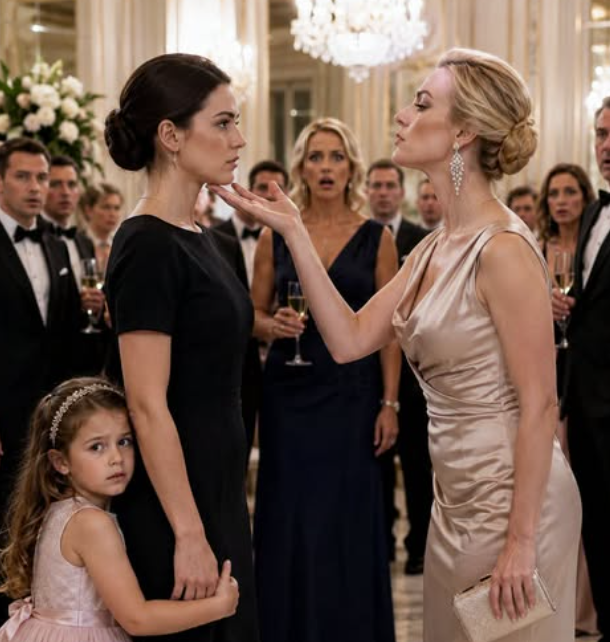
“Last night, at the annual executive celebration, my daughter and I were publicly mistaken for service staff and directed to leave the ballroom through the service entrance.
Several executives witnessed the exchange.
Some found it amusing.”
A few directors shifted.
Robert’s mouth tightened.
“Victoria spoke carelessly.
She regrets the confusion.”
“Has she said that?”
“She was upset last night.
Embarrassed.”
“That isn’t regret.”
He looked at the table.
I opened the folder.
“If last night were isolated, I would expect an apology and a review of event protocols.
It is not isolated.”
The atmosphere changed.
Even Robert felt it.
His shoulders became still.
I nodded to Nora.
She connected her tablet to the screen.
No dramatic presentation.
No theatrical flourish.
Just dates, names, patterns, and carefully redacted statemenTS. The room listened as the evidence formed a map none of them could pretend not to see.
Culture complainTS. Executive favoritism.
Retaliation concerns.
Vendor irregularities.
When Lark & Vale appeared on the screen, Robert leaned forward.
“That contract was approved by marketing.”
“It was pushed by your office,” Nora said evenly.
“Marketing objected to the fee structure twice.”
Robert’s gaze flicked toward me.
“Lark & Vale has delivered excellent visibility.”
Daniel lifted a document.
“Their deliverables include six strategy memos, two event introductions, and a brand sentiment report copied in large sections from publicly available industry analysis.”
Elaine removed her glasses.
“How much have they been paid?”
Nora answered.
“Four point two million dollars.”
The silence that followed had weight.
Robert’s face reddened.
“That sounds alarming without context.”
“Then provide context,” I said.
He adjusted his cufflinks.
“Cassandra Vale is well connected.
Victoria introduced her, yes, but that is not improper by itself.
We operate in relationship-driven markeTS. Everyone in this room knows that.”
“Everyone in this room also knows the difference between relationship and access,” Elaine said.
Robert turned to her.
“Elaine, with respect, we are turning a personal embarrassment into a corporate inquiry.”
“No,” I said.
“We are acknowledging that a personal embarrassment revealed a corporate problem.”
For the first time, Robert’s polished mask cracked.
Not anger, exactly.
Fear.
“Olivia,” he said more quietly, “I built value here.”
“You managed value built by thousands of people.”
“I have protected this company.”
“From what?”
He opened his mouth, then closed it.
That was when the boardroom door opened.
Victoria Blackwell entered wearing a cream suit, pearls, and an expression arranged into penitence.
Cassandra Vale was not with her.
“I hope I’m not too late,” Victoria said.
No one replied.
Robert stood halfway.
“Victoria, this is not—”
“I asked to come,” she interrupted, though her glance toward Elaine suggested otherwise.
“I owe Ms.
Hart an apology.”
She turned to me.
Her face was composed, but there were shadows beneath her eyes.
Perhaps she had slept less than I had.
“Ms.
Hart,” she said, “my words last night were inappropriate.
I made an assumption.
I embarrassed you and frightened your child.
I am sorry.”
It was a clean apology.
Not perfect, not warm, but unqualified.
I studied her for a moment.
“Thank you.”
Relief moved through Robert so visibly that I almost felt sorry for him.
Then Victoria added, “But if this meeting concerns Lark & Vale, you should know I did not benefit from that contract.”
Robert’s relief vanished.
Elaine leaned forward.
“Mrs. Blackwell, are you making a formal statement?”
Victoria’s hands clasped in front of her.
“I am saying Cassandra Vale is not my friend in the way Robert has described.”
Robert stared at her.
“Victoria.”
She did not look at him.
 Coworker Humiliates Her Behind Closed Doors, Then Her Hidden Camera Reveals Everyone Involved
“I introduced Cassandra to Robert at a charity dinner two years ago,” she continued.
“I did not recommend her firm.
In fact, I warned Robert that Cassandra was reckless.”
The room had become entirely still.
Robert’s voice dropped.
“This is not the place.”
Victoria finally turned toward him.
“Where is the place, Robert? Our dining room, where you explain nothing? The hotel suite, where you told me to smile? Or the ballroom, where I was supposed to play hostess while people whispered about a contract I didn’t sign?”
There it was.
Not cruelty.
Not spectacle.
A marriage with its wallpaper peeling.
I glanced at Daniel.
He was already taking notes.
Elaine spoke carefully.
“Mrs. Blackwell, do you have documentation relevant to the board?”
Victoria reached into her handbag and withdrew a small envelope.
“Copies.
The originals are with my attorney.”
Robert went pale again, but this time differently.
Last night, his fear had been social.
Now it was legal.
Daniel accepted the envelope and opened it.
He scanned the first page, then the second.
His expression became unreadable.
“What is it?” I asked.
“Emails,” he said.
“Between Mr. Blackwell and Cassandra Vale.
Also payment routing records.”
Robert pushed back from the table.
“Private marital disputes have no place in governance.”
Victoria’s laugh was small and tired.
“I wish it were only marital.”
Daniel handed the documents to Elaine, then to me.
The emails were brief, businesslike, and damning in their restraint.
Cassandra pushing for accelerated paymenTS. Robert warning her to stop copying certain people.
A reference to “V’s introduction” being useful cover.
Another to “the Hart question” and whether I was likely to attend the annual celebration.
My skin went cold.
The Hart question.
I read the line again.
Make sure Olivia remains unlikely to surface.
Her distance helps everyone.
I looked up slowly.
“What does this mean?”
Robert said nothing.
Victoria’s composure faltered for the first time.
“I don’t know.”
But she did know enough to look frightened.
Nora leaned toward the screen, typing quickly.
“There may be more.”
“More what?” Elaine asked.
“A restricted folder tied to Robert’s executive account.
It was accessed at 2:12 this morning and then partially deleted.”
Robert snapped, “You are monitoring my account?”
Nora did not flinch.
“On company systems, under audit authority approved by this board.”
“Recover it,” I said.
Nora worked in silence.
The board waited.
Outside the glass walls, assistants moved through the executive floor with careful discretion, sensing the pressure inside without knowing its shape.
While Nora searched, Victoria sat down at the empty chair beside Robert, though not close to him.
Her hands trembled once before she pressed them flat on the table.
I found myself thinking of Mia again.
Tell them no guessing.
So I stopped guessing.
“Victoria,” I said, “why did you speak to me that way last night?”
Her eyes lifted.
Robert muttered, “Olivia, really—”
“I’m asking her.”
Victoria’s throat moved.
For a moment, pride struggled with honesty.
Honesty won, but barely.
“Because I was angry before you arrived,” she said.
“Because Cassandra was there, and Robert told me not to make a scene.
Because I saw a woman in a plain black dress with a child, and I made myself feel larger by making you smaller.”
The admission landed quietly.
“I’m not proud of it,” she continued.
“But there it is.”
I had expected excuses.
Her honesty unsettled me more.
“Thank you,” I said.
Her eyes shone, though she did not cry.
“I don’t know who you are beyond the shares and the name.
But last night, when your little girl looked at you, I saw what I had done.”
Robert rubbed his forehead.
“This is becoming absurd.”
“No,” Elaine said.
“It is becoming clear.”
Nora looked up.
“I recovered an index.
The files were moved before deletion.”
“Moved where?” Daniel asked.
“To an external encrypted drive registered through executive security.”
Robert stood.
“I want counsel present.”
“You have counsel,” Daniel said.
“You may contact personal counsel, but this meeting will continue regarding company preservation.”
Nora hesitated.
“There are file names.”
She projected the index.
Most were ordinary enough: vendor summaries, donor lists, travel memos.
Then one title appeared near the bottom.
HART SUCCESSION SCENARIOS.
For a moment, I heard nothing but the hum of the climate system.
Elaine whispered, “Robert.”
He looked cornered now, but something else too.
Resentful.
Almost wounded.
“This company needs stable leadership,” he said.
I stared at him.
“Was I unstable because I didn’t attend enough galas?”
“You are absent,” he replied, voice rising.
“You hold power without carrying the daily burden.
You appear when something offends you and threaten to undo years of work.”
“I appear when the burden you carried becomes dangerous.”
He leaned both hands on the table.
“Do you know what investors say privately? They ask what happens if the grieving daughter loses interest.
What happens if the single mother sells impulsively.
What happens if Hartwell Meridian becomes a family relic instead of a serious institution.”
The words were measured to sound strategic, but beneath them lived contempt.
I did not answer immediately.
My father had taught me that silence could make people reveal the structure of their own thinking.
Robert took the silence as permission.
“I prepared contingencies,” he said.
“Responsible CEOs do that.”
“Did those contingencies include keeping me uninformed?” I asked.
“They included protecting the company from uncertainty.”
“From me.”
He looked away.
There it was.
The truth did not arrive as thunder.
It arrived as a locked door opening onto a room everyone pretended was empty.
Nora’s phone buzzed.
She checked it, then frowned.
“What is it?” Elaine asked.
“Our cybersecurity team found a scheduled data transfer,” Nora said.
“Set for 6:00 a.m.
tomorrow.”
Daniel’s expression sharpened.
“Transfer of what?”
Nora read from the message.
“Board correspondence archives, shareholder communications, legal risk assessments, and executive compensation material.”
“To where?”
“An external server associated with Lark & Vale.”
Victoria covered her mouth.
Robert said, too quickly, “That is impossible.”
Nora looked at him.
“The authorization token came from your office.”
“I didn’t authorize that.”
For the first time all morning, he sounded genuinely shocked.
Elaine noticed it too.
“Nora, can someone else use his token?”
“With physical access or delegated credentials, yes.”
Victoria whispered, “Cassandra.”
Robert turned on her.
“Don’t.”
But his denial lacked force.
My anger shifted.
It did not disappear, but it became narrower, sharper.
Robert had cultivated a culture of distance and entitlement.
Victoria had wounded my child with arrogance.
Cassandra Vale might have used them both.
“Freeze the transfer,” I said.
“Already done,” Nora replied.
“Cybersecurity isolated the route.”
Daniel gathered the documenTS. “We need independent forensic review.
Immediate suspension of vendor paymenTS. Preservation notices to all relevant parties.”
Elaine nodded.
“Agreed.”
I looked at Robert.
“You will step aside pending investigation.”
His jaw tightened.
“You’re removing me?”
“Temporarily.
With board approval.”
Elaine looked around the table.
One by one, the directors nodded.
Some reluctantly.
Some with relief.
Robert sank back into his chair.
The man who had commanded ballrooms now seemed strangely smaller in daylight.
Victoria stood.
“I’ll cooperate with the investigation.”
I believed her, though belief felt like a door I did not want to open too easily.
The meeting ended at 10:42 a.m.
with Robert placed on administrative leave, Cassandra Vale’s contracts frozen, and Nora authorized to begin a full review.
The official language would be calm.
Leadership continuity.
Governance review.
No admission of wrongdoing.
Corporate sentences designed to keep windows from breaking.
But as the boardroom emptied, Victoria remained by the window.
Robert had already left with Daniel to make calls.
“I meant what I said,” she told me.
“About Mia.”
I nodded.
“She asked whether you would apologize.”
Victoria closed her eyes briefly.
“Please tell her I did.”
“I will.”
She looked out at the city.
“Robert thinks I’m the reckless one.
Maybe I have been.
But Cassandra knew things.
Things I never told her.”
“What kind of things?”
Victoria turned back.
“About your schedule.
Your daughter’s school fundraiser.
The fact that you almost sold ten percent of your shares last spring.”
Only three people had known that.
My attorney.
Elaine.
And my private financial adviser.
Not Robert.
A slow unease moved through me.
“Are you certain?” I asked.
“She mentioned it at lunch,” Victoria said.
“Said Robert was worried you might finally cash out.
But Robert wasn’t at that meeting, was he?”
“No.”
Victoria opened her handbag again and removed a folded note.
“Then you should see this.”
It was hotel stationery from The Ritz-Carlton, creased down the center.
On it, in blue ink, were four words.
She will come tonight.
No signature.
“When did you get this?” I asked.
“Yesterday afternoon.
Slipped into my charity folder.
I thought Cassandra sent it to provoke me.”
My pulse slowed into something heavy.
“She knew I would be there,” I said.
Victoria nodded.
“And she knew I would be angry.”
I looked toward the boardroom door through which Robert had disappeared.
For the first time since the gala, the story no longer fit the shape I had given it.
Someone had wanted me in that ballroom.
Someone had wanted Victoria to notice me.
Someone had wanted Robert exposed.
My phone vibrated.
A message from an unknown number appeared on the screen.
Check your father’s old office before they empty it.
Attached was a photograph.
Not of Robert.
Not of Cassandra.
Not of Victoria.
It was a picture of my father, taken years before his death, standing beside a young woman I had never seen.
On the back wall behind them hung the original Hartwell Meridian logo.
And in my father’s hand was a baby wrapped in a yellow blanket.
A baby with my name written on the hospital bracelet.
END OF PART 2 – LIKE, SHARE AND COMMENT “THE ENTIRE STORY” IF YOU WANT TO READ THE FULL STORY