The Witness Waiting Beyond the Wedding Doors
The first bruise Adrian Vale gave me disappeared beneath a silk sleeve.
The last one would be seen by four hundred people.
He stood beside me beneath an arch of white orchids, holding my hand as the officiant spoke about devotion, patience, and the sacred responsibility of marriage.
The ballroom inside the Vale Meridian Hotel had been transformed into something almost unreal.
White flowers climbed the marble columns.
Hundreds of candles glowed beneath glass covers.
A string ensemble played from a balcony overlooking the altar, and sunlight poured through the tall windows facing Lake Michigan.
Every chair was occupied.
Politicians sat beside real estate developers.
Bank executives shared tables with television personalities and hospital trustees.
Adrian’s employees filled the back rows in dark suits, their expressions carefully respectful.
Cameras flashed each time he looked at me.
He knew how to appear loving.
His thumb moved slowly across my knuckles while the photographer captured what looked like tenderness.
Then his fingers tightened.
My rings pressed painfully into the bones of my hand.
Adrian did not stop smiling.
“From today on,” he whispered, “you belong to me.”
The officiant continued speaking.
Adrian leaned closer, his lips nearly touching my ear.
“Know your place.”
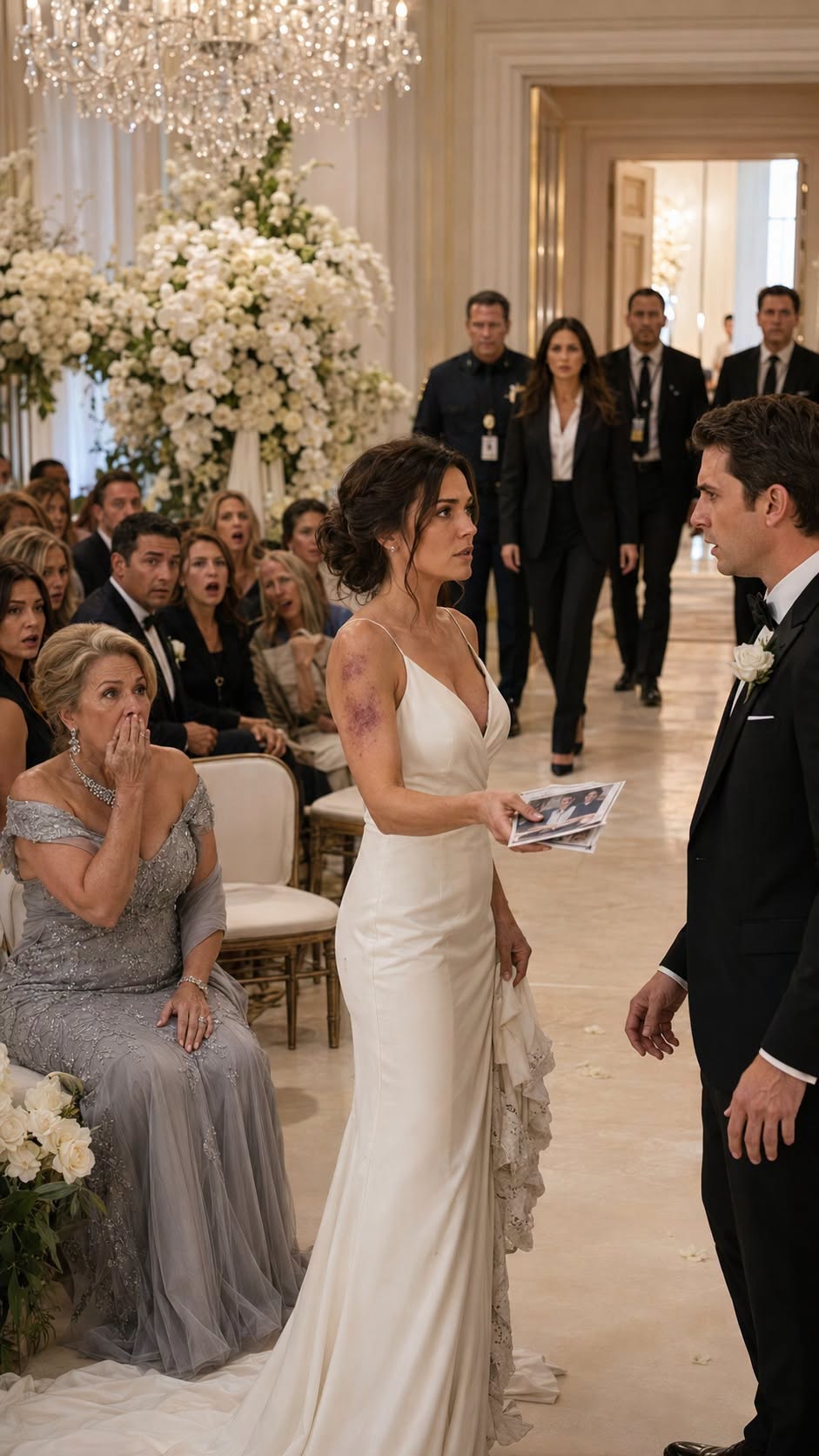
His mother, Helena Vale, watched from the front row.
Her silver dress shimmered beneath the chandeliers.
Diamonds covered her throat, and satisfaction softened the hard line of her mouth.
She could not hear Adrian’s words.
She did not need to.
She had been teaching him the same lesson his entire life.
Men commanded.
Women protected the appearance of harmony.
Money turned cruelty into something respectable.
I looked at my future husband and smiled.
“You want a wife?” I whispered.
His grip loosened slightly.
“Then meet your witness.”
For the first time that afternoon, uncertainty entered his eyes.
Only for a second.
Then he smiled wider and turned toward the officiant.
Eleven months earlier, I would have mistaken his expression for confidence.
By the morning of our wedding, I knew it was calculation.
Adrian was always calculating.
Who needed praise.
Who could be ignored.
Which employee required fear and which investor required charm.
He measured human beings by usefulness, then adjusted his personality accordingly.
With waiters, he was generous when cameras were present.
With journalists, he was thoughtful and self-deprecating.
With his mother, he became the devoted heir.
With me, he had begun as the perfect man.
Then, gradually, he became the man who believed perfection gave him ownership.
I met Adrian at a corporate compliance conference in Boston.
At the time, I was thirty-four and working as a forensic accountant for a federal infrastructure contractor.
My title sounded dull to most people, which suited me.
I did not attend glamorous events or stand in front of cameras.
I traced irregular payments, reviewed procurement records, examined shell companies, and helped legal teams understand how money moved when dishonest people wanted it to disappear.
Adrian approached me after a panel on beneficial ownership.
“You asked the only useful question in the room,” he said.
I had challenged a speaker who claimed that automated screening could replace experienced auditors.
“What question was that?” I asked.
“How easily can dishonest people teach software to recognize the wrong pattern?”
I remembered being surprised.
Most executives left those conferences speaking about innovation, risk mitigation, and compliance culture without admitting that fraud usually survived because someone important benefited from not seeing it.
“You were listening,” I said.
“I listen when people are interesting.”
He introduced himself without mentioning his family name.
Only later did I learn he was the chief executive of Vale Meridian Holdings, a private conglomerate controlling hotels, logistics companies, luxury apartment towers, and several investment funds.
His grandfather had founded the business.
His father expanded it.
Adrian inherited control after his father died in a boating accident ten years earlier.
At least, that was the story repeated in business magazines.
The body had never been recovered.
Adrian became chief executive at thirty-two.
By forty, he was worth an estimated two billion dollars.
He claimed the number embarrassed him.
It did not.
He simply preferred other people to mention it first.
During our first dinner, he asked questions about my work.
Not specific ones.
Enough to seem interested.
“Do you catch criminals?” he asked.
“I identify transactions.”
“That sounds less exciting.”
“It usually is.”
“Do people ever threaten you?”
“People threaten auditors mostly by sending long emails.”
He laughed.
I liked him.
That remained difficult to admit later.
I did not fall in love with an obvious monster.
I fell in love with a man who remembered that I hated lilies, called my mother every Sunday after her surgery, and once drove through a snowstorm because I mentioned feeling lonely.
He brought coffee to my office.
He learned the names of my colleagues.
He listened when I discussed cases without interrupting to prove he understood more.
During our fourth month together, he took me to the small apartment where his parents had lived before the family became wealthy.
“My mother kept the eviction notice,” he said.
He showed me a yellowed paper framed inside a drawer.
“She says fear built the company.”
“Did it?”
“Fear and refusal.”
He smiled.
“She refused to remain poor.”
I admired that story.
I did not yet understand that Helena’s fear of powerlessness had become an excuse to control everyone around her.
Adrian proposed after ten monThS.
He rented the rooftop of a hotel in Montreal and filled it with white roses.
There were no photographers.
No family members.
No audience.
That made it feel intimate rather than staged.
“I don’t want the company without a life,” he said.
Then he knelt.
“You make the life possible.”
I said yes.
The first controlling behavior arrived disguised as concern.
He disliked my apartment because the building had no private security.
He offered to move me into one of his properties.
When I declined, he appeared hurt.
“I’m trying to protect you.”
“I’ve lived there for five years.”
“Before people knew you were connected to me.”
“Nobody cares.”
“You don’t understand the attention around my family.”
He arranged security anyway.
A driver began waiting outside my office.
A man in a dark coat appeared near my apartment entrance.
When I complained, Adrian apologized.
Then said, “I would never forgive myself if something happened.”
The driver remained.
Next came my clothes.
He bought me a pale blue dress for a charity dinner.
“It would photograph beautifully,” he said.
“I already have something.”
“What color?”
“Black.”
“Everyone wears black.”
“I like black.”
He smiled.
“Trust me.”
I wore the blue dress.
People complimented it.
Adrian looked proud.
The next week, three more dresses arrived.
Then shoes.
Jewelry.
A stylist who described herself as a wedding consultant even though we had not set a date.
Each gift carried a quiet instruction.
This is how you should appear beside me.
When I resisted, he became wounded rather than angry.
At first.
“You think everything I do is manipulation,” he said after I refused to change clothes before dinner with his mother.
“I think I can choose my own dress.”
“I wanted you to feel confident.”
“I already did.”
His expression hardened.
“That attitude makes people dislike you.”
“What attitude?”
“The need to prove you don’t need anyone.”
The sentence followed me into the restaurant.
I changed my earrings in the car because he said the pair I wore looked inexpensive.
That night, Helena studied me across a table at the Vale Club.
She was sixty-eight, elegant, and so controlled that silence around her felt intentional.
“My son says you investigate financial misconduct,” she said.
“I review financial records.”
“You must see terrible things.”
“Sometimes.”
“Families destroyed by money?”
“Often.”
She sipped her wine.
“That is why private matters should stay private.”
I thought she was discussing family disputes.
“I suppose it depends on the matter.”
Her eyes sharpened.
“A marriage survives only when a wife understands the difference between honesty and exposure.”
Adrian touched my knee under the table.
A warning disguised as affection.
I smiled.
“We aren’t married yet.”
Helena smiled back.
“Not yet.”
The first bruise appeared two months after our engagement.
Adrian had planned a dinner with several investors at his home.
I was scheduled to attend a government procurement review in Washington the same evening.
He asked me to cancel.
“I can’t.”
“Why?”
“I’m presenting findings.”
“Someone else can present.”
“It’s my investigation.”
“My investors are coming from three countries.”
“That sounds important.”
“It is.”
“So is my work.”
He stared at me.
“You are going to choose a meeting over your fiancé?”
“I’m fulfilling a professional obligation.”
His jaw tightened.
“You enjoy embarrassing me.”
“How does attending work embarrass you?”
“I already told them you would be here.”
“You did not ask me first.”
“I should not have to schedule my life around your permission.”
“That is not what happened.”
He walked away.
For several hours, he refused to speak to me.
Then, shortly before I left for the airport, he entered the dressing room while I was packing.
“You’re still going.”
“Yes.”
He picked up my laptop.
“Give me that.”
“Cancel the meeting.”
“Put it down.”
He held it behind him.
I reached for it.
His hand closed around my upper arm.
Hard.
The pressure shocked me more than the pain.
“Stop treating me like I’m irrelevant,” he said.
“Let go.”
“Say you’ll stay.”
“No.”
His fingers tightened.
“Adrian.”
He released me abruptly.
A dark red mark had already formed beneath my sleeve.
He stared at it.
Then at me.
“I’m sorry.”
I said nothing.
“I didn’t mean to hurt you.”
“You grabbed me.”
“You were trying to take the computer.”
“It belongs to me.”
“I know.”
He began crying.
That mattered.
Or I thought it did.
He sat on the edge of the bed and covered his face.
“My father used to disappear for weeks,” he said.
“He made plans, then left us waiting.
When you walked toward the door, I saw him.”
I stood holding my arm while he described childhood abandonment.
His pain became the center of the room.
By the end of the conversation, I was comforting him.
I missed my flight.
A colleague delivered the presentation.
Adrian bought me a diamond bracelet the next morning.
“I hate what I became,” he said.
At the time, I believed remorse prevented repetition.
I did not understand that remorse without accountability often becomes part of the cycle.
The second incident came three weeks later.
Then the third.
Never in public.
Never where marks would remain visible above my clothes.
He shoved me against a bathroom door because I had not answered his call.
He twisted my wrist when I tried to leave dinner.
He threw my phone into the fireplace after seeing a message from a male colleague.
Each time, he apologized.
Each time, Helena explained.
“Adrian carries enormous pressure.”
“He has never learned how to express fear.”
“You are stronger than most women.
Surely you can help him.”
After she saw fingerprints on my arm, she closed the sitting-room door and lowered her voice.
“A successful man needs obedience at home.”
I stared at her.
“Are you saying he hit me because I disobeyed?”
“I am saying conflict always has two participanTS.”
“He grabbed me.”
“And what happened before?”
“I said I was leaving an argument.”
“That can feel like abandonment.”
I stood.
She remained seated.
“Do not embarrass this family,” she said.
That was when I understood she would never help me.
Still, I did not leave.
People later asked why.
They assumed fear was the only reason a woman stayed.
Fear was part of it.
So was shame.
Love.
Confusion.
The belief that one more conversation might restore the man I met in Boston.
And then I found the first forged document.
It was a loan guarantee for a subsidiary called North Coast Development Partners.
My name appeared beneath the signature line.
The guarantee exposed me personally to twelve million dollars in debt.
I had never seen it.
The signature resembled mine, but the second letter of my surname leaned incorrectly.
I noticed because I had spent years examining signatures.
The document was inside Adrian’s home office, mixed with property records he asked me to organize before a board meeting.
At first, I assumed an administrative error.
I copied the guarantee and checked the corporate registration.
North Coast Development Partners had been established four months earlier.
Its registered manager was a company called Willow Crest Advisory.
Willow Crest was registered in Delaware.
The beneficial owner listed in a private compliance file was me.
I had never heard of it.
That evening, I searched state databases and found six additional entities carrying variations of my name.
All had been created after our engagement.
Several held debt connected to Vale Meridian projecTS.
One owned a warehouse in Indiana.
Another had received twenty-eight million dollars from a private lender.
My supposed signatures appeared on every filing.
Adrian found me studying the guarantee.
He entered the office quietly and stood behind me.
“What are you doing?”
I turned.
“This signature is forged.”
He glanced at the document.
Then laughed.
“You signed so many engagement papers.”
“I did not sign this.”
“You probably forgot.”
“I don’t forget twelve-million-dollar guarantees.”
He took the paper from my hand and kissed my forehead.
“Numbers are not your world anymore.”
I looked at him.
“My entire career is numbers.”
“Your career is changing.”
“No.”
“You won’t need to work after the wedding.”
“I never agreed to resign.”
His smile faded.
“You said you wanted a family.”
“That does not mean I stop working.”
“My wife cannot investigate other men’s businesses while strangers search through our finances.”
“My work does not expose your accounTS.”
“Everything becomes connected after marriage.”
He placed the guarantee inside a drawer.
“Your job is to look beautiful beside me.”
The arrogance of the sentence gave me something fear had not.
Certainty.
The violence was not accidental.
The forged documents were not administrative mistakes.
Adrian had a plan for me.
I needed to understand it before he realized I was looking.
That night, I lowered my eyes.
“I’m sorry,” I said.
His expression softened.
“For what?”
“For forgetting how complicated your life is.”
He kissed me.
I remained still until he left the room.
Then I began collecting evidence.
I did not keep it inside his house.
Photographs went to encrypted storage.
Documents were copied through a portable scanner hidden inside a cosmetics case.
Recordings uploaded automatically to a secure server controlled by my attorney.
I contacted Maya Chen, a lawyer I had worked with during a federal procurement case.
We met in a crowded café near Union Station.
I wore sunglasses even though the day was cloudy.
Maya did not comment.
I placed copies of the forged guarantees on the table.
She read them in silence.
“How many?”
“Seven that I found.”
“Have any lenders contacted you?”
“No.”
“Does Adrian know you discovered them?”
“He knows about one.
I acted uncertain.”
Maya looked at the bruise near my wrist.
“Did he do that?”
“Yes.”
“Are you safe tonight?”
“I have a hotel room.”
“Do not return.”
“I need more evidence.”
“You already have evidence.”
“Not enough to understand the structure.”
“You do not need to understand everything before leaving an abuser.”
“I know.”
“Do you?”
I looked toward the window.
The honest answer was no.
Leaving would protect me physically.
But Adrian’s companies were registered in my name.
If regulators moved first, I could become the visible owner of fraudulent debt.
I also knew he would destroy records the moment he believed I had gone against him.
“I need proof that he created the companies,” I said.
Maya leaned back.
“That is your professional brain speaking.”
“Yes.”
“What does the rest of you say?”
“That he will ruin me if I leave without being prepared.”
She did not tell me I was paranoid.
That was one reason I trusted her.
We created a plan.
Emergency housing.
Medical documentation.
Daily check-ins.
A code phrase if I could not speak freely.
A separate phone hidden at my office.
Maya contacted federal investigators without naming me initially and asked hypothetical questions about identity misuse and corporate fraud.
I returned to Adrian.
For three months, I became what he wanted.
Quiet.
Agreeable.
Decorative.
I stopped challenging his clothing choices.
I attended dinners.
I resigned from my job publicly, though my employer placed me on protected leave and kept the resignation unprocessed.
Adrian celebrated with champagne.
“I knew you would understand,” he said.
Helena gave me a family necklace.
“You are learning,” she said.
They believed they had won.
In private, I collected everything.
Bank transfers.
False invoices.
Audio recordings.
Medical reporTS.
Photographs of bruises.
Copies of the forged guarantees.
Emails linking Adrian to Willow Crest Advisory.
Messages between Adrian and his chief financial officer discussing how marriage would “stabilize ownership.”
A private ledger hidden behind a removable wood panel in his study.
I found it because one shelf had less dust than the others.
The ledger listed payments to shell companies, politicians, inspectors, and private security contractors.
Beside several entries appeared initials rather than names.
One set repeated across ten years.
R.V.
Robert Vale.
Adrian’s father.
The man presumed dead.
The numbers continued long after his supposed boating accident.
At first, I thought R.V.
referred to a company.
Then I found regular transfers to a trust in Switzerland.
The beneficiary was listed through a coded structure.
Maya’s investigators traced it.
Robert Vale was alive.
He had not died in a boating accident.
He had staged his death after discovering that Adrian and Helena were diverting funds from the family companies.
That was the explanation Adrian eventually gave.
It was not the whole truth.
Robert had been involved in his own crimes.
Bribery.
Tax fraud.
Illegal property acquisitions.
When federal investigators began asking questions ten years earlier, the family arranged the accident.
Robert disappeared.
Adrian inherited control.
Helena became chair of the family trust.
They publicly mourned him.
Privately, they continued sending money.
Then Adrian slowly transferred Robert’s personal holdings into companies he controlled.
The son had not merely inherited the empire.
He had stolen it from a father who was still alive.
Robert knew.
For years, he remained silent because revealing himself would expose his own crimes.
That balance changed when Adrian began moving assets into entities registered under my identity.
Robert realized Adrian planned to shift liability away from the Vale family entirely.
The final file came from Robert.
Maya located him through the Swiss trust’s attorney.
He was living under another name in Portugal.
When she first contacted him, he refused to speak.
Then she sent copies of the companies registered in my name.
He responded within twenty-four hours.
The file contained original ownership records, secret agreements, voice messages, and one recorded conversation between Adrian and Helena.
In it, Adrian said:
“Once Clara signs the marriage documents, every disputed entity becomes part of the marital structure.
If regulators come, she becomes the compliance expert who designed it.”
Helena replied:
“And if she resists?”
Adrian laughed.
“She won’t.”
My name is Clara Bennett.
Hearing my future husband discuss my destruction in that calm voice ended whatever remained of my hope.
Still, the wedding had to continue.
That decision frightened Maya.
“We can stop it privately,” she said.
We were sitting in her office two weeks before the ceremony.
The evidence covered an entire conference table.
“No.”
“Clara, you do not owe anyone a public revelation.”
“I know.”
“Then why walk to the altar?”
“Because the final documents are supposed to be signed immediately after the vows.”
“We can obtain them another way.”
“He has not produced them yet.”
“The forged guarantees are enough.”
“Not for the full structure.”
Maya studied me.
“You want witnesses.”
“Yes.”
“Why?”
“Because Adrian controls the newspapers, hotel security, several local officials, and half the people invited.”
“That is why federal agents are involved.”
“He will say I had a breakdown.”
“The evidence prevents that.”
“He will say the bruises came from something else.”
“Medical reports support you.”
“He will say I participated willingly in the companies.”
“The signatures are forged.”
I looked at the photographs.
“He has spent eleven months teaching everyone I am fragile and unstable.”
Maya remained silent.
I continued.
“If I disappear before the wedding, Helena tells the guests I became frightened by marriage.
Adrian controls the narrative before investigators move.”
“This is not a public-relations problem.”
“It becomes one when a powerful man’s defense depends on discrediting the victim.”
She could not disagree.
We created the final plan.
A tear-away wedding gown with a simple fitted dress beneath it.
The lower dress exposed my shoulders, arms, and back.
The bruises would be visible.
Not every injury remained by the wedding day, but enough did.
The largest was beneath my right shoulder blade where Adrian had shoved me against a cabinet.
Another dark mark crossed my upper arm.
Thin healing cuts remained near my wrist from the night he smashed a glass beside me and dragged me across the floor.
I did not intend to remove my clothing completely.
The outer gown would detach, revealing the sleeveless underdress and the evidence taped inside its lining.
Medical reporTS.
Photographs.
Copies of the forged documenTS.
The wedding was being livestreamed to a private network for international guesTS.
Maya arranged for the feed to be mirrored to a protected server.
Federal agents coordinated with local detectives.
Robert agreed to appear.
Not because he wanted justice.
Because Adrian had stolen from him.
I understood that distinction.
A corrupt man could still provide useful evidence.
He would enter only after Adrian committed to the final step.
The post-marital trust documents waited in a side room.
I knew because Adrian showed them to me the night before the wedding.
He placed the folder on the bed inside the bridal suite.
“We’ll sign after the reception,” he said.
“I thought we signed everything already.”
“These are routine.”
“What do they do?”
He smiled.
“You don’t need to worry about legal language tonight.”
I touched the folder.
He moved it away.
“Tomorrow, you become a Vale.”
He kissed me.
Then whispered, “No more questions.”
The wedding morning passed with unbearable normality.
Makeup artists arrived at six.
Photographers took pictures of shoes, flowers, rings, and champagne.
Helena entered wearing silver and kissed my cheek.
“You look acceptable,” she said.
That was her version of praise.
She noticed the slightly unusual structure of the gown.
“The skirt seems heavy.”
“It photographs well.”
She studied me.
“Do not embarrass Adrian today.”
“I won’t.”
That answer was technically true.
He would embarrass himself.
My mother had died four years earlier.
My father was estranged after years of addiction, so I walked down the aisle alone.
Adrian had offered to have Helena escort me.
I refused.
“I want the moment to be mine.”
He called it brave.
The ballroom doors opened.
Four hundred guests stood.
The orchestra began.
I walked toward the man who had bruised me, forged my name, and planned to place an empire’s crimes inside my future.
My body wanted to run.
Each step required a separate decision.
Continue.
Breathe.
Continue.
At the altar, Adrian took my hand.
His fingers found the fading bruise beneath my glove.
He pressed it deliberately.
A reminder.
He believed pain would restore the hierarchy.
The officiant spoke about love.
Adrian whispered that I belonged to him.
I told him to meet his witness.
Then the officiant asked whether anyone knew a reason the marriage should not proceed.
Silence filled the ballroom.
Adrian’s grip tightened.
“Good girl,” he whispered.
I looked toward the side doors.
They opened.
Maya entered first.
She wore a dark navy suit and carried a leather portfolio.
 Mother-In-Law Wanted A Grandson So Badly, She Secretly Interfered With Her Son’s Marriage
Two detectives followed.
Then Special Agent Daniel Ruiz from the federal financial-crimes division.
Guests began murmuring.
Adrian’s smile remained in place.
“What is this?” he asked quietly.
I removed my hand from his.
The microphones near the altar captured my answer.
“My legal counsel.”
Helena stood.
“This ceremony is private.”
Agent Ruiz showed his identification.
“Remain seated, Mrs. Vale.”
She stared at him.
No one had spoken to her that way in years.
Adrian looked toward security.
His head of security took one step forward.
Then stopped when two uniformed officers appeared beside him.
I reached behind my waist and pulled the hidden release.
The outer skirt loosened.
Gasps moved through the ballroom as I removed the detachable layer of the wedding gown.
Beneath it, I wore a simple white dress fitted closely to my body.
Sleeveless.
Low across the back.
The bruises were visible.
The mark near my shoulder.
The fading fingerprints on my upper arm.
The healing cuts around my wrist.
A long yellowing bruise along my ribs.
The room became horrifyingly quiet.
Not the silence of surprise.
The silence of people realizing they had applauded for a man standing beside evidence of violence.
Adrian’s face changed.
Only slightly.
Then he recovered.
“What are you doing?”
I removed my gloves.
The rings had left red marks across my hand.
“This is what you did.”
He laughed.
It was the wrong reaction.
Too sharp.
Too quick.
“She has been under pressure,” he told the guesTS.
There it was.
The prepared story.
“She has struggled emotionally for monThS.”
Maya opened the portfolio.
“We have medical reports from four independent physicians, timestamped photographs, recordings, and security footage.”
Adrian looked at her.
“You have no authority here.”
“I represent Clara.”
“You’re trespassing.”
“The hotel ballroom is subject to an active warrant.”
A murmur moved through the guesTS.
Helena stepped toward the altar.
“Clara, put your gown back on.”
I looked at her.
“You saw the marks.”
“She bruises easily.”
Several women in the front rows turned toward Helena with disgust.
She noticed.
Her expression hardened.
“This is a family matter.”
“No,” I said.
“You made it a family system.
He made it criminal.”
Adrian moved closer.
“Enough.”
His hand reached toward my arm.
Agent Ruiz stepped between us.
“Do not touch her.”
Adrian’s face reddened.
“You know who I am?”
“Yes.”
The agent’s calm answer weakened him more than shouting would have.
I lifted the inner lining of the detached skirt.
Clear document sleeves had been sewn inside.
I removed them one by one.
A medical report.
Photographs.
Loan guarantees bearing my forged signature.
Corporate registrations.
Bank-transfer summaries.
The ballroom screens changed.
Maya had arranged for the presentation system to display the evidence.
The first document appeared behind us.
Twelve-million-dollar guarantee.
My name.
False signature.
Then the second.
Third.
Seven companies.
One hundred and eighty-four million dollars in combined liabilities.
Guests began whispering openly.
Several board members stood.
Adrian stared at the screens.
“This information is confidential.”
“Because it proves fraud?” I asked.
“It proves you were involved.”
The accusation came exactly as expected.
“You registered the companies,” he continued.
“You are the forensic accountant.”
I almost smiled.
“You told everyone I was a little bookkeeper.”
His expression tightened.
“I was protecting your privacy.”
“No.
You were minimizing my expertise so the fraud would look like mine only when you needed it to.”
Agent Ruiz took the private ledger from Maya.
“Mr. Vale, we have evidence connecting you to the creation and financing of these entities.”
Adrian looked toward his board members.
“This is a hostile takeover.”
One of them, Richard Cole, stepped away from him.
“Did you forge her signature?”
“No.”
I played the first recording.
Adrian’s voice filled the ballroom.
“Once Clara signs the marriage documents, every disputed entity becomes part of the marital structure.”
Helena’s voice followed.
“And if she resists?”
“She won’t.”
People turned toward her.
Her face became rigid.
The recording continued.
“She becomes the compliance expert who designed it.”
The audio ended.
No one moved.
Adrian looked at me.
“You recorded private conversations.”
“Robert did.”
The name changed everything.
Helena’s head snapped toward the side doors.
Adrian became pale.
For ten years, the Vale family had mourned Robert Vale publicly.
His portrait hung in every corporate headquarters.
A scholarship carried his name.
Adrian mentioned his father’s tragic death in speeches about resilience.
Helena wore his wedding ring on a chain around her neck.
I looked toward the open doors.
“Meet your witness.”
Robert Vale entered.
He was seventy-one, thinner than the photographs, with white hair and a cane.
He wore a dark suit and no tie.
The guests nearest the entrance stood automatically.
Someone screamed.
Helena gripped the back of her chair.
Adrian took one step backward.
His father walked slowly down the aisle.
Every camera turned toward him.
“Hello, son,” Robert said.
Adrian’s mouth opened.
No words came.
Helena whispered, “You were told never to return.”
Robert looked at her.
“You were told never to steal from me.”
The ballroom erupted.
Agent Ruiz raised his voice.
“Remain seated.”
Robert reached the altar and stopped beside Maya.
He did not look at my bruises.
He looked only at Adrian.
“You moved my holdings into her name.”
Adrian found his voice.
“You abandoned the company.”
“You hid me because prison frightened you.”
“You agreed.”
“I agreed to disappear.
I did not agree to let you take everything.”
I watched them.
This was not a reunion.
It was one criminal accusing another of violating the terms of their conspiracy.
Robert handed Agent Ruiz a sealed drive.
“Original ownership agreements, account keys, private ledgers, and messages.”
Helena stood.
“You cannot use stolen family records.”
Robert laughed.
“You forged my death.”
“You staged it.”
“You signed the declaration.”
“So did you.”
Their accusations exposed years of cooperation.
The guests who had worshiped the Vale family name watched it collapse into something ordinary and ugly.
Adrian turned toward me.
“You brought him here.”
“Yes.”
“He is a criminal.”
“Yes.”
“You trust him?”
“No.”
That answer surprised him.
“I trust records,” I said.
“And your records agree with his.”
Richard Cole, the senior independent director, stepped forward.
“Adrian, did you transfer company holdings from Robert’s trust?”
Adrian looked around.
He still searched for the person who could be controlled.
His mother.
Board members.
Security.
Me.
Nobody moved toward him.
“You all benefited,” he said.
Several guests recoiled.
“The hotels,” he continued.
“The investmenTS. The dividends.
None of you asked how the growth happened.”
Richard’s face hardened.
“That is not a denial.”
Adrian pointed toward me.
“She planned this spectacle.”
“Yes,” I said.
He laughed.
“Finally, honesty.”
“I planned for witnesses because you planned to call me unstable.”
His smile weakened.
“I planned for evidence because you planned to blame me.”
I looked at the wedding documents waiting on the side table.
“And I walked to the altar because you intended to make the transfer effective after the vows.”
Agent Ruiz opened the folder.
Inside were the marital trust agreemenTS.
He read silently.
Then looked at Adrian.
“These documents shift liabilities and beneficial ownership into Mrs. Bennett’s marital trust.”
“She approved the structure.”
“I did not.”
“Her attorney reviewed it.”
Maya spoke.
“No attorney representing Clara reviewed these documenTS.”
The signature page listed a law firm I had never hired.
Investigators later discovered the firm’s named partner had received consulting payments from Vale Meridian.
The fraud reached beyond the family.
That was why Adrian’s confidence had survived so long.
He had built a world where every gatekeeper owed him something.
Helena moved toward me.
“You ungrateful little woman.”
Agent Ruiz blocked her path.
She pointed at my dress.
“We welcomed you.”
“You selected me.”
“I treated you like a daughter.”
“You told me to hide the bruises.”
“You provoked him.”
The sentence echoed through the ballroom.
A woman in the front row stood and left.
Then another.
Not everyone could tolerate witnessing the cruelty they had once excused as sophistication.
Adrian’s expression shifted from panic to rage.
“You think you’ve won?”
I looked at him.
“This is not a competition.”
“You have nothing without me.”
“I had a career before you.”
“You resigned.”
“My resignation was never processed.”
His face changed.
“You lied.”
“I protected myself.”
“That company will never take you back after this.”
My former employer’s general counsel stood from a middle row.
“She remains employed.”
Adrian stared.
I had not known he would attend.
Maya must have invited him as a witness.
The general counsel continued.
“Her leave was protected, and her cooperation has been reviewed.”
Adrian looked around again.
Each exit he expected had closed.
Agent Ruiz stepped forward.
“Adrian Vale, you are under arrest on suspicion of wire fraud, identity theft, conspiracy, financial abuse, and obstruction.”
The words became difficult to hear beneath the guests’ reactions.
A detective moved behind Adrian.
He raised one hand.
“Do not touch me.”
“Turn around.”
“My lawyers will destroy this.”
“Turn around.”
Helena screamed at the board members.
“Do something!”
No one did.
Adrian looked at me one final time before the handcuffs closed around his wrisTS.
The rage disappeared.
In its place came the expression he used after hurting me.
Soft eyes.
Trembling mouth.
Pain carefully presented.
“Clara.”
I remained still.
“I love you.”
The sentence once controlled me more effectively than violence.
That afternoon, it sounded like another strategy.
“No,” I said.
“You loved access.”
His face broke.
Maybe part of his grief was real.
That no longer changed what I needed to do.
The detectives led him down the aisle.
The same guests who had risen when I entered now watched him leave in handcuffs.
Helena followed with her attorney and two agenTS.
Robert remained near the altar.
He looked at the wedding arch.
“Expensive flowers.”
I stared at him.
“That is what you have to say?”
He shrugged.
“I’m not a good man, Ms.
Bennett.”
“I know.”
“I did not come to rescue you.”
“I know.”
“I came because Adrian stole from me.”
“Yes.”
He studied my face.
“You are less sentimental than he said.”
“That is why he underestimated me.”
Robert almost smiled.
Then Agent Ruiz asked him to come for questioning.
He went willingly because cooperation remained his best chance of avoiding the worst sentence.
The ballroom slowly emptied.
Some guests approached me.
Most did not know what to say.
Several women hugged me without asking.
I tolerated it until my body began shaking.
Maya placed the outer wedding skirt around my shoulders.
“You did it.”
“I don’t know what I did.”
“You stopped the marriage.”
“I should have stopped it months ago.”
“Yes.”
Her honesty steadied me.
Then she added, “You survived long enough to stop it safely.”
The distinction mattered.
Not everyone could stay.
Not everyone should.
I had taken risks Maya would never recommend to another client.
The public plan succeeded partly because investigators, attorneys, doctors, and trusted colleagues surrounded me.
Without them, the altar could have become another locked room.
I sat in the bridal suite while detectives processed the ballroom.
My dress lay on the floor.
The veil remained pinned to my hair.
Maya helped remove it.
When the final pin came free, I began crying.
Not gracefully.
Not quietly.
I cried for the woman who met Adrian in Boston.
For every apology I accepted.
For the wedding I had once wanted.
For my mother, who was not alive to hold me.
For the fact that even after seeing him arrested, part of me remembered the coffee he brought during winter mornings.
Abuse did not erase every good memory.
It poisoned the meaning of them.
That was different.
The investigation lasted three years.
Vale Meridian Holdings entered emergency governance within hours of Adrian’s arrest.
The board suspended him.
Banks froze disputed accounTS.
Investors demanded audiTS.
The company’s market value collapsed.
Several hotels and logistics subsidiaries survived because independent managers separated them from the fraudulent structures.
Others failed.
Employees lost jobs.
That became one of the hardest consequences.
Adrian had built crimes inside legitimate businesses.
When accountability arrived, innocent people carried some of the damage.
His defense attorneys blamed me.
They called me vindictive.
Professionally ambitious.
Emotionally unstable.
They showed photographs of vacations and gifts to suggest our relationship had been loving.
They argued the bruises came from consensual intimacy, accidents, or unrelated incidenTS.
Medical records and recordings contradicted them.
The forged signatures were examined by experTS.
The shell companies led back to Adrian’s attorneys, financial officers, and personal devices.
The private ledger matched bank transfers.
Robert’s files confirmed the stolen ownership.
Robert pleaded guilty to financial crimes connected to the staged death and earlier bribery.
His cooperation reduced his sentence.
Helena was convicted of conspiracy, fraud, obstruction, and facilitating identity theft.
She received eleven years.
Adrian faced more.
The trial lasted four monThS.
I testified for six days.
He watched me from the defense table.
Sometimes with anger.
Sometimes with sorrow.
Sometimes with the old expression that said we shared a secret nobody else understood.
We did not.
The jury convicted him on nearly every major count.
He received twenty-eight years in federal prison.
His fortune was reduced through forfeiture, restitution, legal costs, and corporate collapse.
Not everything disappeared.
Money like that rarely vanishes completely.
Trusts remained.
Properties survived.
But the empire he expected to control no longer existed in its previous form.
The marriage never became legal.
The officiant had not completed the vows.
No license was filed.
Legally, I had escaped before becoming Clara Vale.
Emotionally, separation took longer.
For the first year, I woke expecting Adrian beside me.
I checked doors repeatedly.
I panicked when dark cars remained parked outside.
I avoided white orchids.
The smell of his aftershave made me leave an elevator once.
Therapy helped me understand that survival did not end when danger became public.
My body continued protecting me from a man who could no longer reach me.
I returned to work part-time.
Then fully.
My employer offered an executive role overseeing fraud prevention.
I refused at first.
“I don’t want my career built around what happened.”
The chief executive nodded.
“Then tell us what you do want.”
I returned to forensic investigations.
Quiet work.
Records.
Patterns.
Questions.
For years, people recognized me from the wedding video.
The footage had spread despite court restrictions.
Some praised me as fearless.
Others accused me of staging a dramatic revenge.
I disliked both descriptions.
Fearless women do not need plans for escape.
I had been terrified.
The plan worked because fear made me careful.
Eventually, I created a confidential financial-support program for people leaving abusive relationships.
Not a public foundation carrying my name.
A fund administered through domestic-violence organizations.
It provided forensic accounting, identity-repair services, emergency housing, and legal help.
Abusers often used money more effectively than fisTS.
Hidden debt.
Destroyed credit.
Forged signatures.
Controlled bank accounTS.
The same tools Adrian used against me appeared in smaller households every day.
One woman discovered her husband had opened twelve credit cards in her name.
Another learned she owned a company used for tax fraud.
A third had no access to wages she earned for fifteen years.
I understood their documenTS.
I also understood why some still loved the men responsible.
Years after the trial, I received a letter from Adrian.
Prison stationery.
Eight pages.
He apologized.
Then explained.
His father’s abandonment.
His mother’s pressure.
His fear of losing control.
The burden of inheriting an unstable empire.
The letter contained insight but still organized every harm around his pain.
Near the end, he wrote:
I know you believe I never loved you, but I did.
I simply could not separate love from ownership.
That was the truest sentence.
I did not answer.
Understanding did not require renewed access.
Helena died in prison at seventy-six.
Her attorney contacted me about personal belongings recovered from storage.
Jewelry.
Letters.
The family necklace she gave me after I left my job.
I refused it.
The necklace was sold as part of restitution.
Robert completed his sentence in poor health and died two years later.
He left a written statement acknowledging that the Vale fortune had been built partly through corruption long before Adrian inherited it.
Historians and journalists called the statement important.
To me, it confirmed what the wedding had already shown.
The empire was never clean enough to be destroyed by one woman’s evidence.
It had been collapsing beneath concealed debts for generations.
At forty-one, I married again.
His name was Michael Torres.
He was a public school principal and widower with an adult son.
We met through a financial-literacy workshop.
He knew the wedding story before we dated.
Most people did.
He never asked to see the video.
That mattered.
Before our engagement, we exchanged complete financial disclosures.
Not because he demanded them.
Because transparency had become intimate to me.
We signed a prenuptial agreement.
Opened a shared account for household expenses.
Kept separate professional accounTS.
Discussed debt.
Passwords.
Emergency access.
Property.
He once laughed gently and said, “This is the least romantic conversation I’ve ever enjoyed.”
I understood.
Our wedding took place in a small garden.
Thirty-two guesTS.
No livestream.
No orchids.
I wore a simple green dress.
At the ceremony, Michael held my hand lightly.
When the officiant spoke about partnership, he leaned toward me.
“You still belong to yourself,” he whispered.
I started crying.
He panicked.
“Was that wrong?”
“No.”
I laughed through tears.
“It was exactly right.”
The original wedding dress remained in evidence storage for years.
After the appeals ended, authorities returned it.
The outer skirt still contained empty document sleeves.
The fabric had yellowed slightly.
I considered burning it.
Instead, I gave it to an art program working with survivors of domestic violence.
They separated the fabric into hundreds of strips.
Women wrote words on them.
Names.
Dates.
Promises.
Warnings.
The pieces became a large woven installation titled Witness.
No photographs of my body appeared.
No mention of Adrian.
The work belonged to everyone who had once hidden evidence beneath clothing.
I visited the exhibition once.
A woman stood beside me studying the fabric.
“My sister stayed for years,” she said.
I did not tell her who I was.
“People do,” I replied.
“She finally left.”
“I’m glad.”
“I used to judge her.”
The woman began crying.
“I thought staying meant she accepted it.”
I looked at the woven dress.
“Sometimes staying means someone is trying to survive the next step.”
She nodded.
That conversation remained with me longer than any interview.
People love stories with one public reversal.
A cruel groom whispers at the altar.
The bride reveals bruises.
Police enter.
The empire falls.
Those moments are satisfying because they compress justice into something visible.
Real life was slower.
Medical appointmenTS.
Passwords changed.
Bank records traced.
Nightmares.
Court hearings.
Lost friendships.
The first meal eaten without checking the door.
The first disagreement with a new partner that did not become dangerous.
The first time I wore a sleeveless dress without thinking about what it revealed.
The final evidence did destroy Adrian’s public identity.
His fortune.
His authority.
But the most important evidence was not Robert’s return, the private ledger, or the forged signatures.
It was the pattern.
One bruise.
One apology.
One hidden company.
One altered document.
One instruction to know my place.
Abuse survives when each event is treated as an isolated misunderstanding.
The truth became undeniable only after I placed everything together.
At the altar, Adrian believed the wedding would make me his property.
He believed the guests belonged to his world.
The hotel carried his family name.
The security team received his salary.
The board members owed him favors.
The cameras existed to preserve his perfect moment.
He forgot that witnesses do not always remain loyal to the person who invited them.
Sometimes a room changes when people finally see what they have been asked not to notice.
The applause died when I removed the outer gown.
Not because bruises had never existed in that family.
Because they were finally visible beneath the chandeliers.
Adrian told me to know my place.
For a long time, I thought my answer was the altar.
The courtroom.
The investigator’s office.
The career I reclaimed.
Years later, I understood my place was simpler.
It was anywhere I could stand without accepting ownership disguised as love.
That wedding never made me his wife.
It made me the witness who survived long enough to tell the truth.