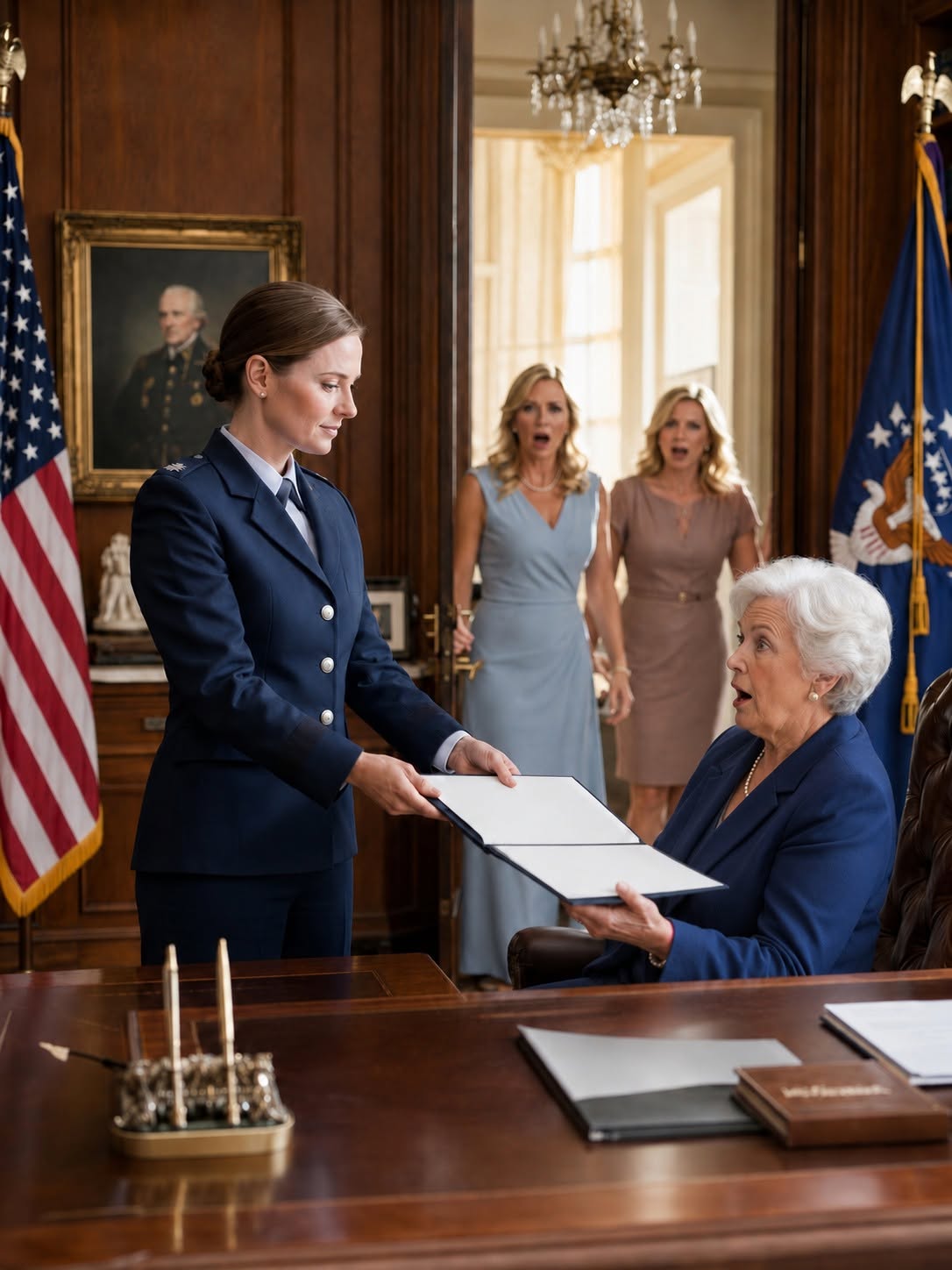
Returning home after a grueling year overseas, I stepped inside only to find my sister living there like she owned the place. My mother backed her up completely, calling it totally reasonable, all while a stack of legal documents waited for me on the kitchen counter.
Part 1. The Homecoming
After twelve months deployed in the Middle East, Major Rachel Kane came home expecting silence, rest, and the house she had paid for in cash.
Instead, her younger sister, Vanessa, stood in the kitchen and told her to pack.
Vanessa said her son, Tyler, needed more space, better schools, and a real home. Their mother, Gloria, sat at the table and nodded as though the decision had already been settled.
Rachel looked around and realized they had not simply stayed there while she was gone.
They had erased her.
The walls were repainted. Her photos were gone. Her shelves had been removed. Expensive furniture, new lighting, and staged decorations filled every room.
When Rachel asked where her things were, Vanessa said they had been placed in storage.
Then Vanessa smiled and said the real reason Rachel had been summoned home.
She needed to sign the house over.
Today.
Rachel reminded them that the deed was in her name. Gloria replied that Vanessa was raising the “golden boy” of the family, while Rachel was single, often on base, and did not need such a large home.
Rachel had spent more than a decade in Army intelligence, reading lies for a living. Their timing, confidence, and rehearsed calm told her this was not just entitlement.
It was a setup.
So when Gloria gave the ultimatum—sign the house over or be dead to the family—Rachel did not argue.
She picked up her duffel bag and walked out.

Part 2. The Forged Transfer
At a hotel that night, Rachel opened her secure financial portal.
Her credit score had collapsed.
A home equity line of credit for $250,000 had been opened in her name, and nearly the entire amount had already been spent.
Rachel had never opened it.
She had bought the house without a mortgage for a reason: no leverage, no debt, no weakness.
Then she searched county property records.
There it was.
A quitclaim deed had transferred her house into a trust controlled by Vanessa.
The document looked clean. The signature looked almost perfect. The notary stamp looked official.
But the date exposed everything.
October 14.
On that date, Rachel had been at a forward operating base in Iraq, attending a night operations briefing. She could not have signed anything in the United States.
The transfer was not a misunderstanding.
It was forgery.
And the document Vanessa wanted her to sign was not about gaining ownership.
It was about retroactive consent.
They needed Rachel to legalize what they had already stolen.
Part 3. Federal, Not Family
On Monday morning, Rachel walked into the JAG office with a folder of evidence.
The captain reviewed the forged deed, the credit report, the HELOC, and Rachel’s deployment records. He immediately identified the case for what it was: identity theft, property fraud, bank fraud, wire fraud, forgery, and a serious violation because Rachel had been deployed when it happened.
This was not a local family dispute.
It was federal.
Rachel hired a forensic accountant to trace the money. The withdrawals had not gone toward survival or necessity. Vanessa had used the funds for a luxury vehicle lease, expensive vacations, designer purchases, new furniture, and home upgrades. Gloria had used part of the money to pay off her own debts.
They had not taken the house because they needed stability.
They had taken it because Rachel’s trust was the easiest asset to exploit.
Then Vanessa texted again.
She reminded Rachel that the “paperwork” needed to be finalized before the massive housewarming party on Saturday.
Rachel replied with one word:
Understood.
Part 4. The Housewarming Trap
On Saturday, Rachel arrived in full dress uniform and parked two houses away.
Her house was already full of guests, caterers, decorations, flowers, music, and staged luxury. Vanessa had turned the theft into a celebration.
Inside, Vanessa greeted Rachel with a polished smile and sent her to the study, where Gloria was waiting.
The door locked behind Rachel.
Gloria slid a retroactive consent form across the desk. Vanessa called it a formality, something that would “clean everything up.”
Rachel read every line.
If she signed, the forged deed became legitimate, the debt remained attached to her name, and Vanessa and Gloria walked away clean.
Rachel said no.
That was when the threats began.
Gloria said they would call Rachel’s base commander and claim she was unstable after deployment. Vanessa added that they would accuse her of financial abuse, paranoia, and erratic behavior.
They expected fear.
Rachel gave them silence.
Then she pulled out her phone and stopped the recording.
“You’ve been talking for twenty minutes,” she said.
Their threats had become evidence.
Rachel looked at Gloria and said quietly, “You can’t end my career. But you just ended your own.”
Then she walked out.
Part 5. The Freeze
Outside, Rachel called the federal financial crimes division.
She reported that her property had been transferred through a forged quitclaim deed while she was deployed, that a $250,000 HELOC had been opened under her identity, and that she had just recorded a blackmail attempt.
The agent sent an encrypted upload link.
Rachel sent everything: the deed, credit reports, transaction logs, screenshots, deployment records, and the audio file.
Within minutes, the bank’s fraud division called to confirm she had not authorized the HELOC.
The account was frozen.
Then federal coordination expanded the scope.
All accounts tied to Vanessa and Gloria were placed under financial hold: bank accounts, credit cards, credit lines, and associated instruments.
Rachel sat in her car and watched the party continue.
Inside, Vanessa was still laughing, hosting, and performing wealth in a house she had stolen.
She had no idea every card in her wallet was already useless.
Part 6. The Public Collapse
The first crack came at the catering table.
Vanessa handed over a platinum card.
Declined.
She tried again.
Declined.
Then she tried another card.
Declined.
Gloria stepped in with her own cards.
Declined.
The caterer calmly began packing up trays, equipment, and supplies. Guests started whispering. Phones came out. Vanessa’s perfect event began unraveling in real time.
Then Gloria reached for public sympathy.
She posted online that Rachel had hacked their accounts to ruin Tyler’s special day.
Rachel had been waiting for that.
She replied under the post with two images: the forged deed dated October 14 and her deployment orders proving she had been in Iraq that same day.
No explanation.
No argument.
Just proof.
Within seconds, the comments shifted from confusion to realization.
People saw the signature date. They saw the deployment record. They understood the fraud before Vanessa could rewrite the story.
Inside the house, guests began leaving.
The celebration became a crime scene before the police even arrived.
Part 7. The Arrests
Then the street filled with red and blue lights.
Federal agents arrived first, followed by military police.
They entered the house without rushing, shouting, or dramatics. Their calm made the room go silent faster than panic ever could.
The lead agent walked straight toward Vanessa and Gloria.
Vanessa tried to claim it was a private event.
The agent ignored her.
He announced that Vanessa Kane was under investigation and being charged under federal statutes related to bank fraud, wire fraud, identity theft, forgery, and fraud committed against a deployed service member.
Then he turned to Gloria and read the same notice.
Gloria tried to retreat down the hallway, but an agent stopped her.
Vanessa froze as the room watched. The housewarming guests recorded every second.
The handcuffs clicked.
No shouting.
No speeches.
Just procedure.
Rachel watched from her car.
She did not need to confront them.
The system was doing that now.
Part 8. The House Returned
Weeks later, the fraud was confirmed.
The HELOC was erased. Rachel’s credit was restored. Every fraudulent record was corrected. The deed returned fully to her name.
Vanessa and Gloria were released on bail while facing serious federal charges. Prison time was being discussed. Warren, the silent family man who had stood by and watched, spent what little money he had left on lawyers.
It was too late.
When Rachel returned with the sheriff to secure the property, Gloria stood outside crying.
“We’re your family,” she said. “How could you leave us with nothing?”
Rachel looked at her and answered evenly.
“You demanded my house for the golden child. Now you have nothing.”
Then she added, “I’m not punishing you. I’m letting you pay the bill.”
Inside, the house felt empty but clean. Not visually restored yet, but legally restored.
The sheriff completed the paperwork.
Rachel signed.
The house was secured.
She stepped outside, locked the door, and left Gloria standing on the other side.
No more access.
Not to the house.
Not to Rachel.
Part 9. What Rachel Learned
A week later, Rachel returned to base. Her record was clean, her promotion was confirmed, and her life moved forward.
But the lesson remained.
This had never truly been about revenge. It was about boundaries.
Rachel understood that toxic family loyalty can become a slow disappearance from yourself. It begins with small things: people using your belongings, speaking over your decisions, expecting you to stay calm, expecting you to absorb damage to keep peace.
Then one day, they do something bigger and act surprised when you finally stop them.
Rachel did not win by arguing.
She won by documenting.
She did not convince them to respect her.
She enforced consequences.
And in the end, she understood the truth clearly:
Boundaries are not what you explain.
They are what you protect.