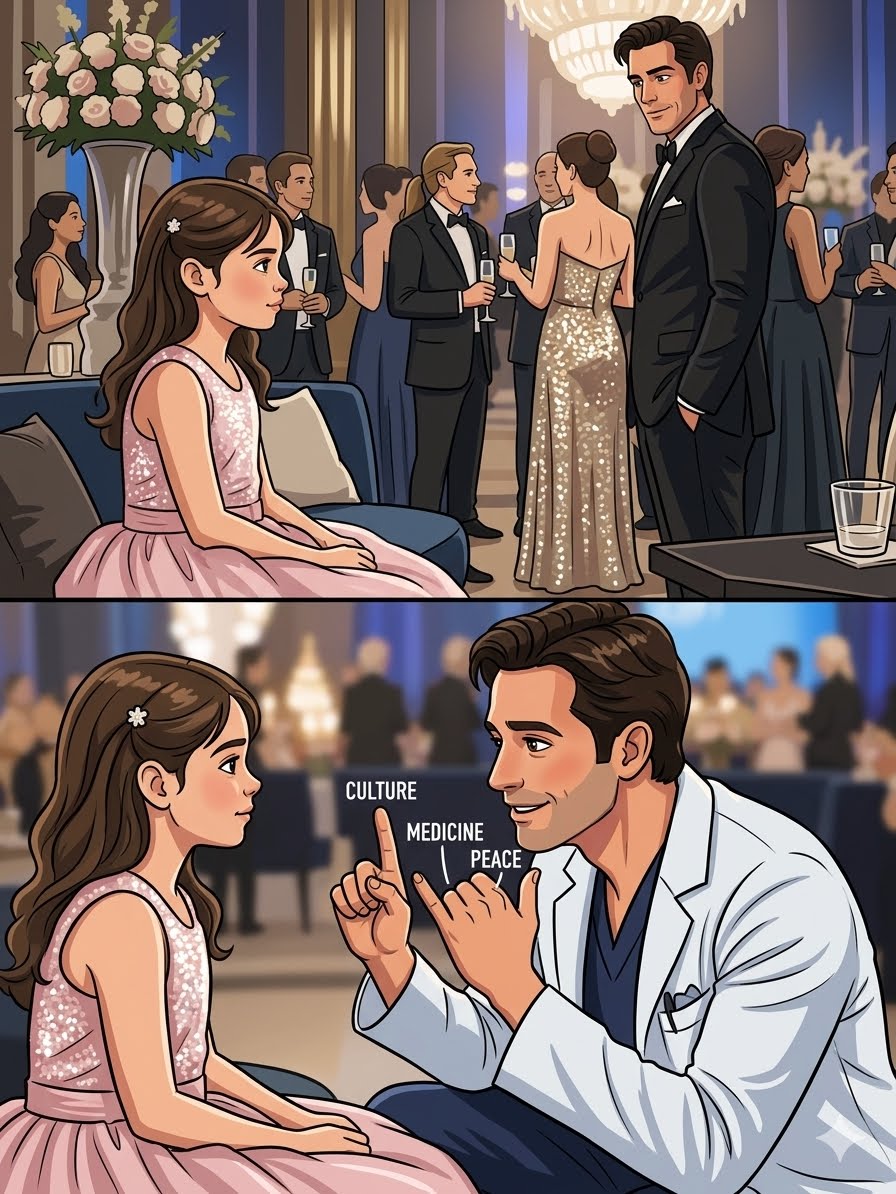
- At table seven, located near the inner curve of the dance floor, a nine-year-old deaf girl sat alone, hands neatly folded in her lap, watching the room perform. Her name was Lily Rock. She wore a midnight-blue dress that her uncle’s housekeeper had carefully ironed at four that afternoon, her hair held in place by a mother-of-pearl comb that had belonged to her mother.
- Inside the small beaded clutch resting on her lap were two items of personal significance: a fingernail-sized piece of meteorite wrapped in tissue paper, and a neatly folded note that read, in case anyone asked: “I am deaf. I read lips a little. I sign.”
- She hadn’t needed to show the note to anyone yet. No one had asked.
- All around her, the cocktail hour was at its peak noise. Waiters wove between tables carrying silver trays of champagne and hors d’oeuvres. Nearby, chandelier light glinted off the sweeping earrings of a senator’s wife. On a low stage, a string quartet played a faint, slow melody—the kind of background music meant to fill silence while no one actually listens.
- Three women had already walked past without a word. The gala chair paused beside Lily’s table, waved to someone across the room, and moved on without looking down. A hospital board member glanced at Lily’s name card with the small, pleased expression of someone recognizing a notable surname, remarked brightly to her companion, “And you simply must come for drinks on the terrace,” and kept walking. A photographer crouched by the table to take a wide shot of the floral centerpiece, angling his camera so Lily was reduced to a soft, intentionally blurred shoulder at the edge of the frame.
- Lily took in all three interactions. She had also watched her uncle Daniel leave. He had escorted her to her seat, rested his palm briefly on the crown of her head, and signed, Two minutes. All right, I have to speak with Andrew. Two minutes had stretched into an hour and twenty minutes. She knew the precise time by tracking the clock above the stage. He would return—he always returned. Sitting down and remaining present was what he struggled with.
- The empty chair beside her bore his place card: Daniel Rock, table 7. The seat on her other side lacked a card altogether. Someone had quietly removed it earlier in the evening.
- Across the room, Lily spotted Aubrey—the only other child at the gala who knew how to sign. Aubrey was seated at table eleven with her parents, grandmother, and a hospital representative named Dr. Han. They were too far apart to talk. Earlier, when their eyes met, they had briefly signed to each other across the crowd, but Aubrey’s mother had gently patted her daughter’s hand and turned her away as the senator’s introduction began.
- So Lily simply watched. She was accustomed to watching rooms. She kept her hands still in her lap so she wouldn’t look like someone anxiously waiting, even though she was.
- She was gazing up at the chandelier when the woman in the navy dress reached her table.
- The woman didn’t approach like the others. She didn’t pause beside the chair or wave across the room. She walked with the steady, unhurried stride of someone moving down a corridor, stopping a half-step back from the chair so as not to loom over the child. Then she crouched all the way down—not just leaning forward, but dropping down so her face was level with Lily’s, one knee on the carpet and the other tucked beneath her, the hem of her navy dress falling neatly out of the way.
- She didn’t begin with a spoken introduction. She raised her hands and signed carefully, Hello. May I sit for a moment? Her movements were deliberate and slow, like a doctor addressing an awake patient. Crucially, she bypassed the typical adult mistake of praising Lily’s outfit before establishing real contact.
- Lily looked at her. The woman appeared to be around thirty, her dark brown hair pinned up with two plain clips, a single stray lock resting along her cheek. Her navy dress was simple, devoid of jewelry except for a thin gold chain at her neck. Her shoes set her apart from the rest of the room—low heels slightly scuffed at the back. Clipped partially out of sight inside her bodice was a small hospital badge, the kind worn by staff who had come straight from a shift and forgotten to remove it.
- Lily signed back, “Yes.”
- The woman took the empty chair on Lily’s other side—the one without a place card—and pulled it slightly inward so they faced each other rather than the room. The subtle shift created a barrier, blocking Lily’s view of the photographer and the gala chair’s path, shielding her from the surrounding noise.
- She signed, “I am Sloan. May I ask your name?”
- “Lily.”
- “Lily. Hello.” A pause followed. Sloan waited, letting the silence exist naturally without feeling forced to fill it. Then she signed, “Are you here with someone tonight?”
- “My uncle. He is in another room.”
- “Will he be coming back?”
- “Yes.” A subtle shift passed over Sloan’s mouth—not a smile, but an quiet acceptance of the answer. She signed, “Has anyone offered you anything to eat?”
- “No.”
- Sloan tilted her head slightly. “I have grapes in my clutch,” she signed. “Would you like some? They are small, green, and seedless.”
- Lily considered this. The servers had passed four times without lowering their trays or pausing. She signed, “Yes, please.”
- Sloan opened her small dark clutch, retrieved a folded square of brown paper, and opened it into a flat packet containing the grapes. She placed it on the white tablecloth between them. Without taking any for herself, she gave a brief nod and signed, “Yours.”
- Lily picked up a single grape and ate it.
- Sloan glanced casually around the room for a moment, like someone checking traffic before stepping off a curb. Turning back, she signed, “I work at Lincoln Memorial. I’m a doctor. Children’s heart things. I learned to sign because some of the children in my unit sign and I wanted to talk to them. So my signing isn’t perfect. Will you correct me?”
- She didn’t say, “I learned sign language to help children like you.” She didn’t offer platitudes about bravery or inspiration. She simply asked, “Will you correct me?”
- Lily, well-versed in distinguishing between different types of adults, signed, “Yes.” After a brief beat, feeling it only fair, she added, “Your signing is fine. It is medical fine.”
- Sloan signed back, “Which means I can ask if you have eaten, how much water you’ve had, and name the main arteries, but almost nothing else. So tonight, I’m hoping you’ll teach me three new words.”
- Lily studied her. A slow, warm feeling began to spread low in her chest—not the sensation of being rescued, but the rare feeling of being genuinely met. She had felt it before with Aubrey, with Aubrey’s mother, with her own mother when she was alive, with a teacher at Kinsey Park Day School, and with Mrs. Fam back home. She hadn’t felt it tonight, nor had she expected to. The room had made its priorities clear all evening.
- She signed, “All right. The first word is meteor.”
- Unbeknownst to Lily, a man in a tailored suit stood motionless in the far doorway. Having returned carrying no glass, folder, or phone, he had scanned the room and frozen at the sight of table seven. He stood silently, watching a stranger offer his niece the presence and warmth he had failed to give her over nine hundred days.
- He didn’t yet realize that this simple act of crouching to meet a child’s gaze was about to unravel two and a half years of controlled, wordless grief—or that before gala chair Vivien Ashworth Pell completed her next lap around the room, she would already be quietly plotting to erase the woman in the navy dress from the story of the evening entirely.
- PART 2
- His name was Daniel Rock. He was thirty-five. He ran the holding company that owned an eleven percent stake in the Lumis Hotel along with the option on the South Loop property designated for Lincoln Memorial’s new pediatric cardiology wing. He had personally paid for table seven—yet server after server carried glasses of champagne past his niece without ever lowering a tray for her.
- He had become her legal guardian two and a half years ago in a lawyer’s office, taking on the duty in the same steady, matter-of-fact tone he used for every business agreement. In the time since, he had never quite admitted to himself what he had actually become: not merely an uncle managing a niece, but a father. Instead, he treated the arrangement as a series of operational improvements—schooling, healthcare, and extracurriculars, all meticulously chosen. The housekeeper, Iris Fam, who had loved Lily’s mother since childhood, was kept on at a generous wage. A second vehicle had been added so Henry, the driver, could handle Lily’s school runs without ever interfering with Daniel’s morning schedule.
- The chair on Lily’s other side had received no such careful thought, simply because Daniel hadn’t anticipated her having a companion. When the floor crew was instructed to prepare the table for nine during cocktails, a staff member had quietly removed the extra seat.
- Daniel stood completely still, his hand motionless at his cufflink. He understood, with the same cold clarity he brought to balance sheets, that he had spent two and a half years organizing his late sister’s daughter’s life into a neat collection of properly managed files—and that not a single one of those files provided an answer for who should sit beside her at her first formal dinner. He also realized that the only person in the room who had answered that question was a total stranger in a navy dress.
- Finally, he stepped forward. Fifteen feet from his table, gala chair Vivien Ashworth Pell intercepted him with the practiced ease of someone who had been intercepting him politely for six years.
- “Daniel,” she said, placing a gloved hand on his forearm and offering a practiced smile that didn’t reach her eyes. “Honestly, I was just about to send Andrew to find you. The senator wants a brief word before seating. Five minutes.”
- “After dinner,” Daniel replied, nodding subtly past her shoulder toward table seven.
- Vivien looked—having paid no attention to table seven all evening—and spotted the navy dress along with the chair that wasn’t supposed to be there. Her polished smile flickered for a fraction of a second, a fleeting break in composure that Daniel, having observed her for years, caught instantly.
- “Of course,” Vivien murmured smoothly. “Of course.”
- He reached table seven and set his hand briefly on the top of Lily’s head. Without turning around, Lily raised her right hand, pressed it once against his, and lowered it back down. The open paper of grapes remained on the white tablecloth between her and the woman in the navy dress. The ice water was at her elbow. The empty seat beside her was filled.
- The woman looked up at him calmly with the steady eyes of someone who had worked an eleven-hour shift before arriving. She gave a single nod, neither rising from her seat nor rushing to introduce herself.
- “You are her uncle,” she said. Her spoken voice was lower and deeper than he expected from someone who signed at a child’s eye level.
- “I am.”
- “Sloan Marchetti. From Lincoln Memorial.” She explained that she was a pediatric cardiologist attending because three of her young patients’ families were present. “I see your niece,” she added, “and we have an agreement. She is teaching me three signs. She’s taught me one.”
- PART 3
- Daniel met her gaze for four full seconds—a long stretch of time on a ballroom floor. He didn’t offer a polite thank-you or insist she didn’t need to bother. He simply asked, “May I sit?” It was less a question and more an acknowledgment.
- He took his seat at his own table, at the gala where he had purchased ten spots, and realized for the first time all evening that only three people in the vast room held any real weight for him: his niece, the stranger sitting beside her, and his sister Cara. Cara had been gone for two years and one month; she was the one who had taught him every sign he knew, yet since her passing, he had not asked his niece for a single lesson.
- Dinner service began at 7:30. Sloan answered Daniel’s practical questions in measured pieces—detailing her training and the linguistic needs of her cardiology wing—but she asked nothing in return. Sometime between crouching at the chair and his arrival, she had decided that this was Lily’s table, and her role was not to interview the executive paying for the seats.
- Between courses, as applause erupted for the honored chef, gala chair Vivien Ashworth Pell glided over to table seven. She remained standing, positioning herself at an angle where the chandelier light flattered her champagne silk gown.
- “I hate to interrupt, Dr. Marchetti, isn’t it?” Vivien began smoothly. “I wonder if I might borrow you for a moment. A few of our colleagues at table eleven were wondering if an on-call sign liaison could step over to help Aubrey’s grandmother navigate the auction program.”
- Sloan turned her head slightly. “Aubrey’s grandmother is Dr. Han. She trained at Northwestern alongside my chief of cardiology. She is fluent in Cantonese, English, and American Sign Language. She does not require assistance understanding any auctioneer in this city.”
- Vivien’s smile remained intact, though the corners of her eyes tightened ever so slightly. “I see. Perhaps I was misinformed. However—the hospital staff are on duty tonight, and I’m sure your colleagues at table eleven would prefer the family portion of the evening remain private. There is a green room off the lobby for on-call personnel who need to step away. If you’d feel more comfortable—”
- She left the sentence hanging.
- “I am not on call tonight,” Sloan stated evenly. “I am attending as a guest on an invitation extended to three pediatric attendings this month. My assigned seat was at table fourteen. I am sitting at table seven because this child was sitting alone, so I came to keep her company, and her uncle invited me to stay. As for the family side of this table, it was missing a chair, which I retrieved from near the freight elevator. I intend to keep it.”
- Daniel spoke up for the first time. “Vivien.” He used the tone of a longtime business associate making a firm point, even amidst a room of nine hundred people. “Thank you. I want Dr. Marchetti to stay at this table for the rest of the event. Please pass along my apologies to the senator.”
- Vivien’s composure recovered instantly. “Daniel, of course.” She didn’t leave right away. Pausing, she placed her hand briefly on Lily’s shoulder—the first adult hand besides Daniel’s and Sloan’s to touch the child all evening—and remarked brightly, “And how is our young lady enjoying her very first gala?”
- Lily looked up at her without answering. She didn’t attempt to read Vivien’s lips, which would have required an awkward angle from her chair. She simply stared up calmly with her dark eyes—the ones she had inherited from her mother—and waited.
- Sloan raised her hand below table level, signing out of Vivien’s direct line of sight: You may answer or not answer. Your choice.
- Lily signed back: Not.
- Sloan translated aloud, offering a slight tilt of her hand toward Lily. “She prefers not to answer that tonight. She’s saving her words.”
- It was the cleanest exit strategy offered to Vivien all evening. She took it, withdrawing her hand and strolling back toward the head table with effortless social grace.
- Neither Daniel nor Sloan knew it yet—as they sat together in a quiet, lamp-lit library on the mezzanine an hour later, listening to the rain begin outside—that this brief confrontation over a pulled-up chair was merely the first move in a much larger conflict. It would eventually involve a veteran columnist, a buried hospital memo regarding deaf patient care, a spiteful social media post published to hundreds of thousands of followers, and a housekeeper breaking four years of silence before Daniel Rock would finally confront how much of his own suppressed grief he had hidden behind professional efficiency.
- The charity auction lasted forty minutes. Once it concluded, Daniel leaned into Lily’s field of vision and signed: Library. Upstairs, the mezzanine room was quiet and dim, its thick green carpet muting all sound beneath the glow of a single green-glass lamp. Lily curled up on a sofa, and Daniel draped his suit jacket over her legs. Sloan took a seat on an adjacent sofa at a right angle.
- For a long stretch, no one spoke. Then Lily raised her hands. I have chosen the third word, she signed slowly and deliberately, giving the lesson like a cherished gift. The third word is meteor.
- Sloan let out a quiet, shoulder-shaking laugh. That was the first word.
- Yes, Lily signed back. And it is also the third, because it needs to be the first word my uncle learns from you, and the last word you learn from me tonight. That way, the word goes around in a circle.
- Daniel froze. For two and a half years, he had not allowed his sister’s daughter to address him in that particular tone—the exact same cadence Cara had used as a nine-year-old to explain why his rules were silly. He had absorbed that tone since he was five years old. But ever since the morning he had identified Cara’s body, he had blocked any signed communication from reaching that painful, buried memory.
- He met Lily’s eyes and raised his hands slowly. Will you teach me then?
- Lily glanced at Sloan. Show him.
- Sloan signed meteor. Daniel’s hands remained still.
- He used to know, Lily signed. He has forgotten.
- Sloan walked quietly over to the window to watch the rain falling on Michigan Avenue, giving them the privacy they needed. Behind her, Daniel signed meteor. Lily adjusted the angle of his hands. He signed it again, correctly this time. Then he signed a full sentence—the exact phrasing Cara had taught him when he was nine and she was thirteen, sitting on the linoleum floor of their father’s hardware store on a cold Sunday.
- He paused, overcome. Lily, understanding instinctively what was happening in her uncle’s heart, climbed across the sofa and rested her face against his shirt. She didn’t look up into his eyes, allowing him his privacy. Daniel placed his hand on the crown of her head and kept it there, finally loosening his tight grip on his cufflink for the first time in over two years.
- Over by the window, Sloan thought of her own father—a deaf welder with large hands and a quiet demeanor who had died in an accident at his shop when she was seventeen. The final sign she had read from his hands was go, as he pointed at her medical school acceptance letter resting on the kitchen table. She had gone. And early that evening, she had resolved never to allow herself to be made invisible in any room where she had a right to be heard.
- The three of them stayed in the library for thirty-eight minutes. Downstairs, Daniel’s chief of staff, Andrew, was waiting with urgent news he had been rehearsing all evening: a columnist named Marisol Espinosa was reframing her gala coverage around Daniel and his niece. Furthermore, a former pediatric cardiology fellow had submitted an internal twelve-page memo last winter regarding communication protocols for deaf patients, which had been promptly shelved. A research assistant had just contacted Daniel’s office for comment, explicitly naming the fellow. The fellow was Sloan.
- Daniel didn’t flinch when Andrew delivered the news. Sloan had served as a shield for his niece for hours, and he had no intention of letting her be turned into gossip for a Sunday column. “Thank you, Andrew,” he said quietly, closing the conversation.
- At the coat check, Marisol Espinosa asked a single question—who had selected Lily’s day school—and Daniel answered truthfully: Lily herself had chosen it at seven years old, after a tour, pointing from the car ride home and saying, That one. Marisol then asked Sloan off the record about the tabled memo. Sloan revealed nothing beyond stating that it remained in the chief’s files, unread by anyone outside the department. Marisol shut her notebook. “The article I write won’t focus on your niece,” she told Daniel. “There will be just one line about you: that you carried a tired nine-year-old out the back exit at 10:46 and were courteous to a reporter on your way out.”
- In the car, Daniel invited Sloan to join them on Tuesday for a meteorite exhibit Lily had been eager to see. She replied simply, “All right.” Not an enthusiastic yes—just a calm all right. She then took a taxi back to her Lake View studio apartment.
- At 11:52 that night, a colleague sent Sloan a link alongside a warning: Don’t read the comments. The Lumis Hotel’s official account had published a photo of her crouched beside Lily’s chair, hands mid-sign, accompanied by the caption: A touching moment between our host family and the hospital’s on-call sign liaison, demonstrating how small acts of inclusion bring warmth to the largest rooms.
- Sloan sat on the edge of her bed in her navy dress, holding one scuffed heel, and said softly to her empty room, “All right.”
- Daniel saw the post at 12:03 after Andrew forwarded it to him. Realizing Vivien’s PR team had released it without authorization, he called immediately. He drafted three messages to Sloan, deleting two before finally sending: Doctor, I just saw the caption. Please give me until tomorrow to fix this. Whatever they chose to call you, you were the only real support at that table tonight.
- On Sunday afternoon, they met along the breakwater near North Avenue Beach. Daniel had removed his cufflinks, leaving them behind in the car. He explained his plan—he would pull his financial backing if the caption wasn’t corrected by Tuesday, and resign his board seat if necessary. He spoke openly about Cara, the memorial gift, and an official letter his sister had written eight years prior that had also been buried. Sloan shared that she had read Cara’s letter the previous winter in the chief’s office. “It was a exceptional letter,” she noted quietly.
- “I should have explained all of this last night,” Daniel admitted. “For two and a half years, I haven’t spoken about her in a sentence that wasn’t strictly operational. I am telling you now.”
- Sloan looked out at the water before turning back to him. “There is something you should know about me. I excel at the first step. I am far less skilled at what comes later—like a Sunday afternoon in October, sitting on a step while a man in a navy overcoat talks about his sister. I have handled those moments poorly in the past.”
- “I won’t misinterpret you,” Daniel said.
- “You might. If you do, I’d prefer you ask me what I meant before assuming.”
- He invited her to the meteorite exhibit again, formally this time, with Mrs. Fam coming along as chaperone. She agreed. They walked back along the shoreline together, and on the drive home, Daniel finally allowed himself to think of the word father in the present tense without trying to replace it.
- By Monday morning, everything fell apart. A new column was published by a junior writer under the title The Quiet Liaison. It framed Sloan as an on-call sign translator who had been “discreetly summoned” for the event, featuring a fabricated quote about Rock Holdings “exploring specialized educational options” for Lily. Sloan read the piece twice at her kitchen counter, ignored the comments section, and headed to her clinic shift.
- Daniel read the article in his car on the way to a board meeting. Applying his usual cold logic, he jumped to the wrong conclusion: he assumed Sloan had leaked the narrative to Marisol’s assistant in exchange for public support regarding her cardiology memo—that she was using Lily for professional exposure. Reacting hastily, he contacted his legal counsel and had Sloan’s access to a grant review committee suspended for forty-eight hours “pending investigation,” copying her department chief and hospital compliance.
- Sloan received the email during her shift. She didn’t write back, didn’t call, and didn’t check the comments. She simply spent the rest of her morning caring for a four-year-old patient named Mateo and his mother, focusing on her work as she always had.
- At 11:41 AM, Mrs. Fam walked directly into Daniel’s corporate office unannounced. She revealed that she had spotted Vivien drafting the fake narrative on a laptop behind the staging screens at 7:09 PM on Saturday—having glimpsed the screen while balancing a tray—and had recognized the exact phrasing used in the published article. “I spent all weekend wondering if it was my place to tell you,” Mrs. Fam said steadily. “It wasn’t. But I am telling you anyway.”
- Daniel sat back, stunned by his own misjudgment. He immediately called the school and asked a question he had long avoided. Then he went home and asked Lily directly if anyone had paid attention to her before the doctor arrived.
- No, Lily signed. The doctor was the first.
- Over the next hour and a half, Daniel resigned from the hospital board, revoked his gala pledge, redirected the full funding amount to the hospital’s pediatric department under his sister’s name, had his attorney reinstate Sloan’s committee position in writing, and drove through the pouring rain to Sloan’s apartment.
- She opened the door just a crack. He asked for four minutes and laid out the full truth plainly: he had assumed the worst of her because accepting that someone else had orchestrated the lie was a reality he hadn’t wanted to face; Mrs. Fam had set him straight; and he had already taken steps to undo the damage before coming to her door, regardless of how she responded.
- “I came here because I owed you an apology in person,” he said. “I misread you, exactly as you warned me I would.”
- She invited him inside. She didn’t offer immediate forgiveness at her kitchen table. Instead, she set clear boundaries: he could ask her through Mrs. Fam on Tuesday morning if Lily still wanted her to attend the exhibit. The focus would remain entirely on the child. If the answer was yes, Sloan would attend and speak only about Lily that day. On Wednesday, she would decide for herself if she was ready to discuss anything further with him.
- “That is the agreement,” Daniel accepted.
- On Tuesday morning, Sloan spent twelve minutes in a private conference room confronting Vivien Ashworth Pell with the evidence—the draft written at 7:09 PM, and the email sent to an editor at 12:40 AM under a junior writer’s name to disguise the source.
- “Your daughter texts you entirely in lowercase,” Sloan remarked calmly. “Children who are forced to perform write in lowercase to their mothers when they are exhausted. You are exceptional at erasing reality from a room—so good at it that your own daughter still hides behind lowercase texts at sixteen. The image you’ve spent sixteen years curating costs your daughter her authentic voice every single weekend. That cost isn’t mine to carry. It’s hers.”
- Vivien said quietly, “Please leave.” Sloan turned and walked out.
- Two Wednesdays later, Vivien arrived at the house on Aster Street carrying a gift-wrapped ASL grammar book and a donation check for a pediatric cardiology nonprofit where Sloan volunteered. She delivered four brief, rehearsed sentences: confessing she had concocted the false narrative, admitting she knew exactly who Sloan was at the time, stating she expected no forgiveness, and announcing her resignation as gala chair effective Friday. “Tonight when I go home,” Vivien added softly at the door before departing, “I am going to ask my daughter to teach me a sentence in her language.”
- Three months later, in late February, the Lumis Ballroom looked completely transformed in the daylight—filled with long white tables, gray folders, and guests attending the research grant ceremony for the newly established Cara Rock Pediatric Cardiology Fund, managed by clinical leadership alongside a lay advisory board chaired by Mrs. Lumis.
- In the front row sat Lily Rock, wearing a navy dress with a green silk collar she had selected herself. Beside her, on a chair pulled close, sat Daniel, his cufflinks plain and unmonogrammed. At the podium, wearing a charcoal blazer with her hospital badge flipped inward, stood Sloan Marchetti—now serving as clinical co-lead for the fund, dividing her time between hospital rounds, a community cardiology clinic on Pulaski Road, and weekly grant reviews.
- She reached the middle of her speech at 1:14 PM, speaking about the very room they were sitting in back in November, and the extra chair someone had pulled up for a lone child. She didn’t name the child directly; she spoke only of the chair.
- In the front row, Lily raised her hand to her shoulder and slowly formed four signs her uncle had begun learning along the breakwater in November: This. Is. Meteor. She added a subtle question mark at the end.
- Beside her, Daniel—having spent three months mastering the alphabet, family signs, and the word meteor—raised his hand and signed back with careful focus, determined never again to be the person at the head of a table who couldn’t communicate with a child in her own language: Yes. It. Is.
- Lily turned her attention back to the podium. Sloan, wrapping up her speech, didn’t look down at her notes. She looked into the front row, catching the final movement of their hands in the dim light, realizing neither of them had needed an audience to see it. She found her spot on the page and continued reading into the next section about the future of the fund.
- Outside, the pale February sunlight filtered through the crisp Chicago air between winter snows. In the front row, the green silk collar on Lily’s dress shifted gently as she took a deep breath.
PART 1 >> The charity gala at the Lumis Hotel, held to benefit the children’s hospital, was designed for nine hundred attendees—nine hundred people who had implicitly agreed to act as if the only person worth noticing was whoever happened to be speaking at any given moment.