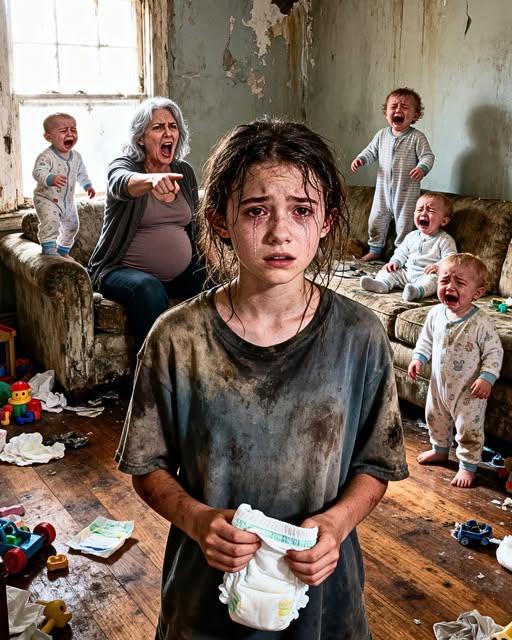
- When the pounding started, I knew my mother would never let me leave without turning it into a war.
- These were not the timid, uncertain taps of a neighbor delivering misdirected mail. Someone was striking the thick wooden front door of Aunt Rebecca’s home in Des Moines with sharp, deliberate, terrifying force.
- The entire living room fell instantly silent. Even the grandfather clock ticking in the corner seemed to freeze.
- I sat curled up on my aunt’s patterned sofa, clutching my worn canvas backpack against my chest. My fingers were wrapped around the straps so tightly that my knuckles had turned chalk-white.
- Everything I owned in the world was inside that bag: three sets of clothes, a toothbrush, and the desperate, fragile hope that sixteen years of living as my mother’s unpaid servant had finally come to an end.
- Aunt Rebecca slowly placed her coffee cup on the end table. The familiar, comforting scent of dark roast and lavender suddenly felt alien beside the cold fear spreading through the room. She looked at me, concern etched into her face, but steel gleamed in her eyes.
- “Stay here, Madison,” she whispered.
- She walked toward the entryway. I tried to remain on the sofa, but my body refused. I rose on trembling legs, my heartbeat hammering so violently that my vision blurred around the edges.
- Rebecca opened the door.
- Two police officers stood on the porch under the pale morning sky, one man and one woman, their crisp dark uniforms severe and imposing.
- “Does Madison Parker live at this address?” the male officer asked, peering past my aunt into the hallway.
- Hearing my name spoken in that official, stern tone felt like a direct accusation.
- Rebecca straightened her posture. “She is staying here. Madison is my niece.”
- The female officer’s name tag read Officer Bennett. She glanced past my aunt to meet my eyes, her expression professional, though not entirely cold.
- “Your mother filed a missing-person report early this morning,” Officer Bennett explained. “She claims you left home without permission. Because you are sixteen and a minor, we need to verify your safety.”
- A missing-person report.
- The sheer, disgusting absurdity of it made something twist painfully in my gut. My mother had spent years abandoning me to raise six children while she slept through the day, vanished for hours, or complained to anyone who would listen about how exhausting motherhood was.
- I was the one warming bottles at three in the morning. I changed diapers, cooked every meal, scrubbed floors, and calmed screaming toddlers while trying to complete my homework on the dirty kitchen tile. My classmates went to football games, learned to drive, and planned for college; I bought diapers after midnight and failed geometry because I was too physically exhausted to keep my eyes open in class.
- My safety had never mattered to my mother. Not until the person doing all her unpaid labor finally walked away.
- “I didn’t run away,” I said, my voice cracking slightly. “I walked here. I called my aunt first. I left because I had no choice.”
- The officers exchanged a quick, knowing look.
- Rebecca swung the door open wider. “She is safe here,” she said firmly. “But she is pushed past her limit. Her mother has forced her to raise those children for years. She’s been treated like free labor.”
- The male officer frowned. “We still need to speak directly with Madison and assess the domestic situation.”
- I stepped forward into the hallway. Anger was beginning to surge beneath the paralyzing fear—an anger born from years of carrying crying babies across stained carpets while my mother, Carla, slept behind her locked bedroom door. It came from every failed exam, every forgotten birthday, and every night I was told that being the oldest meant I had no right to complain.
- “My mom is pregnant again,” I told them, my chest heaving. “This will be her seventh baby. She expects me to raise this one too. I haven’t slept through the night in years. If you force me to go back to that house, I don’t think I’ll survive it.”
- Officer Bennett’s expression softened slightly. She appeared ready to respond when the unmistakable roar of a damaged muffler tore through the quiet street.
- A dented gray sedan mounted the curb outside, screeching to a halt.
- My blood turned to ice. I didn’t even need to look. The police weren’t the real nightmare. The real nightmare had just arrived.
- The car door slammed shut. Carla climbed out, one hand resting dramatically over her seven-month pregnant stomach, the other clutching her old leather purse.
- She was not alone. She dragged my six-year-old brother, Noah, out of the back seat by his arm. He wore pajamas far too small for his growing frame, his face filthy and wet with fresh tears.
- My mother’s expression transformed before she even reached the porch steps. It became the practiced face she wore at church and parent-teacher conferences: the selfless, exhausted mother who sacrificed everything for her family.
- She burst through the front doorway. “Madison!”
- Her cry was perfectly engineered to sound utterly heartbroken. Before I could move, she threw her arms around me, dragging Noah into the embrace. There was no love in the gesture—only the stench of cheap perfume, stale laundry, and the suffocating grip of a jailer reclaiming an escaped prisoner.
- “You terrified us!” she sobbed hysterically. “Your brothers and sisters have been crying all morning!”
- While holding me tight, her hand slid down to Noah’s shoulder. I watched her knuckles turn white through his thin shirt as she pinched his tender skin with cruel force.
- Noah shrieked in agony, his crying turning into desperate, gasping wails. “Please come home, Madison!” he sobbed, clutching my shirt. “Mom said we can’t eat if you don’t come back! Please! I’m so hungry!”
- His desperate words poisoned the air in the room. Officer Bennett’s face hardened immediately. To anyone who didn’t understand my mother’s terrifying games, it appeared as though I had heartlessly abandoned starving children.
- The male officer stepped forward, his hand resting near his belt. “Ma’am, release her.”
- Carla let go of me, pressing a tissue to eyes that were completely dry. “I nearly collapsed from the shock,” she wept, breathing heavily. “Especially in my delicate condition. I don’t understand why she’s behaving like this. I give that girl everything!”
- “Stop it,” I whispered, my hands trembling. “Let go of Noah. You’re hurting him.”
- “Do not speak to your mother in that tone,” the male officer snapped at me.
- Rebecca instantly stepped between us. “You are completely misunderstanding what you’re seeing! Madison did not abandon those children. She escaped a home where she was treated like a slave!”
- Carla’s tragic mask slipped for a fraction of a second, revealing dark fury. “Stay out of this, Rebecca. You don’t have children. You have no idea what motherhood requires. Madison is simply being rebellious and spiteful.”
- “I am not a piece of furniture you can drag home to scrub your floors!” I screamed at her. “I’m not going back!”
- My mother’s eyes narrowed into slits. She reached deep into her purse. “If she wants to stand here and accuse me of being a bad mother,” Carla said coldly, “then perhaps the officers should see what I found hidden beneath her mattress this morning.”
- She pulled out a small blue spiral notebook.
- My journal. The single place where I had documented the nightmare of my life.
- Carla held it up by the plastic binding, a triumphant smile dancing on her lips. “You need to read this,” she told the officers. “Then you’ll understand how mentally disturbed and dangerous my daughter really is.”
- The room felt like it was sinking underwater. That notebook contained every brutal truth: the night she shoved me down the stairs because I forgot to buy milk, the bruises she left on my arms, the endless nights I stayed awake with the infants, and the padlock she kept on the pantry while the toddlers cried from hunger.
- “Give that back to me,” I breathed, stepping toward her. “That’s private.”
- “It’s evidence,” Carla countered smoothly, handing it directly to the male officer. “I found it while searching her room after she ran off. She isn’t escaping household chores, officers. She is severely disturbed. I am terrified she will harm the younger children.”
- The male officer frowned. “What exactly is written in here?”
- “Read the pages marked with paper clips,” Carla directed.
- He opened the notebook. As his eyes scanned the lines, his posture shifted dramatically. His shoulders stiffened, his jaw set, and when he looked up at me, his eyes burned with disgust.
- “Is this your handwriting?” he demanded.
- “Yes, but—”
- “Did you write this?” He turned the open journal toward me.
- The writing looked shockingly like mine—the same uneven loops, the same slanted letters. But the words were horrific:
- > I can’t listen to Noah cry anymore. I want it to stop. Sometimes I stand beside baby Ethan’s crib and imagine covering his face with a pillow so I can finally sleep.
- A wave of violent nausea struck me so hard I stumbled backward against the hallway wall.
- “I never wrote that!” I gasped, choking on air. “She forged it! She tore out the real pages!”
- “She has delusional episodes like this all the time!” Carla cried out, clutching her belly. “I have tried so hard to protect her, but she needs emergency psychiatric help. She is a danger to my babies!”
- I stared at the open notebook in the officer’s hand. The paper near the wire binding was jagged and torn. My actual entries had been ripped out; my mother had painstakingly forged my handwriting to fabricate death threats against her own children, intending to have me locked away in a psychiatric ward forever.
- Officer Bennett unclipped a pair of steel handcuffs from her belt. “Madison Parker, for the safety of the children, turn around and place your hands behind your back. We are taking you into custody for an emergency psychological assessment.”
- Rebecca screamed. “You cannot be serious! Look at her! Carla is lying!”
- “Step aside, ma’am, or you will be arrested for obstruction,” the male officer warned sternly.
- Carla stood behind them, a tiny, dark smile gracing her lips that only I could see. She thought she had won.
- The cold metal of the handcuff brushed against my wrist. Panic narrowed my vision until all I could see was the notebook and my mother’s smug face.
- Then, a sudden memory flashed in my mind—a camera flash lighting up my pitch-black bedroom at 3:00 a.m.
- “Wait!” I shouted.
- Officer Bennett tightened her grip on my arm. “Do not resist.”
- “I’m not resisting! Check the emails!”
- Everyone in the room froze.
- I turned my head toward my aunt. “Rebecca! Get your tablet! Now!”
- Carla’s smug smile instantly vanished. “What are you rambling about?”
- “I knew you searched my room,” I said, addressing her by her first name for the first time in my life. “I knew you picked the lock on my desk drawer weeks ago. Did you really think I would leave my only protection buried under a mattress?”
- I looked Officer Bennett dead in the eye. “Every single night after the babies fell asleep, I took photos of every page I wrote. Then I emailed those pictures to a hidden, secure account linked directly to my aunt’s tablet.”
- Carla turned deathly pale. “She’s lying! She’s just trying to delay you!”
- Rebecca sprinted into the kitchen and returned carrying her tablet. Her hands shook violently as she unlocked the screen and opened the hidden account. “Everything is right here,” Rebecca said, her voice ringing with triumph. “Two full years of photographs, timestamped and organized by date.”
- Officer Bennett took the tablet and opened an email sent three days earlier. A crystal-clear photograph of an intact journal page appeared on the screen. She read the entry aloud:
- > Tuesday, 3:00 a.m. Mom locked the pantry again. Noah was crying because his stomach hurt so bad from hunger. I had to unscrew the hinges on the garage door just to reach the emergency peanut butter. She told me if I mention being tired to my teacher, she’ll report me for using drugs. My wrists still burn from where she pinned me against the sink.
- Bennett compared the photograph on the tablet with the physical notebook in her partner’s hands. She carefully examined the ink, the torn edges, and the faint stains on the original paper.
- Then she held up the page my mother had forged.
- “The handwriting imitation is clever,” Officer Bennett said, her voice dropping into a dangerous, icy register. “But the ink pressure is completely different. And the original pages in the photos clearly show water and formula damage. These replacement pages are completely dry.”
- Carla began breathing in shallow, rapid gasps. “Digital photos can be photoshopped! She made those up!”
- “The email metadata will prove the exact date and time every single photo was taken and uploaded,” the male officer replied, his disgust turning fully toward Carla.
- The trap my mother had painstakingly built had snapped shut on her own neck. She realized it, too. Her face twisted into a mask of pure rage.
- “You ungrateful little brat!” she shrieked, lunging toward me. “I feed you! I put a roof over your head! I needed you in that house!”
- “You used her!” Rebecca yelled back.
- “I have babies!” Carla screamed, her voice echoing down the street. “Who else is supposed to take care of them?!”
- Officer Bennett gently pulled Noah behind her back, shielding him. “You dragged a six-year-old child out here in the cold and physically hurt him just to make him perform for us?”
- “I had to get her back!” Carla yelled hysterically. “She’s the only one who knows how to manage the children! I knew I should have just locked the deadbolts and left them in their cribs instead of bringing Noah along!”
- The entire room froze in utter horror.
- Officer Bennett slowly looked up from the tablet. “What did you just say?”
- Carla blinked, realizing her fatal mistake. “I—I said Madison should have been home.”
- “No,” the male officer said, his voice deadly serious. “You said you locked children inside your house. Who is watching your other five children right now?”
- Carla’s mouth opened, but no sound came out. “They’re sleeping,” she finally stammered, backing away. “They’re fine! I’ve only been gone for an hour!”
- Officer Bennett reached for her shoulder radio, her voice urgent. “Dispatch, send emergency patrol and Child Protective Services to 519 Maple Avenue immediately. Possible child abandonment. Multiple minors, including infants, locked inside a residence without adult supervision.”
- Carla lunged toward the officer. “You don’t understand! They’re fine! The stove is off!”
- The male officer caught her arms, forced her around, and slammed her down onto the sofa.
- Before anyone could speak, the heavy rumble of a diesel engine shook the windows outside. A dented work truck pulled into the driveway. My father, Dean, stepped out wearing muddy work boots and a yellow hard hat. He had ignored our suffering for years; now he was walking straight into the wreckage.
- He stormed onto the porch. “What the hell is going on here?” he demanded, his eyes locking onto me. “What did you do this time, Madison?”
- “I told the truth,” I said standing tall.
- “She’s lying!” Carla shrieked from the sofa. “They’re trying to steal the kids!”
- Dean pointed a finger in my face. “I am sick and tired of your endless drama! Get your backpack and get in the truck right now! You’re going home to clean up this mess!”
- He reached out to grab my arm, but Officer Bennett stepped firmly between us, her hand on her taser. “Back away, sir. Your wife is currently under arrest for child abandonment, child endangerment, fabrication of evidence, and filing a false police report.”
- Dean stopped dead in his tracks.
- Suddenly, the police radio crackled to life with harsh static:
- > Unit Seven at Maple Avenue. We have forced entry into the residence. Five minors located inside. Conditions are severe—trash, spoiled food, and animal waste throughout the home. A nine-month-old infant was found in a heavily soiled diaper. Two toddlers were locked inside a bedroom from the outside. No adults on site. Requesting immediate EMS and emergency CPS placement.
- All the color drained from my father’s face. He turned slowly toward Carla. “You left the babies locked inside the house alone?”
- “I had to get Madison back!” she screamed, writhing against the officer’s grip. “You never help me! You work your shift and then go hide in the shed! Who else is supposed to do everything if she leaves?!”
- Dean looked at the police officers, pure self-preservation flashing in his eyes. “I didn’t know,” he said quickly, backing toward the door. “I work twelve-hour shifts. She stays home. She’s the one who made Madison do all the work.”
- Carla stared at him in utter disbelief. “You coward! You knew everything!”
- She launched herself off the couch, tearing her hand free to scratch across his face before the male officer forced her to the floor and clicked the handcuffs around her wrists.
- The sharp click-clack of the metal constraints sounded like the final lock on my life being shattered open.
- “Carla Parker, you are under arrest,” the officer stated coldly.
- As they hauled her out the door, she twisted her head back toward me, her face contorted in hatred. “You destroyed this family! Your brothers and sisters will hate you forever!”
- The patrol car door slammed shut, drowning out her screams.
- Dean remained standing on the porch, trembling as he tried to answer the officers’ questions, desperately trying to distance himself from the horror he had enabled for a decade.
- I looked down at Noah, who was quietly crying into my aunt’s apron. My hands were no longer shaking. The war was over.
- The months that followed were a blur of social workers, medical evaluations, court dates, and sterile waiting rooms. The horrific state of the house, the timestamped photos of my journal, the forged entries, and the physical testimony of the children created a bulletproof case that even my mother’s court-appointed attorney couldn’t fight.
- Carla was denied bail. She was ordered to undergo a psychiatric evaluation and was later sentenced to prison for child abandonment, felony abuse, and falsifying evidence.
- Dean tried to fight for custody—mostly to avoid paying child support—but my teachers took the stand to testify that I had been falling asleep in class for years. Grocery store clerks remembered a sixteen-year-old girl buying formula with change at midnight. Neighbors testified about hearing toddlers crying for hours while my parents stayed locked away. The judge stripped Dean of his parental rights and formally placed me in Aunt Rebecca’s full legal custody.
- My first night sleeping in her house was terrifying because of the sheer silence. I lay beneath clean sheets that smelled of lavender, staring at the ceiling, waiting for a baby to scream.
- No scream came. I slept for fourteen straight hours.
- When I finally woke up, no one was demanding bottles or clean laundry. There was only a warm plate of scrambled eggs on the kitchen table and the soft hum of the morning news. It felt entirely foreign. It felt safe.
- I returned to high school. I passed geometry. I joined the library club. I discovered that I laugh loudly when I’m not terrified of waking a sleeping infant. Little by little, I began to meet the girl I might have been if I had been allowed to have a childhood.
- I missed my siblings constantly. They were placed in temporary, supportive foster homes while social services worked on long-term arrangements. Visiting Noah, Ethan, and the others in supervised visitation rooms broke my heart every single time. I hadn’t left because I didn’t love them; I left because staying would have destroyed us all.
- Therapy helped me understand a fundamental truth I had never been taught: I was their sister. I was never meant to be their mother. Their survival should never have rested on my shoulders.
- Two months after her arrest, my mother gave birth to her seventh child while in state custody—a baby girl named Grace. When I looked at her through the nursery window, I felt immense grief for everything she had lost before even taking her first breath. But I also felt a profound sense of relief. Grace would never grow up believing her sole purpose in life was to raise everyone who came after her.
- The nightmare cycle had finally broken.
- On my seventeenth birthday, Aunt Rebecca threw a small celebration in her kitchen. There was a slightly lopsided chocolate cake and two friends I had made in the library club.
- “Make a wish, Madison,” Rebecca smiled, setting down the cake.
- I looked at the flickering candles. I didn’t wish for money, or a car, or even for the dark past to vanish. I wished to always remember the sheer courage it took to walk out of my mother’s house—and to never again forget that my life belongs to me.
- I blew out the candles, and for the very first time in my life, the darkness that followed felt entirely peaceful.
- Now, I am working alongside Rebecca and the social workers assigned to my siblings’ cases. When I turn eighteen, we plan to petition for legal guardianship so my brothers and sisters can come live with us permanently.
- Except this time, I won’t be receiving them as an exhausted, broken child forced to be their mother.
- I will welcome them as what I was always meant to be: their sister.
The Breaking Point