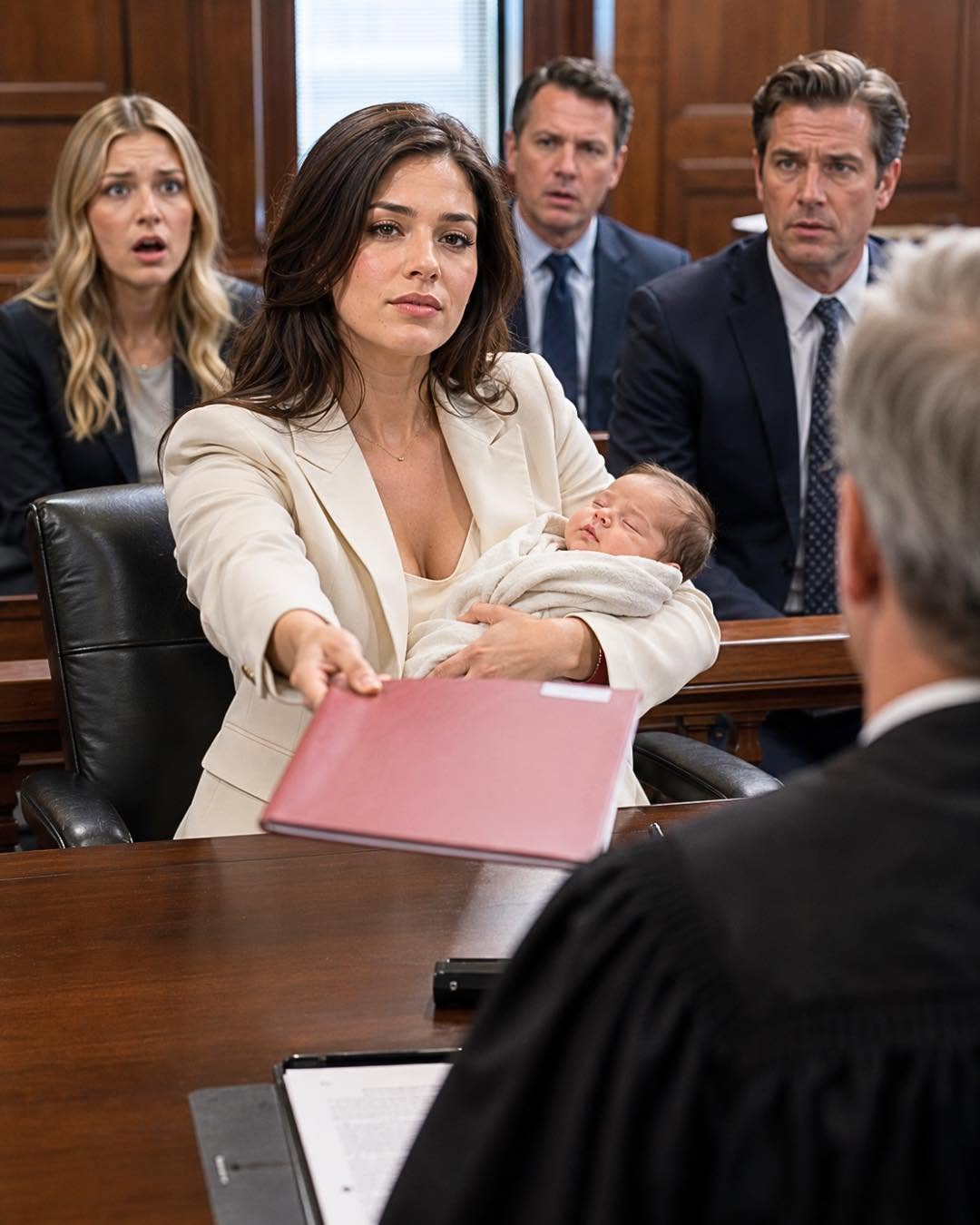
I walked into the courtroom carrying my newborn son while my husband’s lawyer smiled as if the hearing had already been decided.
Nolan Price even leaned toward my husband and whispered, “She brought the baby for sympathy.”
My husband, Grant Foster, sat at the front table in a navy suit I used to press before every board meeting. Beside him was his mother, Diane, covered in pearls, and his new fiancée, Serena, wearing my wedding bracelet like a prize she had won.
Six days earlier, I had delivered my son alone.
Grant refused to come to the hospital unless I signed a custody agreement giving him “temporary care” of our baby until I was emotionally stable. When I said no, he sent Nolan to my recovery room with a threat disguised as legal advice.
“Judges don’t trust unstable women, Ava,” Nolan said, dropping papers next to my IV. “Especially unstable women with no job, no house, and a history of panic attacks.”
My “history” was two therapy sessions after Grant had shoved me into a pantry door and told the doctor I had slipped.
Now they had forced me into court for an emergency hearing, accusing me of kidnapping my own child, inventing abuse, and using the baby to demand money. Grant wanted full custody. Diane wanted me banned from the Foster estate. Serena wanted my son raised in the nursery she had decorated while I was still pregnant.
I wore a cream cardigan because it covered the bruises on my shoulder. My son slept warmly against my chest, unaware that three adults had already tried to erase his mother from his life.
The judge looked over his glasses. “Mrs. Foster, do you have counsel?”
Nolan’s smile widened.
“No, Your Honor,” I said. “Not today.”
Grant laughed softly. “Of course not.”
I carefully shifted my baby and pulled a red folder from my bag. It was thick, organized by date, with yellow, blue, and black tabs. I had assembled it through midnight feedings, hospital contractions, and the long weeks when Grant believed I was too broken to think clearly.
Nolan saw the folder and chuckled. “A plea for mercy?”
I walked to the bench, placed it in front of the judge, and looked once at Grant.
“Your Honor,” I said, my voice steady, “this baby is not the reason I’m asking for protection. He is the proof.”
Grant’s face went white.
For the first time since I had known him, Grant Foster stopped pretending.
Diane grabbed his sleeve. Serena’s mouth parted. Nolan’s smile froze, but only briefly. Then he stood, smooth and polished.
“Your Honor, this is performance. My client is a respected developer. Mrs. Foster has created a fantasy because she cannot accept that the marriage is over.”
The judge opened the folder.
I said nothing while he read the first page. Silence carries weight when the truth is already speaking.
The first document was a certified paternity test. Grant had claimed in his emergency petition that he had been separated from me for eleven months and had “reason to question” my son’s paternity. The test proved otherwise. So did the hospital record from the night Grant visited my room under a false name because he didn’t want Serena to find out.
The second section was medical. Three emergency visits. Two reported “falls.” One fractured wrist. Each report carried the same note: patient anxious, husband answers most questions. Behind those records were printed, dated photographs taken by a nurse who had quietly handed me the card of a domestic violence advocate.
Nolan shifted in his seat. “Medical records do not prove cause.”
“No,” I said. “But text messages help.”
The judge turned the page.
Grant’s voice filled the courtroom when the clerk played the audio transcript from my phone.
“Sign the custody transfer before the birth, Ava, or I’ll make sure the court thinks you’re insane. I own the people who decide what mothers deserve.”
A murmur moved through the room.
Grant slammed his hand on the table. “That’s edited.”
“It was authenticated,” I said.
Nolan narrowed his eyes. “By whom?”
I looked at him calmly. “By the same forensic lab your firm uses in corporate fraud cases.”
That was the first hint that they had chosen the wrong woman.
Before I became Grant’s wife, before Diane taught her friends to call me “the charity girl,” I had worked as a forensic accountant for the state attorney’s office. I knew how powerful men hid money. I knew how lawyers buried threats inside paperwork. I knew the difference between an accident and a pattern.
The black tabs were financial records.
Grant had transferred marital assets into three shell companies after I announced my pregnancy. He had paid a private investigator to follow me to therapy. He had wired fifty thousand dollars to a clinic administrator two days before a false psychiatric summary appeared in Nolan’s custody filing.
The judge’s jaw tightened.
Nolan finally lost some color.