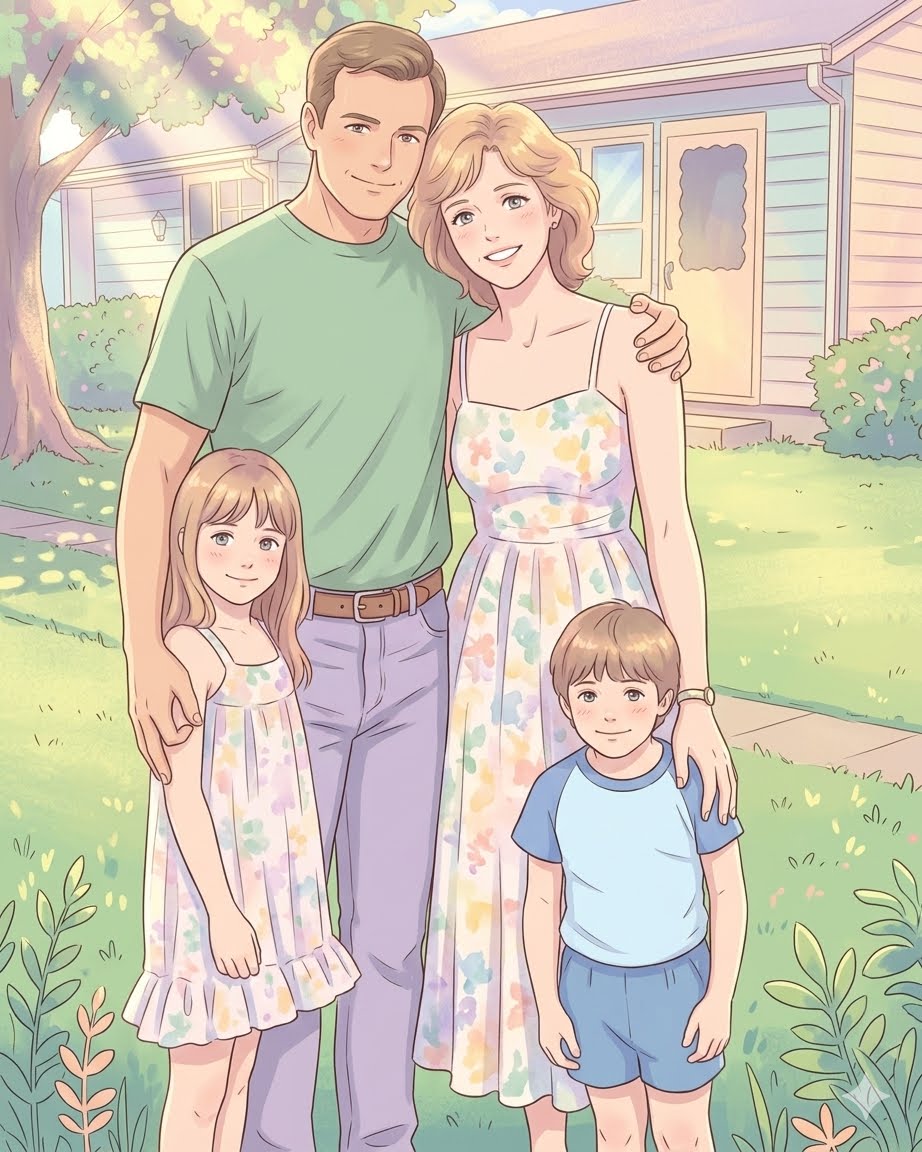
For forty years, I grieved a family I believed I had lost in a single, catastrophic night. When declining health finally forced me to clear out the rooms I had preserved like pristine shrines, I uncovered proof that shattered everything I knew—pointing to a calculated betrayal much closer to home than I had ever dared to imagine.That morning, my nephew Jackson arrived carrying twelve empty moving boxes and zero patience for my excuses. “You were on the kitchen floor for three hours yesterday, Uncle Andrew,” he said, setting the cardboard down with a heavy thud. “Two and a half,” I corrected softly. He stared at me, his expression unyielding. “That exact correction is why you can no longer live alone.” “I slipped.” “And you couldn’t reach your phone. The doctor said next time, you could be stuck down there overnight.” At seventy-three, I knew Jackson was right. He wanted me to sell the house and move in with his family. I had agreed, but under one unnegotiable condition. “Nothing gets thrown away without my explicit permission,” I warned. “Fine. You still have paper receipts from 1989.” “Paper remembers better than people do.” Jackson lifted the first box. “Where do we start?” “Shaun’s room.” My son had been just six years old when he disappeared. His toy cars and faded blue blanket remained exactly where he had left them four decades ago. I walked over to his nightstand, picked up the silver wind-up watch resting beside his lamp, and turned the crown. Jackson watched me in quiet sorrow. “Does that thing still run?” “It loses four minutes every single day.” “Then why keep winding it?” “Because Shaun hated it when it stopped.” I carefully slipped the watch into my pocket.
Next, we stepped into my daughter Aria’s room. She had been nine. She used to love sewing tiny dresses for her dolls, though every stitch ran crooked because she always pulled the thread too tightly. Her unfinished wooden dollhouse still sat beside the window, its front door hanging off its hinges.
“Don’t touch that,” I warned as Jackson approached it.
“You’ve had forty years to fix that door, Uncle Andrew.”
“I know.”
My knees suddenly gave out, and I sank heavily onto Aria’s twin bed.
A sharp, structural CRACK echoed beneath me.
Jackson looked over sharply. “Was that the bed frame?”
“No.”
“How can you be so sure?”
“I repaired furniture for forty-five years,” I said, pressing my hand against the fabric. “That sound came from inside the mattress.”
We flipped the heavy mattress over and found a tightly sewn seam running along the bottom with uneven, frantic stitches.
“Aria did this,” I whispered. “She always pulled the thread too tight.”
I used a pair of scissors to cut the thread, reached deep into the foam, and pulled out a wooden box coated in forty years of dust.
Inside lay several photographs, a letter written by my sister-in-law Gwen, a birthday card, and two folded notes.
The photographs depicted me standing beside a female colleague from my former firm. In one shot, my hand rested casually on her arm; in another, we were walking into a diner together. I immediately recognized the images and understood how damning they looked out of context.
But it was Clara’s handwriting on the first page that stole the air right out of my lungs:
“Andrew, if you’re reading this, something has happened to me. Read everything carefully. Don’t trust Gwen. There’s something you never knew.”
The note abruptly cut off. Beneath it lay a second page, written in jagged purple crayon:
“Daddy, I hid Mommy’s letter because I didn’t want you to be mad. I’m sorry. Please don’t let her leave.”
I read those painful words three times, my hands trembling.
Jackson sat beside me on the floor. “Aria hid the box.”
“She thought Clara was abandoning me,” I whispered, tears blurring my vision.
He picked up the surveillance-style photographs. “Who is this woman, Uncle Andrew?”
“Someone I used to work with.”
“Was there an affair?”
“I never touched her.”
“I didn’t accuse you—”
“Your face did.” I took a deep breath. “Then let me explain.”
The woman in the photos was named Sarah. She was terrified of losing her job after experiencing severe corporate harassment, and she had begged me to meet her in private to review her options.
“Did Clara know?” Jackson asked.
“No. It wasn’t my secret to tell.”
“You could’ve told her enough to reassure her.”
I looked away, crushed by the weight of hindsight. Years ago, Clara had noticed my late hours and asked me directly: “Is there something you need to tell me, Andrew?”
And I had replied: “Nothing you need to worry about.” At the time, I believed staying silent was the honorable, professional thing to do. Now, I realized my noble silence had erected an insurmountable wall between us.
Jackson unfolded Gwen’s written letter. It contained detailed driving directions to her seaside house, suggesting Clara stop at a roadside motel halfway if the children grew tired.
Forty years ago, Clara had taken Aria and Shaun on that short trip. Work had consumed me, so they traveled alone. When Clara hadn’t called by nine that night, I had dialed Gwen in a panic.
“Is Clara there?”
“Andrew, they never arrived,” Gwen had said.
I had knocked my chair over rushing out the door. The police launched a massive search. The next day, they found Clara’s car sitting below a river bridge, its parking brake snapped after she pulled onto the shoulder. Divers found no bodies, but years later, a court legally declared all three of them dead.
Gwen’s old letter gave us the name of the roadside motel Clara might have stopped at.
“We’re going there,” I told Jackson, standing up.
“Not until you take your blood pressure medication,” Jackson insisted, grabbing my coat.
“I’ve already lost forty years, Jackson!”
“Then don’t collapse before you get your answers. I’m driving.”
The old roadside motel had long since been converted into low-income apartments. An elderly woman in the manager’s office studied Clara’s photograph carefully.
“I remember her,” the woman said softly. “Her little boy had a high fever. She kept trying to use the payphone to call her husband.”
I pulled out Gwen’s picture. “Did this woman show up?”
“Yes. They had a screaming match right in the lobby. Your wife wanted to turn around, go home, and demand the truth from her husband.”
“I am her husband,” I said, my voice cracking. “What did Gwen tell her?”
“She told your wife that you had already packed your bags and left town with another woman.”
A brutal, crushing pain tightened across my chest. “That was a complete lie.”
Jackson grabbed a chair. “Sit down, Uncle Andrew! Take a breath.”
“I need one more answer,” I rasped, turning back to the manager. “Did Clara leave with her willingly?”
“Yes,” the woman replied sad, “but she looked completely pale and dizzy when she got into the car.”
Part 2: The Lost Daughter
Once my breathing stabilized, Jackson drove me straight to Sarah’s house. I laid Gwen’s photographs on her kitchen table.
“Clara saw these,” I said softly.
All the color drained from Sarah’s face. “She thought we were having an affair?”
“She died believing it.”
Sarah rushed to her filing cabinet, pulling out employment records and legal logs proving every single photograph had been taken during documented, professional meetings.
She looked at me, tears in her eyes. “I told you to explain things to Clara, Andrew!”
“I couldn’t risk exposing your harassment case.”
“You could’ve protected my privacy without completely shutting your wife out!” Sarah cried. “You left a massive, empty void, Andrew. And Gwen filled it with poison.”
On the drive home, I stared out the window in absolute silence. I had mistaken stubborness for honor. Clara had asked me for simple reassurance, and I had answered with a stonewall silence that Gwen weaponized to destroy my family.
Back at the house, I unfolded Aria’s crayon note again. “She carried this immense guilt her entire life.”
“We don’t know that for sure,” Jackson said gently.
“A nine-year-old child who writes a note like this never forgets it,” I said.
My entire purpose shifted in an instant. I still wanted the full truth, but first, I had to find my daughter before she spent another single day believing she had destroyed our family.
Three days later, Jackson tracked down a public school counselor whose record matched Clara’s maiden name, the region, and Aria’s exact age. In her staff photograph, she held her left elbow with her right hand—the exact nervous habit Aria had as a little girl.
“That’s her,” I whispered.
“Because she looks like Clara?” Jackson asked.
“No. Because she looks like herself.”
Jackson offered to make the initial call, but I refused. I sat at my desk and drafted two emails—one felt too cold, the other too desperate. Finally, I typed from the heart:
“Aria, I don’t know what you were told forty years ago. I only know that I loved you the day you left, and I have loved you every single day since. I found the wooden box and the note you hid inside your mattress. Nothing that happened was the fault of a nine-year-old girl. I won’t push, and I won’t come see you unless you ask me to.”
I included my address and phone number, hit send, and prayed.
She called that exact night.
After a long, suffocating silence on the line, her trembling voice asked, “Did you really know where we were?”
“No, Aria. I had no idea.”
“You never came for us.”
“I didn’t know where to look.”
“Gwen told us you abandoned us for another woman.”
“She lied to you, sweetheart.”
I heard her draw a sharp, agonizing breath over the receiver. “Meet me tomorrow.”
“Where?”
“At the high school auditorium where I work. Come alone.”
The next afternoon, I walked into the quiet auditorium and found a mature woman obsessively straightening rows of chairs that were already perfectly aligned. For a fleeting second, I saw my nine-year-old girl.
She turned around and froze. “You came.”
“I promised I would.”
“Why did you stop looking for us?” she asked, her voice tight.
My immediate impulse was to defend my honor, but I checked myself and sat down in an aisle seat. “Tell me what you remember first, Aria.”
The floodgates opened. She remembered Clara sobbing at the motel while Gwen repeatedly insisted I had traded our family in for a new woman. She remembered Shaun crying, asking when I was going to arrive. After Clara’s car overheated near the bridge, Gwen drove them away in her own vehicle.
That very night, overwhelmed by stress, Clara suffered a massive, debilitating stroke that severely impaired her speech and memory. Gwen relocated them to another state under Clara’s maiden name, intercepted every piece of mail, and convinced the children that I knew where they were but simply didn’t care.
They lived completely off the grid. No one ever connected them to the family presumed drowned in the river.
“When I grew up, I remembered hiding that box in the mattress,” Aria whispered, her voice breaking. “I knew you never got Mommy’s note. I thought… I thought it was all my fault.”
“No, Aria—”
“I hid her letter! If I hadn’t hidden it, you would have saved us!”
“You were nine years old!” I shouted gently, tears streaming down my face. “Being nine doesn’t make you responsible for the cruelty of adults. I hid behind pride and silence. I am the one who failed.”
Aria covered her face, weeping uncontrollably. “I ruined our family.”
“The adults around you made toxic choices,” I said, stepping forward. “You didn’t make them for us.”
She slowly lowered her hands. “Did you really search for us?”
I opened my leather briefcase and laid four decades of evidence across the stage: police reports, private investigator invoices, newspaper clippings, and search logs. “I never stopped looking for a single day.”
Aria picked up a yellowed news clipping, stared at it, and then reached out and tightly took my hand.
Shaun initially refused to see me. I didn’t force him. Instead, I packaged up his silver watch and mailed it to his address with a simple note:
“It still loses four minutes a day. I kept winding it every Sunday anyway.”
Three days later, my phone rang.
“You really wound this thing every week for forty years?” Shaun’s deep voice asked.
“Every single Sunday.”
“Aria told me you showed her the investigation files.”
“I did.”
“Then you weren’t very good at searching,” he said, his voice cracking slightly.
“No,” I admitted softly. “I wasn’t.”
He fell silent for a long moment. “I don’t know how to call you ‘Dad.’”
“‘Andrew’ is fine until you’re ready.”
Just before hanging up, he asked, “Did you ever start another family?”
“No.”
“Why not?”
“Because I already had one.”
Part 3: Rebuilding the Ruin
Near the end of her life, Clara had briefly regained her faculties and stumbled upon a newspaper clipping detailing the memorial service I held at the river bridge every single year.
Realizing I had never abandoned them, she had secretly used a small tape recorder to leave a message, begging Gwen to reunite our children with me. Aria had discovered the cassette tape hidden in a box of Clara’s old belongings that Gwen had kept stashed away.
“Play it,” I told my children. “A peace built on a lie isn’t peace at all.”
Clara’s frail, static-filled voice echoed through the room:
“Aria… Shaun… Your father loved you deeply. Gwen believed she was protecting me, but fear is not the truth. I should have trusted Andrew enough to ask for the truth myself…”
Aria covered her mouth, sobbing softly.
Shaun stood in the doorway, his jaw clenched tightly. “Gwen told us you caused Mom’s stroke, Andrew. She said Mom collapsed because you chose another woman.”
My grip tightened around my wooden cane until my knuckles turned white.
“And after Mom struggled for years, Gwen said she lost the will to live because of your betrayal,” Aria added. “We blamed you for her death.”
I looked at both of my grown children with profound sorrow. “You were innocent kids trapped inside the only story an evil adult allowed you to hear.”
That evening, I placed a call to Gwen.
“I found Clara’s note,” I said cold.
“What do you want from me, Andrew?” she snapped defensive.
“You’ve spoken for my wife for forty years,” I replied. “Tomorrow night, you listen.”
The entire family gathered at my house the following evening. Gwen stood at the head of the dining table, her posture stiff and defiant.
“I did what Clara needed!” Gwen declared.
“No,” I said calmly. “You did what kept Clara completely dependent on you.”
“I protected her from a cheating husband!”
“You staged photographs, assumed the absolute worst, and then used a tragic car break-down to kidnap my family!” I shouted.
I turned to Aria and Shaun. “I failed your mother, too. When she asked me what I was hiding, I offered her prideful silence. I thought being physically faithful was enough.”
Gwen raised her chin arrogantly. “See? He admits it!”
I stepped directly into her space. “That silence was my failing, Gwen. But the forty years of calculated torture that followed were entirely your malicious choice.”
Aria stepped forward and placed Sarah’s certified legal records on the table. “Did Dad ever tell you he was leaving us, Aunt Gwen?”
Gwen swallowed hard. “No…”
“Did you know he spent his entire life savings searching for us?” Shaun asked, stepping up beside his sister, the old silver watch shining on his wrist.
Gwen lowered her eyes, unable to meet their gazes. “Eventually…”
“You let us hate an innocent man,” Shaun said, his voice laced with venom.
“I thought the truth would destroy you kids!” Gwen cried out.
“You had already destroyed us!” Shaun roared.
I picked up the tape player and hit play, letting Clara’s final words fill the room. When the recording finished, an absolute, damning silence fell over the house. Not a single person spoke in Gwen’s defense.
I picked up the recorder and looked Gwen dead in the eye. “You don’t get to speak for my dead wife anymore. You don’t get to manipulate my children. And you sure as hell don’t get to call abuse ‘love.’ Get out of my house.”
Epilogue: Fixing the Door
The next morning, Aria and Shaun met me at the high river bridge.
I walked up to the rusting guardrail and slowly untied the faded yellow ribbon I had replaced every single year on the anniversary of their disappearance.
“This was the terrible place I came to mourn you,” I said, letting the ribbon drop into my hand.
Shaun touched the silver watch on his wrist. “What happens now, Dad?”
I looked at my son, tears filling my eyes at the sound of the word. “Now… I stop grieving people who are standing right beside me.”
Back at the old house, Aria walked into her childhood bedroom and ran her fingers over the cut seam in the mattress. “I thought this seam ruined our lives.”
“No,” I said gently. “Insecure adults did that. You were just a little girl trying to protect her home.”
Shaun grabbed one end of the mattress. “Let’s throw this damn thing in the truck.”
After we carried it out, I walked over to Aria’s unfinished wooden dollhouse sitting by the window. Its front door still hung hopelessly crooked on its tiny metal hinges.
I pulled a small screwdriver from my pocket and reached down to fix it.
Aria gently laid her hand over mine. “It doesn’t have to be fixed all at once tonight, Dad.”
Shaun walked back into the room, pulling a second screwdriver from his pocket with a soft smile. “And you don’t have to fix it alone anymore.”
For forty years, I had grieved the ghost of a lost family. Aria and Shaun had returned to me carrying immense trauma, decades of stolen time, and deep emotional scars. But as I looked at my grown children standing in the warm light of the bedroom, I put my tools down.
We had a long road ahead—but this time, we were going to rebuild together.