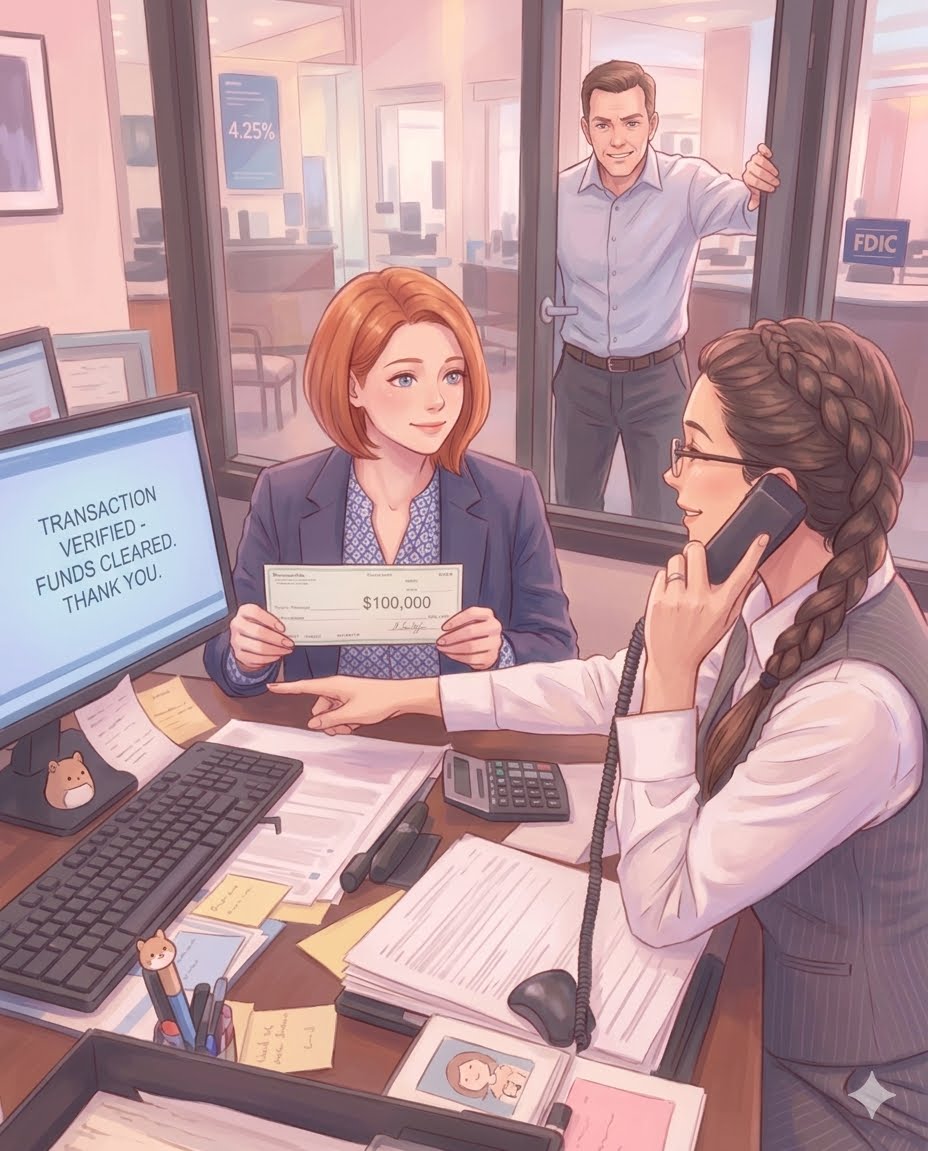
Six months earlier, my brother Cole had handed me a manila folder while I was helping our mother move. He claimed our grandfather needed an updated emergency contact form, assuring me my signature would merely allow me to speak with doctors if an unexpected medical crisis arose. Surrounded by taped boxes and distracted by the chaos of moving day, I signed two pages near the back without reading the full packet. I had always known Cole was reckless and self-absorbed. It had simply never occurred to me that he was also patient, calculated, and methodical. Grandpa remembered signing a nearly identical folder around the same time. Cole had persuaded him that the paperwork temporarily authorized him to assist with routine financial matters. Now, Detective Ortiz suspected that Cole had combined our signatures with stolen identification to manufacture legal authority neither of us had ever intended to give him. By the time I reached the bank branch, the manager had already frozen a fraudulent commercial account opened in my name. Cole had secretly unsealed the $100,000 birthday check Grandpa wrote to me, photographed it, and attempted to clear a duplicate mobile deposit before I even left the house. Worse, when I confronted him in Grandpa’s study, he locked us inside, struck me when I refused to hand over the original draft, and fled the property. That night, I stayed with my closest friend, Taryn—a corporate attorney who helped me draft an immediate triage strategy: freeze my credit reports, change every digital password, replace my state identification, preserve every text and voicemail, and stop discussing the investigation with anyone who might feed details back to my brother. My mother, Denise, called my phone incessantly. For most of our lives, Mom had translated Cole’s worst actions into a softer, blameless language. He hadn’t stolen—he had borrowed. He hadn’t lied—he had panicked. He hadn’t manipulated anyone—he was just struggling and needed a helping hand. When I finally answered her call, she tearfully informed me that Cole claimed I had physically attacked him in the study to hoard money Grandpa had intended for both of us to share. “Did he mention opening a fraudulent business account using my identity?” I asked quietly. Mom hesitated on the line. “He… he said there was a misunderstanding.” “A misunderstanding doesn’t require my Social Security number, Mom.” She begged me not to blow the situation out of proportion. “I’m not making it bigger,” I replied evenly. “I’m refusing to let him make it smaller.” The following morning, forensic investigators searched Grandpa’s home office. Nothing appeared tossed or broken, which made the crime even more chilling: whoever had taken his records knew the exact layout of his filing system. Several paper bank statements were missing. His desktop computer showed unauthorized remote logins from an unrecognized device, and his email had been silently configured to auto-forward any incoming messages containing words like bank, statement, transfer, or verification to an anonymous address. Then Grandpa uncovered old bank records showing recurring monthly payments of $3,850 to a firm called Northline Property Consulting. He had never hired such a company. State business filings revealed Cole as the sole owner. Over eighteen months, nearly $70,000 had been siphoned from Grandpa’s account to Northline for bogus maintenance on rental properties Grandpa had sold years ago. “I trusted him,” Grandpa whispered, staring at the paper trail. Cole had counted on that exact trust turning into paralyzing shame. He believed Grandpa would rather lose his savings than admit his own grandson had betrayed him. He believed I would stay silent out of fear because I had carelessly signed papers in the past. He believed Mom would protect him long before financial investigators could start asking uncomfortable questions. Detective Ortiz asked me to place a monitored, recorded call to my brother. Cole answered on the first ring. “Do you still have the check?” he demanded without greeting me. “Yes.” “Then bring it to me right now.” “What did I actually sign, Cole?” Silence stretched over the line for a long moment before he admitted the papers claimed Grandpa had authorized us to jointly manage specific family accounts. “If you involve the police,” he warned, his tone dropping into a sharp threat, “those documents make you just as guilty. You’re part of it.” He ordered me to bring him the original check immediately so he could shut down the fraudulent account and make the paper trail vanish. “Why did you use my name?” I asked, looking at Detective Ortiz, who nodded for me to keep him talking.
“Because your credit was clean,” he sneered coldly over the speaker. “And nobody ever believes you instead of me.”
This time, he was wrong.
Part 2: The Trap He Created for Himself
After the bank blocked the fraudulent deposit, Cole began circulating a vicious narrative among our relatives, claiming I had manipulated an aging man and attempted to steal his life savings.
Some family members called to question whether Grandpa was still mentally competent. Others suggested I should split the $100,000 check with Cole just to preserve family harmony. Almost no one asked what Cole had done to me in that locked study.
I issued a single, concise statement to the family group chat: Grandpa is safe. The bank uncovered severe financial fraud. Law enforcement is actively investigating. I will not discuss evidence privately. Then, I muted my notifications.
A deep pull of my credit report revealed three credit cards Cole had fraudulently opened in my name, carrying a combined balance of $26,000. The statements showed charges for high-stakes gambling, luxury hotels, and an expensive designer watch Cole had proudly worn to my birthday dinner.
A forensic accountant then discovered he had attempted to secure an equity loan against Grandpa’s home. If the $100,000 check had cleared into the fake account, Cole planned to use the balance to prove he possessed sufficient capital to secure the loan. The total potential loss exceeded $200,000.
Grandpa moved decisively: he officially revoked Cole’s status as alternate executor, canceled every legal authorization, secured his property title, and hired a locksmith to change every lock on the house.
Mom arrived while the locksmith was still working on the front door. “You’re locking out your own grandson?” she cried.
Grandpa looked at her with unshakeable resolve. “He weaponized Maren’s identity and mine. The question isn’t why I’m locking him out—it’s why we kept giving him keys.”
That was when Mom broke down and confessed that she had secretly handed Cole nearly $30,000 from her own retirement savings. He had terrified her with stories about dangerous debt collectors, convincing her that turning him down would put the entire family in peril.
For once, I did not rush to comfort her or absorb the damage.
Detective Ortiz arranged a controlled sting operation at Taryn’s law office. Grandpa instructed Cole to bring every document he claimed proved my involvement, promising that a color duplicate of the birthday check would be waiting in an envelope.
Cole arrived dressed in a sharp suit, wearing the luxury watch bought with my stolen credit. He laid forged authorization forms on the conference table, bearing my forged signature beside Grandpa’s.
“Give me the check,” he said, “and I’ll destroy these right now.”
“What about the fraudulent credit cards, Cole?” I asked. “Northline Property Consulting? The loan application against Grandpa’s house?”
His confident posture instantly collapsed. “You set me up.”
“No,” I replied. “I finally read what you put in front of me.”
Grandpa placed his hand firmly over the envelope on the table. “You stole from me, Cole.”
“I was going to repay it!” Cole insisted, his voice rising in panic.
“With what?”
“With the check you should have given me in the first place!”
A heavy silence fell over the room. Realizing the devastating admission he had just blurted out, Cole snatched the envelope, ripped it open, and discovered it contained only a worthless paper copy. He fled the office, leaving his forged documents behind.
Over the next forty-eight hours, Cole spiraled. He sent escalating threats, begged relatives to intercede, and promised Grandpa full repayment if we dropped the criminal charges.
Then, late one night, someone broke into Grandpa’s home.
Security cameras recorded Cole entering through a side door, walking straight to the office, and taking a laptop along with several boxes of tax files. He had no idea investigators had installed a covert second camera, nor that the laptop contained no sensitive data.
Hours later, someone broke into my parked car outside Taryn’s house, leaving a duffel bag on the passenger seat containing Grandpa’s missing checkbooks, forged agreements, and a fraudulent credit card issued in my name. Cole was attempting to frame me for his entire criminal operation.
Subsequent search warrants executed at Cole’s apartment uncovered counterfeit notary stamps, physical copies of my personal identification, gambling ledgers, Grandpa’s missing bank records, and a printed spreadsheet listing relatives he believed he could manipulate.
Beside my name, he had typed three brutal lines: Clean credit. Responds to guilt. Likely to cooperate if Mom calls.
My lifelong love for my brother had been calculated down to a strategic vulnerability in a spreadsheet.
Part 3: When the Family Stopped Protecting Him
Grandpa refused to cancel his annual birthday lunch.
Before the food was served, he calmly informed the gathered relatives that the bank had exposed severe financial fraud, that accounts had been opened in my name without my consent, and that large sums had been stolen from his accounts.
Right on cue, Cole walked through the door. He immediately pointed at me, loudly accusing me of plotting the entire scheme to secure the full inheritance for myself.
For the first time in my life, Mom stepped directly between us, blocking his path. “Did you ask me to lie and tell everyone Maren stole Grandpa’s checkbook?” she demanded, her voice trembling with anger.
Cole stumbled over his words, claiming he had only acted to protect the family estate. Then he pivoted, asserting to the room that I had explicitly given him permission to use my credit and identity.
I pulled out my phone and played the recorded call.
His amplified voice filled the dining room: “Because yours was clean.”
Then came the arrogant phrase he had relied on for years: “Nobody ever believes you instead of me.”
Cole lunged toward my phone, but plainclothes officers waiting in the adjacent room stepped in, restraining him instantly. As they handcuffed him and led him out, he screamed that I had destroyed our family.
“No,” I said, looking him dead in the eye. “I stopped you from destroying what was left of it.”
For the first time in his life, not a single family member followed him out the door.
The financial investigation ultimately traced $214,600 in stolen funds, unauthorized credit lines, and fraudulent loan applications. The prosecution built an airtight case composed of forged documents, digital bank logs, security camera footage, recovered physical evidence, and Cole’s recorded admissions.
He called Mom from county custody, begging her to post his bail. She listened quietly for a moment.
“I love you,” she said softly. “But I will not rescue you from this.” Then she hung up the phone.
Months later, Cole agreed to a comprehensive plea deal, accepting legal responsibility for fraud, identity theft, financial exploitation, forgery, breaking and entering, and related felony counts. He received a multi-year prison sentence, heavy financial restitution orders, and strict protective mandates prohibiting him from ever contacting Grandpa or me.
At his sentencing hearing, Cole offered a statement of apology. But near the end, he couldn’t stop himself from adding that none of this would have happened if Grandpa had simply divided his estate fairly among the grandchildren. Even in a federal courtroom, his apology carried an excuse.
When I stepped up to address the judge, I explained that the true destruction went far beyond stolen money or ruined credit scores. It was the horrific realization that my brother had studied our empathy and converted it into a predatory financial strategy.
“For years, I protected him from the consequences of his actions and called it love,” I told the court. “It wasn’t love. It was permission.”
Epilogue: Built on Truth
The bank eventually reissued Grandpa’s original $100,000 gift.
I used a portion of the funds to launch the architectural restoration studio I had dreamed about for six years—a project I had repeatedly put on hold because Cole always had another manufactured emergency that demanded my time and money.
The very first piece of work I framed and hung on the studio wall wasn’t the check or my business license. It was a photograph of Grandpa standing beside me on opening day. Mom had taken the picture.
Our relationship rebuilt itself slowly, brick by brick. She attended therapy, coming to understand how decades of enabling Cole had allowed him to devastate the rest of the family. Most importantly, she offered me a genuine, unreserved apology without demanding immediate forgiveness in return.
A year into his sentence, Cole sent me a letter through his defense attorney. He claimed he had found perspective behind bars and hoped we could rebuild our bond as siblings one day. Near the bottom of the page, he asked if I would speak to Grandpa about restoring his portion of the family inheritance.
I folded the letter, placed it in a desk drawer, and closed it.
Perhaps he will genuinely reform one day, but his redemption is no longer my burden to carry. Forgiveness does not mandate access. Love does not require self-surrender.
On my thirty-first birthday, Grandpa handed me a plain white envelope. Inside was a card containing a single hand-written line:
“The best thing you built this year was a life nobody else controls.”
I kept that card on my desk.
The money changed my financial future, but the truth transformed who I was. Sometimes, truly protecting a family requires refusing to protect the person who actively destroys it from within.