
PART 1: THE ACCOUNT IN MY NAME
Six months earlier, my brother Cole had handed me a folder while I was helping our mother move.
He claimed our grandfather needed updated emergency contacts and said my signature would merely allow me to speak with doctors if something happened. Surrounded by boxes and distracted by the move, I signed two pages without reading the entire packet.
I had always considered Cole reckless and selfish.
It had never occurred to me that he might also be patient and methodical.
Grandpa remembered signing a similar folder. Cole had told him the documents temporarily authorized him to assist with financial matters.
Now Detective Ortiz suspected that Cole had combined our signatures with stolen identification to create authority neither of us had intended to give him.
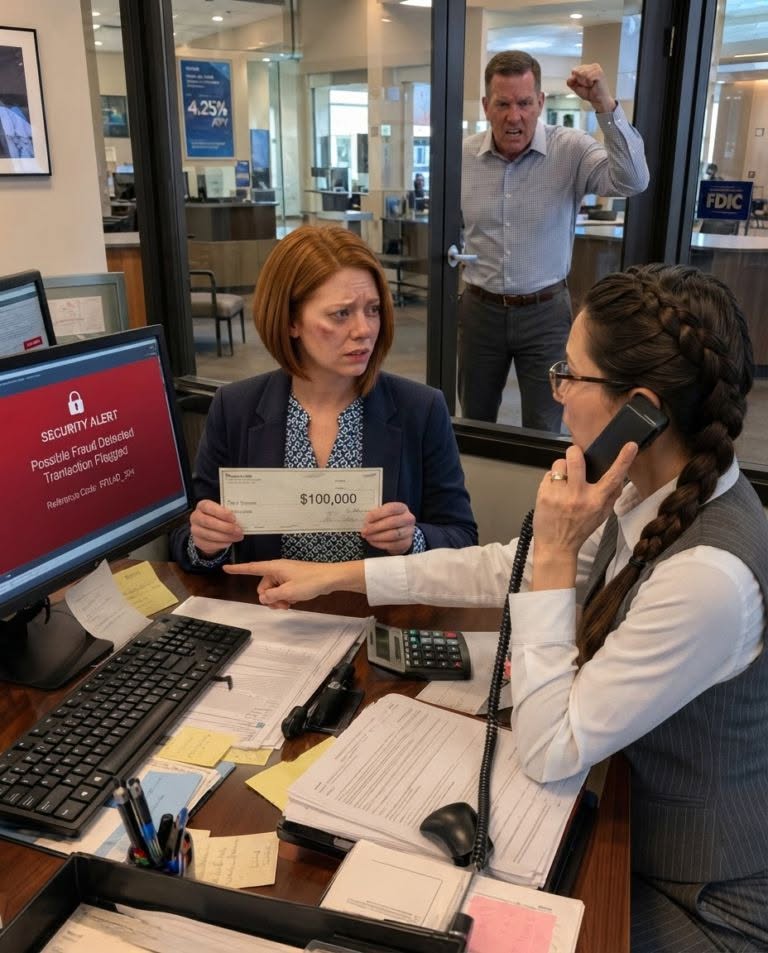
The bank had already frozen a fraudulent account opened in my name. Cole had photographed a $100,000 birthday check Grandpa had written to me and attempted to deposit a duplicate image before I reached the bank.
Worse, when I confronted him, he locked me inside a room and struck me before escaping.
That night, I stayed with my closest friend, Taryn, an attorney who helped me create an immediate protection list.
Freeze my credit.
Change every password.
Replace my identification.
Preserve every message.
Stop discussing the investigation with anyone who might report information back to Cole.
My mother, Denise, called repeatedly.
For most of our lives, she had translated Cole’s actions into softer language. He had not stolen—he had borrowed. He had not lied—he had panicked. He had not manipulated anyone—he had simply needed help.
When I finally answered, she told me Cole claimed I had attacked him and tried to keep money that Grandpa intended for both of us.
“Did he mention opening an account in my name?” I asked.
Mom hesitated.
“He said there was a misunderstanding.”
“A misunderstanding does not require my Social Security number.”
She begged me not to make the situation bigger.
“I’m not making it bigger,” I replied. “I’m refusing to make it smaller.”
The following morning, investigators searched Grandpa’s office.
Nothing appeared damaged, which made the discovery even more disturbing. Whoever had taken his records knew exactly where everything was kept.
Several bank statements were missing. His computer showed logins from an unfamiliar device. His email automatically forwarded messages containing words such as bank, statement, transfer, and verification to an unknown address.
Then Grandpa found old check records showing monthly payments of $3,850 to Northline Property Consulting.
He had never hired that company.
Business records identified Cole as its owner.
Over eighteen months, nearly $70,000 had been transferred from Grandpa’s account to Northline for supposed maintenance on rental properties he had sold years earlier.
“I trusted him,” Grandpa whispered.
Cole had counted on that trust becoming shame.
He believed Grandpa would rather lose money than admit his own grandson had deceived him. He believed I would remain quiet because I had signed papers carelessly. He believed Mom would protect him before investigators could ask difficult questions.
Detective Ortiz asked me to make a recorded call.
Cole answered immediately.
“Do you still have the check?” he demanded.
“Yes.”
“Then bring it to me.”
“What did I sign, Cole?”
After a pause, he admitted the papers claimed Grandpa had authorized us to manage certain funds.
“If you involve the police,” he warned, “those documents make you part of it.”
He told me to bring the original check so he could close the fraudulent account and make the paperwork disappear.
“Why did you use my name?”
“Because your credit was clean,” he replied. “And nobody ever believes you instead of me.”
This time, he was wrong.
PART 2: THE TRAP HE CREATED FOR HIMSELF
After the bank blocked the money, Cole began telling relatives that I had manipulated Grandpa and attempted to steal his savings.
Some family members asked whether Grandpa was still competent. Others said I should divide the check to preserve peace.
Almost no one asked what Cole had done to me.
I sent one statement to everyone:
Grandpa was safe. The bank had discovered suspected fraud. Law enforcement was investigating. I would not discuss evidence privately.
Then I turned off my notifications.
My credit report revealed three cards Cole had opened in my name. Their balances totaled $26,000.
The cards had paid for gambling, hotels, and an expensive watch Cole proudly wore to my birthday dinner.
A forensic accountant discovered that he had also tried to obtain credit against Grandpa’s house.
If the birthday check had reached the fake account, Cole planned to use it as proof that he possessed enough money to secure the loan.
The total possible loss exceeded $200,000.
Grandpa immediately removed Cole as alternate executor, canceled every financial authorization, protected his property title, and changed the locks.
Mom arrived while the locksmith was working.
“You’re locking out your own grandson?” she asked.
Grandpa looked at her steadily.
“He used Maren’s identity and mine. The question is not why I’m locking him out. It is why we kept giving him keys.”
Then Mom admitted that she had secretly given Cole nearly $30,000 from her retirement savings.
He had frightened her with stories about dangerous debts and convinced her that refusing him would place the family at risk.
For once, I did not rush to rescue her from the consequences of protecting him.
Detective Ortiz arranged a controlled meeting at Taryn’s office. Grandpa told Cole to bring every document he claimed made me responsible. A harmless copy of the birthday check would be placed inside an envelope.
Cole arrived wearing a suit and the luxury watch purchased with my stolen credit.
He placed forged documents on the table bearing my signature and Grandpa’s.
“Give me the check,” he said, “and I’ll destroy these.”
“What about the credit cards?” I asked. “Northline? The loan against Grandpa’s house?”
His confident expression disappeared.
“You set me up.”
“No. I finally read what you placed in front of me.”
Grandpa put his hand on the envelope.
“You stole from me.”
“I was going to repay it,” Cole insisted.
“With what?”
“With the check you should have given me!”
The room became silent.
Realizing what he had admitted, Cole grabbed the envelope, opened it, and discovered only a copy.
He fled, leaving the forged papers behind.
Over the next two days, he sent threats, begged relatives to defend him, and promised Grandpa repayment if we withdrew our statements.
Then someone entered Grandpa’s house late at night.
Security cameras recorded Cole going directly to the office and taking a laptop and document boxes.
He did not know investigators had installed a second camera inside the room or that the laptop contained nothing important.
Hours later, someone entered my parked car and left a bag containing Grandpa’s missing checks, fraudulent papers, and a credit card opened in my name.
Cole was attempting to frame me for his crimes.
Search warrants later uncovered counterfeit stamps, copies of my identification, gambling records, Grandpa’s missing statements, and a spreadsheet listing relatives he believed he could pressure.
Beside my name, he had written:
Clean credit. Responds to guilt. Likely to cooperate if Mom calls.
My love for my brother had been reduced to a weakness in a spreadsheet.
PART 3: WHEN THE FAMILY STOPPED PROTECTING HIM
Grandpa refused to cancel his birthday lunch.
Before the meal, he calmly told the family that the bank had uncovered fraud, accounts had been opened in my name, and money had been taken from his.
Then Cole walked through the door.
He immediately accused me of planning everything because I wanted the full inheritance.
For the first time in my life, Mom stood between us.
“Did you ask me to tell everyone Maren stole Grandpa’s checkbook?” she demanded.
Cole claimed he had only been protecting the family.
Then he told everyone I had given him permission to use my identity.
I played the recorded call.
His voice filled the room:
“Because yours was clean.”
Then came the sentence he had relied on for years:
“Nobody ever believes you over me.”
Cole moved toward my phone, but officers waiting nearby entered and stopped him.
As they escorted him out, he shouted that I had destroyed the family.
“No,” I replied. “I stopped you from destroying what remained of it.”
For the first time, nobody followed him.
The investigation eventually traced $214,600 in stolen money, fraudulent credit, and attempted loans.
The evidence included forged documents, digital bank records, security footage, stolen identification, and Cole’s recorded admissions.
He called Mom from custody and asked her to arrange his release.
She listened briefly.
“I love you,” she said. “But I will not rescue you from this.”
Then she ended the call.
Months later, Cole accepted responsibility for fraud, identity theft, financial exploitation, forgery, unlawful entry, and related conduct. He received several years in custody, restitution obligations, and restrictions preventing him from contacting Grandpa or me directly.
At sentencing, he apologized.
Then he claimed none of it would have happened if Grandpa had divided the money fairly.
His apology still contained an excuse.
When I addressed the court, I explained that the deepest damage was not the money or my damaged credit.
It was discovering that my brother had studied our compassion and transformed it into a financial strategy.
“For years, I protected him from consequences and called it love,” I said. “It was not love. It was permission.”
The bank later reissued Grandpa’s original gift.
I used part of the money to open the restoration studio I had dreamed about for six years but repeatedly postponed because Cole always had another emergency.
The first thing I framed was not the check.
It was a photograph of Grandpa standing beside me on opening day.
Mom took the picture.
Our relationship recovered slowly. She attended counseling and learned that protecting Cole had allowed him to harm the rest of us. Most importantly, she apologized without demanding immediate forgiveness.
A year later, Cole sent me a letter through his attorney.
He claimed he had changed and hoped we could become siblings again someday.
Near the end, he asked me to convince Grandpa to restore part of his inheritance.
I folded the letter and placed it in a drawer.
Perhaps he will genuinely change one day.
But his rehabilitation is no longer my responsibility.
Forgiveness does not automatically mean access.
Love does not require surrender.
On my thirty-first birthday, Grandpa handed me a plain envelope. Inside was a card containing one sentence:
“The best thing you built this year was a life nobody else controls.”
I kept that card.
The money changed my future, but the truth changed me more.
Sometimes protecting a family means refusing to protect the person who continues harming it.