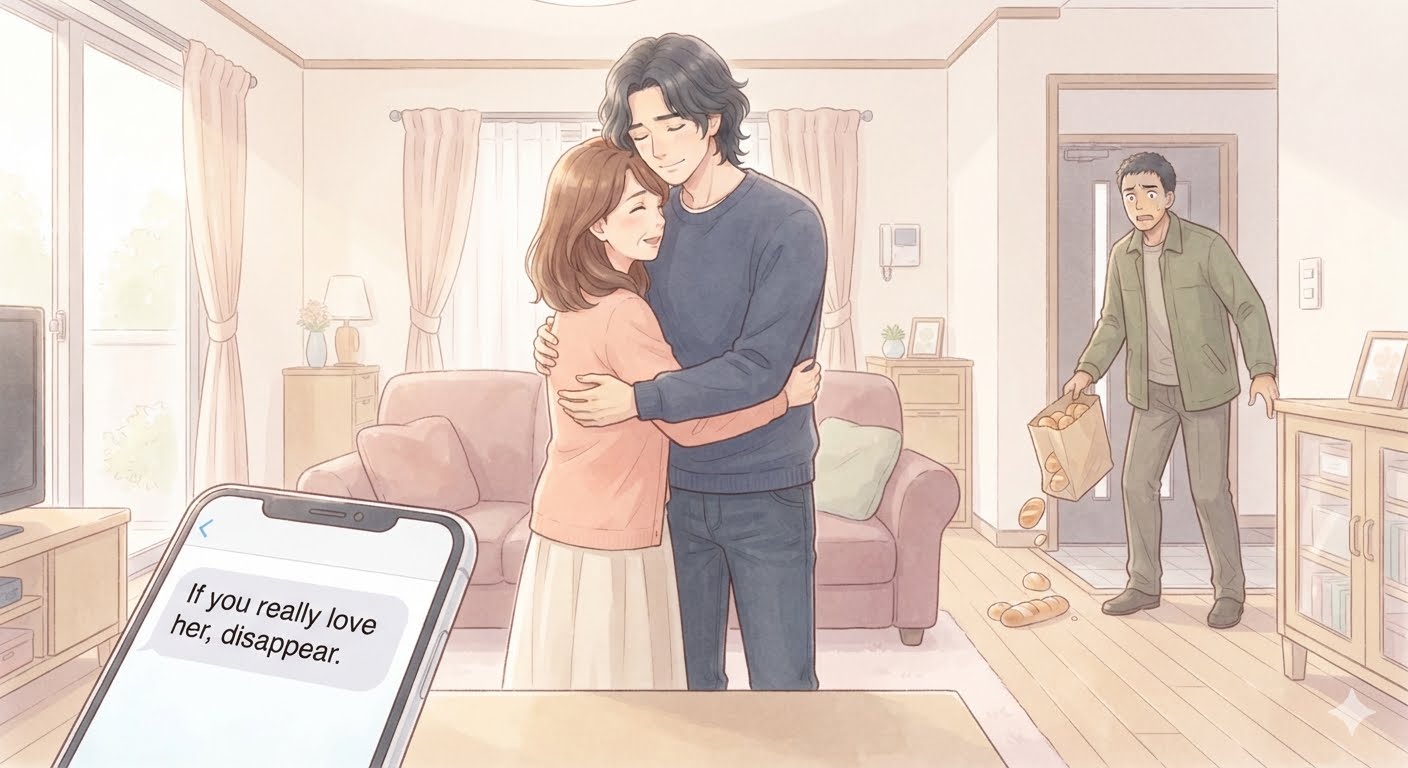
The knock came just after sunrise—sharp and persistent enough to pull me away from the quiet of the kitchen. I nearly ignored it. My husband, Marcus, had already stepped out for his morning walk, and we never had visitors that early. But when I pulled the front door open, the breath caught in my throat. A tall man in dark jeans and a simple navy sweater stood on my porch, his expression guarded and weary. Six years had matured his face, deepened his voice, and transformed the way he carried himself, but I recognized those eyes instantly. “Andrew?” I whispered, my eyes filling with tears as I reached out to embrace the son I hadn’t seen since his eighteenth birthday. He raised a single hand, stepping back just enough to stop me. He didn’t look angry—just tired. Then he looked past me into the empty hallway and said, “I came back because Marcus needs to tell you the truth.” Andrew stepped inside but refused to sit down. He stood stiffly near the center of the living room, hovering as if he might need to run at a moment’s notice. Looking at him, my mind flashed back six years to the night he vanished. I had spent nearly $180 on his eighteenth birthday dinner, hanging decorations and baking the elaborate chocolate cake he loved, desperately hoping the celebration would ease the mounting tension between him and Marcus. Andrew had come downstairs that evening glowing with quiet confidence, wearing polished boots, tailored black slacks, and a flowing burgundy blouse that made him feel like himself. I had hugged him and told him he looked wonderful. Marcus, however, spent the entire dinner picking at him. By the end of the meal, Marcus looked him in the eye and suggested that joining the military might finally turn him into “a real man.” The entire table had gone dead silent. I remember the way Andrew turned to me, his eyes pleading, waiting for me to speak up and defend him. But I was so stunned, so paralyzed by fear of a scene, that I remained frozen in my chair. Later that night, Andrew walked out, leaving a brief note saying he loved me but could no longer survive in that house. In the weeks that followed, Marcus went through all the motions. He helped me hand out missing-person flyers and drove me to police stations. But whenever I broke down and wanted to keep searching, he would put a firm hand on my shoulder and insist that Andrew was an adult who had made his own choice to walk away. The front door unlocked, breaking the heavy silence.
Marcus walked into the foyer carrying a twelve-dollar paper bag of fresh bakery rolls from his walk. The moment his eyes fell on Andrew, he froze in his tracks.
The paper bag slipped from his fingers, scattering rolls across the floor. For the very first time in our marriage, I saw raw, unadulterated fear flash across my husband’s face.
Without saying a word, Andrew pulled out his phone, unlocked a saved screen, and handed it directly to me.
On it were text messages Marcus had sent to Andrew’s phone within minutes of his departure six years ago.
The first message claimed that I deserved a peaceful life without constant conflict. The second asserted that I was physically exhausted from having to defend Andrew every single day.
Then my eyes hit the message that made my hands begin to shake:
“If you really love her, disappear.”
Andrew spoke softly, his voice trembling slightly. He confessed that he had been sitting alone at a cold bus station that night, already feeling like a terrible burden, wondering if returning home would only bring me more pain. He told me he had typed out dozens of messages to me over the last six years, but deleted every single one before pressing send because he believed I was better off.
Then I scrolled down to the final message Marcus had sent before Andrew turned his phone off for good:
“If you come back, she’ll choose me—don’t make her say it to your face.”
A cold, heavy rage settled in my chest. I turned to Marcus, demanding to know how he could stand by and watch me spend six agonizing years baking Andrew’s favorite cake every birthday, and six lonely Christmases wrapping presents that sat unopened in the closet.
Marcus held up his hands, defensively claiming he had only been “protecting our family.” He insisted he truly believed Andrew would build a better life somewhere else.
Andrew looked at him with quiet dignity. “I never wanted special treatment, Marcus. I only wanted my home to feel safe.”
Even then, Marcus refused to take accountability, stubbornly insisting he had merely given an unhappy young man “a gentle push.”
I didn’t scream. I didn’t argue.
Instead, I walked down the hall, pulled our largest hard-shell suitcase out of the closet, brought it into the living room, and set it squarely at Marcus’s feet.
“You’re leaving today,” I said flatly.
When he began to protest and plead, I cut him off, reminding him that he had stolen six irreplaceable years from both me and my son.
By noon, I had already contacted a family law attorney, gathered the mortgage and insurance policies, reviewed our joint investment accounts, and compiled every estate document necessary to ensure he couldn’t manipulate the assets.
Seeing that there was no way back, Marcus finally packed his bags, muttered a hollow apology, and walked out the door. But his apology arrived six years too late to repair what he had deliberately destroyed.
After the door clicked shut, the silence in the house felt entirely different.
Andrew stood near the center of the room, looking around tentatively, unsure if he still had a place there.
I crossed the floor slowly, paused a foot away, and looked up at him. “Can I hug you now?”
His face softened for the very first time that morning. “You never had to ask, Mom.”
I wrapped my arms around him and held him tightly, weeping as I apologized for failing to stand beside him on the night he needed me most.
Andrew pulled back gently and reminded me that both of us had trusted a man who never deserved that trust. He said we couldn’t reclaim the lost years by punishing ourselves with guilt forever.
We spent the rest of the afternoon sitting at the kitchen table, talking openly about where he had lived, the work he had found, and the independent life he had built while carrying the heartbreaking belief that I was happier without him.
The house felt quieter after Marcus left, but it didn’t feel empty. My son was finally home, and though six years were gone, we still had a lifetime ahead of us to build the memories that should have been ours all along.