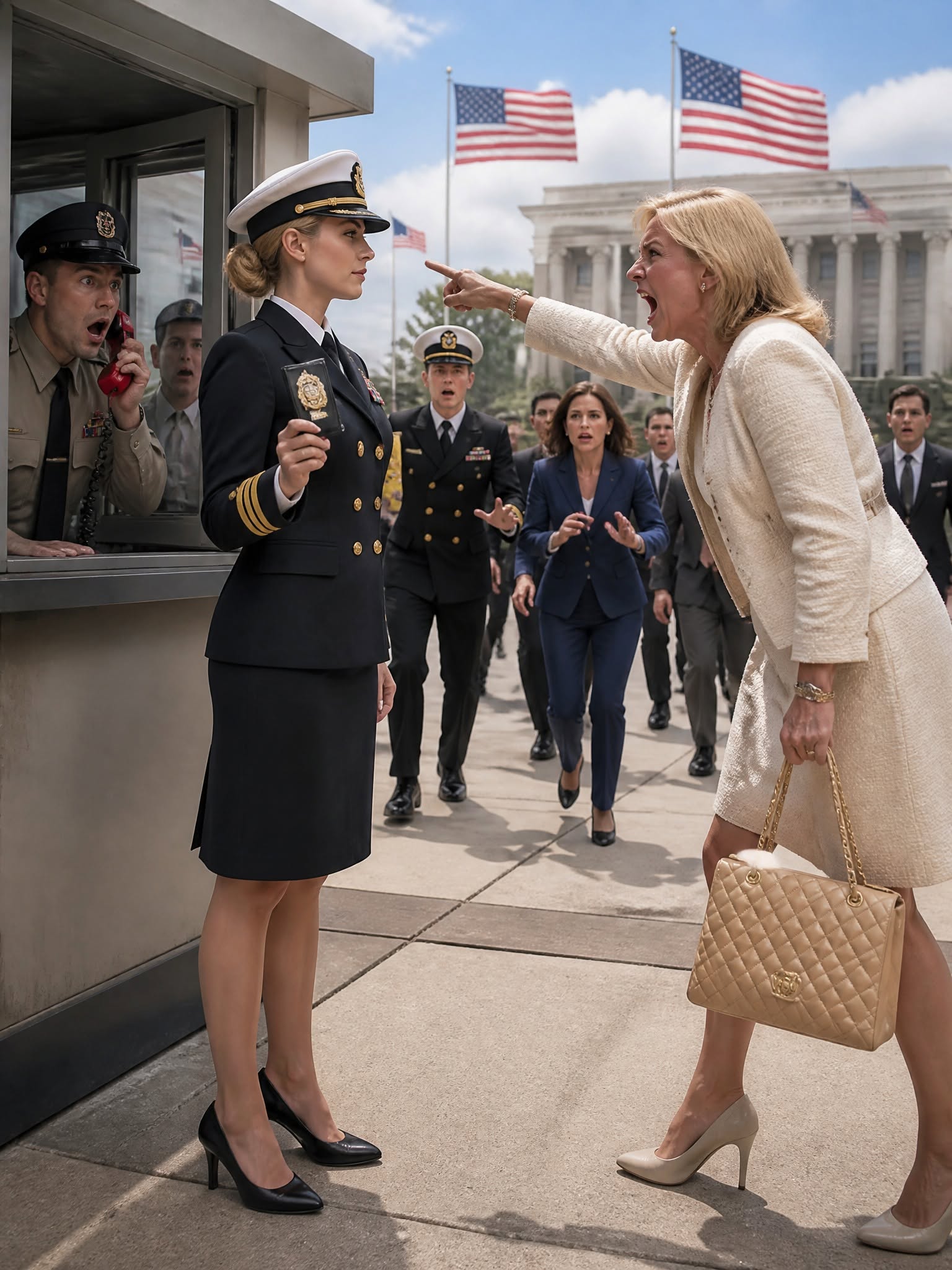
My mother laughed and told the base guard, “My daughter? No, she’s just my plus-one. Twenty years in uniform and she’s still just a desk clerk.” The guard looked at my security badge, read it twice, and went completely white. Ignoring her, he grabbed the emergency red phone and shouted: “Get the commander down here right now. We have an Admiral at the gate!”
Part 1: The Gate
The guard’s flashlight moved through the car one face at a time.
First my mother, Vivian Ross, stiff behind the wheel in a cloud of expensive perfume. Then my younger brother, Derek, lounging in the back seat in a charcoal suit he could not afford. Finally, the beam reached me.
My mother sighed as if my existence had delayed the United States Navy.
“My daughter?” she said. “No, she’s just my guest.”
She flicked two fingers toward me.
“She’s worn a uniform for years, but don’t let that impress you. She pushes papers in an office. Just check her card so we can get inside.”
The young sailor leaned closer.
I opened my handbag and removed the credential I had kept hidden beneath the lining. The plastic felt cool in my fingers.
The guard took it, lowered his flashlight, and read my name.
Then the beam reached the gold seal.
His expression changed instantly. Color drained from his face. His shoulders locked. His mouth opened, but no sound came out.
My mother tapped the steering wheel.
“Well?”
The guard stumbled back, struck his heels together, and snapped into a salute so sharp it echoed off the security booth.
Derek sat forward.
“What is he doing?”
The guard rushed inside, grabbed a red phone, and shouted, “Flag officer at the main gate. Repeat, flag officer on site. Initiate protocol escort immediately.”
My mother laughed.
“You’ve made a mistake.”
He had not.
But my mother had been making the same one for more than thirty years.
The first time I understood I was invisible, I was ten. My father, Arthur Ross, worked as a shipyard welder and believed value had to be solid.
“If you can’t hold it,” he used to say, “it isn’t worth much.”
For the county science fair, I built a guided-missile destroyer model from scrap metal, old wiring, and pieces I found near the shipyard. I spent six weeks in the garage, burned two fingers, ruined one of my mother’s baking pans, and won first place.
When I showed my father the certificate, he looked at the ship, then the paper.
Then he grunted and returned to filing a piece of steel.
Three minutes later, Derek burst in with a plastic trophy for finishing third in a children’s race. My mother screamed with delight, kissed him, called relatives, and placed the trophy on the refrigerator under the kitchen light.
My model stayed on the table until she told me to move it because it blocked the serving dishes.
That was our family.
Derek occupied the center of every picture.
I was the person holding the camera.
When our father died six years later, the pattern became permanent. At the funeral, Derek collapsed into our mother’s arms, and relatives whispered that he was the man of the family now.
I stood behind a stone column correcting an error in the burial invoice.
The funeral home had charged us twice. The hospital had unpaid bills. The cemetery had recorded the wrong plot.
While everyone watched Derek grieve, I kept my father from being buried in the wrong place.
That night, I wrote sixty-one thank-you cards.
At six the next morning, my mother swept them into the trash.
“I need the counter cleared,” she said. “I’m putting Derek’s trophies here.”
Something inside me went very quiet.
Two years later, I came home with an envelope from the United States Naval Academy.
What my mother did with that letter would shape the next three decades of my life—and the credential now trembling in the gate guard’s hand.

Part 2: The Appointment Letter
My mother opened the Naval Academy envelope with a butter knife.
I stood across the kitchen table, hands clasped behind my back so they would not shake.
The letter offered me a full appointment: education, military training, and a future I had wanted before I dared to say it out loud.
I had run before sunrise for five months. I did push-ups in the garage until sweat darkened the concrete. I studied chemistry after Derek slept because he said turning pages distracted him from television.
My mother read the first paragraph twice.
For one dangerous second, I thought she might be proud.
Then she dropped the letter.
“So the Navy is going to teach you to answer telephones?”
“It’s the Naval Academy.”
“I can read.”
Derek stretched across the couch with a game controller.
“Maybe she’ll command the staplers.”
My mother laughed.
I looked down at the appointment letter.
“They selected me from thousands of applicants.”
“And what do you expect us to do? Throw a parade?”
“No.”
“Good. Your brother has regional track trials next week, and that actually matters.”
Derek had not qualified. He was attending as an alternate.
We all knew it.
Facts had never mattered when Derek’s image was involved.
I folded the letter, slid it into my backpack, and zipped it shut. The sound stayed with me for years.
That night, I made a decision I mistook for maturity.
I would stop asking to be seen.
I would succeed quietly, demand nothing, and let my family believe whatever caused the least conflict.
At eighteen, I boarded a bus with one duffel bag and eighty-seven dollars.
My mother did not come.
Derek had a track banquet.
At the Academy, invisibility became useful. I learned to observe before speaking, measure rooms, read posture, and hear the question hidden beneath words. Pressure did not scare me. Pressure was standing at a kitchen table with the best news of your life while the person who raised you searched it for weaknesses.
I graduated near the top of my class.
My mother did not attend.
She said flights were too expensive, though a week earlier she paid for Derek and three friends to celebrate in Las Vegas.
I told people she was sick.
That lie was the first sandbag in a wall I spent thirty years building around her.
After commissioning, I volunteered for explosive ordnance disposal. People asked why. I gave respectable answers: service, challenge, protecting others.
The truth was simpler.
A bomb did not pretend to love you.
It did not smile while draining your bank account. It had a purpose, a mechanism, and a consequence. Study it carefully enough, and you could understand what it intended to do.
My mother told relatives I had become an administrative assistant.
I corrected her once.
She waved me away.
“All military jobs are paperwork eventually.”
So I stopped correcting her.
On my first overseas deployment, I called home every Sunday. She never asked where I was. She only talked about Derek.
Derek needed rent money. Derek needed a better car. Derek had an investment opportunity. Derek was sad because people did not respect his potential.
The first request was eight hundred dollars. I sent it. Then two thousand. I sent that too.
By the time I pulled a teammate from a burning vehicle with an unexploded device less than ten feet away, my family had already learned how to use me. That night, after doctors said he would survive, I found a message from my mother:
Derek needs $6,500 by Friday. Don’t make this difficult.
I sat on my cot, stared at dust floating in yellow light, and transferred the money.
What I did not know was that Derek had found the most profitable business of his life.
The product was me.

Part 3: Selling My Silence
Derek learned to sell my silence before he learned to sell anything else.
He called himself an entrepreneur. His company supposedly connected defense firms with government decision-makers. He had no military experience, no clearance, and no contracts.
What he had was confidence, expensive clothes, and a sister who never publicly contradicted him.
Whenever clients asked about military procurement, he hinted at family connections. He never said my name. He did not need to.
My mother helped.
“Derek has important contacts,” she told people. “Claire works somewhere in the same system, but nothing significant.”
By then, I was doing work I could not discuss.
At thirty-one, I led a team into a harbor before dawn to examine an object attached beneath an allied vessel. The water was brutally cold. Visibility was nearly gone. I moved by touch—metal hull above me, current pulling at my legs, equipment pressing against my chest.
The device was unfamiliar, built from mismatched parts. Improvised devices punish assumptions.
I stabilized the triggering assembly one movement at a time until it went inert beneath my hands.
When I surfaced, dawn had turned the horizon gray.
Someone handed me a phone sealed in plastic.
Seven messages from my mother.
The last said Derek needed fifteen thousand dollars for a luxury car deposit because investors expected him to look successful.
I laughed once under a steel-colored sky.
My senior chief, Miguel Santos, looked at me.
“Everything all right, ma’am?”
“Family issue.”
He nodded carefully, because family issue can hide anything from a missed birthday to a lifetime of damage.
I sent the money.
Over fifteen years, I gave them more than four hundred thousand dollars. I covered my mother’s mortgage, failed investments, Derek’s office rent, vehicle leases, legal bills, club dues, and temporary operating expenses.
Some money came from hazard pay—compensation for duties carrying an unusual chance of death.
My family used it for leather seats, private dinners, and imported tile.
I told myself I was buying peace.
I was financing contempt.
In the Navy, people knew what I could do. I advanced through ranks my mother never learned. I planned operations across commands, briefed leaders whose names appeared in newspapers, and signed orders moving ships, people, and equipment across oceans.
People stood when I entered certain rooms.
At home, my mother handed me empty plates while Derek explained national defense to relatives.
On Thanksgiving in 2023, Derek arrived in an Italian suit and a watch I had unknowingly paid for. He sat at the head of the table and began describing a classified project.
Then he mentioned Admiral Victor Lane.
My fork stopped.
Derek smiled at the relatives.
“Vic called me Tuesday. He needed my advice before a major operational decision.”
No one knew Admiral Lane had stood in front of my desk forty-eight hours earlier, waiting for my authorization.
No one knew he called me ma’am.
And Derek had just built his biggest lie on a man who reported directly to me.
I wanted to expose him.
One sentence would have done it.
Victor Lane reports to me.
Instead, I took a sip of water.
Years of discipline kept my face still.
My mother mistook my silence for weakness.
“Your brother works with admirals,” she told me. “Maybe he can help you get promoted out of whatever basement they keep you in.”
The table laughed.
Derek raised a hand like he was generously defending me.
“Claire’s job matters too. Someone has to organize the forms.”
I looked at each person in turn.
For years, I had called them relatives who did not understand.
That night, I saw they enjoyed the arrangement.
Derek’s superiority entertained them, and my humiliation cost them nothing.
I smiled.
“You’re right. Derek has extraordinary connections.”
His eyes narrowed.
After dinner, he followed me into the kitchen.
“What was that?”
“I agreed with you.”
He watched me.
“You don’t know Lane, do you?”
I dried my hands.
“Why would a paper clerk know an admiral?”
The answer satisfied him because he needed it to.
He smirked and left.
That was when I began keeping records.
Dates. Claims. Transfers. Company names. Amounts.
I did not yet know what I would do with them.
Collecting information was simply what I did when something dangerous entered my field of vision.
Part 4: The Invitation in the Trash
Three months later, I found a cream envelope in my mother’s kitchen trash.
The official seal caught the light.
I brushed off coffee grounds and pulled it free.
My full name was printed on the front:
Rear Admiral Claire M. Ross.
Inside was an engraved invitation to the International Explosive Ordnance Leadership Gala.
Guest of honor and keynote speaker.
I was still reading when my mother entered and snatched it from my hand.
“I threw that away.”
“Why?”
“Because it’s obviously fraudulent.”
She tapped Rear Admiral with one painted fingernail.
“They put fake titles on these things so foolish people will send money. You’ve worked in an office your whole career.”
I watched her crumple the edge.
“You never wondered whether you might be wrong about me?”
Her expression hardened.
“Don’t start pretending to be important.”
She tossed the invitation toward the trash. It missed and landed faceup on the floor.
Then she smiled and lifted her phone.
“Besides, Derek and I are attending that gala.”
The kitchen temperature seemed to change.
“How?”
“My book club friend knows a retired colonel. She secured two VIP tickets. Perfect place for Derek to meet investors.”
She looked me over.
“You can come as my guest. Wear something plain, carry my purse, and please don’t talk to senior officers. I won’t have you embarrassing us.”
I stared at the invitation between our shoes.
My mother believed she was bringing me into the room where I would be honored.
And for the first time in thirty years, I decided not to warn her.
For three weeks, she sent instructions.
Do not wear your uniform.
Choose a dark dress.
Do not mention your job unless directly asked.
Let Derek handle important conversations.
I answered one word each time.
Understood.
Privately, I confirmed my attendance with the gala protocol director.
He sounded relieved.
“We were concerned you hadn’t received the invitation, Admiral.”
“Mail problem.”
He offered a staff vehicle. I declined.
“In uniform?” he asked.
“No.”
Protocol officers dislike surprises.
This time, I allowed uncertainty to remain.
On gala night, I wore navy blue. The dress was simple, modest, and covered the scar on my left forearm. My hair was pinned in a regulation-tight bun from habit.
In my handbag, beneath tissues and a compact mirror, I placed my flag-officer credential.
My mother honked instead of coming to the door.
When I entered the car, her perfume filled my lungs. Derek sat in the back wearing a new watch.
“Finally,” my mother said.
I was two minutes early.
She glanced at my dress.
“That will do.”
Derek said, “Stay close tonight. If anyone asks about our family connection, don’t overcomplicate it.”
“What should I say?”
“That you work for the Navy.”
“I do.”
“In administration.”
I turned toward the window.
At the security complex, my mother announced, “We’re VIP guests. Vivian Ross and Derek Ross. We’re expected.”
The young guard scanned their passes.
“Identification for all occupants, please.”
Then he leaned toward my window.
My mother sighed.
“My daughter? No, just my guest. Low-level Navy job. Twenty years in uniform and still behind a desk. Just swipe her card so we can move along.”
The guard looked embarrassed.
Young sailors recognize cruelty, especially when rank or age prevents them from challenging it.
I opened my handbag.
For thirty years, I had helped my mother maintain a fiction because exposing it felt unkind.
That night, protecting her required humiliating myself in front of one of my own sailors.
I refused to pay that price.
I handed him the card.
His flashlight crossed my photograph, name, and rank.
Then it reached the gold flag-officer seal.
The guard froze.
“Ma’am?”
My mother leaned across the console.
“What is taking so long?”
He stepped back, struck his heels together, and saluted.
Then he rushed to the booth and grabbed the red phone.
“Flag officer at the main gate. Rear admiral on site. Initiate full escort protocol.”
My mother laughed too loudly.
“You have the wrong person!”
Then Master Chief Miguel Santos stepped into the floodlights.
He had served with me in two combat zones. I had once pulled him from a burning vehicle. Years later, he stood beside me when I received my first star.
He recognized me instantly, stopped six feet from the passenger side, and saluted.
“Rear Admiral Ross,” he said. “The entire command has been waiting for you.”
Behind me, Derek made a strangled sound.
“Rear admiral?”
Part 5: The Room Finally Sees
I returned Miguel’s salute.
“At ease, Master Chief.”
A black staff vehicle approached. Officers opened my door while my mother stared ahead like the world had become foreign.
The young guard returned my credential with both hands.
“Apologies for the delay, Admiral.”
“You followed procedure correctly.”
Relief softened his face.
I stepped onto the wet pavement.
My mother finally spoke.
“Claire.”
She had prepared speeches for every situation except this one.
Derek leaned forward.
“What kind of rear admiral?”
The question was absurd.
“The United States Navy kind,” I said.
My mother flinched.
“You never told us.”
“I did. You called the Academy letter a scam.”
“That invitation could have been anything.”
“My Academy letter?”
She had no answer that mattered.
A protocol officer checked a tablet.
“Mrs. Ross and Mr. Ross, your seating assignment is through the civilian entrance.”
“My son is a defense consultant,” my mother said. “He works with Admiral Lane.”
The officer’s expression remained polite.
“Your seating assignment is through the civilian entrance.”
I entered the staff car.
As we pulled away, I saw my mother and Derek still beneath the floodlights.
For once, no one was making their lives easier.
The gala hall overlooked the river. Marble floors reflected chandeliers. Allied flags hung above the stage. Dress uniforms filled the room with white, black, blue, and gold.
As I entered, an announcement sounded:
“Ladies and gentlemen, Rear Admiral Claire Ross.”
More than a thousand people rose.
The sound of chairs moving hit harder than applause.
For a second, I saw my ten-year-old self beside a metal model ship while my father looked away.
Then Admiral Raymond Keating approached, four stars on each shoulder.
“Claire, we thought you might make us send a search party.”
“Mail problem.”
He smiled.
A massive screen displayed my official portrait.
Below it:
Guest of Honor
Rear Admiral Claire M. Ross
Explosive Ordnance Disposal Command
I found my mother and Derek near the back, at a hastily arranged civilian table by a service corridor. My mother was pale. Derek stared at the screen like it was evidence at a trial.
Admiral Lane passed their table.
Derek half-rose.
“Vic.”
Lane kept walking.
Maybe he had not heard.
Maybe he assumed it was meant for someone else.
Derek slowly sat back down.
When dinner ended, I approached the podium.
I spoke about those who walked toward danger without expecting recognition: sailors in dark water, technicians whose families never understood their work, leaders who carried the names of the dead after ceremonies ended.
I did not mention my family.
Near the end, I looked toward their table.
“Silence can be discipline. It can protect operations and lives. But silence becomes destructive when it protects a lie. Humility does not require erasing yourself so someone else can pretend to be larger.”
My mother lowered her head.
Derek’s jaw tightened.
Afterward, officers lined up to greet me. Some had served under my command. Others had trained in programs I built. Several introduced me to spouses as the person who helped bring them home.
My family watched every exchange.
Admiral Lane eventually approached.
“Outstanding speech, ma’am.”
“Thank you, Vic.”
From the back table came the sharp sound of a glass hitting the table.
Lane followed my glance.
“Do you know those people?”
“My mother and brother.”
Recognition crossed his face.
“The consultant?”
“He has never consulted for me.”
Lane’s expression cooled.
That was the first crack in Derek’s business empire.
It would not be the last.
Later, Captain Elena Cruz intercepted me in a quiet corridor.
“How long?” she asked.
“How long what?”
“How long have you let them treat you like that?”
I looked away.
She stepped closer.
“I watched you stay calm while a device burned through steel three feet from your hands. But your mother insults you, and you disappear. That isn’t humility, Claire. It’s fear dressed in uniform.”
The words landed with brutal accuracy.
That night, I refused my mother’s ride home.
In the back of a staff car, I opened my banking app and reviewed every automatic payment supporting her and Derek.
Then I began pressing cancel.
Part 6: Support Ends
The confirmation tone sounded twelve times.
Mortgage assistance.
Canceled.
Derek’s office lease.
Canceled.
Vehicle payment.
Canceled.
Business credit line.
Canceled.
Sports car insurance.
Canceled.
Country club dues.
Canceled.
Each transaction vanished with a small electronic chime.
The sound was quiet.
The consequences would not be.
I wrote one email:
Effective at midnight, all financial support ends permanently. This decision is final. Do not contact my staff, my command, or anyone serving under me to change it.
I attached an unclassified summary of my service record: rank, commands, deployments, decorations, public assignments.
Not to impress them.
So they could never again claim confusion.
Then I turned off my phone.
For the first time in years, I slept without waking to check who needed money.
The collapse began before breakfast.
My mother’s credit card was declined at a hotel restaurant. It was tied to an account I had quietly replenished for eleven years.
Derek’s office manager discovered rent had not come from business revenue in eighteen months.
His sports car payment failed.
Then Admiral Lane’s aide clarified to one of Derek’s investors that Lane had no professional relationship with him.
That was enough.
Derek had built his career from implication. Public reception photos became private access. Handshakes became consultations. Shared charity rooms became strategic partnerships.
Without my money, the illusion had no structure.
Without my silence, it had no protection.
Camille called first, crying.
“Claire, something terrible is happening. Derek’s partners are backing out.”
“Did he lie about his contacts?”
“That isn’t the point.”
“It appears to be their point.”
She asked me to authorize the lie retroactively.
I said no.
She called me selfish, cruel, jealous.
None of it found a place to attach.
By noon, I had seventy-one missed calls from my mother.
I blocked her.
Three days later, Derek emailed with the subject line FAMILY EMERGENCY.
The emergency was that his employees expected to be paid.
I forwarded it to his accountant.
A week after the gala, my mother appeared at my command building with no appointment. She argued with reception and demanded security officers “remember their place.”
My aide called me.
“Admiral, your mother is downstairs.”
“Send her up.”
She entered my office with a leather handbag and the expression of a woman arriving to correct an employee.
She did not apologize for the checkpoint.
She did not congratulate me.
She closed the door and said, “One embarrassing evening does not give you permission to destroy this family.”
I folded my hands on the desk.
She had expected the daughter who absorbed everything.
That daughter was no longer in the room.
Part 7: Something You Can Hold
My mother remained standing.
“You humiliated Derek in front of military officials.”
“He humiliated himself.”
“He was trying to build a career.”
“By claiming relationships he did not have.”
“You could have supported him.”
“I gave him hundreds of thousands of dollars.”
Her lips tightened.
“That was family money.”
“No. It was my money.”
“You never needed it.”
The certainty in her voice was almost impressive. She had turned my generosity into communal property so completely that withdrawing it felt like theft.
Then she showed me a photo of Derek sitting in a dark room, head in his hands.
“He hasn’t eaten properly in days.”
“He is forty-six.”
“Camille may leave him.”
“That is between them.”
“The bank may take their home.”
“They can sell the car.”
She stared at me, realizing her usual weapons had missed.
Then she changed tactics.
“Your father would be disgusted by you.”
The sentence entered like smoke.
My father had been dead for more than thirty years, yet she still kept his memory sharpened for use against me.
“He believed in loyalty,” she said. “Family stood together.”
“He also believed value had to be something you could hold.”
“Exactly. What do you have, Claire? A title? A uniform? People who salute because they’re ordered to?”
I rose.
Behind my desk stood a secure cabinet. I entered the code and removed a crimson-edged folder.
Inside was the public citation for my Silver Star.
I placed it on the glass desk.
“Something you can hold.”
She read the citation slowly: contested waters, hostile fire, multiple explosive threats, eleven service members who survived because I remained after evacuation had been ordered.
The language was formal.
It did not mention the water temperature, blood in my glove, or the nineteen-year-old sailor asking whether he would die.
My mother’s hands trembled.
“You did this?”
“Yes.”
“When?”
“Eight years ago.”
“Why didn’t you tell me?”
“I sent you a copy.”
“I never received it.”
“You called the envelope military junk and told me not to waste postage.”
A tear slid down her cheek.
Once, that would have broken me.
Now I recognized the timing. She had not cried when she insulted me at the checkpoint. She cried when her certainty became impossible to maintain.
“You are not crying because you hurt me,” I said. “You are crying because you discovered I had value after you lost access to it.”
“That isn’t fair.”
“Neither was thirty years.”
She whispered, “I made mistakes.”
“A mistake is forgetting a birthday. You built an entire family around the belief that I was inferior, then used that belief to take from me.”
“I didn’t know.”
“You worked very hard not to know.”
For the first time, her regret looked genuine.
But genuine regret does not erase accumulated harm.
I pressed the intercom.
“My aide will escort you out.”
She looked up sharply.
“You’re throwing your own mother out?”
“I am ending this conversation.”
At the door, she asked, “What am I supposed to do about the house?”
“Speak to the bank.”
Her expression hardened again, revealing how shallow the remorse remained.
A month passed without contact.
Then, late one Sunday, a voicemail arrived from an unfamiliar number.
My mother sounded thin.
“I found something in your father’s toolbox.”
I nearly deleted it.
Then she added, “It has your name on it.”
Part 8: The Toolbox
I returned to the house on a cold Saturday morning because my father’s toolbox had remained unopened since his death.
The neighborhood looked smaller. The porch paint peeled. A PRICE REDUCED sign stood in the yard.
My mother had lost weight. Without jewelry and styled hair, she looked older than her seventy-two years. The hallway smelled of dust, cardboard, and stale coffee.
The living room was half-empty. Pale rectangles marked removed pictures. Derek’s trophies sat in an open box by the fireplace.
My father’s wooden toolbox rested on the kitchen table.
It was scarred, swollen from humidity, and coated in gray dust except where my mother had touched it.
Inside were hand tools wrapped in oily cloth. The smell of machine grease and pipe tobacco rose so clearly I almost expected to hear his boots.
On top lay a yellowed newspaper clipping.
It showed me at twenty-two in dress whites, standing at my commissioning ceremony.
Local Woman Begins Naval Career.
My father had died before that photo was taken.
Beneath it was an older clipping:
County Student Wins Science Award for Naval Engineering Model.
My ten-year-old face stared back.
Under that lay my original science-fair certificate.
The one I thought my mother had thrown away.
It had been laminated.
At the bottom, wrapped in an oil-stained rag, was a piece of steel bent into an anchor.
Five words were etched into it:
For Claire. Stronger than she knows.
The letters were uneven.
My father’s hand.
I sat down.
My mother cried softly.
“He did see you,” she said. “He just didn’t know how to say it.”
I held the anchor.
It should have comforted me.
Instead, anger rose through grief.
My father had seen me and chosen silence. He preserved my achievements in a box while letting me believe they meant nothing. Private pride protected him from vulnerability, but it did nothing for the child waiting three feet away.
Love hidden so completely the recipient cannot feel it is not generosity.
It is secrecy.
My mother reached across the table.
“Maybe this changes things.”
I pulled my hand away.
“It changes what I know about Dad.”
“And us?”
“No.”
She stared.
“He loved you.”
“He never told me.”
“He was a difficult man.”
“So were you.”
Her apology was quiet, without performance.
For the first time, I believed she meant it.
Believing an apology is not the same as granting access.
“I accept that you regret it,” I said. “But I am not restoring our relationship. I will not finance you, return to dinners, or pretend the past is repaired because you finally understand it.”
Her hope vanished.
As I reached the door, she said, “There’s something else.”
She held a long envelope from a law office closed more than twenty years ago.
Across the front, in my father’s handwriting:
For Claire’s education. Do not give this to Derek.
The seal had been broken.
Part 9: The Account
I carried the envelope back to the kitchen.
“Who opened this?”
My mother did not answer.
Inside were documents showing my father had created a small education account for me before his illness: overtime money, unused vacation pay, and proceeds from selling a fishing boat.
Original amount: twenty-eight thousand dollars.
Not a fortune.
But for a shipyard welder, years of sacrifice.
The final page was a withdrawal record.
The account had been emptied six weeks after I left for the Naval Academy.
The authorization carried my mother’s signature.
The funds went to an account held by her and Derek.
“What did you use it for?”
Her lips moved.
“Derek had an opportunity.”
“What opportunity?”
“Private coaching. Travel.”
“He quit track that year.”
“We didn’t know he would quit.”
The papers included my father’s clear instructions: books, uniforms, transportation, and any expenses not covered by my appointment. If unused, the rest was to be given to me at graduation.
My mother had not misunderstood my father.
She had taken the evidence, hidden it, and spent the money on Derek.
“Did Derek know where the money came from?”
Her answer was barely audible.
“Yes.”
Something inside me settled.
Derek had known before I entered the Academy. He watched me leave with eighty-seven dollars while he used my education fund for coaching, hotels, and equipment.
Years later, he accepted hundreds of thousands more.
He was not innocently spoiled.
He was an informed participant.
My phone buzzed.
Derek’s message read:
Mom says you found the papers. We need to talk before you make assumptions.
I showed her the screen.
“You told him I was here.”
“He deserves a chance to explain.”
“No. He deserves the results of his decisions.”
I called my attorney from the kitchen and requested a forensic review of every account connected to my transfers. I also asked whether the education fund presented legal options.
My mother looked frightened.
“You would take your own mother to court?”
“I’m establishing facts.”
“After everything I did raising you?”
“You mean feeding and housing the child you chose to have?”
Her face reddened.
“You’ve become cold.”
“No. I’ve become unavailable for exploitation.”
At the door, she said, “Your father would not want this.”
I looked back.
“My father wrote, ‘Do not give this to Derek.’ You ignored the only clear instruction he left.”
That afternoon, Derek came to my apartment without warning. Building security called from the lobby.
“He says it concerns your late father.”
“Tell him to leave.”
“He says he won’t.”
“Then have him removed.”
Ten minutes later, he sent a video message.
He stood outside in the wind, his expensive suit replaced by a wrinkled jacket.
“I know you hate me,” he said. “But the money isn’t the worst thing Mom hid from you.”
He held up a sealed military envelope dated fourteen years earlier.
Across the front was my name.
In the corner were the words:
Casualty Assistance Office.
Part 10: The Envelope No One Brought
I allowed Derek into the building.
Not my apartment.
We met in a private conference room beside the lobby. He placed the military envelope on the table. It had been opened and resealed with yellowed tape.
I did not touch it.
“Where did you get this?”
“Mom’s desk.”
“What is it?”
“You should read it.”
“No. Tell me why you have my mail.”
Fourteen years earlier, someone from my unit contacted my mother. The date matched my second major combat deployment, when a mission went wrong, two of my team died, and I spent eleven days in a military hospital with burns, a fractured wrist, and hearing damage.
I had told my family it was a minor training injury.
No one asked for details.
Derek said, “The casualty officer called. They said you were alive but seriously injured. They asked if Mom could travel.”
I remembered lying in a hospital room that smelled of disinfectant and scorched fabric.
Every footstep made me look toward the door.
No one came.
“What did she say?”
Derek’s eyes filled.
“She said there must be a mistake. She told them you worked in an office and couldn’t have been in an explosion.”
I opened the envelope.
Inside were formal notification papers, hospital contact information, and travel assistance forms. A handwritten note said multiple attempts to reach next of kin had been declined.
“You knew?”
“I heard part of the call.”
“And did nothing.”
“I was dealing with my business.”
“You were thirty-two.”
He winced.
He said he was jealous.
I waited.
“You were good at everything. Dad watched you even when you thought he didn’t. Mom said you thought you were better than us. It made me feel less afraid.”
“So you helped make me smaller.”
He nodded.
It was the first honest thing I had heard from him in years.
It did not earn forgiveness.
It clarified the injury.
“I’m going to repay what I can,” he said. “I sold the car. Camille is filing for divorce. I took a logistics job.”
“Good.”
“Could we start over someday?”
“No.”
His face tightened.
“Never?”
“We cannot start over. We have a history. I will not erase it so you can feel redeemed.”
He lowered his head.
“You may become a better man, Derek. You should. But you will do it without using me as proof that you changed.”
After he left, my attorney called.
The education account was beyond the normal filing period for a civil claim.
But the forensic review uncovered something current.
My mother had used my personal information three years earlier to guarantee one of Derek’s business loans.
Outstanding balance: $186,000.
The lender believed I had signed it.
Part 11: Correcting the Record
The signature was almost convincing.
My full name curved across the guarantee in dark blue ink. An outdated military ID and old address were attached.
The notary seal was false.
Derek claimed he never saw the guarantee.
My mother claimed she thought she had permission.
The bank records disagreed.
Loan proceeds entered Derek’s company account, then covered office rent, car payments, and personal credit cards.
My attorney advised me to report the fraud.
I did.
My mother sent a six-page letter.
Page one apologized.
The next five explained why everything was partly my fault.
I read it once and filed it.
Investigators interviewed Derek, Camille, my mother, and former employees. Derek eventually admitted he suspected the guarantee was not legitimate but chose not to ask.
My mother accepted a plea agreement avoiding prison because of her age, lack of prior offenses, and cooperation. She surrendered proceeds from the house sale, repaid part of the debt, and began supervised probation.
Derek settled separately with the lender.
He lost his company, marriage, home, and nearly every possession tied to the man he pretended to be.
I did not celebrate.
Consequences are not revenge.
They are reality returning after someone else carried it too long.
Six months after the gala, Aunt Ruth invited me to a family gathering. I nearly declined until she said my mother planned to make a public statement.
I went to see whether the relatives who laughed at Thanksgiving could tolerate truth without rewriting it.
The gathering was held in a rented community hall. It smelled of coffee, sheet cake, and industrial floor cleaner. Folding chairs formed a rough semicircle. Relatives avoided my eyes.
On one wall were framed copies of my Academy appointment and Silver Star citation.
The display made me uncomfortable.
For decades, they had reduced me to nothing.
Now they risked reducing me to medals.
My mother stood at the front in a plain gray dress.
Derek sat alone in the second row.
She faced the room.
“This is my daughter, Rear Admiral Claire Ross.”
Her voice shook.
“She served this country for more than thirty years. She saved lives. She supported me and her brother financially while we belittled her and lied about who she was.”
No one moved.
“I told people Claire was insignificant because admitting her accomplishments forced me to face my failures. I favored Derek because he needed me, and I punished Claire because she did not. I stole money intended for her. I rejected a call when she was injured. I used her identity to guarantee a loan.”
Aunt Ruth covered her mouth.
Derek’s face was wet.
“I am not asking Claire to forgive me,” my mother said. “I am saying this because the truth should have been spoken long before a military guard forced me to see it.”
When she finished, she approached me.
“I meant every word.”
“I believe you.”
Her eyes searched mine.
“Does that change anything?”
“It changes the record.”
“And us?”
“No.”
Her shoulders lowered.
I felt sadness, but not guilt.
“You may continue taking responsibility,” I said. “You may build an honest life. But I will not return to the role you assigned me.”
Derek came next.
“I’m sorry.”
“I know.”
“I’m not asking for money.”
“That is a beginning.”
“Could I write to you?”
“You can write. I may not respond.”
It was not reconciliation.
It was a boundary without hatred.
I left before dinner.
Outside, evening light stretched across the parking lot. Miguel waited by my car.
“How did it go, ma’am?”
“They told the truth.”
“Did it help?”
I considered it.
“Yes.”
As I placed my bag in the car, the steel anchor shifted against the casualty envelope.
For years, I thought being seen by my family would repair the damage.
Now I understood their recognition was not the ending.
The ending would be what I built after I stopped needing it.
Part 12: Stronger Than She Knows
One year after the gala, I stood at a podium overlooking the Chesapeake Bay.
Morning light flashed across the water. Flags moved gently behind me. Rows of sailors sat beneath a white canopy.
It was my change-of-command ceremony.
I was not retiring yet, but leaving the operational post that had defined the hardest years of my career. My next assignment would focus on training, policy, and developing officers who would replace me.
In the front row sat people who had earned their places in my life: Miguel Santos, Admiral Lane, Elena Cruz, and the sailor whose life I had promised to save in dark water eight years earlier. He now wore chief’s anchors and had a daughter entering college.
My mother was not there.
Neither was Derek.
I had not invited them.
My mother sent a handwritten card.
I know I have no right to stand among the people who supported you. I hope the day brings you peace.
I placed it in a drawer.
Derek sent a shorter message:
Congratulations. I’m still working at the logistics company. I haven’t lied about knowing an admiral once.
I almost smiled.
Almost.
They were surviving without me.
That was good for them.
It was freedom for me.
When I approached the podium, the command rose.
This time, the sound of chairs moving did not carry me back to the kitchen or science fair.
It belonged to the present.
I spoke about duty, judgment, and a leader’s responsibility to recognize work done outside the spotlight.
“Some of the strongest people in any organization become invisible,” I said. “Not because they lack value, but because they are dependable. We assume they will continue carrying weight without acknowledgment. That assumption is a failure of leadership.”
After the ceremony, a young lieutenant waited near the reception edge, smoothing one sleeve.
“Admiral Ross?”
“Yes?”
“My parents think I process supply forms.”
“What do you actually do?”
“I lead an underwater systems team.”
Her answer came quietly.
I recognized the shame beneath it—the learned instinct to reduce herself before anyone else could.
“Are you good at it?”
She looked startled.
“Yes, ma’am.”
“Then say it like you believe it.”
Her shoulders shifted.
“I’m very good at it.”
“Better.”
In that moment, I understood what to do with everything I had survived.
Not excuse it.
Not romanticize it.
Use it.
I began mentoring officers who confused humility with self-erasure. I established an assistance fund for service members whose families could not or would not support them during emergencies. No one receiving help had to prove their pain was dramatic enough to deserve attention.
At home, I hung my father’s steel anchor above my desk.
Not beside my medals.
Those belonged to my service.
The anchor belonged to a more complicated truth.
My father had loved me privately and failed me publicly. My mother regretted her cruelty only after its benefits disappeared. Derek admitted jealousy only when his lies collapsed.
I no longer needed to make them heroes or monsters.
They were people who made choices.
So was I.
For thirty years, I chose silence because I thought endurance made me honorable. I funded people who insulted me because I confused usefulness with love. I protected their image at the cost of my own identity.
Then one night, beneath a gate guard’s flashlight, a gold seal exposed the absurdity of the arrangement.
The guard did not give me my worth.
The gala did not give it to me.
The stars on my uniform did not create it.
They only made my family’s denial impossible to maintain.
My worth had existed in the garage when I was ten, shaping scrap metal beneath a flickering light.
It existed at the funeral while I solved problems no one noticed.
It existed in the hospital room when the door never opened.
It existed every time I entered dark water and kept my hands steady.
Being unseen had never made me small.
But continuing to serve those who refused to see me had made my world smaller than it needed to be.
I no longer waited for my mother’s approval. I no longer measured Derek’s progress or wondered whether the relatives who laughed at Thanksgiving felt ashamed.
Their opinions had become information.
Not authority.
Some apologies arrive after love has died. They can be sincere. They can be necessary. They can help close a wound.
But they do not resurrect what was destroyed.
I did not forgive my family in the way they wanted. I did not return to dinners, reopen accounts, or offer my presence as proof that everything was fine.
I accepted that they finally understood.
Then I continued without them.
On quiet mornings, I opened the windows and listened to gulls over the bay. Sunlight touched the rough steel anchor on my wall, lighting the uneven words my father burned into it:
For Claire. Stronger than she knows.
He had been right about one thing.
I was stronger than I knew.
But strength was not how much pain I could absorb without reacting.
Strength was the moment I stopped volunteering to disappear.
THE END