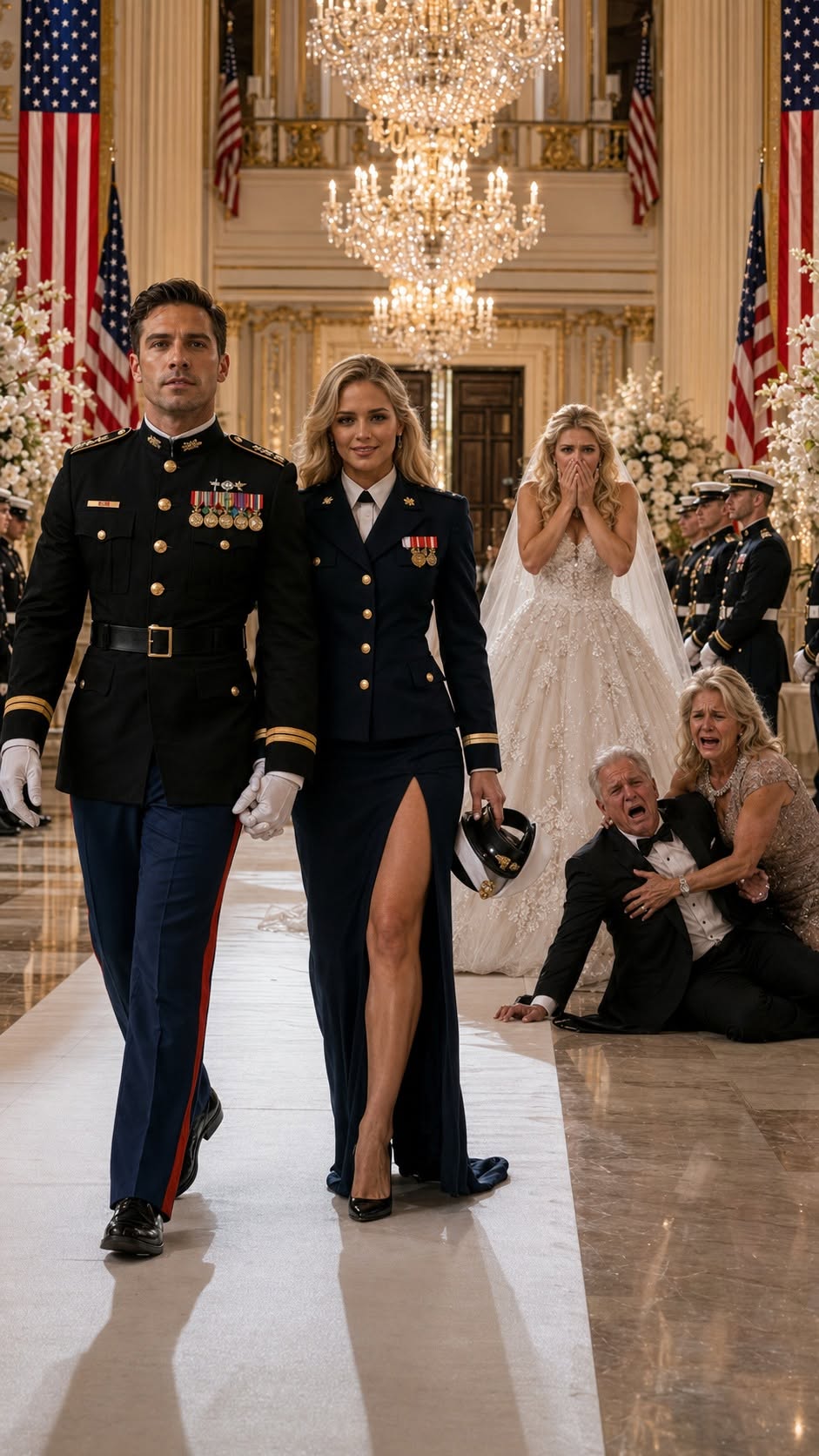
Chapter 1: The Fountain
The laughter hit me before the freezing water did. It rolled across the manicured terrace of the Crestview Country Club, a tidal wave of four hundred impeccably dressed guests howling at my expense.
For thirty-two years, my family had meticulously curated my role. I was the difficult, chronically single older daughter. My primary function within the Hart family dynasty was to act as the dull background against which my younger sister, Sophie, could shine with blinding radiance. Her lavish, six-figure wedding was supposed to be just one more evening of me gripping a champagne flute, plastering a vacant smile on my face, and absorbing the pitying glances.
Then my father, Graham Hart, seized the microphone from the wedding band.
“Look, there’s Clara,” his baritone voice boomed through the towering speakers, echoing off the marble columns. He pointed a thick, manicured finger toward the edge of the terrace. “All by herself. Couldn’t even wrangle a date for her only sister’s big day. Let’s give a round of applause to our lone wolf, holding down the fort at the singles table!”
The ballroom erupted. It wasn’t a polite titter; it was a roaring, unified braying.
A hot flush of absolute mortification crawled up my neck. I retreated backward, stepping out of the glaring spotlights toward the shadowy edge of the terrace where the massive stone fountain sat. I just needed to breathe. I needed the oxygen that my father was sucking out of the room.
But Graham followed me.
He moved with the predatory grace of a man who owned the building, the caterers, and the people inside it. He clamped both of his heavy hands onto my bare shoulders. I could smell the scotch on his breath, bitter and sharp.
“Stop sulking,” he hissed, his charming smile never wavering for the crowd watching us. “You’re ruining the aesthetic of the photos. Smile.”
Then, he shoved me.
It wasn’t a violent, winding blow. It was worse. It was a casual, careless push, executed with the effortless disdain of someone discarding a piece of trash.
The heel of my stiletto caught the slick, mossy lip of the stone basin. My arms flailed, grabbing only empty air, and I pitched backward into the freezing water.
The shock of the cold violently expelled the air from my lungs. My pale green silk gown—a dress I had spent a month’s salary on—instantly morphed into a heavy, suffocating shroud, clinging to my shivering skin. Water flooded my nose, smelling of chlorine and copper pennies.
But the chill of the water was nothing compared to the sound that followed.
No one gasped. No one rushed forward with a towel or an outstretched hand.
They applauded.
I sat waist-deep in the fountain, water streaming from my ruined hair, and watched my father stand above me. He was still clutching the microphone, beaming as if he had just delivered the punchline of the century.
In that fractured second, something vital inside my chest snapped, then went utterly, terrifyingly still. Thirty-two years of absorbing the impact of being the family joke sank to the bottom of that fountain.
I dragged a wet hand across my face, clearing the water from my eyelashes, and looked up into Graham’s triumphant eyes.
“Remember this moment,” I said. My voice wasn’t loud, but it possessed a razor-thin clarity that cut through the dying laughter. “Remember exactly what you just chose to do to me. Because I will.”
His smile flickered, a momentary glitch in his polished armor.
I hoisted myself over the stone ledge, ignoring the water pooling at my feet, and walked with spine-snapping precision straight through the ballroom to the lobby restroom. I peeled off the ruined silk, dried my shivering skin with coarse paper towels, and slipped into the spare black cocktail dress I had packed in my overnight bag. I applied a slash of crimson lipstick.
The woman staring back at me in the mirror was done dissolving into the background.
I dug my water-damaged phone from my soaked clutch. The screen flickered, but it held long enough for me to open a hidden contact I had fiercely protected for thirty-six months. I typed two words.
Come now.
My family derived endless joy from calling me lonely. Tonight, they were going to meet my husband.
But as I pressed send, the restroom door handle began to slowly turn, threatening to expose my secret before I was ready.
Chapter 2: The Sanctuary of Silence
“Clara?”
The voice was tentative, a fragile vibration against the heavy oak door. It was my mother, Elaine.
She slipped into the stark, fluorescent-lit bathroom, pulling a cashmere shawl tightly around her shoulders. Her silver designer gown was immaculate, but the practiced, placid mask she had worn for three decades of marriage to Graham had cracked.
“Oh, sweetheart,” she breathed.
The endearment felt foreign, acidic on her tongue.
“What happened out there wasn’t meant to—”
“Mom.” The word cracked like a whip in the tiled room. I turned away from the mirror. “Do not explain what Dad meant. Do not sanitize it.”
She flinched, dropping her gaze to the floor. That simple downward glance hurt more than if she had slapped me. Because it confirmed what I had always known: she knew exactly what he was.
“I should have stopped him,” she whispered to the grout lines.
“Yes. You should have.”
For my entire life, Elaine had labeled her chronic silence as ‘keeping the peace.’ But in the Hart family ecosystem, her silence was the mortar that held my father’s cruelty together. It was permission.
My phone vibrated against the marble vanity.
Ten minutes. Side entrance.
My pulse, which had been hammering a frantic rhythm against my ribs, instantly steadied.
Elaine’s eyes darted to the glowing screen. “Is someone coming to get you?”
“Yes.”
“Who?”
I paused, tracing the edge of the sink. For three years, I had successfully walled off one beautiful, untainted corner of my life. I had shielded it from Graham’s invasive interrogations, from Sophie’s inevitable comparisons, from the toxic dinner table autopsies that dissected my every flaw.
But hiding no longer felt like a shield. It felt like a cage.
“My husband,” I said, the words falling like anvils onto the tile floor.
Elaine stopped breathing. “Your… what?”
“My husband.”
“You’re married?” Her voice was thin, reedy with shock.
“Yes.”
“For how long, Clara?”
“Three years.”
Her mouth opened, closed, and opened again, struggling to form the syllables. “To whom?”
“Adrian Reyes.”
The name detonated in the small room. Adrian wasn’t a celebrity in the vapid, socialite sense my family worshipped, but he possessed a gravity that terrified men like my father. Adrian was a senior partner at a notoriously ruthless corporate litigation firm. He was quiet, lethal in a courtroom, and possessed a reputation of unyielding integrity.
Elaine swayed, gripping the edge of a bathroom stall for support. “Why didn’t you tell us?”
“Because I wanted one thing in my life that wasn’t placed on a scale next to Sophie,” I said, my voice eerily calm. “I didn’t want Dad demanding a rundown of his portfolio, dissecting his pedigree, or making jokes about how Adrian must have settled for the defective daughter.”
Elaine covered her mouth, a tear finally escaping her mascara. “I wish I had known.”
“I wish,” I replied coldly, “that I had ever felt safe enough to tell you.”
Just as the silence stretched to a breaking point, a frantic pounding echoed against the door, accompanied by a voice that made my blood run cold.
Chapter 3: The Bride’s Guilt
Without waiting for an answer, Sophie burst into the restroom, a cloud of ivory silk, nervous energy, and the heavy scent of gardenias.
“Oh, thank god,” she exhaled, rushing toward me. “Are you okay?”
“I’ll survive. I always do.”
Sophie dragged a hand through her elaborate updo, ruining a perfectly pinned curl. “Dad is absolutely impossible,” she muttered.
I stared at her, genuinely shocked. She claimed she had reprimanded him? For a decade, I had harbored a quiet, festering resentment toward Sophie, hating how effortlessly she basked in the warmth of being the golden child while I froze in the shadows.
Then, she delivered a secondary blow.
“I wanted you up there with me, you know. I asked you to be my maid of honor.”
The air rushed out of my lungs. “No, you didn’t. Tessa is your maid of honor. You’ve been parading her around for six months.”
“Because I asked you first!” Sophie’s eyes flashed with defensive hurt. “You never answered my email, Clara. You just ignored it.”
“I never received an email from you.”
Sophie frowned, her irritation morphing into confusion. “I sent it the first week of January. I poured my heart out.”
“To what address?”
“Your old Hart Foundation corporate account.”
A cold dread coiled in my gut. “Sophie, that account was deactivated eighteen months ago when I quit the board.”
A thick, suffocating silence descended over the three of us. It wasn’t the warm rush of a cinematic reconciliation. But it was the terrifying crack of a foundation shifting.
Before either of us could parse the implication of the missing email, my phone vibrated a second time.
I’m here.
Sophie’s eyes tracked the movement. “Who is here?”
Instead of answering, I reached around to the nape of my neck and unclasped the thin, silver chain I wore under every sweater, every blouse, every dress for the last thirty-six months. A heavy, unadorned platinum band slid down the metal links, catching the harsh fluorescent light.
Sophie stared at the ring as if it were a live grenade. “What is that?”
“My wedding ring.”
My sister looked at our mother, expecting her to laugh, to call it a joke. Elaine just stared at the floor, weeping silently.
“You’re married?” Sophie gasped. “To who?”
“Adrian Reyes.”
Sophie collapsed onto a velvet vanity stool. “The Adrian Reyes? The one Dad’s firm just lost that massive antitrust suit against?”
“He would hate being introduced that way, but yes.”
Sophie pressed her manicured hands over her mouth, her eyes wide with horror. “Clara… I sat through three consecutive Christmas dinners where Dad humiliated you about dying alone. I laughed at those jokes. You were holding this card the whole time? You could have destroyed him. You could have stopped it.”
I looked at my sister, feeling a sudden, overwhelming wave of exhaustion.
“I shouldn’t have needed to produce a powerful husband for my family to treat me with basic human dignity.”
Sophie’s frantic energy evaporated, leaving behind a hollow, devastating shame. “No,” she whispered, her voice breaking. “You shouldn’t have.”
Suddenly, the bathroom door swung open again, revealing a figure who had been listening to every word from the corridor.
Chapter 4: The Husband at the Door
Aunt June glided into the room without an ounce of hesitation. Draped in midnight-blue velvet and clutching a half-empty crystal flute of champagne, she looked like a monarch inspecting a battlefield.
“I assume,” June drawled, her sharp eyes flicking to the platinum ring dangling from my fingers, “that we are finally dropping the theatrical charade.”
Sophie practically leaped off the vanity stool. “You knew?!”
“I signed the marriage certificate, darling,” June replied, taking a nonchalant sip of her champagne.
“Aunt June! How could you keep this from us?”
“I am a vault when it comes to confidences, Sophie. A trait the rest of this bloodline sorely lacks.” June turned her piercing gaze to me. “Your man is in the main lobby. He’s currently being swarmed by three junior partners from your father’s firm and retired Judge Weston, who looks like he’s about to faint from the excitement of seeing him.”
Sophie grabbed my arm, her grip desperate. “Clara, what are you going to do? If you walk out there with Adrian Reyes, Dad will lose his mind. It’ll be a bloodbath.”
For years, during my darkest, most humiliated moments, I had fantasized about this exact scenario. I had pictured a grand, cinematic entrance: sweeping into the ballroom, my hand securely locked in Adrian’s, watching Graham’s smug face contort in terror as he realized the daughter he mocked was married to the apex predator of his own industry.
But standing in that sterile bathroom, the fantasy tasted like ash.
Adrian was not a weapon to be unsheathed. My marriage was a sanctuary, not a piece of retaliatory evidence.
“I’m going to do exactly what I came to do,” I said, securing the chain around my neck and letting the ring drop heavily against my breastbone. “I am leaving with my husband.”
“That’s it?” Sophie demanded, incredulous. “You’re not going to confront him?”
“He will learn, eventually, that not every narrative revolves around him.”
We exited the restroom in a surreal, silent procession: me in stark black, Sophie trailing in her elaborate ivory wedding gown, Elaine shivering in her silver designer dress, and Aunt June bringing up the rear like a highly satisfied general.
We rounded the corner into the grand lobby.
Adrian stood directly beneath the massive crystal chandelier. Clad in a bespoke charcoal suit, he radiated a quiet, immovable authority. He was politely nodding at Judge Weston, but the moment I stepped onto the marble floor, the judge ceased to exist.
Adrian excused himself mid-sentence and crossed the vast expanse of the lobby. He didn’t care who was watching. He stopped inches from me, his dark eyes scanning my face, looking for the damage.
“You’re okay?” his voice was a low, grounding rumble.
“Yes.”
“You texted come now.”
“I know.”
“Something happened.”
“Yes.”
His gaze drifted downward, catching the glint of the platinum ring resting openly against the black fabric of my dress. He had never seen me wear it outside the walls of our apartment.
“So,” Adrian said softly, a muscle ticking in his jaw.
“So.”
He reached out, his thumb gently brushing across my knuckles. “That’s new. Wearing it in the open.”
“It shouldn’t be.”
“No,” Adrian agreed, his eyes darkening with protective fury. “It shouldn’t.”
Before Adrian could wrap his arm around me and guide me to the exit, a booming, arrogant voice shattered the intimacy of the moment.
Chapter 5: The Public Reckoning
Sophie stepped forward, breaking the magnetic tension between Adrian and me. She looked terrifyingly small inside her massive wedding gown.
“Hi.” She offered a trembling hand.
I took a stabilizing breath. “Adrian, this is my sister, Sophie.”
“The bride,” Adrian said, his voice entirely devoid of the warmth he usually reserved for strangers. He shook her hand formally.
“And, apparently, your sister-in-law,” Sophie replied, offering a fragile, self-deprecating smile.
Adrian’s expression softened marginally. “Apparently.”
By now, the gravitational pull of Adrian’s presence had drawn a crowd. Several high-profile guests had drifted from the ballroom into the lobby, their eyes widening as they recognized the legal titan standing near the coat check. Whispers began to ripple through the velvet-draped room.
Then, the sea of guests parted.
“Well, well, well.”
Graham Hart stood framed in the double doors of the ballroom. His tuxedo was impeccable, his silver hair perfectly coiffed. The predatory, camera-ready smile had returned to his face. He thrived on an audience, and he had just found a new one.
He strode forward, extending a hand. “Adrian Reyes. What an unexpected… honor. To what do we owe the pleasure of your company at my daughter’s wedding?”
Adrian didn’t take the offered hand. He looked at me, a silent transfer of power, letting me dictate the terms of the engagement.
“He’s here for me,” I said, my voice projecting clearly across the marble floor.
Graham chuckled, a condescending, buttery sound. He looked around at his wealthy friends, inviting them in on the joke. “Clara, please don’t tell me you called external counsel because you tripped into a decorative water feature.”
Several guests who had been hovering nearby suddenly found their shoes incredibly fascinating, stepping backward to avoid the fallout.
I shook my head slowly. I didn’t yell. I didn’t cry.
I simply reached out and laced my fingers through Adrian’s. He gripped my hand with anchoring strength.
“No, Dad,” I said. “I called my husband.”
The lobby went dead, vacuum-sealed quiet. Not a glass clinked. Not a breath was drawn.
Graham’s eyes dropped to our interlocked hands, his gaze snagging on the platinum band resting against my chest. His arrogant smile froze, twitching violently at the corners.
“Your… what?”
“My husband.”
Graham barked out a single, harsh laugh. He looked around the lobby again. No one joined him. The absolute silence of his peers was deafening.
“This is some kind of sick, elaborate joke,” Graham sneered, the color draining from his cheeks.
“It’s not a joke, Graham,” Adrian spoke for the first time, his voice slicing through the room like a scalpel.
Graham ignored him, stepping aggressively toward me. “How long?”
“Three years.”
I watched the architecture of my father’s face crumble. It wasn’t the fiery explosion of rage I had anticipated. It was something far more pathetic. It was a deep, narcissistic injury.
“You married a man… without consulting me? Without telling us?”
The old, deeply ingrained reflex clawed at my throat. Apologize. Manage his emotions. Explain yourself so he doesn’t feel small.
I looked at the man who had shoved me into freezing water for a cheap laugh. I engaged none of the old programming.
“Yes.”
Graham’s face flushed a violent, mottled purple as he realized he had entirely lost control of the narrative in front of the very people he sought to impress.
Chapter 6: The Long Drive Home
Graham puffed his chest out, desperately trying to re-establish dominance over the fractured room. “We are going to an empty office, right now, and we are talking about this.”
“Not tonight,” I said, turning toward the revolving glass doors.
“Clara!” Graham’s voice cracked like a whip. “This affects the standing of this entire family.”
I paused. I looked at Adrian, at the steady, unbothered calm in his eyes, and then turned back to my father.
“My marriage is not a Hart family asset for you to leverage.”
His jaw locked tight enough to crack a tooth. “Why didn’t you tell me?” he demanded, entirely dropping the plural ‘us’. It was always about him.
I stood there in the chilling lobby and looked at my father. I saw the man who had just humiliated me in front of four hundred people. But, in a tragic twist of human complexity, I also saw the man who used to make me animal-shaped pancakes on Sundays. I saw the man who drove four hours through a blinding blizzard to bring me home from my college dorm when I had pneumonia.
Families are a devastating paradox. Abuse does not magically erase the memory of love, and love does not excuse the enduring scars of abuse.
“Because I didn’t know how to let you into my life without letting you entirely define it,” I answered softly.
He stared at me, genuinely taken aback.
“I didn’t trust you to meet Adrian without sizing him up like a hostile acquisition,” I continued, the words spilling out like a lanced infection. “And worse, I didn’t trust you to witness my happiness without finding a way to turn it into a punchline.”
His arrogant certainty finally evaporated, leaving behind a hollow, aging man in a tuxedo. “You really think that little of me?”
“I think you spent thirty-two years teaching me exactly what to expect from you.”
He physically recoiled, as if I had struck him.
For the first time in my life, I didn’t rush to bandage the wound I had inflicted. I let him bleed.
Sophie lunged forward, wrapping her arms tightly around my neck, crushing her silk gown against my damp dress. “I want to talk,” she whispered fiercely into my ear. “Everything. All of it.”
“So do I.”
“Tomorrow?”
“I promise.”
Adrian kept a protective hand on the small of my back as we exited the hotel. The valet brought his car around, and as Adrian opened the passenger door for me, the cool night air hit my damp skin.
I slid into the leather seat, suddenly violently trembling as the adrenaline crash commenced.
Adrian got in, closed his door, and didn’t start the engine. He turned to me in the dim light of the dashboard. “You know you don’t have to pretend to be fine right now.”
“I know.”
“And,” he added gently, “you do not owe me an apology for hitting the panic button.”
A wet, broken laugh escaped my throat. “I was literally just about to apologize.”
“I know.”
The drive home was wrapped in a heavy, contemplative silence, but the peace was shattered at 2:00 AM when my phone lit up the dark bedroom with a series of frantic messages.
Chapter 7: The Paper Trail
We had spent the night hiding from the world. We ordered matzo ball soup from our favorite 24-hour deli, sitting cross-legged in the middle of our bed, eating tearing off chunks of crusty bread from paper bags. It was fiercely, aggressively normal.
Around two in the morning, the heavy quiet became too much to bear.
“I really am sorry, Adrian,” I whispered, tracing the rim of my soup cup.
“For what?”
“For making the boundaries of our marriage so small. I made us tiny just so my family couldn’t find us and ruin it.”
He reached over and took the cup from my hands, setting it on the nightstand. “Our life together isn’t small, Clara.”
“You know what I mean. I kept you a secret. Like you were something to hide.”
Adrian shifted closer, pulling my hands into his. “Listen to me. I don’t want you to tell the world about us because you suddenly feel guilty about the secrecy. I want you to introduce me to the room because you are genuinely proud of the life we’ve built.”
I looked around our dimly lit apartment. My gaze landed on the lopsided, aggressively ugly ceramic bowl Adrian had made in a failed pottery class. I looked at the framed, slightly blurry photograph of us hiking the Inca Trail in Peru. I looked at the heavy wool blanket he selfishly stole to his side of the bed every single night.
It wasn’t a magazine spread. It wasn’t the pristine, sterile perfection Graham demanded. It was messy, chaotic, and fiercely ours. And I was violently proud of it.
Before I could tell him that, my phone vibrated violently against the wood of the nightstand.
I picked it up, squinting against the harsh backlight. It was a text from Sophie.
I found something. You need to see this.
A second bubble popped up.
It’s about that email I sent you in January.
Then, the third message arrived, turning my blood to ice.
It wasn’t an accident that it went to your dead account. Dad forwarded it there. I handed him a flash drive with the wedding logistics to send out.
I sat bolt upright, the sheets pooling around my waist.
Adrian sat up immediately. “What’s wrong?”
I wordlessly handed him the glowing screen. Sophie’s fourth message appeared right before his eyes.
Clara, I think Dad deliberately made sure you never saw it.
The missing maid of honor invitation wasn’t a tragic technical glitch. It wasn’t a sisterly misunderstanding born of distance. It was a surgical strike. It was a choice someone had actively made to keep us apart.
The next morning, the digital proof Sophie brought to the apartment would reveal a conspiracy much darker than a single missed email.
Chapter 8: The Ultimatum
Sophie arrived at our apartment at 9:00 AM carrying a cardboard box of French pastries and a printed stack of emails. She looked exhausted, her eyes swollen and red.
She bypassed the pleasantries, laying a piece of paper flat on my kitchen counter.
Subject: Please stand with me.
I read her original message. It was heartbreakingly vulnerable. Sophie acknowledged our emotional distance, took ownership of her part in the chasm, and explicitly stated she could not imagine walking down the aisle without her big sister holding her bouquet.
Beneath it was the damning forwarded chain.
Sophie had given Graham the draft, asking him to blast it out with the rest of the family logistics. Graham had forwarded the email to my defunct Hart Foundation address. But he hadn’t just sent it into the void. He had attached a note to his executive assistant:
Make sure this goes to the old Clara address on file. She doesn’t need another reason to make Sophie’s wedding weekend all about her own neuroses. Let Sophie think she ignored it.
There was no grand, Machiavellian monologue. Just two sentences of casual, breathtaking cruelty. That was what made it so lethal.
Sophie’s hands trembled as she pulled out more papers. She had spent the night digging through her father’s sent folders.
There was a VIP invitation to a breast cancer charity gala I supposedly “refused” to attend. There was an email outlining a family ski trip to Aspen that Graham told Sophie I had aggressively declined. There was a draft of a toast I was supposed to give at her engagement party, with a note from Graham instructing the planner to cut me from the schedule because my tone could be “too sharp when she’s uncomfortable.”
Sophie and I stood in my kitchen, staring at the autopsy report of our sisterhood.
For nearly a decade, she believed I deeply resented her joy.
For nearly a decade, I believed she viewed me as an embarrassment.
We had both been played.
“I want to fix this,” Sophie said, wiping her nose with the back of her hand as she stood in my doorway to leave.
“Soph, we can’t fix thirty years of manipulation in one post-wedding weekend.”
“I know.” She nodded slowly. “But we can stop letting him add to the damage.”
I looked at my little sister, really looking at her for the first time in years. There was no guilt in her eyes. No pressure to conform to a family script. She was simply offering me permission to exist.
That afternoon, Adrian and I walked through the sprawling paths of the botanical gardens. My apartment felt too suffocating for the magnitude of the morning.
“I really do owe you that apology,” I murmured, linking my arm through his.
“Clara, we’ve covered the secrecy.”
“Not the root of it.” I stopped walking, turning to face him under a canopy of weeping willows. “When we eloped, I convinced myself that keeping us a secret was an act of boundary-setting. I thought secrecy equaled privacy.”
“At first, it did serve that purpose,” Adrian allowed, his expression unreadable.
“Yes. But then… then I got comfortable. I got comfortable living a fractured life. I could be brave, loved, and entirely myself with you, and then I could drive to my parents’ house and shrink back down into the pathetic version of Clara they expected me to be.”
Adrian sighed, a heavy sound. “That sounds like an exhausting way to live.”
“It was destroying me.”
He looked away, watching a stone fountain in the distance. “I have something to confess, too. Something I’ve been holding back.”
My stomach tightened. “What is it?”
“The partners approached me last month. They formally offered me the managing director position in the new Seattle office. It’s a massive step up. Full partnership track, endless resources, and they’ll let me build the pro bono legal clinic I’ve been pitching for three years.”
The air rushed out of my lungs. Seattle. Thousands of miles away from Graham Hart.
“Do you want it?” I asked, my voice trembling.
“Maybe.”
That single word terrified me far more than a definitive ‘yes’. “Were you going to accept it?”
“No.”
“Were you going to decline it?”
“No.”
I stared at him, confused. “Then what were you doing?”
Adrian looked back at me, his dark eyes intense. “I was waiting, Clara. I was waiting to see if there was actually enough room in your life for us to make monumental decisions together, or if we were going to spend the rest of our marriage tip-toeing around the ghost of your father.”
The brutal honesty of the sentence felt like a physical blow because he was entirely right.
“I never hid you because I was ashamed of who you are, Adrian,” I whispered, tears pricking my eyes. “I hid you because I was deeply ashamed of who I became when I was around them.”
Adrian stepped forward, wrapping his hands around my face, his thumbs wiping away the rogue tears. “Let’s make a deal. From this minute forward, we stop making decisions based on the emotional comfort of people who are not in this marriage.”
I nodded against his palms. We agreed not to give an answer to the Seattle firm until Monday. That delay, that shared space to breathe, felt like a monumental victory.
But before we could look to the West Coast, we had to survive the Sunday morning brunch.
Chapter 9: The Morning After
The following morning, I walked through the gilded double doors of the hotel’s private dining room. I didn’t go because Sophie begged me. I didn’t go because of familial obligation. I went because I actively chose to face the fire.
And this time, Adrian walked in beside me, his hand resting firmly on the small of my back.
As we entered the room, the low hum of gossip immediately dropped an octave, but no one laughed. Eyes tracked us, full of calculated reassessment.
At the head table, Graham stood up.
My spine locked into a rigid column. I braced myself for the counter-attack, expecting a masterful, passive-aggressive performance designed to make me look like a hysterical liar.
Instead, Graham cleared his throat and simply said, “Good morning.”
Breakfast commenced with a painful, agonizing normalcy. The clinking of silver against china. The pouring of black coffee. Polite, stilted stories about the band from the night before.
Then, twenty minutes in, Graham picked up his butter knife and tapped it sharply against his crystal water goblet.
The sound rang like a gunshot. I stiffened. Sophie shot him a terrifying, warning glare.
Graham placed the knife down carefully. He didn’t pick up a microphone. He didn’t stand up.
“I am not giving a speech,” he announced, his voice lacking its usual booming bravado.
A few sycophants offered nervous, polite smiles.
Graham turned his head, his eyes locking directly onto mine. “But I do owe my eldest daughter a profound apology.”
The dining room went graveyard silent. Waiters froze in mid-step.
“What transpired last night by the terrace fountain was not humorous,” Graham said, his voice grating with effort. “I deeply embarrassed Clara. I did it because I believed that controlling the room and generating laughter mattered more than examining why people were laughing in the first place. I was cruel.”
I stared at him, utterly disoriented. There were no caveats. There was no ‘I’m sorry if anyone felt offended.’
“I have, apparently, executed various iterations of that cruelty for years,” Graham continued, his knuckles white as he gripped the tablecloth. “I also actively interfered in the private communications between my two daughters to maintain a specific dynamic. That was a catastrophic failure on my part.”
A dangerous, treacherous emotion flared in my chest: Hope.
I wanted to believe him. I wanted to believe that the shock of Adrian’s presence had shattered his ego enough to let the light in. But hope is a violent liability when dealing with a narcissist.
“I do not expect you to offer me forgiveness today, Clara,” he finished quietly.
“Okay,” I replied, my voice steady.
“I would merely like the opportunity, moving forward, to understand the depth of what I’ve broken.”
“That will take a considerable amount of time.”
“I know.”
There was no tearful embrace. No cinematic rush to hug him. The space between us remained a vast, frozen tundra. And that lack of instant, unearned repair made the moment feel frighteningly authentic.
As brunch concluded and the crowd began to disperse, Elaine touched my elbow, pulling me into a secluded alcove near the coat check. She looked over her shoulder, her movements nervous and bird-like.
“I went back to the main house this morning while your father was sleeping,” Elaine whispered, her hands shaking as she reached into her oversized designer tote. “I dug through the locked filing cabinet in his study. I found something.”
My fingers went ice-cold. “What did you find?”
“Your grandmother’s letters.”
My brow furrowed in utter confusion. “Mom, Grandma Helen died twelve years ago. I never received any letters from her.”
“I know,” Elaine said, tears welling in her eyes again.
She pulled a thin, heavy bundle of parchment envelopes from her bag, tied tightly with a faded, frayed blue ribbon, thrusting them into my hands and setting off a chain reaction that would burn the Hart family legacy to the ground.
Chapter 10: The Legacy
I stared at the bundle resting heavily in my palms. The paper was slightly yellowed, smelling faintly of dry dust and the distinct, powdery lavender perfume my grandmother used to wear.
The top envelope was addressed in Helen’s unmistakable, elegant script.
For Clara. Strictly Personal.
I checked the postmark stamped over the faded postage stamp. It was dated twelve years ago—exactly three weeks before she died.
The seal on the first envelope was already broken. It had been sliced open with clinical precision. Not by me.
My heart hammered a violent rhythm against my ribs. I looked at Adrian, who had stepped quietly into the alcove, acting as a physical shield between us and the lingering wedding guests. He offered a single, encouraging nod.
With trembling fingers, I slid the thick parchment letter from the opened envelope.
I expected a sweet, rambling farewell from a dying woman. I expected family recipes or generic advice about finding love.
Instead, the very first sentence, written in dark, unyielding black ink, re-wrote the entire architecture of my existence and exposed the terrifying reason my father had spent thirty-two years trying to convince me I was worthless.
I read the words, and the ground vanished beneath my feet.
My Dearest Clara,
By the time you read this, I will be gone, and the trust I established entirely in your name—the controlling fifty-one percent voting shares of the Hart corporate empire—will legally transfer to you, provided your father has not successfully convinced you that you are too incompetent to claim it.
I stopped breathing.
I read the sentence again. And then a third time.
Fifty-one percent.
Graham Hart had not spent a lifetime mocking me because I was a disappointment. He hadn’t pushed me into a fountain because he was a careless bully.
He had done it because he was terrified of me.
He had orchestrated a multi-decade psychological campaign to break my self-esteem, to isolate me from Sophie, and to convince the world—and myself—that I was a fragile, unlovable mess, all to ensure I would never feel confident enough to contest his control over the family dynasty. He needed me broken so he could reign supreme.
And the public apology at brunch? It wasn’t an awakening. It was a desperate, tactical retreat. He had realized that I was married to Adrian Reyes—a man who could audit the family trust, uncover the hidden shares, and dismantle Graham’s empire in a single afternoon of litigation.
I looked up from the parchment, my eyes locking with my mother’s terrified gaze, and then turning to look across the lobby at my father, who was schmoozing with the valet.
I wasn’t the family punchline. I was the landlord.
I folded the letter, sliding it carefully back into the envelope, the tremor in my hands completely vanishing. I turned to my husband, a dangerous, beautiful fire igniting in my chest.
“Adrian,” I said, a slow, predatory smile finally touching my lips. “I think we’re going to decline the Seattle offer. We have an empire to restructure.”