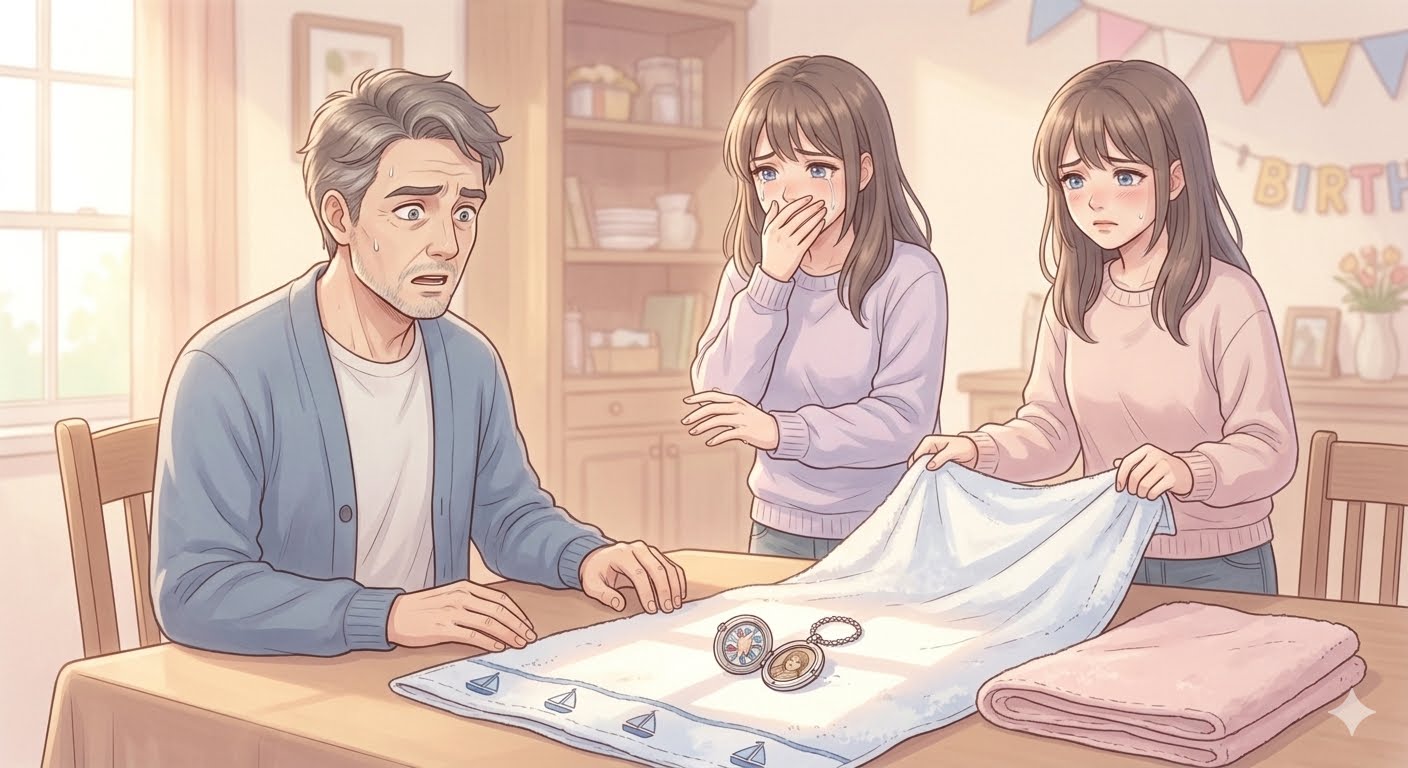
- I recognized those towels instantly. Eighteen years earlier, I had discovered Emily and Grace wrapped inside them in a beach changing cubicle—one in white, the other in pale pink. Now both girls stood before me, their expressions tight with apprehension.
“Dad,” Emily said, taking my hand in hers.
“We need to tell you the truth,” Grace added softly.
My fingers began trembling before I even touched the fabric. In an instant, I was pulled back to the cold sand of that beach—a place where I had once believed my life was already over.
Three weeks before finding the girls, I had buried my fiancée, Sarah, and our unborn daughter, Ivy. Ivy had been thirty-six weeks along. She never took a single breath, but she already had a name, a crib, and a dresser full of yellow clothes because Sarah firmly believed every baby deserved something bright. After the funeral, I completely stopped caring for myself. I barely ate, ignored every ringing phone, and spent endless days sitting motionless inside the nursery, staring at the pale-yellow walls.
My best friend, Chris, eventually forced his way into the house and ordered me to pack a bag.
“I’m not going anywhere,” I told him.
“You haven’t opened the curtains in three weeks.”
“That isn’t your concern.”
“No,” he replied, his voice firm. “But you are.”
I didn’t want to be rescued, but Chris wasn’t asking for permission. He loaded me into his truck and drove several states away to a quiet beach town. By sunset, as the sky turned crimson, I wanted nothing more than to return home and lock myself back inside that silent nursery.
Then I heard a baby crying.
A second cry followed immediately after.
We traced the faint sound to a row of wooden changing cubicles near the water. Inside one of them, lying directly on the sand, were two newborn girls. One was wrapped in a white beach towel, and the other was covered in pink. For a long second, grief paralyzed me. Then raw instinct took over.
I dropped to my knees, draped my jacket over both babies, and shouted for Chris to call for help.
“They’re breathing,” I whispered, checking their tiny limbs. “They’re cold, but they’re alive.”
Police officers, paramedics, and social workers arrived within minutes. A social worker named Andrea explained that the babies would be placed somewhere safe while authorities searched for their relatives. By all logic, I should have walked away and let the system handle it. Instead, I followed the ambulance to the hospital.
The nurses had temporarily named them Emily and Grace. I kept those names. At first, I told myself I was only staying because they had no one else in the world. Eventually, I admitted the deeper truth: I wanted to become their father.
Andrea warned me that finding them didn’t grant me special rights. I would have to undergo background checks, parenting classes, home inspections, and an adoption process that could take months. Then she asked the one question I had been desperately avoiding.
“Do you want these children because they need a father, or because you need a reason to keep living?”
“Both may be true,” I answered quietly. “But only one can come first.”
“And which one is that?”
“They need safety. I can give them that.”
I promised her I would never expect two helpless babies to heal my broken heart. “I don’t want them to save me,” I said. “I want to build a home for them.”
Andrea told me to prove it, so I did. I cleaned my house, completed every required class, bought supplies, and prepared the nursery. I kept the walls yellow. I couldn’t erase Sarah and Ivy, but I could make room for Emily and Grace right beside them.
Months later, the twins came home as my foster daughters. The official adoption followed once the court closed the case. I became their father one small mistake and one steep learning curve at a time.
PART 2
The years rolled by in a blur of formula bottles, midnight fevers, school plays, missing teeth, parent-teacher conferences, and two different birthday cakes every year—because Emily insisted on vanilla while Grace demanded chocolate. After the adoption was finalized, Andrea had returned the original beach towels to me, and I kept them safely stored inside a cedar memory box.
I also kept Sarah’s photograph tucked inside my wallet, though I rarely spoke her or Ivy’s names out loud. I foolishly believed that silence would protect my daughters from ever feeling like second choices or replacements for the family I had lost.
When the girls turned fifteen, they began disappearing for long afternoons and the occasional weekend. They claimed they were studying at the library, attending extracurricular activities, or helping friends. Because their adoption had never been a secret, a quiet fear took root in my chest: I assumed they were secretly searching for their biological family.
I had always promised myself that I would never force them to choose between me and their origins, but fear kept me from asking direct questions. For three long years, I quietly prepared myself to lose them.
On their eighteenth birthday, I cooked their favorite dinner. Afterward, instead of cutting cake, they went upstairs together and returned holding the two faded beach towels.
“What are those doing out of the box?” I asked, my throat tightening.
Emily placed the white towel on the table. Grace set down the pink one beside it.
“For three years, we’ve been lying to you about where we were going,” Grace confessed.
My chest constricted painfully. “Did you find your biological family?”
Emily’s eyes welled with tears. “No, Dad. This isn’t about leaving you.”
Grace gently pushed the white towel toward me. “Open it.”
When I unfolded the heavy fabric, three airline tickets slid onto the wooden table. Three passengers. Three reserved seats.
“We leave in three days,” Grace explained.
It suddenly hit me—they had spent three years babysitting, tutoring, walking neighbors’ dogs, and working weekend jobs not to search for strangers, but to purchase these tickets.
“What is this for?” I asked, my voice cracking.
“For you,” Emily answered softly.
The destination printed on the passes was the exact same beach town where I had found them eighteen years ago.
“I can’t go back there.”
“Yes, you can,” Grace said gently. “And you won’t have to do it alone.”
The pink towel contained a thick scrapbook. Across the front cover, in gold lettering, they had written: Our Family Began Before We Could Remember.
Inside were dozens of photographs documenting our life together. The very first picture showed me fast asleep in a chair with both tiny babies swaddled against my chest. The following pages captured birthday parties, dance recitals, report cards, gaps from lost teeth, and crude, handmade Father’s Day cards.
Near the back of the album, tucked behind a frame, was a copy of Sarah’s photograph.
I stared at it. “Where did you get this?”
Emily admitted she had taken a picture of it with her phone years ago when my wallet accidentally fell open.
“Is she the reason you always get quiet when our birthday comes around?” Grace asked softly.
Tears blurred my vision as I confessed the truth: I had hidden Sarah and Ivy because I never wanted them to grow up feeling like substitutes.
“We never felt that way, Dad,” Emily said firmly.
“You don’t understand—”
“Then help us understand,” Grace urged.
I looked down at Sarah’s bright smile. “If I talked about her, I was terrified you would hear what I had lost instead of understanding how deeply grateful I was for what you gave me.”
Emily turned to the very last page of the album. Four names were neatly handwritten across the paper: Sarah. Ivy. Emily. Grace.
My breath caught in my chest. “You know about Ivy?”
They explained that they had discovered Ivy’s pale yellow baby blanket tucked deep inside the cedar box while searching for old holiday decorations years ago. For eighteen years, I had kept Ivy’s name hidden because speaking it out loud made the agony of her loss feel razor-sharp again. But my daughters had written her name right beside their own, placing her where she had always belonged.
Then they handed me a letter.
In it, they wrote about the father who had taken them in when he had nothing left to give—a man who taught himself how to mix formula, braid hair, help with math homework, soothe night terrors, and face his own fears. They admitted they had noticed how I avoided beaches and grew distant every year as their birthday approached. For a long time, they wondered if raising them was a constant, painful reminder of what I’d lost.
Eventually, though, they understood the truth: I hadn’t loved them because I had forgotten Sarah and Ivy. I had loved them with everything I had while continuing to miss Sarah and Ivy.
Their letter concluded with a phrase Andrea had once shared with them during a visit: “You never wanted us to save you. But you saved us first, Dad. We have spent eighteen years trying to return the favor.”
Emily held out the airline tickets once more. “Come back to the beach with us.”
“I’m terrified,” I admitted truthfully.
“That’s why we’re going together.”
PART 3
Three days later, I stood at the edge of the ocean, feeling the cool sea breeze. The row of changing cubicles still stood near the boardwalk. My chest tightened, and every instinct urged me to turn around and run.
Emily took my left hand. Grace took my right. Together, stepping in unison, we walked across the sand.
Near the dunes, two familiar figures were waiting.
“You brought reinforcements?” I managed a small smile.
“Just in case you tried to bolt,” Emily joked softly.
Grace squeezed my fingers. “They witnessed you choosing us before we were even old enough to choose you.”
Chris stepped forward and threw his arms around me in a heavy hug. “I brought you to this shore eighteen years ago because I thought the ocean might keep you alive,” he admitted.
“It did.”
Chris shook his head, looking over at Emily and Grace. “No, Trent. You did that yourself.”
Andrea stepped up next, handing me a yellowed piece of paper—a note she had written to herself after one of my very first hospital visits with the newborns. At first, she admitted, she had feared I was far too broken by grief to raise two infants. But then she had watched me sit beside their incubators for hours, speaking to two tiny strangers as if they were the most important human beings on earth.
“They were important,” I said, my voice thick.
“And that is precisely why I knew you were meant to be their father,” Andrea replied.
Two beach chairs had been set up near the water. The white towel was draped neatly across one of them. Emily carefully placed Sarah’s photograph on top of the towel, and Grace set a small card bearing Ivy’s name right beside it.
Then my daughters stood shoulder to shoulder with me, facing the tide.
“Tell us about them, Dad,” Emily requested gently.
And for the first time in eighteen years, I let the memories flood out. I told them how Sarah sang horribly off-key in the car, how she despised folding laundry, and how she loved eating raw vegetables that I could barely stomach.
“And what about Ivy?” Grace asked softly.
I drew in a shaky breath, letting the pain wash over me without trying to fight it. “I never got to hold her, but she was stubborn. She kicked continuously whenever Sarah tried to sleep—and somehow kicked twice as hard every time I managed to burn dinner.”
Emily laughed through her tears. “She sounds just like us.”
I looked down at the two faded towels, then at the beautiful, strong women my daughters had become, and finally out at the endless horizon. For the first time in eighteen years, I spoke all four names aloud into the wind:
Sarah. Ivy. Emily. Grace.
The sky didn’t fall. Nothing shattered. Loving the two daughters standing beside me didn’t lessen the enduring love I carried for the daughter and fiancée I had lost.
For eighteen years, I had believed that beach was the tragic graveyard where my life had fractured beyond repair. But standing there with my family, I finally understood that grief and love don’t exist to erase one another.
My grief would always remain a part of me—but this time, my love was coming home.
PART 1 On the day my daughters turned eighteen, they placed two faded beach towels on the kitchen table and asked me not to hate them.