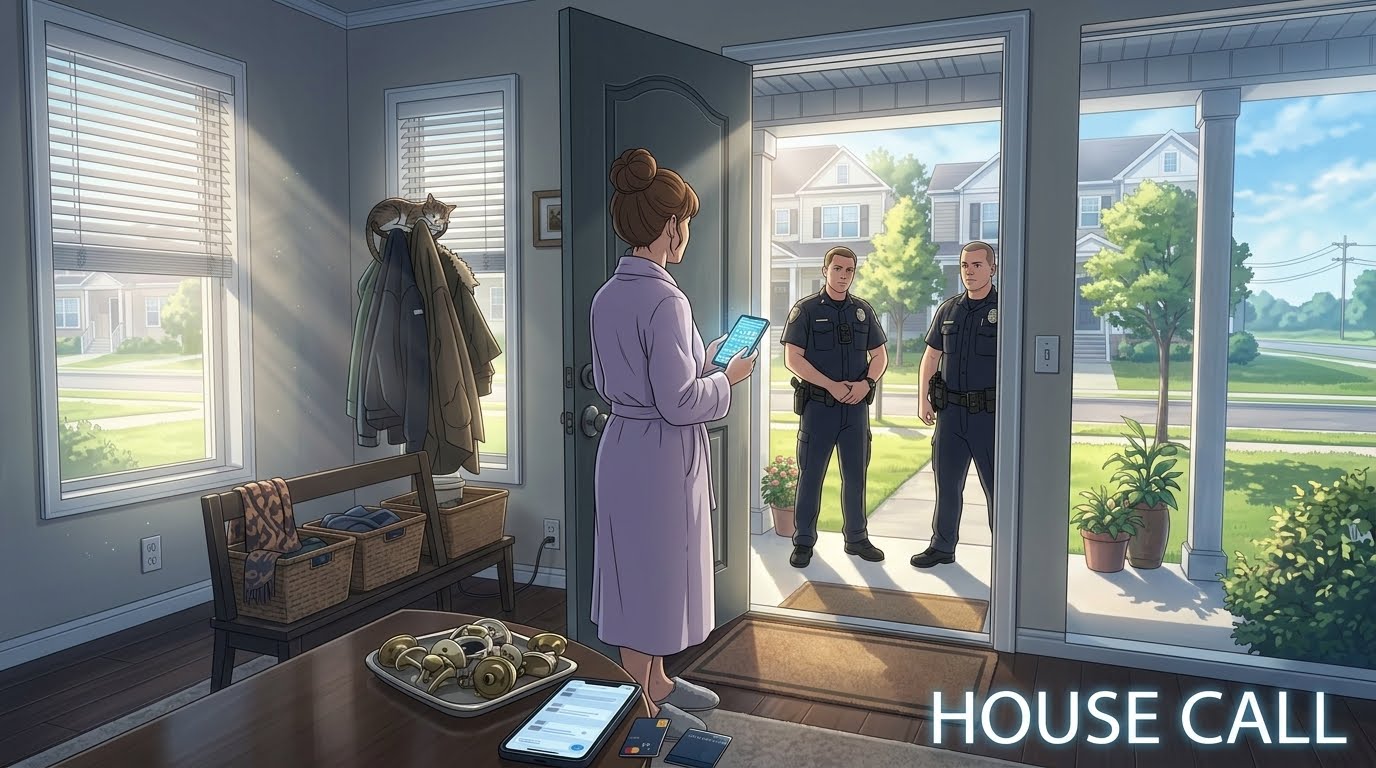
“I specifically told you not to come today.”
“But it’s Christmas.”
“I am aware.”
“The grandkids are so excited to see their grandmother.”
Dangling the grandchildren was the one manipulation tactic they assumed would never fail.
“I love those kids dearly,” I replied through the speaker. “But that doesn’t give you a free pass to completely ignore my wishes.”
Frustrated, Brandon grabbed the wrought-iron gate bars and attempted to hoist himself over.
The security guard stepped out from the shadows immediately.
“Sir, step down off the gate.”
Brandon hopped back down, his face red with anger.
Jessica glared directly into the camera lens.
“You hired a private guard to keep out your own kids?”
“I hired a guard to secure my property. You are the ones attempting to break in.”
“This is my childhood home!” Brandon yelled.
“It was your childhood home. It is my house now.”
Chloe leaned in closer to the microphone.
“What exactly do you want from us, Mom?”
“I wanted just one of you to sit next to my hospital bed. I wanted you to come over because you actually missed your mother, not because you wanted to liquidate my real estate.”
“We’re just trying to help you,” Jessica argued.
“No. You are trying to manage me as an asset.”
Brandon scoffed and shook his head.
“Fine. We are sorry. Does that make you happy?”
“That is not a real apology.”
“Then what the hell do you want to hear?”
“I want you to realize that I am not just a burden in your schedules—and I am not a pending inheritance waiting to be cashed out.”
The three of them went dead silent.
Jessica was the first to pivot.
“So this is all about money to you?”
“You ghosted me for a quarter of a year, showed up without an invitation, and tried to scale a security gate because I refused to talk about selling my property. Yet you somehow think I am the one making this about money.”
“You are going to regret shutting out your own flesh and blood,” Brandon threatened.
He didn’t say he missed me.
He didn’t say he cared about me.
He weaponized regret against me.
I signaled the guard to escort them off the driveway, and I cut the intercom feed.
The following morning, Thomas arrived for a sit-down we had booked weeks in advance. His deep-dive audit of David Vance’s files was finally finished.
He walked in carrying a scuffed leather portfolio.
“When my legal notice hit David’s corporate compliance office, they uncovered this in a locked digital archive he managed,” Thomas explained. “Robert left explicit instructions that this file should be handed over to me if he passed away before our next meeting.”
Robert’s familiar handwriting was scrawled across the cover.
For Eleanor—when the time is right.
Inside was a letter dated just one week prior to his death. Robert had actually booked a meeting with Thomas and me, but his fatal heart attack struck before it could happen.
My dearest Eleanor, the letter read. I pray that I am just being paranoid. But the kids have been asking pointed questions about your capacity to handle the estate and the accounts if I go first.
I spent my life working so you would never have to rely on anyone who didn’t treat you with respect. If our children show you true care, be generous with them. But if they only measure your value by their future inheritance, do not give them a single dime they can use as leverage.
Robert had stapled notes from a private meeting he held six months before he died. He had found out that our kids were interrogating David about the deed and the trust fund.
Jessica had asked if Eleanor could be convinced to sell.
Brandon demanded that he be put in charge of the investment portfolio.
Chloe confessed to sneaking them photocopies of our household financials.
Robert’s final handwritten warning made my hands shake.
If the three of them ever show up together pushing you about the house, know that it is a coordinated effort.
“Why didn’t David give this letter to you?” I asked my lawyer.
“Your kids struck a deal to keep all the family wealth under his firm’s umbrella if Brandon ever took the reins. David tagged this folder as a sealed family dispute and hid it in the archives.”
Thomas then slid another piece of paper across the table.
It was a limited authorization form that allegedly granted Brandon legal permission to access my trust details.
The signature at the bottom was a very good forgery of mine.
But I had never signed it.
“Brandon faxed this in ten days ago,” Thomas noted. “David pushed it through, but your new corporate trustee flagged it, rejected it, and sent it straight to me to verify.”
The document wouldn’t have let Brandon wire funds, but it would have handed him my exact balances, account routing numbers, and the precise terms of the trust.
Later that afternoon, David’s former paralegal, Megan Foster, reached out to Thomas. The internal compliance audit had finally spooked her into blowing the whistle.
She provided copies of email threads between David and my three children.
Their spontaneous Christmas ambush had been orchestrated for over six weeks.
Jessica had picked out a senior living facility and had already interviewed a real estate broker. Chloe had illegally shared my prescription lists and Medicare info. Brandon had drawn up a sweeping financial Power of Attorney, a medical proxy form, and the intake contract for the assisted living center.
Their strategy was to slip those binding legal documents into a stack of harmless facility brochures and pressure me to sign the dotted lines while the grandchildren created a chaotic distraction.
One email from Brandon stated:
She never reads the fine print when the kids are making noise.
The ultimate goal was to trick me into volunteering for the nursing home, use the POA to flip my house, and funnel the real estate proceeds into an account Brandon controlled.
If I dug my heels in and refused to sign, their backup plan was to file for an involuntary conservatorship by arguing I was suffering from dementia and could no longer make sound choices.
Chloe had replied in the thread:
This really feels wrong to do to Mom.
Brandon’s response was ice cold:
Then don’t expect a third of the payout.
Chloe had showed up at my gate anyway.
Thomas formally reported the forged signature and immediately referred my case to Sarah Jenkins, a fierce litigator who specialized in elder law and conservatorship abuse.
True to their leaked emails, within weeks, my children executed their backup plan.
They petitioned the family court to name Brandon as my legal conservator, arguing that my sudden security upgrades, erratic estate changes, and refusal to let them inside for Christmas proved I was deeply paranoid and mentally incompetent.
The legal battle dragged on for four exhausting months.
I was subjected to a rigorous, independent psychological evaluation, which concluded I was perfectly lucid and fully capable of handling my own life and wealth.
When the court date finally arrived, Sarah presented Robert’s hidden letter, the forged authorization form, the damning email chains, the trust logs, and the security footage of Brandon aggressively trying to scale my gate.
Under oath, Chloe finally cracked.
She broke down and confessed that Jessica and Brandon had plotted to corner me into signing away my rights. She admitted she had gone along with it purely out of fear that she’d be written out of her share of the money.
The presiding judge threw out their petition with prejudice, citing bad faith, and ordered my three children to cover every penny of my legal fees. The forged POA was handed over to the district attorney’s office for criminal review.
Outside the courtroom doors, Jessica walked up to me.
“Mom, we really just wanted you somewhere safe and supervised.”
“If that were true, why did you plot to bury legal contracts under Christmas cards?”
Her tough facade crumbled.
“We were terrified you were going to leave all the family money to total strangers.”
And there it was. The absolute truth.
They hadn’t lost sleep over losing their mother.
They had lost sleep over losing my bank accounts.
“You were so consumed with what you might miss out on after I died, that you completely destroyed the family you had while I was still breathing,” I told her.
Brandon stepped up and bitterly insisted that Robert had built that trust specifically for the family’s legacy.
“I am the family he built it to protect,” I fired back.
Chloe was standing a few feet away, tears streaming down her face.
“I am so sorry,” she whimpered.
“You knew what they were doing was evil.”
“I did.”
“But you rode in the car with them anyway.”
She stared at the pavement.
I did not offer her forgiveness that afternoon.
David Vance was subsequently fired by his firm and heavily sanctioned by the regulatory board for breaching client confidentiality and suppressing Robert’s directives. Brandon admitted to submitting the forged document. Jessica confessed to drafting the illicit property transfer paperwork. Chloe cut a deal, cooperating fully with state investigators and handing over every single deleted email.
I updated my estate plan one last time.
The 529 education trusts for my grandchildren remained fully funded and locked. The vast majority of my remaining wealth was diverted to non-profits dedicated to protecting the elderly from predatory financial exploitation.
My three children were completely disinherited.
I wasn’t doing it to be vindictive. An inheritance is an optional gift, not a mandatory debt a parent owes their offspring. I wasn’t taking their money away, because the money had never belonged to them in the first place.
A year later, I put the house on the market.
Not because I was bullied into it.
But because I was finally ready.
I purchased a lovely, smaller cottage near a botanical garden, filled with cozy rooms that carried no bitter memories or heavy expectations.
Jessica mailed me apology letters. Brandon only communicated through his lawyers for a few months before giving up. Chloe checked herself into intense therapy and gradually started taking accountability for her actions—without demanding cash or immediate absolution in return.
After a long while, I permitted her to call me once a month.
I never made any promises about reinstating her inheritance. If our mother-daughter bond was going to survive, it was going to survive on love, not a financial payout.
The next Christmas, Chloe tentatively asked if she could bring the grandkids over for dinner.
She pulled up at the exact time we agreed upon and respectfully rang the doorbell instead of just walking in.
“I hope we’re still welcome,” she said nervously.
“You are.”
She walked inside and quietly helped me fold the napkins and set the dining table. She did not bring up the trust fund, the sale of my old house, or my final will.
As the sound of my grandkids laughing filled my new living room, my mind drifted back to the previous Christmas—three idling SUVs stuck outside a locked iron gate, and Brandon staring in disbelief at a keypad that had shut him out.
My kids had assumed I merely changed the deadbolts and passcodes.
In reality, I had completely rewired my life.
I was no longer sitting by the phone, waiting for them to decide if I was worthy of a five-minute conversation. I was no longer hoarding a massive inheritance in the desperate hope that a payday would buy their affection.
Robert had left me with much more than a paid-off mortgage and a bloated trust account.
PART 3: THE REPORT WITH MY NAME ON IT
“What exactly has my husband told you?” I asked.
Detective Harris looked at the chain stretched between my door and its frame.
“Before we discuss that, are you alone in the house?”
“Yes.”
“Has anyone threatened you?”
“Not yet.”
His eyes lifted to mine.
“Why do you say it that way?”
I thought about the message still sitting on my phone.
I ran away with your best friend.
We’re never coming back.
“Because I stopped paying for his vacation about six hours ago.”
Officer Morales glanced at the new lock.
Then she glanced at the small cardboard box of discarded hardware beside the staircase.
“Mrs. Carter, we received a report overnight involving a substantial transfer from your husband’s business.”
I held the door still.
“A transfer?”
“Your husband told the reporting party that you had access to the money.”
For a moment, the morning seemed to stop around us.
A delivery truck idled somewhere down the street.
A bird landed on the porch railing.
My fingers tightened around the edge of the door.
“Who was the reporting party?”
“His business partner, Martin Ellis.”
I knew Martin.
He had eaten Thanksgiving dinner at my table.
His wife had sent flowers when my mother died.
Last spring, Daniel had complained that Martin was too cautious to understand ambition.
Now the police were standing on my porch before breakfast.
“What amount are we discussing?”
Detective Harris hesitated.
“Approximately two hundred and eighty thousand dollars.”
I stared at him.
Then I looked back toward the kitchen, where two mugs still sat upside down on the drying rack.
One mine.
One Daniel’s.
Fifteen years of ordinary mornings.
Two hundred and eighty thousand dollars.
“Before I say anything else,” I said, “I want to show you a message.”
I retrieved my phone without taking the chain off the door.
I opened Daniel’s text and turned the screen toward them.
Officer Morales leaned closer.
Detective Harris read it twice.
“Who is the friend?” he asked.
“Rebecca Sloan.”
“And when did you receive this?”
“Eleven forty-three last night.”
“Have you spoken to either of them since?”
“I replied with two words.”
“What words?”
“Good luck.”
Neither officer smiled.
That frightened me more than if they had.
Detective Harris stepped back slightly.
“Mrs. Carter, we need to establish what happened to the business funds.”
“And I need an attorney before anyone decides my husband’s story is mine.”
“Of course.”
I kept my hand against the door.
“Am I being detained?”
“No.”
“Then leave me your contact information.”
He passed a card through the opening.
His expression had changed.
Whatever he had expected to find at my door, it apparently wasn’t a woman in a silk robe holding proof that the man accusing her had abandoned the country with her best friend.
Officer Morales spoke before they turned away.
“Please preserve those messages.”
I looked at her.
“All of them.”
I nodded.
Then I closed the door.
I stood in the foyer for several seconds, listening to their footsteps descend the porch.
Only when the car pulled away did my knees begin to shake.
The night before, I had believed my marriage had ended.
That morning, I understood Daniel intended to leave me holding something much worse than heartbreak.
THE WOMAN I HAD BEEN BEFORE HIM
My name is Julia Carter.
Before that, it was Julia Bennett.
For fifteen years, I had thought the difference was simply a marriage certificate and a new signature.
That morning, the old name came back to me like someone knocking from inside a room I had locked years ago.
Julia Bennett had run the payroll department of a regional manufacturing company.
Julia Bennett had known how to reconcile accounts, challenge discrepancies, and look a man in the eye when his numbers failed to match his explanation.
Julia Carter had spent the previous four years hearing that she worried too much.
“You see a problem in everything,” Daniel would tell me.
Then he would kiss my forehead, take whatever document I was holding, and put it somewhere I would never see it again.
I had mistaken that gesture for reassurance.
Now I wondered how often it had been removal.
I called my sister.
She answered on the fifth ring, sounding half asleep.
“Jules?”
“I need you to come over.”
The sleep vanished from her voice.
“What happened?”
“Daniel is in Cancun with Rebecca.”
There was silence.
Then:
“I’m putting on shoes.”
“Mara.”
“What?”
“The police were just here.”
Another silence.
Different this time.
“Don’t touch anything,” she said.
“I’m not planning to.”
“I mean papers, computers, accounts.”
“I know.”
“I’m coming.”
After we hung up, I stood at the kitchen sink and filled a glass with water.
I drank half of it.
My hands were steady again.
That steadiness was useful.
It was also terrifying.
I had not cried.
I had not screamed.
I had not called Daniel and demanded an explanation.
Some part of me knew that if I allowed myself to feel the whole thing at once, I might never get out of that kitchen.
So I gave myself one task.
Find a lawyer.
Then another.
Preserve the messages.
Then another.
Write down the times.
At eight twenty-six, Mara arrived wearing mismatched earrings and carrying a paper bag from the bakery.
She set it on the counter and looked at me.
“You look awful.”
“Thank you.”
“You look like you’re doing an excellent impression of someone who isn’t about to fall apart.”
“That sounds more accurate.”
She came around the counter.
I stepped toward her.
The instant her arms closed around me, the calm cracked.
Not dramatically.
There was no collapse to the floor.
Just one sound I had never heard come out of my own mouth.
A small, wounded sound.
Mara tightened her hold.
“I know,” she whispered.
I shook my head against her shoulder.
“No.”
She waited.
“You don’t know the part about Rebecca.”
My best friend had been there when my mother died.
She had helped me select the dress I wore to the funeral.
She had sat beside me in the cemetery afterward, holding my hand while Daniel stood a few yards away answering a call.
She knew which drawer held my mother’s wedding ring.
She knew I hated sleeping in a silent house.
She knew the exact shape of the loneliness I had been too embarrassed to admit existed inside my marriage.
And she had apparently decided to occupy it.
Mara drew back just enough to look at me.
“We can hate her later.”
“I don’t think I can wait.”
“You can hate her now, too.”
For the first time that morning, I almost laughed.
Then my phone rang.
Daniel.
We both looked down.
His photograph filled the screen.
A photograph I had taken on our anniversary.
He was smiling at me across a restaurant table.
Mara reached for the phone.
I stopped her.
“Let it go to voicemail.”
THE FIRST LIE IN HIS OWN VOICE
The voicemail arrived thirty seconds later.
“Julia, what the hell have you done?”
No greeting.
No apology.
No concern.
“The hotel says there’s a problem with the card.”
I stood perfectly still.
“Whatever point you’re trying to make, you’ve made it.”
A pause.
Then his voice lowered into the tone he used when he wanted me to feel unreasonable.
“Be an adult and call me.”
Mara looked at me.
“The police were here about missing money, and he’s worried about room service.”
Another message arrived.
This one from Rebecca.
Julia, please don’t make this uglier than it already is.
I read it aloud.
Mara’s face changed.
“Give me the phone.”
“No.”
“I only need thirty seconds.”
“That’s twenty-nine seconds too many.”
I captured the message and saved it.
Then another one appeared.
You can’t just strand people in another country.
My thumb hovered over the keyboard.
For one delicious second, I wanted to ask whether she had worried about stranding me in my own life.
Instead, I put the phone down.
At nine ten, an attorney named Nina Patel returned my call.
Mara’s husband had worked with her firm years earlier.
I explained the police visit first.
Then the text.
Then the cards.
Then the locks.
She listened without interrupting.
When I finished, she asked a question I had not expected.
“Have you helped with your husband’s business accounts recently?”
“No.”
“Ever?”
“Early in the marriage.”
“How early?”
“About twelve years ago.”
“Does he still have copies of your identification?”
“We’re married.”
“That wasn’t quite my question.”
I closed my eyes.
“Yes.”
“Passwords?”
“Some old ones, probably.”
“Your signature?”
“On everything.”
“Julia, I want you to come in today.”
Her voice remained calm.
That was the first comforting thing about her.
The second was that she did not tell me everything would be fine.
She told me what to bring.
Identification.
Messages.
Recent statements.
Any business correspondence bearing my name.
“And preserve everything as you find it,” she added.
“No editing, no deleting, no trying to investigate accounts you aren’t authorized to access.”
“I understand.”
“We’ll address the house separately.”
I glanced at the new keys on the counter.
“He said he was never coming back.”
“Save that message.”
“I already have.”
“Good.”
After the call, Mara opened the bakery bag.
“You need to eat.”
“I’m not hungry.”
“You’re allowed to ruin his life after breakfast.”
I took the croissant.
For the next ten minutes, we sat at the kitchen table where Daniel had once told me Rebecca was the only one of my friends who understood him.
I remembered laughing.
I remembered thinking it was nice that the two people closest to me got along.
That memory hurt worse than the text.
THE ADDRESS ON THE APPLICATION
Nina’s office had gray chairs, a wooden desk, and a window overlooking a parking lot.
There was nothing theatrical about it.
No towering shelves of leather books.
No promises of revenge.
She offered me water and opened a notebook.
“Start with yesterday morning.”
So I did.
Daniel had left before seven.
He said he was flying to Atlanta to meet a potential distributor.
He had kissed my cheek while I was filling the coffee machine.
Rebecca had sent me a picture of a headache medicine bottle at nine.
Migraine day.
Don’t call.
I had replied:
Rest.
Love you.
At eleven forty-three that night, Daniel had sent the message from Cancun.
Nina wrote down the times.
“Now tell me about the business.”
“Commercial kitchen equipment.”
“Ownership?”
“Daniel and Martin.”
“Your role?”
“None.”
“Have you signed a guarantee for them?”
“No.”
“Applied for business credit?”
“No.”
She slid a legal pad toward me.
“Write down every bank and lender you know they use.”
I wrote three names.
Then I stopped.
“What?”
“There’s been mail.”
“What kind of mail?”
“From a lender I didn’t recognize.”
“Addressed to whom?”
“Daniel.”
“When?”
“Maybe six weeks ago.”
“What did he say?”
“That it was a financing offer.”
“Did you open it?”
“No.”
“Do you remember the company?”
I did.
Nina wrote it down.
Then she asked whether I could download my own credit reports.
We worked through the process on my phone.
The unfamiliar account appeared halfway down the first report.
A business credit obligation.
Opened seven weeks earlier.
My name attached.
I leaned closer to the screen.
“That isn’t mine.”
Nina stopped writing.
“I didn’t sign that.”
“Let’s preserve what we’re seeing.”
My throat went dry.
Until that moment, I had been able to think of the missing money as something Daniel had done elsewhere.
At his office.
In his business.
In a life I did not control.
Now my name was on a debt I had never agreed to carry.
Nina contacted the lender while I sat across from her.
The first representative could offer little.
The next person requested identification.
By early afternoon, we had instructions for formally disputing the account and obtaining the application materials.
We would not receive everything that day.
But the confirmation they could provide was enough to make the room feel smaller.
The application had used an email address resembling mine.
One extra letter.
A difference easy to miss at a glance.
The mailing address was a rented mailbox across town.
I looked at Nina.
“He made an email address?”
“We don’t know who created it yet.”
“Whoever did it used my name.”
“Yes.”
I stared at the glass of water on her desk.
“I have spent fifteen years reminding that man to renew his driver’s license.”
Nina let the silence sit.
Then she said:
“People can be helpless in the areas they want you to manage and very capable in the areas they want to hide.”
I looked away.
That sentence would stay with me longer than anything else she said that day.
THE FRIEND WHO HAD MY KEYS
When we returned home, Mara walked through the house with me.
Not searching.
Just accompanying me while I noticed things.
The missing travel bag.
The empty space where Daniel kept his passport.
The drawer in his office that stood slightly open.
I photographed it before touching anything.
Inside were warranty papers, old receipts, and a folder labeled HOUSE.
The folder held copies of our deed, insurance documents, and several years of tax returns.
Near the bottom was a photocopy of my driver’s license.
A recent one.
I had never put it there.
I sat down in Daniel’s chair.
Mara stood behind me.
“Did he take that copy for something?”
“I don’t remember.”
But another memory had begun working its way to the surface.
Rebecca at my dining table two months earlier.
Her laptop open.
Me standing beside her with a stack of old photographs.
She had offered to help assemble a slideshow for my fiftieth birthday.
“Go get the albums from upstairs,” she had said.
“I’ll scan these.”
I had left her alone near the small home printer.
The printer with a scanning tray.
The printer beside the drawer where I sometimes set my wallet.
I pressed my hands together.
“Mara.”
“What?”
“She had keys.”
“I know.”
“Not just to the house.”
My sister waited.
“When we went away last summer, I gave her the code to the alarm.”
I could hear Rebecca’s voice.
Of course I’ll check the place.
You know you can trust me.
I stood so abruptly the chair rolled backward.
“The camera.”
“What camera?”
“The driveway camera.”
Daniel had wanted to cancel the subscription.
I had kept it because packages disappeared on our street.
I opened the app.
The ordinary recordings were stored for a limited time.
But one clip had been saved.
I had saved it myself because a delivery driver dropped a planter and I had needed proof for the retailer.
It showed Rebecca’s car arriving while I was at work.
Six weeks earlier.
Daniel’s car was already in the driveway.
That alone proved little.
Rebecca visited often.
Daniel sometimes worked from home.
But the timestamp was the same morning I had spent three hours at a client’s office helping fix a payroll problem.
A place with visitor records.
Emails.
People who had seen me.
I sent the recording to Nina with one short message.
This may matter.
Then I sat down again.
For years, I had believed trust meant refusing to keep score.
Now I was learning that proof sometimes survived in the smallest, most unromantic corners of a life.
A delivery complaint.
A calendar entry.
A receipt for coffee.
THE PARTNER AT MY TABLE
Martin came to the house the following afternoon.
Nina had spoken to his attorney first.
Detective Harris knew about the meeting.
Nothing about it felt like a friendly visit.
Martin stood on my porch holding his hat in both hands.
He looked ten years older than he had at Thanksgiving.
“Julia.”
“Come in.”
He glanced at the new lock.
Then he looked down.
We sat in the kitchen.
Mara remained beside me.
Martin did not ask for coffee.
“I’m sorry,” he said.
I waited.
“For the officers coming here.”
“Tell me what Daniel told you.”
He rubbed one hand over his face.
“He said there had been an emergency.”
“What kind?”
“That you were trying to move assets before leaving him.”
I felt Mara straighten in her chair.
“He said you’d discovered something personal and were taking it out on the company.”
I looked at Martin for a long moment.
“And you believed him.”
“I believed we had money missing.”
“That wasn’t my question.”
He bowed his head.
“Yes.”
It would have been easier if he had argued.
If he had said he had always known something was wrong.
Instead, he gave me the ugly truth.
Daniel had called him shortly after midnight.
He had sounded frightened.
He had said I was unstable.
He had said I had access to old business credentials.
He had suggested Martin report the transfer immediately.
“He told me not to wait until morning,” Martin said.
Of course he had.
He wanted his version recorded first.
“Where did the money go?”
“We’re still tracing it.”
“What was it for?”
“A supposed equipment purchase.”
“Supposed?”
“The supplier denied sending the invoice.”
Martin pulled a folder from his bag.
He did not hand me confidential account information.
He showed me the invoice itself.
I recognized the formatting before I recognized why.
Rebecca used that same layout for invoices in her freelance administrative work.
A narrow blue line across the top.
The same small gray type for payment instructions.
Lots of people used templates.
I knew that.
I was careful with my words.
“Rebecca does administrative work.”
Martin’s mouth tightened.
“For us, recently.”
I stared at him.
“Daniel hired her?”
“He said you recommended her.”
The kitchen became very quiet.
Mara placed her palm flat on the table.
“When?”
“Three months ago.”
I thought of Rebecca telling me she was struggling.
I thought of buying her groceries.
I thought of inviting her to dinner because she hated eating alone.
Then I thought of Daniel insisting we order takeout instead of cooking.
Let Julia rest.
It sounded so considerate now.
So convenient.
Martin looked at me.
“I should have called you.”
“Yes,” I said.
“You should have.”
THE HONEYMOON THEY COULDN’T AFFORD
By the third day, their messages had changed.
Daniel stopped commanding.
Rebecca stopped scolding.
They began bargaining.
Just restore one card temporarily.
We can discuss the rest when we’re home.
Please think about what this is doing to us.
I read that last sentence several times.
Us.
They had managed to create an us out of the people who had hurt me.
Then Daniel left a voicemail from somewhere noisy.
“Julia, this has gotten out of hand.”
A pause.
“I know you’re hurt.”
There it was.
The explanation that made everything smaller.
Hurt.
As though my feelings were the inconvenience.
As though the strange debt, the police report, and the missing business money were background noise.
“I never meant for things to happen like this.”
I stared at the phone.
No one accidentally booked two flights to Mexico.
No one accidentally packed a passport.
No one accidentally created an email address one letter away from his wife’s.
At the end of the message, he said:
“We need to be practical.”
Nina listened to it at our next meeting.
“Do you want to answer?”
“No.”
“Then we won’t.”
She explained what would happen next.
Separate disputes.
Separate investigations.
A divorce proceeding.
A review of property and accounts.
It would take time.
The credit issue would not disappear because I was angry.
The business transfer would not be resolved because Daniel had written a cruel text.
Evidence would have to support each allegation.
I appreciated her saying that.
I had no desire to become another person who expected a story to replace facts.
That evening, Rebecca called from an unfamiliar number.
I answered before I recognized the voice.
“Julia.”
I closed my eyes.
“Send whatever you need to say in writing.”
“Please don’t hang up.”
I said nothing.
“I didn’t know about the money.”
“You’ll need to tell the investigator what you knew.”
“I’m talking to you as your friend.”
“You are not my friend.”
A sharp breath.
Then crying.
I had heard Rebecca cry through a failed engagement, two layoffs, and the death of her father.
My body almost reacted before my mind could stop it.
Almost reached toward comfort out of habit.
That was the worst part.
Love did not disappear at the speed of knowledge.
She had betrayed me.
And some trained, faithful part of my heart still wanted to ask whether she had eaten.
“Daniel told me you were already separating,” she whispered.
“I bought him an anniversary gift last month.”
“He said you were keeping up appearances.”
“You helped me choose it.”
Silence.
I could hear air moving through the line.
Somewhere behind her, a door slammed.
“I thought—”
“No,” I said.
“You knew.”
She started crying harder.
I gripped the phone.
“You sat across from me while I told you I was worried my husband didn’t love me anymore.”
“I know.”
“You told me I was imagining things.”
“I know.”
“You told me he was tired.”
Her voice broke.
“I know.”
For the first time, my own voice rose.
“Then stop asking me to help you pretend you didn’t understand.”
She said my name again.
This time it sounded small.
I hung up.
Then I stood in my kitchen and cried until Mara arrived.
THE PAPER IN THE DRAWER
The lender’s application materials came through Nina’s office the following week.
I sat across from her while she placed the pages in front of me.
My name.
My birth date.
My address.
My supposed consent.
The signature looked like mine at first.
Then I saw the second letter in Bennett.
I had kept Bennett as part of my legal name.
The two n’s in my signature always ran together.
This version separated them.
A tiny difference.
A detail no one who loved me should have needed to counterfeit.
“There’s more,” Nina said.
She showed me an attachment used to support the application.
It was a copy of a financial statement.
One I had prepared years earlier for a home renovation loan.
Only the date had changed.
The income figure had changed, too.
Upward.
Considerably.
I stared at the page.
My work.
My name.
His numbers.
“Can they make me pay this?”
“We’re disputing the account and providing the evidence.”
“What if they don’t believe me?”
“Then we keep working through the process.”
She leaned forward.
“You don’t have to persuade everyone in one afternoon.”
I had not realized how badly I needed to hear that.
For the past week, every room I entered felt like a place where I might be required to prove I was innocent.
Even my own bedroom.
Even the grocery store.
I imagined the neighbors seeing the police car.
I imagined Martin’s employees hearing Daniel’s version.
I imagined people saying there were two sides to every story without caring whether one side had been manufactured.
Nina slid a second folder toward me.
“Your old email records may help establish that statement’s original date.”
“I can find them.”
“We also have the records of your work appointment on the morning the application was submitted.”
“The morning Rebecca came over.”
“Yes.”
I ran my hand over the edge of the desk.
“Why?”
Nina did not pretend I was asking about paperwork.
“Sometimes the people who betray us have been practicing small betrayals for a long time.”
I thought of Daniel’s jokes about my caution.
Rebecca’s little corrections.
The way both of them had told me I was too sensitive whenever something hurt.
“How do you know when it started?”
“You may never know every part.”
“That feels unbearable.”
“It does at first.”
THE NIGHT I FINALLY SLEPT BADLY
The terrible sleep came late.
For the first few nights, I had rested as though my body had shut down to keep me useful.
Then the shock wore thin.
I woke at two in the morning with my heart racing.
I woke at four convinced I had heard the front door.
I woke at six reaching across the mattress toward someone I no longer wanted there.
That reflex humiliated me.
I told Mara.
She sat beside me on the bed.
“Your arm hasn’t read the evidence yet.”
I laughed.
Then I cried.
Then I laughed again because I was crying over an arm.
We stripped the bed together.
I had been sleeping beneath sheets Rebecca had helped me choose.
I had not remembered that until I touched them.
So many objects carried her fingerprints in memory.
A blue bowl.
A framed photograph.
A scarf hanging by the back door.
Mara took the photograph down.
I stopped her.
“Not yet.”
She looked at me.
“I don’t want to throw everything away while I’m like this.”
“Okay.”
“Put it in a box.”
“Okay.”
We made three boxes.
Things I needed.
Things I could not look at.
Things I would decide about later.
That third box saved me.
I did not have to determine the fate of fifteen years before lunchtime.
I only had to move the objects out of my sight.
When we finished, Mara opened the bedroom curtains.
Morning light fell across the bare mattress.
I sat beside the box holding our wedding album.
“Do you think any of it was real?”
My sister leaned against the dresser.
“I think you were real.”
“That isn’t what I asked.”
“I know.”
I waited.
She folded her arms.
“I don’t know what was inside him.”
Neither did I.
For the first time, I accepted that his private truth might never become available to me.
I could spend the rest of my life interviewing memories.
Or I could begin making new ones.
I was not ready for the second option yet.
But I could see it.
THEY CAME BACK
Daniel returned twelve days after his message.
He did not come straight to the house.
His lawyer contacted Nina.
By then, the lender dispute was underway and the investigators had begun comparing the application, business records, and communications.
The story Daniel had told Martin was failing in places he had apparently assumed no one would examine.
The business transfer had required approval from credentials assigned to Daniel.
The altered invoice had arrived through an account Rebecca used for her contract work.
My supposed email address was not an address I had ever owned.
None of those facts alone answered every question.
Together, they gave the people doing the investigation reasons to keep looking.
Daniel wanted access to the house.
Nina explained that changing a lock had not magically settled possession or ownership.
My text messages mattered.
So did the deed.
So did the rules we had to follow.
I hated that there were rules for a man who had announced he would never return.
I followed them anyway.
The house had been mine before the marriage.
My parents had helped me buy it.
We still needed to handle his belongings and any claims through the proper process.
A supervised collection was arranged by agreement.
Saturday.
Ten in the morning.
Two hours.
Mara stayed with me.
Daniel arrived wearing sunglasses and the navy shirt I had bought him for his birthday.
He stood on the porch holding his old key.
For a second, he seemed unable to understand why it did not work.
Then he remembered.
I watched through the side window.
He knocked.
I opened the door.
There are moments the mind spends days rehearsing.
The speech.
The accusation.
The devastating sentence.
When he finally stood in front of me, I forgot every one of them.
He looked tired.
Ordinary.
Smaller than the person who had filled so much space in my life.
“Julia.”
“Your boxes are in the dining room.”
He looked past me.
“Can we talk?”
“Your attorney can contact mine.”
“Fifteen years, and that’s all you have to say?”
I looked at him.
“You announced the end of those fifteen years in a text.”
He removed his sunglasses.
“I was angry.”
“From Cancun.”
“We’d been unhappy for a long time.”
“You had been hiding things for a long time.”
His mouth tightened.
Behind me, Mara moved into view.
Daniel’s face changed.
“Of course.”
“What does that mean?” she asked.
“Nothing.”
“Then keep it that way.”
He stepped inside.
The house had not changed much.
That seemed to unsettle him.
The sofa still stood beside the window.
The clock still ticked above the kitchen door.
The plant he always forgot to water was thriving.
He had apparently expected the physical world to register his departure more dramatically.
At the dining room, he looked at the stacked boxes.
“You packed my things?”
“Only what we agreed.”
He opened one.
Shirts.
Photographs from his office.
His headphones.
He lifted a small wooden carving from another box.
A bird my father had made.
“That was mine.”
“My father gave it to both of us.”
“So now you’re taking gifts back.”
I reached into the box and set the bird on the table.
“You can have it.”
He stared at me.
I no longer needed every object to testify.
Some things were just wood.
THE EXPLANATION HE WANTED ME TO ACCEPT
Halfway through the collection, Daniel found me in the kitchen.
The agreed supervisor was in the dining room with Mara, making a note of the boxes.
He kept his voice low.
“Rebecca used me.”
I looked at him for a long time.
Then I turned off the tap.
“Is that the story now?”
“You don’t know what she’s like.”
“I thought I did.”
“She was always saying you didn’t appreciate me.”
I leaned against the counter.
“And you enjoyed hearing it.”
He rubbed his forehead.
“I was under pressure.”
“So you took her to Mexico.”
“I needed to get away.”
“You could have taken a walk.”
He glanced toward the dining room.
“Do you want everyone hearing this?”
“I haven’t raised my voice.”
His shoulders dropped.
For a moment, he looked almost like the man I had married.
“Jules.”
I felt the old nickname land.
Not tenderness.
Recognition.
He was reaching for a key that had worked before.
“We can fix some of this.”
“No.”
“You don’t even know what I’m going to say.”
“I know you want something.”
He looked offended.
Then tired.
Then calculating.
The changes came so quickly I wondered how I had missed them for years.
“The credit account is a misunderstanding.”
“Then provide the evidence to the investigator.”
“You know I would never hurt you like that.”
“You accused me of taking company money.”
“I was trying to buy time.”
The words came out before he could stop them.
We both heard them.
I went still.
“Buy time for what?”
He looked toward the door.
“Julia.”
“For what, Daniel?”
“I need my lawyer.”
“Then speak to your lawyer.”
He stared at me.
I could see him realizing that there would be no private agreement in the kitchen.
No promise sealed with my silence.
No chance to make me responsible for saving him from what he had chosen.
I stepped away from the counter.
“Your remaining boxes are ready.”
At the door, he paused.
“Do you really hate me this much?”
I looked at the man whose return I had once waited for every evening.
“I am spending all my energy getting through what you did.”
Then I closed the door.
THE MESSAGE SHE ALMOST DELETED
Rebecca contacted Nina’s office three weeks later.
Her attorney was involved by then.
I did not receive a confession wrapped in tears.
I received notice that additional records had been provided to the investigators.
Some of those records eventually became part of the proceedings.
One message from Daniel had been sent two days before they left.
Julia will panic when she sees the charges.
She’ll call me before she calls anyone else.
Another:
If Martin asks, she still had access.
Keep it simple.
I read those lines at Nina’s desk.
No music swelled.
No dramatic realization arrived.
I simply felt cold.
He had counted on knowing me.
On my fear.
On my loyalty.
On the fact that I had spent years calling him first when something went wrong.
The plan did not require me to be foolish.
It required me to remain the wife I had been.
The woman who fixed.
The woman who explained.
The woman who believed a crisis could always be softened if she found the right words.
“He expected you to call him,” Nina said.
“Yes.”
“Why didn’t you?”
I looked down at the messages.
“I think I finally understood there was nothing left to ask.”
Rebecca had also supplied a longer exchange.
In it, Daniel told her I would eventually cover the disputed debt because I would not want a scandal.
She replied:
She’ll hate me.
His answer:
She’ll get over it.
Those four words stayed with me for weeks.
While I shopped for groceries.
While I folded towels.
While I sat in traffic beside couples who looked perfectly ordinary.
She’ll get over it.
The casual certainty.
The belief that my pain would become manageable if he simply waited.
Perhaps I would get over it.
But he had mistaken recovery for consent.
THE FIRST ROOM THAT BELONGED TO ME
I began with his office.
Not because Nina told me to.
Not because Mara suggested it.
Because one morning I opened the door and realized I had been avoiding a room in my own house.
The desk was mostly empty after he collected his belongings.
Dust marked the places where his monitor and framed awards had stood.
I opened the curtains.
Then the window.
Cold air moved through the room.
I stood there with my hands in my pockets.
For years, Daniel had said the room was too small.
Too dark.
Too close to the street.
He had complained about it every time I asked whether he could move his work upstairs so we could use the space differently.
Now, without his equipment, it looked generous.
I bought paint.
A soft green.
The hardware store clerk asked if I needed brushes.
“Yes.”
“A roller?”
“Yes.”
“Drop cloths?”
“I’m starting to think I need everything.”
He smiled and helped me fill the cart.
Mara came over on Sunday.
We painted badly at first.
There was a streak on the ceiling.
A green fingerprint near the door.
We ordered pizza and ate sitting on the floor.
At some point, she asked what the room would become.
“I don’t know.”
“A guest room?”
“Maybe.”
“A library?”
“Maybe.”
She looked around.
“You don’t have to make it useful immediately.”
I watched the late afternoon light touch the wet paint.
“I think I want a room where nobody needs anything from me.”
So that was what it became.
A chair.
A lamp.
Books I chose.
A table large enough for a cup of tea and small enough that nobody could turn it into an office.
When I sat there for the first time, I cried.
Not over Daniel.
Over how long I had believed every corner of my life needed to serve someone.
THE FRIENDS WHO CHOSE SIDES
People learned about the affair before they learned about the financial investigation.
That meant the first advice I received was spectacularly useless.
Don’t throw away fifteen years over one mistake.
People change.
Maybe counseling would help.
You don’t want to grow old alone.
A woman from our dinner group called one afternoon and said she hoped I would be gracious.
“Gracious about which part?” I asked.
She hesitated.
“The situation.”
“The affair?”
“Well.”
“The credit application?”
“I don’t know anything about that.”
“The report to the police?”
“Julia, I don’t want to take sides.”
“Then stop asking me to make his side more comfortable.”
She did not call again.
Other people surprised me.
A neighbor I barely knew left soup at my door.
An old colleague invited me to lunch and did not mention Daniel until I did.
Martin’s wife, Ellen, sent a message.
I believed the wrong version for two days.
I am sorry.
You don’t have to respond.
I read that message several times.
It did not ask me to reassure her.
It did not insist she was a good person.
It simply admitted harm.
A week later, I called her.
We met for coffee.
She looked nervous.
“I don’t expect you to trust me immediately.”
“Good.”
She nodded.
Then she asked how I was sleeping.
Not whether I had heard from Daniel.
Not whether Rebecca was still with him.
Not whether the rumors were true.
How I was sleeping.
I began to understand that friendship could be recognized in the questions people chose.
THE WOMAN IN THE PARKING LOT
I saw Rebecca again in the parking lot outside Nina’s office.
It was nearly three months after Cancun.
She was waiting beside an older car I did not recognize.
Her hair was shorter.
She wore no makeup.
For one second, I saw the woman I had known for twenty-three years.
Then I remembered the altered invoice.
The scanner.
The migraine message.
I stopped several feet away.
“You shouldn’t be here.”
“I asked your lawyer if I could leave a letter.”
“Then leave it with her.”
“I wanted to know if you’d read it.”
“I don’t know.”
She folded her arms tightly across her stomach.
“I’m not asking you to forgive me.”
“Then what are you asking?”
She stared at the pavement.
“I wanted you to hear me say I knew.”
I waited.
“When I told you he was just stressed.”
Her voice shook.
“When you asked me if something was wrong.”
A car passed behind us.
The driver waved at someone by the building.
Life continued with unbearable ease.
“I knew,” Rebecca said.
I felt my fingers curl around my car keys.
“How long?”
She swallowed.
“The affair started last fall.”
I pictured Halloween.
The three of us carving pumpkins at my kitchen table.
Rebecca laughing because Daniel had cut his too wide.
Me taking a photograph.
“Before my birthday?”
“Yes.”
“Before Christmas?”
“Yes.”
I looked away.
She wiped her cheeks.
“He told me he loved me.”
“Did you think that made it harmless?”
“No.”
“Did you think I would understand?”
“I think I avoided imagining you finding out.”
That answer was so plainly selfish it almost felt like honesty.
“Why my documents?”
She went still.
“Tell the investigators,” I said before she could begin.
“I don’t want an explanation tailored to make me feel sorry for you.”
She nodded slowly.
“I gave them what I had.”
“Good.”
Then she said:
“We aren’t together anymore.”
I looked at her.
Something in her expression waited.
For recognition.
For satisfaction.
Perhaps for the old intimacy of sharing bad news.
I had nothing to give it.
“That doesn’t change what happened to me.”
“I know.”
“I hope you do.”
I unlocked my car.
She stepped back.
For twenty-three years, we had hugged goodbye.
That afternoon, I got into the car without touching her.
I sat behind the wheel until she walked away.
Then I drove home.
THE WORK OF GETTING MY NAME BACK
The lender did not remove the disputed account overnight.
There were forms.
Requests.
Follow-up calls.
A second packet of records.
A written explanation I had to review so many times that I could recite portions of it in my sleep.
Nina handled the legal correspondence.
I supplied documents.
The investigators supplied what could properly be shared.
Eventually, the lender confirmed that I would not be held responsible for the account opened without my authorization.
I read the letter standing at my kitchen counter.
Then I read it again.
My relief was not dramatic.
I sat down.
I put my hands flat on the table.
And I breathed without counting the breaths.
The divorce moved separately.
Some disputes were resolved by agreement.
Others required additional disclosure.
I did not get everything I wanted simply because Daniel had behaved badly.
I had to accept that.
I also did not owe him a private rescue because we had once loved each other.
That took longer to accept.
There were days I remembered him fixing my car in the rain.
Days I remembered the way he had stayed beside my mother’s hospital bed so I could go home and shower.
Those memories were real.
So were the messages.
So was the debt.
I stopped trying to make one set erase the other.
At the final settlement meeting, Daniel sat across a conference table wearing a suit that no longer fit him well.
His attorney spoke.
Nina responded.
Numbers were checked.
Terms were clarified.
My life changed in sentences that sounded dry enough to belong to someone else.
Near the end, Daniel looked at me.
“I never thought we’d end up here.”
I met his eyes.
“You knew we were going somewhere.”
He looked down.
I signed only after reading every page.
No one rushed me.
When we left the building, Nina stood beside me on the sidewalk.
“How do you feel?”
I watched a bus pull away from the curb.
“Tired.”
“That makes sense.”
“Is this the part where I’m supposed to feel free?”
“You’re allowed to feel tired first.”
So I did.
I went home.
I put on clean pajamas.
I ate toast for dinner.
And I slept.
WHAT THE COURTROOM COULD NOT GIVE ME
The criminal proceedings took longer than the divorce.
Much longer.
By then, investigators had traced enough records to challenge the accounts Daniel and Rebecca initially gave.
There were communications between them.
Documents connected to the false application.
Records related to the business payment.
There were also limits.
Not every dollar was recovered.
Not every cruel act was a crime.
Not every betrayal belonged in a courtroom.
The business suffered.
Martin sold assets and renegotiated obligations while trying to protect the people who worked for him.
I thought often about those employees.
People who had not appeared in Daniel’s grand escape story at all.
People whose paychecks had become uncertain while he ordered dinner beside the sea.
Rebecca eventually admitted her role in preparing and submitting false materials.
Her cooperation mattered to the proceedings.
It did not turn her into an innocent bystander.
Daniel accepted a plea agreement on fraud charges after the evidence had been reviewed and his attorney had advised him.
The result included a prison term and restitution obligations.
Rebecca received a separate sentence reflecting her conduct and cooperation.
I attended Daniel’s sentencing.
Not because I wanted to watch him suffer.
Because I wanted the person he had accused to stand in the same room while the truth was recorded.
He looked toward me when I entered.
I did not look away.
When it was my turn to speak, I carried one page.
I had written three.
Then cut them down.
There was no need to describe every sleepless night.
No need to make the room understand every memory.
I said that Daniel had used the familiarity of marriage to make wrongdoing appear ordinary.
I said that being accused had changed the way I moved through my own life.
I said that clearing my name had required time, money, and help I was fortunate to have.
Then I said the part that mattered most to me.
“I trusted my husband.”
My voice shook.
I let it.
“That was not permission to use my identity.”
I folded the paper.
I sat down.
For months, I had imagined leaving that courtroom triumphant.
Instead, I left sad.
A whole life had narrowed to a case number.
There were consequences.
There was an official record.
But there would never be a ruling that restored the woman I had been before eleven forty-three that night.
I had to take care of the woman who remained.
THE BIRTHDAY I ALMOST CANCELED
I turned fifty in September.
For months, I had intended to ignore it.
Rebecca had once offered to organize a party.
Daniel had promised a surprise.
The thought of either made my stomach turn.
Mara refused to let the day disappear entirely.
“Six people,” she said.
“No decorations?”
“One cake.”
“No speeches?”
“I can control everyone except myself.”
I agreed.
We gathered in the backyard.
Mara.
Her husband.
Ellen.
A colleague named Denise.
My neighbor Ruth.
And me.
Six people around a table I already owned.
No elaborate theme.
No slideshow.
No husband waiting to be praised for remembering the date.
Ruth brought flowers from her garden.
Denise brought a bottle of wine.
Ellen brought nothing because I had asked her not to, and she had listened.
That small act made me love her a little.
After dinner, Mara carried out the cake.
There were fifty candles.
“You said one cake.”
“I complied.”
“I also said no drama.”
“These are candles, Jules.”
We laughed.
They sang.
I looked around the table.
No one there knew every detail.
No one needed me to perform recovery.
I had not become dazzling.
I had not lost twenty pounds.
I had not found a new man with a better car.
My hair was going gray at the temples.
My eyes still looked tired some mornings.
My life was smaller in certain ways.
It was also more honest.
Before I blew out the candles, I thought of the wish I would have made a year earlier.
Let us be okay.
Let him love me.
Let me stop feeling something is wrong.
This time, I did not ask for another person to change.
I wished for the courage to keep believing what I knew.
Then I blew.
It took three tries.
Everyone applauded anyway.
THE LETTER FROM DANIEL
His letter arrived in winter.
My name was written carefully on the envelope.
Julia.
No nickname.
No claim.
I left it on the kitchen counter for two days.
On the third, I carried it into the green room and sat beneath the lamp.
He wrote that he had been thinking.
He wrote that he had lost everything.
He wrote that he finally understood how much I had done for him.
Those sentences hurt because once, I would have waited years to hear them.
Then came the question.
Would I consider visiting?
I set the page on my lap.
Outside, rain touched the window.
I could imagine him writing it.
I could imagine his loneliness.
I could imagine, too easily, the work I would begin doing if I answered.
Choosing the right words.
Softening the refusal.
Making sure he understood I was not cruel.
It was exhausting before I had even picked up a pen.
I showed the letter to my therapist the following week.
“What do you want to do?” she asked.
“I don’t know if not answering makes me a bad person.”
“That wasn’t my question.”
I looked at her.
She waited.
“I don’t want to go.”
“Then start there.”
So I did.
I did not visit.
I did not write a letter explaining why.
I kept his in a folder with the other records.
Not as punishment.
As part of a life that had happened and no longer required my participation.
THE DAY GOOD LUCK CHANGED ITS MEANING
Spring came slowly that year.
A cold March.
A wet April.
Then one bright Saturday, I walked into the garden center and bought plants without calling anyone to ask whether they thought it was a good idea.
That was the entire event.
Nothing dramatic.
No revelation beside the roses.
Just six pots of lavender, two climbing plants, and a lemon tree that would have to come indoors for winter.
Daniel would have called the tree impractical.
Rebecca would have found one on sale somewhere else and made me feel foolish for paying full price.
I bought it anyway.
At home, I spent the afternoon kneeling in the dirt.
My back hurt.
My fingernails turned black.
One of the climbing plants leaned stubbornly in the wrong direction.
I tied it gently to the support and left it time.
Ruth came over with lemonade.
She looked at the lemon tree.
“That’s optimistic.”
“I know.”
“Good.”
We sat on the back steps.
For a while, neither of us spoke.
The silence did not ask anything from me.
Eventually, she said:
“Are you keeping the house?”
“Yes.”
“You sound sure.”
“I am.”
For months, people had suggested I move.
Start fresh.
Get away from the memories.
They meant well.
But the house had held my life before Daniel.
My mother had helped me plant the first garden.
My father had repaired the porch railing.
Mara and I had eaten terrible takeout on the kitchen floor the day I got the keys.
I was not ready to surrender those memories because Daniel had damaged newer ones.
The house could hold both.
So could I.
That evening, after Ruth left, I opened my phone to find the original message.
I had not looked at it in months.
There it was.
His escape.
His announcement.
His certainty that he had decided the shape of my future.
Under it, my reply….
