Three days after my father died, my husband quit the job he had held for twenty-two years.
That sentence still sounds ridiculous when I say it out loud.
At the time, however, nothing about my life felt real enough for ridiculousness to register properly.
My father was dead.
His funeral had not happened yet.
His last voicemail was still sitting unopened in the deleted-message menu because I could not bring myself to erase it permanently.
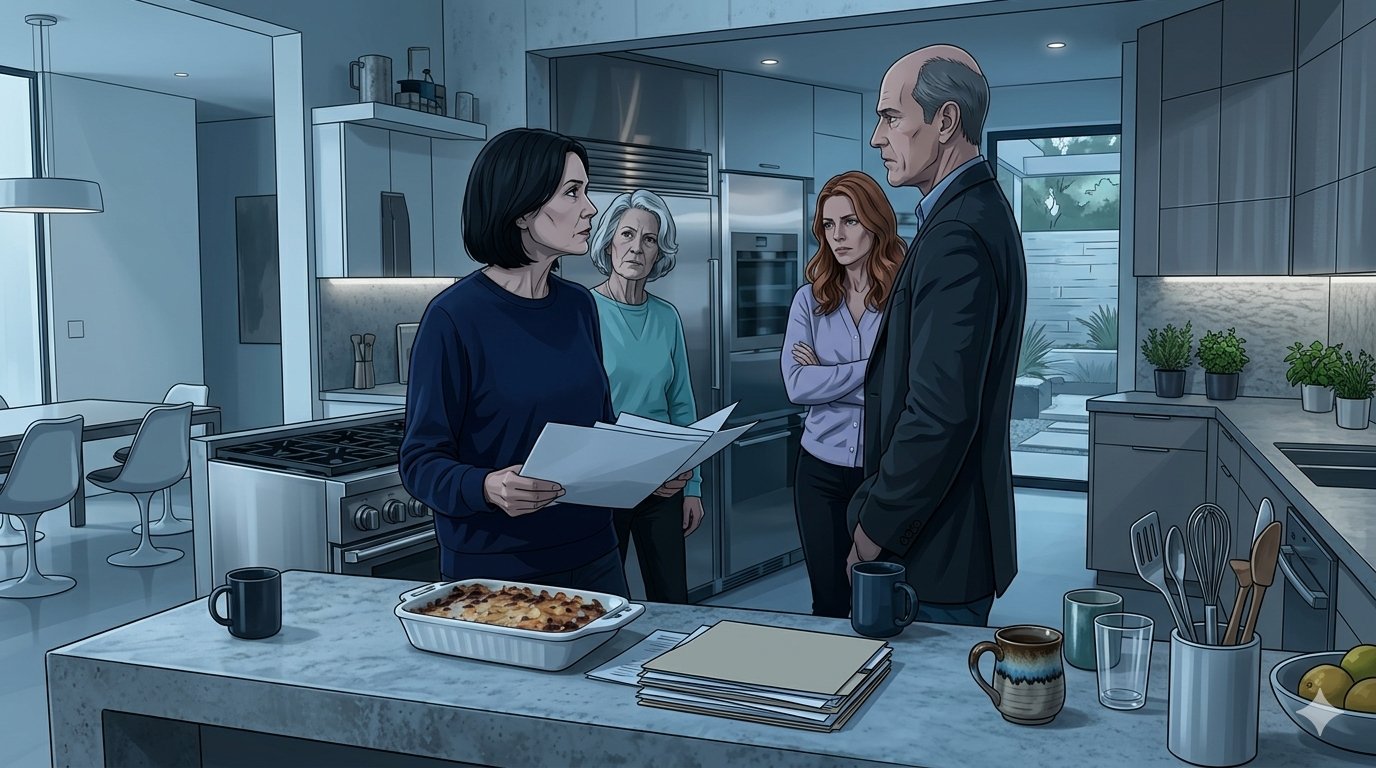
And at 10:30 on a Wednesday morning, Mark was sitting at our kitchen table in gray sweatpants, drinking coffee like the next twenty years of his life had already been paid for.
For two decades, I had known the sounds of his workday better than I knew some songs.
The cabinet opening before sunrise.
The click of the travel mug.
His company phone vibrating against the counter.
The garage door rolling upward a few minutes before eight.
That morning there was nothing.
Just Mark.
Coffee.
And an expression I would later understand was relief.
“Why are you home?”
He did not hesitate.
“I quit.”
I thought grief had scrambled my hearing.
“You what?”
“I quit yesterday.”
Yesterday.
Two days after Dad died.
I stared at him.
Mark took another drink and said, almost casually, “There wasn’t any point dragging it out.”
“Dragging what out?”
“Work.”
I remember noticing a stack of sympathy cards beside him.
One had Dad’s name written across the envelope in blue ink.
Mark’s coffee cup was sitting on top of it.
Then he said, “Your inheritance should be enough for both of us.”
That was the moment something inside me shifted.
Not broke.
Not yet.
Shifted.
Because I did not know what my father had left me.
Dad had sold Hail Mechanical several years earlier, but he had never discussed the sale price with me.
He owned his house outright.
He lived carefully.
He drove the same truck until repairing it became more expensive than replacing it.
He bought good tools and cheap shirts.
That was Dad.
Mark saw those same facts and somehow converted them into a retirement plan.
“How much do you think I’m inheriting?” I asked.
He shrugged.
“Millions, probably.”
“Probably?”
“Clare, your dad sold a company and had no mortgage.”
That was his entire calculation.
No documents.
No numbers.
No conversation with me.
Just expectation.
I asked whether he had spoken to Dad about money before he died.
Mark looked offended.
“Of course not.”
I believed him then.
That night, Diane and Melissa came over.
I had not invited them.
Mark had.
I was too tired to argue.
The refrigerator hummed behind us while a casserole cooled untouched in the middle of the table.
Diane asked how I was doing.
Before I could answer, Mark said, “She’ll be okay.”
Then he began spending Dad’s money.
“Mom, once everything clears, I’m getting you out of that townhouse.”
Diane blinked.
“What do you mean?”
“I’ll buy you a house.”
Her expression changed immediately.
Within seconds she was talking about neighborhoods, yards, whether she wanted one story or two.
I sat there listening to my husband discuss somebody else’s future with an inheritance neither of us had seen.
Then he turned to Melissa.
“And we’ll straighten you out.”
Melissa frowned.
“What does that mean?”
“Your business debt.”
She looked at me for the first time all evening.
Mark kept talking.
“I’ll give you two hundred thousand dollars.”
The room changed.
Diane smiled.
Melissa covered her mouth.
Mark looked pleased with himself.
And I sat there with Dad’s funeral folder less than ten feet away.
Nobody asked what Dad had left.
Nobody asked whether the inheritance was large enough to do any of this.
Nobody asked what I wanted.
That was the part I could not stop thinking about.
Mark had not merely assumed there would be money.
He had assumed my consent.
“Dad hasn’t even been buried,” I said.
Mark’s jaw tightened.
“I’m talking about taking care of family.”
I looked at Diane.
Then Melissa.
Then back at the man I had been married to for more than twenty years.
“Whose family?”
Nobody answered.
The next morning I drove to Dad’s house.
I needed to choose the suit he would wear for the service.
The house smelled like cedar, old coffee, and the faint machine-oil scent that always seemed to follow Dad home from Hail Mechanical even years after he stopped working there.
His reading glasses were on the dresser.
A yellow legal pad rested beside them.
His handwriting covered half the top page.
Hardware store.
Call insurance.
Clare birthday.
I sat on the edge of his bed and cried harder over those three ordinary words than I had at any point since he died.
Then my phone rang.
Dad’s estate attorney.
“Clare, before we discuss what your father left you, I need to confirm something about your husband.”
My hand tightened around the phone.
“What about Mark?”
“Did he know your father had changed the structure of your inheritance?”
“No.”
I looked toward the open closet.
“I didn’t know either.”
The attorney went quiet for a moment.
Then he told me Mark had called his office that morning.
Mark had identified himself as my husband and asked when “our funds” would be released.
He also asked whether any money could be distributed before the estate administration was finished.
I closed my eyes.
That was why the attorney had called me first.
“I told him I could not discuss your father’s estate with him,” he said.
“What did Mark say?”
“He seemed surprised.”
Of course he did.
People become very interested in boundaries when they finally encounter one.
The attorney continued.
“Your father anticipated that you might someday need to keep inherited assets separate and under your own control.”
I frowned.
“Why?”
“There’s a letter for you that explains some of it.”
He asked me to come to his office after the funeral.
Then he gave me the number.
After debts, taxes, and several charitable gifts Dad had specified, the property and investment assets intended for me were valued at approximately $2.8 million.
I sat perfectly still.
Two point eight million dollars.
Mark had guessed that Dad was worth millions.
What Mark had not guessed was that Dad had not left those millions to “us.”
Dad had created a trust for my benefit.
I was the beneficiary.
I would become the controlling trustee after the estate transferred the assets.
Mark had no authority to direct distributions.
He was not a co-trustee.
He was not named as a beneficiary.
The attorney carefully explained that marriage and inheritance rules could vary depending on how money was handled afterward, and that I should get my own legal advice before moving, combining, gifting, or spending anything.
But Dad’s intention was unmistakable.
The inheritance was for me to control.
Not Mark.
Not Diane.
Not Melissa.
Me.
When I got home, Mark was waiting in the kitchen.
“Why didn’t you answer?”
“I was talking to Dad’s attorney.”
His posture changed.
“Finally.”
That single word told me everything.
Not How are you?
Not Was it difficult?
Finally.
“How much?” he asked.
I put my purse down.
“Before we talk about that, why did you call Dad’s attorney?”
His face went blank.
Then defensive.
“I was helping.”
“With what?”
“Getting information.”
“About my father’s estate?”
“Our estate situation.”
“No.”
He stared at me.
“What?”
I said it again.
“No.”
The word seemed to offend him more than anything else I had said during our marriage.
I asked when he had actually resigned.
He admitted he had submitted notice the morning after Dad died.
He had not waited for the will.
He had not waited for the funeral.
He had not even waited to learn whether Dad had left me money at all.
He had simply decided.
Then I asked the question I had been avoiding.
“Did you ever ask Dad about his money?”
Mark looked away.
That was the first real answer.
Eventually, it came out.
Months earlier, during a backyard cookout, Mark had made a joke to Dad about how I would be “set for life someday.”
Dad had not laughed.
Mark claimed it had been harmless.
According to the letter Dad later left me, it had not felt harmless to him.
I read that letter two days after the funeral.
Dad wrote that he had watched Mark talk increasingly often about what “we” would do when Dad was gone.
A bigger house.
Travel.
Helping Mark’s family.
Early retirement.
Dad said he had hoped he was misreading it.
Then, during that cookout, Mark asked whether selling Hail Mechanical meant Dad had “put Clare in the millionaire club.”
Dad changed his estate plan the following month.
Not to punish Mark.
To protect my ability to choose.
One sentence in the letter stayed with me.
Money shows you who believes your choices belong to them.
I read it three times.
Then I remembered Diane naming neighborhoods.
Melissa accepting $200,000.
Mark announcing retirement.
Nobody had asked me a single question.
The next week I opened an account in my name alone for estate-related expenses after speaking with independent counsel.
I did not transfer inherited funds into our joint checking account.
I did not buy Diane a house.
I did not pay Melissa’s debt.
And I told Mark he needed to decide whether quitting his job had been a temporary act of grief-fueled stupidity or a permanent declaration of how he saw our marriage.
He accused me of humiliating him.
I told him I had not announced his retirement.
He had.
He said married people shared everything.
I reminded him that he had made every decision alone.
His job.
His mother’s house.
His sister’s $200,000.
My inheritance.
The only thing he suddenly wanted to share was my authority.
Mark spent the next several weeks trying to reverse course.
He contacted his former employer.
His position had already been offered to someone else.
Eventually he found another job, but it paid less and came without the seniority he had thrown away.
Diane stopped discussing houses.
Melissa sent me one awkward message saying she had never meant to pressure me.
I believed that she had enjoyed the promise.
I also believed Mark had created the expectation.
So I did not punish her.
I simply declined to fund it.
The harder decision was my marriage.
For months, Mark kept describing the problem as money.
It was not.
If Dad had left me twenty thousand dollars, Mark’s behavior would still have mattered.
If Dad had left me nothing, the resignation still would have mattered.
The inheritance only made something visible that had apparently been there for years.
Mark believed my future could be assigned before I spoke.
I eventually asked him to move out while I decided what I wanted.
He resisted.
Then he realized I was serious.
That separation became permanent.
I filed for divorce after months of counseling made one thing clear: Mark regretted losing access to the future he had imagined more consistently than he regretted imagining it without my permission.
The $2.8 million remained under the structure Dad had created for me.
I kept Dad’s house for a while.
Not because it was the most profitable choice.
Because for the first year after he died, I was not ready to let strangers sleep in the room where his reading glasses had stayed on the dresser.
Eventually, I sold it.
I kept the yellow legal pad.
I also kept his final voicemail.
Mark never bought Diane a house.
Melissa never received $200,000 from me.
And I never used Dad’s inheritance to become the person Mark had already decided I would be.
Three days after my father died, my husband looked at grief and saw a retirement account.
Dad, months earlier, had looked at the same man and quietly made sure my choices would remain mine.
That was the real inheritance.
The money changed my finances.
The protection changed my life.
And sometimes, when I miss Dad most, I listen to his voicemail and look at those reading glasses I kept from the dresser.
They remind me that the last thing he gave me was not permission to spend.
It was permission to decide.
PART 3: THE CHOICES I MADE AFTER DAD
The first time I spent money from my father’s inheritance, I bought a new battery for his old truck.
It cost less than two hundred dollars.
I stood in the auto parts store holding the receipt and cried so suddenly that the clerk asked if I needed to sit down.
I told him I was fine.
I was not fine.
Dad had left me enough money to change my life, and I was still trying to keep his truck alive for one more winter.
The battery had died in the driveway of his empty house.
I had gone there to collect a box of photographs before the new owners arrived.
I could have called a tow truck.
I could have left the truck where it stood and asked the buyers whether they wanted it.
Instead, I spent an hour watching a stranger fit a new battery beneath the hood while I held Dad’s keys so tightly they marked my palm.
When the engine started, I heard a familiar rattle beneath the steady hum.
Dad used to say the truck sounded as though it had a pocketful of screws.
For a moment, I expected him to come out of the house and tell me the mechanic had charged too much.
Then I looked at the porch.
There was nobody there.
That was how grief kept finding me.
It did not always arrive in the dramatic moments.
Sometimes it waited beside an open truck hood.
Sometimes it lived in a grocery aisle, where I reached for the coffee Dad liked before remembering I no longer needed to buy it.
And sometimes it appeared when someone congratulated me on my inheritance.
A woman I knew from church did that at the pharmacy.
“I hear your father took good care of you,” she said.
She meant it kindly.
I could see that.
But I was holding a prescription in one hand and Dad’s old house keys in the other, and all I could think was that he had taken care of me better when he was alive.
I thanked her because I did not know what else to say.
Then I went to my car and sat there until the pharmacy closed.
By then, Mark and I had been living apart for seven months.
The divorce was moving forward.
His name no longer appeared on the mailbox beside mine.
His travel mug was gone from the kitchen cabinet.
The house felt quieter, though quiet had stopped feeling like peace.
Most mornings, I woke expecting to hear him leaving for work.
Then I remembered he lived across town, and Dad was gone, and there were two kinds of absence waiting for me before I even got out of bed.
The strange part was that I missed Mark sometimes.
I missed the man who used to warm my hands between his when we walked home in the cold.
I missed the way he could identify a song from the first three notes.
I missed the person who had known what I meant when I said my father was being impossible.
Missing those things made me question myself.
Then I would remember Mark’s coffee cup resting on a sympathy card and hear him ask, “How much?”
Both memories were true.
That was what made leaving so hard.
One Saturday, as I finished loading the last photographs from Dad’s house into the truck, my phone rang.
It was an unfamiliar number.
I almost let it go to voicemail.
“Clare?”
The woman sounded older, with a firm voice and a little uncertainty beneath it.
“Yes?”
“My name is Rosa Bell.”
“I worked for your father.”
I leaned against the truck.
Dad had employed dozens of people at Hail Mechanical over the years.
Some had attended his funeral.
Rosa’s name felt familiar, though I could not immediately place her.
“I’m sorry to call you out of nowhere,” she said.
“I heard the house was being sold, and I wondered if you had found a blue metal box.”
I looked back at the open front door.
“What kind of box?”
“About the size of a shoebox.”
“It might have Hail Mechanical painted on the side.”
I had spent months sorting through Dad’s things.
I could picture the contents of nearly every closet and drawer.
But then I remembered the workshop behind the garage.
Dad had kept old invoices, broken fittings, spare parts, and things he swore he might need someday.
“I haven’t finished the workshop,” I said.
Rosa was quiet.
“Would you mind looking?”
“Of course.”
“Thank you.”
She hesitated before adding, “He told me years ago that if anything happened to him, I should make sure you got it.”
I turned toward the workshop.
“What’s in the box?”
“I think that’s something he wanted to tell you himself.”
The workshop door stuck at the bottom, just as it always had.
I pulled it open with both hands.
Dad’s workbench stood under the window, its wooden top darkened by years of oil and use.
Someone else might have called the room cluttered.
To me, it looked like the inside of his mind.
Everything had a place, even when nobody but Dad could explain the system.
I found the blue box beneath the bench, behind a coil of extension cord.
My name was written on a strip of masking tape across the lid.
For a long time, I did not touch it.
Then I carried it into the house and placed it on the kitchen table.
Inside were photographs, folded letters, and a small notebook.
The first photograph showed Dad at about thirty, standing outside a narrow storefront with a hand-painted sign.
HAIL MECHANICAL REPAIRS.
His sleeves were rolled up.
He was smiling in a way I had rarely seen in pictures.
Beside him stood a younger woman with dark hair pulled back from her face.
I recognized her only after I looked at the next photograph.
It was my mother.
She had died when I was eleven.
Dad talked about her often enough that I never doubted he loved her, but he almost never spoke about the years when they were young.
I knew their marriage from my childhood.
I had not known its beginning.
I opened the notebook.
Dad’s handwriting filled the first page.
Clare, if Rosa had to remind you to find this, then I waited too long again.
I sat down.
Outside, a car drove past the house.
Someone’s dog barked twice.
I kept reading.
Your mother painted that sign.
She said nobody would trust a repair shop that looked as though it was hiding from the street.
I thought she was right, but I told her the blue was too bright because I enjoyed arguing with her.
She brought me lunch the first month because I kept forgetting to stop working.
Rosa joined us later.
Between the two of them, that little shop became a business people trusted.
I know you heard me talk about building Hail Mechanical.
I should have told you more often that I did not build it alone.
I turned the page.
Dad had written down stories I had never heard.
My mother had kept the books while he learned how to run a company.
When a customer could not pay, she was the one who worked out what they could manage.
She insisted that Dad hire an apprentice before he thought the business could afford one.
When Rosa’s husband became ill, my mother rearranged the office schedule so Rosa could care for him without losing her job.
There was no grand secret in the notebook.
There was something harder to face.
Whole parts of my mother’s life had existed beyond the small space I had left for her in my memory.
And Dad had meant to tell me.
At the back was a letter dated six months before he died.
Clare, I know you sometimes think I worried too much about Mark.
Perhaps I did.
You are the one who lived your marriage, and I will not pretend I could see every part of it from the outside.
I hope I am wrong about what I saw.
I hope you read this years from now and laugh at your old father for being stubborn.
But there is something I want you to understand whether Mark proves me right or wrong.
Your mother was generous.
People sometimes mistook that for agreement.
They would tell her what she ought to do because they knew she cared about them.
She learned to say no without loving them any less.
I wish I had learned it from her sooner.
I left the trust the way I did because I wanted you to have time to make your own decisions.
Take that time.
And when you are ready, ask Rosa about the apprentices.
The letter ended there.
I turned it over.
Nothing.
I searched the box for another page.
There wasn’t one.
That evening, I called Rosa back.
“The apprentices?” I asked as soon as she answered.
She gave a soft laugh.
“He really left you with that.”
“What does it mean?”
“He wanted to show you something.”
Rosa invited me to meet her the following Tuesday at a small technical college across town.
I had never been there.
Dad had.
I learned that the moment I walked into the electrical workshop and saw a photograph of him on a wall beside the door.
He was older in this one.
His hair was almost completely gray.
He stood between two students holding tool bags, and neither student looked comfortable having a camera pointed at them.
Rosa was waiting beneath the photograph.
She wore a green coat and carried a folder thick enough to strain its elastic band.
“Your father hated this picture,” she said.
“He thought his eyes were closed.”
“They nearly are.”
“He made us take six more.”
“We used this one anyway.”
She led me through the workshop while students worked at benches along the far wall.
Rosa knew several of them by name.
They greeted her with the easy warmth of people who had seen her often.
At a table near the back, she opened her folder.
Dad had helped start a small apprenticeship fund through Hail Mechanical.
It covered tools, course fees, and sometimes transportation for students who could not manage those costs themselves.
He had continued contributing after he sold the company.
Rosa had helped choose applicants.
My mother, years earlier, had been the one to suggest paying for the first apprentice’s tools.
“She said a person can’t learn a trade if the price of walking into the workshop stops them at the door,” Rosa told me.
I looked down at the folder.
There were letters from former apprentices inside.
One had become a supervisor.
Another had opened a repair business with his brother.
A woman named Erin had written that the fund paid for a bus pass when her car failed, and that bus pass was the reason she finished her course.
I read her letter twice.
“Why didn’t Dad tell me about this?”
Rosa looked toward the students.
“He intended to.”
“He kept saying he’d bring you here.”
“Then something always came up.”
I knew what some of those things had been.
A leak in his roof.
My overloaded work schedule.
A birthday dinner rescheduled twice.
Ordinary life, which never announces when it is using up the time you thought you had.
Rosa slid a sheet of paper toward me.
“The fund will cover this year’s students,” she said.
“After that, we need to decide what to do.”
“You mean you need to decide.”
“It was your father’s contribution.”
“I can show you the records and explain what it costs.”
“You have time to think about it.”
I heard Dad’s words in my head.
Take that time.
I spent the next few weeks reading everything Rosa gave me.
I met the college director and the instructor who supervised the apprentices.
I asked questions until I understood what the fund actually paid for and how students were chosen.
Then I asked to meet Erin.
She was in her thirties, with a quick smile and a habit of turning her coffee cup as she talked.
We met at a café near her workplace.
“Your father was the one who found out about my car,” she said.
“I had missed two mornings.”
“I told the instructor it was temporary.”
“Your dad asked me how I was getting to class.”
I smiled faintly.
“He could be difficult when he thought somebody needed help.”
“He was.”
“He handed me a bus schedule and said, ‘This route gets you here before eight.’”
“I told him I couldn’t afford a monthly pass.”
“He said, ‘I didn’t ask what it cost.’”
That sounded exactly like Dad.
Erin’s smile faded a little.
“I was embarrassed.”
“I thought he’d tell everybody.”
“He never mentioned it again.”
I drove home thinking about all the ways Dad had helped people without making himself the center of the story.
At dinner that night, I took out the blue box and placed my parents’ photograph on the table.
For once, the inheritance did not feel like a number looming over every choice.
It felt connected to two people I knew, and to parts of them I was still learning.
I decided to keep the apprenticeship fund going.
Rosa and I worked out an amount that could support it for several years, with clear records and people who knew the students making the decisions.
The first time I signed a document for the fund, I paused above the line for my name.
Mark had spoken as though any money from Dad would arrive with its purpose already assigned.
Now I was choosing something Dad had cared about, after taking the time to learn whether I cared about it too.
I signed.
That afternoon, Mark called.
We had mostly communicated through our attorneys by then.
Seeing his name on my screen still made my heart race.
I answered because I thought something might be wrong.
“Hi, Clare.”
“Hi.”
He asked whether I was busy.
“I have a few minutes.”
“I heard about the college.”
I looked at the folder on my desk.
“How?”
“My mother ran into Rosa.”
Of course she had.
“It’s a good thing,” Mark said.
“It sounds like something your dad would want.”
“It is.”
There was a pause.
“I wish you’d talked to me about it.”
I closed my eyes.
“We’re getting divorced, Mark.”
“I know.”
“I just meant I would have liked to hear it from you.”
I could have argued.
I could have asked why he thought he was owed a place in that decision.
Instead, I said, “I’m glad you think it’s a good thing.”
“I do.”
His voice softened.
“Clare, I know I made a mess of everything.”
For months, I had wanted him to say something like that.
Now that he had, I felt wary of how much hope I might put into a single sentence.
“What do you mean by everything?” I asked.
He took a breath.
“I quit my job.”
“I embarrassed you in front of my family.”
“I called the attorney.”
“Yes.”
“I should have waited.”
The word caught me.
“Waited for what?”
“For us to talk.”
I rested my hand on the blue box.
“Would you have accepted it if I said no?”
He did not answer quickly.
That mattered.
“I don’t know,” he said at last.
It was the most honest thing I had heard from him in a long time.
We stayed on the phone a little longer.
He told me his new job was going well enough.
I told him I was preparing to move.
Then we said goodbye.
I was sad afterward.
I also knew I had asked the right question.
The following spring, I left the house Mark and I had shared.
I chose a smaller place with a kitchen window that faced a row of trees.
On moving day, I packed Dad’s reading glasses in the same padded box as the blue metal one.
His yellow legal pad went into my purse.
The truck carried the last load.
It still rattled.
I kept it another year before giving it to one of the apprentices, who wanted to repair it properly.
I gave him every receipt Dad had saved in the glove compartment.
There were more than I expected.
Dad would have approved of that.
Nearly two years after the funeral, the first students supported by the renewed fund completed their training.
Rosa asked whether I would say a few words at the small ceremony.
I told her I was terrible at speeches.
“So was your father,” she said.
“He came anyway.”
The students stood at the front of the workshop in clean shirts, looking proud and uncomfortable.
Their families filled the folding chairs.
I had written a speech on an index card.
I lost my place after the first sentence.
So I looked at the photograph by the door instead.
“My father taught me that good tools are meant to be used,” I said.
“He and my mother helped make this fund possible.”
“I’m grateful you let me see where it goes.”
Then I sat down before I could cry in front of everyone.
Rosa reached over and squeezed my hand.
Afterward, a young man came up to me with his grandmother.
He had used the fund to buy his first set of tools.
He showed me the case, opening it carefully even though he had already used everything inside.
His grandmother told me how many evenings he had spent studying at her kitchen table.
She was proud enough to tell the story twice.
I listened both times.
On the way home, I stopped at the cemetery.
The grass around Dad’s grave had grown thick and green.
I sat beside it with the ceremony program folded in my lap.
For a while, I told him about Rosa and the students.
 :PART 2-Before I knew what I had, my husband quit his job three days after my father passed away and began spending my inheritance.