The Poison in the Porcelain: A Chronicle of Toxic Care
Chapter 1: The Descent into the Dollhouse
I have always believed that the most dangerous forms of control do not announce themselves with raised voices or clenched fists. They do not arrive wearing the mask of a villain. Instead, they slip through the front door disguised as devotion, carrying a tray of warm food, wearing a saccharine smile that never quite reaches the eyes.
“If your sister desires to eat, then she can certainly eat that. We simply do not tolerate waste in this household.”
That chilling, casually delivered sentence was the very first thing that greeted me when I stepped across the threshold of my sister Abigail’s home in Columbus, Ohio. She was exactly six months into her first pregnancy. I had driven just over forty minutes from our parents’ suburban property because a heavy, unshakeable knot of anxiety had been tightening in my chest for weeks.
Abigail had always been a vibrant, chatty woman who could spend hours on the phone dissecting the mundane details of our lives. But lately, she had become a ghost in her own life. She was taking days to reply to simple text messages. When she did answer, her words were brief, dismissive, and saturated with an exhaustion that felt unnatural. She constantly cited fatigue, always weaving a delicate web of excuses to avoid our family gatherings.
The person who swung the heavy oak door open to greet me was her mother-in-law, Mrs. Brenda.
“Nora! Heavens, what a completely unexpected surprise. Do come in, dear,” Mrs. Brenda cooed. Her voice was dipped in honey, yet her posture remained as rigid as a sentry. “Our sweet Abby is resting right now. You know exactly how first-time mothers behave. Every little twinge hurts them, and the entire world is a source of unnecessary worry.”
I stepped into the foyer and immediately felt a prickle of unease. The house was not just clean; it was sterile. It was unnervingly, clinically spotless, resembling a museum exhibit rather than a home where a young, expectant couple lived. Not a single ceramic mug was left on the granite countertops. Not even a throw blanket on the living room sofa was folded with anything less than militant precision.
Mrs. Brenda glided ahead of me down the hallway, her heels clicking a sharp rhythm against the hardwood. As we walked, she began delivering what sounded like an official, rehearsed medical report. She detailed how she was personally managing Abigail’s dietary intake, curating her prenatal supplements, dictating her afternoon rest periods, and—most bizarrely—tracking every single fluid ounce of water my sister was permitted to consume.
“My son, Brandon, works such grueling hours at the firm,” Mrs. Brenda sighed, adopting the tone of a weary martyr. “Someone simply has to step in and keep a very close, watchful eye on her. She is so delicate.”
When I finally pushed open the door to the master bedroom, the air in my lungs vanished. My entire body turned to ice.
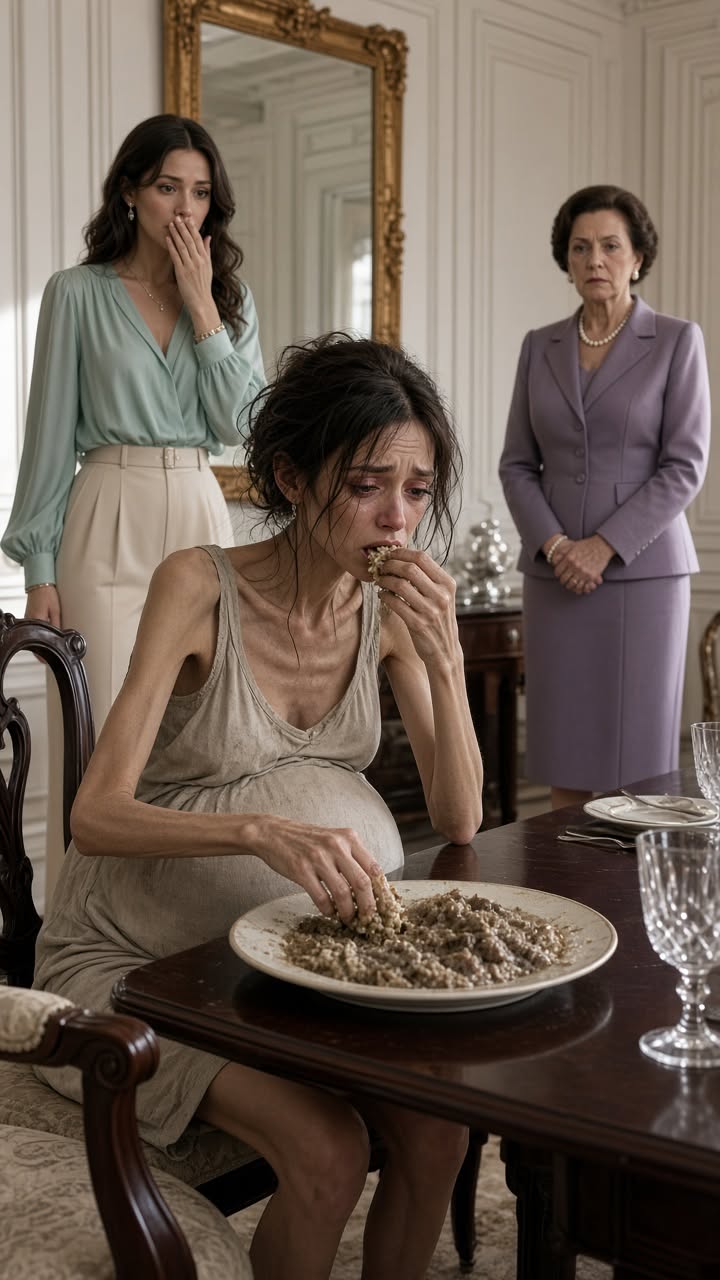
Abigail was curled into a tight, defensive ball on her side. Her swollen, round belly bulged visibly beneath a faded, oversized t-shirt, creating a horrifying contrast with the rest of her body. Her face, once round and flushed with vitality, looked sunken and hollow. Her lips were visibly cracked, peeling at the edges. Deep, bruised-looking shadows pooled beneath her dull eyes, and the arms resting over her stomach looked as fragile as dry kindling.
“Abby… what on earth has happened to you?” I breathed out, my voice trembling as I rushed forward and sank onto the edge of the mattress.
She flinched slightly before her trembling fingers reached out to squeeze my hand. Her grip was terrifyingly weak.
“Nothing, Nora. Really, I am completely fine,” she whispered. Her voice was raspy, like dry leaves scraping across pavement.
But as she spoke, her eyes darted frantically toward the open doorway. It was the terrified, hyper-vigilant glance of a cornered animal. That tiny, anxious micro-expression terrified me infinitely more than her skeletal arms or her bruised eyes.
“Where is Brandon?” I asked, keeping my tone intentionally soft, trying not to spook her.
“He… he is still at the office,” she mumbled, her gaze fixed firmly on the bedsheets.
Before I could press her for the truth, the rhythmic clicking of heels returned. Mrs. Brenda stepped triumphantly into the bedroom, her arms bearing a heavy, ornate wooden tray.
“Look what time it is! It is lunchtime for our little incubator,” Mrs. Brenda announced cheerfully.
She set a deep, ceramic dish down onto the mahogany nightstand. She placed her hands on her hips and beamed with a pride that made my stomach churn.
The foul, suffocating odor assaulted my senses long before my eyes could process the visual horror on the plate. It was a heavy, sour stench—a nauseating, acidic mixture of rotting seafood, congealed grease, and vegetables that had been boiled into a state of decay. The smell hit the back of my throat like a physical blow.
I forced myself to lean over and look. Resting in the bowl was a clump of gray, hardened rice. Next to it sat a dark, rubbery chunk of unidentified fish that was completely encrusted in an absurd, glittering mountain of coarse rock salt. Beside the fish lay several pale scraps of pork that consisted entirely of rubbery skin and translucent fat, accompanied by a few limp, yellowing leaves of Swiss chard swimming in a murky puddle of oil.
“You are honestly planning to feed her this?” I asked, my voice rising in pitch as I struggled to mask my visceral disgust.
“Well, of course I am,” Mrs. Brenda snapped, her cheerful facade slipping just a fraction. “Fish is absolutely miraculous for fetal brain development. And the heavy salt ensures the child grows a strong constitution. Women in my generation were never this fragile or demanding.”
Abigail squeezed her eyes shut and turned her face toward the wall, remaining entirely mute.
I leaned an inch closer to the dish. The scent wafting off the dark fish wasn’t just old; it was chemically sharp. It smelled undeniably like ammonia.
“Mrs. Brenda, this food is not just unappetizing. It is completely spoiled. It has gone rotten,” I stated, squaring my shoulders and locking eyes with her.
The older woman’s artificial smile vanished entirely, replaced by a sneer of pure venom. “Do not you dare march into my home and attempt to lecture me on how to care for my own daughter-in-law.”
“You are not caring for her!” I fired back, my protective instincts flaring into open anger. “You are actively making her sick!”
Abigail suddenly grabbed my wrist, her fingernails digging painfully into my skin. “Nora, please…” she begged, a tear slipping down her hollow cheek. “Please, just leave it. Do not make a scene here.”
That was the exact, horrifying moment the pieces clicked into place. The resignation in her voice. The terror in her eyes. This was not a one-time culinary mistake. This was a daily, systemic routine.
Without breaking eye contact with Mrs. Brenda, I reached out, picked up the ceramic plate, and marched straight toward the bedroom window that overlooked the backyard. With a flick of my wrists, I dumped the entire putrid, salted mess straight down into the open outdoor trash bin below.
Mrs. Brenda let out a shrill, piercing screech that rattled the windowpanes.
“You are completely psychotic! Get out of my house this instant!” she roared, her face turning a mottled, furious red.
I calmly reached into my back pocket and pulled out my cell phone. “Oh, do not worry, I am leaving,” I replied, my voice eerily calm despite the adrenaline surging through my veins. “But Abigail is coming right along with me.”
I hit the speed dial for my father. He answered on the second ring.
“Dad. I need you to get in the truck and drive to Abby’s house right now. Bring Mom. And whatever you do, do not ask me any questions until you pull into the driveway.”
I hung up and immediately pulled a small, canvas duffel bag from the closet, furiously stuffing it with whatever maternity clothes I could grab. Behind me, Abigail finally broke. She pressed her face into her palms and began to sob—a silent, heaving, heartbroken sound.
“You really do not know, Nora,” she whispered into the quiet room, her voice barely audible over Mrs. Brenda’s frantic pacing in the hallway. “You have no idea what has been happening in this house.”
“Then show me, Abby. Tell me,” I pleaded, zipping the bag shut.
With trembling fingers, Abigail pointed toward the locked bottom drawer of her wooden vanity—the exact place she always kept her expensive, doctor-prescribed prenatal supplements.
I crossed the room, dropped to my knees, and yanked the drawer open. What I found inside made the blood roar in my ears. I realized then that the rotten fish was not just a terrible meal. It was merely the surface of a deeply sinister trap.