Title: The Harvest of Deception: A Father’s Vow
Chapter 1: The Boundaries of Our Kingdom
The day of the ceremony broke with a crisp, brilliant clarity unique to the high altitudes of Wyoming. The September weather in these parts is notoriously fickle, capable of burying you in snow or baking you in late-summer heat, but that morning felt ordained by something benevolent. The mountains stood as jagged silhouettes cut out of sapphire paper against the horizon, and the groves of aspen trees bordering the western flank of our ranch were already bleeding into a vibrant, fiery gold among the stoic, dark pines.
The old farmhouse was awake long before the sun even considered rising. It was a symphony of chaotic, nervous energy. Hairdressers hurried down the narrow wooden corridors, makeup artists spread their expansive kits across my dining room table, and a flock of bridesmaids vibrated with a frequency that could shatter glass. From the kitchen came the smell of slightly scorched toast, accompanied by a muffled apology. Every square inch of the home I had built hummed with the manic anticipation of a wedding.
Yet, beneath it all, I carried a secret colder than the frost on the morning grass. Because while the man standing at the altar thought he was executing the final phase of a flawless, calculating scheme to inherit my land and my life’s savings, he was entirely unaware that the trap he was walking into had been set by me.
To understand how a father finds himself actively plotting the demise of his future son-in-law, you have to understand the land. By the time Gavin asked me about the property markers for the third time, I could have drafted the topographical map for him in my sleep.
He would stand by the massive bay window in my kitchen—the same window where my late wife, Diane, used to watch the deer graze—holding his artisanal coffee mug, his reflection superimposed over the sweeping meadow. Outside, the morning mist would be burning off the low-lying pastures, revealing the weathered silhouette of our century-old barn and the shivering shadows of the birch trees. Past the vegetable garden, past the sagging wire fence I kept meaning to mend, sat a rugged, untamed line of timber. That was where our sanctuary ended and the rest of the world began.
Gavin’s gaze always drifted to that timberline.
“Where exactly does your acreage stop, Frank?” he would ask. He possessed this practiced, breezy tone, a veneer of casual curiosity that he wore like a tailored suit.
“The tree line,” I would reply, methodically scrubbing a cast-iron skillet, feigning complete disinterest. “You see that massive, leaning birch? That’s the northeast corner marker. The fence line runs north from there, and the creek dictates the southern boundary.”
He would nod slowly, his eyes cataloging the information like a ledger. “Two hundred acres, right?”
“Two hundred and fifteen,” I corrected gently.
“Incredible,” he’d murmur, shaking his head. “That is really something else.”
The first time he inquired, I brushed it off. It’s a common reaction. Urbanites drive out from Salt Lake City, gorge themselves on the unpolluted air, and become instantly infatuated with the sheer volume of empty space. They ask about acreage, livestock, and the distance to the nearest neighbor as if they are studying an alien civilization.
But by the fifth time Gavin brought it up, a deep, primal knot tightened in my stomach.
Before retiring, I spent forty years as an engineer. I didn’t design glamorous sports cars or consumer electronics; I designed industrial refrigeration systems. My world consisted of massive steel units hidden behind supermarkets, humming in the dark to keep things perfectly preserved. Engineering rewires your brain. You learn that catastrophic failures do not happen by magic; they occur in observable patterns. One micro-fracture in a coolant pipe might be a fluke. But if you find three fractures in the exact same location across different units, you aren’t looking at bad luck. You are looking at a fundamental flaw in the design.
Gavin’s relentless curiosity about my property line was a glaring, flashing variable in an equation I was just beginning to solve. But when I voiced my mild unease to my daughter, Grace, she just tossed her head back and laughed—a sound so painfully identical to her mother’s that it made my chest ache.
“Dad, he’s a city boy,” she teased, reaching past me to pour herself another cup of coffee. “He’s just fascinated by the cowboy lifestyle. Give him a break; he sees a tractor and thinks he’s starring in a Western.”
“Maybe,” I muttered, but the knot in my gut refused to loosen. If only I knew then that his fascination had absolutely nothing to do with romance, and everything to do with a balance sheet.
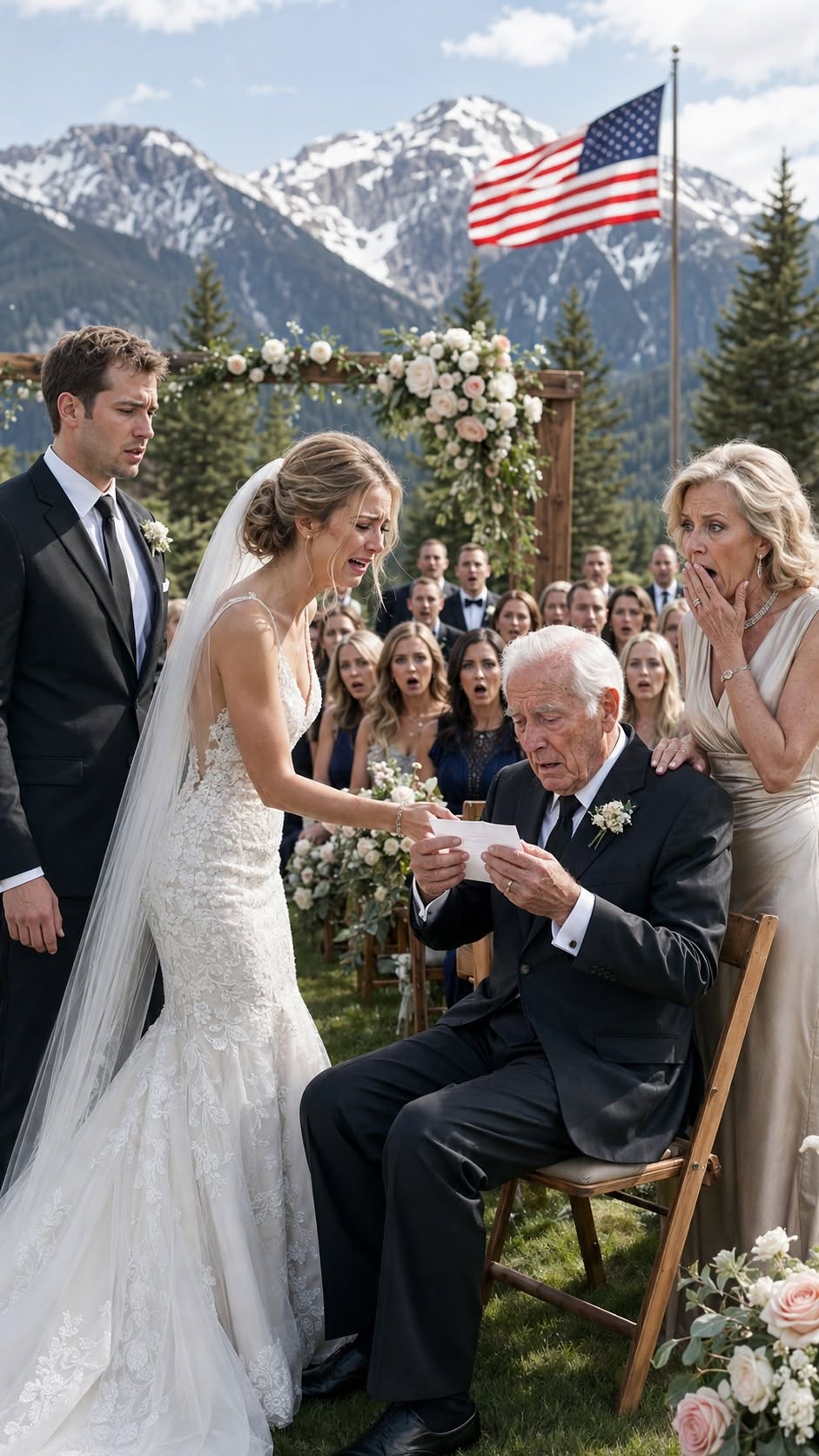
During my daughter’s wedding, she slipped a note from her bouquet into my palm that said only, “Dad, help me,” and before the groom could finish his vows, I stood up in front of two hundred guests, stopped the ceremony cold, and watched his face drain white as the sheriff I’d invited as a “family friend” rose from the crowd.