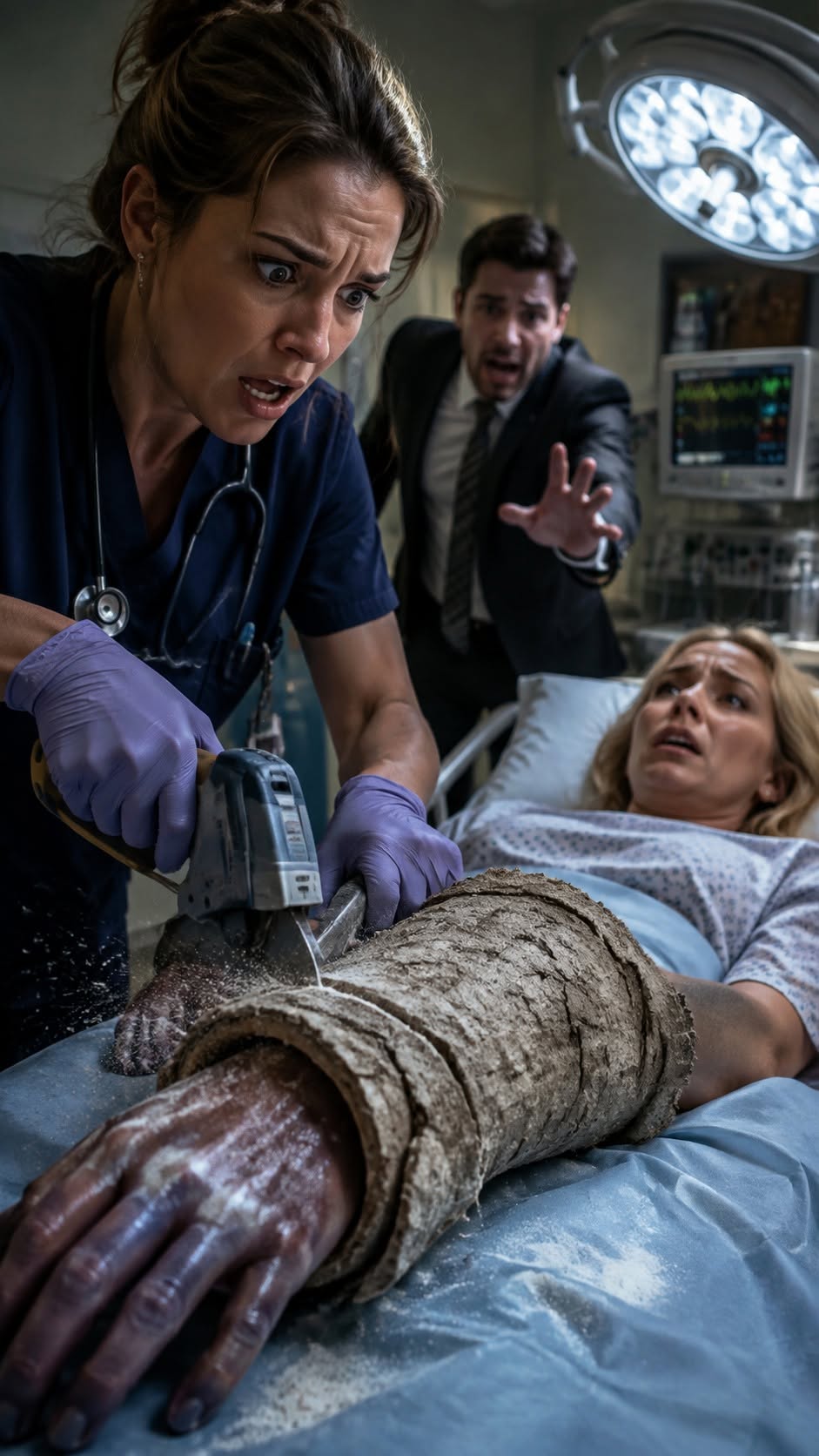
Chapter 1: The Scent of Decay
The whir of the mechanical cast saw chewed through the ambient chaos of Trauma Room 3, its high-pitched mechanical whine vibrating against my own teeth.
“Keep her arm completely immobilized, Sanjay,” I instructed, raising my voice over the noise.
Beside me, Dr. Sanjay Patel, my chief resident, nodded grimly. His gloved hands gripped the plaster like a vice, his eyes locked on the monitor where our patient’s heart rate galloped at a dangerous one hundred and forty beats per minute.
On the gurney lay Emily, a woman who looked at least a decade older than the thirty-two years listed on her intake chart. She was practically vibrating with febrile rigors, her skin a mottled, translucent gray, save for the angry, flushed patches blooming across her cheeks. She was defenseless, stripped of everything but a thin hospital gown and the terrifying, silent agony radiating from her right forearm.
And then there was her husband, Daniel Harris.
He paced the cramped perimeter of the room, a picture of polished, overbearing panic. He wore a tailored navy suit that smelled faintly of expensive cedar and stale espresso, completely incongruous with the raw, metallic scent of blood and betadine that usually coated my trauma bays.
“You’re making a massive mistake!” Daniel barked, stepping so close to my shoulder I could feel the heat radiating from his chest. “I told the triage nurse, she needs her specific orthopedic surgeon! You don’t have authorization to remove that cast!”
“Mr. Harris, your wife is in septic shock,” I said, my voice dropping an octave into the flat, unyielding register I reserved for belligerent family members. “Her blood pressure is plummeting, and her white count is astronomical. Whatever is under this fiberglass shell is killing her.”
I pressed the oscillating blade against the thick plaster. The saw doesn’t spin; it vibrates, designed to slice rigid material without catching the flesh beneath. But the moment the fiberglass cracked open, releasing the trapped air beneath, the saw was no longer the most jarring thing in the room.
The smell hit us like a physical blow.
It was the putrid, unmistakable stench of active necrosis—a sickeningly sweet, grape-like rot of pseudomonas bacteria mixed with the foul sulfur of dying muscle tissue. Beside me, a junior nurse audibly gagged, stepping back from the table.
“God in heaven,” Sanjay muttered behind his mask, his eyes widening.
I peeled the bivalved cast away, gently pulling back the soaked, yellowed cotton padding. Beneath it lay a horror show. The skin of Emily’s forearm was a bruised, mottled purple. Running down the center was an improperly closed, jagged surgical wound, violently inflamed and oozing thick, purulent fluid. Branching out from the incision, a thick, telltale red line tracked viciously up her inner arm, pointing like a bloody arrow straight toward her heart.
“Who did this?” I demanded, looking up at Daniel. The polished veneer of the angry executive had vanished, replaced by a pasty, sweating pallor.
“It was… it was a standard fracture repair. A slip on the stairs. She’s fine, she just needs her doctor—”
“Step back, Mr. Harris,” I ordered, stepping between him and the gurney, asserting a physical wall of professional dominance to sever the handler from his victim. I leaned down, bringing my face inches from Emily’s ear. “Emily? I am Dr. Sarah Jenkins. I am asking you, what is destroying your body right now? Who operated on you?”
Emily’s cracked lips parted. Her eyelids fluttered, struggling against the heavy pull of the infection. Her gaze drifted past me, landing on her husband.
“You have…” she whispered, her voice a dry rasp of sandpaper. “You have… the house.”
The words made absolutely no medical sense, but the reaction they provoked in Daniel was instantaneous and chilling. He froze entirely, the frantic energy draining from his limbs as if someone had cut his strings. His eyes darted to the floor, a dark, terrible panic settling over his features. It was the look of a man whose deepest, most desperate secret had just spilled into the harsh fluorescent light.
“Dr. Jenkins,” Sanjay’s voice broke the heavy silence. His tone was tight, stripped of its usual calm.
I turned back to the wound. Sanjay had used a pair of forceps to clear away the worst of the sloughing tissue near the distal end of the incision.
“Look at this,” he said, pointing the metal tip into the inflamed muscle bed.
Embedded deep within the rotted fascia, half-swallowed by swelling and pus, was a two-inch severed segment of a medical-grade silicone surgical drain tube. It was snipped haphazardly, left behind like forgotten trash, and it was absolutely nowhere on any official medical chart Daniel had handed triage.