The Velvet Box: A Chronicle of a Mother-in-Law’s Eviction
Chapter 1: The Architecture of Exclusion
I never warned my mother-in-law that my daughter—the sweet, quiet child she treated like an unwanted shadow—held the absolute power to erase her from our lives completely.
To understand the magnitude of what transpired on that freezing December morning, you must first understand the chilling perfection of Gene. My husband’s mother did not merely live in her sprawling Tacoma estate; she reigned over it. Her home was a fortress of impeccable manners and unspoken threats, a place where compliance was the currency of survival.
The holidays were Gene’s ultimate stage. Her grand dining room always looked breathtakingly flawless, curated in that specific, suffocating way a room feels when every single person inside it is holding their breath. Heavy, fragrant pine garlands draped luxuriously over the dark mahogany archways. Trays of freshly glazed cinnamon rolls cooled slowly under sheets of immaculate silver foil on the antique sideboard. Overhead, a massive crystal chandelier cast sharp, diamond-like reflections across polished silver napkin rings. Outside, a crisp American flag tapped rhythmically against the wooden porch railing, whipped by the bitter winter wind.
Inside that house, however, the temperature was entirely dictated by Gene’s mood. Everyone in the extended family knew the golden rule: smile until your jaw aches, remain relentlessly polite, and never, under any circumstances, challenge the matriarch when she decided someone needed to be reminded of their inferior place in the hierarchy.
That particular Christmas, she determined her target would be my seven-year-old daughter, Holly.
Holly sat quietly beside me in a brilliant gold velvet dress. My husband, Brandon, had spent twenty painstaking minutes steaming that dress in our hotel room before we drove to the estate. Beneath her chair, her shiny black Mary Janes were tucked neatly together. Both of her small, delicate hands were folded tightly in her lap. She looked like a perfect porcelain doll, though my heart ached knowing the anxiety churning beneath her quiet exterior.
Just before we had stepped onto Gene’s imposing front porch, Brandon had knelt in the driving snow. He pulled a handkerchief from his pocket, wiped a barely visible scuff off Holly’s right shoe, and looked deeply into her brown eyes.
“My sweet girl,” he had whispered, his breath pluming in the freezing air, “you deserve at least one holiday where you feel completely chosen.”
Those words were a quiet rebellion. For three long, agonizing years, Gene had spent every waking moment ensuring Holly felt the exact opposite.
Holly was my child from a previous marriage, a fact that Brandon had never once treated as a secondary footnote. From the moment he came into our lives, he was all in. He was the man who packed her school lunches every single morning, cutting the sandwiches into perfect stars. He knew precisely which floppy-eared stuffed rabbit had to stand guard facing her bedroom door to keep the nightmares away. Most importantly, he possessed a father’s radar; he could instantly decipher the difference between Holly’s genuine, bell-like laughter and the careful, timid chuckle she deployed around adults who made her feel nervous or unwanted.
Gene, on the other hand, weaponized language with the precision of a sniper. She steadfastly refused to ever utter the word “granddaughter” when referencing Holly.
Instead, she utilized a lexicon of subtle alienation. Holly was “Brandon’s girl,” “your child,” or, worst of all, “that sweet little holiday visitor.” The architecture of her cruelty was brilliant because it sounded pleasant enough on the surface. If I were to confront her, she would widen her eyes, clutch her pearls, and accuse me of being wildly sensitive. Holly was always positioned to feel almost like family, yet permanently exiled from the true inner circle.
As we sat around the roaring fireplace, the grandfather clock in the hallway chimed loudly. It was exactly time for the grand gift exchange, an event Gene conducted with the theatrical self-importance of an emperor distributing spoils to loyal subjects. The air in the room grew thick. I reached out and squeezed Holly’s small hand, feeling a knot of dread tighten in my stomach. I prayed, foolishly, for a Christmas miracle. I prayed that this year, Gene would just let my daughter be a child.
But as Gene’s eyes swept over the room and landed on the gold dress, I saw a familiar, icy glint in her gaze. The theater of cruelty was about to begin, and I had no idea that Brandon had already armed our daughter for war.
Chapter 2: The Four-Dollar Insult
At exactly 8:47 a.m. on Christmas morning, the distribution of presents commenced. Gene sat in her ornate, high-backed armchair, pulling brightly wrapped packages from beneath a towering, professionally decorated spruce.
She summoned the grandchildren forward one by one, a parade of favored bloodlines. The oldest cousin, a teenager with a smug smirk, ripped open shimmering paper to reveal a glossy new iPad. He cheered, while another cousin eagerly tore into an identical, expensive tablet. The older nieces and nephews were handed crisp, embossed holiday envelopes; I could see the thick stacks of hundred-dollar bills peeking out from the flaps. The room descended into a chaotic symphony of joyful shouting, flying tissue paper, and fawning adults praising Gene’s unmatched generosity.
Then, the storm of celebration suddenly lulled. Gene shifted her posture, smoothing the fabric of her tailored slacks, and turned her cold, calculating eyes directly toward my daughter.
“Oh, look at that. It is little Holly,” Gene announced, her voice dripping with a performative, syrupy sweetness that made my skin crawl.
She reached behind her chair, ignoring the pile of beautifully wrapped boxes. Instead, she produced a flimsy, wrinkled drugstore gift bag. A severely crooked, cheap red bow dangled pathetically off one of the paper handles.
“This is for you, sweetheart,” Gene said, extending her arm. “I certainly did not want you to feel totally left out of the morning.”
Totally left out. The phrasing was intentional, a verbal poison dart.
Holly, raised to be unfailingly polite regardless of the circumstance, stood up and accepted the flimsy paper bag with both hands. “Thank you, ma’am,” she whispered. She returned to her seat and carefully, meticulously pulled back the single, torn sheet of white tissue paper tucked inside.
I leaned over, holding my breath. Sitting at the very bottom of the bag was a four-dollar, generic vanilla-scented jar candle. The wax was slightly discolored, as if it had been sitting on a clearance shelf for years.
I felt a hot flush of anger rise in my chest, but children do not inherently judge love by price tags. Holly wasn’t a greedy child. The cheap candle itself was not the serrated knife that cut my heart to ribbons.
It was the tag.
Tied around the glass jar with a piece of frayed twine was a handwritten cardboard tag. Gene had personally penned the words in her elegant, swooping calligraphy.
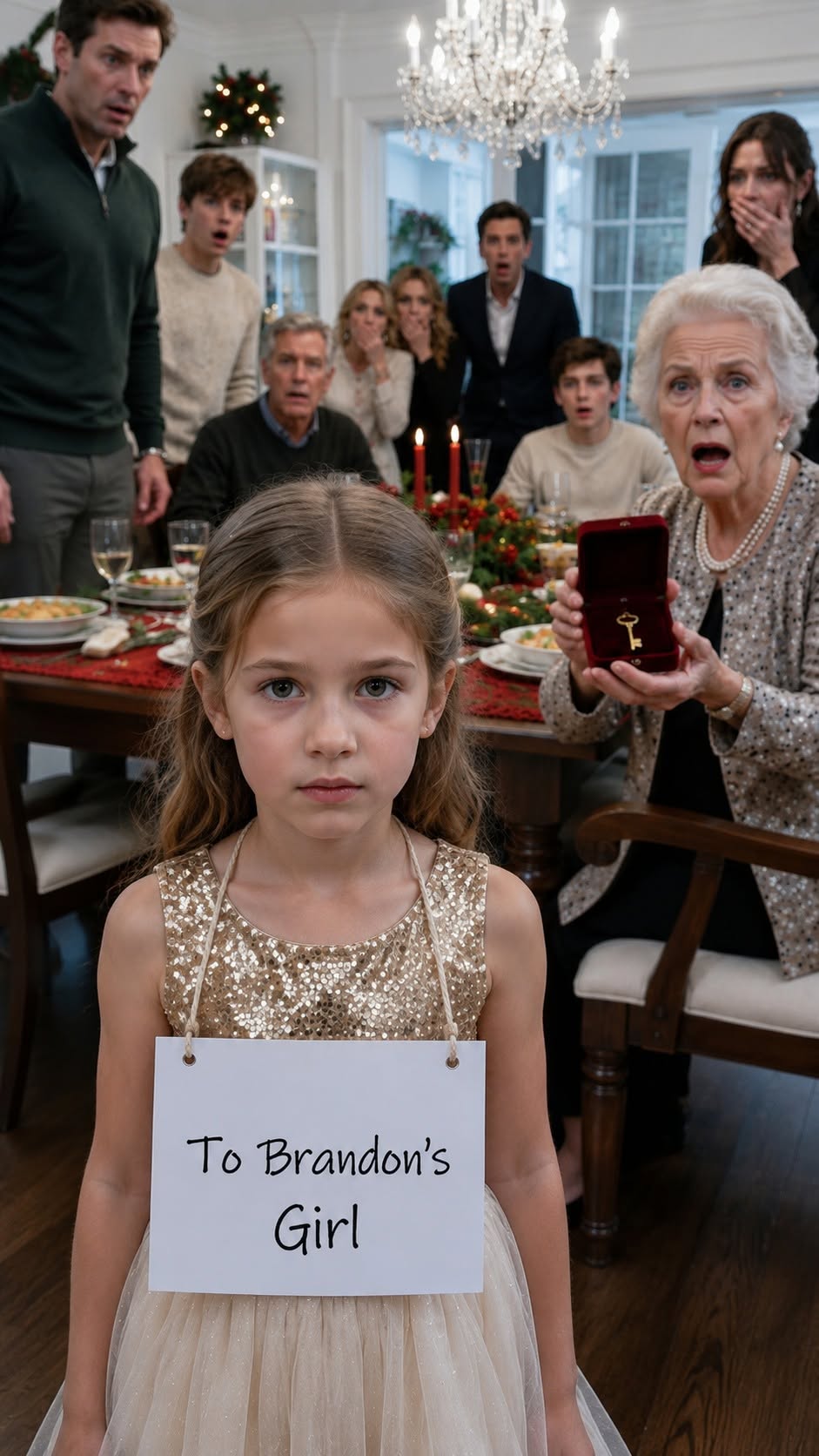
It read: To Brandon’s Girl.
In an instant, the joyful, chaotic noise of Christmas morning evaporated. The silence that fell over the room was absolute and suffocating.
Across the room, a silver fork stopped abruptly halfway to my brother-in-law’s mouth. One of the teenage cousins suddenly became intensely fascinated by the intricate pattern of the Persian rug, refusing to look up. Even the family’s golden retriever seemed to sense the shift in atmospheric pressure, backing slowly away from the table legs with its tail tucked.
Beside me, I heard a sickening crunch. I glanced over to see Brandon squeezing his heavy, insulated paper coffee cup so fiercely that it collapsed inward. Dark, scalding roast spilled over his knuckles and dripped onto the hardwood floor, yet he did not flinch. His face was carved out of granite, his jaw muscles ticking with suppressed fury.
Gene, meanwhile, maintained her tight, artificial smile. She took a delicate sip of her mimosa, already pretending that her malicious insult was far too trivial for any civilized person to bring up. If we screamed, we ruined Christmas. If we stayed silent, she won. It was her favorite trap.
“Brandon,” I whispered under my breath, my voice trembling with a potent mix of rage and heartbreak. I leaned my head slightly toward his shoulder. “We are leaving. Now.”
He didn’t move to stand up. Instead, he leaned close to my ear, his voice lower and colder than I had ever heard it.
“I explicitly told her,” Brandon murmured, his eyes locked dead onto his mother’s smiling face, “to give my mother the little red box if this exact thing happened again.”
My mind scrambled to make sense of his words. “What little red box are you talking about?” I asked, my heart pounding against my ribs.
“The velvet one. It’s sitting in the side zipper pocket of her pink overnight bag,” he replied smoothly, finally unclenching his burned hand.
I stared at his profile in complete disbelief. My husband, the perpetual peacemaker, the man who always tried to smooth over his mother’s abrasive edges, had brought a secret weapon into the house.
“Did you… did you actually plan this entire scene?” I breathed.
Brandon finally turned to look at me. The absolute certainty in his eyes gave me chills.
“No, honey. I did not plan it,” he stated quietly. “I prepared for it.”
But as the morning dragged on into a miserable, tense afternoon, Brandon made no move to retrieve the bag. The candle sat on the end table, mocking us. I watched Holly retreat into herself, her bright spirit dimming with every passing hour. Why was Brandon waiting? What was in the box?
Chapter 3: The Midnight Transfer of Power
The remainder of Christmas Day felt like wading through wet concrete. We survived the heavy dinner through sheer willpower, chewing on dry turkey and participating in hollow, meaningless small talk. The horrible cardboard tag hung over our heads long after the torn wrapping paper had been swept into the trash bags.
At 9:12 p.m., the house had finally quieted down. I walked down the dim hallway and pushed open the heavy oak door to the guest bedroom.
I found Holly sitting cross-legged in the center of the massive, antique mattress. Her beautiful gold dress was now heavily wrinkled, matching the exhausted slump of her small shoulders. Resting in her lap was the cheap vanilla candle.
She wasn’t throwing a tantrum. She wasn’t crying. Instead, she was tracing the elegant, cruel handwriting on the tag with her index finger, analyzing it with the deep, quiet concentration that young children utilize when they are desperately trying to decode adult cruelty.
I felt tears prick my eyes. I sat down gently on the edge of the mattress, the springs groaning softly.
Before I could wrap my arms around her and offer hollow words of comfort, she stopped tracing the letters. She didn’t look up, but her voice shattered the quiet room.
“Mom,” she asked, her tone terribly small and fragile, “am I really just Dad’s girl? Am I not real family?”
It was the precise question I had been terrified of hearing all day. The poison had seeped in.
I opened my mouth, desperate to flood her with reassurances, but the bedroom door creaked wider. Brandon stepped into the room. He didn’t say a word to me. He walked straight past the foot of the bed, dropped heavily to his knees on the floor, and placed his large hands over Holly’s tiny ones, covering the hateful tag.
“Look at me, Holly,” Brandon commanded softly.
She lifted her tear-streaked face to meet his gaze.
“You are my absolute daughter,” Brandon declared, his voice thick with raw emotion. “You are my child, my heart, and my family. No cheap piece of cardboard written by anyone in this house will ever, ever get to decide who you are.”
Holly sniffled, searching his face for the truth. “But Grandma…”
“Grandma is wrong,” Brandon interrupted firmly. He stood up, walked over to her pink duffel bag resting on the luggage rack, and unzipped the side pocket.
When he returned to the bedside, he was holding a small, deep red velvet jewelry box. It was no larger than a ring box, soft and unassuming. He sat on the edge of the bed and carefully placed the object directly into Holly’s open palms.
“Listen to me very carefully, sweetie,” Brandon said, his tone shifting from comforting father to serious ally. “If Grandma ever tries to make you feel invisible, unwanted, or second-class again, you have a choice to make. You get to decide whether she receives this box.”
I gasped softly. He was giving it to her?
“Not me. Not your mother,” Brandon continued, ignoring my shock. “You. This belongs to you.”
Holly turned the soft red velvet over in her small fingers, sensing the heavy gravity of the object.
“Is she going to be really mad at us?” Holly asked, her voice trembling slightly.
“She probably will be furious,” Brandon answered with brutal honesty. He wasn’t shielding her from the reality of the conflict; he was trusting her with it.
Holly looked down at the box, then back up at the man who had chosen to love her. “Are you still going to be my real dad if she gets mad and yells?”
For a fraction of a second, Brandon’s confident facade completely cracked. His face twisted in a momentary expression of absolute agony—heartbroken that his own mother had successfully planted such a vicious doubt inside a seven-year-old’s mind.
He swallowed hard, his eyes shining with unshed tears. “I will always be your dad. Even if the sky falls down. No matter what happens in this house tomorrow, or anywhere else in the world, I am yours.”
Holly nodded slowly. With a newfound sense of solemn purpose, she clicked the latch shut, slid off the bed, and tucked the velvet box deep into her small beaded holiday purse.
Nothing else transpired that evening. We turned out the lights and lay in the dark, listening to the wind howl against the windowpanes. Gene went to sleep down the hall, blissfully convinced that her subtle psychological warfare had been entirely successful. She believed she had put my daughter in her place without a single shot being fired.
She had no idea what was waiting for her at breakfast.
Chapter 4: The Guest
The following morning dawned gray and bitter cold. It was Boxing Day, and Gene was hosting her annual, highly anticipated family brunch.
When we descended the sweeping staircase and entered the dining room, I saw that the long mahogany table had been meticulously reset. Gene operated with a painstaking attention to detail, acting as if the suffocating tension of the previous day had never existed.
Sparkling white porcelain plates were aligned with geometric precision along the dark wood. Heavy silver napkin rings clasped crisp white linen. At the head of the table, Gene was pouring fresh orange juice, looking radiant and utterly victorious.
Her ultimate tactic of control lay in the seating arrangements. Placed above every single fork was a thick, cream-colored, handwritten place card. It appeared incredibly hospitable, yet it granted Gene absolute authority over who belonged where, and next to whom.
I found my card near the middle of the table. Beside it was Brandon’s name. I glanced around, seeing the elegant cards assigned to all the visiting uncles, aunts, and teenagers. Every single blood relative and spouse had their official first name printed in beautiful black ink.
Then, my eyes drifted to the small chair positioned at the very end of the table, furthest from the warmth of the fireplace.
I saw the card.
It did not say Holly.
The card carried a single, capitalized word.
It read: GUEST.
A wave of dizzying, blinding fury washed over me. The candle had been a subtle jab, veiled in the excuse of a “gift.” This was a blatant, undeniable declaration of exclusion. My initial, primal reaction was to leap across the room, tear the heavy cardstock to shreds, and unleash three years of bottled-up, venomous rage directly into Gene’s perfectly made-up face.
I tightened my fists and took a step forward, but a heavy hand clamped down gently on my shoulder. Brandon.
He didn’t move toward the table. He didn’t raise his voice. We both simply looked down.
Holly was standing right beside her assigned chair. She had already seen the card.
I braced myself for the tears. I waited for her small face to crumple into devastation, for her to run into my arms and beg to go home. I waited for her to ask us to fix this deliberate, cruel insult.
She did none of those things.
Instead, a profound stillness settled over my seven-year-old daughter. She reached down to the small beaded purse hanging from her shoulder. Her tiny fingers slid beneath the fabric clasp. When she withdrew her hand, her fingers were wrapped securely around the red velvet box.
In that exact fraction of a second, the fundamental power dynamic of the entire family shifted permanently, even though the room remained blissfully unaware. Yesterday, Holly had been a victim, forced to endure humiliation while the adults calculated how much noise they were willing to make. Today, she was the executioner.
Holly pushed her heavy wooden dining chair back. The scrape of the wood against the floor echoed like a gunshot in the chatty room. Conversations began to taper off.
She stood up incredibly straight. Her gold dress was still creased from the day before, but her posture was remarkably composed, almost regal. Without looking at me or her father, she began to walk the long length of the dining room.
Every aunt, uncle, and cousin fell dead silent, their eyes tracking the small girl marching toward the matriarch. Nobody dared to intercept her. The air crackled with electric tension.
Holly stopped right beside Gene’s imposing armchair.
Gene paused, the crystal pitcher of orange juice hovering over a glass. She looked down at the child, her fake, hospitable smile slipping just a fraction.
“Grandma,” Holly said. Her voice did not shake. It rang out like a bell, clear and bright, carrying all the way to the far end of the long room. “Dad told me to give this directly to you if you ever ignored me again.”
Gene’s rigid, perfectly polished smile tightened into a grimace. She set the heavy pitcher down with a loud thud. She clearly believed she could brush this off, that she could swat away a child’s grievance as easily as a pesky fly.
“Well,” Gene sneered softly, glancing around the silent table for validation, “isn’t that just wildly dramatic of you.”
Before Gene could utter another condescending word, a large figure loomed over her. Brandon had crossed the room in three long strides. He planted his feet firmly directly behind Holly. He did not take the box from his daughter’s hands; he simply stood as an impenetrable wall of support at her back.
Gene looked up at her son, her eyes flashing with a warning. She expected him to apologize for the awkwardness, to laugh off the tension, to play his role in her perfect play.
Brandon stared down at her with eyes as cold as the winter snow outside.
“Open the box, Mom,” Brandon commanded. His tone was flat, devoid of any affection, and left absolute zero room for negotiation.
Gene scoffed, rolling her eyes playfully for the benefit of the watching audience. She snatched the velvet box from Holly’s hands. She slowly pried open the lid, maintaining her smug, dismissive expression, her lips already parting to deliver a rehearsed lecture about overly sensitive stepchildren and the fatal flaws of modern, coddling parenting.
She looked down at the velvet lining.
The lecture never came.
Instead, Gene’s eyes widened in sheer, unadulterated horror. The smugness drained from her face, replaced by an ashen, ghost-like pallor. Her manicured fingers began to tremble violently.
And then, she opened her mouth and let out an agonizing, piercing cry that rattled the crystal glassware on the table.
It was a gasp of pure, sudden terror. One of the teenage cousins jumped backward, knocking a water glass to the floor where it shattered into a hundred pieces. Relatives leaped out of their chairs, leaning forward in shock.
Gene slumped back into her chair, the velvet box falling from her shaking hands onto the white linen tablecloth, its contents spilling out for the world to see.
No one understood the magnitude of what had just happened. But as I looked at the objects resting beside the butter dish, I knew our lives would never be the same.
Chapter 5: The Final Verdict
Gene’s sharp, breathy scream seemed far too massive, far too theatrical for the objects that now lay innocent and exposed on the white tablecloth.
Brandon did not move a single inch toward his mother to comfort her. He remained firmly anchored right behind Holly, standing close enough that our daughter could feel the heat of his supportive presence, but careful not to strip away her defining moment of personal authority.
Gene stared down at the table, her chest heaving as she looked up at Brandon in frantic disbelief.
I stepped closer, my eyes locking onto the items that had tumbled from the red velvet lining. There were no severed fingers, no blackmail photos, no dramatic weapons.
There was only a single, shiny brass house key.
Beside it lay a neatly folded, thick white index card.
The brass key itself was completely ordinary. It wasn’t ornate or antique. It offered no immediate explanation to the stunned, silent relatives craning their necks to see what had caused the great matriarch to hyperventilate. Yet, Gene stared at that piece of metal with pure terror, as if a venomous snake had just uncoiled on her breakfast plate.
Her dramatic reaction caught everyone completely off guard. Nobody in the room had given a speech. Brandon hadn’t shouted or cursed. Holly had simply delivered the box.
Yet, Gene knew exactly what she was looking at. The woman who had spent three long years treating my child like an outsider was suddenly terrified of a seven-year-old girl.
I looked at my husband, desperate to understand the depth of his preparation. He did not look triumphant. He did not wear a smirk of petty revenge. That was what struck me the most deeply. He looked utterly exhausted, like a loving son who had harbored a desperate, secret hope that the object in that pink duffel bag would never have to see the light of day. He had given his mother one final test, and she had failed spectacularly.
Holly stayed right by his side, watching Gene’s meltdown with quiet, undisturbed composure. The very same child who had wept the night before, terrified of losing her family, was now the exact person who had just dismantled Gene’s kingdom.
Across the polished wooden table, sitting next to Holly’s abandoned seat, the handwritten place card still screamed the word GUEST. That made two separate, deliberate labels in less than twenty-four hours. Two cruel messages delivered by a coward who refused to speak them out loud.
“What is it, Mom? What’s wrong?” one of Brandon’s brothers finally asked, stepping tentatively toward the head of the table.
Gene couldn’t speak. She pointed a shaking, manicured finger at the folded white card.
Brandon reached past his mother, picked up the thick index card, and held it out. “Read it aloud, David,” he instructed his brother.
David took the card, his eyes scanning the elegant, typed text. He cleared his throat in the suffocating silence.
“This is… it’s a formal notice,” David stammered, looking nervously between his brother and his mother.
“Read it,” Brandon repeated softly.
David swallowed hard. “It says… ‘Notice to Genevieve. Be advised that the deadbolt locks on our home in Spokane were officially changed on December 23rd. The spare brass key provided in this box is the old lock. Your unrestricted access to our home, our lives, and our peace has been permanently revoked.’”
A collective gasp echoed around the dining room. Gene pressed a napkin to her mouth, her eyes wide with shock. For years, she had weaponized her unannounced visits, using her spare key to intrude on our safe space, critique my housekeeping, and subtly undermine me in my own domain.
David’s voice trembled as he read the final, devastating sentence of the card.
“Any future attempts to contact our family, visit our home, or participate in our lives will no longer be determined by Brandon. Re-entry into our family requires the express, personal, and explicit permission of the only person whose judgment we trust on this matter: Holly.’”
The silence that followed was absolute.
Gene looked up from the useless brass key to her seven-year-old step-granddaughter. Then she swung her frantic, tear-filled gaze toward Brandon, silently begging for him to say it was a cruel joke. But not a single relative in the room moved to rescue her. The shield of polite compliance she had built around her family had shattered into a million pieces.
Holly took a small step backward, pressing her back against Brandon’s sturdy legs for warmth. She was still wearing her wrinkled gold holiday dress. She was still just seven years old, her head barely reaching her father’s ribs.
However, Gene was no longer in the position of power. She could no longer dictate who belonged in the family circle.
For the very first time in three years, the great matriarch was facing the terrifying, unalterable reality that a child she deemed an “outsider” held the keys to the kingdom.
“Go pack the bags, honey,” Brandon said softly, turning to me with a gentle smile that didn’t reach his tired eyes. “We are going home.”
We didn’t stay for the cinnamon rolls. We didn’t stay for the forced apologies that Gene attempted to sputter as we walked toward the heavy mahogany front doors. Brandon carried Holly on his shoulders as we walked out into the freezing Tacoma morning, leaving the grand estate behind us.
Epilogue: The New Normal
It has been two years since the incident with the red velvet box.
True to his word, Brandon never wavered. When Gene attempted to send a lavish, expensive apology gift basket to our house a month later, Brandon intercepted the delivery driver and returned it to sender. When she tried to call his cell phone weeping, begging to see her son, he politely reminded her of the rules and hung up.
The boundary was absolute, and the peace that settled over our home in Spokane was profound.
Holly is nine years old now. She laughs loudly, with her whole chest. She leaves her shoes by the front door without fear of being scolded for scuffing the floorboards. She knows, with absolute certainty, that she is not a guest, not a visitor, and not an accessory. She is the center of our family.
As for Gene, she remains in her grand, flawless house in Tacoma. We hear through the family grapevine that her holidays are quieter now. The table is still perfectly set, the silver rings still shine, but there is an empty chair at the end of the table that no one is allowed to talk about.
She has written three letters directly to Holly, asking for forgiveness. Holly keeps them in a small shoebox under her bed. I asked her once if she ever wanted to write back.
She just smiled, a calm, knowing expression on her face, and shook her head. “Maybe when I’m ready,” she said. “But not today.”
She knows she has the ultimate power. And sometimes, realizing you have the power means you don’t ever have to use it.