Chapter One: The Silence on the Hardwood
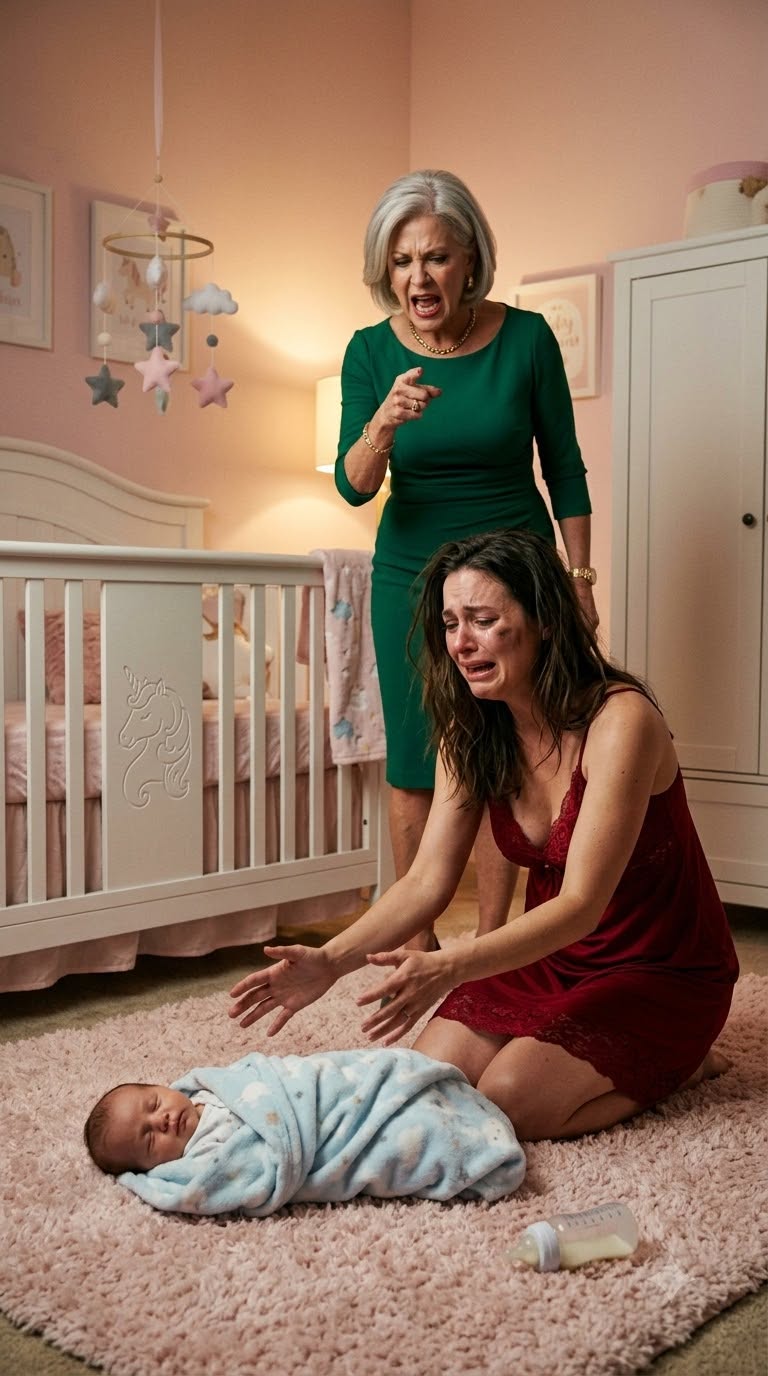
My name is Athena Wheeler, and I was thirty years old the night my mother-in-law slapped me hard enough to knock my newborn daughter out of my arms.
It was 12:40 in the morning. My daughter, Nora, was screaming through a jagged, relentless fever. My muscles ached from pacing the floorboards, and the last thing Lorraine hissed before her hand came down like a judge’s gavel was, “Shut her up, or get out of my house.”
But the slap wasn’t the most catastrophic thing that happened that night. The true horror wasn’t the stinging heat blooming across my cheekbone, nor the sickening thud of my baby hitting the floor. The worst thing was what the pediatric trauma doctor found on my daughter’s skeletal scans hours later. Hidden, healing injuries that were already weeks old, inflicted during afternoons I naively believed she was safe.
And what my mother-in-law did next, while my baby lay tethered to monitors in a sterile hospital crib, is the exact reason I am unearthing this nightmare. She didn’t offer a tearful apology. She didn’t crumble into a confession. She straightened her posture, picked up her phone, and she went to work on destroying me.
To understand how a mother ends up trapped on her mother-in-law’s pristine floor plan, you have to look at the math. Nobody volunteers for a cage. Back in January, my husband, Caleb, lost his fabrication job a mere two weeks after two pink lines appeared on a plastic stick. He scrambled and secured a lucrative pipeline welding contract. The money was a lifeline, but the logistics were a death sentence: three weeks in the dirt of Oklahoma, one week home in Ohio. Meanwhile, I taught second grade on a rigid yearly contract, meaning my maternity leave paid me exactly zero dollars.
We sat at our scuffed kitchen table, staring at a calculator and drinking cold coffee, admitting what the numbers already knew. We couldn’t afford our cramped apartment and simultaneously save for a down payment on a real home.
Lorraine’s imposing colonial house in Dayton boasted four massive bedrooms and only one occupant. Caleb’s mother had been a widow for eight years, and she extended the invitation before we even summoned the courage to ask. Family helps family, she had smiled, her voice dripping with artificial honey. The blueprint was simple: endure six months beneath her roof, bank four thousand dollars in a moving fund by autumn, and then escape to a rental with a fenced yard close to my school.
I need to confess something else, because it is the fatal flaw that blinded me. My own mother passed away when I was twelve. My father, a long-haul trucker, raised me on diner pancakes and blunt common sense; he was gone now, too. So, when Caleb hauled our cardboard boxes up Lorraine’s sweeping porch steps, a bruised, fragile part of me was carrying a hope I had never dared to vocalize. I wanted a mother again. I craved Sunday pot roasts, someone to hold my hand when the baby wouldn’t latch, a woman to tell me everything would be okay.
I desperately wanted Lorraine to be something she was biologically incapable of being.
She greeted us at the mahogany door clad in a severely pressed blouse, the air around her reeking of chemical lemon polish. She hugged me stiffly. I remember thinking her house was the most immaculately clean space I had ever entered—the kind of sterile, breathless clean that feels less like a home and more like a warning. It was the very last embrace that didn’t cost me a piece of my soul.
Nora arrived in the first week of March, seven pounds even, inheriting Caleb’s stubborn chin and possessing a cry that could strip the paint off a wall. Lorraine drove us home from the maternity ward. For approximately four days, bathed in the glow of new motherhood, I believed I had struck gold.
Then, the “help” began to mutate.
I would carefully pump and label breastmilk bottles, only to find them rearranged in the fridge, some poured down the drain because she unilaterally decided I had overfed the baby. Lorraine would intercept a bottle, write a designated feeding time on a magnetic pad, and enforce it like martial law. She erected a rigid schedule on the refrigerator door: Feedings. Naps. Tummy time. All dictated in her elegant, looping cursive. Not mine.
Whenever I instinctively scooped Nora up between those sanctioned slots to soothe a whimper, Lorraine would materialize like a ghost and pry her right back out of my grasp.
“You’ll spoil her to rot,” she would chide, her tone dismissive. “Infants require absolute order, Athena. Not this suffocating hovering.”
I attempted the polite, diplomatic version of a boundary. I softly explained that I was profoundly grateful for her roof, but I intended to follow our pediatrician’s explicit advice to feed on demand. Lorraine chuckled—that distinct, patronizing laugh reserved for a toddler who has just mispronounced a simple word.
“Honey, I raised a strapping son on a strict schedule, and he survived just fine.”
The psychological whiplash was dizzying. When we were alone, Nora was our baby, it was our routine, our rules. But the moment her gossiping church circle dropped by with foil-wrapped casseroles, I would hear Lorraine holding court in the parlor, her voice pitched low and warm. Oh, my sweet grandbaby. I’m practically raising her myself, you know. Her poor mother is still… adjusting.
I would stand frozen in the shadowed hallway, clutching my own child against my chest, feeling like an unpaid nanny in a house where I possessed zero authority. I rationalized it. I swallowed the bile. It’s just a generational gap, I lied to myself. Six months. Just survive six months. I was actively engaging in the very behavior that nearly cost my daughter her life: translating glaring, crimson red flags into a language my desperate heart could tolerate.
Lorraine’s domain operated on unspoken edicts, much like a cult operates on dogma. Shoes instantly removed at the threshold. Laundry strictly executed on Tuesdays and Fridays, whites obsessively segregated. If I folded a towel improperly, she would re-wash the entire load in silent reprimand. Phone conversations were mandated to occur in the kitchen on speakerphone, because, according to her, people who whispered behind closed doors were harboring deceit.
I should have packed my bags the first Sunday of April.
Lorraine’s sister, Carol, had arrived for dinner—a woman constructed entirely of cheap perfume and unsolicited opinions. Over dry pot roast, I casually mentioned the neighbors across the street. The wife had abruptly moved out during a blizzard, and I gently offered that I hoped she was safe, adding that women don’t typically abandon good marriages without a profound reason.
The dining room plunged into a suffocating silence.
Lorraine precisely laid her silver fork and knife on either side of her porcelain plate. She lifted her chin and looked at me as if I were a cockroach traversing her pristine tablecloth.
“A good mother,” Lorraine stated, her voice dropping the temperature in the room by ten degrees, “knows how to keep quiet.”
Carol nodded gravely into her sweet tea, as if gospel had just been delivered. A hot, prickly flush crawled up my neck. I looked down at my plate and said absolutely nothing. At the time, I convinced myself I was merely keeping the peace. Looking back, I realize I was practicing my own subjugation.
That night, lying in the dark with Nora’s bassinet an arm’s length away, I frantically calculated the moving fund. Caleb would return in eleven days. Nine more weeks, maybe ten, and we would be free. Nine weeks.
I didn’t know it then, but counting those weeks would become the most expensive arithmetic of my life.
Chapter Two: The Bruise and the Blueprint
Caleb flew back to the dusty trenches of the pipeline on a Tuesday morning. The atmospheric pressure inside the house shifted before his truck even turned the corner.
That first night alone, Lorraine materialized in my bedroom doorway at ten o’clock, her arms outstretched like a striking snake. “Give her here. You look haggard. I raised a baby before you were even a thought.”
I forced a polite smile. “Thank you, Lorraine, but no. We’re perfectly fine. She’s settling down.”
She ignored my words completely. She stepped into my personal space, scooped Nora up mid-sentence, and marched out, leaving me standing in the center of the room, rehearsing fierce objections to the empty air. I am deeply ashamed of my paralysis that night. But I was three weeks postpartum, my body stitched and aching, severely sleep-deprived, existing in a fortress where her name was on the deed.
I awoke at two in the morning to an unnatural, suffocating silence.
I reached blindly into the dark where my baby should be. My fingers brushed empty, cold cotton sheets. A specific, terrifying ice poured through my veins. I sprinted down the long, shadowed hallway to the master suite and shoved the door open without knocking.
Lorraine was sitting in her plush armchair, Nora swaddled brutally tight and placed on the massive bed beside her. She glared at me as if I had tracked dog feces onto her Persian rug.
“You would think a new mother would be weeping with gratitude for a full night’s sleep,” she sneered. “Ungrateful is an incredibly ugly color on you, Athena.”
I snatched my daughter back. My hands were vibrating with rage and adrenaline, a tremor Lorraine maliciously noted out loud.
The next morning, I stood in the freezing backyard and called Caleb. I kept my voice fiercely level, recounting the kidnapping of our child from my room. Over the grinding roar of heavy machinery in the background, there was a long, agonizing pause.
Then came the sentence that would haunt my marriage.
“Babe, that’s just Mom. She’s intense, but she raised me fine. Just let her help.”
But there was a detail I couldn’t stop chewing on. That morning, Nora had slept until almost noon—an impossibly deep, unnatural stillness. When I nervously mentioned it to Lorraine, she had offered a chilling, satisfied smirk. “She finally learned to surrender.”
In late April, the true nightmare breached the surface.
I was changing Nora on the nursery table before her bath. As I unclasped her onesie, my stomach violently plummeted. There, on her fragile left bicep, sat three distinct, oval-shaped bruises. They were perfectly spaced. They looked exactly like someone had forcefully driven their fingertips into soft bread dough.
I carried her downstairs and confronted Lorraine directly. I didn’t yell. I simply asked the question.
Lorraine didn’t even blink. She didn’t miss a beat while chopping celery. “She wiggles relentlessly during her diaper changes. You have to pin them down firmly, or they’ll roll right off onto the floor and crack their skulls. You’d know that if you ever bothered to listen to me.”
I didn’t argue. I marched upstairs, booked an emergency pediatrician appointment for the following dawn, and photographed the bruises with my phone’s date-stamp activated. Some primal, animal instinct deep within my marrow had definitively concluded that this was no longer a misunderstanding. This was a war.
Dr. Hartmann examined Nora with measured, gentle hands. “Bruises on an infant this young are highly concerning,” he murmured, his brow furrowed. “It could be rough handling, or it could be an underlying issue. We need to keep a very close eye on this.”
I heard the unspoken subtext loud and clear: Keep an eye on who is handling her.
That weekend, under the guise of wanting Caleb to see the baby from his motel in Oklahoma, I unearthed a digital baby monitor from our shower gifts. Caleb enthusiastically walked me through mounting the little white camera high on the nursery shelf, angled perfectly to capture the crib and the entire room.
The accompanying app offered a premium cloud storage plan: thirty days of continuous recording for $2.99 a month. I quietly subscribed using a burner email address I had created years ago for junk mail—one Lorraine couldn’t possibly know existed. Instinct doesn’t file a formal report; it just builds a bunker.
Lorraine stood in the nursery doorway later that afternoon, her arms crossed over her chest, eyeing the blinking red light. “Cameras,” she scoffed, her voice dripping with disdain, “are for paranoid people who don’t trust their own flesh and blood.”
Then she turned on her heel and walked away. She never demanded I take it down. I should have been deeply terrified by how quickly she accepted its presence.
May arrived, bringing a deluge of financial ruin. The transmission on my aging sedan shattered in a grocery parking lot. The mechanic quoted nineteen hundred dollars. Take it, or start walking. I paid it, because a mother without a vehicle in a sprawling suburb is effectively a hostage. Simultaneously, the hospital billing department escalated their aggressive demands for our remaining labor and delivery deductible.
Late one night, I sat at the kitchen table, aggressively erasing and rewriting numbers on a yellow legal pad. My beautiful moving fund, once nearing four thousand dollars, had been butchered down to fifteen hundred. Autumn freedom felt like a mirage slipping over the horizon.
I didn’t hear Lorraine glide into the room. She was practically weightless when she wanted to be. She leaned over my shoulder, her eyes tracing my desperate columns of shrinking numbers.
“Where would you even run to, Athena?” she whispered, her tone laced with a sickening, faux-pity. “You have absolutely nothing. You’re trapped.”
She filled the copper kettle as if she had just commented on the lovely spring rain.
I wasn’t paralyzed. I secured two exhausting summer tutoring contracts. I secretly transferred the remaining fifteen hundred dollars into a hidden account at a different credit union. I pressed my pen so hard into my planner that it tore the paper: Eight more weeks.
I did everything a rational woman does when she smells smoke creeping under the door. What I lacked was hard evidence and a witness. Lorraine knew the exact, crushing weight of my isolation.
But Nora didn’t have eight weeks.
I found the photograph on a Tuesday. Lorraine was at her church circle, leaving me unsupervised in the laundry room. A dusty shoebox sat precariously on the high shelf above the dryer. I reached up to push it back, but the loose lid tumbled off, spilling a cascade of ancient photos onto the linoleum.
On top of the pile was a square Polaroid, its edges orange with decay. It featured a painfully skinny, terrified-looking girl in a lace collar, perhaps twenty-two years old, standing on a snow-covered porch. Next to her stood an imposing, severe older woman with a face like a locked iron vault.
The terrified girl was Lorraine.
I had never, in all our time together, seen my mother-in-law look uncertain. Yet here she was, her shoulders violently curled inward, hands clasped in pure submission, standing a physical half-step behind the older woman like an abused servant. Scrawled on the back in faded blue ink: First winter in Dorothy’s house, 1987.
I knew the name from a single, fleeting conversation. Dorothy was Caleb’s late grandmother. When I had casually asked about her, Caleb had shuddered. She was a brutal woman. Mom refuses to speak of those years.
I stood over the humming dryer, staring at the terrified girl in the snow. A heavy, dark realization shifted in my chest.
Suddenly, the front door slammed open. Lorraine rushed around the corner, unwinding her silk scarf. She saw the open box. She saw the Polaroid trembling in my hand.
For a fraction of a second, the mask slipped. Her face drained of all blood, turning a horrifying, chalky white. It wasn’t the white of anger. It was the stark, primal white of absolute terror.
She closed the distance between us in three feral strides. She plucked the photograph from my fingers with a terrifying gentleness—the way one might disarm a live grenade.
“Some things,” she breathed, her eyes burning into mine, “are not yours to look at.”
For one fleeting moment, the apex predator of the house had looked exactly like prey. And then, the door to the nursery clicked locked.
Chapter Three: The Red Light in the Dark
The colic descended in late May like a suffocating plague. Every evening from six o’clock to ten, Nora would writhe in agony, unleashing a raw, ragged wail that no bottle, bath, or lullaby could penetrate. Dr. Hartmann assured me it was a common developmental phase. Lorraine, however, declared it a failure of discipline.
“You pick her up the second she whimpers, so she continues to fuss,” Lorraine barked over the screaming. “Let her cry it out. Babies are training you, Athena, when it should be the other way around.”
I ignored her. I paced the floorboards, holding my sweating, weeping daughter against my chest.
Then came the Thursday I foolishly rushed to the pharmacy for diaper cream. A twenty-minute errand. Lorraine had waved me off with an airy flick of her wrist.
When I returned, stepping through the mudroom, the house echoed with a horrific, hoarse shrieking from the second floor. It was the sound of a baby who had been screaming so long her vocal cords were tearing. Lorraine was sitting placidly in the parlor, watching a game show, her hands neatly folded in her lap.
A cold dread spiked my adrenaline. I took the carpeted stairs three at a time and grabbed the nursery doorknob.
It didn’t turn.
It was locked from the hallway side. The heavy brass skeleton key that always rested in the keyhole was gone.
Panic seized my throat. I threw my shoulder against the wood, rattling the frame until I managed to force the ancient mechanism. I burst into the room and snatched Nora from the crib. Her face was a mottled, terrifying purple. Her cotton sleeper was drenched in cold sweat. She clamped onto my neck, violently hiccuping, her tiny body rigid with trauma.
I carried her downstairs, my vision swimming with rage. Lorraine didn’t even tear her eyes away from the television screen.
“Ten minutes of crying won’t kill her,” she stated smoothly. “You’re making her weak.”
“If you ever,” I growled, my voice shaking with a feral intensity I didn’t know I possessed, “lock a door on my child again, I will tear this house down around you.”
Lorraine merely smiled at the television host as if he had just delivered a charming punchline. Two days later, I checked the nursery door. The brass key had permanently vanished.
When Caleb returned for a brief five-day stint in June, Lorraine orchestrated a theatrical performance worthy of an Oscar. She baked fresh peach cobblers, hummed hymns while basting roasts, and cooed over Nora like a fiercely devoted matriarch.
“Your wife is incredibly blessed to have me here,” she purred to Caleb, spooning rice cereal into Nora’s mouth—a solid food the pediatrician had explicitly forbidden at this age. “So many young girls have absolutely no guidance.”
I waited until midnight, when Caleb and I were alone behind our closed bedroom door. I laid out the evidence like a prosecutor: the stolen key, the bruising, the hijacked feedings, the empty bassinet in the dead of night.
I watched the man I loved fracture in real-time. He rubbed his exhausted, grease-stained hands over his face, caught between the wife he swore to protect and the mother whose love he had been conditioned to view as absolute law.
“Babe,” he pleaded, his voice cracking. “Maybe the door just jammed. It’s an old house. You’re exhausted. I know she’s overbearing, but Mom would never, ever hurt a baby.”
He wasn’t choosing her over me. He was actively choosing to go blind, because acknowledging the monster in the kitchen meant dismantling his entire reality. He kissed my forehead on Sunday night and drove back to the pipeline.
As his taillights faded down the street, I turned back into the foyer. Lorraine was standing in the kitchen archway, drying a ceramic bowl. The grandmotherly warmth had instantly evaporated.
“He was my son long before he was your husband,” she stated, setting the bowl down with a sharp clack. “Just so we understand the hierarchy of this house.”
The explosion happened that Wednesday at three in the afternoon.
I was in the damp basement, folding a mountain of tiny onesies, when my phone vibrated in my pocket. The nursery camera app had triggered a motion alert. Usually, I ignored them, but a dark premonition urged me to open the screen.
I watched the live feed in horror.
Nora had startled awake in her crib, letting out a sharp cry. Lorraine stormed into the frame. Instead of soothing her, my mother-in-law reached down, grabbed my infant daughter by one fragile armpit, and violently jerked her upward. It was a vicious, aggressive snatch—the way one might yank a heavy weed from the dirt. She gave Nora a single, jarring shake. On the small screen, my baby’s unsupported head snapped back.
My blood turned to Freon. I hit save.
I walked upstairs, my pulse hammering against my teeth. The parenting books tell you to remain calm, to avoid an ambush. I held my phone out, the video looping.
“This terrified me, Lorraine,” I said, struggling to keep my voice from shattering. “Look how violently her head snaps. She is far too fragile to be handled like this.”
Lorraine watched the footage with the detached boredom of someone watching a commercial for detergent. She slowly raised her eyes to mine, and her voice was spun velvet.
“A jumpy, pixelated little video from a cheap camera,” she sighed, smoothing her floral skirt. “Oh, Athena. You’ve been so incredibly erratic since the birth. Postpartum psychosis does terrible things to a woman’s mind. Everyone in my prayer circle has noticed how you shake, how paranoid you are. I would deeply hate for anyone official to start asking questions about whether you’re a danger to this child.”
She handed the phone back and walked away.
It took me a full minute to process the absolute mastery of her threat. I had shown her my evidence, and she had shown me her weapon. If I ever breathed a word of this outside these walls, she had already meticulously constructed a narrative where I was the unhinged, dangerous mother. She had been laying the groundwork with her church friends for months.
I drove to a neutral coffee shop to meet Bri, my oldest friend and a labor and delivery nurse at Miami Valley Hospital. I spilled everything, trembling so hard I spilled my latte. Bri didn’t offer toxic positivity. She looked me dead in the eye.
“Athena, she isn’t just ‘old school.’ She is systematically dismantling your sanity and calling it love. You need an exit strategy today.” Bri offered her spare bedroom, no questions asked.
I returned to Lorraine’s house feeling a dangerous spark of rebellion. But the moment I stepped into my bedroom, the spark died. My dresser drawers, which I always left slightly ajar, were pushed perfectly flush against the wood.
Someone had been hunting through my life.
Three nights later, a cream-colored envelope rested on my dinner plate. My name was written in Lorraine’s flawless calligraphy. Inside was an itemized invoice.
Room and Board: $300/month x 5 months. Utilities (Rounded up). Total due immediately: $1,750.
I looked up. Lorraine was slicing a roast, pleasant as a summer breeze. “Nothing in this world is free, sweetheart. Family least of all.”
I stood at the teller window of my secret credit union the next morning and drained the hidden account I had bled to build. I handed over a cashier’s check that eradicated my escape plan. I realized then that Lorraine didn’t need my money; her late husband’s pension left her flush. The bill was a calculated strike to sever my financial legs.
That Saturday, desperate for backup, I opened the camera app to forward the violent jerking clip to Bri.
The local SD card folder was completely empty.
I dragged a step-stool into the nursery and checked the camera. The tiny memory card was clicked into its slot—too perfectly flush. I never pushed it in that far. Lorraine had waited for me to leave, climbed up, pulled the card, and wiped the physical record clean.
I slumped into the rocking chair, a hysterical laugh bubbling in my throat. She thought she had won. She thought she had erased her sins.
Then I looked at the bottom of the app screen. Cloud Backup Active.
Everything the camera had captured didn’t just live on that tiny plastic card. It had been silently beamed up and out of that suffocating house to a server tied to an email address Lorraine didn’t know existed.
I put the step-stool away. I left the camera exactly where it was, the red light glowing like a silent sentinel. Let her think she’s invisible, I prayed to the dark room. Keep recording.
Chapter Four: The Verdict of the Scans
The only time I ever witnessed Lorraine’s armor crack was a rainy Tuesday night in mid-June.
She had just hung up the kitchen phone after speaking with a church friend. Some young mother in the congregation had finally snapped, packing her babies into a sedan and fleeing an abusive husband’s family in the dead of night.
Lorraine sat at the table, pouring herself a heavy glass of cheap sherry—a drink I had never seen her touch. She stared out the rain-streaked window, her eyes hollow, and began to speak to the glass.
“The winter Caleb was born, he had colic,” she murmured, her voice stripped of its usual venom. “He screamed from dusk until dawn. One night, Dorothy—my mother-in-law—grabbed me by the tricep. She dragged me out onto the back porch into a blizzard, shoved me into the snow with the screaming baby, and threw the deadbolt.”
I stood frozen by the sink, holding a warm bottle.
“She stood in the warm kitchen, staring through the glass,” Lorraine said, taking a slow sip. “Watching me freeze until I figured out how to make him stop crying. Nobody came to save me. I swallowed my tears, and I survived. That is how respect is earned.”
For sixty horrifying seconds, I saw the genesis of the monster. I saw a terrified, freezing twenty-year-old girl learning that love was a conditional currency bought with absolute submission. She had spent forty years refining that trauma to pass it down to me. I felt a fleeting, tragic sorrow for her.
I need to remember that sorrow, because the very next morning, she poured my freshly pumped milk down the drain. The girl in the snow vanished; the warden returned.
In late June, the school district called. The principal regretfully informed me over the phone that my second-grade contract would not be renewed for the fall. I was devastated. When I confronted Lorraine, asking if anyone from the school had called the house landline while I was out, she didn’t even look up from her crossword puzzle.
“Oh, yes. Weeks ago,” she replied breezily. “I told the principal you wouldn’t be returning. You have your hands full here, dear. I did you a massive favor. Your place is here now.”
The floor violently tilted beneath my feet. My career, my income, my final tether to the outside world—severed with a single phone call by a woman filling in a seven-letter word for ‘control’.
“You had absolutely no right,” I hissed, trembling violently.
Lorraine looked up, her face eerily gentle. “A good mother knows where she belongs, Athena. And she knows how to keep quiet about it.”
That brings us to the last Sunday in June. The night of the fever.
By midnight, Nora was wailing with a sickly, high-pitched intensity that sawed at my nerves. I walked a hundred desperate laps around the nursery. At 12:40 AM, the heavy footsteps charged down the hall.
The door violently swung open, the brass knob cracking the drywall. Lorraine stood there in her housecoat, her hair in rollers, her face contorted in pure, unadulterated rage.
“Shut her up, or get out of my house,” she snarled.
“She’s sick, Lorraine! She’s just a baby—”
She didn’t let me finish. She crossed the room and drove her hand across my face with the force of a swinging bat.
The room jerked sideways. My hip slammed into the wooden crib rail. As I threw my hands up to protect my face, Nora slipped from my grasp.
The sound of my infant hitting the hardwood floor was small. But the silence that followed was an oceanic roar. The crying stopped instantly. Nora lay in her yellow sleeper, one arm splayed out, utterly motionless.
Above the crib, the little white camera stared down, its red eye unblinking.
I grabbed my baby, my car keys, and ran. Lorraine’s voice chased me down the stairs, already frantically rewriting history. “Babies bounce, Athena! Don’t you dare make a scene out of this!”
I drove to Miami Valley Hospital like a demon, one hand on the steering wheel, the other pressed desperately against Nora’s chest to feel the flutter of her tiny heart.
The emergency room was a blur of trauma scrubs, blinding lights, and terrifying medical jargon. They whisked Nora behind closed doors. Hours later, in a sterile pediatric bay, Dr. Reyes pulled a plastic stool up to my knees. Her face was an impenetrable mask of clinical gravity.
“Your daughter is stable,” Dr. Reyes began, and I collapsed forward, sobbing in relief. “She has a linear skull fracture and a minor subdural bleed, but she is responsive. We expect a full recovery.”
I closed my eyes, thanking God.
“But I need you to brace yourself,” Dr. Reyes continued, her voice dropping. “When a baby presents with head trauma, protocol mandates a full skeletal survey. Athena… Nora has two healing rib fractures. They are approximately three to four weeks old. Tonight’s fall did not cause them.”
The math hit me with the force of a freight train. Three weeks ago. The Tuesday afternoons when Lorraine insisted on watching her so I could tutor. The bread-dough bruises.
“We are required by law to contact Child Protective Services and the police,” Dr. Reyes said softly.
My inner dam finally, violently broke. I didn’t wait for the hospital social worker. I pulled out my phone and dialed 911 myself. When the dispatcher asked who I was reporting for suspected child abuse, I screamed Lorraine’s name into the receiver.
By nine the next morning, Lorraine arrived at the hospital wearing a lavender church suit and clutching a pristine teddy bear. Through the glass of the ICU, I watched her perform an Oscar-winning tragedy for Detective Dana Coleman of the Crimes Against Children unit.
I couldn’t hear every word, but I read her lips and caught the fragments. Postpartum… She’s erratic… I saw her shake the baby… She dropped her and now she’s blaming me.
Lorraine wept beautifully. By noon, a CPS caseworker with a laminated badge informed me that, due to the conflicting stories and Lorraine’s allegations, a safety plan was enacted. I was legally barred from being alone with my own fractured daughter.
Before Detective Coleman left the ward, she paused, eyeing my bruised cheekbone. “Mrs. Wheeler, is there any physical evidence in that house that could corroborate your version of events?”
I thought of the wiped SD card. Lorraine was confident she had destroyed the past. But she didn’t know about the cloud.
“Yes,” I rasped, my voice raw. “There is.”
Chapter Five: The Bribe and the Cloud
That evening, I sat at Bri’s kitchen table, my hands shaking so violently I couldn’t type. Bri gently took the laptop, and together, using my secret burner email, we logged into the cloud archive.
Thirty days of encrypted storage. Eighty-seven motion-activated clips.
We started three weeks back. We watched the Tuesday afternoon Dr. Reyes had pinpointed. The video loaded. Nora was squalling in her crib. Lorraine marched into the frame, her face twisted in malice. She hoisted my daughter up, squeezed her tiny ribs violently against her chest, and gave her two distinct, brutal shakes.
The microphone picked up the hissing whisper. “Hush. Hush. In this house, we hush.”
I barely made it to Bri’s bathroom before I vomited.
I washed my face in cold water, stared at my hollow eyes in the mirror, and walked back to the table. I forced myself to watch every single clip. I watched the gaslighting, the rough handling, and finally, the horrific footage from 12:40 AM. The housecoat, the slap, the fall. I watched my daughter hit the floor.
I became the iron-clad witness my baby needed.
The next morning, acting on the advice of Ranata Voss, a ruthless former child-welfare attorney Bri recommended, I didn’t post a single frame to Facebook. I didn’t confront the family. I exported the raw, unedited data files onto a portable hard drive and placed them directly into Detective Coleman’s hands, providing the login credentials to prove the chain of custody.
“Mrs. Wheeler,” Detective Coleman murmured, closing her laptop after watching the slap. Her stoic face remained unreadable, but a dangerous glint sparked in her eye. “In her sworn statement yesterday, your mother-in-law assured us the nursery camera had been broken for months. I find overconfidence like that incredibly useful.”
They arrested Lorraine on a Thursday afternoon in the sunlit parking lot of the First Baptist Church, mere feet from her beloved prayer circle.
I wasn’t there to witness the steel cuffs clicking around her wrists, but Carol later confirmed she went quietly, her chin raised, clutching her pearls in defiance. It didn’t feel like victory. It felt like standing in the smoldering wreckage of a bombed house, counting the bodies.
The CPS safety plan was dissolved within forty-eight hours. The caseworker officially labeled me a “non-offending protective parent.” Caleb flew home from the pipeline in a frantic daze. I didn’t scream at him. I simply set the laptop on Bri’s table, queued the eighty-seven clips, and left the room.
When I returned an hour later, my husband looked as though he had aged a decade. He had heard his mother hiss the gospel of abuse into his daughter’s ear. The lifelong brainwashing had finally snapped. He went to the precinct and amended his statement, corroborating the missing keys, the bruises, and the wiped SD card.
Lorraine made bail, but by September, her defense attorney realized they were backed into a corner by high-definition video. She was preparing to plead guilty to felony child endangerment and assault to avoid a brutal trial.
But Lorraine had one final, venomous card to play. And she played it through Carol.
The hospital bills were drowning us. Nora’s ICU stay, the neurology follow-ups, and the trauma evaluations had eclipsed forty thousand dollars. Caleb was working himself to the bone, but we were drowning.
Carol asked to meet us for coffee. She slid a legal document across the table.
“If you stand aside at the sentencing,” Carol explained, her voice dripping with fake sympathy. “If you decline to read a victim impact statement and ask the judge for leniency—probation instead of prison—Lorraine will sign the Dayton house into an irrevocable trust for Nora. And she will write a check today to clear every single medical debt.”
Forty thousand dollars. A paid-off house.
I looked at Caleb. My exhausted, broken husband stared at the table, tears pooling in his eyes. “Athena,” he whispered, his voice cracking. “It would fix everything. The debt is gone. Nora has a future.”
And in the darkest, most terrified corner of my mind, I knew he was almost right. It would solve the math.
But later that night, as I sat beside Nora’s crib in our temporary apartment, Ranata called to reveal the hidden edge of the blade.
“If you speak at the sentencing, Athena, the defense will use the cloud archive against you,” Ranata warned, her tone grim. “Thirty days of footage doesn’t just catch the abuser. It caught you. They have clips of you sobbing on the floor at 3 AM. They have a clip from June where you set a screaming Nora in the crib, walked out to the hallway, and leaned your head against the wall for two minutes before going back in. They will play that in open court. They will argue that you were the negligent, unstable mother who abandoned her child.”
Lorraine’s entire empire was built on the weaponization of shame. Who holds it? Who hides it? She was betting her freedom that I was too terrified of public judgment to take the stand. She was betting I would take the money and keep quiet, just like the girl on the snowy porch in 1987.
I looked at my sleeping daughter, the healing ridge on her tiny skull.
I picked up the phone. “Tell the prosecutor the deal is dead,” I said. “I am speaking.”
Chapter Six: The Verdict and the Voice
Sentencing was scheduled for a bleak, overcast morning in October. The Montgomery County courtroom smelled of floor wax and old wood.
The left side of the gallery was packed with Lorraine’s church circle, a sea of autumn cardigans and tight lips, rustling peppermint wrappers in a show of unified disapproval. Bri and Ranata sat on the right. Caleb waited in the hallway as a witness, pacing the marble floors.
Lorraine sat at the defense table wearing a soft gray cardigan, her hands folded neatly. She looked incredibly small, frail, and grandmotherly. It was a performance of victimhood so spectacular it made my stomach turn.
Her attorney executed their threat flawlessly. He spoke of an overwhelmed household, a devoted grandmother trying to help, and a young, unstable mother. Then, he fired up the projector.
On the massive screen, the court watched me at my absolute lowest. They watched a sleep-deprived, weeping woman set a screaming baby in a crib, retreat to the hallway, and press her forehead against the drywall in agonizing defeat.
“Even the mother, Your Honor,” the defense attorney proclaimed, gesturing dramatically at the screen, “had moments where she simply walked away from this child.”
A collective, condescending murmur rippled through the cardigans on the left. I felt the familiar, suffocating heat crawl up my neck—the same heat from that April dinner. The heat that demanded I swallow my pride, lower my eyes, and keep the peace.
But the peace was a lie.
The bailiff called my name. I stood up, leaving my prepared, sanitized speech on the wooden bench. I walked to the podium, gripped the edges until my knuckles turned white, and stared directly up at the judge.
“Your Honor, the defense just showed you a video of me leaving my crying daughter in her crib,” I began, my voice ringing clear and steady off the high ceilings. “I am not here to paint myself as a perfect martyr. I stood in that hallway because I had not slept in forty-eight hours, and I was terrified I might lose my temper. So, I placed my baby in a safe space, and I stepped away to breathe. That is what the end of a mother’s rope looks like.”
I paused, letting the silence stretch.
“But it is not what a fractured skull looks like. There is a profound difference between a desperate woman who walks away to protect her child, and a hand that comes down to break one. This court has watched both on the exact same camera.”
I turned my head. For the first time in months, I locked eyes with Lorraine.
“I found a photograph this spring,” I continued, my gaze pinning my mother-in-law to her chair. “A girl standing in the snow in 1987. Years later, someone locked that very same girl out on a frozen porch with a screaming baby, and watched her freeze until she figured out how to silence him. Nobody came to save her.”
The courtroom went graveyard still. The rustling of peppermints ceased. Lorraine’s face drained of color, mutating into the terrified ghost I had seen in the laundry room.
“I believe that girl is sitting in this room,” I stated, my voice echoing. “And I believe she was beaten down until she learned the exact lesson she spent this spring trying to teach me: that a good mother knows how to suffer in silence.”
I gripped the podium harder. “But she was wrong. A good mother knows exactly when to scream.”
I turned back to the judge. “Whatever toxic, violent inheritance this family has been passing down—mother to mother, hand to hand—it dies today. My daughter will not inherit it. I refused forty thousand dollars of hush money so I could stand here, out loud, where no one can ever rewrite history and call this an accident.”
I stepped away from the podium and walked back to my seat. There was no cinematic applause. Courtrooms don’t cheer. There was only the sound of Lorraine violently rising from her chair, her grandmotherly mask shattering into jagged pieces.
“Athena!” she shrieked, the venomous, 12:40 AM voice filling the room before her lawyer desperately yanked her back down by her cardigan.
The judge’s gavel slammed twice.
Lorraine was sentenced to four years in a state penitentiary, with a permanent, iron-clad no-contact order covering both Nora and me for the duration of the term.
Outside on the sweeping concrete steps of the courthouse, Caleb was waiting. We didn’t embrace. We weren’t there yet. The damage was too profound, the wounds too raw. But he was facing me when I walked through the heavy doors, and after the year I had survived, a man standing his ground and facing the right direction was a foundation I could work with.
It is January now. The snow is falling in Dayton.
I am writing this from a cramped, two-bedroom apartment on the east side of the city. The radiators violently clank, the couch is secondhand, and the draft from the windows is bitter. But my name is the only one on the lease.
Nora is ten months old. Her final neurological scan came back pristine. Last Tuesday, she pulled her tiny body up on the edge of our wobbly coffee table and clapped her hands in triumph. Bri and I cheered so loudly the neighbors pounded on the ceiling.
The money is what it is. I left the trust fund and the blood money on the table. A sympathetic hospital caseworker helped me transfer the bulk of the medical debt into a charity care program, leaving me with a manageable monthly payment plan. Every month, I write that check, and I remind myself that financial debt is just a number. The debt Lorraine wanted me to take would have cost me my soul.
Caleb rents a tiny room ten minutes away. He attends aggressive therapy every Thursday evening, dismantling thirty-three years of brainwashing. He shows up every weekend to scrub bottles, pace the floors with a teething Nora, and do the unglamorous, agonizing work of real love. We are rebuilding our marriage from the studs, slowly, painfully, and I cannot guarantee the house will stand. But he knows my presence is not owed to him. The man is under construction.
A letter arrived in November from the women’s correctional facility. I recognized Lorraine’s flawless, looping calligraphy on the envelope. I didn’t burn it, but I didn’t open it either. It sits in a locked box on the top shelf of my closet. Perhaps one day, when Nora is grown and asks her own questions about the grandmother she never knew, we will open it together.
You don’t have to open every door to know what lives in the dark.
Last night, Nora awoke at midnight. Her gums were throbbing, and she unleashed a furious, deafening howl into the cold apartment.
And I want you to understand exactly what happened next.
Nothing.
No aggressive footsteps thundered down a hallway. No fist of pure dread clenched beneath my ribs. No ghost in a housecoat threatened to throw us into the street.
I stood up in my own home, wrapped in my own glorious, sovereign quiet. I walked into the nursery, scooped up my loud, furious, magnificent daughter, and I held her against my chest. I didn’t shush her. I let her cry echo off the walls.
“Cry as loud as you need to, baby girl,” I whispered into her warm hair, swaying in the dark. “In this house, we make noise.”