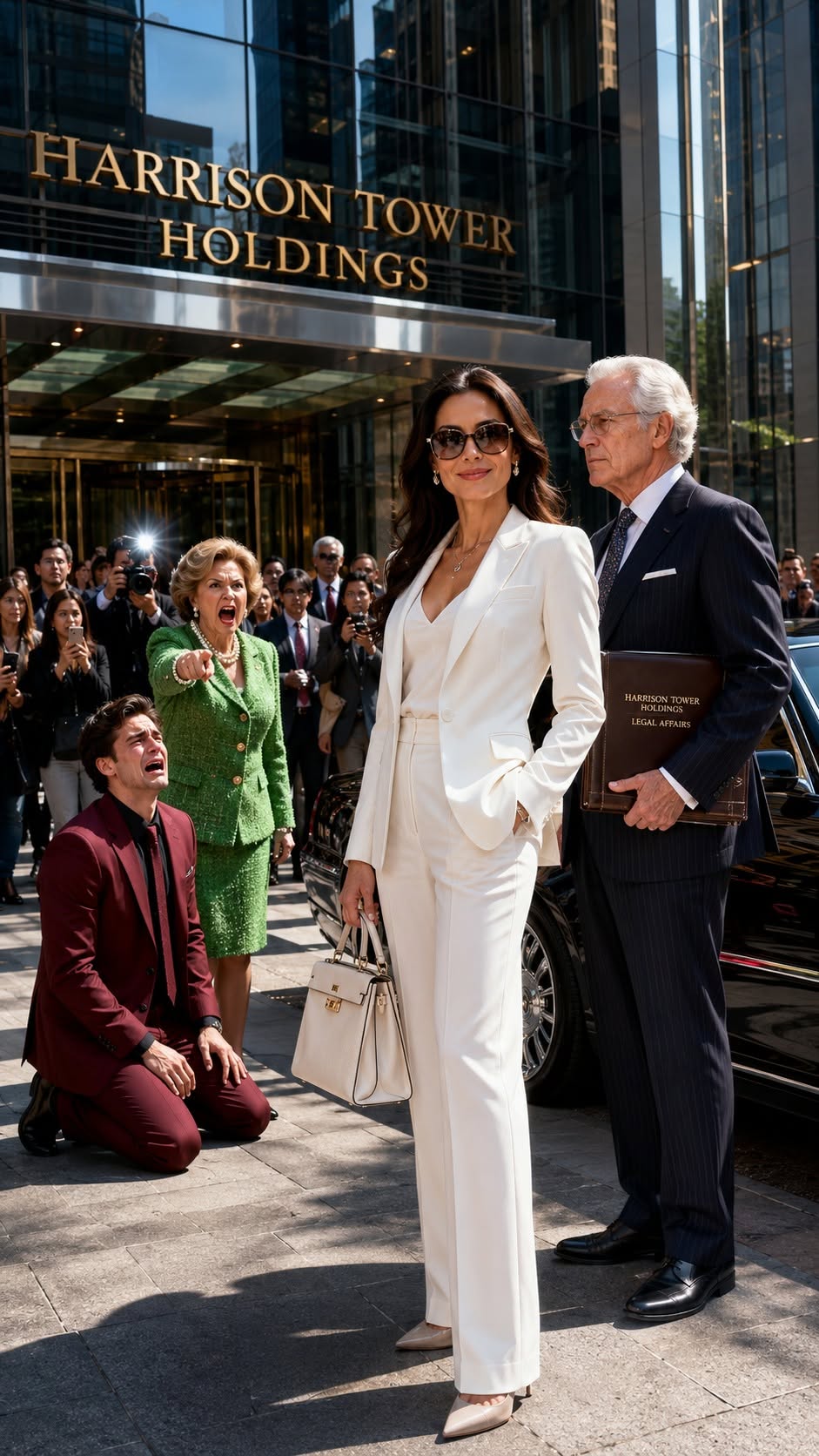
Chapter 1: The Weight of a Gold Watch
On the day my father died, I said absolutely nothing about the twenty-eight million dollars in liquid assets about to fall into my lap. I kept my mouth shut about the forty-two-story Manhattan skyscraper that had already been quietly transferred into my name. That very same evening, barely hours after the monitor had flatlined, my stepmother stood in the foyer of my father’s house and shrieked, “Pack your bags, you’re not staying here!”
I didn’t yell back. I didn’t cry. I simply looked at her and whispered, “Okay.”
Then, I made a single, calculated decision that left the woman frozen in her tracks.
To understand the sheer audacity of that night, you have to understand the profound exhaustion that preceded it. I was thirty-nine years old, standing in the cavernous hallway of the Blackwood Estate in Connecticut, still wearing the rumpled black cashmere sweater I had slept in for three consecutive nights beside Dad’s hospital bed. His vintage Patek Philippe watch rested heavily in the right pocket of my wool coat. A sympathetic oncology nurse had silently pressed it into my palm after they turned off the machines, her eyes offering apologies that medical science could no longer provide.
I still couldn’t force my brain to process the word dead without feeling a jagged fault line crack open right through the center of my chest.
So, when Vivian, a woman who had spent the last decade treating my father’s wealth as her personal revolving credit line, pointed a manicured finger toward the heavy oak doors, I merely nodded. She mistook my profound grief-induced numbness for surrender. It was a fatal miscalculation.
What my stepmother didn’t know—what she couldn’t possibly fathom behind her cloud of expensive perfume and sudden, intoxicating power—was that just three hours prior, my father’s longtime attorney, Samuel Price, had gently guided me into a fluorescent-lit, private conference room on the hospital’s fourth floor. While Vivian was likely already drafting an inventory of the antique silver, Samuel had asked me to sign two heavily redacted receipts.
The first document formally acknowledged an impending inheritance of approximately twenty-eight million dollars in cash and diversified securities.
The second, far more substantial document, confirmed that Harrison Tower, a gleaming glass-and-steel monument to my father’s life work in the heart of Midtown Manhattan, had been irrevocably transferred eighteen months earlier into a blind trust. A trust bearing my name.
Dad had kept everything buried in shadows because he knew his wife. He had anticipated, with chilling accuracy, exactly how this night would unfold.
Vivian’s son from a previous marriage, Caleb, slouched against the base of the grand mahogany staircase as I slowly zipped my canvas overnight bag. He wore a smug, lopsided grin that made my stomach churn.
“You heard my mother, Hannah,” Caleb sneered, crossing his arms. “This is her house now. Time to go.”
I stopped zipping. The metallic slide of the zipper echoed in the deadly quiet of the foyer.
Dad had purchased Blackwood Estate years before Vivian ever entered the picture. I was well aware that his current, public will granted her a life estate—the legal right to live out her days in the sprawling mansion. It was a generous provision for a woman who had rarely visited his hospital room without complaining about the lack of valet parking.
What Vivian hadn’t bothered to study carefully, blinded by her own avarice, was the microscopic condition attached to that specific housing right.
Samuel had.
With slow, deliberate movements, I pulled my phone from my pocket, dialed Samuel’s private number, and tapped the speakerphone icon. The dial tone rang out, sharp and loud, echoing off the marble floor.
“Samuel,” I said, my voice eerily calm as the call connected. “Vivian is asking me to leave the estate tonight.”
There was a profound, heavy pause on the other end of the line. I could almost hear the gears of justice grinding to life in the attorney’s mind.
“Tonight?” Samuel asked, his tone laced with a dangerous sort of curiosity.
“Yes. Right now.”
Vivian rolled her eyes dramatically, crossing her arms over her silk blouse. “Oh, please. Tell your lawyer you are a grown woman, Hannah. I’m not running a charity hostel for grieving daughters.”
Samuel’s demeanor shifted from sympathetic counselor to predatory litigator in a fraction of a second.
“Mrs. Pierce,” Samuel’s voice crackled through the small speaker, resonating with absolute authority. “Robert’s will grants you a life estate in the Blackwood property on one highly specific condition: his daughter must be permitted to occupy the east guest suite for ninety days following his death while the estate is actively administered.”
Vivian’s haughty expression dissolved into a blank, uncomprehending stare.
“If Hannah is expelled, harassed, or otherwise forced to vacate before that ninety-day period expires,” Samuel continued, his words falling like hammer strikes, “your life estate terminates. Immediately. Without right of appeal.”
Caleb abruptly stopped slouching. He straightened up, his smug grin melting into an ugly grimace of panic.
Vivian swallowed hard, her throat bobbing. “That’s… that’s ridiculous,” she whispered, the bravado bleeding out of her.
I reached down and wrapped my fingers around the leather handle of my suitcase, lifting it from the marble. I looked my stepmother dead in the eye.
“I was going to leave quietly anyway, Vivian. I can’t bear the air in this house right now,” I said, delivering the sentence that would permanently freeze the blood in her veins. “But since you made it an explicit, verbal eviction… Samuel? Please enforce my father’s will exactly as written.”
Vivian’s mouth opened, but no sound came out.
“I already am, Hannah,” Samuel replied. “Hold your position.”
Before Vivian could formulate a defense, before Caleb could begin to yell, the heavy brass knocker on the front door clattered against the wood. Two sharp, aggressive raps.
Through the frosted sidelight windows, the silhouette of an overnight courier stood waiting in the freezing Connecticut rain. He was holding a thick, certified legal envelope.
Chapter 2: The Phantom Fortune
Vivian snatched the envelope from the rain-soaked courier before he could even offer a sympathetic nod. She practically tore the heavy cardstock to shreds in the foyer, her eyes darting frantically across the dense legal typography.
The first page was a stark, formal notice from the executor’s office, explicitly detailing the ninety-day occupancy clause. It outlined, in terrifying legal threats, that any attempt to change the locks, dispose of Robert Pierce’s property, or remove me from the premises would trigger an immediate, catastrophic court review.
“You knew about this,” Vivian hissed, her hands trembling so violently the paper rattled. “You set me up.”
“No,” I replied, my voice flat, devoid of the theatrical emotion she was desperate for. “I learned about the clause tonight. You set yourself up.”
Caleb lunged forward and snatched the damp papers from his mother’s hands, his eyes scanning the paragraphs. “Dad would never write something this humiliating!” he barked, his face flushing a dangerous crimson. “He wouldn’t put Mom on a leash like this!”
Samuel, still quietly listening via the speakerphone resting on the console table, cleared his throat. The sound cut through the foyer’s tension like a surgical blade.
“Your stepfather,” Samuel corrected coldly, “signed that specific addendum to the will eleven months ago. In my presence. With two independent, sworn witnesses. He was entirely lucid.”
Vivian turned her rage away from the paperwork and unleashed it entirely on me. Her eyes narrowed into venomous slits.
“So this is what you were doing all those weekends,” she spat, stepping closer, invading my space. “This is what you were waiting for? You wanted him to die so you could play the martyr and take everything out from under me?”
That accusation—so incredibly vile, so entirely disconnected from reality—finally sliced through the protective numbness that had wrapped around my brain since the flatline.
For four agonizing months, I had driven four hours from my apartment in Boston to the Connecticut oncology ward every single Friday evening. I had watched pancreatic cancer systematically strip the muscle and dignity from a man who used to run marathons. I had meticulously organized his complex cocktail of pain medications, spent hours fighting hostile insurance adjusters on the phone, and slept in vinyl hospital chairs that left permanent aches in my spine.
Vivian? Vivian visited twice a week. She hated the sterile smell of the hospital. She complained that the fluorescent lights gave her migraines, and she rarely stayed long enough to see him struggle through a bout of nausea.
A cold dread had been sitting in my gut all night, but now, it ignited into a slow-burning fury. My palms grew slick with sweat, but my posture remained rigid.
“I didn’t take anything from you, Vivian,” I said, keeping my voice dangerously low. “Dad decided what belonged where. He knew exactly who was holding his hand when the lights went out.”
She let out a harsh, bitter laugh that echoed off the high ceiling.
“Oh, spare me the saintly daughter routine,” she mocked. “And I’m supposed to believe you walk away with nothing? Just a suitcase and a moral victory?”
I could have destroyed her right then and there.
I could have told her about the twenty-eight million dollars resting safely in diversified, high-yield accounts. I could have told her about the forty-two stories of prime Manhattan real estate that generated more passive income in a month than she spent on her lavish European vacations in a year. I could have told her about the ironclad, irrevocable trust Dad had engineered specifically after Caleb had cornered him over Thanksgiving, repeatedly begging for massive business loans to save his sinking company.
I looked at her, standing in a house she had never made a home, adorned in my father’s money.
Instead of crushing her, I stayed completely, terrifyingly silent. I reached out, ended the call with Samuel, grabbed my coat, and walked out into the freezing rain, leaving my suitcase precisely where she had demanded I pack it.
I spent the night in a generic roadside motel, staring at the water stains on the ceiling, waiting for the sun to rise on a day that would change the trajectory of all our lives.
Tomorrow was the formal reading of the estate. And tomorrow, Vivian was going to learn that the ninety-day clause was merely the smallest, most insignificant trap my father had set.
Chapter 3: Crumbs and Skyscrapers
The next morning, the sky over Boston was a bruised, heavy purple. I arrived at Samuel’s prestigious law firm thirty minutes early, my clothes still slightly damp, my father’s heavy watch ticking relentlessly in my pocket.
By the time Vivian and Caleb arrived, the atmosphere in the sprawling mahogany boardroom was stifling. It smelled of old paper, expensive leather polish, and impending doom.
Vivian breezed into the room wearing a sharply tailored black mourning suit and—in a move that made my jaw clench so hard my teeth ached—Dad’s diamond anniversary bracelet. The one he had bought her in Paris, before he understood the depth of her shallowness. Caleb trailed behind her, a thick yellow legal pad tucked under his arm, his pen already clicking nervously. He looked less like a grieving stepson and more like a hungry auditor.
Samuel sat at the head of the long table, a mountain of thick, bound folders arranged impeccably before him. He offered me a brief, sympathetic nod before adjusting his glasses.
“We are gathered to formally execute the final testament and estate documents of Robert Pierce,” Samuel began, his voice devoid of the emotion he had shown on the phone the night before. This was clinical. This was war.
He started with the smaller bequests. Charitable donations to the university. A generous payout to my father’s longtime executive assistant. Caleb scribbled numbers furiously on his pad, calculating the remaining pie.
Then, Samuel addressed Vivian’s provisions.
“To my wife, Vivian,” Samuel read from the heavy parchment, “I leave my retirement accounts, the entirety of the household furnishings at Blackwood, and a designated marital trust valued at three point two million dollars.”
Vivian exhaled a long, shaky breath. Her shoulders, previously wound tight with tension, visibly relaxed. Three point two million, plus a house full of art and antiques. It wasn’t the empire, but it was a golden parachute.
“Furthermore,” Samuel continued, “Vivian retains the conditional right to remain in the Connecticut estate, subject to the clauses we discussed… previously.”
Vivian shot me a triumphant, sideways glare. She assumed the worst was over. She assumed I had triggered the eviction clause to steal the house, and she was already planning her legal defense to keep it.
Then, Samuel turned a fresh page. The rustle of the thick paper sounded like thunder in the quiet room.
“To my only daughter, Hannah Pierce,” Samuel’s voice deepened, “I leave the remainder of my liquid financial estate, presently valued at approximately twenty-eight million dollars.”
The clicking of Caleb’s pen stopped abruptly. The silence in the room was absolute, heavy enough to crush bone.
Vivian’s smug expression shattered. She blinked rapidly, her mouth falling open. “Twenty-eight… what?” she stammered, the words choking in her throat.
Samuel didn’t look up. He wasn’t finished.
“Additionally,” the attorney pushed his glasses up the bridge of his nose, “it is formally noted for the record that eighteen months prior to his passing, Robert Pierce executed a transfer of all ownership interests, deeds, and controlling shares in Harrison Tower Holdings.”
Caleb jumped up from his leather chair with such explosive force that the heavy piece of furniture struck the paneled wall behind him.
“Harrison Tower?” Caleb yelled, his voice cracking with panic. “That’s not in probate! That’s the crown jewel! Where did it go?”
Samuel looked at him with the cold, detached pity one might reserve for a squashed insect.
“The Manhattan building is not part of probate,” Samuel explained smoothly, “because the transfer was legally completed over a year ago. It was moved in its entirety into the Hannah Pierce Irrevocable Trust.”
Caleb’s face drained of color. “That building… the commercial leases alone… it’s worth more than the cash.”
“Considerably more,” Samuel agreed softly.
Vivian turned slowly to look at me. Her eyes were wide, terrified, staring at me as though I had suddenly morphed into a stranger. In her mind, she had been battling a grieving, exhausted spinster. She suddenly realized she was sitting across from a titan.
Before the chaos could truly erupt, Samuel reached into the breast pocket of his suit coat and withdrew one final, sealed envelope. The thick wax seal on the back bore my father’s signet ring.
“There is one final item,” Samuel said, silencing Caleb’s impending rant. “Robert left a personal letter. He instructed me to read it aloud only if a specific condition was met. That condition was met last night in the foyer of Blackwood Estate.”
Samuel broke the wax seal. The crisp snap echoed loudly.
He unfolded the heavy stationary. The first sentence was not addressed to me.
“Vivian,” Samuel read my father’s words, his tone carrying the ghostly echo of Dad’s quiet authority. “If you are hearing this after attempting to expel Hannah from my home, then you have finally answered the last, lingering question I was simply too afraid to ask while I was alive.”
Nobody dared to breathe. Samuel glanced at me, his eyes full of sorrow, before diving into the paragraphs that would explain exactly why Dad had hidden his empire, and why Vivian’s right to a roof over her head was about to be legally incinerated.
Chapter 4: The Dead Man’s Gambit
Hearing Dad’s words read aloud in that sterile boardroom was an agony I hadn’t prepared for. His letter wasn’t filled with malice or screaming accusations. It was methodical, weary, and profoundly sad.
That lack of anger somehow made it infinitely harder to hear. It meant he had accepted his betrayal long before the cancer killed him.
Through Samuel, Dad explained that during the grueling final two years of his illness, while I was blissfully unaware in Boston, Vivian and Caleb had initiated a relentless campaign of pressure. Caleb’s real-estate venture, Apex Developments, was hemorrhaging money due to gross mismanagement. They had cornered my father repeatedly, pleading, then demanding, that he leverage Harrison Tower to secure massive bailout loans for Caleb.
Dad had steadfastly refused. Harrison Tower was his legacy; he had laid the foundation stone himself. He wasn’t going to let a reckless stepson gamble it away.
After his final refusal, Dad noted in the letter, Vivian stopped asking about Caleb’s loans. Instead, she began casually, consistently asking what would happen to the skyscraper “when he was gone.”
“I never accused my wife of plotting a crime,” Samuel read, his voice softening. “I simply stopped trusting the nature of her questions. A dying man cannot afford the luxury of doubt.”
So, while the chemo hadn’t entirely clouded his mind, while he could still walk into a lawyer’s office under his own power, he orchestrated his coup. He moved the tower into an impenetrable, irrevocable trust. He utilized independent, outside counsel to ensure the transaction was bulletproof, bypassing his usual corporate team to avoid leaks.
He kept the twenty-eight million dollars separate from the real estate for a highly specific reason. “I wanted Hannah to decide, without the burden of my towering ambitions, what kind of life she wanted to build after I was gone. The cash is for her freedom. The tower is for her legacy.”
Then, Samuel reached the final, devastating paragraph concerning the Connecticut estate.
Dad hadn’t wanted to leave Vivian destitute. His provision for her life estate was originally genuine. But he had inserted the ninety-day clause because he knew my heart. He knew I would be gutted. He wanted me to have the grace of time—time to organize his chaotic study, time to grieve in the gardens we had planted together, time to say goodbye without being treated like a squatter by a woman who merely married his bank account.
“If Vivian cannot muster ninety days of basic, human kindness toward my daughter after I take my last breath,” the letter concluded, “then I refuse to let my home serve as a monument to her cruelty for the remainder of her life.”
Vivian pressed a trembling hand over her mouth, stifling a sob.
Caleb, desperate and cornered, slammed his fists on the mahogany table. “He was manipulated! Hannah poisoned his mind while we weren’t looking!”
Samuel neatly folded the letter, placing it back into the envelope with maddening slowness. He looked at Caleb.
“Manipulated by whom, Caleb? Hannah didn’t even know this trust existed until three hours before you tried to throw her out onto the street.”
Nobody answered. The truth was a suffocating weight in the room.
But Vivian, driven by the sheer terror of losing her social standing, refused to surrender gracefully. She hired a team of aggressive litigators and challenged the condition in probate court. Her attorneys painted a picture of a grieving widow, arguing that the chaotic emotions of death had caused a minor “misunderstanding,” and that a momentary lapse in judgment shouldn’t forfeit a multi-million-dollar housing right.
They thought they had a compelling narrative.
Then, our side presented the evidence.
The judge, a no-nonsense woman with a grim expression, reviewed the security footage from the Blackwood foyer. She watched Vivian point to the door. She heard the sheer venom in her voice.
But the final nail in the coffin wasn’t the video. It was the digital footprint. During discovery, Samuel had subpoenaed Vivian’s phone records. On the massive projector screen in the center of the courtroom, he displayed the text messages Vivian had sent to Caleb on the very afternoon my father was suffocating in his hospital bed.
The first message read:
As soon as Robert is gone, Hannah goes. I want her out before she starts poking around his office.
The second message, sent ten minutes later, sealed her fate:
Once she leaves, we lock down the estate. We control the house, and we can force a settlement on the tower later.
A collective gasp echoed through the gallery. The judge didn’t even need to recess to deliberate. The ruling was swift, brutal, and absolute.
Vivian had maliciously and deliberately violated the occupancy condition with premeditated intent.
The gavel fell. Her life estate was terminated immediately.
Under the alternate provision baked into Dad’s brilliantly vindictive will, the Blackwood property was seized, sold at market value, and every single penny of the proceeds was donated directly to the oncology center that had treated him.
As the judge announced the ruling, I watched Vivian collapse back into her chair, the diamond bracelet heavy on her wrist, finally realizing the true cost of her greed.
Chapter 5: Echoes in the Tower
Vivian wasn’t left entirely penniless. Dad was, in the end, a man of his word. She kept her three point two million dollar marital trust and her lavish personal inheritances. But she lost the house. She lost her anchor to high society. She lost the illusion of control.
Caleb walked away with a measly two hundred and fifty thousand dollars. It was a drop of water in the raging inferno of his corporate debts. Within a year, Apex Developments officially filed for Chapter 11 bankruptcy.
I watched it happen from afar. I did not lift a finger to rescue him.
Harrison Tower remained untouched, shielded within my trust. In the months that followed, the sheer gravity of the twenty-eight million dollars frightened me. That kind of wealth didn’t feel like the freedom Dad had promised; it felt like an immense, terrifying responsibility.
I paid off the mortgage on my modest Boston condo. I established a robust, fully-funded scholarship in my father’s name for first-generation architecture students. The rest of the cash, I left locked in investments, letting it grow in the dark.
But the tower was different. The tower required a pulse.
I fired the corporate sharks Caleb had tried to install years prior. I hired an independent, fiercely loyal management company and retained every single existing employee—down to the overnight janitorial staff my dad used to share coffee with.
Then, I took the entire fourteenth floor, stripped it of its luxury corporate leases, and converted it into heavily subsidized, state-of-the-art office space for nonprofit organizations. Half the floor went to a legal advocacy group for struggling veterans. The other half went to a charity providing financial relief for families decimated by cancer treatments.
Dad had been a veteran. Dad had died of cancer. It felt like the only logical blueprint.
Exactly six months after the gavel fell, my phone buzzed in my pocket. It was a text message from an unknown number, but the venom in the syntax was unmistakable.
Your father would be absolutely disgusted by what you did to this family, Vivian wrote. You destroyed us.
I stared at the glowing screen, sitting at my father’s old oak desk in my Boston apartment. I typed my response slowly, my thumb deliberate and steady.
I didn’t do anything, Vivian, I replied. I simply followed the exact documents he wrote while he was alive, watching you. You made your choice before you even knew what the paper said.
I hit send. Then, I permanently blocked her number. The digital silence that followed was the most peaceful sound I had heard in a year.
A year after the monitor flatlined, I stood in the cavernous, marble-clad lobby of Harrison Tower. The air smelled faintly of lemon polish and expensive coffee. High above the reception desk, a newly polished brass plaque bore my father’s name: Robert Harrison Pierce.
For months, financial magazines and society gossips had called my inheritance a brilliant, strategic victory. They painted me as a mastermind who had outplayed a wicked stepmother.
It never felt like a victory.
Standing there, watching the bustling crowds of New York push through the revolving doors, a familiar ache blossomed in my chest. I would have traded the skyscraper, the trust, the twenty-eight million dollars, and every ounce of my legal vindication for just one more quiet afternoon sitting on the porch with my father.
But money is a funny, cruel thing. It rarely changes people. Instead, it acts as a powerful solvent, washing away the polite masks and revealing the stark, undeniable truth beneath. Grief had temporarily hidden Vivian’s true nature from me, but the prospect of unchecked power had exposed it.
Vivian firmly believed her reign began the exact second my father stopped breathing.
My father, brilliant even from the grave, had meticulously ensured that my life didn’t end in that same moment.
On that rainy, miserable night in Connecticut, she had pointed to the door and told me, “You’re not staying here.”
She was absolutely right. I couldn’t stay in a house poisoned by her presence.