The Awakening of Eloen Hayes
Chapter 1: The Cake and the Crown
The sprawling lawns of the Newport, Rhode Island estate had been meticulously engineered to resemble a cinematic masterpiece. Three hundred guests, a curated mix of New England’s elite, tech moguls, and legacy politicians, milled beneath a canopy of imported white roses. Drones hummed softly overhead, livestreaming the opulent union to millions. I was twenty-seven years old, encased in a custom Oscar de la Renta lace gown that felt less like silk and more like a beautifully tailored straightjacket.
My name is Eloen Hayes. And this is the chronicle of my own coup d’état.
My godfather, Winston Carmichael—a man whose wealth was built on a foundation of quietly swept state corruption scandals—gripped my arm tightly as he walked me down the crystal-lined aisle. “You’re entering a powerful family, girl,” he muttered under his breath, his smile completely entirely detached from the cold warning in his eyes. “Learn to keep quiet about what doesn’t concern you.”
I smiled back. I had spent three years perfecting the art of the hollow, compliant smile.
At the altar stood Thatcher St. James. He was everything a naive girl was supposed to want: an Ivy League-educated surgeon with a family name that opened every heavy oak door in Boston. He looked at me with that signature arrogant charm, but his eyes were empty. In the front row sat his mother, Constance St. James, draped in funereal black, a silent protest against her son marrying an Appalachian charity case. She only tolerated my presence because Thatcher had threatened to legally sever ties with the family trust if she objected.
The vows were exchanged. The champagne flowed. The cameras flashed. Then came the cake—a five-tier masterpiece detailed in gold leaf.
Thatcher’s hand clamped around my waist. It wasn’t an embrace; it was a vice grip. He leaned in, his breath hot against my ear. “You are going to do exactly what I tell you, Elo,” he hissed, his grip tightening until pain flared down my spine. “You are going to shove a piece of this cake right into my mother’s face. It’s a joke. It’ll make everyone laugh.”
I froze, bewildered. “What? No, Thatcher. Are you out of your mind?”
“Do not contradict me in public,” he growled, twisting his fingers into my flesh. “Obey me.”
I pulled away. My rehearsed smile finally crumbled. My best friend, Lyra, caught my eye from the bridesmaid line, instantly recognizing the terror flashing across my face. She took a step forward, but she was too late.
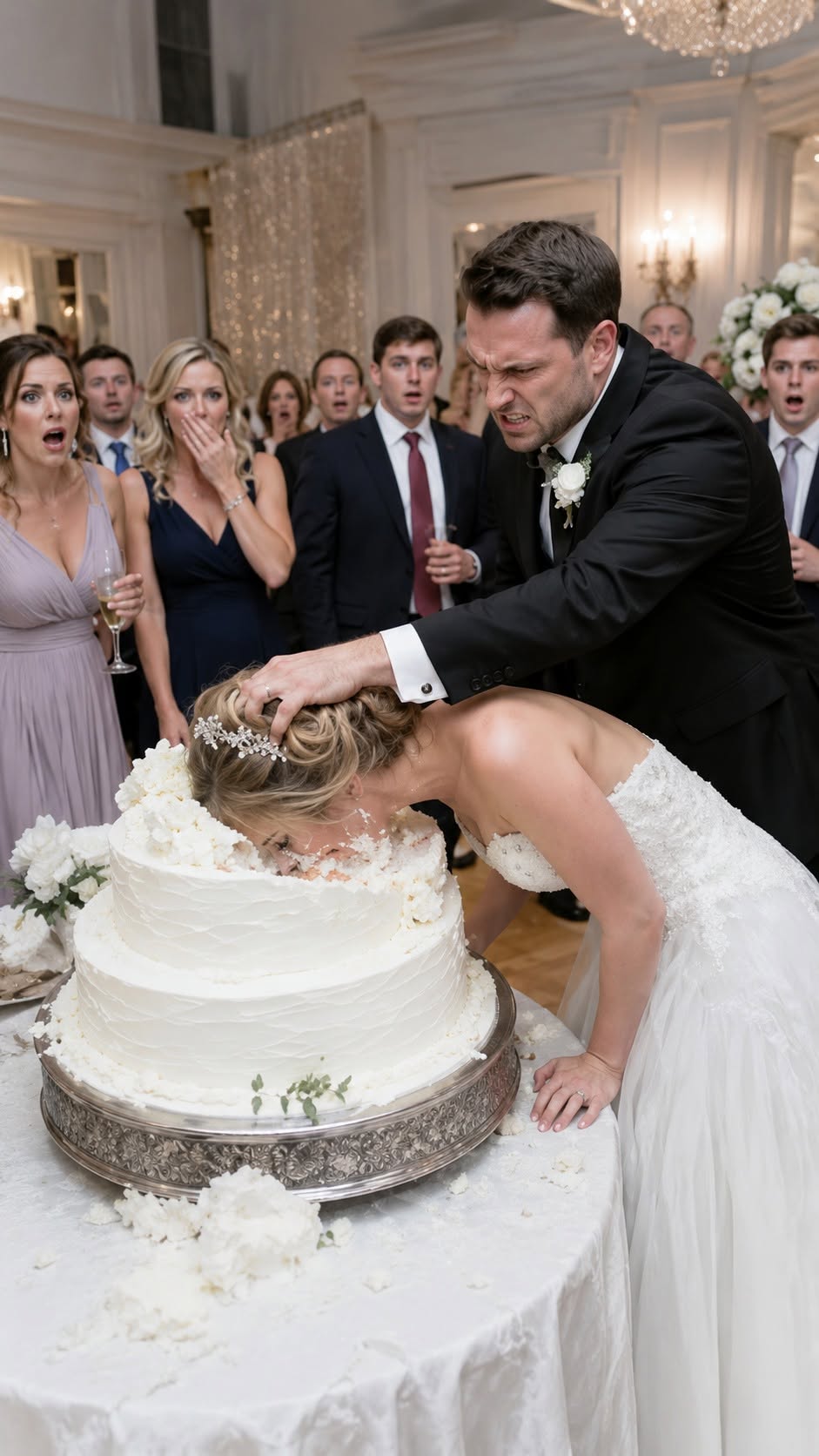
Thatcher, enraged by my microscopic defiance, let out a booming, theatrical laugh for the crowd. In a lightning-fast blur, his hand shot out, grabbing the back of my neck. He forced me downward, driving my face violently into the cake table.
My head cracked against the crystal base. Frosting blinded my eyes. The metallic tang of blood flooded my mouth where my lip had split against my teeth.
The grand ballroom fell into a deathly, breathless silence. I stayed on the floor for three agonizing seconds. I couldn’t catch my breath. Then, his voice cut through the quiet.
“Just a joke! Don’t overreact,” Thatcher announced, offering a cynical chuckle to the horrified crowd. “My wife is so dramatic.”
A few nervous titters rippled through the wealthy aunts in the front rows. People kept their phones raised. Lyra sprinted toward me, dropping her bouquet, falling to her knees to wipe the buttercream and blood from my face with a linen napkin.
Thatcher leaned down, his voice dropping to a demonic whisper. “Don’t you dare ruin this.”
Something inside the darkest, deepest part of my soul clicked into place. I didn’t feel the familiar panic. I didn’t feel the paralyzing fear that had governed my life for three years. I felt absolute, terrifying clarity. It was either I ended this right now, or I would end up buried in a literal grave.
I stood up, shaking off Lyra’s gentle hands. I walked straight to the wedding band’s frontman and ripped the microphone from his hands.
“What are you doing?” Thatcher barked, his face flushing with genuine rage.
“Back off,” Lyra ordered, stepping firmly between us.
I turned to face the sea of billionaires and socialites. My dress was ruined. My face was smeared with sugar and my own blood. But my voice, amplified through the massive speakers, did not tremble.
“I am not getting married,” I stated, the words echoing off the marble pillars. “Not to a man who subjects me to unrelenting terror, who monitors my every breath, and whose violent rage cornered me, causing the fall that stole my unborn child.”
A collective gasp swept through the crowd like a shockwave.
“Yes,” I continued, staring dead at the matriarch in the front row. “I was pregnant. And his mother, Constance, paid me fifty thousand dollars to hide the tragic loss. I have the wire transfers. I have the threats. And I am done keeping your putrid secrets.”
Thatcher lunged. Winston Carmichael grabbed him by the shoulders, struggling to hold back the groom. Constance shrieked, clutching her pearls, screaming that I was an opportunistic gold-digger.
I dropped the microphone. It hit the floor with an electronic screech. I hooked my arm through Lyra’s, and together, we turned our backs on the St. James empire, walking out of the ballroom as the doors shut behind us like a vault.
But as we stepped into the cool Rhode Island breeze, my phone buzzed in my hand. A text from an unknown number.
You have no idea what you just woke up. Run.
Chapter 2: Roots of Coal and Gilded Cages
To understand how I ended up bleeding on a crystal cake stand, you have to understand where I came from. I wasn’t bred for their world. I was raised in the shadow of the Appalachian mountains in West Virginia, a place where poverty was an inherited trait. My mother supposedly died giving birth to me. My father was a phantom. I was raised by my blind grandmother, Odessa, a woman woven from grit and cornbread. Amidst the chicken coops and Sunday prayers, she taught me one ironclad rule: Never accept that being a woman means bowing your head.
At twenty, armed with Odessa’s memory and a fierce hunger for independence, I moved to Boston. I scrubbed brownstones. I nannied for people whose grocery budgets eclipsed my yearly income. I studied accounting at night, dreaming of freedom.
Then, Thatcher St. James walked into the boutique where I worked the afternoon register. He was everything I had been conditioned to believe I didn’t deserve. He courted me with private helicopter rides over Cape Cod and orchids that cost more than my rent. I thought the universe was finally balancing the scales for my hard childhood.
I didn’t realize his love was a gilded bear trap.
It started with small things. Normalizing his sudden need to check my text messages. Staying quiet when he criticized my clothes for being “too provincial.” Learning to walk on eggshells to prevent his sudden, terrifying outbursts. Once, he cornered me against a wall simply because a male classmate had borrowed my notes. I love you, but don’t make me lose control, he had whispered into my hair.
I forgave him. I forgave him because I was isolated, and because the psychological conditioning of abuse makes you believe you are the architect of your own misery.
The nightmare culminated when I was eight weeks pregnant. We were at a private clinic for a routine checkup. We argued in the hallway because I had dared to ask a nurse a question without his permission. He shoved me into a heavy bathroom door. I fell hard. A piercing, unimaginable pain ripped through my abdomen. When I tried to cry out, he clamped his hand over my mouth. Stop being so dramatic, he sneered, leaving me on the cold tile.
I lost the baby in that emergency room bathroom. Constance arrived an hour later, bypassing the waiting room. She didn’t offer a hug. She offered a check. No one is going to believe a girl like you, she had said, her voice dripping with venom. Take the money and fix your makeup.
Now, sitting on the floor of Lyra’s cramped Somerville apartment, the memories threatened to drown me. I had washed the frosting and blood from my face, my ruined Oscar de la Renta dress crumpled in the corner like a shed skin.
The television in the background was already vomiting edited fragments of the disaster. Cable news pundits were debating my mental health. Thatcher was on screen, giving an exclusive prime-time interview from his penthouse. He looked sorrowful, perfectly composed.
“Elo is deeply unbalanced,” Thatcher lied smoothly to the camera. “She suffers from severe paranoia. I love her profoundly, but she needs psychiatric help. I would never hurt her.”
Lyra hurled her coffee mug against the wall, shattering it into ceramic dust. “You sick, manipulative bastard!”
I didn’t scream. I pulled my laptop onto my lap. If I didn’t take control of the narrative tonight, they would bury me beneath their PR machine. I hit record. Backlit by a cheap desk lamp, my face bruised and bare, I told the world everything. I named the clinic. I named the date of the miscarriage. I detailed the bribe. I posted the video at 2:00 AM.
By sunrise, it had surpassed two million views.
We were packing our bags, realizing the apartment was no longer safe, when a piece of paper slid underneath the front door. Lyra froze. She slowly bent down and picked it up. It was comprised of letters cut from magazines.
Keep quiet, or we will quiet you.
Before Lyra could speak, the sound of heavy boots echoed in the hallway outside. Someone was trying the doorknob.
Chapter 3: The Sound of Shattered Glass
We didn’t wait to see who was on the other side of that door. We grabbed the fire escape ladder, descending into the damp Boston alleyway with nothing but a duffel bag and the clothes on our backs.
The next two weeks were a blur of cheap motels and burner phones. I formally filed a criminal complaint with the district attorney’s office. I handed over the bank statements proving Constance’s bribe, the medical records of the miscarriage, and my personal diaries.
The press hunted us. The public response was a tidal wave. #NotMarryingHim trended globally. Thousands of women flooded my inbox with their own stories of survival. But the St. James machinery was also grinding into motion. Thatcher’s lawyers leaked forged medical certificates claiming I had Borderline Personality Disorder. They paid actresses to pose as my former roommates.
But the real retaliation wasn’t going to happen on the news. It was going to happen in the streets.
We were leaving a legal defense office downtown. The afternoon sun was blinding. I was reading a supportive sign a group of women had left on my windshield when the roar of an engine shattered the calm.
A black SUV, devoid of license plates, accelerated from the intersection, tearing through the crosswalk, aiming directly for us.
“Elo, move!” Lyra screamed.
She shoved me violently into the brick facade of the building. The impact knocked the wind out of me. I heard the sickening thud of metal striking bone. The SUV didn’t even brake; it swerved back into traffic and vanished into the labyrinth of the city.
I scrambled to my feet, my knees scraping against the asphalt. Lyra was lying on the ground, bleeding heavily from her head, her right leg twisted at an unnatural angle.
“Lyra! Oh god, Lyra, stay with me!” I sobbed, pressing my hands against the gash on her forehead. The sirens in the distance sounded like a funeral dirge.
The police took a report, but their eyes told the true story: as long as the St. James name was hovering over this, no real investigation would occur. Lyra survived, but the doctors warned her left leg had suffered severe nerve damage. She might never walk without a cane again.
The guilt was a physical weight pressing on my chest. They wanted to kill me, and I dragged her into the crossfire.
That night, an underground domestic violence network relocated us. We drove deep into the Berkshire mountains of western Massachusetts, navigating winding rural roads until we reached an old stone church hidden behind rusted iron gates. This was Mount Carmel, a clandestine sanctuary for broken women.
We were greeted by Reverend Mother Cresa. She wasn’t a traditional nun. She wore dark, simple clothes, but her eyes possessed the sharp, uncompromising glare of a veteran prosecutor. She had been a fierce civil rights attorney for two decades before her own teenage daughter was killed by an abusive boyfriend. She traded the courtroom for the sanctuary, but she never lost her instinct for war.
“You’ve suffered enough,” Cresa told me bluntly, handing me a mug of hot tea. “You come here to be reborn, not to cry forever. You are a symbol now, Eloen. And symbols make corrupt people very uncomfortable.”
With Cresa’s guidance, we transformed a nearby abandoned farmhouse into Meadowlark House, a covert legal and psychological support center for abused women. I worked day and night, channeling my trauma into a weapon. We listened to mothers fleeing monsters, girls escaping trafficking. Listening to their pain fortified my own spine.
But the St. James family wasn’t done. Constance had hired a private security contractor—a ghost known in the underworld as the Wraith—to track us.
One evening, while sorting through a massive stack of donated legal files at Meadowlark, Lyra found a plain manila envelope tucked between the folders. No return address. Just a single sheet of paper with shaky, cursive handwriting.
Lyra handed it to me, her face pale. I read the words, and the floor seemed to drop out from beneath my feet.
Your mother is not dead. She lives at Briarwood Manor in Connecticut. Constance put her there. She asks for you.
Chapter 4: The Ghosts of Briarwood Manor
My grandmother Odessa had sworn my mother died the day I was born. I had spent my entire life mourning a phantom. Now, standing on the porch of the sanctuary with the Berkshire wind whipping my hair, I realized my entire existence was built on a foundation of orchestrated lies.
“Do you want to know the truth?” Cresa asked gently, stepping out into the cold night beside me. “Or would you rather keep the illusion that helped you survive?”
“I have zero interest in surviving anymore,” I replied, my voice hard as flint. “I want to dismantle them.”
We left at dawn. Lyra, leaning heavily on her new customized cane, drove us across the state lines. Briarwood Manor was an imposing, decaying brick facility hidden behind ancient oak trees. It reeked of sterile bleach and forgotten humanity.
At the front desk, the mention of the name Seraphina Hayes caused the head nurse to pale. We were escorted to the maximum-security east wing. The room was tiny, stripped bare of any personal belongings. In the bed sat a frail woman with stark white hair pulled into a long braid.
I stepped closer. When she turned her head, the resemblance was undeniable. It was like looking into a mirror warped by decades of unspeakable trauma.
“Eloen,” she rasped, her voice dry like cracked parchment. “Is it you?”
My knees buckled. I collapsed beside the bed, grabbing her fragile hand. “I’m here. Who did this to you? Why did they tell me you were dead?”
Seraphina closed her eyes, tears leaking into the deep wrinkles of her face. “Constance,” she whispered. “Constance hated me more than anyone on this earth.”
The name hit me like a physical blow. “You know Constance St. James?”
“I was her maid,” Seraphina sobbed, the dam of decades finally breaking. “We were close once, in college. But her father arranged her marriage to a powerful, terrifying man. She brought me along to their estate. And then… her husband noticed me.”
A cold dread coiled in my gut. I squeezed my eyes shut, afraid of the next sentence.
“He used his immense power to force himself upon me, stripping me of every choice,” Seraphina continued, trembling. “I got pregnant. When I gave birth to a boy, Constance stole him. She couldn’t have children of her own, so she took mine. She raised Thatcher as her own son.”
The air left the room. My lungs refused to expand.
“Years later, the abuse happened again,” my mother cried. “I got pregnant with you. Constance was furious. The moment you were born, she banished you to West Virginia and locked me in this nightmare. She erased me.”
My head spun so violently I had to grip the metal bedrail to stay upright. Thatcher wasn’t Constance’s biological son. He was her husband’s. He was Seraphina’s.
He was my half-brother.
I stumbled backward, a wave of pure, toxic nausea overtaking me. The memory of his hands on my body, the child we had conceived, the horrific, demonic level of violation—Constance had known. She had watched me walk down the aisle toward my own brother. She had paid me to cover up the tragic loss of a child born of incest.
I barely made it to the small sink in the corner before my stomach emptied itself. Lyra rushed in, holding my hair, demanding to know what happened. But language had lost its utility. My soul felt permanently contaminated.
Back in the Berkshires, sleep was an impossibility. I compiled every document we had stolen from Briarwood’s archives. Fake psychiatric holds. Admission papers signed by Constance St. James.
I didn’t go to the press. Not yet. I requested a private meeting with Constance in her executive office at the St. James Medical Tower. She agreed, likely out of sheer arrogance, believing I was coming to negotiate a surrender.
I walked in alone, bypassing the plush leather chairs, and slammed the Briarwood documents onto her mahogany desk.
“Did you know Thatcher isn’t your biological son?” I asked, my voice deadly calm.
Constance didn’t flinch. She adjusted her reading glasses. “You know too much, and you hide too little. That changes nothing.”
“It changes everything,” I countered, leaning over the desk. “Because I know he is my brother. You locked my mother in a cell. You faked her death. You watched me carry his child. Why?”
Constance stood up, her silhouette casting a long, dark shadow against the floor-to-ceiling windows. “Do you know why I never wanted you near him? Because every time I looked at your Appalachian trash face, I saw your mother. The woman who stole my husband’s attention. You were a mistake. You shouldn’t exist.”
“And yet,” I whispered, my eyes burning with a fire that could have leveled the building, “here I am. Alive. Awake. And I am going to burn your empire to the bedrock.”
I walked out. But as I reached the elevator bank, my vision suddenly blurred. My left leg went entirely numb, refusing to support my weight, and I collapsed onto the marble floor.
Chapter 5: The Body’s Betrayal
I woke up in a sterile hospital room, the harsh fluorescent lights drilling into my skull. The symptoms had started quietly weeks ago—a tingling numbness in my fingers, sharp electrical shocks shooting down my spine. I had chalked it up to trauma, insomnia, the paralyzing anxiety of being hunted.
The neurologist stood at the foot of my bed, holding a chart that felt as heavy as an anvil.
“You have primary progressive multiple sclerosis,” he stated in a tone devoid of emotion. “Your immune system is actively attacking your central nervous system. Gradually, your motor functions will deteriorate. Your vision, your balance. There are already permanent lesions. It cannot be reversed.”
I stared at him, the sentence hanging in the air like an invisible guillotine. My body is shutting down just as I’ve finally learned how to fight.
“Prepare yourself,” he advised softly. “Get your affairs in order. Rest.”
Lyra, sitting beside me, burst into tears. I didn’t cry. A strange, serene defiance settled over my chest. “I have no intention of resting,” I told the doctor.
I returned to Meadowlark House in a wheelchair. The disease advanced like a silent thief in the night. My hands shook violently when I tried to pour coffee. But my mind was sharper than ever.
While I was hospitalized, Cresa had been busy. She had cross-referenced internal billing codes smuggled out of Thatcher’s hospital by a whistleblower nurse. She brought the files to my desk late one night, her face grim.
“It’s not just abuse, Eloen,” Cresa said, spreading the papers out. “Thatcher is running a massive illegal pharmaceutical ring. Medicare fraud. He’s administering expired chemotherapy drugs to cancer patients and pocketing the federal funds. We have cloned patient charts and forged signatures.”
He wasn’t just a monster behind closed doors; he was an institutional predator killing vulnerable patients for profit.
“Do we have enough to bury him?” I asked, my speech slightly slurred from the MS flare-up.
“If we leak it to the press, they’ll shred the hard drives before the FBI can raid them. We need an undeniable, global intervention. Something the Boston political machine can’t silence.”
That night, my hands trembling so hard I could barely grip the pen, I wrote a letter. I addressed it to the Pope in Rome. Cresa utilized her old Archdiocese contacts to bypass the bureaucratic labyrinth. It was a desperate plea into the universe, a strategic gambit relying on moral authority to shatter legal corruption.
My burner phone buzzed on the desk. An unknown number. I answered it without thinking.
“So, the great savior of women can barely walk anymore,” Thatcher’s voice slithered through the speaker, dripping with malicious glee. “How ironic.”
My blood ran cold. He knew about the MS. He had eyes inside the hospital.
“Don’t worry, Eloen,” he continued smoothly. “I’ll take care of you. All you have to do is come back to me. I still love you. If you aren’t mine, you won’t be anyone’s.”
“I would rather rot in the earth than breathe your air,” I spat, and hung up.
Three days later, the Vatican responded.
During a globally televised broadcast from St. Peter’s Square, Pope Francis spoke of a brave woman in the United States fighting against injustice, sickness, and the agonizing weight of institutional silence. He declared that my cause was a testament to human dignity.
The internet imploded. The federal government, humiliated on a global stage, could no longer stall. The DOJ issued the arrest warrants. But a cornered rat is the most dangerous kind, and the St. James family was preparing their final, lethal strike.
Chapter 6: The Trial of the Century
The federal courthouse in Boston was surrounded by a sea of humanity. News vans blockaded the streets. Thousands of women held massive signs bearing my face. This wasn’t just a trial anymore; it was a public autopsy of a corrupt aristocracy.
I arrived pushed by Lyra in my customized wheelchair. I wore a tailored, unadorned suit. My posture was rigid, demanding respect from a body that was actively failing me.
Inside the courtroom, Thatcher sat in a beige inmate jumpsuit beside his high-priced defense attorneys. When he saw me roll in, he smirked—a pathetic, childish grimace. He still believed his money would build a bridge out of this hell.
The prosecution’s opening statement was devastating. The Medicare fraud, the bribery, the sexual predation of patients. The first witness, a nineteen-year-old girl granted anonymity, testified about how Thatcher assaulted her during a checkup and threatened to withhold her vital medication if she spoke. The courtroom wept.
But the St. James fixers were working in the shadows. The second key witness vanished from her apartment overnight. A third ended up in an intensive care unit after a suspicious “hit and run,” suddenly refusing to cooperate with the feds.
Then, Constance took the stand.
Draped in mourning black, hiding behind designer sunglasses, she performed a masterpiece of weaponized victimhood. “My family is being destroyed by a calculated campaign of jealousy,” she wept, dabbing her dry eyes. “I only tried to protect my son from a dangerous, opportunistic woman. Eloen Hayes is deeply disturbed.”
The defense attorneys looked smug. They were spinning the narrative successfully, casting doubt on the entire prosecution. The judge called for a brief recess.
I sat in the hallway, my vision blurring, my lungs aching. Are they actually going to get away with it?
Suddenly, the heavy oak doors at the end of the corridor swung open. Federal marshals flanked a medical transport chair. The murmurs in the hall died instantly.
Seraphina Hayes had arrived.
She was dangerously thin, her skin almost translucent, transferred from the Hartford trauma center under heavy federal protection. Her doctors had stated she wasn’t fit to testify, but my mother had demanded to speak before her failing heart gave out.
When court resumed, Seraphina was wheeled to the center of the room. The judge called for absolute silence.
“My name is Seraphina Hayes,” she rasped into the microphone, her voice echoing like a ghost returning to haunt her murderers. “I am the biological mother of Eloen. And I am also the biological mother of Thatcher St. James.”
Thatcher’s defense attorney dropped his pen. It clattered loudly against the hardwood floor. Thatcher’s face drained of all color, his arrogant smirk melting into absolute horror.
“I was a maid in Constance’s house,” Seraphina continued, staring directly at the matriarch. “Her husband assaulted me. When I gave birth, Constance stole my son to pass off as her own. She locked me in a psychiatric ward for thirty years to hide her shame. She raised my boy to be a monster.”
Screams erupted in the gallery. Journalists sprinted for the doors to break the story. Constance lowered her head, staring blankly at her manicured hands. The castle was collapsing.
Thatcher couldn’t take the psychological pressure. He leaped out of his chair, completely snapping. He pointed wildly at me, screaming at the top of his lungs.
“This is all her fault! She ruined my life! She provoked me! She made me lose control!”
Federal marshals tackled him to the floor. The judge slammed his gavel, roaring for order. The cameras captured the great, brilliant surgeon reduced to a screaming, rabid animal.
But the victory was short-lived. That very night, as we celebrated the inevitable guilty verdict back in the Berkshires, I woke up to the smell of gasoline and smoke.
Meadowlark House was on fire.
Chapter 7: The Empire Burns
The roar of the flames was deafening. The deliberately set fire tore through the sanctuary’s roof, sending burning drywall and shattered glass raining down upon us. Panic erupted. Women screamed, grabbing their children, fleeing into the freezing mountain night.
Lyra dragged me from my bed, pulling my wheelchair through the thick, choking black smoke. We barely made it to the front lawn before the central support beam collapsed in a shower of sparks. Ambulances wailed in the distance. Several women were injured, choking on ash.
I was rushed to the hospital with a punctured lung and severe smoke inhalation. The MS spasms wracked my body, making every breath an agonizing battle. The police claimed they had no suspects, but we all knew who ordered the strike. It was a desperate, dying gasp from the St. James syndicate.
From my hospital bed, my face bruised and covered in an oxygen mask, I demanded Lyra hand me my phone.
“You need to rest, Elo,” she pleaded, tears cutting through the soot on her face.
“Hit record,” I ordered, my voice barely a whisper.
I stared into the lens with pure, unadulterated fury. “They want to silence us. They want to burn us to ash. But they don’t understand one simple truth: we are not afraid anymore. There is no weapon on this earth more powerful than a woman who rises back up after every single hit. The truth burns like a wildfire, but it also purifies.”
I posted the video. It didn’t just go viral; it ignited a revolution.
Hundreds of thousands of women poured into the streets of Boston, Washington, and New York. They marched on the state capitals. They surrounded the St. James hospital, demanding immediate federal action. The investigative press, emboldened by the public outrage, finally took the gloves off. Hackers leaked the hospital’s internal server emails, exposing dozens of politicians who had actively covered up Thatcher’s abuse.
The final blow came two days later. An anonymous source leaked the hospital’s internal surveillance footage. It showed Thatcher, moments before his arrest, frantically shredding patient files and handing thick envelopes of cash to administrators.
There was no PR spin left. The illusion was dead.
That afternoon, Thatcher suffered a complete, irrecoverable psychological collapse in his federal holding cell. Guards found him rambling incoherently, curled into a fetal position on the concrete floor. He was transferred to a maximum-security psychiatric penitentiary. He never spoke another coherent word.
Constance St. James met her end a week later. She suffered a massive heart attack while sleeping alone in her sprawling, empty Newport mansion. Her army of lawyers had abandoned her. Her offshore accounts had been frozen. She died exactly as she had lived: cold, isolated, and entirely devoid of love.
My mother, Seraphina, passed away peacefully in a hospice facility shortly after, her hand holding mine. She died knowing the world finally knew her name, and that her oppressors had been vanquished.
The monsters were gone. But my own clock was rapidly running out.
Chapter 8: The Final Vow
On September 15th, Meadowlark House triumphantly reopened its doors in a massive, newly renovated facility in upstate New York. It was fully funded by international human rights foundations. Above the heavy oak front doors, a plaque read: We will not judge you here. We will only hold you.
I was transported via a specialized medical ambulance. My body was failing, tethered to an oxygen tank, but I refused to miss this day. Lyra, standing proud with her cane, helped wheel me onto the stage set up on the lush green lawn.
The crowd of thousands—survivors, activists, women who had driven across the country just to be there—erupted into a deafening standing ovation.
Lyra took the microphone first. “When I first walked into the original Meadowlark, I was broken,” she boomed, her voice carrying across the valley. “But this place taught me that carrying scars doesn’t mean you are beneath anyone. Thank you, Eloen, for carrying our screams when our throats were too broken to make a sound.”
I wept openly. I couldn’t speak loudly anymore, so I had pre-recorded my final message, which played over the massive speaker system.
“I don’t know how much time I have left. But it doesn’t matter. I lived way too long hiding in the shadows, apologizing for taking up space. I was brainwashed into believing that love required agony. But the failure was never mine. It belongs to the monsters who convinced us that being a woman means being born to endure pain. I don’t want to be remembered as a tragic victim. I want to be remembered as the woman who finally said enough.”
A week later, in a deeply intimate ceremony surrounded by the women of Meadowlark, I performed one final act of rebellion. I married myself.
I wore a simple, flowing white dress. Reverend Mother Cresa officiated. There were no rings, only promises.
“I promise to fiercely respect myself,” I whispered, my voice weak but my spirit soaring. “I promise to be my own safe house. Today, I marry myself so that I will never again rely on someone else’s broken love to feel like I am finally enough.”
A few months later, as the first winter snow began to fall over the Berkshires, I passed away quietly in my sleep. There was no pain. I simply closed my eyes and let go.
My ashes were scattered across the vibrant wildflower gardens of Meadowlark House. And every year, on the anniversary of my passing, women gather in that exact spot. They sit in the grass, they read their testimonies, and they listen to the final words of my recorded interview echoing through the sanctuary grounds:
“Sometimes we are tricked into believing that the story ends in the trauma. But it doesn’t. The true ending only begins the moment we decide to become the exact love that no one else knew how to give us. My story didn’t end face down in a wedding cake. It started the second I opened my eyes and decided I would never, ever close them again.”