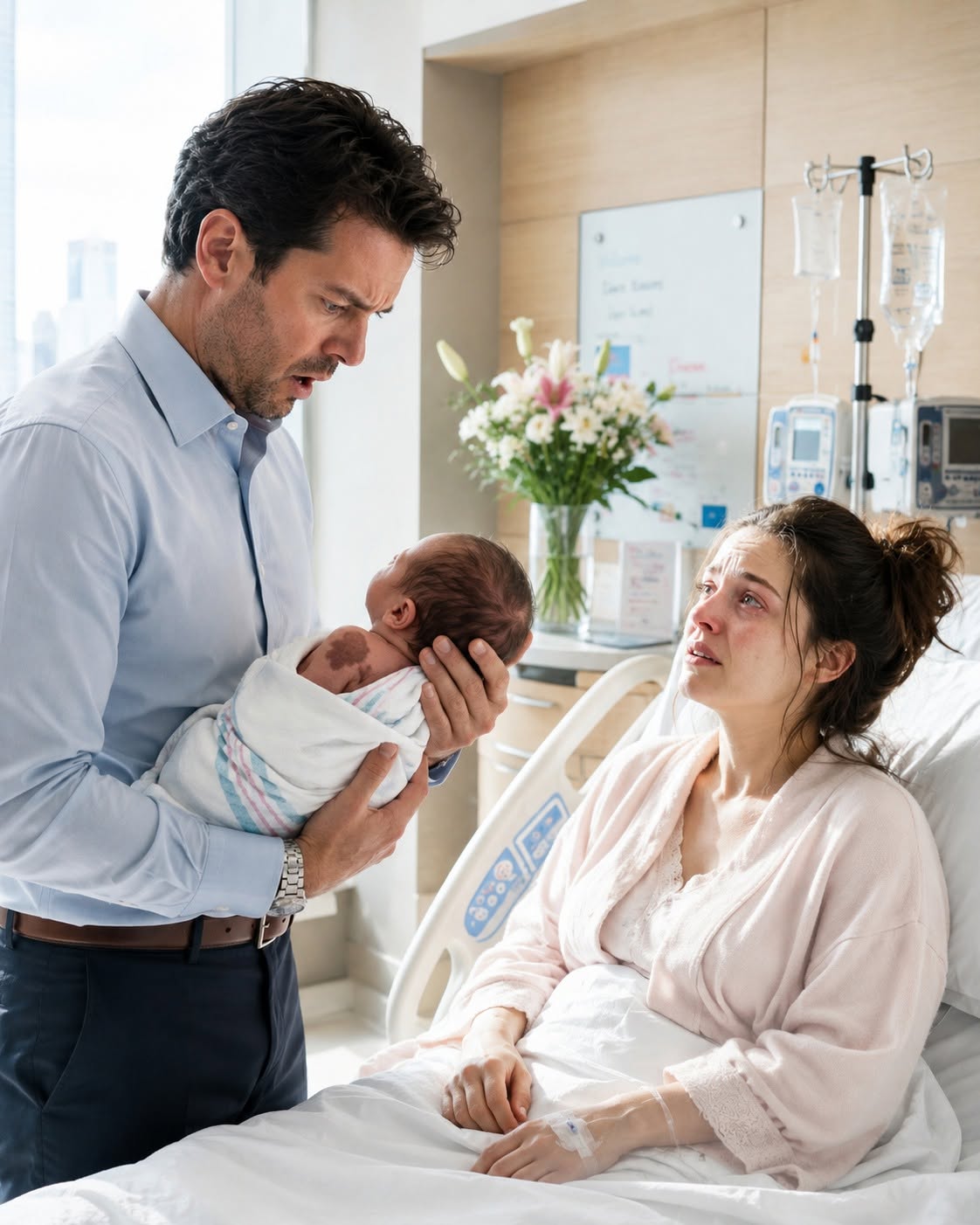
“That boy isn’t mine.”
Daniel barely raised his voice, but inside that hospital room, the words landed like a brick crashing through glass.
I was still lying in bed, my entire body aching after almost 12 hours of labor. My hospital gown clung to my chest, and my legs were still trembling from exhaustion. Beyond the door, I could hear the wheels of a nurse’s cart moving down the hallway, a family laughing somewhere in the distance, and the thin cry of another newborn.
Inside our room, though, everything went still.
Only 5 minutes earlier, Daniel had been crying with joy.
He had cradled our son as though someone had placed a miracle directly into his hands. His eyes were red with tears, and he stared down at the baby with a smile I had never seen when our 4 daughters were born: Grace, Lily, Chloe, and little Emma.
It wasn’t that he didn’t love our girls.
He did.
But after each of their births, there had always been something in his face. A flicker of disappointment. Small, quick, almost invisible.
“Maybe next time,” he would whisper before kissing my forehead.
Next time.
For years, those 2 words felt like a stone hidden beneath my pillow.
After Emma, I didn’t want to be pregnant again. My body was exhausted. My nights had become an endless blur of diapers, homework, fevers, school clothes, grocery lists, and bills.
But Daniel desperately wanted a son.
An heir, his mother called it.
A boy to carry on the family name, his father used to say before he died.
And like a fool, I convinced myself that sacrifice was another form of love.
When we learned that this baby was finally a boy, Daniel painted the nursery navy blue before we even bought the crib. He ordered a wooden sign with “Noah” carved across it. He bought tiny sneakers, footballs, and miniature Carolina Panthers jerseys, even though I reminded him that we had no idea whether our son would even like football.
“My son is going to play with me,” Daniel said.
My son.
Not our son.
That day at the hospital in Charlotte, Daniel couldn’t stop texting everyone.
His sister Jennifer messaged him to say the girls had made an enormous welcome-home poster. Apparently, Emma had somehow ended up with green marker all over her forehead while helping.
I laughed even though my entire body hurt.
“I can’t wait for them to meet him,” I said.
“I get him first,” Daniel replied, grinning.
A nurse entered a few minutes later to change Noah’s clothes.
She placed him gently inside the clear hospital bassinet, pulled away his white blanket, and unsnapped his onesie.
That was when Daniel seemed to stop breathing.
I watched him lean closer.
Slowly.
His eyes fixed on Noah’s lower back.
“What’s wrong?” I asked, immediately terrified that the nurse had noticed something.
She examined Noah.
“He’s perfectly fine, ma’am. It’s only a birthmark.”
But Daniel didn’t seem to hear her.
There was a small, pale mark shaped like a crescent moon near the base of Noah’s back.
Daniel stared at it.
“No,” he whispered.
Then again:
“No. That can’t be.”
“Daniel, you’re scaring me.”
He asked the nurse if she could give us a minute.
She hesitated, glanced at me, then eventually stepped outside and closed the door.
Daniel turned toward me.
I will never forget his face.
The joyful man who had been holding our newborn only minutes earlier had disappeared.
A stranger stood in his place.
“Michael has that exact same birthmark.”
For a moment, I felt as if the room had tilted beneath me.
Michael had been Daniel’s best friend since middle school.
Michael was the man who picked our daughters up from school when I was at risk of premature labor.
He was the one who brought groceries when Daniel had to work double shifts.
He was the man who sat at our kitchen table drinking coffee while Emma slept across my lap.
“What are you trying to say?”
Daniel gave a bitter laugh.
“Don’t make me look like an idiot, Emily.”
“He’s your son.”
“That boy has Michael’s birthmark.”
I forced myself upright.
Pain ripped through my body.
“Then get a DNA test. Today. Right now. I don’t care how much it costs.”
Daniel stepped backward as though I had slapped him.
“I don’t need some test to tell me what I just saw.”
“Daniel, please…”
“When they discharge you, go stay with Rachel.”
I stared at him.
“What?”
“I can’t bring that baby home.”
That baby.
Noah began to cry.
I reached toward him instinctively.
Daniel didn’t even turn around.
He grabbed his jacket, opened the hospital door, and walked away.
And there I was, alone with the son he had spent 8 years begging me to give him, realizing that one tiny birthmark had just shattered my marriage.
I had no idea that the truth behind that mark would be even worse.
My sister Rachel opened her front door 2 days later.
I still had my hospital gown underneath my sweater, and the admission bracelet was still wrapped around my wrist.
Rachel didn’t ask questions.
She took the stroller from me, wrapped her arms carefully around my shoulders, and let me cry in her living room.
The girls were staying in the guest room.
Grace kept asking whether Dad was coming.
Lily wanted to know why we weren’t going back to our own house.
Chloe was carrying the welcome-home poster, now folded in half.
And 3-year-old Emma kept asking the same question.
“Is Daddy mad at the baby?”
I didn’t know how to answer without breaking apart in front of them.
Daniel ignored every call I made.
At 9:17 that night, he finally sent me a message.
“My lawyer will contact you. I don’t want any drama.”
I handed my phone to Rachel.
“Stop calling him,” she said.
“He’s my husband.”
“No. Right now, he’s the man who abandoned you immediately after you gave birth because he trusted his suspicion more than he trusted you.”
It hurt because she was right.
That afternoon, I ordered a DNA test.
Rachel went to my house and retrieved one of Daniel’s toothbrushes because he wouldn’t even open the door for me.
While Noah slept, I gently swabbed the inside of his cheek.
We sealed everything inside the envelope and mailed it.
The following days became their own quiet version of hell.
My milk came in while I was running a fever.
I slept sitting upright.
The girls constantly asked where their father was.
My phone remained silent.
And whenever Noah moved, I found myself looking at that tiny crescent-shaped mark on his back.
I hated that something so innocent had been turned into evidence against me.
On the fourth day, Michael appeared at Rachel’s house carrying a teddy bear and a bag of pastries.
“Daniel blocked me,” he said from the doorway. “What happened? Is the baby okay?”
I couldn’t look him in the eye.
Michael looked exhausted.
He was tall, calm, the kind of man who always seemed to know exactly what needed to be done during an emergency.
Throughout my pregnancy, Michael had carried heavy cases of water into the house, driven Lily to the dentist, and picked up medicine whenever I became too uncomfortable to drive.
Daniel had taken every act of kindness and twisted it into something dirty.
“We’re okay,” I said. “I just need some time.”
Michael glanced past me.
“Emily, if I did something that upset Daniel…”
“It’s not you,” I interrupted.
Then I hesitated.
“Or maybe somehow it is. I don’t know.”
The color disappeared from his face.
Rachel stepped up behind me.
“You should leave, Michael. When the time is right, someone will call you.”
Michael slowly placed the teddy bear near the doorway.
Then he walked away with his shoulders lowered.
A week later, the DNA results arrived by email.
I opened the PDF at Rachel’s kitchen table while she stood behind me.
“Probability of paternity: 99.99%.”
Noah was Daniel’s biological son.
For about 3 seconds, relief washed over me.
Then it disappeared beneath pure anger.
I didn’t call Daniel.
I didn’t text him.
I simply forwarded the report.
He arrived less than an hour later.