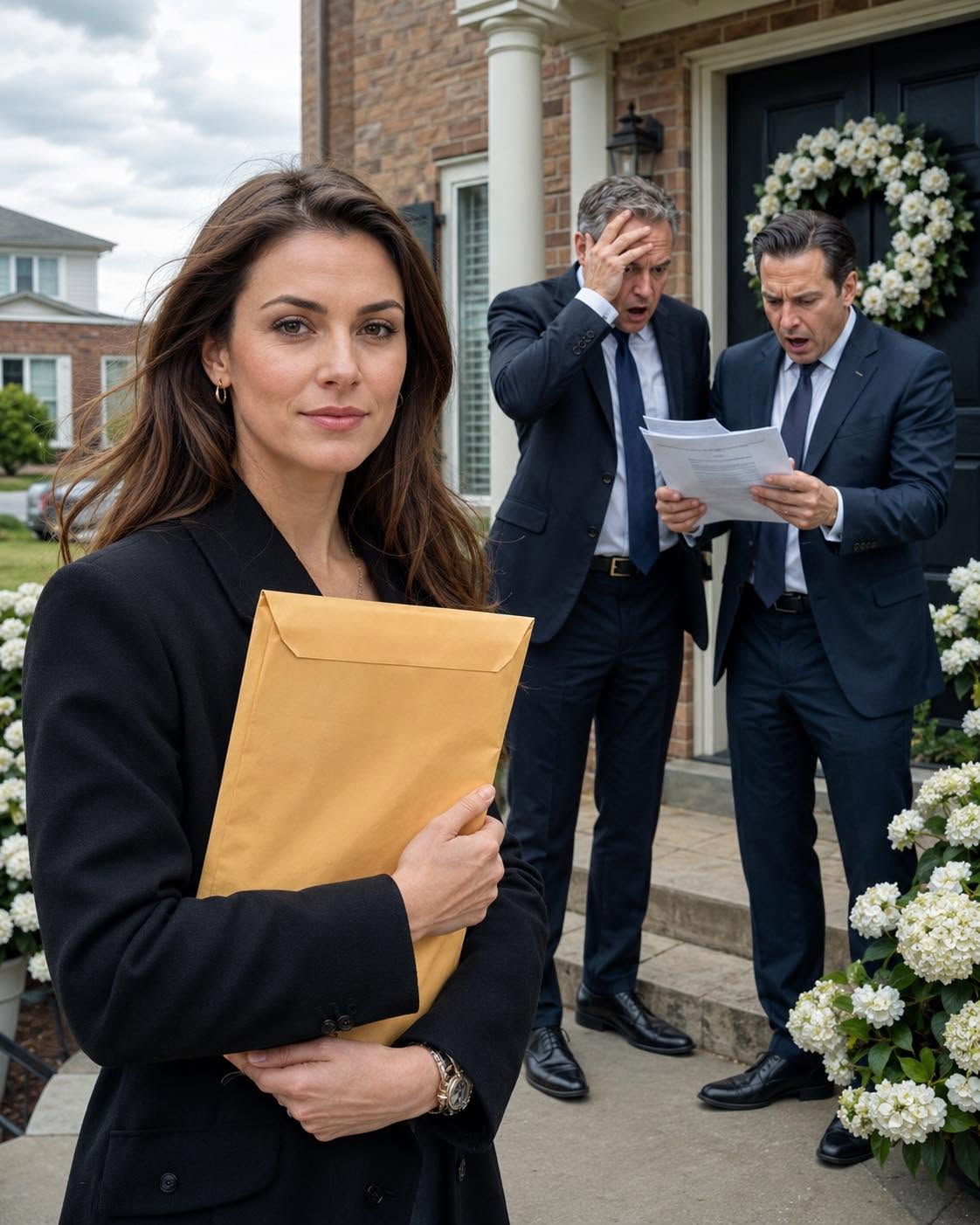
“How much did you think you were going to make by doing favors for a lonely old woman?”
Those were the first words Daniel Parker said to me the morning after his mother’s funeral, standing outside my front door in Pasadena with an attorney beside him and a black folder pressed tightly against his chest.
He didn’t say good morning.
He didn’t ask how I was holding up.
He didn’t mention that Margaret had died barely 24 hours earlier, or that the same black dress I had worn to the funeral was still hanging over the back of a chair because I hadn’t found the strength to put it away.
He simply arrived with that accusation, sharp as a kitchen blade.
I opened the door but left the security chain fastened.
Daniel was 52, dressed in a navy suit that looked far too expensive for an ordinary morning on our quiet street. His eyes were swollen, though I couldn’t tell whether he had been crying or whether anger had kept him awake. The attorney beside him looked as though he had just walked out of some polished downtown Los Angeles office: spotless shoes, silver watch, measured expression.
“Mrs. Claire Bennett,” the attorney said. “My name is Michael Grant. I’m Daniel’s attorney. We need to ask you a few questions concerning Mrs. Margaret Parker.”
“You can ask them from where you’re standing,” I replied.
Daniel gave a dry little laugh.
“Of course. Always careful, aren’t you? Always so discreet.”
I glanced toward the house next door.
Margaret’s bougainvillea still spilled over the old iron gate. The curtains in the living room were drawn. For the first time in years, the porch light had remained dark after sunset.
Margaret was 84 when she died. She had lived in that house since 1974, back when that part of Pasadena smelled more like wet soil and orange blossoms than expensive coffee shops. Her husband died in 2012, and afterward the garden slowly became its own little wilderness: crooked rosebushes, cracked clay pots, and an old metal chair that always looked as though it were waiting for someone to sit down.
I met her almost by accident.
One Tuesday in April 2019, I noticed an orange water shutoff notice taped to her front door. It said that unless the bill was paid by Friday, the water would be disconnected.
The overdue amount was $540.
I stood there staring at that piece of paper as if someone had posted her humiliation for the whole neighborhood to see.
Margaret stepped outside at that exact moment, carrying a grocery bag in one hand. She walked slowly, but she still moved with the dignity of a woman who had survived too much in life to bow her head for anybody.
Before she noticed the notice, I tore it down and slipped it into my purse.
That same afternoon, I called Pasadena Water and Power, asked how I could pay someone else’s account as a third party, and settled the balance. The next month, I did the same thing.
And the month after that.
For 6 years, I paid Margaret’s water bill.
I never told her.
It wasn’t charity. At least, it never felt that way to me. I was simply making sure that a woman who took cold showers to save on her gas bill would never have to ask anyone’s permission to remain independent.
Margaret would never have accepted cash from my hand.
If she had known, she would have felt smaller every time we crossed paths on the sidewalk.
I didn’t want that.
I wanted her to keep stepping outside in the afternoons wearing her gray shawl. I wanted her to keep complaining to the man at the neighborhood food cart because he had started getting stingy with the sauce. I wanted her to continue living in her own home as Margaret Parker, not as “that lonely old lady at the end of the block.”
Daniel lifted a yellowed sheet of paper.
“I found this in my mother’s drawer.”
It was an old water bill.
Across the top, written in Margaret’s shaky but unmistakably clear handwriting, was my name:
Claire has been paying this since 2019. She’ll insist she never did anything important. Don’t embarrass her.
My throat tightened.
Until that moment, I had believed my secret had died with Margaret.
“I found something else,” Daniel continued. “Three days before the funeral, her estate attorney sent me a copy of her updated will.”
“I didn’t know she had changed her will.”
“Don’t insult my intelligence,” he snapped. “My mother wouldn’t even switch coffee brands without thinking about it for 3 weeks.”
Michael opened the folder.
“We’re trying to determine whether there may have been undue influence over a vulnerable elderly person.”
“I paid her water bill.”
“You made her dependent on you,” Daniel said. “You worked your way in little by little. One bill here. One visit there. A bowl of soup when she was sick. So what did you ask for in the end?”
I stared at him without answering.
I had spent years listening to Margaret defend that man.
“Daniel works so hard.”
“Daniel lives far away.”
“Daniel doesn’t call because he has too much going on.”
There was always an explanation for his absence.
Mothers have a terrible gift for wrapping abandonment in beautiful paper.
“When was the last time you spoke to her?” I asked.
Daniel blinked.
“That has nothing to do with this.”
“September 11. You called at 8:04 that evening and hung up at 8:09. I was standing in her kitchen replacing the refrigerator light bulb.”
His jaw tightened.
“I was busy.”
“In February, she fell in the bathroom. She was on the floor for 47 minutes before I heard her banging against the wall.”
Michael looked up.
Daniel’s face lost a little color.
“Why didn’t anyone call me?”
“Because she asked me not to.”
“She was my mother.”
“Then you should have known she was terrified of hospitals ever since your father died in one.”
Daniel looked down for a moment.
Then the anger came rushing back.
Sometimes guilt, when it has nowhere to escape, puts on the face of rage.
“You don’t have the right to judge me.”
“I’m not judging you. I’m answering your questions.”
Michael cleared his throat.
“Mrs. Bennett, we need to establish whether you received anything in exchange for paying those bills.”
“Then you need to hear the whole story.”
I stepped back inside and went straight to the dresser in my bedroom.
Inside the bottom drawer was the manila envelope Margaret had handed me the previous October.
She had come into my kitchen one afternoon carrying cinnamon rolls and wearing an expression that was strangely peaceful.
“Don’t open this, Claire,” she had told me. “Just give it to whatever lawyer my son brings here when he decides I’m no longer capable of defending myself.”
I hadn’t asked any questions.
Maybe I should have.
I returned to the porch and handed the envelope to Michael.
Across the front, Margaret had written:
For the attorney Daniel hires if he tries to undo my decisions.
Daniel stared at me as though he had just uncovered some enormous betrayal.
“So you did plan this together.”
“No,” I said. “She planned it. I only kept the envelope.”
Michael broke the seal.
He read the first page.
Then he went back to the top and read it again.
His expression changed so abruptly that Daniel seemed to stop breathing.
“Daniel,” Michael said, his voice suddenly much quieter, “I need to ask you something before we go any further.”
Daniel frowned.
“What?”
Michael looked up from the document.
“Why did you continue transferring money from your mother’s accounts after she revoked your financial power of attorney?”
And just like that, the anger disappeared from Daniel’s face as though someone had turned off a switch.
The silence on my porch became heavier than the May heat.
Daniel opened his mouth.
Nothing came out.
Michael held the document where he could see it.
“This states that your mother granted you temporary financial power of attorney in 2020 following hip surgery. It also states that she revoked it in August 2021 after discovering unauthorized transfers.”
“My mother was already getting confused by then,” Daniel said.
“No,” I said before I could stop myself. “Margaret got confused by her television remote. She did not get confused about her money.”
Daniel shot me a look filled with venom.
“You weren’t family.”
“No. Which meant I could listen to her without expecting anything in return.”
Michael continued sorting through the papers.
He pulled out bank statements marked in red ink, copies of transfers, and a page bearing the letterhead of a company called Parker North Development.
“The transfers total $386,000,” he said. “Every one of them went to an account connected to your company.”
Daniel’s jaw tightened.
“They were loans.”
“Where are the loan agreements?”
“She was my mother.”
“That isn’t a legal answer.”
“She knew my company was struggling.”
“Did you ask her permission before transferring the money?”
Daniel looked toward the street.
A woman carrying two grocery bags was walking along the sidewalk.
A dog barked behind a wooden fence.
The entire neighborhood continued as usual, as though an invisible grave weren’t being opened directly in front of my house.
“I was going to pay it back,” Daniel finally said.
“Did you?” Michael asked.
Daniel said nothing.
I remembered Margaret sitting at my kitchen table months earlier, both hands wrapped around a cup of tea.
“My son thinks I don’t understand things anymore,” she had told me.
“Understand what?”
“That a house isn’t only property. That a bank account isn’t only a balance. That a mother isn’t a safe full of old family photographs.”
That was the afternoon she told me about the money.
She asked me not to report him.
I argued with her.
I became angry.
She only looked at me with the exhausted sadness mothers sometimes carry when they love someone who is slowly breaking them.
“He’s my son, Claire.”
“That doesn’t give him the right.”
“No. But I don’t want to spend the last years of my life hating him.”
And now Daniel was standing outside my door, trying to turn a $540 water bill into some elaborate conspiracy while his mother’s documents exposed something much uglier.
Michael pulled out another page.
“There’s also a medical evaluation from 2023. It confirms that Mrs. Parker had full mental capacity to make legal and financial decisions.”
“She did all this?” Daniel whispered.
“Yes,” Michael said.
“How long had she known?”
“Since 2021.”
Daniel’s face collapsed.
He didn’t look like some villain from a television drama.
That would have been easier.
He looked like a son who had arrived ready to defend himself against the wrong accusation and had suddenly discovered the real one.
Michael handed him a folded letter.
“This is for you.”
Daniel took it with rigid hands.
He recognized his mother’s handwriting immediately.
He began reading silently.
Halfway through, his breathing faltered.