Chapter 1: The Porcelain Trap
By six o’clock that Friday evening, my entire future had been meticulously engineered, poured into concrete, and set to cure.
My charcoal suit, freshly delivered from a bespoke tailor on Chicago’s Oak Street, draped perfectly over my shoulders. My late grandfather’s brushed silver cuff links rested heavily at my wrists, cold against my skin. Tucked securely inside the breast pocket of my jacket was a flawless, three-carat diamond ring. I had selected it after three exhausting consultations with a private jeweler and several hushed, strategic conversations with my mother.
At exactly eight o’clock, I was contractually expected to ask Camille Redford to be my wife.
The stage for this performance was a private reception at the Hollowell family’s prized glass rooftop garden, an architectural marvel overlooking the icy, black expanse of Lake Michigan. Everyone of transactional importance would be there, holding flutes of vintage champagne. My mother. Camille’s aristocratic parents. A flock of our board members. Two senior partners from Redford Capital.
This marriage wasn’t born of passion; it was a merger. It was designed to fuse a business partnership that our respective dynasties had been cultivating for years.
There was only one glaring, hollow problem.
I respected Camille. I admired her sharp wit and her effortless grace. But I had never loved her.
I had learned long ago, however, that men born into the suffocating privilege of families like mine were expected to treat personal happiness as a highly negotiable asset. Duty was the only currency that mattered. As I stood in the lobby of the luxury restaurant downstairs from the rooftop, waiting for the evening to commence, I had almost successfully convinced myself that I could endure a lifetime of polite, loveless companionship.
I ducked into the restroom to splash cold water on my face and steady my accelerating pulse.
That was when the meticulously engineered blueprint of my life violently collapsed.
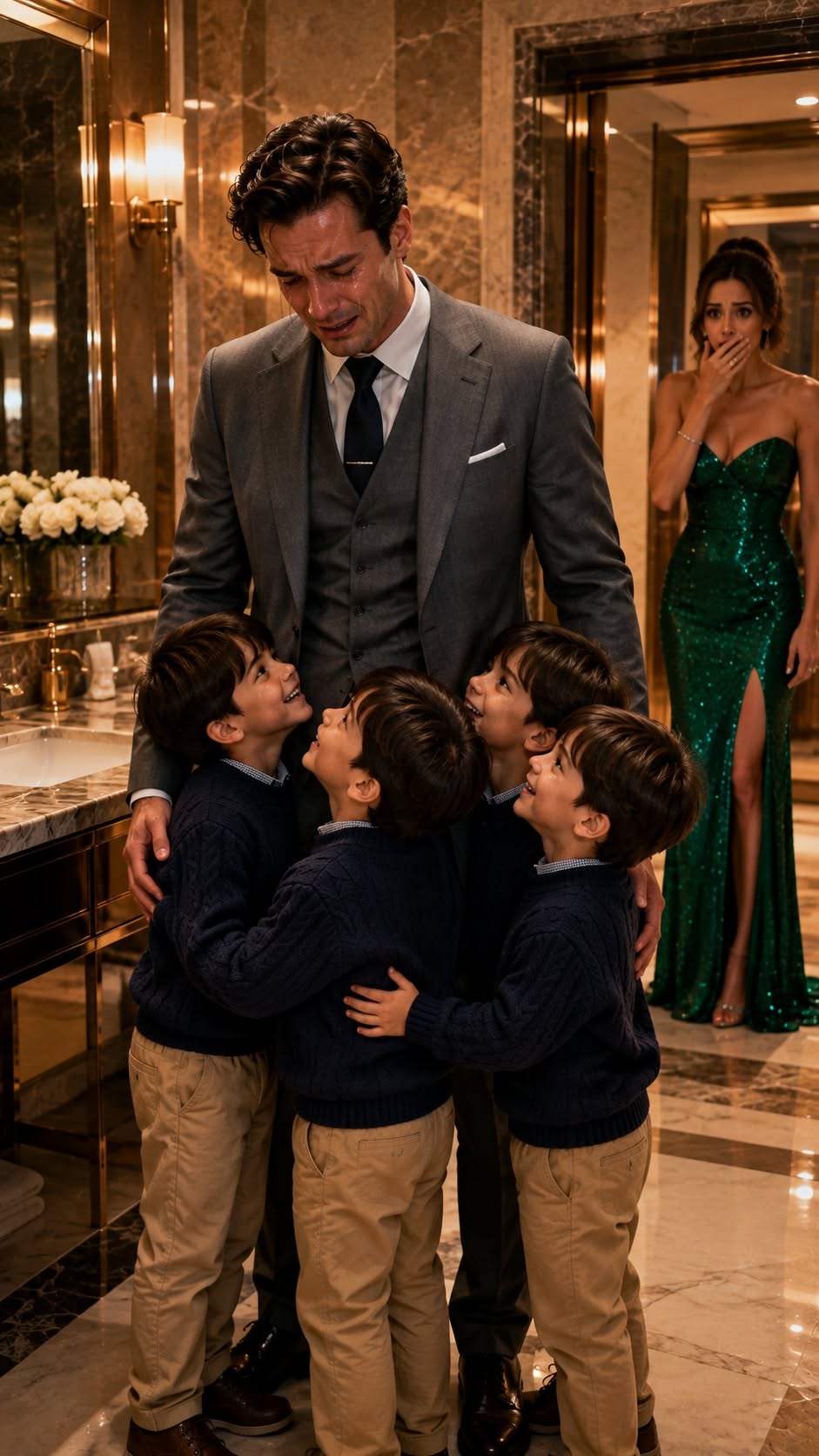
Four little boys, all dressed in matching navy-blue knit sweaters, stood clustered near the marble sinks. They were waging a losing battle against an automatic hand dryer that flatly refused to acknowledge their tiny, waving hands. They looked to be about six years old.
I offered a brief, polite smile and stepped toward the massive mirror to check my tie.
As I adjusted the silk knot, my gaze caught the reflection of one of the boys. He pushed a lock of dark, unruly hair away from his forehead using exactly two fingers. Then, he tilted his head slightly to the right and rubbed the back of his neck with his palm.
My blood turned to ice.
A second boy, standing next to him, did the exact same thing. Two fingers to the hairline. Palm to the neck.
Then the third.
Then the fourth.
I froze, my hands hovering over my collar, staring at their reflections as if I were looking at ghosts.
My late father used to mercilessly tease me about that exact physical tic. Whenever a wave of anxiety hit me, I pushed my hair back with two fingers before touching the left side of my neck. It was an involuntary comfort mechanism I’d possessed since kindergarten.
The tallest of the four boys noticed me staring through the mirror. He turned around, wiping his damp hands on his jeans.
“Why are you staring at us, mister?”
I blinked, trying to force oxygen back into my paralyzed lungs. “I’m… I’m sorry. I didn’t mean to stare.”
The boy narrowed his stormy gray eyes, assessing me with an intense, familiar scrutiny. “You do the neck thing too.”
I slowly dragged my eyes back to my own reflection in the glass.
Same stormy gray eyes. Same narrow, stubborn chin. Same slight, asymmetrical crease beside the left cheek when the mouth tightened. Even the aggressive arch of our eyebrows looked like they had been lifted directly from the dusty photograph albums in my mother’s library.
The boldest boy took a step forward and extended his hand with a startling amount of confidence. “I’m Miles. Those guys are Mason, Micah, and Milo. We’re brothers.”
I reached down, operating entirely on autopilot, and shook his tiny, warm hand. “Are you all the same age?”
Miles offered a gap-toothed grin. “Yep. We’re quadruplets.”
A phantom fist reached into my chest and squeezed my heart until it ached. My throat went desert-dry. “Where is your father?”
The bright grin vanished from Miles’s face, replaced by a guarded neutrality. “We don’t have one.”
I swallowed the heavy lump forming in my throat. “And your mother?”
Miles turned and pointed a small finger toward the frosted glass doors leading back out to the restaurant floor. “She works here.”
I followed the trajectory of his finger. I walked out of the restroom, my vision tunneling, the ambient noise of clinking silverware and smooth jazz fading into white noise.
And in a single, shattering heartbeat, six years of forced amnesia disappeared.
Standing near the service station, wearing a stiff black apron over a faded blue blouse, was Tessa Marlowe.
I would have recognized her in a pitch-black room simply by the scent of vanilla and rain she always carried, but seeing her under the harsh amber lights of the restaurant felt like taking a bullet to the ribs. Her soft, chestnut hair was cropped shorter now, grazing her jawline. There were faint, bruised lines of sheer exhaustion beneath her eyes—lines that had not existed when we were twenty-six and invincible. But she still possessed those striking, hazel-green eyes, and the small, crescent-shaped scar resting just above her right brow.
I had once memorized every micro-expression on that face. I had once believed, with every fiber of my naive soul, that I would grow old and gray beside her.
Then, she vanished.
At least, that was the narrative I had been spoon-fed.
A sharp-featured restaurant supervisor stood across from Tessa, speaking in a low, reprimanding hiss. “I am sorry, Tessa, but the staff breakroom cannot be used as an overnight shelter.”
Tessa’s shoulders slumped, her voice tight with suppressed panic. “I understand, Brenda. I swear I do. I only need a few hours. The temporary housing office promised they can place us somewhere safe tomorrow morning.”
“I wish I could help,” the supervisor replied, her tone devoid of actual warmth. “But I cannot make an exception to company policy.”
I barely heard the rest of the exchange. Tessa turned her head toward the restroom corridor and saw me standing there, paralyzed.
Her face underwent a violent metamorphosis.
First, shock. Her lips parted, all the color draining from her cheeks.
Then, raw, unfiltered fear.
And finally, something colder and far more dangerous than anything I had ever seen from her.
“Boys,” she snapped, not taking her eyes off me. “Get your coats. Now.”
I took a trembling step forward. “Tessa.”
She moved with the speed of a protective lioness, inserting her body between me and the four children clutching their winter jackets. “Not here, Grant. Do not do this here.”
Minutes later, we stood outside on the pavement. Chicago’s brutal February wind howled between the towering skyscrapers, gnawing at the exposed skin of my neck. Two battered, faded canvas travel bags sat slumped near the restaurant’s service entrance.
I looked at the luggage, then at the four shivering children huddled against their mother’s legs.
“Where are you staying tonight?” I asked, my voice barely working.
“That is entirely none of your concern,” she spat, her hazel eyes ablaze with defensive fury.
“Tessa, you have four children standing outside in a freezing wind chill.”
“I have managed without a single ounce of your concern for six years!” she fired back.
The sentence struck me with the force of a physical blow. I reached into my tailored trousers, my fingers bypassing the velvet box containing the three-carat diamond, and pulled out my leather wallet. I extracted a heavy, black key card.
“I have a corporate apartment over in River North,” I said, holding it out. “I barely ever use it. It’s warm, it’s safe, and it’s completely empty. Take the boys there tonight.”
Tessa shook her head violently. “No. Absolutely not.”
“I am not asking for anything in return, Tessa.”
She let out a bitter, humorless laugh that cut me to the bone. “You Hollowells never give a single thing without demanding something back with interest.”
Before I could argue, little Micah—his nose red from the biting cold—tugged gently at Tessa’s sleeve. “Mom? I’m really cold. And I’m tired.”
Tessa squeezed her eyes shut. A tear escaped, freezing instantly on her cheek. The fight drained out of her, replaced by maternal desperation. That quiet plea from her son was enough.
She snatched the key card from my fingers.
When my driver, looking deeply confused, opened the door to my idling black SUV, Tessa stopped right beside me. The scent of vanilla was overpowered by the smell of exhaust and impending snow.
“Do not mistake this desperation for permission to force your way into our lives,” she whispered, her voice trembling.
I looked past her shoulder, watching four boys who shared my face clamber into the heated leather seats of the vehicle. “I’m not asking for permission yet, Tessa.” My voice softened, cracking under the weight of the moment. “I am just trying to understand why four children I’ve never met look exactly like me.”
Her face instantly became an unreadable mask of stone. She climbed into the SUV without another word, slamming the heavy door shut.
I stood alone on the frozen sidewalk for several long seconds, the cold seeping into my marrow. I watched the taillights disappear into the chaotic Chicago traffic. Then, I pulled my phone from my pocket and dialed my executive assistant.
“Daphne,” I said, my voice shockingly calm. “Cancel tonight’s announcement.”
A heavy, terrified silence echoed over the line. “The… the proposal, Mr. Hollowell?”
“Everything. The proposal. The dinner. The merger. All of it.”
“Grant, there are more than sixty highly influential guests upstairs right now.”
“Send my profound apologies. Tell them there has been a family emergency.”
“Your mother is going to call you the second I do this,” Daphne warned, her voice pitching up in panic.
I looked at the empty space where the SUV had been. “I know.”
I had just detonated the empire my mother built for me, and the blast wave was coming directly for my chest.
Chapter 2: The Ghosts of Six Years Past
I lasted exactly forty-two minutes before I broke my silent vow and ordered a taxi to the River North high-rise.
I had promised myself I would leave Tessa alone to process the shock, to let her rest until morning. But the silence of my own thoughts was deafening. The diamond ring in my pocket felt like a radioactive stone.
When I unlocked the door to the sprawling, minimalist apartment, the sterile silence of the place had been entirely transformed. Two of the boys were fast asleep, tangled beneath heavy cashmere throws on the massive sectional sofa. The other two were sitting cross-legged on the Persian rug, quietly building a towering structure out of wooden architectural blocks the concierge had clearly scavenged from a storage closet.
Tessa stood in the center of the sleek, marble-clad kitchen. She was holding a steaming mug of tea with both hands, staring blankly out the floor-to-ceiling windows at the glittering city skyline. She looked utterly, profoundly depleted.
“You promised no questions tonight,” she whispered without turning around.
“I know,” I replied, remaining anchored near the foyer doorway, afraid to step fully into her space. “But I am suffocating, Tessa. I need one single answer. Just one.” I swallowed hard. “Are they mine?”
Tessa finally turned. She looked at the children on the rug, her expression softening into fierce love, before locking her gaze onto mine.
“Biologically?” she asked, her voice raspy.
My pulse began to hammer against my ribs. “Yes.”
She nodded once, a slow, heavy movement. “Yes, Grant. They are yours.”
The room seemed to immediately lose all ambient sound. The hum of the refrigerator, the distant wail of a siren on Ontario Street—it all vanished. My knees gave out, and I sank slowly into a leather armchair.
Four sons.
Six years.
An entire lifetime of milestones I had missed. First steps. First garbled words. The terror of first fevers. The chaotic joy of Christmas mornings. The first day of kindergarten. I pressed a trembling hand over my mouth, trying to hold back the violent sob tearing its way up my throat.
“Why?” I choked out, staring at the floor. “Why didn’t you tell me? How could you keep this from me?”
Tessa’s head snapped back as if I had slapped her. She stared at me in pure disbelief. “I tried, Grant.”
I looked up, anger warring with my grief. “No. You didn’t. You disappeared in the middle of the night and changed your number.”
Her expression hardened into a shield of pure ice. “I disappeared because your beloved family made it abundantly, violently clear that you wanted me erased from the earth.”
She set her mug down with a harsh clatter, walked over to one of her frayed canvas bags, and dug through the side pocket. She withdrew a yellowed, sealed envelope, carefully protected inside a plastic sleeve. She walked over and dropped it onto my lap.
“The morning after my doctor confirmed the pregnancy—before I could even wrap my head around the word ‘quadruplets’—a corporate lawyer named Everett Cole showed up at my front door.”
I recognized the name instantly. A cold dread coiled in my gut. Cole had served as the ruthless outside counsel and “fixer” for the Hollowell family for over three decades before he abruptly, inexplicably retired five years ago.
“He handed me that letter,” Tessa continued, her voice shaking with remembered trauma. “It was signed by you. It stated, in cold, legal terminology, that you had chosen your family legacy over me. That you wanted zero involvement with the pregnancy, and that attempting to contact you would only create ‘insurmountable legal problems’ for everyone involved.”
I stood up so fast the chair scraped loudly against the hardwood. “Tessa, I never wrote a single word of that. I never signed anything.”
Tessa laughed, a hollow, agonizing sound. “He didn’t just bring the letter, Grant. He brought a dossier. He showed me internal documents proving you were already in negotiations to marry Camille Redford.”
“Camille and I weren’t even dating six years ago!” I yelled, my voice cracking. “We were introduced at a gala a year after you left!”
Tessa’s hazel eyes began to shine with unshed tears. “He told me your mother would unleash her legal team to make sure I lost my job, my apartment, and eventually my children, if I tried to force my way into your pristine, billionaire life. He gave me twenty-four hours to vanish.”
I shook my head violently, trying to dislodge the horror creeping into my brain. “Tessa… my mother sat me down in her study and showed me a completely different story.”
She went unnervingly still. “What story?”
“She looked me in the eye and told me you had accepted a massive cash buyout from the family trust. She said you took the money and moved to California with another man.”
Tessa stared at me, her lips parted in horror. “I have never set foot in the state of California in my entire life.”
“She showed me a lease cancellation for your apartment, bearing your signature,” I said, my voice weakening to a horrified whisper.
“I never signed a lease cancellation. I was evicted two weeks later because I couldn’t make rent after I got fired from my design firm. A firing I now assume your mother orchestrated.”
I felt physically sick. “She held my hand and told me the pregnancy had ended naturally… and that you hated me too much to ever want me contacting you again.”
Tessa slowly lowered herself onto the edge of the sofa, clutching her stomach as if she’d been struck. For several long, agonizing moments, neither of us dared to speak.
We had spent the last two thousand days blaming each other, marinating in a toxic stew of betrayal and heartbreak. Now, standing in the dim light of this quiet apartment, the horrifying truth was blooming between us. We hadn’t abandoned each other. We had been the victims of a masterfully executed, ruthlessly financed assassination of our lives.
The intercom on the wall buzzed with a sharp, electronic shriek. The architect of our misery had arrived.
Chapter 3: The Matriarch’s Trap
My phone vibrated in my pocket. It was my building manager.
“Mr. Hollowell,” the manager said, his voice laced with nervous deference. “Your mother is downstairs in the lobby. She is demanding immediate access.”
I looked across the room at Tessa. The defiant woman who had just yelled at me dissolved, and the raw, visceral fear returned to her face. She pulled her arms around her chest.
“How did she know I was here?” Tessa whispered, terrified.
I already knew the answer. Vivienne Hollowell possessed a surveillance network that rivaled intelligence agencies. She always knew where her assets were located. And I was her most valuable asset.
“Is she alone?” I asked the manager.
“She arrived with her personal driver and two members of her private security staff.”
“The staff remains in the lobby,” I ordered, my voice hardening into a tone I usually reserved for hostile takeovers. “Send her up alone.”
I ended the call. Tessa scrambled up from the sofa and moved to stand protectively over the sleeping boys. “Grant, please. Please do not let that woman speak to my children.”
I looked directly into her terrified hazel eyes. “She won’t get within ten feet of them. I promise you.”
Three minutes later, the private elevator chimed. The polished oak doors slid open.
Vivienne Hollowell stepped into the foyer wearing a pristine cream wool coat and immaculate pearl earrings. Her posture was flawless. She looked every inch the terrifying, polished chairwoman of a century-old family holding company.
She didn’t even wait for the doors to close behind her before she began her assault.
“Grant, you have lost your mind. Camille’s family is apoplectic. Redford Capital has already requested an emergency board discussion for tomorrow morning, and there are sixty guests currently stranded on the rooftop—”
Then, her gaze swept past me. She saw Tessa standing near the windows.
Her sentence died in her throat.
For a fraction of a second—a fleeting, microscopic moment—the great Vivienne Hollowell looked genuinely, profoundly terrified. The mask slipped. I saw it. Tessa saw it.
But Vivienne was a master of warfare. She recovered with terrifying speed, her face smoothing back into a mask of aristocratic disdain.
“I see,” she murmured smoothly, stripping off her leather gloves. She placed her expensive handbag on the console table. “So, this little ghost from the past is why you decided to humiliate two legacy families on the most important night of your life.”
I stepped forward, using my larger frame to physically block her line of sight to Tessa. “Do you remember Everett Cole?”
Vivienne’s perfectly manicured eyebrows narrowed. “Of course I do. He was a loyal servant to this family for years.”
“Did you send him to Tessa’s apartment six years ago?”
Silence descended on the foyer. A heavy, suffocating silence.
“Grant, this is hardly the time or the place for historical grievances—”
“Did you send him, Mother?” My voice cracked like a whip.
Vivienne straightened her spine, adopting the posture of a martyr. “I handled a highly volatile, difficult situation because you were young, emotional, and blind to the reality of the world.”
Tessa inhaled sharply from across the room.
I stared at the woman who gave me life, feeling nothing but a glacial disgust. “So you admit it. You orchestrated the entire thing.”
“I protected you!” Vivienne snapped, her composure finally fraying.
“Protected me from what?” I yelled.
Vivienne gestured wildly toward Tessa. “From throwing away your entire future, your inheritance, and your name, all because you were infatuated with a girl who had zero understanding of the crushing responsibilities attached to the Hollowell empire!”
I almost laughed. The sheer, narcissistic delusion was staggering. Instead of yelling, I pulled my phone from my pocket and tapped the screen.
For the past three years, acting as the new VP of Finance, I had been quietly investigating several highly unusual, heavily redacted payments funneled through an archaic Hollowell charitable trust. Until tonight, I had never understood their true purpose.
Now, the puzzle pieces locked together with sickening clarity.
“I found the offshore payments to Cole’s consulting firm, Mother. They began exactly six years ago.”
Vivienne’s jaw tightened. “Those were standard legal retention expenses.”
“One massive payment was wired the exact same week Tessa supposedly ‘disappeared’,” I stepped closer, forcing her to look up at me. “Another chunk of money went to a shadowy document forge service in the city—the same one that prepared her fake lease cancellation. I have the paper trail, Mother.”
For the very first time in my thirty-two years of life, my mother had no immediate, razor-sharp rebuttal. She looked cornered.
Then, a small, sleepy sound drifted from behind the sectional sofa.
Miles and Mason had awakened from the shouting. They stood shoulder-to-shoulder in their mismatched pajamas, clutching their blankets, watching the adults with wide, frightened eyes.
Vivienne looked past me. She saw the boys.
Her entire expression shifted. I watched her cold eyes dart from Miles’s face, to Mason’s, to the two younger boys sitting frozen by their wooden blocks.
These boys were impossible to explain away. They were walking, breathing DNA tests.
As if on cue, little Mason pushed his dark hair backward with two tiny fingers. Then, he nervously rubbed the side of his neck.
Vivienne’s face lost all its color. She looked like she had seen a ghost.
“They’re mine,” I said quietly, the truth ringing off the walls.
She looked back at me, her eyes darting frantically. “You… you don’t know that for certain. DNA can be—”
“I know,” Tessa interrupted, her voice shaking but laced with absolute steel. “I know who their father is.”
Vivienne swallowed hard, calculating. She immediately lowered her voice to her boardroom whisper. “Grant. Listen to me. This can be handled privately. We have the resources to manage this.”
I stared at her, feeling a sick twist in my gut. “Handled? Like a PR crisis?”
“Grant, think carefully with your head, not your heart,” she hissed, grabbing my forearm. “Four previously unknown, illegitimate children emerging now could create disastrous questions about the trust. It complicates the succession planning. The board will lose confidence just as we merge with Redford—”
And there it was. The absolute, unvarnished truth.
I finally understood the monster I had been raised by.
Not one single word about the boys’ health. Not one question about their names. Not a shred of maternal curiosity about whether her own grandsons had been safe, or fed, or warm for the past six years.
Only the trust. The board. The family reputation.
“They slept in temporary homeless shelters, Mother,” I said, my voice dropping to a dangerous, lethal calm. “While you hosted five-thousand-dollar-a-plate charity dinners downtown, lecturing the press about helping vulnerable families.”
Vivienne looked away, unable to meet my eyes. “I made the executive decision I believed was strictly necessary at the time.”
“For me?” I asked, daring her to lie one last time.
She hesitated.
That one, microscopic hesitation answered every question I would ever have for the rest of my life.
I nodded slowly, stepping out of her physical reach. “No. You didn’t do it for me. You did it for the Hollowell name. You sacrificed my soul on the altar of your balance sheet.”
I pulled my phone back out and unlocked the screen. It was time to burn the empire to the ground.
Chapter 4: Severing the Strings
I opened my contacts and swiped down until I found Everett Cole. I had saved the retired attorney’s private number months ago during the climax of my financial audit, waiting for the day I figured out what he was hiding.
Cole answered after four long, agonizing rings. His voice was gravelly with sleep. “Hello?”
“Everett. It’s Grant Hollowell.”
A long, heavy pause followed. I could practically hear the gears grinding in his head.
I pressed the speakerphone button, ensuring the audio filled the silent foyer. “I am standing here in my apartment with Tessa Marlowe, my mother, and the four sons I was never told existed.”
I heard a sharp intake of breath over the line. Cole exhaled heavily, a sound of profound defeat. “Grant… listen to me…”
“I don’t want excuses, Everett,” I commanded. “I need the absolute truth. Right now. Or my next call is to the Illinois State Bar Association and the District Attorney.”
Another agonizing pause. The ghosts of six years hung in the digital silence.
Then, Cole broke.
“Your mother asked me to permanently separate the two of you,” Cole confessed, his voice sounding hollow and old. “She provided the explicit instructions. I prepared the forged letters. I arranged the intimidation. I set up the shell accounts for the hush money she paid me. I’m sorry, Grant.”
Vivienne closed her eyes. Her shoulders finally slumped. The invulnerable armor cracked.
Tessa covered her mouth with one hand, silent tears tracking down her pale cheeks as the vindication she had waited six years for finally arrived.
I remained perfectly still. “Do you have the original records and communications, Everett?”
“Yes. I kept a failsafe file. I always knew Vivienne might try to burn me if the truth came out.”
“Send every single document to my personal legal counsel by midnight tonight,” I ordered.
Cole agreed quietly. I ended the call.
The silence in the room was absolute. Vivienne looked suddenly, tragically older. The regal aura had evaporated, leaving behind a frail, paranoid woman.
“You would destroy this family over one mistake?” she whispered, her voice trembling with genuine disbelief.
I shook my head, feeling lighter than I had in a decade. “No, Mother. I’m not destroying my family. I’m finally trying to rebuild the part of my family you decided didn’t matter.”
I raised my arm and pointed a rigid finger toward the open elevator doors. “Please leave.”
“Grant, if you walk away from Redford Capital tomorrow—”
“Tonight,” I interrupted, my voice dropping to a terrifying calm, “I am asking you politely to leave my home. If you are still standing on this rug in sixty seconds, I will have building security drag you out.”
Vivienne looked at me, realizing she had completely lost the war. She turned her head and looked at the four little boys peering over the sofa—the legacy she had thrown away like trash.
She turned on her heel and walked into the elevator.
The brass doors slid shut, sealing away the architect of our misery.
The apartment became quiet again, save for the howling of the winter wind against the floor-to-ceiling glass.
I slowly turned around to face Tessa. I had imagined finding her hundreds, perhaps thousands of times during the bleak, lonely years after she disappeared. I had dreamt of screaming at her, of holding her, of begging for answers.
But in none of those vivid dreams had four little boys been standing beside her.
I approached the sofa slowly, telegraphing my movements so I wouldn’t frighten them, and crouched down until I was at eye level with the children.
Miles, the brave one, stepped forward and studied my face with intense scrutiny. “Are you really our dad?”
I felt fresh, hot tears fill my eyes. I looked up at Tessa, seeking permission. She gave a small, almost imperceptible nod.
I looked back at Miles. “I am your biological father. Yes.”
Miles frowned, his little eyebrows bunching together. “Is that the exact same thing as a dad?”
I let out a shaky, wet smile. Out of the mouths of babes. “No. Not exactly, buddy.” I glanced at all four boys—Mason clutching his blanket, Micah rubbing his tired eyes, Milo hiding slightly behind his brother. “Being a biological father is just biology. Being a real dad is something I am going to have to prove to you guys.”
Micah took a timid step closer, his voice small and fragile. “Will you leave tomorrow? Like the other men at the shelter did?”
That innocent question hurt more than any lie my mother had ever told me. It was a physical ache in my chest.
I shook my head firmly. “No. I am not going anywhere. Not tomorrow, not ever. Unless your mom asks me to leave.”
All four boys simultaneously looked up at Tessa.
I did too, holding my breath.
Tessa’s eyes were bloodshot and wet, but the defensive, icy walls she had erected at the restaurant had completely melted. Her expression had softened into something resembling hope.
“I can’t pretend the last six years didn’t happen, Grant,” she said softly, her voice thick with emotion. “I can’t just erase the struggle.”
“I don’t want you to erase it,” I replied, standing up to face her.
“And you cannot just arrive with your family’s money and expect everything to be magically fixed.”
“I know.” I took a step closer, leaving a respectful distance between us. “I don’t want to purchase a place in your lives, Tessa. I want to earn one. Even if it takes me the rest of my life.”
She studied me for a long, quiet moment, searching my eyes for the ghost of the man she used to love. Apparently, she found him. She offered a small, exhausted smile, and nodded her head toward the empty armchair in the kitchen.
“Then start by staying for breakfast.”
I smiled through my tears, a profound sense of peace washing over me. “I can definitely do breakfast.”
Little Milo suddenly raised his hand in the air as if he were in a classroom. “We like pancakes.”
I threw my head back and laughed. It was a loud, echoing sound—the very first genuine laugh I had managed to produce all evening, perhaps in years. “Then pancakes it is, Milo.”
And as I sat down on the rug with my sons, I realized the blueprint of my old life was gone, and I couldn’t wait to draw a new one.
Chapter 5: A Foundation of Pancakes
That night, there was no grand, orchestrated engagement announcement. There was no crystal champagne toast, and there was absolutely no carefully curated photograph taken for the Chicago society pages.
Instead, Grant Hollowell, the disgraced heir to a billion-dollar empire, sat on the plush rug of an apartment he rarely used, wearing a ruined bespoke suit, while four six-year-old boys passionately argued over which animated movie to watch on the massive television.
For the very first time in my adult life, my schedule was completely, beautifully unplanned. And for the first time in my life, my future finally felt like it belonged exclusively to me.
Sometimes, the unvarnished truth does not arrive when we expect it, or when it is convenient. But when it finally kicks down the door, it possesses the power to completely rewrite the meaning of years we arrogantly thought we already understood.
I learned the hard way that a person’s family crest, their immense wealth, their corporate reputation, or their pristine social standing should never, under any circumstances, be treated as more valuable than the flesh-and-blood people who genuinely love them.
When two souls are forcefully separated by carefully constructed, weaponized misunderstandings, the greatest tragedy isn’t necessarily the dramatic fallout. The true tragedy lies in the silent, ordinary moments they were never allowed to share—the lazy Sunday mornings, the burned dinners, the quiet arguments, the shared laughter.
Parents, particularly those blinded by legacy, may genuinely believe they are protecting their children by ruthlessly controlling their choices. But love devoid of respect isn’t love at all; it slowly, insidiously mutates into a cage of control disguised as care.
Money can effortlessly provide comfort, security, and elite opportunity. But a billion dollars in a trust fund cannot replace a single missed birthday. It cannot buy back the bedtime stories left untold, or refund the years a parent never even knew they had children waiting for them in the dark.
Before passing judgment on someone for leaving abruptly, for changing drastically, or for remaining stubbornly silent, we must remember that there is often an entire, agonizing chapter of their story we have never been granted permission to read.
Real, terrifying responsibility begins at the exact moment a person stops defending the gilded cage others designed for them. It begins when they become willing to face the ugly, uncomfortable truths about their own bloodline and past.
I know that true forgiveness does not require Tessa to pretend those painful, starving years never happened. Forgiveness simply means she is allowing me the fragile opportunity to prove, through relentless, consistent action, that our future can be different.
Children do not require perfect parents with flawless, untainted histories. But they desperately, deeply benefit from flawed adults who are willing to show up, listen carefully, admit their catastrophic mistakes, and keep choosing them, day after ordinary day.
As I sat on the floor, watching Tessa drape a blanket over a sleeping Micah, I finally understood the truth.
The most meaningful home in the world is not necessarily the largest sprawling estate, or the most impressive, highly coveted address on Oak Street. A true home is simply the place where people finally feel wanted, fiercely protected, truly heard, and completely free to love one another without a single condition.