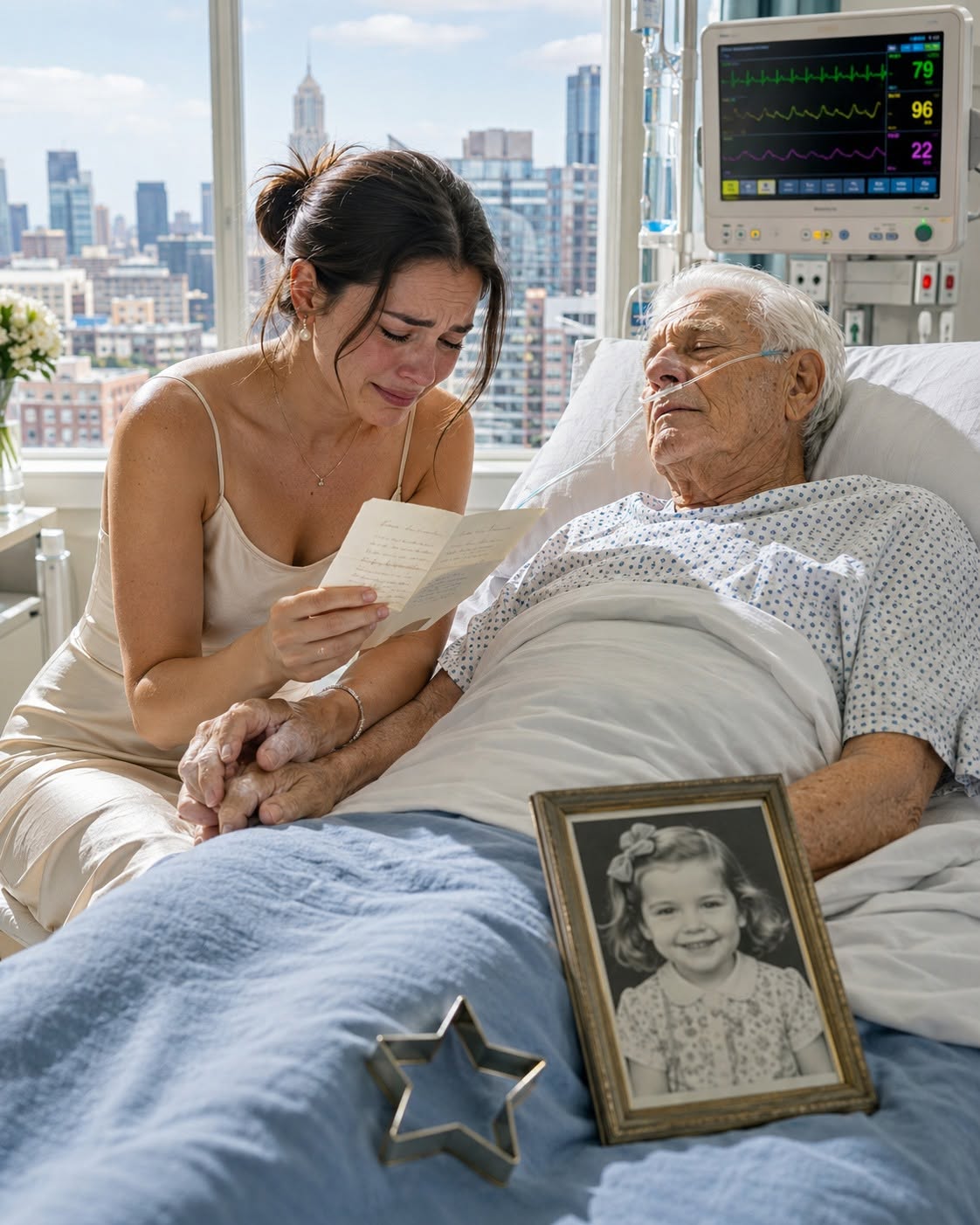
“I kept something from you your entire life, Claire.”
My stepfather said those words from a hospital bed, his voice barely holding together, his freezing fingers wrapped around mine, his eyes carrying a kind of guilt I had never seen in them before.
Until that moment, I had believed I knew everything there was to know about him.
To me, Arthur Collins was the man who entered my life when I was 4 years old, married my mother, taught me to ride a bicycle on a quiet street in Queens, and stayed even when everyone around us assumed he would eventually walk away.
My biological father disappeared before I was old enough to keep even a clear image of his face in my memory. My mother, Susan, died from a brain aneurysm when I was 5. One afternoon, we were arguing because I had left my shoes in the middle of the living room. By the next day, the house was crowded with crying relatives, neighbors carrying casseroles, and people whispering in the kitchen.
“Arthur doesn’t owe her anything.”
“She isn’t his child.”
“Her aunt Patricia can take her.”
I heard every word from underneath the dining table.
That night, Arthur found me there, curled into myself, my black funeral dress wrinkled and my cheeks sticky from hours of crying.
He didn’t tell me to come out.
He didn’t scold me.
He simply lowered himself onto the floor beside me, as though the space under that table were a cave and we were both hiding from the same monster.
“Are you going to leave me?” I asked.
He swallowed.
“No.”
“Everybody leaves.”
“I won’t.”
“Promise?”
Arthur reached under the table and held out his pinky finger.
“I promise, sweetheart.”
And he kept it.
He stayed when leaving would have been easier.
He stayed even when my aunts treated him like an intruder.
He stayed when I had a fever, when I shattered a window kicking a soccer ball, when I came home sobbing because another child told me Arthur wasn’t my real father.
Every Sunday, he made apple-cinnamon pancakes with an old metal cutter shaped like a star.
They were awful.
He always burned the tips.
But I ate them like they had come from a five-star restaurant because Arthur would sit across from me waiting for my reaction, wearing the shy smile of a large, awkward man who never quite knew how to ask for love.
Years later, he walked me down the aisle.
When my daughter Lily was born, he cried harder than I did.
He bought her a soft yellow blanket and held her with almost ridiculous care, as though she were made from the thinnest glass.
Whenever I asked about his life before he met my mother, Arthur always gave me the same answer:
“The part that mattered began with you, Claire.”
I always believed that was simply love.
I never realized it was also a door he had kept locked.
His illness came after he turned 78.
First, he stopped making his regular trips to the grocery store.
Then he began losing weight.
After that came scans, specialists, chemotherapy that offered little hope, and doctors whose expressions looked like condolences delivered too early.
During his final week, I slept in a vinyl chair beside his bed at a hospital on Manhattan’s Upper East Side.
I learned every machine by sound.
I knew when his oxygen was struggling.
I knew when he was hurting.
I knew when he pretended to sleep because he didn’t want to watch me cry.
That night, the nurse quietly told me:
“It may only be a few hours.”
I returned to his room with my chest tied into a knot.
Arthur suddenly opened his eyes.
“Promise me you’ll listen to everything before you hate me.”
The floor seemed to disappear underneath me.
“I could never hate you, Dad.”
He reached beneath the blanket and pulled out a folded piece of paper.
“Go to this address. Now.”
“I’m not leaving you here alone.”
“I need you to know who I was before I run out of time.”
“Then tell me yourself.”
Tears slipped silently from his eyes.
“Some truths have to be told by somebody else.”
I walked into the hallway with the paper shaking between my fingers.
The address was less than 20 minutes from the home where Arthur had raised me.
As I drove through nearly empty streets, my mind filled in every possible nightmare.
Another family.
A secret wife.
A child he had abandoned.
A lie enormous enough to destroy everything I believed about the only father I had ever known.
When an elderly woman opened the door and saw my face, she covered her mouth.
“Claire,” she whispered, as though someone dead had suddenly returned.
That was when I realized the truth waiting inside that house would be nothing like what I had imagined.
Her name was Helen.
She wore her white hair in a low braid, had thin delicate hands, and lived in an old house in Forest Hills that smelled of reheated coffee, old wood, and secrets that had been kept quiet for too many years.
“How do you know who I am?” I asked from the doorway.
“Arthur called me about a month ago,” she said. “He told me you might come.”
“Might?”
Helen lowered her eyes.
“He was scared.”
I wanted to leave.
I wanted to run straight back to the hospital, take my father’s hand, and pretend that folded address had never existed.
But something in Helen’s eyes stopped me.
There was no danger there.
Only sadness.
The old kind.
The kind that no longer screams because it has learned to breathe softly.
“Tell me what he hid from me,” I said.
Helen walked into the kitchen.
She opened a drawer beside the stove and removed a small tin box.
Inside were cookie cutters shaped like hearts, flowers, moons, and apples.
And one star.
The same shape.
The same faded metal.
The same slightly bent point.
My stomach dropped.
“That star…”
“It belonged to Arthur.”
“No. His is at my house.”
“He had two,” Helen said.
Underneath the cutters was a photograph.
She handed it to me with both hands, as though it weighed far more than paper should.
The picture showed Arthur as a young man.
Much thinner.
Black hair.
A wide, unguarded smile I had never seen before.
He stood behind a little girl who looked about 5 years old, sitting in front of a plate of star-shaped pancakes.
The girl was laughing with food still in her mouth.
“Who is she?” I asked, although some part of me was already afraid I knew.
Helen inhaled slowly.
“Her name was Grace. Everyone called her Gracie.”
I stared at the photograph until my eyes blurred.
“Was she…”
“His daughter.”
Silence filled the room like freezing water.
“Arthur had a daughter before he ever met your mother,” Helen continued. “Gracie died when she was 5.”
I sat down without asking.
My legs simply stopped supporting me.
“How?”
“There was an accident at a lake in the Catskills. It happened in seconds. Arthur turned away to grab her jacket because the temperature had dropped. When he looked back, she wasn’t where he had left her.”
I covered my mouth.
“He went into the water. He pulled her out. He carried her all the way toward the road trying to find help. But it was already too late.”
Helen closed her eyes.
“His marriage collapsed afterward. His wife couldn’t forgive him. Arthur couldn’t forgive himself either. He kept everything Gracie owned. Toys. Clothes. Photographs. He stopped speaking her name, as though saying it aloud might kill him too.”
I looked at the metal star again.
“The pancakes.”
“He made them for her every Sunday.”
One part of me wanted to feel betrayed.
But somewhere deeper, I suddenly understood that every Sunday breakfast of my childhood had carried the shadow of another little girl sitting beside me.
“Why didn’t he tell me?”
“Because he was terrified you would think he loved you because he was trying to replace her.”
The words went through me.
Helen placed the photograph carefully on the table.