PART 1

“Your mother isn’t sick, Maya. She’s acting so you’ll keep funding her little whims.”
Richard said it without even looking up from his phone, using that cold, detached tone men use when they’ve already decided a woman’s pain is nothing more than an inconvenience.
My mom, Teresa, was 75 years old and had never been one to complain. She was the kind of woman who would sweep the front porch with a fever, water her potted plants before breakfast, and still say, “It’s nothing,” even if her soul was splitting in two inside.
She lived alone in a cozy little house in a quiet neighborhood in Miami, surrounded by her bougainvillea, a statue of St. Jude next to the television, and a pot of chicken soup that seemed like it would never run out.
But for the past few weeks, she hadn’t been the same.
She would eat two bites and push her plate away. She woke up looking pale as a ghost. Sometimes she would freeze, holding a hand over her abdomen, as if something inside her was burning.
“Mom, that’s not normal.”
She would smile, but her eyes were completely dim. “It’s just old age, honey. You reach a point where you can’t act strong anymore.”
I wanted to believe her. Until one afternoon, while pouring me coffee, she dropped her mug. It shattered on the tile floor, and she let out a whimpering gasp so low it made my blood run cold.
“How long has it been hurting like this?”
“Don’t start, Maya.”
“Tell me.”
Her eyes filled with tears. “For months.”
That night, I brought it up to Richard while we were eating dinner. He was checking work emails, as usual. Wearing an expensive shirt, an expensive watch, wearing expensive cologne. But whenever it came to my mother, suddenly every dime was a waste of money.
“I’m taking her to the doctor tomorrow.”
Richard let out a dry laugh. “To throw money down the drain?”
“She’s losing weight. She’s nauseous. Her stomach is burning.”
“Your mother has always been dramatic.”
I felt my face flush hot. “Don’t talk about her like that.”
He set his fork down on his plate. Slowly. Like a quiet threat.
“Listen to me carefully, Maya. You’re not spending a single cent without running it by me first.”
“She’s my mother!”
“And I’m your husband.”
In that moment, I realized something I had been denying for years.
It wasn’t financial concern. It was control.
The next morning, I waited for Richard to leave for his corporate office. I hid my purse, my credit cards, and my car keys inside a reusable grocery bag so he wouldn’t suspect anything. Then I drove straight to pick up my mom.
“We’re going for a ride.”
She was sitting in her armchair, a knitted cardigan draped over her shoulders, her face drawn and gray.
“Where?”
“To get you checked out by a doctor. And don’t argue with me.”
She didn’t even have the strength to fight me.
I drove her to a private clinic in Coral Gables. One of those quiet medical centers with beige walls, the sharp smell of antiseptic, and a receptionist who spoke in hushed tones because everyone who walked through those doors was afraid of something.
The nurse took her blood pressure. Then she took it again. Then she called for the doctor.
That was when terror set in.
The physician was young, but the gentle smile wiped off his face the second he pressed on my mom’s abdomen.
“How long has she been like this?”
“Weeks,” I said.
My mom looked down at her hands. “Months,” she corrected quietly.
I felt the ground slide out from beneath my feet.
They ran blood tests. An ultrasound. And then a CT scan.
I waited in the hallway with ice-cold hands. My phone began to buzz in my pocket.
Richard.
One call.
Two calls.
Five calls.
Then the text messages poured in:
“Where are you?”
“Answer me.”
“Don’t you dare do something stupid.”
I powered off my phone.
For the first time in years, I wasn’t afraid of his anger. I was far more terrified of losing my mother.
Nearly an hour later, the doctor stepped out clutching a thick medical folder against his chest.
“Maya, I need you to step inside.”
My mom was sitting on the examination table, hunched over, her lips dry and chapped. The doctor closed the door firmly behind me.
That locked door scared me more than any diagnosis could have.
“What is it? Please, tell me the truth.”
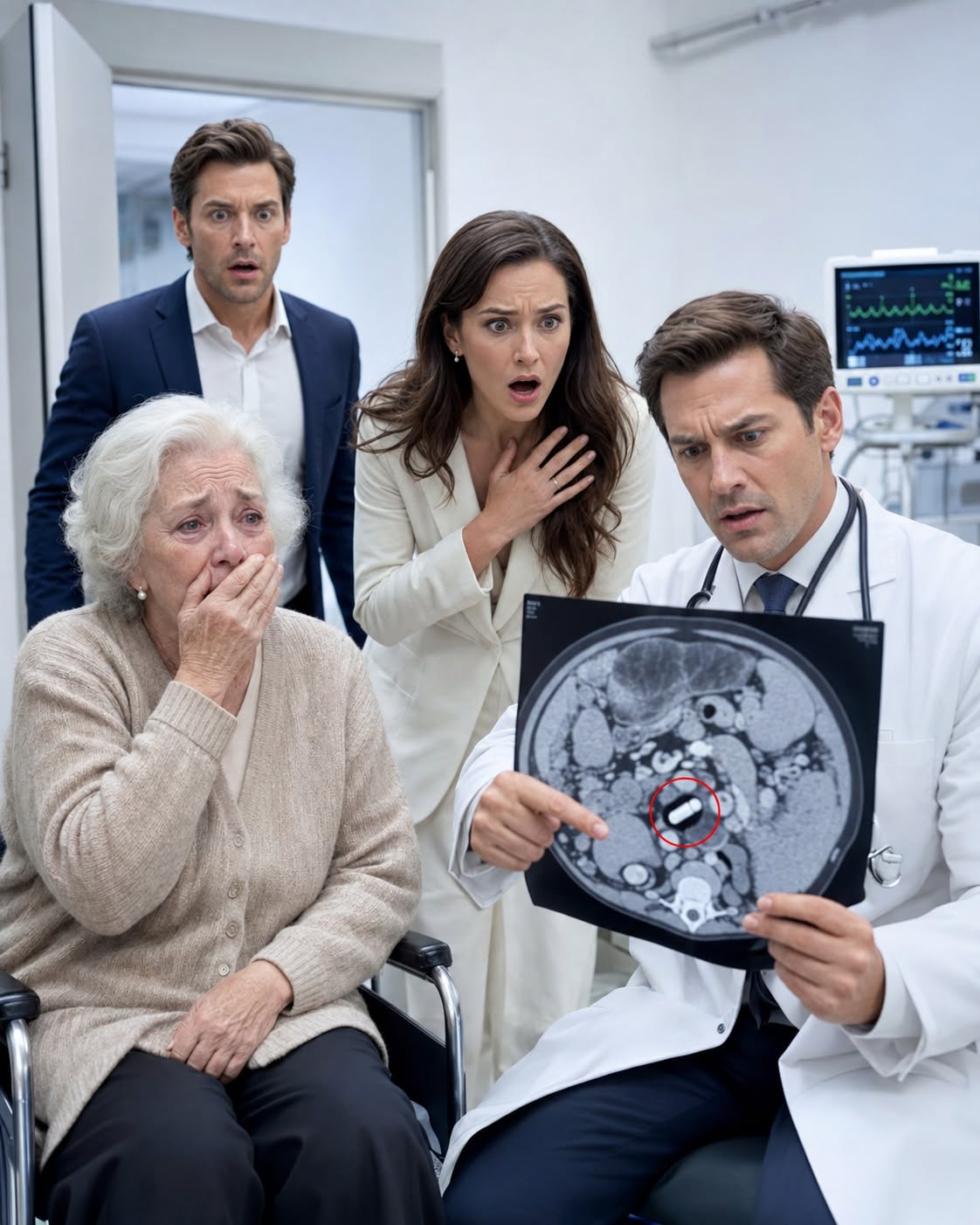
He turned on the viewbox screen. The black-and-white CT scan lit up.
Shadows. Bones. Organs.
He pointed a finger deep inside her abdominal cavity.
“We found something.”
“A tumor?” I whispered, choking back a sob.
The doctor hesitated. My mom closed her eyes tightly.
“It doesn’t look like a tumor.”
My breath caught in my throat. “Then… what is it?”
He zoomed in on the digital scan.
There it was.
A small, elongated, dark shape—far too defined and symmetrical to belong to the human body.
It looked like a metal capsule.
A solid object.
Wedged where it never should have been.
“This didn’t get here through natural means,” the doctor said quietly.
My mom began to cry silently.
But the worst part wasn’t the object on the screen.
The worst part was that she didn’t look surprised at all.
“Mom… did you know about this?”
She grabbed my hand with a desperate, trembling strength.
“Forgive me, sweetie. Forgive me.”
Suddenly, the door burst open.
Richard stormed into the room, his face flushed red with rage, breathing heavily as if he had run all the way from the parking lot.
“What the hell is going on here?!”
The doctor stepped back toward the display. My mom squeezed my hand even tighter.
Richard’s eyes landed on the CT scan.
He saw the capsule.
And instead of looking confused, his face turned completely white.
As if he recognized it.
As if the secret he thought he had buried deep inside an old woman had just flickered to life right in front of everyone.
My mother raised her head, looked him dead in the eye, and whispered