Chapter 1: The Ironed Dress Blues
For twelve years, the gossip in Willow Creek, Tennessee moved with the quiet efficiency of a mountain creek—relentless, smooth, and utterly destructive.
Everyone in town believed I had turned my back on my family. They believed I had abandoned my father to chase military rank, choosing naval postings over my filial duty while he withered away in an empty house.
My mother had spent over a decade carefully cultivating that precise narrative.
On the humid morning of my father’s memorial service, I sat alone on the edge of a sagging mattress in a motel on the outskirts of town. Before me lay my Navy Service Dress Blue uniform. Every gold button reflected the dim light; every ribbon was pinned with mechanical precision, millimeter by millimeter. Beneath the stiff wool, my body throbbed with a dull, persistent ache—the lingering souvenir of a mortar blast that had torn through my unit’s quarters six weeks prior in Landstuhl, Germany.
I knew my mother would despise the sight of the uniform.
Yet, resting inside my leather passport wallet was the final handwritten letter my father had smuggled out to me through a trusted intermediary two months before his heart failed.
Rebecca, his precise cursive read, when they gather to remember me, wear what you earned. Do not wear it to provoke them. Wear it for me.
I took a slow, measured breath, smoothed the front of my jacket, and drove into town.
The parking lot of the First Baptist Church of Willow Creek was overflowing. Retired servicemen, local business owners, choir members, and old family friends had assembled to pay homage to Colonel Thomas Carter—a decorated combat veteran, a pillar of the community, and, to me, simply Dad. He was the man who had taught me how to clean a carburetor, who insisted on adding a dash of ground cinnamon to pancake batter, and who had mailed handwritten letters across the globe even when my official APO address was classified.
I had missed his quiet funeral two weeks prior.
It had not been a matter of choice. While my mother was accepting casseroles and sympathetic nods on her front porch, I had been floating in a medically induced coma in a military trauma center overseas, my lungs healing from smoke inhalation and my thighs stitched together with surgical steel.
My mother had deliberately withheld those details from the town. Instead, she had whispered across church pews that I had become cold, detached, and too busy with my military ambitions to bother flying home for a dying old man.
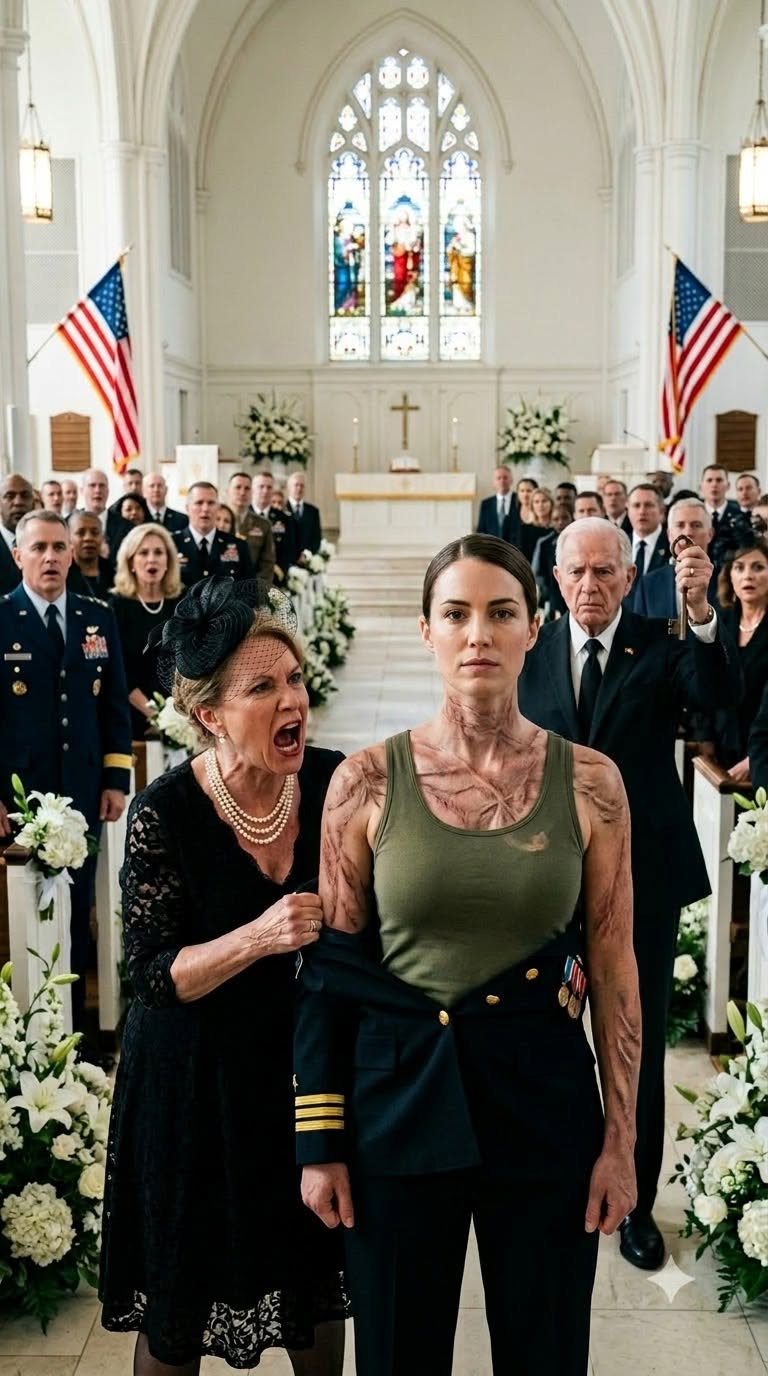
As I pushed through the heavy oak doors into the church lobby, the ambient hum of conversation vanished instantly. Heads turned. Whispers cut short. Eyes locked onto the gold rank stripes on my sleeves.
Then, through the crowd, I spotted my younger sister, Anna Carter. Her breath hitched as she took in my appearance.
“Rebecca?” she whispered, taking a timid step forward.
“Hello, Annie,” I murmured, offering her a faint, reassuring smile.
Her eyes brimmed with immediate tears. “You… you actually came.”
Before I could reach for her hand, a razor-sharp voice sliced through the vestibule.
“No.”
Elaine Carter stepped out from the main sanctuary doors. Clad in an immaculate, high-necked black dress with a triple strand of cultured pearls framing her throat, her posture was regal, her eyes blazing with suppressed fury.
“You are not bringing that performance into this house of God,” she said, her voice carrying across the silent hall.
“Mom—” I began.
“No,” she interrupted, her jaw tight. “Your father’s memorial is not a stage for your career display. You take that off, or you leave.”
The silence in the lobby was suffocating. I felt the collective gaze of fifty neighbors pressing against my back.
“I am standing here because Dad requested it,” I replied, keeping my voice steady despite the adrenaline surging through my chest.
Elaine’s features hardened into a cold, contemptuous sneer. “Then you should have arrived dressed as a grieving daughter, not a stranger looking for a parade.”
“This uniform is how I honor him.”
“Not after what you did to him,” she hissed softly, stepping closer so only those nearest could hear. “Not after you abandoned him when he needed you most.”
“I was deployed, Mom. I was serving.”
“You always had a duty somewhere else,” she replied, her tone shifting seamlessly into the soft, trembling pitch of an exhausted martyr—a performance designed specifically for the surrounding audience. “Your father lay in that bed calling your name, Rebecca. He waited for you until his very last breath.”
The sentence landed like a physical blow. Around us, several church elders lowered their eyes, nodding in quiet agreement with her version of reality.
I opened my mouth to speak, to tell them about the leave requests that had been denied by central command, about the operational red tape, about the shrapnel that had nearly severed my femoral artery while my father lay dying—but I knew my words would sound like calculated excuses against a mother’s tears.
Suddenly, the heavy scrape of a pew echoed from the front row of the sanctuary.
An elderly man stood up slowly, leaning heavily on a carved wooden cane. He wore a crisp suit jacket adorned with a single, highly distinguished military pin on his lapel.
“My name is Major William Hayes,” the old veteran declared, his raspy voice echoing through the acoustics of the church. “And before one more slanderous word is hurled at that young woman, this congregation is going to hear the truth.”
My mother went deathly pale. “William, sit down. This is a private family matter.”
“No, Elaine,” Major Hayes replied, taking a deliberate step toward the foyer, his cane thumping against the carpeted aisle. “This sanctuary has harbored enough comfortable lies.”
He paused at the edge of the foyer, reached into his breast pocket, and retrieved a heavy brass key alongside a sealed white envelope.
“Colonel Carter gave me explicit instructions,” Major Hayes announced, looking directly at my mother. “He knew you would attempt to humiliate her at the door. And he made sure I had the means to stop you.”
My mother took an involuntary step back, her hand fluttering to her pearl necklace, as Major Hayes raised the brass key into the ambient light.
Chapter 2: The Campaign Box
“What is the meaning of this spectacle?” Elaine demanded, her voice cracking as she attempted to regain control of the room. “William, you are dishonoring Thomas’s memory!”
“On the contrary, Elaine. I am executing his final direct command,” Major Hayes countered sharply.
He turned his weathered face toward the gathered crowd. “Colonel Thomas Carter was my commander and my friend for forty years. Before his passing, he asked me to stand guard over his legacy—not the sanitized version his wife crafted, but the truth.”
Major Hayes gestured toward the front of the sanctuary, where my father’s memorial display had been arranged beside the altar. It was an elaborate showcase featuring his framed service portrait, his folded ceremonial flag, his dress cap, and his silver officer’s sword mounted in a velvet-lined mahogany case.
The old Major walked directly past my mother, gesturing for me and Anna to follow him down the center aisle. The congregation parted like the Red Sea, whispers rising in a soft wave around us.
Major Hayes approached the wooden display platform. Beneath the sword case, partially concealed by a velvet skirt, sat a hidden compartment. He bent down, inserted the brass key into a concealed keyhole, and turned it with a firm click.
A heavy cedar door swung open, revealing a faded green military campaign box—the very chest my father had carried through three overseas tours when I was a child.
“Your father kept his most vital records in this box, Rebecca,” Major Hayes said softly, lifting the heavy trunk and placing it atop the altar lectern.
He flipped open the brass latches and lifted the lid. Inside lay several thick stacks of letters tied tightly with green military ribbon, a digital voice recorder, two official legal folders marked Colonel Thomas Carter Service Foundation, and dozens upon dozens of unopened envelopes.
I stepped closer, my heart pounding violently against my ribs.
I recognized the handwriting on those unopened envelopes instantly. It was mine.
They were the letters I had painstakingly written from cold barracks in Pensacola, from the deck of aircraft carriers in the Mediterranean, and from windowless operational centers in Europe. Some bore postmarks going back seven years. Many had been returned to my military postal unit marked Unclaimed, while others had simply vanished into silence.
Major Hayes picked up one of the ribbon-bound bundles and held it up for the front rows to see. Attached to the top envelope was a bright yellow sticky note.
“Thomas discovered these hidden inside a locked linen trunk in the master suite six months before he passed,” Major Hayes stated loudly. “They were intercepted before he could ever read them.”
He unclipped the yellow slip and read the neat, frantic handwriting aloud: “Do not deliver to Thomas. It causes unnecessary agitation.”
Major Hayes turned the slip over, exposing a second note: “Return to sender if military tracking permits.”
The handwriting on both notes belonged unmistakably to my mother.
A collective gasp rippled through the pews. Anna whirled around, staring at our mother with absolute horror. “Mom… you hid Rebecca’s letters? All these years?”
“I was protecting your father’s heart!” Elaine declared, her voice rising in a desperate, screeching pitch as she marched down the aisle. “He was sick! He didn’t need to be reminded every day that his eldest daughter was thousands of miles away living her own life!”
“She wasn’t just living her life, Elaine,” Major Hayes interjected coldly.
He pulled a thin manila folder from the campaign box and opened it. “These are official Department of the Navy documentation records. Emergency leave requests submitted by Lieutenant Rebecca Carter during her father’s initial hospitalization—denied due to active theater deployment. Medical transport appeals—denied. And finally, casualty reports from six weeks ago, documenting severe shrapnel trauma sustained in the line of duty.”
Major Hayes looked down at Anna. “Your mother told you that Rebecca refused to take a commercial flight home when your father entered hospice. The truth is, Rebecca was unconscious in an ICU bed in Germany, hooked to a ventilator.”
Anna buried her face in her hands, letting out a choked sob.
“Now,” Major Hayes said, setting the papers aside and picking up the digital voice recorder. “Colonel Carter anticipated that written documents might be dismissed as forged or manipulated. So he ensured his own voice would speak in this room.”
He clicked the red play button and held the device up to the altar microphone.
Static hissed through the church’s PA system, followed by the sound of a heavy breath. Then, a familiar, deep voice filled the sanctuary—raspy, weakened by illness, but unmistakable in its authority.
“If William is playing this recording,” my father’s voice echoed off the stained-glass windows, “then my daughter Rebecca has returned home.”
I gripped the wooden edge of the lectern, my knuckles turning white as hot tears spilled over my lashes.
“Rebecca,” Dad’s voice continued, floating over the silent room, “I am deeply sorry that it took me so long to realize what was happening in my own house. Six months ago, I forced open the locked cabinet in the back room. I read every letter you wrote. I read about your promotions, your fears, your loneliness, and the burden of the men and women under your command. I read where you asked if the old maple tree in the backyard survived the spring tornado.” A soft, wet chuckle sounded over the speaker. “It survived, sweetheart. It’s still standing.”
In the third row, several older women began weeping quietly into their tissues.
“I confronted your mother,” the recording proceeded, his voice hardening. “She claimed she was shielding me from grief. The brutal reality is that she was punishing us both because you chose a life beyond her perimeter of control. Elaine, if you are listening to this, do not dare accuse my mind of confusion. Major Hayes, my attending physician, and my legal counsel were present when this was recorded. I was of sound mind and absolute clarity.”
My mother stood frozen in the center aisle, her lips trembling, her hands clasped tightly over her chest as if trying to physically contain the collapse of her social standing.
“Rebecca,” Dad’s voice softened, taking on an intimate, fatherly warmth that broke through my military composure. “You did not abandon me. You became the leader, the officer, and the woman I always prayed you would be. Your mother may never forgive you for leaving Willow Creek. But you must never confuse her fear with your failure.”
The recording paused for a brief second before his voice returned, crisp and decisive.
“To ensure my legacy serves a true purpose, I have established the Colonel Thomas Carter Service Foundation, funded entirely by my military life insurance and personal estate. It will provide full scholarships and equipment grants for young men and women from rural Tennessee entering the Armed Forces, emergency medical services, and public health. I appoint my daughter, Lieutenant Rebecca Carter, as executive chair of the board. My daughter Anna may serve as co-trustee if she so chooses.”
Elaine took a swift step toward the altar. “No! That estate belongs to the family maintenance trust!”
As if anticipating her objection, my father’s recorded voice answered her instantly through the speakers: “Elaine, I know you wished for these funds to be directed to the church building committee. I disagreed. Rebecca understands what it means to serve without requiring applause. She understands the true cost of duty.”
The final line of the audio file resonated through the high ceilings: “My daughters, do not allow my passing to become another weapon between you. Speak the truth. Protect one another. And Rebecca… wear the uniform with pride.”
The speaker went quiet with a final click.
Major Hayes slowly lowered the recorder. For three seconds, absolute silence hung over the First Baptist Church.
Then, Major Hayes snapped his heels together, raised his right hand to his brow, and held a crisp, formal salute aimed directly at me.
Beside him, an eighty-year-old Marine veteran in the second row pushed himself up on trembling legs and saluted. Then another veteran stood. Then a young Army specialist in civilian clothes. One by one, every active service member and veteran in the church stood at attention, their eyes fixed on me.
I lifted my right hand to the brim of my combination cover, returning their salute through a haze of quiet tears.
Chapter 3: Standing at the Altar
Anna threw her arms around my neck, pulling me into a desperate embrace. As her weight shifted against my side, a sharp spike of pain shot through my recovering leg, causing me to wince subtly.
She instantly pulled back, her eyes dropping to the stiff way I was favoring my left side. “You’re… you’re actually wounded,” she whispered, horror washing over her face. “You were really in a hospital.”
“I spent three weeks in intensive care, Annie,” I said softly, brushing a stray tear from her cheek. “I tried calling your cell phone from the base hospital in Landstuhl. The calls wouldn’t connect.”
Anna turned slowly toward our mother, her voice trembling with a mixture of rage and profound heartbreak. “You changed my phone number last summer… You told me Rebecca had blocked our family.”
Elaine stood utterly isolated in the center of the aisle. The neighbors who had sat beside her for years were now staring at her with cold, uncomfortable detachment.
“I was trying to preserve this family!” Elaine insisted, her voice pitch-thin as she looked around the sanctuary for a sympathetic face. “I gave my entire life to your father and this town! Rebecca left us the moment she received her appointment to the Naval Academy! She discarded us!”
I stepped down from the altar platform, my polished black shoes striking the hardwood floor with slow, measured steps until I stood three feet from her.
“I didn’t discard you, Mom,” I said, my voice carrying clearly to every corner of the room. “I served my country. But in your eyes, anything short of total submission to your will was considered an act of treason.”
“You were my daughter!” she choked out, tears finally breaking through her cold facade. “You were supposed to stay here! You were supposed to need me!”
“A mother is supposed to raise her children to be strong enough to stand on their own,” I replied quietly. “Not force them to stay small so she never has to confront her own insecurity.”
Elaine opened her mouth to launch another defense, but no sound emerged. For the first time in my thirty years of life, she had run out of retorts.
Pastor Collins stepped slowly toward the pulpit, clearing his throat nervously. “Rebecca… if you are able, your father’s service program designates time for a eulogy from his primary heir.”
I hadn’t prepared a written speech. I hadn’t expected to make it past the church foyer.
I walked up the steps to the pulpit, resting my hands on the smooth oak edges. I looked out over the congregation—at the faces of people who had watched me grow up, people who had spent twelve years whispering about my supposed selfishness, and people who were now waiting to see if I would use this platform to exact revenge.
I took a deep, steadying breath.
“For twelve years,” I began, my voice clear and resonant, “many of you in this room believed I had forgotten where I came from. You believed I was a daughter who deemed herself too important to return home to a sick parent. I allowed those rumors to persist because, in the military, we are trained to absorb hardship quietly. I believed that airing private family pain was a dishonor to my service.”
I turned my head to look at my father’s campaign box resting beside his portrait.
“My father reminded us today that while silence can preserve personal dignity, it can also act as a shield for a lie,” I continued. “I did not abandon Colonel Thomas Carter. I wrote to him from every ocean I crossed. I requested leave every time his health failed. I spent nights praying in shipboard chapels that I would make it back in time to hold his hand.”
I looked directly into the eyes of the church elders seated in the front rows.
“I am not standing here today to demand your apologies,” I said firmly. “I am simply asking this community to exercise caution when crafting stories that turn a person into a villain merely because that narrative is convenient for someone else’s ego.”
My voice softened as I turned toward my father’s photograph.
“Dad asked me to wear this uniform today because he refused to let me arrive here feeling ashamed of the life I chose. I am not ashamed, Dad. I carried your honor overseas, and I brought it back home.”
I stepped back from the microphone.
For a brief moment, the church remained suspended in total quiet. Then, Major Hayes brought his hands together, his applause echoing sharply against the high ceiling. Anna joined him, followed by the veterans, then the choir members, until the entire congregation rose to their feet in a thunderous, standing ovation.
I did not feel a sense of smug triumph. I felt an overwhelming wave of exhaustion, accompanied by the deep, comforting realization that my father had built a fortress of truth around me from beyond the grave.
After the memorial concluded, several townspeople approached the altar with bowed heads. My former high school history teacher apologized profusely, admitting she had accepted my mother’s version without question. A long-time neighbor confessed to spreading rumors at the local bakery and begged for forgiveness.
Major Hayes approached me as the church finally emptied, lifting the heavy cedar campaign box from the lectern and placing it gently into my arms.
“This belongs to you now, Rebecca,” he said softly. “Your father left specific instructions regarding what comes next. There is a second key attached to the underside of the lid.”
I looked down, feeling a small metallic key taped beneath the cedar hinge.
“He left a final package at the cabin on Millstone Lake,” Major Hayes whispered, leaning close. “He told me to ensure you went there alone—away from the town, away from your mother—to find what he hid beneath the floorboards.”
Chapter 4: The Floorboard Ledger
The drive out to Millstone Lake was quiet. Because my medical clear status prohibited me from operating a vehicle for extended periods, Major Hayes drove my father’s vintage pickup truck down the winding, gravel access roads.
The cabin sat perched on a pine-forested ridge overlooking dark, glass-still water. It was a modest, single-story cypress structure with a stone chimney and a wide front porch. During my teenage years, Dad and I had spent dozens of weekends here repairing the dock, fishing for bass, and talking about history. My mother had always detested the location, branding it primitive and uncomfortable.
To my father and me, it was the only place where the truth felt completely unburdened.
Major Hayes unlocked the front door and stepped aside, allowing me to enter first.
The air inside smelled faintly of aged cedar, cold woodsmoke, and my father’s distinct pipe tobacco. His favorite stoneware coffee mug sat clean beside the sink; his reading glasses rested atop a stack of military history journals on the desk near the window.
“I’ll wait out on the porch,” Major Hayes said gently, closing the front door behind me to give me privacy.
I walked across the squeaking floorboards to his study corner. Following the instructions tucked inside the campaign box, I slid his heavy oak desk three inches to the left, exposing a section of seamless floorboard. I inserted the small metallic key into a tiny, almost invisible notch between the planks.
A floor section popped upward with a soft click.
Beneath it lay an airtight metal ammunition box. I lifted it out, settled into my father’s leather armchair, and unlatched the steel lid.
Inside sat a thick, leather-bound journal, accompanied by a stack of official bank statements and a sealed letter addressed specifically to me.
I opened the journal first. It was a detailed daily log kept by my father during the final two years of his life.
I turned to an entry dated March 4th of the previous year:
Confronted Elaine today after discovering a blocked number setting on the landline router. Rebecca’s deployment unit had attempted to patch through an emergency satellite call three nights ago. Elaine claimed it was an accident. The router log proves it was deliberately programmed.
I flipped to an entry from June 20th:
Found seven years of unopened mail hidden in the cedar chest in the attic. Letters from Pensacola, Norfolk, and the Mediterranean. Every single one had been intercepted. My wife looked me in the eye and said she did it to keep my blood pressure stable. I told her that by trying to erase my daughter, she was erasing me.
The final entry, written in a shaky, uneven script just weeks before his final hospitalization, read:
My body is failing, but my mind is clear. Rebecca will inevitably believe she failed me because she could not reach my bedside. I am setting a trap with William Hayes that will shatter Elaine’s fiction the moment Rebecca arrives in uniform. My daughter gave her youth to defend this nation. I will give my final act on earth to defend her name.
Tears fell freely onto the yellowed pages of the notebook.
For twelve years, I had carried an invisible weight, constantly questioning whether I had been too selfish, whether my ambition had inflicted collateral damage on my family, and whether I was a terrible daughter. In a single afternoon, that guilt was completely dismantled.
Two months later, the Colonel Thomas Carter Service Foundation officially opened its administrative office in town. Anna accepted the role of full-time director, managing local operations while I served as board chair, coordinating with military liaison offices across the state.
Our inaugural scholarship cycle awarded four grants to local youths: an aspiring flight surgeon, an Air Force recruit, a young man training for wildland firefighting, and an eleven-year-old girl whose father had been killed in an industrial accident.
My mother did not attend the foundation’s inauguration.
Instead, she dispatched a series of bitter letters to my legal counsel, alleging that the foundation was a public smear campaign designed to ruin her reputation. I did not respond to a single one.
Nine months after the memorial, my phone rang while I was working at the cabin. I answered to hear my mother’s voice on the line—shaky, depleted, and stripped of her usual theatrical anger.
“I want my family back, Rebecca,” she said quietly.
“I am right here, Mom,” I answered calmly. “But if we are going to speak, you need to acknowledge what you did.”
“I was trying to hold onto my home!” she cried out. “You left, your father was slipping away, and I felt completely powerless! Why can’t you understand how terrified I was?”
“I understand your fear, Mom,” I replied firmly. “What I will no longer tolerate is you using your fear as a license to destroy my life.”
“You need to tell William Hayes to issue a public statement correcting what he said at the church,” she pressed, her old manipulation resurfacing. “The town looks at me like a monster.”
I took a slow breath, remembering my father’s warning: Do not let her fear become your prison.
“I will never retract the truth to make your lies comfortable, Mom,” I said. “When you are ready to apologize without conditions, my door is open.”
Before she could respond, I ended the call and set the phone face down on the desk.
Chapter 5: The Weight of the Uniform
A full year passed before my mother truly capitulated.
The initial letters she sent were laden with self-pity, blaming her actions on grief, stress, and medical exhaustion. I left every one unanswered.
Then, eighteen months after the memorial, a simple white envelope arrived at the cabin. Inside was a single sheet of stationary written in her trembling handwriting:
Rebecca,
I intercepted your letters. I blocked your phone calls. I told our neighbors that you had chosen to abandon us.
I committed those cruelties because every time your father spoke proudly of your military achievements, I felt a terrible envy. I believed he loved your courage more than he loved my devotion. I wanted him to depend on me exclusively, so I turned your independence into a betrayal.
When you were injured in Germany, I hid the truth because I realized that if the town learned you were a wounded hero, they would forgive your absence before I was ready to release my anger.
None of it was your fault. I destroyed our family with my own hands, and I do not expect you to forgive me.
I am deeply sorry.
There were no demands tucked into the margins. There were no pleas for me to fix her social standing in Willow Creek. It was the first honest statement my mother had uttered in over a decade.
I sat on the porch overlooking Millstone Lake, reading the letter three times as the evening mist settled over the water. I did not instantly forgive twelve years of systematic alienation, but for the first time, she had chosen reality over self-defense.
We began rebuilding our connection slowly—not through grand family reunions, but through short, structured letters. Months later, we graduated to brief phone calls. Whenever she drifted back into subtle guilt-tripping, I calmly ended the conversation. Over time, she learned that access to my life was a privilege contingent on mutual respect.
Two years after Dad’s passing, she visited the cabin for the first time in twenty years.
Major Hayes and Anna were sitting on the porch with me when her car pulled up the gravel driveway. She stepped out onto the grass, looking significantly older, her shoulders slightly stooped, stripped of the grand posture she used to wear like armor.
She walked up the porch steps, looking at the three of us. “I cannot undo twelve years,” she said softly.
“No, you can’t,” I replied, pulling out a wooden chair for her at my father’s table. “But you can sit here today without rewriting history.”
She nodded quietly and sat down. It wasn’t a fairy-tale reconciliation, but it was a real, grounded beginning.
My physical injuries ultimately ended my operational career in the Navy. I transitioned from active duty to a specialized civilian leadership role within the Department of Veterans Affairs, directing emergency family support networks for deployed service members.
I used my own story as a blueprint. I created protocols to ensure deployed service members had secure, unalterable communication channels with trusted secondary contacts, preventing manipulative family members from isolating ill or injured veterans. I turned my private trauma into a shield for thousands of young soldiers.
Five years after my father’s memorial, Major William Hayes passed away peacefully in his sleep at the age of eighty-six.
At his funeral, I wore my Navy Service Dress Blue uniform one final time.
His daughter asked me to deliver the eulogy. I stood before another packed church, looking out at a community that had been completely transformed by the truth.
“Major William Hayes taught us that true courage is not merely tested on the battlefield,” I declared from the pulpit. “Sometimes, the greatest act of valor is standing up in a room full of comfortable lies and speaking the truth on behalf of someone who can no longer speak for themselves.”
In the front row, my mother stood alongside the veterans during the final honors. She didn’t look down. She didn’t hide. She stood at attention, quietly acknowledging the uniform I wore.
After the service, as we walked out into the warm afternoon sunlight, my mother reached out and gently touched the silver ribbons pinned to my chest.
“Your father would be immensely proud of you today, Rebecca,” she whispered.
I looked down at her, offering a warm, genuine smile. “He was always proud, Mom. It just took us a while to hear his voice.”
She lowered her eyes, a soft tear tracking down her cheek. “Yes,” she whispered. “It did.”
People in Willow Creek still recount the dramatic morning Major Hayes stood up with a brass key and unlocked Colonel Carter’s campaign box. The story has become local legend, often retold with dramatic flourishes about how a daughter returned from war to reclaim her family’s honor.
But the true victory didn’t occur because the town changed its mind about me.
The true victory occurred because I stopped allowing their ignorance to define my worth.
For twelve long years, I believed I needed my mother’s permission to be proud of my service. I believed I needed the town’s approval to feel like a good daughter.
My father’s final recording had shattered that illusion forever.
When Major Hayes handed me that brass key at the altar, he didn’t just give me a trunk full of old letters. He gave me my name back.
Rebecca Carter.
Daughter. Sister. Naval Officer. Wounded Veteran.
A woman who had loved her father across every ocean, and who finally walked out of the shadows, standing tall in the uniform she had earned.