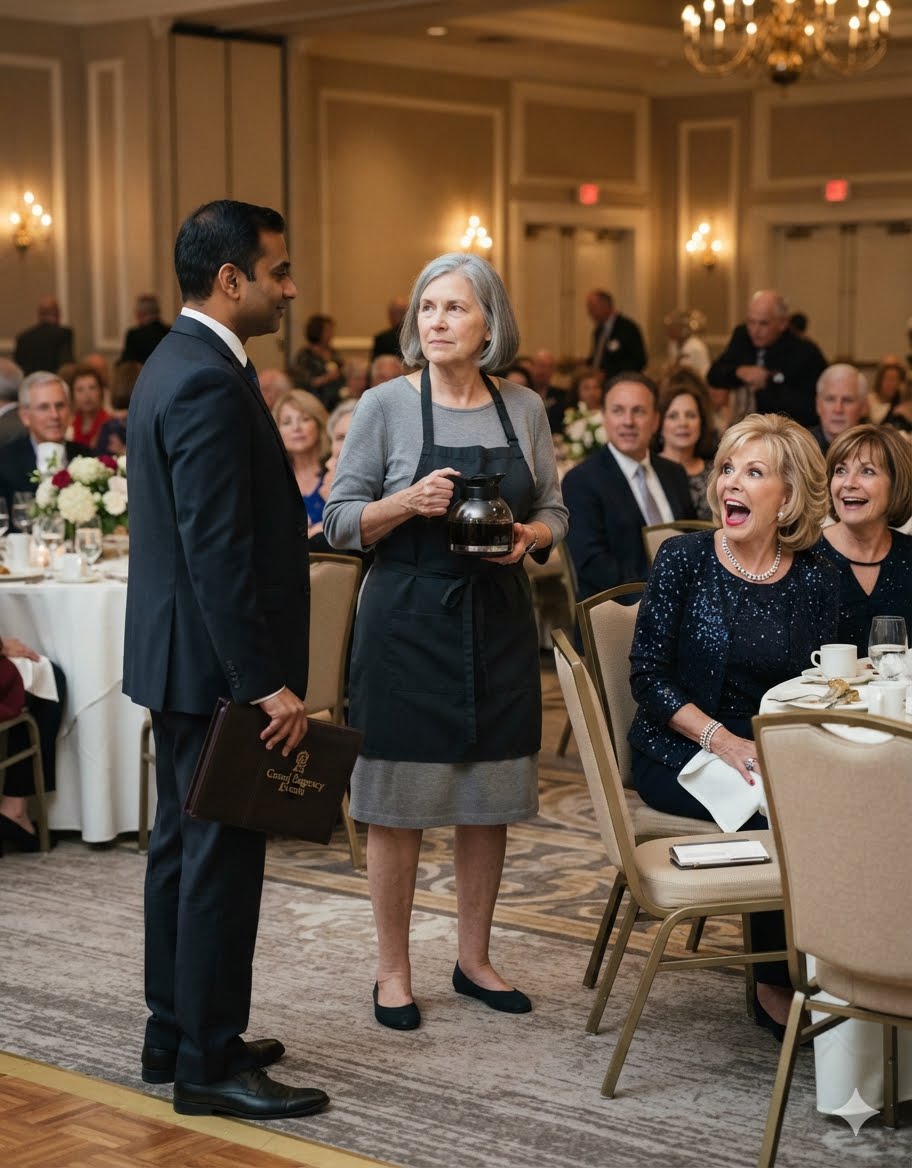
At my fifty-fifth class reunion, the woman who tormented me for four years handed me an apron and said, “Be a dear, the caterer’s short-handed, and honestly, you’d be more comfortable in the back anyway.” The whole table laughed. I put the apron on. I worked in that kitchen for one hour and ten minutes.
Then the hotel manager came looking for the person whose name was on the contract for the entire ballroom. I took the apron off. My name is Wilma Delacroix. I am seventy-three years old, and in 1971 I was the girl at Kettering High who wore her cousin’s dresses. Bernadette Voss was the girl who counted them out loud. You probably knew a Bernadette.
Maybe you had one in your school. Maybe she sat behind you in algebra or passed you in the hallway and somehow always knew exactly which insecurity you had spent the morning trying to hide.
Or maybe, if you are being very truthful with yourself, you were someone’s Bernadette.
I will not make you sit through all four years of high school.
One night will give you the shape of it.
Junior prom.
The gymnasium had been decorated with silver paper stars and blue crepe streamers. Someone’s father had brought in a rotating light that threw tiny dots across the walls. The theme was something ridiculous like “Moonlight Memories.”
My mother and I had made my dress.
She worked mornings at a bakery and cleaned offices three nights a week, but for three weekends she sat beside me at our kitchen table sewing blue checked fabric my grandmother had saved in a cedar chest.
It was not expensive fabric.
It was originally intended for table linens.
We knew that.
We did not care.
My mother altered a pattern from a magazine, and I sewed most of the skirt myself. She did the difficult parts around the waist and zipper.
When I tried it on the Friday before the dance, she stood behind me in our narrow hallway and cried.
“You look beautiful, Willie,” she said.
Nobody except my mother called me Willie.
I believed her.
For one evening, I truly believed I looked beautiful.
A boy named Denny Fowler asked me to dance.
Denny was not my boyfriend. I barely knew him. He was simply kind enough to notice that I had been standing near the wall for three songs pretending to be interested in the refreshments.
Halfway through the dance, Bernadette appeared.
She cut between us, laughing.
“Denny, you know she made that dress out of a tablecloth.”
He looked confused.
Bernadette raised her voice.
“Ask her. Go on. Ask her about the tablecloth.”
People nearby turned.
Her friends laughed first.
Then several others joined them because cruelty spreads quickly when teenagers are frightened of becoming the next target.
My face burned.
Denny tried to say something kind.
“It looks nice, Wilma.”
That somehow made it worse.
Bernadette pinched the fabric near my waist between two fingers.
“Blue check. I swear my grandmother has napkins like this.”
The laughter grew.
I left the gymnasium.
I walked three miles home because I did not want to call my mother and make her come get me.
Halfway there, it began raining.
When I reached our house, my mother was sitting at the kitchen table drinking tea.
She stared at my wet hair and asked what happened.
“Nothing.”
She looked at the dress.
The hem was muddy.
“Nothing doesn’t usually walk three miles in the rain.”
I cried then.
Not dramatically.
Quietly.
The kind of crying where you try to breathe through your nose because making noise would feel like another humiliation.
My mother listened.
When I finished, she reached across the table and touched the blue fabric.
“This dress is not something to be ashamed of.”
“I know.”
“No, you don’t.”
I looked at her.
She said, “Some people spend money to prove they have value. Other people create value because they never had much money to spend.”
At seventeen, I did not understand how important those words would become.
I only knew that I never wanted to go to another school dance.
And I didn’t.
I skipped senior prom.
I skipped graduation.
My diploma came through the mail because I told the administration I was sick.
I wasn’t sick.
I simply could not face that gymnasium again.
Ten years later, in 1981, Russell convinced me to attend our class reunion.
I lasted ninety minutes.
Bernadette asked if my husband repaired toilets.
Russell repaired heating systems.
I know that sounds like a small distinction, but that was Bernadette’s talent.
She could turn anything into something smaller.
We left early.
I told Russell in the car that I would never attend another reunion.
He kept both hands on the steering wheel.
After a while, he said, “All right.”
That was Russell.
He never told me what I should feel.
He simply stayed beside me while I felt it.
I met him in 1973 at a grocery store.
I dropped a carton of eggs.
He helped me pick up the broken shells.
That is not a romantic story, but it is ours.
Russell was quiet.
He did not have expensive clothes.
He owned one decent jacket when we married.
He could fix almost anything involving pipes, boilers, radiators or stubborn machinery.
More importantly, he was never embarrassed by honest work.
We married in 1975.
Four years later, we bought a laundromat.
The building smelled like detergent, warm metal and quarters.
We borrowed money from everyone willing to lend us any.
My mother gave us six hundred dollars she had saved in a coffee tin.
Russell’s brother gave us twelve hundred.
The bank gave us just enough to be terrified.
For the first eighteen months, Russell continued working full-time while I managed the laundromat.
If a machine broke, I called him.
If a customer complained, I handled it.
If someone left lipstick in a pocket and turned an entire load pink, I learned how to explain that washing machines were not magicians.
We were exhausted.
But for the first time in my life, I owned something.
Not something impressive.
Not something anybody at Kettering High would have envied.
But something that belonged to us.
Three years later, we bought a second laundromat.
Then came the linen business.
It began with a restaurant owner named Mr. Carmichael.
He came into our laundromat one afternoon carrying three sacks of tablecloths.
His usual laundry service had failed to show up.
“Could you clean these by Friday?”
I asked how many he had.
“One hundred and forty.”
I laughed.
He did not.
Russell and I worked until nearly three in the morning for two nights.
We cleaned every tablecloth.
Pressed them.
Folded them.
Delivered them ourselves.
Mr. Carmichael paid us and asked if we could do the same thing every week.
That was the beginning.
We bought used commercial equipment.
Then a delivery van.
Then another.
A motel signed with us.
Then a restaurant group.
Then two nursing homes.
Then the Grand Regency Hotel.
Every time we grew, Russell would look at me across the office and say, “Think your tablecloth dress prepared you for this?”
He knew the story.
Of course he knew.
He was the only person who could joke about it without hurting me.
By the 1990s, we had thirty-two employees.
By the time Russell became ill, we had almost sixty.
Today, Delacroix Linen Services launders and supplies linens for eleven hotels, six restaurants and two hospitals across three counties.
My son, Michael, runs transportation and operations.
My daughter-in-law handles payroll.
My granddaughter works with us during summers while studying business.
I still review contracts.
People ask why.
I am seventy-three.
I have enough money.
I could sit on a porch.
I could travel.
I do travel occasionally.
But I like contracts.
Contracts tell you a great deal about people.
Everybody is polite until money appears on paper.
Then you see them clearly.
Russell died in 2016.
Pancreatic cancer.
Seven months from diagnosis to funeral.
After forty-one years of marriage, seven months feels like being told a library is burning and you may save only one book.
You start grabbing memories randomly.
The grocery store.
The broken eggs.
Our first apartment.
The first laundromat.
The night our son was born.
Russell teaching Michael to change a furnace filter.
Our twentieth anniversary.
Our fortieth.
His hand resting on mine in the hospital.
The last thing he said clearly was, “You’ll be fine, Willie.”
He was the only person besides my mother who ever called me that.
For almost two years after he died, I barely left the house except for work.
I eventually learned that grief does not disappear.
It changes jobs.
At first, grief stands in the middle of the doorway and blocks everything.
Later, it sits quietly in the corner while you live.
Eight months ago, an envelope arrived.
Kettering High School.
Class of 1971.
Fifty-Fifth Reunion.
Saturday evening.
Grand Regency Hotel ballroom.
I almost threw it away.
Then I saw the committee list.
Chairwoman: Bernadette Voss.
I actually laughed.
Some names carry their own temperature.
Even after fifty-five years.
Michael happened to be in my office when I opened the letter.
He looked at my face.
“What?”
“High school reunion.”
“You going?”
“No.”
He waited.
Michael knows me well.
“Who’s organizing it?”
I handed him the letter.
He read the name.
“Oh.”
He knew about Bernadette.
Not every detail, but enough.
He put the letter down.
“You should go.”
“I would rather have dental surgery.”
“Mom.”
“No.”
“You own half the tablecloths in the hotel.”
That stopped me.
Technically, the linens belonged to the company.
Still, I appreciated the irony.
That afternoon I called Amy Lawrence, the events director at the Grand Regency.
I had known Amy for fourteen years.
“Tell me something,” I said. “Who signed the contract for the Kettering reunion?”
“Nobody yet.”
“Why?”
Amy laughed.
“The chairwoman is negotiating.”
“For what?”
“Everything.”
That sounded familiar.
Amy continued.
“She wants a ballroom discount, a reduced service charge, complimentary dessert, upgraded centerpieces and a cheaper staffing package.”
“What did you tell her?”
“That we are a hotel, not a church basement.”
I smiled.
“Who is the chairwoman?”
There was a pause while Amy checked.
“Bernadette Voss.”
“I thought so.”
“Do you know her?”
“We were classmates.”
Amy could hear something in my voice.
“Oh.”
I asked for the estimated total.
She gave me the figure.
It was substantial, but not remotely dangerous to me.
I looked at Russell’s photograph sitting beside my desk.
Then I made a decision.
“I want Delacroix Linen to underwrite the evening.”
Amy went silent.
“All of it?”
“All of it.”
“Wilma, that’s—”
“I know what it costs.”
“Why?”
“Entertainment.”
She laughed.
I said, “There are conditions.”
“Of course there are.”
“My name appears nowhere in the program.”
“All right.”
“Nobody tells the reunion committee who paid.”
“Done.”
“And I want the event contracted privately through my company. They can believe whatever they like about the final bill.”
Amy hesitated.
“What exactly are you planning?”
“Nothing illegal.”
“That answer does not comfort me.”
“I am attending my reunion.”
“Oh.”
“One more condition.”
“I knew there would be.”
“At nine o’clock that evening, I want Mr. Prashad to come into the ballroom carrying the contract folder. I want him to find me personally.”
Amy was silent again.
“And?”
“And address me by my full name.”
“Wilma Delacroix?”
“Mrs. Wilma Delacroix will do.”
“What happens after that?”
“I have no idea.”
That part was true.
People may imagine I spent eight months creating a revenge fantasy.
I did not.
I did not know Bernadette would hand me an apron.
I did not know anyone would laugh.
I simply wanted to attend the reunion without arriving as a display.
I did not want to pull up in an expensive car.
I did not want my company logo anywhere.
I did not want to spend the evening explaining my life to people who had made assumptions about it fifty-five years earlier.
I wanted to see what they did when they believed nothing had changed.
So I bought a plain gray dress.
Not designer.
Not custom.
No expensive jewelry except Russell’s wedding ring, which I wear on a chain around my neck.
I drove my own six-year-old Buick.
And at 7:05 on Saturday evening, I entered the Grand Regency ballroom.
The first thing I noticed was how small everyone looked.
Not physically.
Age had done what age does.
Shoulders were rounder.
Hair was thinner.
Walking was slower.
But that was not what I mean.
The people who had once seemed enormous in my memory were simply elderly men and women standing around banquet tables trying to read name tags.
For decades, they had occupied some grand courthouse in my mind.
I had remembered them as judges.
Now I saw them clearly.
They were people.
Just people.
Some had oxygen tanks.
Some had canes.
One man had brought photographs of his grandchildren.
A woman I vaguely remembered from chemistry class hugged me and said she was happy I came.
That surprised me.
Her name was Elaine.
She apologized for not remembering whether we had ever spoken in school.
“We didn’t,” I said.
“Then we should correct that tonight.”
We talked for fifteen minutes.
She had been a librarian.
Her husband died three years earlier.
She had two daughters in Oregon.
It was pleasant.
Then I heard my name.
“Wilma?”
I turned.
Bernadette Voss was walking toward me.
Seventy-three years old.
Blond hair professionally styled.
Pearl earrings.
Cream jacket.
Perfect posture.
And somehow she still walked like the hallway belonged to her.
For one ridiculous second, I was seventeen again.
Then she looked me up and down.
Slowly.
Gray dress.
Simple shoes.
No obvious jewelry.
Something in her face relaxed.
That was when I knew she had worried.
Not consciously perhaps.
But some part of Bernadette had wondered whether the girl in the tablecloth dress had become someone she could no longer look down upon.
Seeing me relieved her.
“Wilma!”
She squeezed my arm.
“Look at you.”
I smiled.
“Hello, Bernadette.”
“Still simple.”
There it was.
Not even five seconds.
She had not changed the machinery.
Only the packaging.
She leaned closer.
“I nearly didn’t recognize you.”
“I recognized you.”
She took that as a compliment.
“Come sit with Doris. She doesn’t hear anymore either.”
I hear perfectly well.
I considered telling her.
Instead, I followed.
Doris was lovely.
She did, in fact, struggle with hearing, but she was funny and sharp.
We spent twenty minutes discussing our knees.
When you are seventy-three, the body provides universal conversation.
At 7:45 dinner service began.
That was when things became interesting.
Bernadette had insisted on the lowest staffing package the hotel would allow.
I knew because Amy had forwarded the committee correspondence when we assumed responsibility for the bill.
Two scheduled servers had also called out sick.
The remaining staff was struggling.
Bernadette became visibly irritated.
She waved at a waiter.
“Excuse me! We need more coffee.”
The waiter apologized.
“Right away, ma’am.”
Ten minutes later she complained that water glasses had not been refilled.
Then that plates were not being cleared quickly enough.
Mr. Prashad had already offered to pull employees from another event, but Bernadette refused the additional labor fee because she still believed the reunion committee would ultimately be responsible for the charges.
That detail matters.
At 7:50, she looked around the ballroom.
She was not searching for the most capable person.
She was searching for the person least likely to refuse her.
Her eyes stopped on me.
I knew that look.
I had seen it in locker rooms and cafeterias and hallways.
She walked over carrying a white service apron she had apparently obtained from somewhere near the kitchen.
“Wilma, be a dear.”
I looked at the apron.
“The caterer’s short-handed.”
“I noticed.”
“You wouldn’t mind helping, would you?”
Around her table, several people were listening.
Bernadette smiled.
Then came the sentence.
“Honestly, you’d probably be more comfortable in the back anyway.”
A man named Harold laughed.
Someone else chuckled.
Then a woman said, “Same old Wilma.”
That did it.
Not the apron.
The sentence.
Same old Wilma.
Something about hearing those words after fifty-five years opened a door inside me.
Not to pain.
To clarity.
They truly believed this was still high school.
They believed there was still a hierarchy.
Bernadette at the top.
People like me useful in the background.
I looked at the apron.
Then I looked at Bernadette.
“All right.”
She blinked.
“You’ll do it?”
“Of course.”
I took the apron.
Tied it around my waist.
And walked toward the service doors.
Inside the kitchen, Amy nearly dropped a tray.
“Wilma!”
I put one finger to my lips.
She hurried toward me.
“What are you doing?”
“Helping.”
“You are not helping.”
“They are short-handed.”
“Because that woman refused backup staff.”
“I know.”
Amy stared at the apron.
“Did Bernadette give you that?”
“Yes.”
“Oh, I am going to enjoy nine o’clock.”
I laughed.
“Behave yourself.”
“Absolutely not.”
The kitchen staff knew me.
Most of the Grand Regency laundry and banquet linen had passed through my company for more than twenty years.
One dishwasher hugged me.
A server named Carlos asked if I had lost my mind.
“Probably.”
He handed me a coffee pot.
“You remember how to do this?”
“I was serving coffee before your mother was born.”
For one hour and ten minutes, I worked.
And I mean worked.
I poured coffee.
Refilled water.
Carried bread baskets.
Cleared plates.
Folded napkins.
Helped plate dessert.
I was not pretending.
That would have insulted the staff.
If you put on an apron, you work.
Bernadette waved her water glass at me twice.
The first time, she did not even look up from her conversation.
“Wilma, sweetheart, water.”
I filled it.
The second time she said, “See? I knew you’d be happier doing something useful.”
I smiled.
“I am.”
And I was.
Because sometime during that hour, I realized something.
At seventeen, I believed being seen working made me lesser.
At seventy-three, I knew better.
Work had purchased my first home.
Work had paid for my son’s college education.
Work had employed families.
Work had carried Russell and me through recessions, equipment failures, late invoices and years when we did not know whether payroll would clear.
There was no shame in an apron.
The shame belonged entirely to anyone who believed there was.
At 8:58, Amy appeared briefly at the kitchen entrance.
She looked at her watch.
I nodded.
At nine o’clock exactly, the ballroom doors opened.
Mr. Ravi Prashad entered.
He had managed the Grand Regency for twenty-two years.
He wore his best dark suit and carried a leather contract folder.
I watched from beside table four.
He stopped a passing waiter.
The waiter pointed toward me.
The room slowly noticed.
Mr. Prashad crossed the ballroom.
Bernadette continued talking for several seconds until the woman beside her nudged her arm.
Mr. Prashad stopped directly in front of me.
“Mrs. Delacroix.”
The room quieted.
I set down the coffee pot.
“Mr. Prashad.”
“My apologies for interrupting you. I have the signed contract for this evening’s event, and the staff needs your approval before we bring out the champagne service and anniversary dessert you authorized.”
Silence.
Beautiful, complete silence.
Mr. Prashad opened the folder.
“Also, the florist needs confirmation regarding the centerpieces you donated to the alumni scholarship auction after tonight’s dinner.”
I removed the apron.
Folded it once.
Placed it over the back of an empty chair.
Bernadette was staring at me.
“Your approval, Mrs. Delacroix?” Mr. Prashad asked.
I reviewed the page.
Everything was in order.
I signed.
“You may proceed.”
“Thank you.”
Mr. Prashad turned to the room.
“Ladies and gentlemen, on behalf of the Grand Regency, I would also like to acknowledge Mrs. Wilma Delacroix, whose company generously underwrote tonight’s ballroom, dinner service, linens and hospitality expenses.”
I had not told him to say that.
I looked at him.
He gave me a small smile.
Amy’s work, I suspected.
Nobody moved.
Then Elaine began clapping.
Doris joined her.
Carlos was standing near the kitchen entrance.
He clapped too.
Soon half the room was applauding.
Then nearly everyone.
Not Bernadette.
She looked as if someone had rearranged the furniture in her own house while she was sleeping.
Harold, the man who had laughed earlier, stared at his plate.
The woman who had said “same old Wilma” suddenly became fascinated by her napkin.
Mr. Prashad handed me the folder.
Bernadette finally found her voice.
“You paid for this?”
“Yes.”
“The reunion?”
“Yes.”
“All of it?”
“Yes.”
“But why?”
That was the first genuinely interesting thing she had asked me in fifty-five years.
I thought about it.
“Because I could.”
Her face tightened.
Someone laughed.
Not cruelly.
But Bernadette heard it.
And for perhaps the first time in her life, she experienced what it felt like to stand in the center of a room while laughter did not belong to her.
She looked at the apron.
Then at me.
“You planned this.”
“No.”
“Of course you did.”
“I planned to attend.”
“You knew the hotel manager would come over.”
“Yes.”
“You wanted to embarrass me.”
I shook my head.
“Bernadette, I had no idea you were going to hand me an apron.”
That landed.
Because everyone knew it was true.
She had created the entire situation herself.
I did not lure her into cruelty.
I simply gave her enough room to choose it.
She chose exactly what she had always chosen.
Bernadette stood.
“This is ridiculous.”
Nobody answered.
She pointed at the apron.
“You deliberately made me look bad.”
“No.”
My voice stayed quiet.
“You mistook kindness for weakness. Again.”
The room became still.
I looked around at the people who had known us when we were teenagers.
“I was perfectly willing to help the staff. I have spent most of my life working alongside people wearing aprons, uniforms, coveralls and rubber gloves. There is nothing embarrassing about honest work.”
Several people nodded.
I turned back to Bernadette.
“What embarrassed you was finding out the woman you sent to the kitchen could afford the ballroom.”
Her face changed.
“You think money makes you better than me?”
“No.”
I answered immediately.
“Money has nothing to do with it.”
I touched the apron.
“This is the difference between us. You thought wearing this made me smaller. I know it doesn’t.”
Nobody spoke.
I had imagined perhaps that moment would feel triumphant.
It did not.
It felt sad.
Because I saw Bernadette clearly.
And beneath the pearls and perfect hair and carefully controlled expression was a seventy-three-year-old woman still guarding the same imaginary throne she had built at sixteen.
How exhausting.
She sat down.
I returned the apron to Carlos.
Then something unexpected happened.
Doris reached across the table and took my hand.
“I remember the blue dress,” she said.
My chest tightened.
I had forgotten she attended that prom.
Doris looked toward Bernadette.
“I laughed.”
Her voice shook.
“I didn’t say anything, but I laughed.”
I did not know what to say.
She squeezed my fingers.
“I have thought about that night before. I should have apologized decades ago.”
Bernadette muttered, “Oh, for heaven’s sake.”
Doris turned.
“No.”
Her voice was suddenly firm.
“No, Bernie. We’re too old for that.”
Bernadette’s expression hardened.
Doris looked back at me.
“I’m sorry, Wilma.”
I believed her.
“Thank you.”
Then Harold stood.
The man who had laughed when Bernadette gave me the apron.
He cleared his throat.
“I owe you an apology for about ten minutes ago.”
“You do.”
That surprised him.
He nodded.
“I do.”
“Thank you.”
Another woman spoke.
Then another.
Not everyone apologized.
Some avoided me for the remainder of the evening.
That was fine.
Age does not automatically produce wisdom.
Sometimes it merely produces older fools.
The hotel brought out champagne.
Mr. Prashad introduced the anniversary dessert.
It was a large blue-and-white cake decorated with tiny silver stars in honor of the prom theme from 1970.
Amy had arranged that too.
I nearly cried when I saw it.
Elaine leaned toward me.
“Are you all right?”
“Yes.”
“You sure?”
“I’m thinking about my mother.”
She waited.
I told her about the tablecloth dress.
The whole story.
When I finished, Elaine lifted one corner of the ballroom tablecloth.
“Would she appreciate the irony?”
“My mother?”
“Yes.”
I laughed.
“She would have found it hilarious.”
The rest of the evening changed.
Not because people discovered I had money.
At least I hope not.
It changed because the truth had broken the old arrangement.
People began talking like adults instead of reenacting high school.
A man named Peter told me he had spent forty years teaching special education.
A woman named Joanne had become a veterinarian.
Denny Fowler, my prom dance partner, had died six years earlier.
His widow had sent a note to the reunion committee.
Someone found a photograph of him from high school.
I stood looking at it longer than I expected.
I had spent decades remembering the worst five minutes of junior prom.
I had forgotten the first part.
Denny asking me to dance.
Denny telling me my dress looked nice.
He had tried to be kind.
Maybe memory does that.
Pain edits.
It cuts away the moments that complicate the wound.
At around ten fifteen, I walked onto the hotel terrace.
The air was cool.
I needed quiet.
A few minutes later, the door opened.
Bernadette stepped outside.
I expected another argument.
Instead, she stood beside the railing.
For a while, neither of us spoke.
Finally she said, “What happened to your husband?”
“Cancer.”
“I’m sorry.”
“Thank you.”
“My husband died four years ago.”
“I heard.”
“He left me.”
I turned.
She looked toward the parking lot.
“Before he died. We were separated.”
“I didn’t know.”
“Nobody does.”
That sentence explained more than she probably intended.
Bernadette had spent a lifetime presenting a polished surface.
I wondered how many people truly knew her.
She crossed her arms.
“Do you hate me?”
At seventeen, I would have said yes.
At thirty, perhaps.
At fifty, I would have pretended not to care.
At seventy-three, I could answer honestly.
“No.”
She looked surprised.
“I did.”
“When?”
“For years.”
“What changed?”
“Life got bigger.”
She stared at me.
I continued.
“I had a husband to love. A son to raise. Employees depending on me. Parents to bury. Bills to pay. A company to build. Cancer appointments with Russell. Grandchildren. Funerals. Weddings. Ordinary Tuesdays.”
I looked toward the ballroom.
“You became smaller.”
That hurt her.
I could see it.
But unlike Bernadette at seventeen, I did not enjoy seeing someone hurt.
So I added, “Not because I became better. Because what happened in high school stopped being the biggest thing that had ever happened to me.”
She looked down.
“I was awful to you.”
“Yes.”
“I was awful to a lot of people.”
“I imagine so.”
That almost made her smile.
Then she said something I never expected.
“My father was worse.”
I waited.
“He inspected everything. Clothes. Grades. Friends. Weight. Hair. He used to tell me if people weren’t afraid of losing my approval, I had no power.”
There it was.
An explanation.
Not an excuse.
I have lived long enough to know the difference.
“I’m sorry,” I said.
She looked at me sharply.
“Don’t pity me.”
“I don’t.”
“Then why say you’re sorry?”
“Because a father should not teach his daughter that.”
Her eyes became wet.
She turned away.
For once, Bernadette had no polished response.
After a minute, she said, “I remember your prom dress.”
“So does everyone, apparently.”
“It was pretty.”
I looked at her.
She laughed once, bitterly.
“I knew it was pretty.”
That stopped me.
Bernadette wiped beneath one eye.
“That was part of why I said it.”
There are confessions you wait decades to hear and then discover they do not change nearly as much as you imagined.
I thought learning Bernadette had been jealous might heal seventeen-year-old Wilma.
It didn’t.
But it helped me understand something.
Cruelty rarely begins with strength.
It begins with hunger.
For attention.
Control.
Status.
Safety.
The cruel person simply decides someone else should pay for it.
Bernadette looked at me.
“I’m sorry.”
I waited.
She tried again.
“I am sorry, Wilma. For the dress. For the reunion in 1981. For tonight. For all of it.”
I believed she meant it in that moment.
Whether she would still mean it Monday morning was not my responsibility.
“Thank you.”
“Is that all?”
“What else do you want?”
“I don’t know.”
“Forgiveness?”
She looked uncomfortable.
“Maybe.”
I thought about my mother.
Russell.
The rain-soaked dress.
The girl walking home from prom.
“I forgave you years ago.”
Her eyes widened.
“Then why did you arrange tonight?”
“I didn’t arrange tonight. I paid for dinner.”
She actually laughed.
So did I.
The sound surprised both of us.
I said, “Forgiving someone does not mean volunteering to be fooled by them again.”
She nodded slowly.
“That sounds like something your mother would say.”
“You never knew my mother.”
“No.”
“But you’re right.”
We returned to the ballroom separately.
At eleven, the disc jockey played songs from 1971.
People who could barely climb stairs twenty minutes earlier suddenly decided they could dance.
Elaine grabbed my hand.
“Come on.”
“I do not dance.”
“You used to.”
“That ended badly.”
“Then we are fifty-five years overdue.”
She pulled me onto the dance floor.
Doris followed.
Then Joanne.
Even Harold.
We danced badly.
Every joint in my body filed a formal complaint.
I laughed harder than I had in months.
At one point I caught my reflection in the ballroom mirror.
Gray dress.
Silver hair.
Wrinkles.
No apron.
I thought of the girl in the blue checked dress.
For fifty-six years I had remembered her as humiliated.
Small.
Running away.
But standing there, I saw something else.
She had made that dress herself.
At seventeen.
She had walked three miles home in the rain instead of letting people watch her cry.
She had gone to school Monday morning.
She had graduated even if she did not walk across the stage.
That girl had never been weak.
She simply had not known her own strength yet.
Near midnight, the ballroom began emptying.
Amy found me near the entrance.
“Well?”
“Well what?”
“Was it worth it?”
I looked across the room.
Bernadette was helping Doris put on her coat.
That surprised me.
“Yes.”
Amy smiled.
“Also, you should know Bernadette tried to pay the bill.”
“What?”
“About twenty minutes ago.”
“What did you tell her?”
“That the invoice was settled.”
“And?”
“She asked whether she could reimburse you.”
I laughed.
“What did you say?”
“That she would need to ask you.”
I found Bernadette near the coat check.
She looked uncomfortable.
“Amy told me you covered almost twelve thousand dollars.”
“Yes.”
“I want to pay my portion.”
“No.”
“At least let me—”
“No.”
Her face tightened.
“Wilma, I don’t want charity.”
“Good.”
I reached into my purse and handed her a card.
She read it.
Kettering County Community Scholarship Fund.
Russell and I had supported it for years.
“If you feel strongly about paying something,” I said, “make a donation.”
She looked at me.
“For how much?”
“Whatever you think tonight was worth.”
Three days later, the scholarship fund called.
Bernadette had donated five thousand dollars.
Anonymous.
They told me only because she had written my name in the dedication line.
For Wilma, and for all the girls we should have been kinder to.
I sat at my desk reading that sentence three times.
Then I turned Russell’s photograph toward me.
“Well,” I said. “You missed quite a night.”
I could almost hear him.
Did you wear the tablecloth?
“No.”
Missed opportunity.
I laughed until I cried.
The following Monday, Michael came into the office.
“How was the reunion?”
“Educational.”
He sat down.
“Did Bernadette recognize you?”
“Immediately.”
“Did you tell her about the company?”
“Eventually.”
His eyebrows lifted.
“What happened?”
I told him everything.
When I got to the apron, he stood.
“She made you serve dinner?”
“She asked.”
“And you did it?”
“Yes.”
“Mom!”
“For one hour and ten minutes.”
“Why?”
“Because there was work to do.”
He dropped back into the chair and stared at me.
Then I told him about Mr. Prashad entering with the contract.
Michael laughed so hard he had to remove his glasses.
“You are terrifying.”
“I am seventy-three.”
“Exactly.”
Before he left, he picked up the reunion program from my desk.
“You know what’s funny?”
“What?”
“You spent your whole life in the linen business because somebody mocked your tablecloth dress.”
I shook my head.
“No.”
“No?”
“I spent my life in the linen business because a restaurant owner needed tablecloths cleaned.”
He smiled.
“But you stayed good at it because of the dress.”
Maybe he was right.
A week later, I went into our main processing facility.
Hundreds of white sheets moved through the steam press.
Tablecloths hung from automated rails.
Employees loaded carts.
Trucks backed into loading bays.
I stood watching for a while.
One of our younger employees, a woman named Marisol, asked why I was smiling.
“Long story.”
She pointed at the conveyor.
“Something wrong?”
“No.”
Everything was exactly as it should be.
I walked over to a rack of freshly pressed banquet linens.
Ran my hand across one.
Perfectly clean.
Perfectly smooth.
Ready for some wedding, retirement dinner or high school reunion.
My mother had died in 1998.
She never saw how large the company eventually became.
But she saw enough.
One afternoon, several years before she died, I brought her through the new facility after we purchased our first industrial folding machine.
She stood beside rows of white hotel linens and laughed.
“Would you look at all these tablecloths.”
I knew what she meant.
We stood there holding hands.
I said, “You were right.”
“About what?”
“That night after prom.”
She thought for a moment.
Then remembered.
“Some people spend money to prove they have value.”
“Other people create value.”
She smiled.
“You listened.”
“Eventually.”
That memory came back to me after the reunion.
I think because I finally understood it completely.
For years, I believed success would heal humiliation.
I imagined that if I became wealthy enough, respected enough or accomplished enough, the girl in the blue dress would finally stop hurting.
Success helped.
I will not pretend otherwise.
Money gives you choices.
Achievement gives you confidence.
But neither can go backward.
You cannot buy a better junior prom.
You cannot earn enough money to make seventeen-year-old laughter disappear.
What changes the past is understanding it differently.
Bernadette handed me an apron because she thought I was still the girl who should be grateful to be included.
I put it on because I knew I wasn’t.
There is a difference.
A large one.
When I was seventeen, Bernadette decided what the tablecloth meant.
Poor.
Embarrassing.
Inferior.
At seventy-three, I finally understood that I had always been allowed to decide its meaning myself.
That blue checked fabric meant my mother loved me enough to sew until midnight after cleaning other people’s offices.
It meant my grandmother saved something useful instead of throwing it away.
It meant I learned to create beauty from what I had.
It meant I understood fabric before I ever signed a hotel contract.
It meant I had hands that knew how to work.
There was never anything shameful in that dress.
The shame had belonged to the laughter.
A month after the reunion, I received an envelope at work.
No return address.
Inside was a photograph.
Junior prom, 1970.
Someone had found it in an old yearbook committee box.
There I was.
Seventeen.
Blue checked dress.
Standing near the gymnasium wall.
I looked terrified.
But the dress looked beautiful.
It really did.
There was a note attached.
Wilma — thought you should have this. I remembered the dress before I remembered what happened. I’m sorry we let one cruel voice become the whole room. — Elaine.
I took the photograph home.
For two days, it sat on my kitchen counter.
Then I bought a frame.
I placed it beside my wedding photograph.
Michael noticed immediately.
“I’ve never seen that.”
“My prom.”
“That’s the tablecloth dress?”
“Yes.”
He leaned closer.
“Mom.”
“What?”
“That dress is great.”
I laughed.
“Thank you.”
“Grandma made that?”
“We made it together.”
He studied the picture for another moment.
“You look like Grandma.”
“I know.”
The photograph is still there.
People sometimes ask why I display it.
I tell them because I like the dress.
That is true.
But there is another reason.
For fifty-five years, when I remembered that girl, I saw her through Bernadette’s eyes.
Now I see her through mine.
And that has made all the difference.
As for Bernadette, we are not suddenly best friends.
Life is not a movie.
There was no magical reconciliation.
We do not meet for coffee every Tuesday.
We do not exchange Christmas gifts.
But occasionally she sends me an email.
Usually short.
A photograph from school.
News that another classmate has died.
Once, a recipe.
Last month she wrote to tell me the reunion committee was planning a smaller luncheon next year.
Her final line said:
I promise not to put you to work.
I replied:
That depends on the staffing.
She responded with a laughing face.
People can change.
Sometimes.
Not always enough.
Not always quickly.
And not because we give them one more chance to hurt us.
Sometimes they change because life finally holds up a mirror they cannot turn away from.
I do not know what Bernadette saw in that ballroom when Mr. Prashad approached me.
Maybe she saw the company owner.
Maybe she saw the girl from 1970.
Maybe she finally saw herself.
What matters is what I saw.
I saw a woman wearing an apron who had nothing to be ashamed of.
I saw sixty years of work behind her.
I saw my husband beside every delivery truck we ever bought.
My mother at the kitchen table pinning blue fabric.
My grandmother saving material because nothing useful should be wasted.
My son learning the business.
My employees.
My customers.
My life.
And suddenly that ballroom did not seem like a courtroom anymore.
There were no judges.
No popular girls.
No poor girls.
No queens of the hallway.
Just seventy-three-year-old people standing at the far end of lives none of us could have predicted.
Some successful.
Some struggling.
Some widowed.
Some married.
Some healthy.
Some frightened.
Some carrying regrets they had never spoken aloud.
All of us much closer to the finish than the beginning.
That changes what feels important.
Before I left the Grand Regency that night, I walked back into the empty ballroom one final time.
The staff was clearing glasses.
The music had stopped.
Several tablecloths had already been removed.
Carlos was stacking chairs.
“Need help?” I asked.
He laughed.
“Go home, Mrs. Delacroix.”
“I know how to stack chairs.”
“I know.”
He pointed toward the doors.
“Go enjoy being the boss.”
I smiled.
“Being the boss means knowing when to help.”
“Tonight you helped enough.”
On a chair near table four lay the apron Bernadette had given me.
I picked it up.
Carlos looked worried.
“You’re not taking hotel property, are you?”
“Put it on my bill.”
I brought the apron home.
It hangs in my laundry room.
Not as a trophy.
Not as revenge.
As a reminder.
People will sometimes hand you the role they think you deserve.
Poor girl.
Uneducated girl.
Background girl.
Divorced woman.
Widow.
Failure.
Old woman.
Nobody important.
They will hold it out like an apron and expect you to put it on.
Sometimes you should refuse.
And sometimes, if you know exactly who you are, you can tie it around your waist, do the work better than anybody expected, and take it off when you are finished.
Because clothes do not determine your worth.
Jobs do not determine your worth.
Money certainly does not determine your worth.
And the people who laughed at you fifty-five years ago do not get to determine your worth either.
That decision was always yours.
I just wish it had not taken me seventy-three years to understand it.
Then again, maybe some lessons require a lifetime.
My mother used to say nothing useful should be wasted.
Not fabric.
Not hard work.
Not pain.
So I suppose even Bernadette gave me something useful.
She gave me a story.
And fifty-five years later, I finally got to choose the ending.
THE END! Thank you for reading.