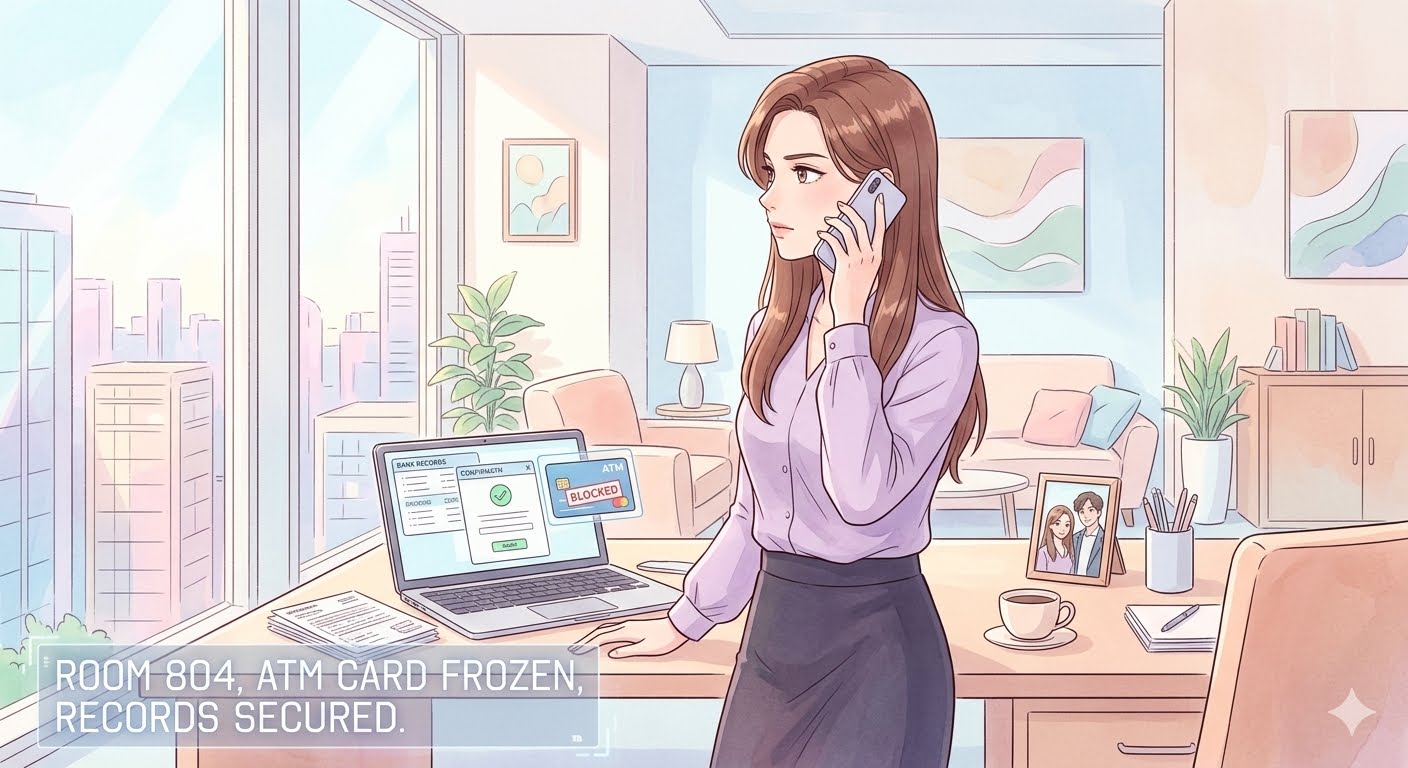
- “Lauren, where is Ethan?”
- “New York,” I answered. “He left yesterday for a business trip.”
- Daniel went silent. Then he said, “No. He’s here in Honolulu.”
- My stomach tightened. Daniel owned a boutique hotel there and rarely called during work hours, so the hesitation in his voice frightened me more than his actual words.
- “He checked into room 804 yesterday,” he continued. “And he isn’t alone. There’s a woman with him. And Lauren… he appears to be paying with your personal ATM card.”
- For several seconds, I simply stared at my computer screen. Ethan and I had been married for five years. There had been small lies before—strange explanations, slightly off business trips, and expenses I had convinced myself not to question. But this was different. My husband had taken my bank card, told me he was flying to New York, traveled to Hawaii with another woman, and checked into my brother’s hotel.
- “Don’t confront him,” I told Daniel.
- “I wasn’t planning to.”
- “Preserve whatever hotel records you’re legally allowed to keep—check-in info, payment records, timestamps. Nothing improper.”
- “I can do that,” he said, before asking quietly, “Are you okay?”
- “I will be.”
- I ended the call, gave myself ninety seconds to feel the overwhelming shock, and then called my attorney, Sonia Reyes, who had handled my legal affairs for seven years, including our prenuptial agreement.
- I told her everything. Her instructions were immediate: do not touch joint funds except for ordinary scheduled household expenses, protect my personal accounts, cancel the missing card, and dispute any unauthorized charges. She then reminded me of a critical detail Ethan had apparently forgotten—our prenup contained an infidelity clause that stripped him of certain financial rights during a separation if adultery was documented.
- “Your brother’s records may become important,” Sonia said. “But only legitimate documentation. Careless people usually leave evidence themselves.”
- I left work early and logged into my bank account. Seven unauthorized transactions had appeared in less than a week: dinner in Honolulu, a spa appointment for two, cash withdrawals, room service, a snorkeling reservation, and a $412 jewelry purchase in Waikiki.
- My husband had bought another woman jewelry using my money. That detail hurt more than I expected.
- I immediately called the bank to cancel the card, dispute the charges, and transfer my personal savings—my salary, my separate property—into a new account at another bank. Then, I reviewed the past six months of statements. Small cash withdrawals appeared repeatedly—$60, $80, $100. Individually minor, they totaled thousands of dollars. I also noted seven supposed business trips over the past year, suddenly doubting every single one. I documented every date, city, and withdrawal. I was no longer wondering if Ethan had betrayed me; I was wondering how long he had been doing it.
- The next day, my phone rang. Ethan.
- “Lauren, something’s wrong with the card,” he said nervously. “The hotel says it isn’t working. Can you call the bank? And could you wire me some money? I’m stuck.”
- “Where are you, Ethan?”
- A pause. “New York.”
- Even now, he lied.
- “Interesting,” I said.
- His tone shifted. “What did you do?”
- “I canceled my card.”
- “My card?”
- “My card, Ethan. My personal account. My money.”
- Silence.
- “I know where you are,” I said smoothly. “I’ve already talked to Sonia. So whatever decision you make next, make it knowing that.”
- I hung up. A minute later, Daniel texted me: Ethan had checked out of room 804, looking completely terrified.
- Ethan didn’t come home that night, or the next. Instead, he left long voicemails blaming stress, emotional distance, and work pressure. His excuses sounded rehearsed, as if he had prepared them long before he got caught. I didn’t respond.
- Meanwhile, Daniel sent Sonia the records he was legally allowed to provide: room 804 booked under Ethan’s name, arrival and departure timestamps, and payment history matching my stolen card. The bank completed its investigation, confirming the charges were fraudulent.
- Sonia sent Ethan a formal, fact-based letter documenting the affair, the card misuse, and the enforceable prenuptial clause. Ethan hired an attorney, Grayson, within eight days. Grayson quickly informed Sonia they wouldn’t challenge the prenup; the evidence was undeniable. What Ethan wanted now was a quiet, “amicable” separation.
- I almost laughed at the word. There was nothing amicable about taking another woman to Hawaii on my dime. Still, Sonia advised against seeking revenge. “A clean separation protects you better than years of expensive litigation,” she noted.
- She was right. I didn’t want to destroy Ethan; I just wanted to be free of him.
- The negotiations lasted six weeks. Our shared assets were divided by documented contributions, my personal accounts remained mine, and the infidelity clause reduced Ethan’s claims as outlined. The bank resolved the fraudulent charges. At Ethan’s request, we included a confidentiality agreement—a clause Sonia noted would also prevent him from later rewriting the story publicly to play the victim.
- When the final papers were signed, I called Daniel to thank him.
- “I couldn’t let you sit at your desk thinking he was in New York while I watched him walk into my hotel with someone else,” he said. When I wondered aloud how long the affair would have continued if he hadn’t seen them, he stopped me. “Don’t do that to yourself. You know now. That’s what matters.”
- In the months after the separation, an unexpected feeling set in: I was less tired. For years, I had drained my energy explaining away inconsistencies, ignoring uncomfortable instincts, and accepting stories that didn’t fit. Once I stopped, I felt lighter.
- When a friend asked what hurt the most, I realized it wasn’t the affair itself. “The worst part,” I told her, “was being managed.” Ethan had constantly calculated what I knew and didn’t know, assuming he could control my perception of reality.
- “He knew you could handle difficult things,” my friend observed. “Instead of trusting you with the truth, he decided to handle you.”
- When Daniel visited later that year, he asked how I had managed to move straight into legal planning after his call without falling apart.
- “I did fall apart,” I admitted. “For about ninety seconds. Then I realized the situation required decisions more than emotion.”
- Room 804 eventually became part of the permanent legal record. The hotel charges, spa visits, snorkeling, and jewelry were tiny pieces of paperwork that dismantled an elaborate lie. Documentation turned out to be my best defense. Memory can be challenged, but evidence is harder to manipulate. Ethan believed he was safe because he thought he controlled the information, underestimating both my brother’s presence at the hotel and my own resolve. He had mistaken my trust for weakness.
- On the morning the divorce was finalized, I sat in a coffee shop near my office and received a text from Sonia confirming everything was complete. I thought about the prenup I had insisted on years ago, Daniel’s phone call, room 804, and the ninety seconds of grief I had allowed myself before taking action.
- I didn’t feel victorious, nor did I need Ethan to suffer to feel whole. I simply felt ready—ready to trust my instincts, stop carrying the weight of someone else’s deception, and build a life that didn’t require me to ignore the truth.
- I finished my coffee, opened my laptop, and went back to work. This time, the life in front of me belonged entirely to me.
My brother called me in the middle of a Tuesday workday and asked one question that changed my marriage forever.