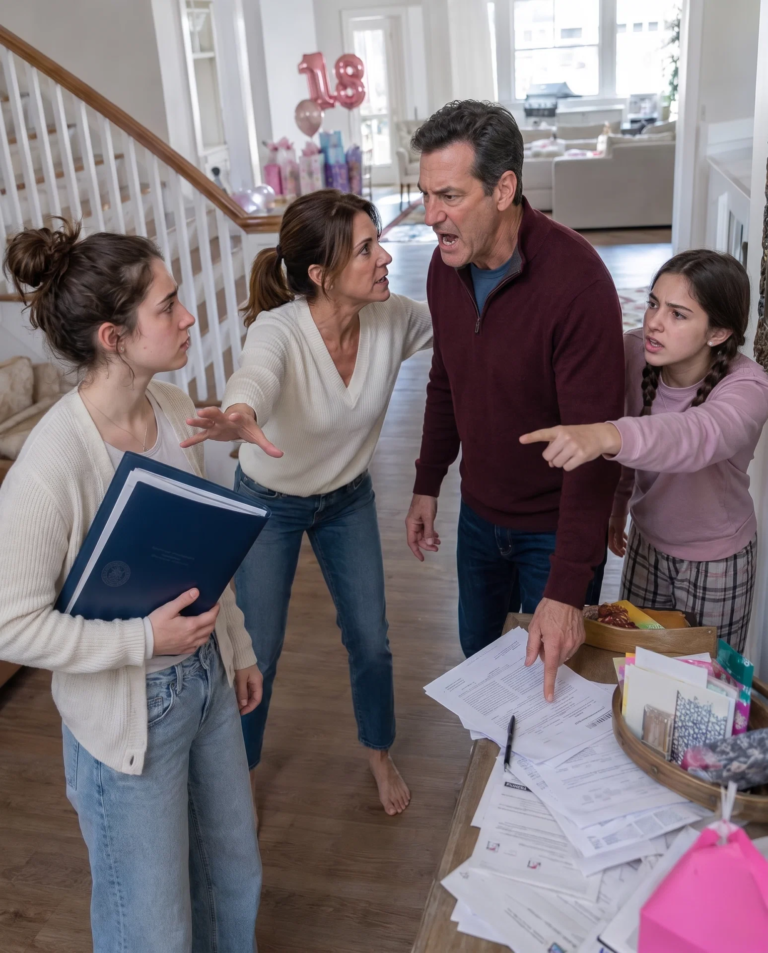
- At my eighteenth birthday party, I quietly moved my entire multi-million-dollar inheritance from my grandparents into a protected trust, just to be safe. The next morning, my parents and younger sister found out.
- At 7:12 a.m., my father kicked open my bedroom door and demanded to know where six million dollars had gone.
- My mother stood behind him in the silk dress she had worn the night before, one diamond earring still missing.
- My sixteen-year-old sister, Lily, held a folder against her chest and stared at me as though I had stolen from her.
- “You moved it,” Dad said. “Put it back.”
- The night before, my parents had hosted an elaborate birthday party at our Greenwich, Connecticut home.
- White roses.
- A string quartet.
- Nearly a hundred guests congratulating me on the inheritance my grandparents had left me.
- Everyone kept saying how lucky I was.
- Nobody mentioned that my parents had already spent the money in their minds.
- I discovered that when I passed Dad’s study while searching for my coat.
- Mom was describing the beach house she wanted in Nantucket.
- Dad said the money could save his failing development company.
- Lily asked whether her new car could be black instead of silver.
- Then Dad laughed.
- “Emma will sign whatever we put in front of her. She always does.”
- I stood outside the door with birthday cake still sweet on my tongue and suddenly understood why Grandpa had made me memorize one phone number before he died.
- Rebecca Shaw.
- His attorney.
- She answered on the second ring.
- At 11:38 that night, while my parents were still celebrating downstairs, I signed documents transferring my $6.2 million inheritance into a protected trust with Rebecca serving as independent trustee.
- I remained the beneficiary.
- But no one—including me—could withdraw the principal without review.
- I told myself it was only a precaution.
- By morning, it felt more like survival.
- Dad threw a stack of papers onto my bed.
- Purchase contracts.
- Loan guarantees.
- And a “family investment agreement” carrying a copy of my signature.
- Mom’s voice trembled with anger.
- “Your father committed us to those deals because you promised to help.”
- “I promised nothing.”
- Lily opened her folder.
- Inside were photographs of a waterfront house, a private-school bill, and an order for a luxury car.
- “You ruined everything,” she whispered.
- Then Rebecca called.
- She told me the bank had stopped three attempted transfers totaling $2.4 million.
- One request had been submitted at 6:03 that morning using my old online credentials.
- Another included a notarized power of attorney I had never signed.
- Dad reached for my phone.
- I stepped away.
- Rebecca’s next words came through the speaker loudly enough for everyone to hear.
- “Emma, do not leave that house alone. I’m outside with two detectives—and your parents have already filed papers claiming you are mentally incompetent.”
- PART 2
- The petition had been filed at 5:41 that morning.
- It described me as emotionally unstable, financially irresponsible, and incapable of understanding “the responsibilities created by sudden wealth.”
- Attached was a letter from a psychologist claiming I suffered from severe anxiety and impaired judgment.
- I had never met him.
- Detective Marisol Vega entered our foyer while Dad was still holding my phone.
- Rebecca followed carrying the original trust papers inside a blue case.
- Dad changed immediately.
- His anger disappeared.
- His voice softened.
- He told the detectives I was grieving, confused, and being manipulated by an attorney who wanted control of my money.
- Rebecca did not argue.
- Instead, she placed the forged power of attorney beside the genuine signature card I had completed in her office.
- The handwriting looked similar.
- The pressure marks did not.
- Then Vega asked who had access to my laptop.
- Everyone looked at Lily.
- My sister’s face collapsed.
- She admitted Dad had told her to copy my saved passwords while I was downstairs greeting guests.
- He promised the money would cover her college, a car, and a house where “the whole family could finally be happy.”
- “I didn’t know they were going to take all of it,” she said.
- Mom slapped the folder from Lily’s hands.
- “You ungrateful little liar.”
- That was the first time I stopped seeing my sister only as an accomplice.
- She suddenly looked sixteen again.
- Bare feet.
- Smeared mascara.
- Shaking under the weight of promises adults had taught her to confuse with love.
- Vega separated us.
- The detectives found my debit card in Dad’s desk.
- A photocopy of my passport in Mom’s purse.
- A mobile notary’s stamp inside a locked drawer.
- The psychologist’s letter had been created from a template downloaded two days earlier.
- The largest attempted transfer was headed to Bennett Development, Dad’s company.
- The second was intended as a deposit on the Nantucket house.
- The third was stranger.
- It was going to a private account in Lily’s name.
- My sister began crying before anyone explained why.
- She had never opened that account.
- Rebecca examined the beneficiary paperwork and went still.
- The account had been created years earlier, when Lily was eleven.
- Nearly $380,000 had moved through it from my grandparents’ estate while Mom served as temporary administrator.
- The theft had not begun on my eighteenth birthday.
- It had started before my grandparents were even buried.
- Then Vega opened Dad’s laptop and found an email scheduled to send after the guardianship hearing.
- “Once Emma is declared incompetent, liquidate the trust challenge fund first. Lily knows enough to become a problem.”
- Lily read the sentence over my shoulder.
- For the first time that morning, she stopped defending our parents.
- She looked at me and whispered, “They were going to blame me.”
- PART 3
- Lily’s account became the thread that unraveled the entire family story.
- For seven years, my parents had been siphoning money from distributions intended for my education and medical needs.
- They routed payments through the account opened in Lily’s name, then recorded them as expenses for both daughters.
- Summer camps we never attended.
- Tutors we never met.
- A $74,000 “medical treatment” during a year when neither of us had suffered so much as a broken bone.
- My grandparents had suspected something before they died.
- That was why Grandpa made me memorize Rebecca’s number.
- And why the final inheritance bypassed my parents entirely once I turned eighteen.
- He had tried to protect me without forcing a child to understand what she needed protection from.
- The guardianship petition was dismissed that afternoon.
- The judge froze my parents’ personal accounts, barred them from contacting the trust, and ordered an independent audit of the estate.
- Dad’s company collapsed two weeks later.
- He had used false promises tied to my inheritance to secure bridge loans and reassure investors.
- Without my money, there was nothing supporting those promises.
- My father pleaded guilty to attempted larceny, identity theft, forgery, and conspiracy.
- He received four years in state prison and was ordered to repay the stolen estate funds.
- Mom claimed she had only followed his lead.
- The emails proved otherwise.
- She had selected the Nantucket house.
- She hired the false psychologist.
- She wrote the plan describing me as unstable if I resisted.
- She pleaded guilty before trial and received thirty months, followed by probation and restitution.
- The mobile notary lost his commission and served six months for false notarization.
- Lily was not prosecuted as an adult.
- She entered a juvenile diversion program for accessing my accounts and agreed to cooperate with investigators.
- For months, I could not decide whether I hated her, pitied her, or missed the little girl who used to crawl into bed beside me during thunderstorms.
- The answer was all three.
- Rebecca arranged for Lily to stay with our aunt in Vermont.
- Before leaving, she gave me the folder from that morning.
- The photo of the luxury car was still inside.
- “I thought they were finally choosing me,” she said.
- I closed the folder.
- “They were choosing what they could make you do.”
- She cried then.
- Not loudly.
- With the exhausted silence of someone realizing the reward she wanted had always been a leash.
- The trust remained intact.
- Rebecca paid my college expenses directly and required financial counseling before approving any large distribution.
- At eighteen, that felt humiliating.
- At nineteen, it felt like freedom.
- I enrolled at Boston University, rented a small apartment with mismatched chairs, and learned to live without wondering whether love came attached to paperwork.
- I did not buy a mansion.
- I did not buy a sports car.
- The first thing I purchased with an approved distribution was a secondhand piano like the one that had stood in my grandparents’ living room.
- A year later, Lily came to visit.
- We played the same duet Grandma had taught us.
- We made mistakes.
- We started again.
- Forgiveness did not arrive like a courtroom verdict.
- It came through smaller things.
- A returned phone call.
- An honest apology.
- A door left unlocked because no one was trying to force their way inside.
- On my eighteenth birthday, my parents believed adulthood began the moment my money became available to them.
- They were wrong.
- It began when I finally believed the warning my grandfather had left behind.
- I transferred the inheritance to protect the money.
- What I really protected was my right to decide what kind of family my life would finance.
At my 18th birthday party, I quietly transferred my entire multi-million-dollar inheritance from my grandparents into a trust, just as a precaution. The next morning, my parents and younger sister…