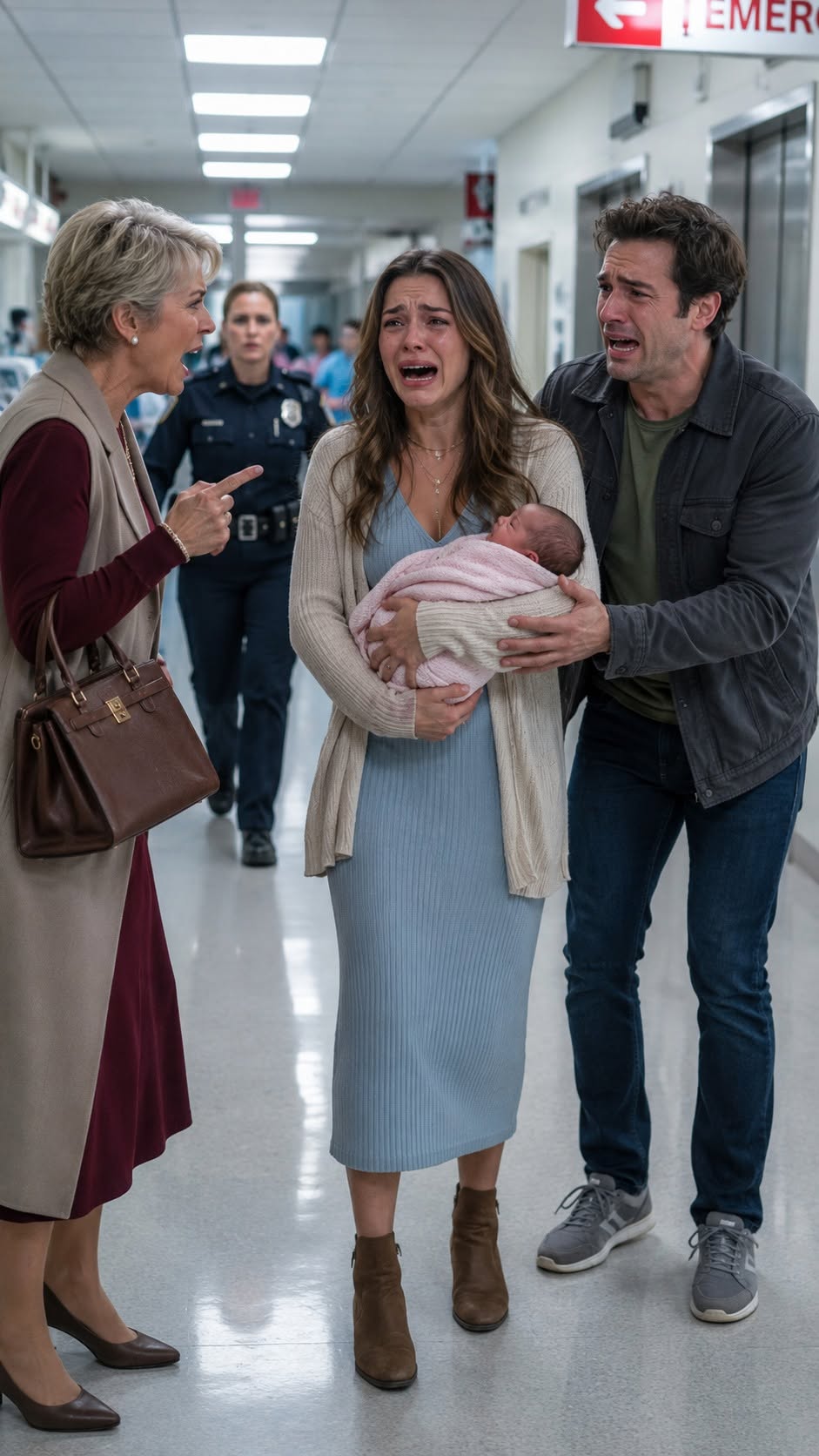
The Weight of Silence
Chapter 1: The Echo of the Fall
The strike materialized with such terrifying velocity that my brain couldn’t even process the sudden movement of my mother-in-law’s arm.
One agonizing second, I was pacing the dim, suffocating hallway of our shared house in Columbus, Ohio. The floorboards creaked under my bare feet as I rocked my three-week-old daughter, Lily. She was screaming—a high, reedy wail of pure infant distress that vibrated against my collarbone. The next second, Patricia Miller’s palm collided with my cheek.
The impact was a brutal, deafening crack that sent a high-pitched ringing echoing through my skull.
“Shut her up, or get out of my house!” Patricia bellowed, her voice a serrated edge tearing through the midnight quiet.
The force of the blow threw me off balance. My vision blurred into a smear of shadowy walls. I stumbled sideways, my slippers losing their grip on the polished oak.
In that frantic, chaotic shifting of weight, my arms opened instinctively to break my own fall.
Lily slipped from my embrace.
Her tiny, fragile body plummeted toward the hardwood floor.
The sickening thud of the impact was immediately followed by a profound, terrifying absence of sound. The crying abruptly ceased. For a fraction of a second, that absolute silence was infinitely worse than her loudest scream. It was a heavy, suffocating vacuum that seemed to suck the oxygen directly out of my lungs.
“Lily!”
I scrambled to my knees, my breath tearing from my throat in ragged gasps. My daughter lay entirely motionless. Her delicate eyelids were closed, and one impossibly small fist was curled tightly beside her pale cheek. She looked as though she were merely sleeping, but her chest wasn’t moving.
Footsteps thundered down the hall. My husband, Daniel, burst from the bedroom, his eyes wide with sleep and sudden terror.
“What just happened?” he demanded, his gaze darting from me to the floor.
“Call 911!” I shrieked, my hands hovering over Lily’s still form, terrified that touching her might somehow make it worse.
Patricia stood just three feet away. She was pale, yet her posture remained rigidly defiant, like a statue carved from ice.
“She dropped the baby,” Patricia stated. Her tone was eerily flat, completely devoid of panic.
I whipped my head around to stare at her, a cold shock wave of disbelief washing over me.
“You hit me!” I screamed, pointing a trembling finger at her face.
Patricia scoffed, rolling her eyes in the shadows. “Oh, please. I barely even grazed you.”
Daniel froze, a statue caught between the two women in his life. He looked at his mother, his voice cracking. “Mom?”
“She’s sleep-deprived, Daniel,” Patricia said smoothly, adjusting the collar of her robe. “She doesn’t know what she’s saying. She just lost her grip.”
I didn’t possess the time or the sanity to argue. Every passing microsecond felt like sand draining from an hourglass. The nearest emergency department was less than a ten-minute drive from our subdivision. I scooped Lily up—her body felt terrifyingly limp, devoid of that rigid newborn tension—ran out the front door into the biting night air, and threw myself into my car.
I sped through the deserted suburban streets, dialing 911 on speakerphone with shaking, bloodless fingers. The dispatcher’s voice filled the cabin, offering to send an ambulance to intercept me, but the towering illuminated sign of Riverside Methodist Hospital was already looming just two blocks away. I laid on the horn, running a red light, my eyes fixed on the emergency bay.
The moment I breached the sliding glass doors, screaming for help, a swarm of medical personnel descended upon us. They took Lily from my arms instantly, whisking her away through a set of heavy double doors before I could even comprehend the flurry of their movements.
I was left standing in the harsh, fluorescent glare of the hallway. My body shook with violent, uncontrollable tremors. I looked down at myself—I was still wearing flannel pajama pants, my shirt heavily stained with a mixture of sour formula and my own sweat.
The minutes stretched into an agonizing eternity. The sterile smell of antiseptic and floor wax made my stomach churn.
Twenty minutes later, a set of doors swung open. A physician in dark blue scrubs, his badge identifying him as Dr. Aaron Blake, walked toward me. He didn’t have the hurried, efficient stride of a doctor delivering good news. His steps were measured. Heavy.
His expression made the floor beneath me feel as though it were dropping into an abyss.
“Mrs. Miller?” his voice was incredibly gentle.
“Yes,” I choked out, wrapping my arms around my shivering torso.
Dr. Blake stopped a few feet away, clasping his hands in front of him. “Your daughter is already in cardiac arrest.”
Will Lily survive the next few moments, or is the silence going to be permanent?
Chapter 2: The Awakening of Clarity
The world around me ceased to exist.
“What?” The word barely made it past my lips. It sounded like it belonged to a stranger.
“She had no detectable pulse when you arrived at the triage desk,” Dr. Blake explained, his eyes locked onto mine with a steady, grounding intensity. “We are actively performing CPR on her right now.”
My knees buckled. Gravity simply overtook me.
A triage nurse standing nearby lunged forward, catching me by the elbow and easing me into a hard plastic waiting room chair. The roaring in my ears returned, louder than the ringing from the slap.
Dr. Blake knelt to meet my eye level. He chose his next words with agonizing care. “Emily, there are immediate signs of significant, blunt-force head trauma. We need to know exactly how this happened. Every detail matters for her treatment.”
Before my paralyzed brain could form a coherent sentence, the frantic squeak of rubber soles on linoleum echoed down the corridor. Daniel and Patricia were rushing toward us.
Patricia reached me first. She didn’t look at the doctor. She didn’t look toward the trauma bay where my daughter was dying. She grabbed my arm, her manicured nails digging into my skin.
“Emily,” she hissed, her voice a desperate, commanding whisper. “Tell the doctor it was a tragic accident. Tell him you tripped.”
I stared at her face. I looked at the slight tremor in her jaw, the calculated panic in her eyes.
And in that precise fraction of a second, a profound and terrifying metamorphosis occurred within my soul.
It wasn’t grief that washed over me. It wasn’t the paralyzing fear that had gripped me in the car.
It was absolute, crystalline clarity.
For two years, I had shrunk myself to fit into the cramped, suffocating corners of Patricia’s world. I had bitten my tongue, swallowed my pride, and made countless excuses for her psychological warfare. But gazing at her now, as my newborn’s heart stubbornly refused to beat, the fragile illusion of our ‘family’ shattered into a million jagged pieces.
I slowly peeled her fingers off my arm, stepping back. I pulled my cell phone from my pocket and dialed a number I had memorized but never dared to use.
“What are you doing?” Patricia demanded, her voice rising in pitch.
“Columbus Division of Police, what is your emergency?” the dispatcher answered.
I didn’t break eye contact with my mother-in-law. “My name is Emily Miller. My newborn daughter was critically injured tonight. My mother-in-law assaulted me, and my baby was dropped because of it. I am at Riverside Methodist Hospital.”
Patricia’s complexion transitioned from pale to a sickly, ashen gray. She stumbled back as if I had physically struck her.
Daniel rushed forward, grabbing my shoulders. “Emily, what the hell are you doing? Have you lost your mind?”
I looked directly into my husband’s eyes. The man I loved, the man who had perpetually chosen the path of least resistance.
“I am doing something I should have done a very long time ago,” I said, my voice eerily calm.
Suddenly, a piercing, frantic alarm began blaring from the trauma rooms behind the double doors. The steady, terrifying rhythm of a code blue.
Dr. Blake didn’t say another word to us. He spun on his heel and sprinted back into the room, the heavy doors swinging shut behind him, cutting off my view of the chaos.
What is happening behind those doors, and who will pay the price if the alarm suddenly stops?
Chapter 3: The Illusions We Keep
Two patrol officers arrived at the hospital within fifteen minutes, their heavy duty belts jingling as they strode into the tense waiting area.
Officer Rachel Torres, a sharp-eyed woman with an aura of absolute authority, immediately took control of the scene. She took one look at the dynamic in the room and expertly separated me from Daniel and Patricia, guiding me into a quiet, secluded alcove near the vending machines.
As soon as we were alone, her flashlight flicked on. She aimed the beam at my face, gently inspecting the side of my head. She noticed the raised, angry red welt swelling on my left cheekbone instantly.
“Did the assailant strike you with an open palm or a closed fist, ma’am?” Officer Torres asked, her pen hovering over a small notepad.
“An open hand,” I replied, my voice steady despite the adrenaline coursing through my veins.
“And you were actively holding the infant when she made physical contact?”
“Yes. I was rocking her against my shoulder.”
From across the main waiting area, Patricia’s shrill voice cut through the air. “She’s lying! She’s a hysterical, unfit mother!”
Officer Torres didn’t even flinch. She simply turned her head sharply, locking eyes with Patricia. “Ma’am, I need you to stay exactly where you are and remain quiet, or I will have you removed from the premises.”
Daniel looked utterly miserable. He paced like a caged animal before inching closer to the alcove.
“Emily, please,” he pleaded, his voice cracking with desperation. “Can we maybe just focus on Lily right now? We can sort out the rest of this later.”
I stared at him, a cold, unfamiliar disgust rising in my throat. “Our daughter might not survive the night because your mother hit me, Daniel.”
“My mom didn’t mean to—”
“Stop.”
That single, commanding syllable severed his sentence like a guillotine.
For two excruciating years, Patricia had manipulated every facet of our marriage. She held the deed to the house. Daniel and I had moved into her basement after the construction firm he worked for went bankrupt. From the moment we brought our boxes inside, Patricia made it her daily mission to remind us that we were breathing “under her roof.”
She critiqued the way I folded laundry, the nutritional value of my cooking, the clothes I wore, and, most recently, my parenting. She even commented on how long I chose to breastfeed Lily, calling it “excessive and unnatural.”
And every single time, Daniel deployed the exact same defense. She doesn’t mean anything by it, Em. That’s just how she is. Don’t take it personally.
But tonight, intention no longer held any currency.
The double doors swung open once more. Dr. Blake stepped out, pulling down his surgical mask. He looked exhausted.
I bolted upright, abandoning the officer. “Lily?”
“We’ve successfully restored her heartbeat,” he said.
I slapped both hands over my mouth, a choked sob tearing from my chest.
“But I need you to understand that she is critically ill,” he continued, his tone devoid of false hope. “An emergency CT scan revealed severe bleeding around the brain, along with a complex skull fracture. We are transferring her immediately to the Pediatric Intensive Care Unit.”
“Will my baby survive, Doctor?” I begged.
Dr. Blake looked down. “I cannot make you that promise, Mrs. Miller.”
Fresh tears cascaded down my face.
Dr. Blake lowered his voice, stepping closer to me and Officer Torres. “There is a secondary issue. The specific pattern of this injury is consistent with a significant, high-velocity impact. It does not align with a simple, stationary drop. Because she is a newborn, hospital protocol legally mandates us to involve Child Protective Services and law enforcement.”
Officer Torres nodded grimly. “I am already initiating a criminal investigation, Doctor.”
Hearing this, Patricia leaped to her feet, her bravado returning. “This is an absolute witch hunt! It is insane. Babies fall all the time. It was a clumsy accident!”
Officer Torres walked slowly toward the older woman. “Mrs. Miller, I strongly advise you to stop talking.”
Patricia crossed her arms defensively over her chest. “I know my legal rights, Officer.”
“Then you should be well aware that you do not have to answer any of my questions,” Torres replied coolly.
Another uniformed officer stepped up to Daniel. “Sir, were you physically present in the room when this incident occurred?”
Daniel hesitated.
I watched his face closely. I watched his eyes dart to the floor, then to his mother, then back to the officer. That agonizing three-second hesitation told me everything I ever needed to know about my husband.
He had heard Patricia screaming her lungs out before he ever stepped out of the bedroom. Maybe he hadn’t witnessed the physical connection of the slap, but he knew his mother. He knew her rage. He knew exactly what she was capable of when she felt her authority was being challenged.
Finally, he cleared his throat. “No. I… I was in the bedroom.”
Officer Torres turned her attention back to him. “Did your mother ever verbally threaten or physically intimidate your wife prior to tonight, sir?”
Daniel looked at Patricia. Patricia shot him a glare that could have melted steel.
“No,” Daniel lied.
I felt a sensation that was vastly colder and sharper than anger. It was the icy resolve of a woman who had nothing left to lose.
I pulled out my phone and unlocked the screen. For eight months, I had meticulously saved and screenshotted text messages. Patricia texting me that I was a parasite. Patricia threatening to change the locks while I was at prenatal yoga. Patricia insisting that Lily was “Miller blood” and belonged more to her than to the woman incubating her.
I found a specific thread from three days prior and held it out.
The message read: If you don’t find a way to make that little brat stop screaming all night, I will throw both of you out to sleep on the street. I am sick of it.
I handed the glowing screen to Officer Torres. Her professional facade slipped for a fraction of a second as she scrolled through the vitriol.
Then, a sudden jolt of memory hit me. A detail so mundane I had almost forgotten it.
The security lens.
Months ago, after a series of Amazon packages had been stolen from our front porch, Daniel had installed a motion-activated security camera in the living room. It was angled toward the front door, but a wide portion of the dim hallway was clearly visible in its periphery.
Including the exact spot where I had been standing.
I turned my head and locked eyes with Daniel. “The camera.”
All the blood drained from his face. His eyes widened in absolute horror.
Patricia spun toward him, her false confidence evaporating. “What camera? What is she talking about, Daniel?”
Officer Torres immediately stepped between them. “Where is the video recording stored, sir?”
Daniel swallowed hard, his Adam’s apple bobbing. “It’s… it’s on a cloud storage app on my phone.”
Patricia’s face completely collapsed. The rigid defiance melted into raw, unadulterated terror.
What exactly did the camera record in the shadows, and is it enough to put Patricia behind bars?
Chapter 4: The Digital Witness
Officer Torres did not permit Daniel to touch his cellular device again. She instructed him to place it face down on the waiting room table.
Another officer, Marcus Reed, was dispatched to the hospital. He brought a professional camera and documented the rapid bruising and swelling on my face from multiple angles, while Officer Torres contacted a precinct detective to secure an emergency warrant for the home security footage.
Patricia had ceased her shouting entirely. She sat slumped in a plastic chair, her hands trembling in her lap. That frightened, suffocating silence told me everything. She understood the permanence of digital memory. The camera didn’t care about “her roof” or her authority.
Daniel sat three chairs away from me, his elbows resting heavily on his knees, his face buried in his hands.
“Emily,” he whispered, his voice trembling with tears. “Whatever happens next… please, just remember that she is my mother.”
I turned my head slowly, staring at the side of his face.
“And Lily is your daughter, Daniel.”
He squeezed his eyes shut and looked down at his shoes.
For years, I had allowed myself to believe that Daniel’s chronic weakness was actually a form of gentle kindness. He loathed confrontation. He actively avoided arguments, often leaving the house to go for long drives when Patricia started a fight. He proudly wore the badge of a “peacemaker.”
But tonight, I realized a fundamental truth: a peace that is constructed entirely on someone else’s suffering and silence isn’t peace at all. It is permission. It is complicity.
Around 3:10 a.m., I was finally allowed into the Pediatric Intensive Care Unit.
Lily looked impossibly fragile, swallowed by the massive, sterile hospital equipment. She was surrounded by a chaotic web of translucent tubes and wires. A mechanical ventilator was forcing air into her tiny lungs, the rhythmic hiss-click the only sound in the room. A glowing monitor displayed a chaotic array of numbers and jagged neon lines that I didn’t understand, yet I couldn’t tear my eyes away from them.
Dr. Blake introduced me to Dr. Karen Patel, the on-call pediatric neurologist. Dr. Patel had a gentle demeanor but didn’t sugarcoat the reality. She explained that the intracranial bleeding had caused dangerous, rapid swelling inside Lily’s skull.
“We are monitoring her intracranial pressure continuously,” Dr. Patel said, adjusting an IV line. “If the pressure continues to spike, emergency neurosurgery will be unavoidable.”
I reached through the bars of the crib and took Lily’s tiny, cool foot between my index finger and thumb.
“Can she… can she hear me?” I asked, my voice barely a whisper.
“We honestly don’t know, Emily,” the doctor replied softly.
I leaned over the metal railing anyway, bringing my face as close to my daughter’s as the tubes would allow.
“Mommy is right here, baby girl,” I whispered, my voice breaking completely. “I am not leaving you. I am right here.”
From the doorway behind me, Daniel began to sob quietly. I didn’t turn around.
At 4:00 a.m., Detective Samuel Brooks arrived on the floor. He was a veteran investigator in his late forties, projecting a calm, methodical aura that grounded the chaotic energy in the room. He led me into a private family consultation room and asked me to walk him through the entire incident from the moment I woke up to Lily’s crying.
I detailed everything. The exhaustion. The pacing. Patricia emerging from her bedroom like a hurricane. Her screaming that I was spoiling the infant. The violent swing of her arm. The sickening snap of my head turning. The loss of footing. The fall.
Patricia’s chilling demand that I lie to the doctors.
Detective Brooks barely wrote anything down while I spoke, his eyes analyzing my micro-expressions. When I finally finished, he leaned forward, clasping his hands on the table.
“Mrs. Miller, has Patricia ever laid hands on you before tonight?”
I hesitated. A wave of deep shame washed over me.
“Yes. Once.”
Daniel, who was sitting in the corner, snapped his head up. “When?”
“Five months ago,” I said softly.
Daniel stared at me, dumbfounded.
I turned my attention back to the detective. “I was heavily pregnant. We got into a screaming match because she wanted to clear out the spare bedroom we were setting up as a nursery to store her old antique furniture. When I refused, she shoved me backward with both hands. I hit the hallway wall.”
Daniel stood up abruptly. “You never told me she put her hands on you!”
“I did tell you, Daniel.”
“No, you didn’t! I would have remembered that!”
“I called you at the job site while you were on your lunch break,” I countered, my voice eerily steady. “I was crying. I told you she pushed me.”
His face contorted in confusion, then realization dawned.
I recited the memory, word for verbatim word. “You sighed into the phone, Daniel. You said, ‘Em, you two really need to stop provoking each other. Just let her have the room, we’ll put the crib in our bedroom.’ That’s what you said.”
Daniel’s legs gave out, and he sank back into his chair, utterly defeated.
Detective Brooks turned a page in his notebook. “Were there any other escalating incidents?”
“Constant threats. She would physically block doorways so I couldn’t leave a room during an argument. Once, she hid my car keys for two days so I couldn’t drive to my prenatal appointment.”
Brooks nodded slowly. “That establishes a pattern of coercive control. That matters.”
A uniformed officer knocked softly on the door, stepped inside, and whispered something into Brooks’s ear.
The detective listened intently, his expression unreadable. He looked toward the hallway, where Patricia was sitting under guard by the elevator banks.
“We have successfully accessed the video footage,” Brooks announced.
My heart hammered a frantic rhythm against my ribs.
We relocated to a small, windowless security office on the main floor. I was permitted to observe. Daniel, pale as a ghost, trailed behind us.
The footage on the monitor was grainy, the angle slightly skewed by a potted plant, but the scene was undeniably clear.
The time stamp flashed 12:17 a.m. I appeared in the hallway, bouncing Lily rhythmically against my chest.
A moment later, Patricia stepped into the frame from the left.
Initially, there was no audio. The camera’s microphone was programmed to activate only after the motion sensor triggered a recording sequence. After three seconds, the audio kicked in.
“Take that screaming child somewhere else,” Patricia’s voice hissed from the small computer speakers.
“I’m trying to calm her down,” my exhausted voice replied on screen.
Patricia took two aggressive steps forward, invading my personal space. “You’ve been trying for an hour. You are incompetent.”
“She’s only three weeks old, Patricia.”
“Then learn how to control your damn kid!”
On the screen, I turned my back, attempting to walk away.
Patricia lunged, grabbing the fabric of my pajama shirt at the shoulder.
I twisted around, alarmed.
Then, her right arm pulled back and swung like a pendulum.
The slap was thunderous. Even through the cheap speakers, the sharp smack of flesh hitting flesh was unmistakable. My head snapped violently to the right. My arms flailed wildly as I tried to regain my footing.
Lily plummeted out of frame.
The hollow, sickening thud of her body hitting the floor echoed through the security room.
I had to turn away from the screen, pressing my fists into my eyes.
Beside me, Daniel dry-heaved into a trash can, whispering, “Oh God. Oh my God.”
The footage didn’t stop there. It showed me dropping to my knees, frantically hovering over my lifeless baby.
Then, Patricia stepped forward. She looked down at the floor, and uttered a phrase that none of us had accurately recalled in the chaos. The microphone caught it perfectly.
“Don’t you dare try to blame me for this.”
Detective Brooks hit the spacebar, pausing the footage on Patricia’s scowling face. The silence in the small room was suffocating.
He stood up and adjusted his belt. “That establishes undeniable probable cause.”
Will Patricia finally face the consequences of her rage, and more importantly, will Lily survive the night?
Chapter 5: The Operating Theater
Patricia Miller was placed in handcuffs and arrested before the sun even breached the Ohio horizon.
The initial booking charges were severe: suspicion of domestic violence and felony child endangerment. The district attorney’s office was waiting on the final medical prognosis to determine if the charges would escalate to manslaughter.
When Officer Torres and her partner clamped the cold steel around Patricia’s wrists in the hospital lobby, her facade of arrogant control completely fractured. She thrashed against their grip like a wild animal.
“This family belongs to me!” she shrieked, her voice echoing off the glass walls. “You can’t do this!”
She locked eyes with Daniel, who was standing frozen near the automatic doors.
“Daniel! Tell them!” she commanded, desperation making her voice crack. “Tell them she is a liar! Tell them she dropped the baby on purpose!”
Daniel did not move a single muscle. He didn’t speak.
Patricia violently wrenched her neck to glare at me, her eyes burning with a venomous hatred. “You destroyed my son’s life, you little bitch.”
I felt a wave of exhaustion so profound it transcended anger. I looked at the woman who had terrorized me for years, and felt absolutely nothing but pity.
“No, Patricia,” I said, my voice eerily calm. “You nearly destroyed your granddaughter’s life.”
The officers hauled her away. The elevator doors slid shut, severing her from our lives forever.
Daniel retreated to the hospital’s non-denominational chapel. He sat alone in the dim, stained-glass light for almost an hour. When he finally emerged, his eyes were bloodshot, his face swollen from weeping.
He approached me near the coffee machine, keeping a respectful distance. “I should have put a stop to her behavior years ago, Em.”
I stirred a wooden stick in my black coffee, refusing to look at him.
“I kept telling myself that if I just stayed out of the line of fire, if I just kept the peace, eventually things would calm down and she would accept you.”
“They didn’t calm down, Daniel.”
“I know that now.”
I stopped stirring and finally met his gaze. “No. You knew it before tonight. You just didn’t care enough to stop it.”
He flinched as if I had struck him.
That was the pivotal moment I saw him truly grasp the magnitude of his failure. Acknowledging a disaster after the debris has settled is easy. Standing in front of the storm and taking the hit before the disaster strikes requires courage he never possessed.
At 7:30 that morning, the monitors in Lily’s room began blaring a frantic warning. Her intracranial pressure was spiking dangerously high.
A team of doctors rushed into the room, physically pushing me out into the hallway. The lead neurosurgeon, Dr. Michael Chen, emerged minutes later with a grim expression. He explained that the brain swelling was compressing her brainstem. They needed to perform an emergency craniotomy to relieve the pressure and evacuate the pooling blood.
I signed the surgical consent forms with a pen that violently shook in my grasp, smearing the blue ink.
Daniel stepped forward, tentatively reaching out to place a hand on my trembling shoulder.
I instantly pulled away, stepping out of his reach.
“Please, Emily,” he begged, his voice cracking.
“I cannot deal with ‘us’ right now, Daniel. Don’t touch me.”
He nodded slowly, letting his arm drop to his side.
The surgery dragged on for four agonizing hours. I couldn’t bear the claustrophobia of the family waiting room, so I sat on the cold linoleum floor beside a vending machine, staring blankly at a row of stale potato chips.
Detective Brooks returned to the hospital briefly during the surgery. He informed me that crime scene investigators had executed a search warrant on Patricia’s bedroom, with Daniel’s explicit, legal consent as a resident of the property.
They didn’t find any weapons or physical evidence relating to the incident.
However, Daniel had handed the police a piece of evidence I didn’t even know existed: his mother’s old, discarded smartphone.
Patricia had upgraded to a newer model a few months ago, but she had never bothered to factory reset the old device. Daniel, knowing her passcode, had unlocked it for the detectives.
The recovered text messages revealed a chilling, multi-year manifesto of resentment and malice. Patricia had spent years complaining to her sisters and friends that I was a “gold digger” who had “stolen her boy.”
After I became pregnant, the digital venom escalated into dangerous territory. One message sent to Patricia’s older sister, dated four months ago, read: Once that baby arrives, Emily is going to think she calls the shots in my family. I am going to have to remind her exactly whose house she is living in, even if I have to do it the hard way.
Another message to a friend read: Daniel is entirely too soft to put his wife in her place. So, I will do it for him.
The messages weren’t a smoking gun proving she intended to give Lily a traumatic brain injury. But they painted a crystal-clear picture for the prosecutor. This wasn’t a sudden, uncharacteristic loss of temper. It was the calculated escalation of a woman obsessed with dominance.
Late that afternoon, the heavy surgical doors finally swung open. Dr. Chen walked toward us, stripping off his blood-speckled surgical cap.
I vaulted to my feet so fast that my plastic chair tipped over and crashed backward onto the floor.
“The procedure went exactly as planned,” Dr. Chen said immediately, reading the absolute terror on my face.
“Is she still alive?” I choked out.
“Yes. She is alive.”
My knees gave way. Daniel caught my elbow, keeping me from collapsing onto the floor, but I quickly stepped out of his grip once I found my balance.
Dr. Chen held up a hand, halting my relief. “She is alive, but she remains in incredibly critical condition. The next forty-eight hours are the most crucial window. We have to monitor her round the clock for secondary swelling, seizures, severe infections, and any signs of permanent neurological deficits.”
Daniel was weeping openly, hiding his face in his hands.
I looked Dr. Chen dead in the eye and asked the only question that mattered in the universe. “Will my baby wake up?”
Dr. Chen paused. It was a terrifying, calculating pause.
“I believe she has a fighting chance.”
Will that fighting chance be enough, or will the silence return to claim her?
Chapter 6: The Long Road to Sunlight
That single, fragile “chance” became the center of my entire universe.
The first night crawled by in a blur of alarms and nurses checking vitals. Then the second night.
Lily remained heavily sedated, medically paralyzed to give her bruised brain the energy to heal.
On the morning of the third day, Dr. Patel authorized a slow reduction in the paralytic medications.
I stood vigil beside the metal crib, my unwashed hair tied in a messy knot, my fingers resting as light as a feather against the back of Lily’s pale hand.
“Lily?” I whispered into the sterile air.
Nothing. Not a twitch.
“Sweetheart, it’s Mommy. Mommy is right here.”
Underneath my index finger, I felt a microscopic shift. Her tiny fingers curled, ever so slightly, grazing my skin.
I stopped breathing entirely.
“Doctor!” I screamed, my voice cracking the quiet of the ICU.
A nurse sprinted into the room.
As she approached the crib, Lily’s translucent eyelids fluttered. They twitched, heavy with drugs and exhaustion. And then, very slowly, they opened.
She stared blindly at the ceiling for only a few seconds before the exhaustion dragged them shut again. But she had opened them.
I collapsed over the railing of the crib, crying harder, deeper, and louder than I had since the horrifying night she fell from my arms.
Over the agonizing span of the next two weeks, my daughter fought her way back to life. It was a slow, grueling march. She was successfully weaned off the mechanical ventilator, her small chest rising and falling on its own. She began tracking the beam of the nurse’s penlight with her eyes. Eventually, she managed to drink half an ounce of formula from a tiny bottle.
A follow-up MRI revealed undeniable scarring on her brain. Dr. Patel sat me down in a private room and explained that it was far too early to predict the trajectory of her long-term cognitive and physical development.
She might recover with miraculous resilience. She might suffer from severe developmental delays. She would almost certainly require years of physical and occupational therapy. Nobody in that hospital could promise me she would have a “normal” childhood.
But Lily was breathing. She was alive. And for that moment, that was a miracle I would gladly accept.
Meanwhile, the legal net around Patricia Miller tightened into a noose.
The county prosecutor officially charged her with felony child endangerment and felony domestic violence. Her high-priced defense attorney attempted to argue that Patricia had never possessed the specific intent to cause an infant to fall, framing it as a tragic accident stemming from a minor scuffle.
The aggressive prosecutor shut that defense down in a preliminary hearing. She argued that while Patricia may not have mapped out the exact, horrifying outcome, she deliberately and violently struck a woman who was actively holding a three-week-old newborn. The act was intentional; therefore, she was criminally liable for the catastrophic consequences.
The security camera footage was the nail in the coffin. It made any denial of the assault completely impossible.
Patricia was released on bail pending trial, but under incredibly strict judicial conditions. A permanent protective order was issued, strictly prohibiting her from coming within five hundred feet of me, or having any contact whatsoever with Lily.
During those agonizing weeks in the hospital, I made a decision. I contacted my older sister, Megan, who drove down from Indianapolis. While I stayed at the hospital, Megan packed up my belongings from Patricia’s house and moved them into a small, cramped, two-bedroom apartment across town.
Daniel moved out of his mother’s house permanently as well.
But we did not move into the same apartment.
On the day Lily was finally discharged, after twenty-six harrowing days in the ICU, Daniel showed up at the hospital. He asked if he could ride with us to the new apartment.
I looked at him—at the heavy bags under his eyes, the weight of his guilt pulling down his shoulders—and I shook my head.
“You can drive your own car and help Megan carry the heavy boxes up the stairs,” I told him coldly. “That’s it. Nothing more.”
He nodded, accepting the boundary without a single word of protest.
For the first several months, our marriage existed purely as a legal technicality. We were parents to a traumatized infant, but we were no longer partners.
Daniel threw himself into individual intensive counseling. He voluntarily enrolled in a state-sponsored parenting class, despite it not being court-ordered. He finally secured a stable, union job with a commercial electrical contractor.
And every single time he came to my apartment to visit his daughter, he strictly adhered to the unyielding boundaries I had erected.
No unannounced visits. No mentioning Patricia’s name in Lily’s presence. And absolutely no pressuring me to forgive him or reconcile the marriage.
One rainy evening, about five months after the incident, Daniel sat across from me at my tiny, scratched kitchen table. Lily was asleep in her crib in the next room.
“I used to tell myself that you forcing me to choose between my wife and my mother was an unfair position to put a man in,” he said quietly, tracing the rim of a water glass.
I didn’t say anything. I just waited.
“But I realize now that wasn’t what was happening at all,” he continued, looking up to meet my eyes.
“No. It wasn’t.”
“You were just begging me to protect our family. To protect our home.”
“Yes.”
“And I completely refused to do it… because refusing was easier than fighting her.”
For the first time since I had met him, Daniel did not ask for my forgiveness. He simply stated his failure as an absolute fact.
That raw, painful honesty mattered infinitely more to me than any hollow apology ever could.
Eventually, Patricia’s high-priced lawyer realized they couldn’t beat the video evidence. They accepted a plea agreement. Patricia formally pleaded guilty to the felony child endangerment charge and the domestic violence charge, avoiding a lengthy, public trial.
At her sentencing hearing, I stood before the judge to deliver my victim impact statement.
I did not stand at the podium and scream about how much I hated her. I didn’t need to. I simply laid out the cold, devastating facts.
I described the agonizing reality of sleeping in a hard plastic chair beside Lily’s hospital bed for twenty-six days. I described the sheer, paralyzing terror of watching a neurosurgeon drill into my infant daughter’s skull before she was even old enough to smile. I described the endless, grueling physical therapy appointments. The neurological evaluations. The panic attacks I suffered every time Lily slept a little too deeply.
When I finished, Patricia was given the opportunity to address the court.
She stood up. She looked frail, her hair graying at the roots, the arrogant fire entirely extinguished from her eyes. She wept openly. She told the judge she had lost her temper. She swore she had never, ever wanted to see her granddaughter hurt. She stated she would give anything to take back that one, singular second of her life.
For the first time in the three years I had known her, Patricia Miller did not try to blame me.
The judge was unmoved by the tears. He sentenced her to a mandatory period of incarceration in a state facility, to be followed by five years of strictly supervised probation and mandatory anger-management rehabilitation. The permanent protective order was extended, legally barring her from ever contacting me or Lily until Lily turned eighteen.
Daniel attended the sentencing hearing.
He did not sit on the defendant’s side of the gallery with his aunts and uncles. He sat in the second row, directly behind me.
Exactly one year to the day after the fall, Lily celebrated her first birthday in my cramped apartment.
It wasn’t a grand affair. I had taped some cheap pink balloons somewhat crookedly along the living room wall. Megan had driven down and baked a messy, sprinkle-covered cake. Daniel arrived carrying a giant, ridiculously fluffy stuffed elephant.
Lily still suffered from mild hemiparesis—a noticeable weakness on the left side of her body. She still required intensive physical therapy twice a week. But she could sit up completely unassisted on the play mat.
She could laugh—a deep, belly-shaking giggle.
She could recognize the sound of my footsteps from the hallway.
And when Daniel placed the massive stuffed elephant in front of her, she reached out with her stronger right hand, grabbed its floppy ear, and squealed with delight.
Daniel watched her, a bittersweet smile playing on his lips. He looked up at me.
“She is so incredibly strong, Em.”
“She is a fighter,” I agreed, leaning against the doorframe.
He hesitated, shifting his weight. “So are you.”
I didn’t offer a response to that. Some truths didn’t require sentimental validation.
Daniel and I did eventually finalize our divorce. It wasn’t a bitter, drawn-out battle. We didn’t divorce because he was an evil monster. He wasn’t.
We divorced because I had learned the hardest lesson a mother can learn: love, when stripped of courage and action, can become the most dangerous thing in the world.
We negotiated a shared custody agreement, which included an ironclad, legally binding clause explicitly stating that Patricia was forbidden from ever having contact with Lily, unless a future court order deemed otherwise.
Daniel signed the papers without a single moment of hesitation.
Three years later, the heavy shadows of that Columbus hallway feel like a lifetime away.
I am sitting on a wooden bench at a vibrant, sunlit playground in Cincinnati. I am watching a four-year-old girl sprint across the rubber mulch.
When she gets tired, her left leg still turns inward just a fraction of an inch. Most strangers at the park never even notice the slight limp.
I always do. It is a permanent, physical reminder of the price we paid for silence.
Lily scrambles up the metal stairs of the towering spiral slide. She reaches the top, waving frantically.
“Mommy! Mommy, watch me!” she shrieks at the top of her lungs.
“I’m watching you, baby! Go ahead!” I yell back.
She throws her arms in the air and flies down the plastic chute, her laughter ringing out over the noise of the park.
For years, I was haunted by the phantom echoes of that midnight trauma. Every time I closed my eyes, my brain would force me to relive it. The sudden sting of the slap. The terrifying feeling of empty arms. The hollow thud.
The suffocating, awful silence.
But time, and fierce love, have a way of rewriting our darkest memories. The nightmare no longer ends on that cold hardwood floor, or beneath the harsh, blinding lights of the emergency room.
Now, when I think of my daughter, the image of her lying motionless is immediately aggressively pushed aside by the reality right in front of me.
A little girl running wildly through the afternoon sunlight.
Alive.
Vibrant.
Loud.
Absolutely impossible to silence.
And every single time she laughs, or screams, or throws a noisy tantrum, I think back to the violent command Patricia had screamed at me that horrible night.
Shut her up.
I watch Lily sprint from the bottom of the slide toward the swing set. She lets out a joyous, ear-piercing shriek that makes three nearby parents turn their heads in surprise.
I don’t shush her. I just smile, leaning back against the wooden bench.
“Go ahead, baby girl,” I whisper into the autumn breeze. “Make all the noise you want.”