- It wasn’t because it was particularly loud, but because I recognized the men behind it.
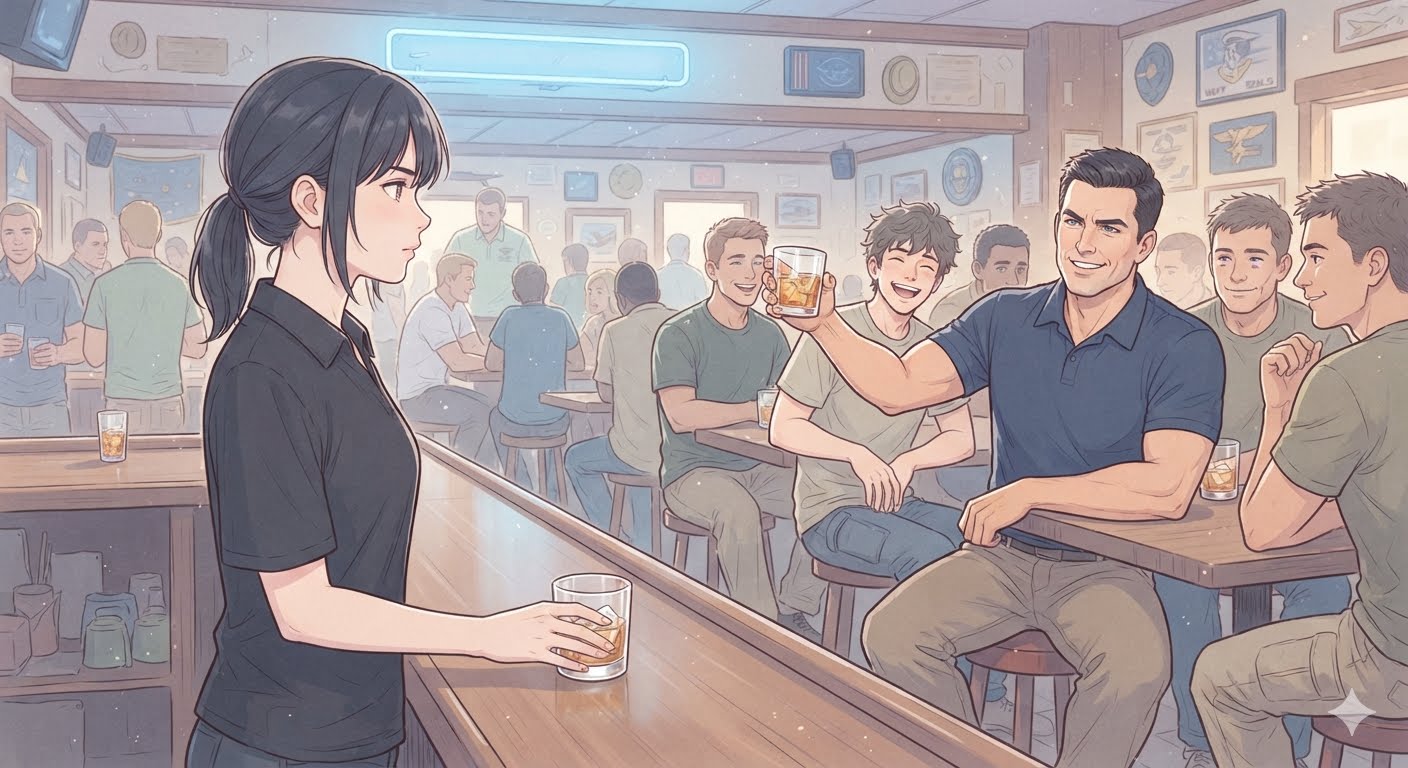
- Commander Grant Mercer raised his glass from across the packed bar, grinning as if he’d just stumbled upon the joke of the night.
- “Hey, Bennett.”
- I looked over as he leaned an elbow against the polished wooden counter.
- “What’s your call sign, darling?” he asked, his grin widening. “Or do computer people even get those?”
- The table behind him erupted. Someone slapped the bar, while another nearly spilled his drink. Tyler Vance, the youngest SEAL in the group, laughed harder than anyone.
- I stood beneath the blue neon light, my hand wrapped around a glass I had barely touched. The bar smelled of salt drifting in through open doors, fried food, old wood, and the sweat of men celebrating another completed training week.
- I could have answered immediately. Instead, I just looked at Grant. He had no idea what he was asking.
- That was the strangest part—I knew his voice far better than he knew my face.
- Years ago, I had listened to that same voice crack through static from thousands of miles away. Back then, there was no laughter in it. Only raw fear.
- “Anybody receiving?”
- Then gunfire in the background. Then the words I had never forgotten:
- “If anyone can hear us, we’re dead.”
- I had heard them. And they were alive because I did.
- Grant Mercer had spent years believing some anonymous operator had pulled his team out of the dark. Now, he was standing ten feet away from that very operator, laughing.
- I slowly set my glass on the counter and turned to meet his eyes.
- “You really want to know my call sign?”
- The laughter softened slightly. Grant lifted his drink toward me, still smiling. “That’s why I asked.”
- He shouldn’t have been smiling. But to understand why, you have to understand what silence meant to me long before I ever met Grant Mercer.
- I grew up outside Norfolk, Virginia, close enough to the harbor that ship horns sometimes woke me before my alarm. Morning air there had a distinct scent: salt, diesel, wet rope, and cold metal after rain.
- My father spent his life around ships and believed the ocean revealed everything about a person’s character. “Water doesn’t care how impressive you think you are,” he used to tell me. “It rewards attention.”
- My mother worked long hospital shifts, coming home smelling faintly of antiseptic and coffee. Neither of them raised me to be loud. They raised me to notice things.
- At twenty, I joined the Navy. I was never interested in being the person kicking down the door; I wanted to know what was behind it before anyone touched the handle.
- Signals fascinated me. Patterns fascinated me. The invisible architecture connecting one decision to another fascinated me. Over the years, I became exceptionally good at finding meaning inside noise—a strange burst of traffic, an unauthorized frequency, a missing acknowledgment, or three seconds of silence that told me more than three pages of written reports.
- Eight years into my career, while stationed overseas, a routine night transformed into the one operation that followed me forever.
- The room was cold enough that I kept rubbing my hands together between commands. Fluorescent lights buzzed overhead, and stale coffee sat cooling beside my terminal. Then a broken transmission cut through.
- A special operations team had lost its primary communications route. Their location data was unreliable, and a secondary channel was rapidly collapsing. Nobody in the room knew if the signal would survive another minute.
- Then I heard Grant’s voice. I didn’t know his name yet—only his designation and the panic he was desperately trying to conceal.
- “We’re blind.”
- A second voice said something unintelligible. Then Grant came back.
- “If anyone can hear us, we’re dead.”
- People imagine moments like that involve dramatic shouting, but they rarely do. Real emergencies narrow your focus entirely. The entire room shrank to the screen in front of me: numbers, timing, interference, and a thin, irregular signal buried under heavy static.
- I rerouted what I could, recovered a fading path, and re-established enough connection for their extraction instructions to reach them.
- Ninety seconds. That was all it took.
- Ninety seconds for seven men to go from isolated to reachable. Ninety seconds for lost helicopters to locate them. Ninety seconds for my life to become permanently linked to men who would never know my name.
- The official report categorized it as a recovered emergency channel, and my involvement disappeared beneath classification markings. That was normal. I didn’t protest. The mission succeeded, and people came home. That was supposed to be enough.
- Eventually, I returned to Norfolk and took a position at the Naval Signal Center. My days became quieter, filled with server rooms, training reviews, secure briefings, and coffee cooling beside classified files. I appreciated the predictability.
- Then, on a gray Tuesday afternoon, my secure line rang.
- “Commander Mara Bennett?”
- “Speaking.”
- “We need you in Coronado.”
- I sat up straight. “For what?”
- “Cyber defense integration for special operations training. You’ll be leading the program.”
- Something tightened behind my ribs. Coronado. I knew which units trained there—and I knew which team had been stationed there years before.
- “When do I leave?”
- “Monday.”
- After the call ended, I stayed frozen in my chair for nearly a minute. Then I opened an old encrypted archive. One photograph sat inside the after-action material: seven exhausted men standing beside an aircraft after extraction. One of them was Grant Mercer.
- I closed the file. “They won’t remember me,” I whispered.
- That was fine. I remembered them.
- California greeted me with sunlight sharp enough to reflect off every windshield in the airport lot. By noon, I was walking through a secured training facility with my laptop tucked under one arm. The building smelled of fresh paint, electronics, and ocean air.
- A group of officers waited inside the briefing room, with Grant Mercer standing at the front. He was older than in the photograph, broader through the shoulders, with a few more lines around his eyes. But he was unmistakably him.
- For one strange second, I heard his old transmission echoing over the silence: If anyone can hear us…
- Then he stepped forward. “Commander Bennett.”
- His handshake was firm, his expression amused. “Welcome to Coronado.”
- “Thank you.”
- He glanced toward the air vent. “Hope the AC isn’t too cold for you.”
- Several men chuckled. I understood immediately: I wasn’t being welcomed as an equal, but as the computer specialist they were mandated to tolerate.
- I gave a tight smile. “I’ve survived worse temperatures than sarcasm.”
- A few men stopped laughing, and Grant’s eyebrows shot up before he smiled again. “Good. You’ll fit right in.”
- I didn’t think I would.
- During my very first briefing, I identified an unusual vulnerability in their simulation network—an irregular authorization path that shouldn’t have existed.
- “We should isolate that section before tomorrow’s exercise,” I noted.
- Grant barely glanced at the screen. “We’ve got it covered.”
- My hand paused over the keyboard. Those four words hit me harder than they should have. Years earlier, right before his team lost communications, someone had said almost the exact same thing: We’ve got it handled.
- They hadn’t.
- I looked around the table. “You don’t have it covered if you don’t know why the path is open.”
- Tyler Vance leaned toward the man beside him. “Here comes the password lecture.”
- A few quiet chuckles followed, but I continued anyway. Only one person appeared genuinely attentive: Lieutenant Noah Reed sat near the back, watching me rather than the screen.
- Afterward, as everyone else filed out, Noah remained behind.
- “Commander?”
- “Yes?”
- He hesitated. “Were you ever stationed near Kabul?”
- I stopped gathering my papers as the room suddenly felt colder. “Why?”
- His brow furrowed. “I don’t know.” He searched my face carefully. “Your voice just sounds familiar.”
- A heartbeat passed. Then another.
- I closed my laptop. “Let’s keep our attention on the current assignment, Lieutenant.”
- His eyes sharpened. It wasn’t an answer, and we both knew it.
- That evening, while surveying the facility, I passed Grant’s office. The door was open, and a framed photograph sat on the shelf behind his desk—the same seven men from the classified archive.
- Underneath the photograph rested a small metal plaque. I stepped closer to read the engraving:
- TO THE GHOST IN THE MACHINE.
- I stood there longer than I intended. They remembered. Not me, but the ghost.
- Grant appeared behind me. “Something interesting?”
- I turned. “Old deployment?”
- His expression shifted for half a second. “A long time ago.” He walked past me and adjusted the frame slightly. “Somebody we never met saved our asses.”
- “Did you ever find out who?”
- “No.” He gave a short, humorless laugh. “Probably some analyst who forgot about us by the next morning.”
- I looked back at the plaque. “No. People don’t always forget the lives they save.”
- For the first time, Grant studied me thoroughly. But before he could reply, the facility alarm sounded—a single, sharp electronic pulse followed by another.
- A message flashed on the wall display: UNAUTHORIZED SIGNAL ACTIVITY.
- Grant turned toward the operations floor. “What the hell?”
- I was already moving. My terminal instantly filled with red warnings. A foreign signal pattern was probing the training network—not random traffic or a routine glitch, but a deliberate attempt to map our systems.
- I pulled up the sequence and felt my breathing stop.
- Seven repeating intervals. A delayed handshake. A false routing response inserted at precisely the wrong moment.
- I had seen that exact architecture before, years ago, on the night Grant Mercer’s team vanished from every standard channel in Afghanistan.
- I opened the archived comparison file, and the patterns aligned almost perfectly.
- Noah came up behind me. “What is it?”
- I stared at the screen. “The past.”
- Grant walked up to us. “Can you shut it down?”
- “Yes.”
- “Then do it.”
- I looked over my shoulder at him. “That’s not the question you should be asking.”
- His jaw tightened. “What question should I be asking?”
- I watched the signal disappear, only to re-emerge through an alternate route. The intruder was learning—and somehow, impossibly, using a method buried inside an operation almost nobody knew existed.
- I turned fully toward Grant. “You should be asking how someone outside this building knows what happened to your team in Kabul.”
- The color drained from Noah’s face. Grant froze. For the first time since I arrived in Coronado, nobody was laughing.
- And I realized the ghost I had buried years ago hadn’t followed me back—someone had been waiting for it.
- Part 2
- By six the next morning, the unauthorized signal had vanished. That didn’t reassure me; it terrified me. Amateurs leave footprints because they don’t know how to hide them. Professionals leave them because they want you looking in the wrong direction.
- I sat alone in the operations room as the sunrise turned the windows a pale orange. The ventilation system hummed, and my coffee had grown cold. Across three monitors, I compared the previous night’s activity with the archived Kabul logs.
- The architecture wasn’t identical—that would have been easier. Someone had rebuilt it using the same logic with different tools, like hearing a familiar melody played on another instrument.
- Grant entered without knocking. “You stayed all night?”
- “I’ve worked longer shifts.”
- He dropped a folder beside my keyboard. “Security says no classified material was extracted.”
- “Security is wrong.”
- His expression hardened. “You have proof?”
- “They didn’t take files.”
- “Then what did they take?”
- “Behavior.”
- He frowned, so I enlarged a section of network traffic. “They were watching how your systems react to failures. If you know how people respond during training, you can predict how they’ll react during a real crisis.”
- Grant stared at the display, understanding enough to be concerned before his pride took over. “Or somebody ran a sloppy scan.”
- I leaned back. “You called your communication failure in Kabul a radio malfunction for almost twenty minutes.”
- His eyes snapped to mine. “How do you know that?”
- The room seemed to shrink. I had stepped too close.
- I looked back at the screen. “It was in the archival report.”
- “That detail wasn’t in the standard report.”
- “No.”
- Grant moved closer. “What clearance did you have?”
- “Enough.”
- Before he could press further, Tyler Vance walked in with two other SEALs. “Morning.” He looked between us. “Am I interrupting cyber couples therapy?”
- Grant stepped away from my desk as the questions in his mind dissolved behind a familiar smirk. “Commander Bennett thinks someone’s studying us.”
- Tyler spread his arms wide. “Of course they are.” He nodded toward me. “How else would the enemy learn how to restart a router?”
- The others laughed. Grant didn’t. That was new.
- I stood up. “At fourteen hundred, your team runs the coastal coordination drill.”
- Tyler’s grin remained intact. “We know.”
- “I’m recommending a postponement.”
- His smile widened. “Because the scary internet might get us?”
- “Because someone accessed the network used to generate your navigation data.”
- Tyler turned to Grant. “You’re actually considering this?”
- Grant’s jaw worked for a moment before he shook his head. “Exercise proceeds.”
- I felt an old anger rise—not hot, but cold and precise. “Then give them an independent navigation package.”
- “Unnecessary.”
- “Grant.”
- The use of his first name stopped him in his tracks. I almost never used it.
- “You’ve made this mistake before,” I said.
- His face went dead still. Tyler looked between us. “What mistake?”
- Grant picked up his folder. “Exercise proceeds.” He turned and walked out.
- Two hours later, Noah caught up with me in the equipment corridor.
- “Ma’am.” His voice was low as I kept walking. “You’re going to tell me something you’re not supposed to tell me.”
- “Probably.”
- “Then walk faster.”
- He matched my pace. “I checked last night’s maintenance schedule.”
- “And?”
- “One access credential remained active after its assigned session.”
- “Whose?”
- He hesitated. “Tyler Vance.”
- I stopped walking. A cart rattled around the corner. “Does he know?”
- “No.”
- “Does anyone else?”
- “Not yet.”
- I looked through the glass panel toward the training floor. Tyler was joking with two teammates—careless, confident, and young enough to believe competence made him untouchable.
- “Disable it,” I said.
- Noah blinked. “Shouldn’t we report him?”
- “If there was negligence, yes.”
- “Wasn’t there?”
- “There was.”
- “Then why protect him?”
- I faced Noah directly. “I’m protecting the exercise while we determine whether his mistake was exploited.”
- He understood, though barely.
- At 13:58, Grant’s team boarded for the coastal drill while I remained inside the control center. A thick marine layer hung low offshore—gray water, gray sky, and white spray breaking behind the boats.
- Tyler’s voice crackled through the speakers: “Comms check.”
- One by one, the team checked in. Grant was last. “Mercer, good.”
- I monitored the network; everything appeared completely normal, which worried me most.
- At 14:12, a navigation packet arrived three milliseconds late. I leaned forward.
- At 14:13, another arrived—three milliseconds late again. Same spacing, same signature.
- “Grant, verify your secondary reference.”
- His voice came through. “Bennett, we’re in the middle of an exercise.”
- “Verify it.”
- “We’re green.”
- I looked at the coordinates. They had shifted—not enough for anyone on the boats to notice, but enough to matter.
- “Abort route.”
- Grant answered immediately. “Negative.”
- “Your position data is being altered.”
- A pause, then Tyler’s voice cut in. “Maybe the computer needs glasses.”
- Someone laughed over the channel, but I ignored it. “Grant, switch to independent reference now.”
- “Bennett—”
- The main feed went dark. Every monitor turned red as the room filled with overlapping alarms.
- “Lost GPS reference!” a technician yelled.
- Noah looked at me. “Primary channel is gone.”
- Through the speakers came static, followed by Grant: “Control, we lost navigation.”
- My skin went cold as years collapsed into a single sound: static, heavy breathing, and a man trying desperately to sound calm.
- “Control, anybody copy?”
- I was back overseas—cold room, stale coffee, dying frequency. Only this time, I could see Grant’s position. And this time, he knew my name.
- I dragged the network away from the corrupted path. “Give me the emergency relay.”
- A technician shook his head. “Automatic routing won’t accept it.”
- “Then stop asking automatic routing.”
- My fingers moved deliberately across the keys. One path closed; another opened. The spoofed packets kept pursuing us.
- “They’re predicting us,” Noah said.
- “Because we’re behaving exactly as trained.”
- I manually disconnected the standard recovery sequence. The technician stared at me in disbelief. “Commander, that isn’t procedure.”
- “Neither is being attacked during a training exercise.”
- I rebuilt the link through a clean, redundant channel. For several excruciating seconds, nothing happened. Then a green indicator flashed—one boat, then another.
- Grant’s voice filled the room: “Control, we have you.”
- The room collectively exhaled. I checked the system clock: 89 seconds.
- I stared at the number, and Noah saw it too. His face completely changed. “Eighty-nine.”
- I said nothing.
- The boats returned forty minutes later. Tyler walked into the control room laughing too loudly. “Well, that was fun.”
- Nobody joined in.
- Grant followed him, his hair wet and salt dried along the shoulder of his gear. He came straight to my desk. “Good catch.”
- I waited.
- He looked at the others, then back at me. “Lucky timing.”
- There it was—the shield men use when gratitude would require admitting someone else was better prepared.
- “It wasn’t luck.”
- Grant’s eyes hardened. “It was math.”
- The control room went silent. I picked up my notebook. “You almost lost your team because you ignored the warning.”
- “We were never in real danger.”
- “You don’t know that.”
- “Neither do you.”
- I stepped closer to him. “I know someone reached into your system and altered your position.”
- He lowered his voice. “And I know you seem to know a whole lot about a classified operation you were never supposed to be part of.”
- Noah looked away while Tyler stopped smiling.
- Grant leaned in. “Maybe we should both start asking questions.”
- I held his gaze firmly. “Start with why you keep needing to learn the exact same lesson.”
- I turned and walked out.
- That night, I sat alone at the end of the pier as a cold wind blew off the water. Base lights stretched across the black surface in broken gold lines. For the first time in years, I wondered if staying anonymous had been a mistake. You can save someone’s life—save it twice—and they can still convince themselves you were just lucky because the truth threatens their ego.
- Footsteps sounded behind me. Grant stopped several feet away, neither of us speaking.
- I expected another argument, but he just looked out toward the water. “That route you used today… I’ve seen it before.”
- My fingers tightened around the edge of the bench. “Have you?”
- “In Kabul. Our emergency channel came back online the exact same way.” He turned to me, his voice stripped of arrogance. “Do you know who did it?”
- I looked at him, realizing he was closer than ever to the truth. But then his expression shifted, and the wall went right back up.
- “Forget it,” he muttered, turning to walk away.
- By morning, the mood on base had shifted—not toward respect, but suspicion. Conversations halted whenever I entered a room. Someone had started calling me “Phantom Lady,” and Tyler used it most of all.
- “Morning, Phantom,” he mocked during class, leaning back in his chair. “Commander, can you teach us how to delete our mistakes, too?”
- Laughter rolled through the room. I met his eyes calmly. “No. But I can teach you how not to repeat them.”
- The laughter died instantly.
- That evening, I re-examined the access logs connected to the coastal failure. Noah was right: Tyler’s credentials opened the first door. It was careless and embarrassing, but something else bothered me—his key had been copied before the intrusion. Someone hadn’t just found his mistake; they had been waiting for him to make it.
- I filed the external compromise, omitting Tyler’s name from the preliminary report until I could prove intent. Protect the mission, not the ego.
- At 23:00, Noah knocked on my office door. “You need to see this.”
- He handed me an old personnel-routing document. My name wasn’t on it, nor was Grant’s—just an identifier attached to the Kabul recovery operation: OPERATOR PHANTOM NINE.
- I looked up to see Noah’s face pale. “I knew I’d heard your voice.”
- I closed the file. “You didn’t.”
- “Ma’am—”
- “You didn’t.”
- He swallowed hard and nodded. But the real danger wasn’t Noah knowing—it was the timestamp at the bottom of the document.
- Someone had accessed that classified file three days before I arrived in Coronado. Someone knew Phantom Nine was coming.
- And for the first time, I realized that the humiliation, the network breach, and my sudden transfer were not separate events at all.
- Part 3
- Rumors move faster than classified information. By Friday, half the training group was convinced I had manufactured the network failure just to make myself look important.
- Nobody said it to my face at first, but I caught the whispers: “Convenient she found it.” “Convenient she fixed it.” “Cyber people love creating problems.”
- I had spent years learning to ignore background noise, but human noise was harder. The worst part wasn’t Tyler or even Grant—it was the men who had been in Kabul. A few of them rotated through Coronado that week, men whose names I remembered from casualty assessments, whose desperate voices I had listened to when they thought they were going to die.
- One passed me in the hallway and nodded politely, completely unaware. Another joked about “the computer lady,” having no idea either.
- I told myself that remaining anonymous had been my choice, but that wasn’t entirely true. Classification made the choice for me; I had simply learned to live with it.
- Noah came to my office late Friday afternoon. “There’s another problem.”
- “How bad?”
- He closed the door. “Depends on whether you enjoy being investigated.”
- I looked up. “Usually not.”
- He placed a tablet on my desk. Someone had submitted an anonymous allegation claiming I deliberately triggered the coastal communications failure.
- My initial reaction was disbelief, followed by amusement, and finally concern. “Who can see this?”
- “Senior command.”
- “Grant?”
- “Probably.”
- I stood and walked to the window, watching sailors cross the courtyard under the harsh California sun. “Evidence?”
- “None.”
- “Then we keep working.”
- Noah stared at me. “That’s it?”
- “What do you want me to do?”
- “Be angry!”
- “I am angry.”
- “You don’t look it.”
- I turned back to him. “Looking angry won’t clean up the system logs.”
- That evening, I reopened the complete Ghost Net archive. I had avoided it for years, not because of what I did, but because of what followed.
- There had been an inquiry after Kabul: Who interfered with the team? Why were navigation packets shifted before the communications collapse? Why did the hostile pattern vanish immediately after extraction?
- The investigation eventually concluded the failures were due to battlefield interference, but I never believed that. The pattern was too deliberate. Now, someone was reproducing it here in Coronado.
- I scrolled deeper into the administrative routing and saw one name appear repeatedly: Grant Mercer. Not as a suspect, but as the officer who had pushed hardest for the original inquiry to remain open.
- I sat back. I had assumed Grant forgot about the ghost who saved him, but he hadn’t. He just never found her.
- A system notification flashed: Training Group Gathering at Pacific Harbor Bar. Mandatory Morale Event.
- I almost laughed. Nothing boosts morale like forced drinking with people who think you’re a fraud. I considered skipping it, but then I imagined Tyler explaining my absence: “Phantom Lady’s scared of sunlight.”
- So, I went.
- The bar sat a few blocks from the water, warm air rolling in whenever the doors opened. Music thumped beneath dozens of overlapping conversations. Old ship photos covered the walls, and a brass bell hung above the bar.
- I wore jeans and a plain black shirt—no rank, no uniform, no visible armor. Maybe that’s why they forgot themselves.
- At first, the evening was bearable. Noah chatted near the back while Grant stood near the counter. But as the night wore on, Tyler grew increasingly loud.
- Eventually, I heard the nicknames drift across the room: “Data Queen.” A few chuckles. “Ghost Operator.” More laughter.
- Then Tyler lifted his glass. “There she is—Phantom Lady.”
- I pretended not to hear, but he sauntered over. “Commander Bennett.”
- “Tyler.”
- He grinned with the relaxed confidence of a man who assumed everyone in the room backed him. “We’ve been debating something.”
- “That sounds dangerous.”
- A few people laughed, which he clearly enjoyed. “Everybody here has a call sign. So, what’s yours?”
- I stayed quiet.
- He tilted his head. “Come on, darling. What’s your call sign? Or do computer people even get one?”
- The room grew quiet. Another man chuckled. “Do computers like her even get one?”
- There it was—the laugh. The one I would remember long after the night ended.
- Grant should have shut it down, but he didn’t. Instead, he raised his glass and smirked. “Go easy. She’s sensitive.”
- The laughter erupted again. I looked around the room at men I had protected, trained, and defended when their own mistakes could have ruined their careers.
- Tyler was standing three feet away. I remembered deleting his name from the breach report, and for the first time, I regretted it. Not because he deserved punishment, but because mercy given in secret is often mistaken for weakness.
- I set my glass down, its base clicking firmly against the wood.
- “You really want to know my call sign?”
- Tyler spread his hands. “That’s the question.”
- Grant was still smiling—barely.
- I turned, met his eyes, and said, “Phantom Six.”
- Nothing happened for two full seconds. Then everything did.
- His laugh died in his throat as he realized exactly who I was.
- Noah stood up so fast his chair scraped loudly against the floor. Grant’s smirk vanished entirely—not with dramatic flair, but with the quiet horror of a mind refusing to accept what it suddenly knows to be true.
- His lips parted, but no sound came out. Then he breathed my name: “Mara.”
- It was the first time he had spoken it without a trace of sarcasm.
- I felt no satisfaction, which surprised me. For years, I had imagined what recognition might feel like—justice, pride, vindication. Instead, I just felt tired.
- Grant put his glass down, his voice rough. “That’s classified. You shouldn’t joke about that.”
- “I’m not joking.”
- The color drained completely from his face. An older petty officer pushed through the crowd. “Phantom Six? The one who restored the extraction channel?”
- I looked at him. “Yes.”
- His face softened. “My brother was attached to that operation. He came home because that channel came back.”
- The crowded bar seemed to fade away. “I’m glad he came home,” I said quietly.
- Grant stared at me, processing every memory in real-time—my voice, the recovered route, the timing, all the missing pieces finally attaching to a face.
- “You heard us,” he whispered.
- “Yes.”
- “You heard me.”
- “Yes.”
- Nobody moved. Upbeat music continued playing absurdly from the ceiling speakers. Tyler looked physically sick.
- I grabbed my jacket.
- “Mara, wait,” Grant stepped toward me, looking as if a dozen apologies were battling to get out. “You should have told us.”
- That sentence did it. Not the mockery, not the jokes, but that.
- I turned back to face him. “You never asked.”
- Grant flinched.
- “You didn’t ask what I did before coming here,” I continued, my voice calm and low. “You didn’t ask why I recognized the Kabul pattern. You didn’t ask why I kept telling you not to repeat the same mistake.”
- I met his gaze. “You decided what I was before I even had a chance to speak.”
- Grant lowered his eyes, unable to answer.
- I turned to Tyler. “I protected your career this week.”
- His head snapped up. “What?”
- “Your access credentials were compromised because you left them active. I kept your name out of the report until we knew if you were negligent or targeted.”
- He stared at me, speechlessly humiliated.
- I pulled on my jacket. “That’s what your ‘computer person’ was doing while you were calling her Phantom Lady.”
- I turned and walked out the door. Nobody laughed.
- Outside, the air was cool, carrying the sound of distant traffic and crashing waves.
- The bar door swung open behind me, and Grant hurried out. “Mara!”
- I kept walking, but he caught up. “I didn’t know.”
- “That’s the point.”
- “How was I supposed to know something that classified?”
- I stopped and faced him. “This isn’t about Kabul, Grant.”
- He looked confused.
- “It’s about everything after,” I said as headlights washed over us. “You didn’t need to know I saved your life to treat me like I belonged in the room.”
- He had no response. I turned and walked away into the night.
- By sunrise, the story had swept through the base. People who used to look right through me now stepped aside; men who had mocked me nodded with newfound respect.
- I hated it. Their respect felt entirely conditional—as if I needed to save seven lives just for my warnings to be taken seriously.
- At headquarters, a sealed folder waited on my desk: OPERATION GHOST NET.
- My stomach churned. An inquiry officer entered shortly after 08:00.
- “Commander Bennett, we need to discuss last night.”
- “I expected as much.”
- “Your operational identifier was classified.”
- “I know.”
- “You confirmed it publicly.”
- “I answered a question.”
- He studied me coldly. “That’s not a defense.”
- “No,” I replied, sliding another folder across the desk. “But this might matter more.”
- Inside were the new intrusion logs, the compromised credentials, the matching Kabul pattern, and the record showing someone had accessed my classified Phantom Six file before my transfer orders were even issued.
- He skimmed the first page, then the second, his expression shifting dramatically. “Who else has seen this?”
- “Lieutenant Reed.”
- “Commander Mercer?”
- “Not all of it.”
- The officer closed the file firmly. “Don’t tell him.”
- “Why?”
- He stood up. “Because until we determine who accessed that archive, Commander Mercer is a primary suspect in the inquiry.”
- My chest went cold. Grant had been arrogant, dismissive, and humiliating—but I had never believed he was involved in the breach.
- Then I remembered his office: the photograph, the plaque, and the way he knew classified details that never appeared in the official reports.
- I looked through the glass partition toward the hallway. Grant was standing outside, waiting for a chance to speak to me.
- And for the first time since arriving in Coronado, I didn’t know if the man I saved was simply arrogant—or if he had been hiding something dangerous all along.
- Part 4
- Grant waited outside my office for twenty minutes.
- I knew because I watched his shadow shift beneath the frosted glass. Normally, I would have let him in, but that morning, I couldn’t. The inquiry officer’s warning kept repeating in my head: Commander Mercer is part of the inquiry.
- Eventually, Grant knocked. “Mara.”
- I remained silent.
- Another knock followed. “I know you’re in there.”
- I opened the door. “What do you want?”
- He looked exhausted. “I owe you an apology.”
- “That’s not why you’re here.”
- His expression shifted. “No.”
- I stepped aside, and he entered, the door clicking shut behind him. For several seconds, neither of us spoke. Then Grant noticed the empty space on my desk where the Ghost Net folder had been.
- “They questioned you,” he said.
- “They questioned everybody.”
- “About the bar?”
- “About more than the bar.”
- His eyes narrowed as I watched him closely. “Someone accessed the Phantom Nine archive before I ever came to Coronado.”
- Grant didn’t react quickly enough—a fraction of a second delay. That was all. But noticing fractions was my profession.
- “You knew,” I said.
- He looked away.
- “Grant.”
- He exhaled heavily. “I knew the archive had been opened.”
- My stomach dropped. “By whom?”
- “I don’t know.”
- “Why didn’t you tell me?”
- “Because I didn’t know you were Phantom Nine.”
- “That’s not an answer.”
- He paced once toward the window. “I’ve been trying to reopen the Kabul investigation for years.”
- There it was—another truth, just not the one I expected.
- He turned to face me. “I never believed the communications collapse was random.”
- “Neither did I.”
- “I requested access to the complete signal record twice.”
- “And?”
- “Denied twice.”
- “Then what changed?”
- “Three months ago, somebody sent me a fragment.”
- I froze. “What fragment?”
- “The routing sequence.”
- My routing sequence.
- “The emergency path Phantom Nine built,” I whispered.
- “Yes.”
- “Who sent it?”
- “An anonymous account.”
- “Where is it?”
- “In my secure archive.”
- “Show me.”
- We went directly to his office. The framed Kabul photograph still sat behind his desk, but the metal plaque beneath it suddenly looked less like sentiment and more like an obsession.
- Grant opened an encrypted message: no sender, no explanation, only a small block of old routing data accompanied by a single sentence:
- THE GHOST WILL RETURN TO CORONADO.
- My skin prickled. “When did you get this?”
- “Three months ago.”
- “And nobody thought to warn me?”
- “I didn’t know who ‘the ghost’ referred to.”
- I looked at the plaque, and Grant followed my gaze.
- “I called whoever saved us ‘the ghost’ long before anyone knew the call sign,” he admitted.
- “Who knew that nickname?”
- “My team.”
- “All of them?”
- “Most.”
- “And anyone who read your private notes.”
- His face went tight.
- We spent the next four hours reviewing personnel overlap between Kabul and Coronado. No dramatic revelation surfaced—no obvious villain. That made it worse. The truth was buried somewhere among ordinary names, old assignments, and routine access permissions.
- At 16:30, Noah entered. “We’ve got another intrusion.”
- I stood immediately. “Where?”
- He looked at Grant. “The Washington command network.”
- My pulse spiked. “What system?”
- “Remote training telemetry.”
- Grant swore.
- I ran to the operations room. The signature matched the previous breaches, only faster and more confident. Whoever had been testing Coronado was done learning; they were moving outward.
- I contacted the inquiry officer. He took one look at the live traffic and instantly stopped caring about the incident at the bar.
- Within two hours, a joint security team placed the training network on lockdown. The internal source was eventually traced not to Grant, Tyler, or any active SEAL, but to an old contractor account buried beneath years of administrative permissions. It had been compromised long ago, allowing an outside actor to use forgotten access to study military response procedures.
- Tyler’s mistake opened one door; the contractor account opened the rest.
- Grant wasn’t innocent of arrogance, but he wasn’t a traitor.
- When the security team confirmed it, I expected relief. Instead, I felt a heavy exhaustion. People like Grant rarely understand the cost of being doubted until that doubt is pointed directly at them.
- He found me on the pier after sunset. “You thought it might be me.”
- “For several hours.”
- “How did that feel?”
- I looked at him. “Uncomfortable.”
- He gave a quiet laugh. “I deserved that.”
- “No.”
- He looked surprised.
- “I don’t think anyone deserves to be judged without evidence,” I said.
- The irony hung thick between us. Grant looked out toward the water. “I’m sorry.”
- I said nothing.
- “Not because you’re Phantom Nine,” he continued, getting my full attention. “I’m sorry because I should have respected you before I knew.”
- For once, he had found the right words. But while some apologies repair, others simply mark where the damage occurred.
- “I accept that you understand it now,” I said.
- He nodded slowly. It wasn’t forgiveness, and he knew it. That was enough.
- The investigation expanded rapidly. Within weeks, the vulnerability was contained, and new safeguards were implemented throughout the training network.
- My assignment in Coronado ended earlier than planned. Rear Admiral Evelyn Sloane summoned me to headquarters—a compact woman with silver hair and the calm expression of someone who had spent decades watching nervous officers lie badly.
- She slid a folder across her desk. “Washington.”
- I opened it: Joint Intelligence Defense Group. Senior Cyber Operations Lead.
- I read the first page twice. “Why me?”
- Admiral Sloane raised an eyebrow. “You want the ceremonial answer or the true one?”
- “The true one.”
- “Because when a room full of confident people ignored evidence, you kept looking at the evidence.”
- I closed the folder. “That’s a low bar.”
- “You’d be amazed.”
- As I left, Grant was waiting outside with his hands in his pockets. “You taking it?”
- “Yes.”
- He nodded. “Good.”
- I waited. He looked almost embarrassed before speaking again. “Thank you.”
- “For Kabul?”
- “For Kabul.” He took a breath. “And San Clemente. And Tyler. And for not letting my stupidity become somebody else’s funeral.”
- That last line stayed with me.
- I extended my hand. Grant looked at it, then shook it. There was no hug, no dramatic reconciliation, and no promise of friendship. Some relationships aren’t meant to transform into something beautiful; sometimes the healthiest ending is simply understanding what happened and walking away changed.
- Two years later, Washington felt nothing like Coronado. The air smelled of concrete after rain rather than salt. My office offered no view of the ocean—only traffic and government buildings.
- I led a small operations unit responsible for detecting compromised command data before it reached decision-makers. We called ourselves Redline. Most nights were boring, and boring was good.
- Then, on a November evening, an alert flashed. A remote aerial system over North Africa had received conflicting targeting coordinates—shifted by four hundred meters.
- My stomach tightened. “Run source verification.”
- A technician complied. “Field channel says coordinates confirmed.”
- I checked the packet timing; it was wrong. “Run it again.”
- Same answer.
- The duty officer entered. “We’re cleared.”
- “No.”
- He looked at me. “Excuse me?”
- “The coordinates are being manipulated.”
- “Field confirmation says otherwise.”
- “Field confirmation is part of the compromised stream.”
- He glanced at the clock. “We have an authorization window.”
- “I know.”
- “Then proceed.”
- I enlarged the packet structure—there, a tiny delay. The exact same logic as Kabul and Coronado. Improved, but unmistakable.
- “Abort the strike,” I ordered.
- He shook his head. “Not your authority.”
- “Then find me someone whose authority it is.”
- “Commander Bennett—”
- “Now.”
- Phones rang, messages flew, and minutes crawled past as the aircraft moved closer to its release point. Nobody high enough in the chain of command was responding quickly enough.
- I watched the timer count down: ten minutes, nine, eight.
- A junior analyst whispered, “If those coordinates are wrong…”
- I knew. Residential buildings sat inside that shifted zone—homes and civilians who had nothing to do with the target.
- The duty officer stood behind me. “The order remains.”
- I stared at the screen. For most of my career, I had followed rules designed to keep people alive, but rules become dangerous when blind obedience replaces judgment.
- I opened the redundant control authorization.
- The officer saw what I was doing. “Bennett—do not do that.”
- “I am freezing the route.”
- “You’ll end your career.”
- “Maybe.”
- “Mara!”
- I executed the override. Alarms blared across the operations floor as the aircraft entered holding status, and every phone began ringing at once.
- The duty officer stared at me in disbelief. “You just countermanded an operational order.”
- “I delayed it.”
- “Without authority!”
- “Then someone with authority can review the data.”
- Rear Admiral Sloane appeared on secure video six minutes later, her face filling the wall monitor. “Commander Bennett.”
- “Admiral.”
- “Explain.”
- I did—no speeches, no self-defense, just packet timings, source discrepancies, the four-hundred-meter shift, and the repeated architecture.
- When I finished, she said nothing. The entire room waited in silence.
- Then an intelligence update arrived: the original coordinates were corrupted. A secondary source confirmed armed insurgents had moved from the expected position, meaning the four-hundred-meter shift would have directed the strike straight into a residential block.
- The duty officer sank into his chair. Nobody spoke.
- Admiral Sloane looked directly at me. “Maintain abort.”
- “Yes, ma’am.”
- The screen went dark. My hands finally began to shake—not during the decision, but after. Always after.
- At three in the morning, I returned to my office to find a promotion recommendation sitting in my inbox. I almost laughed. Years earlier, men had mocked me because they thought I only understood computers; now, that same invisible information had prevented a disaster.
- I looked through the window at the sleeping city, my reflection staring back—older, more tired, still quiet.
- My aide knocked. “Commander?”
- “What is it?”
- “You have a visitor.”
- “At three in the morning?”
- “He said you’d understand.”
- The door opened, and Grant Mercer stepped inside. His uniform looked older, as did he. He placed a photograph on my desk—a new SEAL training class standing in front of a display that read: TACTICAL INTELLIGENCE INTEGRATION.
- “We changed the curriculum,” he said.
- I looked at him. “Why are you here, Grant?”
- His expression turned deadly serious. “Because the breach you stopped tonight used one piece of code that shouldn’t exist anymore.”
- The room went cold. He leaned over my desk, pointing at the packet signature in my report. “This wasn’t copied from Coronado.”
- “Then where did it come from?”
- Grant’s answer erased every trace of exhaustion from my mind.
- “It came from Kabul.”
- The original attack hadn’t returned—it had never ended.
- Part 5
- The next six months dismantled everything I thought I knew about Kabul. There was no theatrical villain hiding in the shadows, no dramatic confession, and no single person responsible for every failure. The truth was far quieter and more dangerous.
- The original interference pattern had been copied, studied, and reused through compromised systems for years. Small fragments surfaced in different networks—insignificant on their own, but together revealing a method designed to exploit human certainty. Attack the information, wait for confident people to trust it blindly, and let them make the mistake for you.
- That was what nearly killed Grant’s team in Kabul, what happened in Coronado, and what almost redirected the strike in North Africa.
- We built Redline around one core principle: Verify before certainty becomes action.
- Grant returned to California after assisting with the investigation. We never became close, and that mattered. Stories like ours are often rewritten into something sentimental, as if every insult must resolve in friendship, or every wound requires reconciliation to be healed. I didn’t need Grant’s friendship; I needed the institution to learn.
- And it did—slowly.
- Three years after Coronado, intelligence verification became a permanent requirement in advanced special operations training. Five years after that, Redline protocols expanded across multiple naval commands. My career moved alongside them: Captain, Senior Director, and then, one winter morning, I received the stars I had assumed in my youth would belong to someone louder.
- Rear Admiral Mara Bennett.
- I stood before a mirror ahead of the ceremony, staring at the uniform as my mother’s voice echoed in my memory: “Don’t let a title become a personality.”
- My father would have laughed and asked if the coffee at headquarters was still terrible. It was.
- As years passed, I stopped measuring my life by the people who had underestimated me. That was perhaps my greatest victory. When humiliation is fresh, you imagine success as a courtroom where you return with medals, titles, and proof to show everyone who laughed how wrong they were. But real freedom arrived when their opinions simply stopped mattering.
- Ten years after that night in the bar, I returned to Norfolk for a graduation ceremony. The harbor smelled exactly as I remembered—salt, metal, fuel, and wet wood. Morning sunlight cut thin gold lines across the water while rows of new officers stood in formation: men and women of different backgrounds and specialties, all sharing the same nervous pride.
- I waited behind the podium as the Navy band finished, and my name was announced: “Rear Admiral Mara Bennett.”
- Applause rolled across the pier. As I walked forward, I briefly recalled a noisy bar and Grant raising his glass to ask, “What’s your call sign?” The memory no longer hurt, which surprised me.
- My speech was brief. I spoke to the officers about attention, responsibility, and the danger of confusing confidence with competence. I never mentioned Grant or Tyler; I didn’t need villains to make the lesson stick.
- “Listen before you decide,” I told them. “Verify before you act. And when somebody in the room notices what everyone else missed, don’t ask whether they look like the person you expected. Ask whether they’re right.”
- The crowd fell silent, and the applause that followed was deafening.
- After the ceremony, a young lieutenant approached. She looked barely older than I was when I enlisted, her uniform so new the fabric was still stiff.
- “Admiral Bennett?”
- “Yes?”
- She swallowed nervously. “I wanted to meet you.”
- I smiled. “Now you have.”
- She laughed, then reached into her pocket to hold out a small silver pin displaying an anchor crossed by a circuit pattern. Redline qualification.
- “I’m part of the first graduating class using the full protocol,” she said proudly.
- “Congratulations.”
- She looked down at the pin. “My instructor told us why it exists—the Phantom Nine incident.”
- The sounds of the pier faded. “I joined cyber operations because of that story,” she added.
- I felt a tightness in my throat. “Then do one thing for me.”
- “Anything, ma’am.”
- “Don’t become me. Become better.”
- She smiled warmly. “Yes, ma’am.”
- She turned the pin over, revealing engraved letters on the back: IN HONOR OF PHANTOM NINE.
- I ran my thumb across the engraving. Once, that call sign was buried under classification, then turned into a joke, then a sudden revelation. Now, it was doctrine.
- “We don’t forget ghosts anymore,” the lieutenant said softly.
- “Good,” I managed to reply.
- She saluted and departed. I stood holding the pin as the crowd thinned, then noticed a familiar figure near the back—gray hair, civilian jacket, but a posture straight enough to betray decades in uniform.
- Grant Mercer.
- He didn’t approach immediately, which I appreciated. When our eyes met, he raised a hand in salute, and I returned it.
- He walked over. “Admiral.”
- “Grant.”
- He smiled faintly. “That sounds strange.”
- “What?”
- “Calling you Admiral.”
- “You can always call me Data Queen.”
- He stared at me in sheer horror before I laughed. It took him a second, but he joined in.
- “I’m never going to live that down, am I?”
- “No.”
- “Fair.”
- We stood by the pier railing. He looked older—not weaker, just less inclined to pretend age hadn’t caught up with him.
- “I retired last year,” he said. “Teaching part-time now—intelligence integration.”
- “That’s almost poetic.”
- “Punishment, probably.”
- “No,” I said, looking out at the water. “Punishment doesn’t teach much.”
- He grew quiet. “I used to think about that night at the bar all the time.”
- “I don’t anymore.”
- He absorbed that. “I’m glad.”
- “I don’t mean I forgot it,” I added. “It just stopped taking up space in my life.”
- Grant nodded slowly. “I spent a long time wishing I could redo it.”
- “You can’t. And I wouldn’t let you if you could.”
- He looked at me. “Why?”
- “Because then maybe nothing changes. You embarrassed me, ignored warnings you should have taken seriously, and let others follow your example. But eventually, you learned.”
- “So did the Navy,” Grant noted.
- “Exactly.”
- He exhaled. “Does that mean you forgive me?”
- Years earlier, I might have needed a clean answer, but life had made me less interested in simple labels.
- “I don’t carry anger toward you,” I told him. “But forgiveness doesn’t mean pretending it didn’t matter.”
- He nodded. “I can live with that.”
- “You don’t need my permission to live with anything.”
- A faint smile touched his face. “Still the same Mara.”
- “No,” I said, looking at the silver pin in my hand. “Not even close.”
- He left moments later without dramatic promises or attempts to forge an artificial friendship. He simply walked away, and it felt right.
- Further down the pier, Noah Reed waited holding two cups of coffee. He had transitioned from operational work years ago to become an instructor.
- “Thought admirals got better coffee,” he teased, handing me a cup. “They lied.”
- We walked toward the end of the pier. “Funny,” Noah said. “A stupid bar joke helped change training doctrine.”
- “The joke didn’t,” I replied. “The failure behind it did.”
- He reflected on that and smiled. “Still hate giving dramatic answers.”
- We caught up on old assignments and former colleagues. Tyler Vance had eventually become a strong team leader. Years ago, he had sent me a brief handwritten note with no self-pity or excuses: I WAS WRONG ABOUT YOU. I WON’T TEACH MY PEOPLE TO MAKE THE SAME MISTAKE.
- I never replied because I didn’t need to. He had finally understood that an apology isn’t meant to buy your way back into someone’s life, but to change how you move forward.
- After Noah left, I remained as the pier slowly emptied. Afternoon set in as ropes creaked against cleats and gulls circled overhead. A distant ship horn blasted across the water—deep, steady, and familiar.
- I closed my eyes. For a moment, I was a girl again with my father by the harbor and my mother returning from her shift. Then I was twenty, then overseas in a freezing room hearing a stranger say, “If anyone can hear us, we’re dead.” Then Coronado—Grant laughing, Tyler smirking, my glass resting on the bar counter.
- “You really want to know my call sign?”
- Everything had changed because of those words—or perhaps nothing had, because the truth was always there. The bar simply forced everyone else to see it.
- I reached beneath my collar and pulled out my worn dog tag. The edges had smoothed over time, but beneath my name, the faint marking remained: PHANTOM 9.
- I turned it over in my palm. For decades, I thought silence was something to endure, then something to master. Only with time did I realize silence itself was neither strength nor weakness. Sometimes silence protects, sometimes it enables, and sometimes the bravest act is remaining quiet long enough to understand the room—until it’s time to set down your glass and answer the question.
- The wind lifted my hair as the harbor glittered in the light. A group of young sailors passed behind me, laughing about something I couldn’t hear.
- I smiled. They didn’t know who I was, and that felt wonderful. I no longer needed every room to recognize me, nor did I need Grant’s regret or Tyler’s realization. Vindication hadn’t arrived when the people who mocked me finally understood my value; it arrived when their opinions no longer defined it.
- Across the water, ships were operating under procedures born from hidden failures. Young officers were learning to question corrupted data, realizing that the quiet person in the corner might be the one keeping them alive.
- The ghost had become doctrine. The insult had become irrelevant. And I no longer needed to remain invisible, either.
- I closed my hand around the old tag.
- “You don’t have to shout the truth,” I whispered. “You just have to live it.”
- The waves lapped against the pilings below—slow, steady, and patient, just as they had when I was a child.
- I tucked the tag back beneath my collar, turned away from the water, and walked toward my car. Behind me, the harbor breathed steadily—no applause, no laughter, no demands for proof. Just the sea.
- And for the first time, that silence felt like peace.
- THE END
Part 1 The first laugh hit harder than anything I expected from Coronado.